Differential Cryptanalysis of Round-Reduced SPECK
Ashutosh Dhar Dwivedi, Pawe l Morawiecki
Institute of Computer Science, Polish Academy of Sciences, Warsaw, Poland
Abstract
In this paper, we propose a new algorithm inspired by Nested to find a differential path in ARX ciphers. To enhance the decision process of our algorithm and to reduce the search space of our heuristic nested tool, we use the concept of partial difference distribution table (pDDT) along with the algorithm. The algorithm itself is applied on reduced-round variants of the SPECK block cipher family. In our previous paper, we applied a naive algorithm with a large search space of values and presented the result only for one block size variant of SPECK. In this new approach, we provide the results within a simpler framework and within a very short period of time for all bigger block size variants of SPECK. More specifically, we report the differential path for up to 8, 9, 11, 10 and 11 rounds of SPECK32, SPECK48, SPECK64, SPECK96 and SPECK128, respectively. To construct a differential characteristics for a large number of rounds, we divide long characteristics into short ones, by easily constructing a large characteristic from two short ones. Instead of starting from the first round, we start from the middle and run the experiments forwards as well as in the reverse direction. Using this method, we were able to improve our previous results and report the differential path for up to 9, 10, 12, 13 and 15 rounds of SPECK32, SPECK48, SPECK64, SPECK96 and SPECK128, respectively.
Keywords: Differential path, Nested Monte-Carlo Search, ARX ciphers, SPECK Cipher, Differential Cryptanalysis
1
Introduction
ARX (Addition/Rotation/XOR) is a class of cryptographic algorithms which use three simple arith-metic operations: namely modular addition, bitwise rotation and exclusive-OR. In both industry and academia, ARX cipher has gained a lot more interest and attention in the last few years. By using combined linear (XOR, bit shift, bit rotation) and non-linear (modular addition) operations and it-erating them for many rounds, ARX algorithms have become more resistance against differential and linear cryptanalysis. ARX lacks a look-up table, associated with S-box based algorithms and therefore has an increased resistance against side-channel attacks. Due to the simplicity of operations, ARX algorithms exhibit excellent performance, especially for software platforms.
In our analysis, we focus on SPECK [1]. SPECK is a secure, flexible and lightweight block cipher designed by researchers from the National Security Agency (NSA) of the United States of America (USA) in June 2013. It has great performance both in software and hardware applications. Its design is similar to Threefish - the block cipher used in the hash function Skein [7]. SPECK is a pure ARX cipher with a Feistel-like structure in which both branches are modified at every round. SPECK consist of 5 variants SPECK32, SPECK48, SPECK64, SPECK96 and SPECK128 with block sizes 32, 48, 64, 96 and 128 bits, respectively.
possible. This becomes possible due to the fact that the probabilities of XOR (resp. ADD) differentials through the modular addition (resp. XOR) operation are monotonously decreasing with the bit size of the word.
In this paper, we propose a method for finding good differential paths in ARX ciphers. Finding a differential trail becomes a problem since a huge state space exists and there is no clear and obvious way to take the next step. This kind of problem exists in different areas, but our inspiration comes from single-player games such as Morpion solitaire, SameGame and Soduku. The heuristics called Nested Monte-Carlo Search works very well for these games [4]. We can treat a search for good differential paths also as a single-player game and argue that this approach could be a base for more sophisticated heuristics. However, our modified algorithm depends on the technical complexity of this problem, but it is also strongly inspired by Nested Monte-Carlo Search.
In our previous paper [6], we applied a naive approach algorithm to all variants of SPECK and found good results only for one variant with the smallest state size in SPECK32. For bigger variants, our algorithm was demanding to reduce the search space to enhance the random decision process and therefore we used the partial difference distribution table (pDDT) [2] to reduce the search space of our algorithm.
Besides the concept of pDDT our inspiration is drawn from the highways and country roads anal-ogy proposed by Biryukov et al. [2] [3]. We relate the problem of finding high probability differential trails in a cipher to the problem of finding fast routes between two cities on a roadmap, then dif-ferentials that have high probability (w.r.t. a fixed threshold) can be thought of as highways and conversely differentials with low probability can be viewed as slow roads or country roads. Therefore, our algorithm first tries to find a probability above the threshold probability and if such a probability does not exist, then it uses the low probability values. Using this concept, the algorithm does not take a completely random decision in iterations and hence improves the random decision process by using a much smaller search space.
2
Related Cryptanalysis
Biryukov et al.[2] published a paper where they analysed ARX cipher SPECK and by introducing the concept of partial difference distribution table (pDDT) they extend Matsuis algorithm, originally proposed for DES-like ciphers, to the class of ARX ciphers. They found differential trails of 9, 10 and 13 rounds for 3 variant SPECK32, SPECK48 and SPECK64, respectively.
Biryukov et al. [3] again presented a paper where they propose the adaptation of Matsuis algorithm for finding the best differential and linear trails to the class of ARX ciphers. It was based on a branch-and-bound search strategy which does not use any heuristics and returns optimal results. They report the probabilities of the best differential trails for up to 10, 9, 8, 7 and 7 rounds of SPECK32, SPECK48, SPECK64, SPECK96 and SPECK128, respectively.
Song et al. [9] presented a paper where they develop Mouha et al.’s framework for finding differential characteristics by adding a new method to construct long characteristics from short ones. They report the probabilities of the best differential trails of SPECK for up to 10, 11, 15, 17, and 20 rounds of SPECK32, SPECK48, SPECK64, SPECK96 and SPECK128, respectively.
3
Description of SPECK
3.1 Round Function
SPECK uses 3 basic operations on n-bit word for each round:
– bitwise XOR,⊕, – addition modulo 2n,
– left and right circular shifts byr2andr1 bits, respectively.
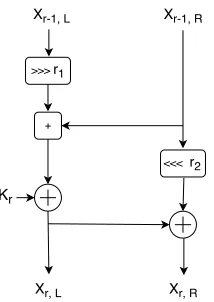
Left half n-bit word is denoted byXr−1,L and right half n-bit word is denoted by Xr−1,R to the
r-th round andn-bit round key applied in the r-th round is denoted by kr. Xr,L and Xr,R denotes
output words from roundrwhich are computed as follows:
Xr,L= ((Xr−1,L≫r1)Xr−1,R)⊕kr (1)
Xr,R= ((Xr−1,R≪r2)⊕Xr,L) (2)
Fig. 1: The round function of SPECK
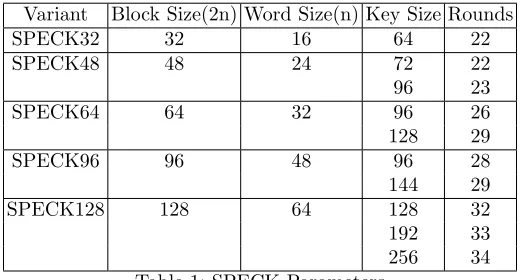
Different key sizes have been used by several instances of the SPECK family and the total number of rounds depends on the key size. The value of rotation constantr1 andr2 are specified as:r1 = 7,
r2= 2 for SPECK32 andr1= 8,r2= 3 for all other variants. Parameters for all variants represented
in Table 1.
4
Calculating Differential Probabilities
In [8], Moriai and Lipmaa studied the differential properties of addition. Let xdp+(a, b→ c) be the
XOR-differential probability of addition modulo 2n, with input differences a and b and the output
differencec. Moriai and Lipmaa proved that the differential (a, b→c) is valid if and only if:
eq(a1, b1, c1)∧(a⊕b⊕c⊕(b1)) = 0 (3)
where
eq(p, q, r) := (¬p⊕q)∧(¬p⊕r) (4)
Variant Block Size(2n) Word Size(n) Key Size Rounds
SPECK32 32 16 64 22
SPECK48 48 24 72 22
96 23
SPECK64 64 32 96 26
128 29
SPECK96 96 48 96 28
144 29
SPECK128 128 64 128 32
192 33
256 34
Table 1: SPECK Parameters
w(a, b→c) =−log2(xdp+(a, b→c)) (5)
The weight of a valid differential can then be calculated as:
w(a, b→c) :=h(¬eq(a, b→c)), (6)
whereh(x) denotes the number of non-zero bits inx, not countingx[n−1].
A differential characteristic defines not only the input and output differences but also the internal differences after every round of the iterated cipher. In our analysis, we follow a common assumption that the probability of a valid differential characteristic is equal to the multiplication of the probabili-ties of each addition operation. The XOR operation and the bit rotation are linear in GF(2), therefore for these two operations for every input difference there is only one valid output difference.
5
Partial Difference Distribution Tables (pDDT)
The Partial difference distribution table (pDDT) proposed by Biryukov et al. [2] is a table that contains all XOR differentials (a, b → c) whose differential probabilities (DP) are greater than or equal to pre-defined thresholdpthres.
(a, b, c)∈pDDT ⇔DP(a, b→c)≥pthres (7)
To compute pDDT efficiently, we will use the following proposition: The differential probability of XOR of addition modulo 2n is monotonously decreasing with the word size.
pn ≤...≤pk≤pk−1≤....≤p1≤p0 (8)
wherepk=DP(ak, bk→ck), n≥k≥1, p0= 1 andxkdenotes thekLSB’s of the differencexthat
is,xk =x[k−1 : 0]. The algorithm is defined in a recursive fashion. For each bit positionk:n > k >0
check if probability of partially constructed (k+ 1)−bitdifferential is greater than thresholdpthres.
If yes, then move to the next bit, otherwise go back and assign different values toa[k], b[k] andc[k]. Repeat the process untilk=nand oncek=nadd (ak, bk →ck) to the pDDT. The initial value ofk
Algorithm 1Computation of a pDDT for XOR
1: Input:n, pthres, k, pk, ak, bk, ck.
2: Output:pDDTD: (a, b, c)∈D : DP(a, b→c)≥pthres.
3: functioncomputepddt(n, pthres, k, pk, ak, bk, ck)
4: if n==kthen
5: Add (a, b, c)←−(ak, bk, ck) to D
6: end if 7: return D
8: forx, y, z∈0,1do
9: ak+1←−x|ak, bk+1←−y|bk, ck+1←−z|ck
10: pk+1=DP(ak+1, bk+1→ck+1)
11: if pk+1≥pthresthen
12: computepddt(n, pthres, k+ 1, pk+1, ak+1, bk+1, ck+1)
13: end if
14: end for 15: end function
Table 2: Timings on the computation of pDDT for XOR on 32-bit words using Algorithm 1
Threshold Probability Elements in pDDT Time
0.1 3951388 1.23 min
0.07 3951388 2.29 min
0.06 167065948 44.36 min
0.01 ≥72589325174 ≥29 days.
6
Nested Monte Carlo Search
Our algorithm is inspired by Nested Monte Carlo Search (NMCS) algorithms. The Monte Carlo method is a heuristic based random sampling method. Remi Coulom proposed an application to game-tree search based on Monte Carlo method in 2008 named as Monte Carlo Tree Search (MCTS). This algorithm was useful to games where it is hard to formulate an evaluation function, such as the game of Go. Later for a single player game, a variant called Nested Monte Carlo Search has been proposed [4].
Let us take a tree-like structure to understand the Nested Monte-Carlo Search algorithm. At each step, the NMCS algorithm tries all possible moves and memorises the move associated with the best score of the lower level searches. In other words, a nested of level 1 makes a playout for every possible move and choose to play the move of the best playout. A nested of level 2 does the same thing except that is replaces the playout by a nested of level one.
During the first iteration the initial state (root) is selected and for the selected state all legal actions are determined (Figure 2). Therefore at level 0 it play the random game for all possible moves valid for selected state (root). Then it moves one step ahead to the next level with greatest associated score.
Therefore, we changed the original NMCS algorithm to eliminate this problem for our cipher and presented a new algorithm based on NMCS with an example in the next paragraph. Instead of trying all possible moves, we try only one random move.
15 10 30
20 30 10
10 30 10
Fig. 2: Nested Monte Carlo Search.
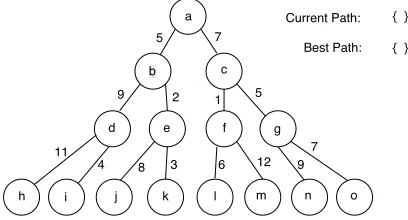
algorithm with this example. Our goal is to find the shortest path from one city to another city. We represent all possible paths as a tree. The root of the tree is considered as the starting point, and all leaves are ending points reached by different paths (nodes). Each edge between nodes is associated with a number which represents the distance between two nodes. Initially, we have two lists named as BestPath andCurrentPath. They represent the best available path from previous searches and a random path which is under investigation, respectively. The last element in both lists represents total distance travelled. Both the lists are initially empty.
Fig. 3: Different paths from the root (base node) to the destination (leaf nodes)
Initially, the algorithm takes a random move from the base node to the leaf node and saves the path in the Current Path list. Let us say that the random path selected by the algorithm is{a, b, d, i} with distance score 18. Since initially there was no better path available (BestPath is empty), then we save the current path and its distance asBestPath (See Figure 4).
Fig. 4: Random path from the base node to the leaf node.
Fig. 5: A random path from theb node to the leaf node.
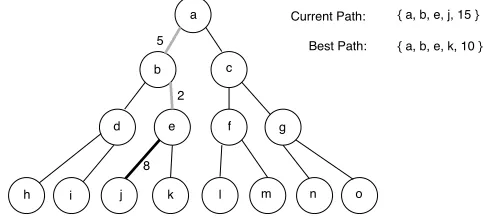
Again in theBestPath we go one step down and repeat the same process. We play a random move from eand find the new path is {e, j}(See Figure 6.) The score for CurrentPath is 15, which is not better than the previous best path. Hence, we do not updateBestPath.
Fig. 6: Random path from nodeeto leaf node.
Once we reach the leaf node, we repeat the whole process from the base node. This timeBestPath would not be empty, as there would be some result from the previous search.
7
Formal description of Algorithm
To formally describe the algorithm, let us first define two functions, which are the main building blocks of the algorithm. The first functionRandomP ath(node position) is the function, which for a given node walks a random path in the search tree until it reaches the leaf node. The functionRandomP ath returns a list of nodes (from the base node to the leaf) and the cost corresponding to the path.
Algorithm 2A basic function to generate a random path
1: functionrandomPath(node position) 2: while node position6= leaf do 3: go randomly to the next node 4: end while
5: returnpath, cost 6: end function
The second function N ested(node position) is a recursive function, which calls itself on every level of the tree search until it reaches the leaf node. The pseudo-code of the function is given in Algorithm 2. In the given pseudo-code we use two global variables, which keep a list of nodes in the best path (best path) and its corresponding cost (best cost). Initially,best pathis empty andbest cost is initialized with some big value. (Here we assume that a lower cost means a better solution.)
Algorithm 3The recursive function Nested
functionNested(node position) whilenode position6= leaf do
path, cost=RandomP ath(node position) if (cost < best cost)then
best cost=cost best path=path end if
updatenode position
by going a level below inbest path
if node position6= leaf then Nested (node position) end if
end while
end function
Algorithm 4Iterative calls to the function Nested
1: best-score = 9999999, node position = base node 2: whilei < number of iterationsdo
3: Nested (node position) 4: i=i+ 1
5: end while
8
Finding differential paths in SPECK
In SPECK cipher the only source of non-linearity is the modular addition, and its complete differential properties (differential distribution tables) are infeasible to calculate. Therefore, we have used our heuristics algorithm to circumvent this limitation and to find the best differential trails. As described earlier, the algorithm took a random decision from the search space. For the larger variant of SPECK, this random property of the algorithm is not enough to produce good results. Therefore, we decided to reduce the search space of the algorithm by introducing a partial difference distribution table (pDDT). This table is used in our algorithm and instead of taking random inputs for SPECK, we take the initial inputs from pDDT table, which contains valid differentials above the threshold value. Each time SPECK starts the next round, the algorithm initially checks the values in the pDDT table. If it does not find such a value in the pDDT set it simply calculates a valid differential output for given inputs, without any threshold condition. In our experiment with SPECK cipher, modular addition for each round is treated as a node where we need to take a decision of required output (valid differential), and the weight of a valid differential is treated as a score. Our aim is to find a differential path for a given number of rounds with lower weight.
The basic FIND-BEST-PATH function runs the cipher for a given number of rounds. The function checks the differential values in the pDDT table having a probability greater than some threshold value. In case the algorithm does not find such a value in the table then it calculates a valid differential output by XOR-ing the two inputs, which gives the highest probability with given inputs (best possible path for given differences). We have not mentioned the SPECK encryption operations in the algorithm for simplicity, and it is trivial that after each round of encryptionst0andst1 changes its value and every
time we check these two values in the pDDT table list.
Algorithm 5Function to find differential path
1: functionint FIND-BEST-PATH(st0,st1, rounds)
2: while not end of the roundsdo 3: if (st0andst1)∈pDDTthen
4: Add differential output and the weight to the path and weight 5: list, respectively
6: else
7: op=st1⊕st0
8: wt=weight(st0, st1, op) (Calculate the weight using method described
9: in section )
10: Add differential outputopand the weightwtto the path and weight 11: list, respectively
12: end if
13: SPECK Encryption operations 14: end while
To calculate the differential path by our algorithm using the pDDT table, we are using the main function in Algorithm 6. The calculated weight from round 1 to the current round is represented by weight above. The two listsweight listandbest path listsaves the weight and list of the path for each decision from one round onwards. Both lists are initially empty, and the value ofweight aboveand best weightgiven to algorithm is 0 and 9999 respectively. Every time theweight listandbest path list is updated with the newly found sequence, and the best move is played. The total number of rounds for which we are trying to find the lowest weight is represented byrounds. The first and second half block of SPECK cipher is represented byst0andst1.
Algorithm 6Finding differential paths in SPECK through Nested Monte-Carlo Search
1: functionint Nested(st0,st1,rounds,best weight,weight above) 2: whileround <=roundsdo
3: temp path list,temp weight= FIND-BEST-PATH(st0,st1,rounds) 4: if (temp weight+weight above < best weight)then
5: best weight=temp weight+weight above
6: updatebest path listbytemp path list(from current round to end of the 7: round)
8: updateweight listbytemp weight(from current round to end of the 9: round)
10: end if
11: updatest0 andst1frombest path listwith the decision for currentrounds 12: weight above= weight from first round to current speck round
13: round=round+ 1 14: end while
15: returnbest weight 16: end function
We can now call NESTED in a loop until a criterion is met (e.g. best weight threshold).
Algorithm 7Searching a differential path with NESTED
1: whilebest weight > weight thresholddo 2: Take theith indexed value ofst
0,st1 from pDDT list
3: path,best weight= Nested (st0, st1,rounds, best weight, weight above)
4: i=i+ 1 5: end while
9
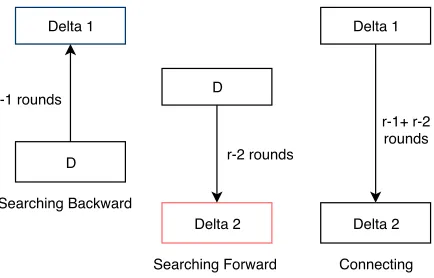
Obtaining a long characteristic from two short ones
Delta 1
D
D
Delta 2
Delta 1
Delta 2 r-1 rounds
r-2 rounds
r-1+ r-2 rounds
Searching Backward
Searching Forward Connecting
Fig. 7: Algorithm applying on SPECK Cipher
10
Differential Attack
Dinur proposed an enumeration technique [5] for key recovery in differential attacks against SPECK. Consider we have differential characteristic of SPECK2n/mn withrnumber of rounds that has prob-abilityp >2·2−2n. The technique can be used to recover (r+m) rounds. We first attack (r+m) rounds with the value m = 2. The number of plaintexts required to recover the key will be 2·p−1 with an average time complexity of 2·p−1·2(m−2)n encryptions. Then we can extend the attack to the remaining instances, withm= 3 andm= 4.
Let us take one variant SPECK32, we have 8 rounds differential characteristics with probability 2−30. Combined with Dinur’s enumeration technique for key recovery, given differential characteristics
can be used to attack 12-round SPECK32 with 2·230 = 2·231 plaintexts and 2·230·232 = 263
encryptions.
11
Results
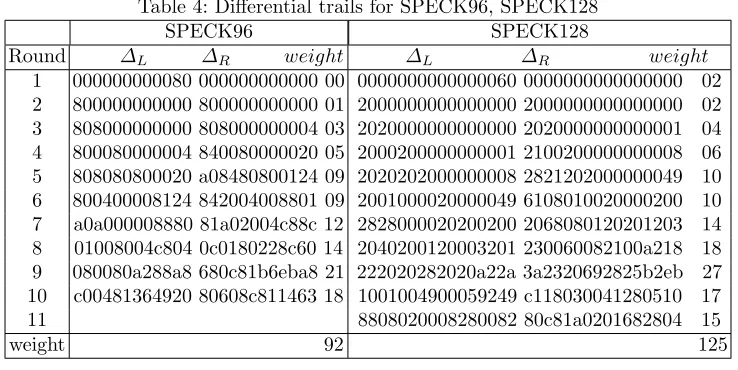
In this paper, we used our naive algorithm extended with the partial difference distribution table (pDDT) for finding the best differential trails in ARX cipher SPECK. We showed the practical ap-plication of the new method on round-reduced variants of block cipher from the SPECK family. For the 32-bit state of the cipher, it only makes sense to analyse the differential paths with probability higher than 2−32. It is because a path with lower probability would not lead to any meaningful attack, which would be faster than exhaustive search in the 32-bit state. Similarly for SPECK48, SPECK64, SPECK96 and SPECK128 probability should be higher than 2−48, 2−64, 2−96and 2−128respectively. We run the experiments for long characteristics starting from the first round. We report the dif-ferential path for up to 8, 9, 11, 10 and 11 rounds of SPECK32, SPECK48, SPECK64, SPECK96 and SPECK128 respectively. In the table left and right part of the state are denoted by ∆L and
∆R, respectively. Differences are encoded as hexadecimal numbers (Probability for a given weight is
Table 3: Differential trails for SPECK32, SPECK48, SPECK64
SPECK32 SPECK48 SPECK64
Round∆L ∆R weight ∆L ∆R weight ∆L ∆R weight
1 0014 0800 2 100082 120000 3 08000000 00000000 1 2 2000 0000 1 901000 001000 3 00080000 00080000 2 3 0040 0040 1 008010 000010 3 00080800 00480800 4 4 8040 8140 2 100090 100010 3 00480008 02084008 6 5 0040 0542 4 801010 001090 5 0a080808 1a4a0848 9 6 8542 904a 6 109080 101400 5 12400040 c0104200 5 7 1540 546a 7 900490 10a490 8 80020200 80801206 5 8 d440 85e9 7 803494 051014 8 80001004 84008030 5
9 919020 b91080 9 80808020 a08481a4 8
10 80040124 84200c01 7
11 a0a00800 81a0680c 9
weight 30 47 63
Table 4: Differential trails for SPECK96, SPECK128
SPECK96 SPECK128
Round ∆L ∆R weight ∆L ∆R weight
1 000000000080 000000000000 00 0000000000000060 0000000000000000 02 2 800000000000 800000000000 01 2000000000000000 2000000000000000 02 3 808000000000 808000000004 03 2020000000000000 2020000000000001 04 4 800080000004 840080000020 05 2000200000000001 2100200000000008 06 5 808080800020 a08480800124 09 2020202000000008 2821202000000049 10 6 800400008124 842004008801 09 2001000020000049 6108010020000200 10 7 a0a000008880 81a02004c88c 12 2828000020200200 2068080120201203 14 8 01008004c804 0c0180228c60 14 2040200120003201 230060082100a218 18 9 080080a288a8 680c81b6eba8 21 222020282020a22a 3a2320692825b2eb 27 10 c00481364920 80608c811463 18 1001004900059249 c118030041280510 17
11 8808020008280082 80c81a0201682804 15
weight 92 125
Table 5: Differential trails for SPECK32, SPECK48, SPECK64
SPECK32 SPECK48 SPECK64
Round∆L ∆R weight ∆L ∆R weight ∆L ∆R weight
1 14ac 5209 7 020888 5a4208 7 02080888 1a4a0848 9 2 0a20 4205 5 d24000 005042 6 92480040 40184200 8 3 0211 0a04 4 008202 020012 4 008a0a00 0481a021 8 4 2800 0010 2 000090 100000 1 00489008 02084018 8 5 0040 0000 0 800000 000000 1 0a080888 1a4a0848 9 6 8000 8000 1 008000 008000 2 92400040 40104200 6 7 8100 8102 2 008080 048080 3 00820200 00001202 4 8 8000 840a 4 848000 a08400 4 00009000 00000010 2 9 850a 9520 6 a00080 a42085 7 00000080 00000000 0
10 248085 0584a8 8 80000000 80000000 1
11 80800000 80800004 3
12 80008004 84008020 5
weight 31 43 63
Table 6: Differential trails for SPECK96, SPECK128
SPECK96 SPECK128
Round ∆L ∆R weight ∆L ∆R weight
1 a22a20200800 013223206808 14 0096492440040124 0420144304600c01 18 2 019009004800 080110030840 10 2020820a20200800 0120201203206808 14 3 0800800a0808 480800124a08 10 0100009009004800 0801000010030840 10 4 400000924000 004000001042 06 08000000800a0808 4808000000124a08 10 5 000000008202 020000000012 04 4000000000924000 0040000000001042 06 6 000000000090 100000000000 01 0000000000008202 0200000000000012 04 7 800000000000 000000000000 01 0000000000000090 1000000000000000 01 8 800000000000 008000000000 02 8000000000000000 0000000000000000 01 9 008080000000 048080000000 04 0080000000000000 0080000000000000 02 10 048000800000 208400800000 06 0080800000000000 0480800000000000 04 11 208080808000 24a084808001 10 0480008000000000 2084008000000000 06 12 248004000081 018420040088 09 2080808080000000 24a0848080000001 10 13 80a0a0000088 8c81a02004c8 12 2480040000800001 0184200400800008 10
14 00a0a00000808008 0c81a02004808048 14
15 04810080048000c8 608c018020840288 17
weight 89 127
12
Conclusion
smaller threshold values, pDDT table is large, and the resulting experiment speed is slow because of the bigger search space. That being said, the larger search space might include the values which are necessary to make a good differential path.
Acknowledgement
The project was financed by Polish National Science Centre, project DEC-2014/15/B/ST6/05130.
References
1. Ray Beaulieu, Douglas Shors, Jason Smith, Stefan Treatman-Clark, Bryan Weeks, and Louis Wingers. The SIMON and SPECK families of lightweight block ciphers.IACR Cryptology ePrint Archive, 2013:404, 2013. 2. Alex Biryukov and Vesselin Velichkov. Automatic search for differential trails in arx ciphers. In Josh Benaloh, editor,Topics in Cryptology – CT-RSA 2014, pages 227–250, Cham, 2014. Springer International Publishing.
3. Alex Biryukov, Vesselin Velichkov, and Yann Le Corre. Automatic search for the best trails in ARX: application to block cipher speck. InFast Software Encryption - 23rd International Conference, FSE 2016,
Bochum, Germany, March 20-23, 2016, Revised Selected Papers, pages 289–310, 2016.
4. Tristan Cazenave. Nested monte-carlo search. InIJCAI 2009, Proceedings of the 21st International Joint
Conference on Artificial Intelligence, Pasadena, California, USA, July 11-17, 2009, pages 456–461, 2009.
5. Itai Dinur. Improved differential cryptanalysis of round-reduced speck. InSelected Areas in Cryptography, volume 8781 ofLecture Notes in Computer Science, pages 147–164. Springer, 2014.
6. Ashutosh Dhar Dwivedi, Pawe l Morawiecki, and Sebastian W´ojtowicz. Finding differential paths in arx ciphers through nested monte-carlo search. International Journal of electronics and telecommunications, 64(2):147–150, 2018.
7. N. Ferguson, B. Schneier S. Lucks, D. Whiting, M. Bellare, T. Kohno, J. Callas, and J. Walker. The Skein Hash Function Family. Submission to the NIST SHA-3 Competition (Round 2), 2009.
8. Helger Lipmaa and Shiho Moriai. Efficient algorithms for computing differential properties of addition. In FSE, volume 2355 ofLecture Notes in Computer Science, pages 336–350. Springer, 2001.