Available Online atwww.ijcsmc.com
International Journal of Computer Science and Mobile Computing
A Monthly Journal of Computer Science and Information Technology
ISSN 2320–088X
IJCSMC, Vol. 3, Issue. 3, March 2014, pg.915 – 925
RESEARCH ARTICLE
THE DOORWAY OF SECURE
DATA SHARING SCHEME FOR
CONFEDERACY CLOUDS
K.ISRAIL
1, Y.SURESH
21
M.Tech Student, Department of Computer Science & Engineering, KMMITS, Tirupati, A.P, India Email: [email protected]
2
Assistant Professor, Department of Computer Science & Engineering, KMMITS, Tirupati, A.P, India Email: [email protected]
Abstract: Cloud computing allows users to viewcomputing in a new direction, as it uses the existing technologies to provide better IT services at low-cost. To offer high QOS to customers according SLA, cloud services broker or cloud service provider uses individual cloud providers that work collaboratively to form a federation of clouds. It is required in applications like Real-time online interactive applications, weather research and forecasting etc., in which the data and applications are complex and distributed. In these applications secret data should be shared, so secure data sharing mechanism is required in Federated clouds to reduce the risk of data intrusion, the loss of service availability and to ensure data integrity. So In this paper we have proposed zero knowledge data sharing scheme where Trusted Cloud Authority (TCA) will control federated clouds for data sharing where the secret to be exchanged for computation is encrypted and retrieved by individual cloud at the end. Our scheme is based on the difficulty of solving the Discrete Logarithm problem (DLOG) in a finite abelian group of large prime order which is NP-Hard. So our proposed scheme provides data integrity in transit, data availability when one of host providers are not available during the computation.
Keywords: Cloud computing, Federated clouds, Secure Data sharing, SMC, WRF, Encrypted secret, primitive polynomial, primitive number
I. INTRODUCTION
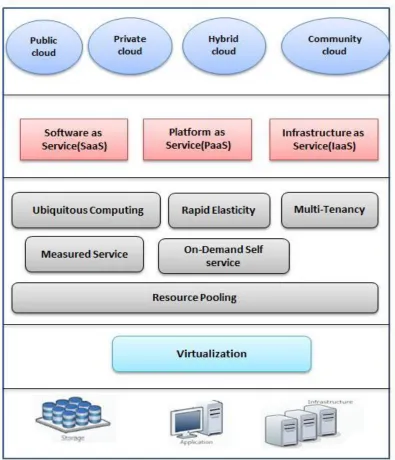
Service-PaaS (e.g. Google app engine (2011), Microsoft‘s Azure (Azure services platform, 2011)) and Infrastructure as Service-IaaS (e.g. Amazon web services, 2011(AWS); Eucalyptus, 2011; Open Nebula (OpenNebula, 2011).To deliver the services efficiently cloud should possess the characteristics like Resource pooling, Virtualization, Multi-tenancy, On-demand self-service, Rapid elasticity ,metered service etc., as show in Fig-1.
Figure 1: Cloud Computing Model
As cloud computing evolves, the vision of federated clouds across which Communications, data, and services can move easily within and across several cloud infrastructures—adds another layer of complexity to security equation. Even though federated Cloud paradigm aims to provide flexible and reliable services composed of a mixture of internal and external mini-clouds, but this heterogeneous nature is also fuelling the security concerns of the customers. To allay the fears and deal with the threats associated with outsourcing data and applications to the Cloud, new methods for security assurance are urgently required. Cloud providers should address privacy and security issues as a matter of high and urgent priority. In this paper among the various security issues we consider the issue of exchanging of private data between the clouds in federation securely.
The purpose of this paper is to provide a new data sharing scheme for federated clouds which comprises various host providers which ensures privacy and availability of data. The remainder of this paper is organized as follows Section-2 summarizes previous work in the area of federated computing and its security. Section-3 introduces the federation computing, technologies and various security issues. Section- 4 specifies the proposed model and Section-5 provides working mechanism of the model. In Section-6 we have given results for the scheme and final section we have given our conclusions along with future work.
II. RELATED WORK
As in [3] Federation is the ability of multiple independent resources to act like a single resource. Cloud computing itself is a federation of resources, so the many assets, identities, configurations and other details of a cloud computing solution must be federated to make cloud computing practical. Also many issues like trust, Identity access management; Signing-in has been discussed regarding Federation of clouds.
Buyya et al. in [4] suggests a cloud federation oriented, just-in-time, opportunistic and scalable application services provisioning environment called Inter Cloud. As a result Cloud application service (SaaS) providers will have difficulty in meeting QoS expectations for all their consumers. Hence, they would like to make use of services of multiple Cloud infrastructure service providers who can provide better support for their specific consumer needs. This kind of requirements often arises in enterprises with global operations and applications such as Internet service, media hosting, and Web 2.0 applications. This necessitates building mechanisms for federation of Cloud infrastructure service providers for seamless provisioning of services across different Cloud providers.
In paper by Subashini and kavitha[5], has discussed various security issues at various service models like Data security, Network security, Data locality, Data integrity, Data segregation, Data access, Authentication and authorization. Cloud computing has significant implications for the privacy of personal information as well as for the confidentiality of business and governmental information. In the case of federated clouds this becomes more serious issue that is to be addressed. For computation exchange of data between clouds in federation is necessary so both privacy and integrity of data should be considered.
Even within the cloud provider‘s internal network, encryption and secure communication are essential, as the information passes between countless, disparate components through network domains with unknown security, and these network domains are shared with other organizations of unknown reputability[6].The confidentiality of sensitive data must be protected from mixing with network traffic with other cloud hosts. If the data is shared between multiple users or clouds , the CSP must ensure data integrity and consistency. The CSP must also protect all of its cloud service consumers from malicious activities or data modification [7-8].
In [10] Mohammed Abdullatif et.al, has discussed about data privacy in DAAS. In their paper Shamir‘s secret sharing mechanism has been used for securing data , so that individual data values will not be visible to the service provider and provider can recover data in case of data loss. By above literature study we have proposed this scheme for secure data sharing in federated clouds which ensures that secret data used in computation is not visible to anyone except to owner of data ie., one of the cloud host provider who participates in computation by sharing data and avoids modification of data due to malicious host.
III. FEDERATION COMPUTING
improve what was offered in single clouds by distributing reliability, trust, and security among multiple cloud providers.
When increasing resources on the cloud to restore or improve application performance, administrators can scale either horizontally (out) or vertically (up), depending on the nature of the resource constraint. Vertical scaling (up) entails adding more resources to the same computing pool—for example, adding more RAM, disk, or virtual CPU to handle an increased application load. Horizontal scaling (out) requires the addition of more machines or devices to the computing platform to handle the increased demand. Scalability is the inherent feature of cloud computing which has at least two dimensions, namely horizontal cloud scalability and vertical cloud scalability [2]. Horizontal cloud scalability is the ability to connect and integrate multiple clouds to work as one logical cloud.
For instance, a cloud providing calculation services (calculation cloud) can access a cloud providing storage services (storage cloud ) to keep intermediate results. Two calculation clouds can also integrate into a larger calculation cloud. Vertical cloud scalability can be used to improve the capacity of a cloud by enhancing individual existing nodes in the cloud (such as providing a server with more physical memory) or improving the bandwidth that connects two nodes.
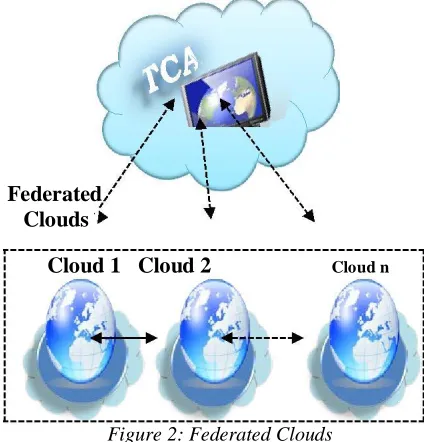
Federated Clouds
Cloud 1 Cloud 2 Cloud n
Figure 2: Federated Clouds
A. Cloud Federation Technologies
As discussed in [9] the following technologies provide mechanisms which support Cloud services and even federation. Such as, Open Nebula provides an open-source and extensible architecture that can be modified to fit an individual Cloud. It can be leveraged by adding APIs and plug-ins to the existing architecture in order to facilitate inter-Cloud communication at different layers of the service stack. Eucalyptus is also an open-source framework that uses storage and computational infrastructure to provide a Cloud computing platform. Eucalyptus provides a modular, extensible framework with an Amazon EC2compatible interface which can be utilized for federation at the IaaS layer. CometCloud is an autonomic computing engine that enables the dynamic and on-demand federation of Clouds as well as the deployment and execution of applications on these federated environments. It supports heterogeneous and dynamic Cloud infrastructures, enabling the integration of public/private Clouds and autonomic Cloud bursts, i.e., dynamic scale-out to Clouds to address dynamic workloads. Conceptually, CometCloud is composed of a programming layer, service layer, and infrastructure layer.
B. Security issues in Federated Clouds
paramount elements of such a computing environment.
In a cross-clouds federated environment, security concerns are even more important and complex. Cloud computing paradigm, in general, will only be adopted by the users, if they are confident that their data and privacy are secured. Cloud computing involves the sharing or storage by users of their own information on remote servers owned or operated by others and accesses through the Internet or other connections. Cloud computing services exist in many variations, including data storage sites, video sites, tax preparation sites, personal health record websites and many more. The entire contents of a user‘s storage device may be stored with a single cloud provider or with many cloud providers. Whenever an individual, a business, a government agency, or any other entity shares information in the cloud, privacy or confidentiality questions arise which should be properly addressed to tap the market among various cloud players.
IV. PROPOSED SCHEME
Our secure data sharing scheme for Federated cloud contains various cloud instances belonging to same Cloud host or different hosts that participate in computation to get overall benefit which is not possible with a single cloud. Each cloud instance will share their data secretly without knowing other hosts data thus ensuring privacy and achieve the final result. Cloud host providers Exchanges data to solve the n2 problem by facilitating as mediators for enabling connectivity among disparate cloud environments.
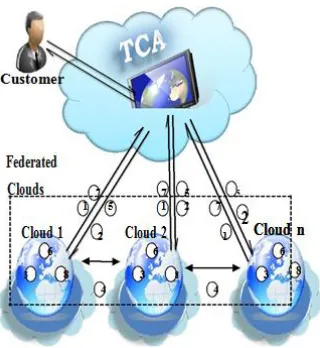
In our proposed scheme whenever customer requests cloud host provider for service, also if it is an complex application request and the computation depends on other cloud hosts values then it is required to form into federation of clouds as shown in figure-2 above. Among the cloud one will act as Trusted Cloud authority (TCA) which will control and coordinate entire computation. TCA will request will accepts credential / if already contains credentials of each cloud it will use it to initialize the secure data sharing scheme by giving secret keys and initiate the process. The various phases of working in our proposed scheme are described in the next section and outlined diagrammatically in the given figure-3.
Upon request from client/application TCA will creates a Session for that particular instance of computation and session-id‘s are dynamically created for each host participating in computation. Session-id‘s are sent to all the cloud hosts in federation privately. Session-id can be used for authentication when each of them exchange data during computation. Internally cloud hosts will have co-coordinators to coordinate the computation which will work according to SLA. Our scheme uses SMC[12] mechanism but the secret value used in data sharing is encrypted which is difficult to know as we have used DL technique and finally each cloud can decrypt the final value by using their secret keys. In our scheme secret value will not be known to the TCA also, as it is encrypted by hosts with their own keys.
Customer
1. Credentials 2. Private Key gi
3. Generation of Secret Primitive Polynomial
4. SMC implementation to computer Sum polynomial
5. Public key hi, ti for individual verification and δ for secret recovery
6. Malicious cloud verification 7. Report malicious cloud
8. Recover secret from SUM Polynomial
V. WORKING OF PROPOSED SCHEME
The proposed scheme is used to secure secret data when shared during computation between federated clouds. In this scheme the secret data is encrypted and decrypted by the each cloud to retrieve original value. We assume that following assumptions hold good at initialization phase.
1. That TCA and cloud hosts providers exchange data securely 2. All Cloud providers are honest without malicious in nature. The data sharing scheme works in following phases as
1. Initialization Phase 2. Distribution Phase 3. Verification Phase 4. Recovery Phase
A. Initialization Phase
In this phase TCA will starts session and session id‘s are sent to all clouds secretly that participate in computation. Then TCA by using their credentials computes and sends private and public keys for cloud hosts in federation for computation.
Let C1,C2,C3,………..Cn are the clouds involved in computation.
1. The credentials of each cloud Ci are sent to TCA by C1,C2….Cn
2. TCA generates large primes CPi from credentials of each cloud Ci.
3. TCA computes NPi=2*CPi
4. For each cloud Ci, TCA generates a primitive root ‗gi‘ from NPi.
5. TCA sends gi securely which is private to each cloud Ci, and NPi is public to all the clouds.
B. Generation of Polynomial
1. Each cloud Ci generates a group ZNpi* with the generator gi and Npi.
2. Ci builds Galois field (GF) consisting of primitive elements with the group ZNpi *
ie., Galois field(ie.,GF(gi bi
) has Ф(gibi – 1) primitive elements where bi Є ZNpi*.
3. Each cloud Ci generates a polynomial fi(x) with coefficients in GF and hence fi(x) is a primitive polynomial.
[ie. fi(x) = a0 x+ a1x 1
+ a2x 2
+………+an-1x n-1
] where fi(0)=a0
C. Distribution Phase
In this phase each cloud host in federation exchange secrets for computation to achieve final polynomial with secret value in encrypted form
1. Each Coefficient ai in primitive polynomial fi(x) is the primitive number in GF(gi bi
) where 0<i≤ n-1 and a0 is secret value of Ci.
2. Each Ci computes, a0= Sidi where di=(gi bi
)δi where δi Є ZNpi *
such that gi bi
δi≡ 1 mod Npi here Si is the secret
that is to be shared between clouds during computation.
sum polynomial F(x)=
∑
in=1f i( x) and coefficientsare in GF sends it to TCA for verification.
D. Verification Phase
In this phase each cloud host in federation verifies the secret value by decrypting and finds the malicious host if exists and reports to TCA or rejects its value.
Note: Any polynomial f(x) with co-efficient of GF(P)
satisfies the Identity, F(xP)≡[f (x)]P (since gi=P and GF(P)=GF(gi))
1. TCA randomly selects a prime gpi that satisfies the identity stated above.
hence F(xgpi)≡F(x)gpi
2. Then TCA chooses a small random number ti Є Z +
. ∀ti ∃ hi Є Z +
∋ hiti≡1 (mod gpi).
3. TCA sends gpi, hi,ti to the corresponding clouds Ci and announces as public to all the clouds.
4. Each cloud Ci chooses a secret element ri∈GF(gi bi
) such that Xri≡hi(mod F(x), gpi)
5. Each cloud Ci verifies Cj as Xritj≡(Xri)tj≡hjtj ≡1(mod ( F(x),gpj))
6. If any cloud Ci is malicious then the above congruence dissatisfies, since the Sum Polynomial F(x) sent from
Ci to Cj is wrong.
ie. Xri t
j ≠ 1(mod F(x),gpi)
E. Recovery Phase
In this phase after verification by each cloud Ci , the secret is recovered by using following steps by each party
. Secret can be recovered even if there exists a malicious party m(m<n/2). S=∑(Sidi) where di=(gbi)δi where δi Є Znpi* such that gibi δi≡ 1 mod npi
S = S1(g1 b
1)δ1+S2(g2 b
2)δ2+………..+Sn(gn b
n)δn. =S1g1 b
1.δ1+ S2g2 b
2.δ2+………..+ +Sngn
b n.δn
=S1(g1b1* g1-b1 mod np1)+ S2(g2b2* g2-b2 mod np2)+…………..+ Sn(gnbn* gn-bn mod npn) = S1 (g10
mod np1)+ S2 (g20 mod np2) +………+ Sn (gn
0
mod npn)
=S1*1+ S2*1+……….+ Sn*1
=S1+S2+……….+Sn
Further in recovery phase SMC can be applied to the following three cases in recovering secret if malicious cloud host exists during data sharing or data recovery when it is distributed among multiple or federated clouds.
Case 1: Assume All ‗n‘ clouds hosts in federation are Honest for ‗n‘ honest clouds, The co-efficient of xo in sum
polynomial F(x) is the sum of secret shares of all Ci and it is valid for each Ci iff Xriti≡1(mod F(x),gpi)
Case 2: Assume that n-1 cloud hosts in a Federation are Honest with some are malicious
For ‗n-1‘ honest clouds, If any cloud is dishonest among ‗n‘ clouds the ‗n-1‘ clouds together obtains the sum of secret shares as sum of secret shares as
For n-1 parties we reconstruct secret S as
Sn-1=(S1g1b1)δ1+(S2g2b2)δ2+………..+(Sn-1gn-1bn-1)δn-1.
In the sum Polynomial, the sum of the secrets obtained by each cloud is ,
S=∑(Sidi) where di=(gbi)δi where δi Є ZNpi* such that gibi δi≡ 1 mod Npi
S = S1(g1 b
1)δ1+S2(g2 b
2)δ2+………..+Sn(gn b
n)δn. =S1g1 b
1.δ1+ S2g2 b
2.δ2+……….. + Sngn
S= Sn-1+ Sngnbn.δn
ie., Sngn b
n.δn =S-Sn-1
Case 3: Assuming that there are >=n/2 cloud hosts are malicious in federation.
If n/2 are malicious clouds then
S = S1(g1b1)δ1+S2(g2b2)δ2+………+
S2(gn/2 b
n/2)δn/2+……..+Sn(gn b
n)δn
S = S1(g1b1)δ1+S2(g2b2)δ2+………+
S2(g n/2 b
n/2)δn/2+……..+Sn(gn b
n)δn +Sn(gn b
n)δn
∴S = 4*(n/2) un knowns+… ……… …….+Sn-1+Sn
S≠Sn/2
The unknowns in the sum polynomial are 2n, so it is not possible to get S from 2n unknowns.
VI. EXPERIMENTAL ANALYSIS OF PROPOSED SCHEME
We have verified the only the base scheme used in data sharing between the clouds by using Java 1.7 on Intel Core-i3 processor with 4 GB RAM. We have taken only small values as credentials due to computation resource constraint which has given following results, here number of clouds in federation is taken as 4.
Enter how many Clouds involve in Federation for Communication: 4
A. Generation of Parameters:
Enter the grant type: Client
Enter the service type: Application
Enter the client name: Amazon
Enter the client region: Asia
Enter the client location: India
Enter the service payment: 250000000
Enter the service expiry date: 31-Dec-2025
Cp = 4327 Np1 = 8654 g1 = 8647
Enter the grant type: Client
Enter the service type: Application
Enter the client name: Google Docs
Enter the client region: America
Enter the client location: Mexico City
Enter the service payment: 3000000000
Enter the service expiry date: 31-Dec-2030
Cp = 5669 Np2 = 11338 g2 = 11311
Enter the grant type: Client
Enter the service type: Application
Enter the client name: Google Cloud Services
Enter the client region: Asia
Enter the client location: Pakistan
Enter the service payment: 300000000000
Enter the service expiry date: 31-Dec-2025
Cp = 6203 Np3 = 12406 g3 = 12401
Enter the grant type: Client
Enter the service type: Application
Enter the client name: HP Cloud Provider
Enter the client location: Bangladesh
Enter the service payment: 3600000000
Enter the service expiry date: 31-Dec-2035
Cp = 5843 Np4 = 11686 g4 = 11681
B.
Generation of Polynomials:
(7)X^3 + (26)X^2 + (6)X^1 + (2)X^0 (19)X^3 + (16)X^2 + (12)X^1 + (4)X^0 (10)X^3 + (13)X^2 + (3)X^1 + (6)X^0 (24)X^3 + (15)X^2 + (19)X^1 + (8)X^0
C. Distribution of Secret:
s1=2 (original secret) s2=4 (original secret)
a0= s1d1= 646541456023 (E)encrypted)
a0= s2d2= 1636831633111541 (E)encrypted)
s3=6 (original secret) s4=8 (original secret)
a0= s3d3= 293280735995777662001(E)
a0= s4d4= 2540271545712591010246081(E)
where di=(gi bi
)δi where δi Є ZNpi *
such that gi bi
δi≡ 1 mod Npi ==> δi= gi -bi
mod Np i
The revised polynomials are:
(24)X^3 + (4)X^2 + (20)X^1 + (8368306130700080)X^0 (3)X^3 + (18)X^2 + (23)X^1 + (2076343186244444682973568)X^0
(18)X^3 + (24)X^2 + (20)X^1 + (21783804456699014989946336906386176)X^0 (11)X^3 + (4)X^2 + (24)X^1 + (16408063398992467575067769015170019871641600)X ^0
The Sum of the Polynomials obtained at each party is
(56)X^3 + (50)X^2 + (87)X^1 +
16408063420776272031766784005116356778027776
)X^0 (encrypted value) original values is (20)
D. Recovery of Secret:
Case 1: Assuming there are no malicious cloud host in Federation of clouds S = ∑(Sidi) i=1,2,3,4
S = s1d1+ s2d2+ s3d3+ s4d4
S = S1(g1 b
1)δ1+S2(g2 b
2)δ2+ S3(g3 b
3)δ3+S4(g4 b
4)δ4.
= S1g1b1.δ1+ S2g2b2.δ2+ S3g3b3.δ3+ S4g4b4.δ4
= S1(g1 b
1* g1 -b
1 mod np1)+ S2(g2 b
2* g2 -b
2 mod np2)+ S3(g3 b
3* g3 -b
3 mod np3)+ S4(g4 b
4* g4 -b
4 mod np4) = S1 (g10 mod np1)+ S2 (g20 mod np2)+
S2 (g30 mod np3)+ S4 (g40 mod np4)
= S1 *
1+ S 2 *
1+ S 3 *
1+ S4 *
1 = S1+S2+ S3+S4
S = 2+4+6+8 S = 20
Case 2: Assuming honest clouds in federation are <=n-1
S0 = ∑(Sidi) i=1,2,3
S0 = s1d1+ s2d2+ s3d3
S0 = S1(g1b1)δ1+S2(g2b2)δ2+ S3(g3b3)δ3
= S1g1b1.δ1+ S2g2b2.δ2+ S3g3b3.δ3
= S1(g1 b
1* g1 -b
1 mod np1)+ Sn(g2 b
2* g2 -b
2 mod np2)+ S3(g3 b
3* g3 -b
3 mod np3)
= S1 (g10 mod np1)+ S2 (g20 mod np2)+ S2 (g30 mod np3)
= S1 *
1+ S2 *
1+ S3 *
1 = S1+S2+S3
The original Sum of Secrets is, S=20 S=S0+ S 4d4 20=12+ S4d4
S4d4=20-12c
S4d4=8
Therefore, S=S0+ S 4 d4
S=12+8 S=20
The Sum of the Polynomials after recovering the secret at each party is ::
(56)X^3 + (50)X^2 + (87)X^1 + (20)X^0
Case 3: Assuming we are having n/2 or (n-1)/2 are malicious clouds
S = S1(g1 b
1)δ1+S2(g2 b
2)δ2+………+ S2(g
n/2 b
n/2)δn/2+……..+Sn(gn b
n)δn
S = S1(g1 b
1)δ1+S2(g2 b
2)δ2+………+ S2(g n/2bn/2)δn/2+……..+Sn(gnbn)δn +Sn(gnbn)δn
S= ∴4*(n/2) un know ns+…… ……… ….+Sn-1+ Sn
S≠Sn/2
The unknowns in the sum polynomial are 2n, so it is not possible to get S from 2n unknowns.
VII. USE CASES
In Weather Research and Forecasting application used for Agriculture or for any governmental purposes uses values from different cloud host stations at different locations to analyses the final result which works in federation. Here data should be correct and secure so that it may not give wrong results which may lead to disaster.
For forecasting stations, due to the nature of certain weather phenomena such as hurricanes or tornadoes, performing accurate predictions in very short time spans is vital to make appropriate preparations involving business operations management and government and human related logistics. Thus, sharing of resources between institutions to provide elasticity and dynamic capacity in extreme situations is key.
The applications like Online Voting or Online Bidding or Real time Game playing stations when deployed on clouds uses multiple hosts at located at different geographical areas will demands data to have privacy and secure.
VIII. CONCLUSION
Cloud computing key role in IT sector in delivering services at low cost and in an effective manner. Clouds should form into federation in order to perform computation collectively to achieve a result. At the same time the security threats like data should be addressed with by using novel techniques. In this paper we have used threshold data sharing technique to be used in federation of clouds which allows data privacy and security in transit between them. We have analyzed the base scheme and results are noted. The same technique can be used to recover data when distributed between multiple clouds and one of the cloud host was not available due to natural disaster or technical problem thus provides solution to data availability in cloud computing. In future we try to implement this technique on real time cloud and also for authenticating automated applications running on clouds.
REFERENCES
[1] Recommendations of National Institute of Standards and Technology [online]. Available http://csrc.nist.gov/publications/nistpubs/800-145/SP800-145.pdf
[2] Cloud computing. Wikipedia. [online]. Available at http://en.wikipedia.org/wiki/Cloud_computing.
[3] July 2010,Cloud Computing Use Cases, A white paper produced by the Cloud Computing Use Case Discussion Group, Version 4.0 .[online].Available. http://cloudusecases.org.
[4] Rajkumar Buyya, Rajiv Ranjan, and Rodrigo N. Calheiros,‖InterCloud: Utility-Oriented Federation of Cloud Computing
Environments for Scaling of Application Services”, ICA3PP,2010,Part I, LNCS 6081, Springer, 2010, pp. 13–31. doi: 10.1007/978-3-642-13119-6_2
[5] S. Subashini and V. Kavitha, ―A survey on security issues in service delivery models of cloud computing‖, Journal of
[6] Cloud Security Alliance, ―Security Guidance for Critical Areas of Focus in Cloud Computing”,V2.1, 2009.
[7] Dec, 2011,‖Federated identity management‖,[Online], [Available],http://en.wikipedia.org/wiki/Federated_iden
tity_management
[8] Xiao Zhang; Hong-tao Du; Jian-quan Chen; Yi Lin; Lei-jie Zeng,"Ensure Data Security in Cloud Storage", Network Computing and Information Security (NCIS), International Conference (IEEE),vol.1,14-15 May,2011 pp.284- 287. doi: 10.1109/NCIS.2011.64
[9] David Villegas, Norman Boboroff, Ivan Rodero, Javier Delgado, yanbin Liu, Aditya.D, Liana Fong, S.Masoud Sajadi, ManishP ,―Cloud federation in a layered service model‖,Journal of Computer and System sciences, Elsevier, 2012. doi: 10.1016/j.jcss.2011.12.017
[10]M. A. AlZain and E. Pardede, ―Using Multi Shares for Ensuring Privacy in Database-as-a-Service‖, 44th Hawaii,
International Conference on System Sciences (HICSS),2011,pp 1-9. doi: 10.1109/HICSS.2011.478
[11]David Bernstein, DeepakVij, ―Intercloud Security Considerations‖, 2nd IEEE International Conference on Cloud
Computing Technology and Science, doi: 10.1109/ CloudCom.2010.82. doi: 10.1109/ CloudCom. 2010.82