Preimage attacks on Reduced-round Stribog
Riham AlTawy and Amr M. Youssef
Concordia Institute for Information Systems Engineering, Concordia University, Montr´eal, Qu´ebec, Canada
Abstract. In August 2012, the Stribog hash function was selected as the new Russian crypto-graphic hash standard (GOST R 34.11-2012). Stribog employs twelve rounds of an AES-based compression function operating in Miyaguchi-Preneel mode. In this paper, we investigate the preimage resistance of the Stribog hash function. Specifically, we apply a meet in the middle preimage attack on the compression function which allows us to obtain a 5-round pseudo preim-age for a given compression function output with time complexity of 2448and memory complexity of 264. Additionally, we adopt a guess and determine approach to obtain a 6-round chunk sep-aration that balances the available degrees of freedom and the guess size. The proposed chunk separation allows us to attack 6 out of 12 rounds with time and memory complexities of 2496 and 2112, respectively. Finally, employing 2tmulticollision, we show that preimages of the 5 and 6-round reduced hash function can be generated with time complexity of 2481 and 2505, respec-tively. The two preimage attacks have equal memory complexity of 2256.
Keywords: Cryptanalysis, Hash functions, Meet in the middle, Preimage attack, GOST R 34.11-2012, Stribog.
1
Introduction
The attacks by Wanget al. on MD5 [23] and SHA-1 [22] followed by the SHA-3 compe-tition [18] have led to a flurry in the area of hash function cryptanalysis. The primary targets of these attacks are the Add-Rotate-Xor (ARX) based hash functions where one can find differential patterns that propagate with acceptable probabilities. Ad-ditionally, using message modification techniques, significant complexity reduction is achieved. Consequently, during the SHA-3 competition, different design concepts were introduced, out of which are the Advanced Encryption Standard (AES) based designs that are known for their resistance to standard differential attacks due to the wide trail strategy. The ISO standard Whirlpool [19], the SHA-3 finalist Grøstl [7], and the new Russian hash standard Stribog [1] are among the proposed AES-based hash functions.
Following the work of Lai and Massey [12], the meet in the middle (MitM) preimage attack [6] was proposed by Aoki and Sasaki. The main idea of the proposed technique is to divide the attacked rounds into two independent executions such that each execution is affected by a different set of inputs. The outputs of the two executions meet at a matching point where a solution is selected to satisfy both executions. The MitM preimage attack has been applied to MD4 [6, 8], MD5 [6], HAS-160 [9], and all functions of the SHA family [5, 4, 8]. The attack exploits the fact that all the previously mentioned functions are ARX-based and operate in the Davis-Mayer (DM) mode, where the state is initialized by the chaining value and some of the expanded message blocks are used independently each round. Thus, one can determine which message blocks affect each execution for the MitM attack. However, several AES-based hash functions operate in the Miyaguchi-Preneel mode, where the input message is fed to the initial state which undergoes a chain of successive transformations. Consequently, the process of separating independent executions becomes relatively more complicated.
In FSE 2011, Sasaki proposed the first MitM preimage attack on several AES hashing modes [20]. In the same work, a 5-round pseudo preimage attack on the compression function of Whirlpool was presented and used for a second preimage attack on the whole hash function. Afterwards, Wu et al. applied the MitM preimage attack on Grøstl [24] and used a time-memory trade off approach to improve the time complexity of the 5-round attack on the Whirlpool compression function. Lastly, a pseudo preimage attack on the 6-round Whirlpool compression function and a memoryless preimage attack on the reduced hash function were proposed in [21].
In this work, we investigate the security of Stribog and its compression function, as-sessing their resistance to the MitM preimage attacks. We present a pseudo preimage attack on the compression function reduced to 5 out of 12 rounds by employing the partial matching and initial structure concepts [20]. In particular, we present an ex-ecution separation for the compression function that balances the degrees of freedom in both execution directions with their corresponding matching probability [24]. Fur-thermore, we extend the attack by one round using the guess and determine approach [21], which allows us to guess parts of the state that belongs to one execution. The proposed 6-round chunk separation maximizes the overall complexity of the attack by balancing the adopted degrees of freedom and the guess size. Finally, we show how to generate preimages of the Stribog hash function using the presented pseudo preimage attacks on the compression function. In Table 1, we provide a summary of the current cryptanalytic results on the Stribog hash function.
Target #Rounds Time Memory Data Attack Reference
Internal cipher 5 2 8
28
-Free-start collision [2]
8 264 28
-Internal permutation 6.5 2 64
- 264MS
Integral [3] 7.5 2120 - 2120 MS distinguisher
Compression function
7.75 2184 28
-Semi free-start
[2]
4.75 28 - - collision
7.75 272 28
-Semi free-start near 8.75 2128 28
-9.75 2184 28 - collision 5 2448 264
-Pseudo preimage Sec. 4
6 2496 2112 - Sec. 5
6 264 - 264MS
Integral [3] 7 2120 - 2120 MS distinguisher
Hash function 5 2
481 2256
-Preimage Sec. 6 6 2505 2256
-Table 1.Summary of the current cryptanalytic results on Stribog. MS: middle states
of the hash function are generated using the attacks presented in Sections 4 and 5. Finally, the paper is concluded and a short discussion is provided in Section 7.
2
Specification of Stribog
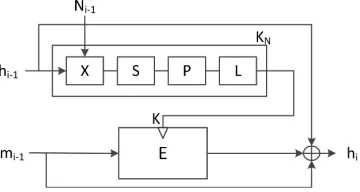
Stribog outputs a 512 or 256-bit hash value, where half the last state is truncated when adopting the 256-bit output. The standard specifies two differentIVs to be used with the two output lengths. The function can process messages of length up to 2512 −1. The compression function iterates over 12 rounds of an AES-like cipher with an 8×8 byte internal state and a final round of key mixing. The compression function operates in Miyaguchi-Preneel mode and is plugged in Merkle-Damg˚ard domain extender with a finalization step. The input message M is padded into a multiple of 512 bits by
Fig. 1.Stribog’s compression functiongN
included as an extra separate block, followed by a block of a checksum evaluated by the modulo 2512 addition of all message blocks as a finalization step. More precisely, let n = ⌊|M|
512⌋ and the input message M = x∥mn∥..∥m1∥m0, where |M| is length of M, and x is an un-complete or an empty block. The message is padded as follows: let mn+1 = 0511−|x|∥1∥x, then the padded message M = mn+1∥mn∥..∥m1∥m0. Let
∑
= mn+1+..+m1+m0. The compression functiongN is fed with three inputs: the chaining
valuehi−1, a message block mi−1, and the counter of bits hashed so far Ni−1 = 512×i.
(see Figure 1). Lethi be a 512-bit chaining variable. The first state is loaded with the
initial value IV and assigned to h0. The hash value of M is computed as follows:
hi ←gN(hi−1, mi−1, Ni−1) fori= 1,2, .., n+ 2
hn+3 ←g0(hn+2,|M|,0)
h(M)←g0(hn+3,
∑
,0),
whereh(M) is the hash value ofM, and g0 isgN with N = 0. As depicted in Figure 1,
the compression functiongN consists of:
– KN: a nonlinear whitening round of the chaining value. It takes a 512-bit chaining
variablehi−1 and a counter of the bits hashed so farNi−1 and outputs a 512-bit key
K.
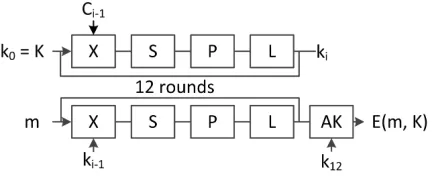
– E: an AES-based cipher that iterates over the message for 12 rounds in addition to a finalization key mixing round. The cipher E takes a 512-bit keyK and a 512-bit message block m as a plaintext. As shown in Figure 2, it consists of two similar parallel flows for the state update and the key scheduling.
Fig. 2.The internal block cipher (E)
BothKN and E operate on an 8×8 byte key state K. E updates an additional 8×8
byte message stateM. In one round, a given state is updated by the following sequence of transformations:
– AddKey(X): XOR with either a round key, a constant, or the counter of bits hashed so far (N).
– SubBytes (S): A nonlinear byte bijective mapping.
– Linear Transformation (L): Row multiplication by an MDS matrix in GF(2).
Initially, stateK is loaded with the chaining valuehi−1 and updated byKN as follows:
k0 =L◦P ◦S◦X[Ni−1](K).
NowK contains the keyk0 to be used by the cipherE. The message stateM is initially
loaded with the message blockmandE(k0, m) runs the key scheduling function on state
K to generate 12 round keysk1, k2, .., k12 as follows:
ki =L◦P ◦S◦X[Ci−1](ki−1), fori= 1,2, ..,12,
whereCi−1 is the ith round constant. The state M is updated as follows:
Mi =L◦P ◦S◦X[ki−1](Mi−1), for i= 1,2, ...,12.
The final round output is given by E(k0, m) = M12 ⊕k12. The output of gN in the
Miyaguchi-Preneel mode isE(KN(hi−1, Ni−1), mi−1)⊕mi−1⊕hi−1 as shown in Figure
1. For further details, the reader is referred to [1].
2.1 Notation
LetM and K be (8×8)-byte states denoting the message and key state, respectively. The following notation will be used throughout the paper:
– Mi: The message state at the beginning of round i.
– MU
i : The message state after the U transformation at roundi, where U ∈X, S, P, L.
– Mi[r, c]: A byte at rowr and columnc of state Mi.
– Mi[row r]: Eight bytes located at row r of Mi state.
– Mi[col c]: Eight bytes located at column cof Mi state.
Same notation applies to K.
3
MitM preimage attacks on AES-based hash functions
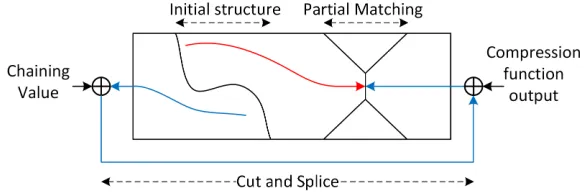
must meet at a common round (matching point) for matching a solution from both the forward and backward directions that satisfies both executions. This is accomplished by adopting the cut and splice technique [6] that employs the mode of operation of the hash functions which chains the input and output states through feedforwarding. More precisely, this technique regards the first and last states as successive rounds. Subsequently, the whole attacked rounds behave in a cyclic manner and one can find a common matching point between the forward and backward executions and one can also select any starting point.
Improvements to this attack aim to stretch the starting and matching points over more than one round state and hence extend the number of the overall attacked rounds. Specifically, the initial structure approach [20] provides the means for the starting point to cover a few successive transformations where bytes in the states belong to both the forward and backward chunks. Although, neutral bytes of both chunks are shared within the initial structure, independence of both executions is achieved in the rounds at the edges of the initial structure. Additionally, the partial matching technique [6] allows only parts of the state to be matched at the matching point. This method is used to extend the matching point further and makes use of the fact that round transformations may update only parts of the state. Thus the remaining unchanged parts can be used for matching. This approach is highly successful in ARX-based hash functions which are characterized by the slow diffusion of their round update functions and so some state variables remain independent in one direction while execution is in the opposite direction. The unaffected parts of the states at each chunk are used for partial matching at the matching point. However, in AES-based hash functions, full diffusion is achieved after two rounds and this approach can be used to extend the matching point of two states for a limited number of transformations. Once a partial match is found, the inputs of both chunks that resulted in the matched values are selected and used to evaluate the remaining undetermined parts of the state at the matching point to check for a full state match. Figure 3 illustrates the MitM preimage attack approaches when a hash function operates in the Miyaguchi-Preneel mode. The red and blue arrows denote the forward and backward executions on the message state, respectively.
In what follows, we apply the techniques discussed in this section to derive a 5-round pseudo preimage attack on the Stribog compression function.
4
5-round pseudo preimage of the compression function
For a compression functionCF that operates on a chaining valuehand a message block m, a preimage attack is defined as follows: given h and x, where x is the compression function output, findmsuch thatCF(h, m) = x. However, in a pseudo preimage attack, onlyx is given and we must find h and m such that CF(h, m) =x. Generally, pseudo preimages of the compression function of some narrow pipe constructions are important because they can be turned to preimages of the hash function with little cost [17]. As for Stribog, the impact of the pseudo preimage attacks on its compression function is demonstrated in Section 6, where we combine these attacks with 2t multicollision to produce preimages for the hash function. Pseudo preimage attacks are adopted when the compression function operates in Davis-Mayer mode where the first state is initialized by the chaining value. Subsequently, using the cut and splice technique enforces changes in the first state through the feedforward. Additionally, the initial phase of MitM preimage attack usually produces pseudo preimages when the function operates in the Miyaguchi-Preneel mode and the complexity of finding a preimage is higher than the available bits that can be chosen freely in the message. Consequently, the chaining value is utilized as a source of randomization to satisfy the number of multiple restarts required by the attack. As a result, we end up with a pseudo preimage rather than a preimage of the compression function output.
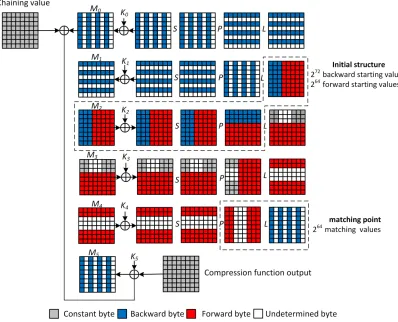
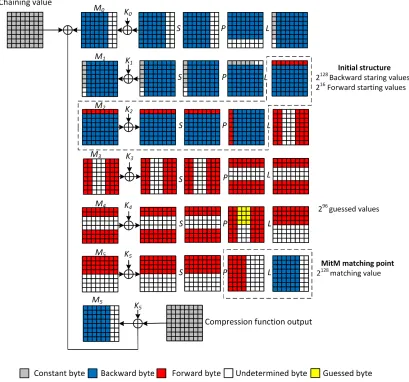
The attack on the compression function starts by chunk separation. Specifically, we divide five rounds of Stribog execution into a forward chunk and a backward chunk around a starting point (initial structure). The adopted chunk separation is shown in Figure 4. The forward chunk starts atM3 and ends at M4P which is the input state to
the matching point. The backward chunk starts at MP
1 and ends after the feedforward
atM4L which is the output state of the matching point. The red bytes are the neutral bytes for the forward chunk and after choosing them in the initial structure, all other red bytes can be independently calculated. White bytes in the forward chunk are the ones whose values depend on the neutral bytes of the backward chunk which are the blue bytes in the initial structure. Accordingly, their values are undetermined, these bytes cannot be evaluated until a partial match is found. Same rationale applies to the backward chunk and the blue bytes. Grey bytes are constants which are either given (compression function output) or chosen (chaining value and constants in the initial structure).
Fig. 4.Chunk separation for a 5-round MitM preimage attack on Stribog compression function.
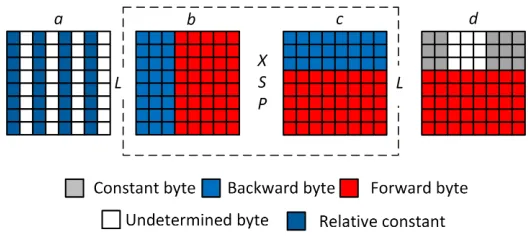
both chunks must be greater than the matching size. For further clarification, we first explain the idea behind the initial structure. The main point is to choose several bytes as neutral bytes so that the number of output bytes of theL and L−1 transformations at the start of each chunk that are constant or relatively constant is maximized. A rel-atively constant byte is a byte whose value is affected by the degrees of freedom in one execution direction but remains constant from the opposite execution perspective. The initial structure for the 5-round MitM preimage attack on the compression function of Stribog is shown in Figure 5. We start by randomly choosing the five constant bytes in d[row 0] and then determine the values of blue bytes inc[row 0] so that after applyingL onc[row 0], we maintain the chosen five constants. Since we need five constant bytes in d[row 0], we only need five free variables inc[row 0] to solve a system of five equations when the other three bytes are fixed. Accordingly, for any of the first three rows in state c, we can randomly choose any three blue bytes and compute the remaining five so that the output ofLmaintains the previously chosen five constants atd[row 0]. To this end, we have nine free blue bytes (three for each row in statec). Thus the backward degrees of freedom is 272which means that we can start the backward execution by 272different
starting values and hence 272 different output values at the matching point ML
Simi-Fig. 5.Initial structure for the 5-round attack on the Stribog compression function.
larly, we choose 32 constants in stateaand for each row in stateb we randomly choose one red byte and compute the other four bytes such that, after theL−1 transformation,
we get the predetermined constants at each row in a. However, the value of the four shaded blue bytes in each row of state a depends also on the three blue bytes in the rows of state b. We call these bytes relative constants because their final values cannot be determined until the backward execution starts and these values are different for each execution iteration. Specifically, their final values are the predetermined constants XORed with the corresponding blue bytes multiplied by the L−1 coefficients. In the
sequel, we have eight free bytes (one for each row inb) which means 264forward degrees
of freedom to start the forward execution and hence 264 different input values to the matching pointMP
4 .
At the matching point, we match results at M4P from the forward chunk with the values at ML
4 from the backward chunk through the L transformation. As depicted in
Figure 4 at the matching point, five bytes are known from the forward computation and four bytes are known from the backward computation in each row. As a result, we can form four linear equations using three unknowns and match the resulting forward and backward values through the remaining equation. More precisely, we use the following equation to compute a given output row y through the linear transformation L given an input rowx.
[
x7 x6x5x4x3 x2x1x0
]
l0,7l0,6 l0,5l0,4l0,3 l0,2l0,1 l0,0
l1,7l1,6 l1,5l1,4l1,3 l1,2l1,1 l1,0
l2,7l2,6 l2,5l2,4l2,3 l2,2l2,1 l2,0
l3,7l3,6 l3,5l3,4l3,3 l3,2l3,1 l3,0
l4,7l4,6 l4,5l4,4l4,3 l4,2l4,1 l4,0
l5,7l5,6 l5,5l5,4l5,3 l5,2l5,1 l5,0
l6,7l6,6 l6,5l6,4l6,3 l6,2l6,1 l6,0
l7,7l7,6 l7,5l7,4l7,3 l7,2l7,1 l7,0
=[y7 y6y5y4y3y2y1 y0
]
output contains the known bytes y7, y5, y3, and y1. Accordingly, given the GF(28)
equivalent of the Stribog binary matrix [11], we can form the following equations: y7=tin7 ⊕x5·l2,7⊕x4·l3,7⊕x3·l4,7 (1)
y5=tin5 ⊕x5·l2,5⊕x4·l3,5⊕x3·l4,5 (2)
y3=tin3 ⊕x5·l2,3⊕x4·l3,3⊕x3·l4,3 (3)
y1=tin1 ⊕x5·l2,1⊕x4·l3,1⊕x3·l4,1, (4)
where tin
i is the total of the known input bytes in the ith row multiplied by their
corresponding matrix coefficients. To this end, we calculatex5,x4, andx3from equations
1, 2, and 3 and substitute their values in equation 4. Consequently, the two sides of equation 4 are all known from both input and output directions. Hence, the matching size per row is one byte and hence the matching probability for the whole state is 2−64.
The choice of the number forward and backward values directly affects the matching probability as their number determines the number of red and blue bytes at a given row at the matching point. If the number of blue and red bytes are not properly chosen at the initial structure, one might have no value to match at the matching point. In other words, we cannot have a MitM matching value if the total number of red and blue bytes in a given row at the matching point is less than or equal to eight. The attack can be summarized as follows:
1. Randomly choose the chaining value and the constants at the initial structure. 2. For each forward starting valuef wiin the 264forward starting values atM2, compute
the forward matching value f mi at M4P and store (f wi, f mi) in a lookup table T.
3. For each backward starting value bwj in the 272 backward starting values in M2P
compute the backward matching valuebmj at M4L and check if there exists anf mi
= bmj in T. If found, then a partial match exists and the full match should be
checked using the matched starting points f wi and bwi. If a full match exists, then
output the chaining value and the message M0, else go to step 1.
The complexity of the MitM preimage attack is given by 2n(2−r+ 2−b + 2−m), where n is the state size and r, b, and m are the forward, backward, and matching bit sizes, respectively [24]. The choice of these parameters should minimize the complexity and this can be achieved by keepingr,b andm, as close as possible. In the chunk separation shown in Figure 4,r = 64,b= 72, andm= 64. To further explain the complexity of the attack, we consider the attack procedure. After step 2, we have 264 forward matching
values and we need 264 memory to store them. At the end of step 3, we have 272 backward matching values. Accordingly, we get 264+72 = 2136partial matching candidate
pairs. Since the probability of a partial match is 2−64, we expect 272partially matching
pairs. The probability that a partial match results in a full match is 264−512 = 2−448. Consequently, the expected number of fully matching pairs is 2−376. Thus we need to
repeat the attack 2376 times to get a fully matching pair. The time complexity for
one repetition of the attack is 264 for the forward computation, 272 for the backward computation, and 272 to check that partially matching pairs fully match. Consequently,
5
Extending the attack to 6-rounds
The previous 5-round attack cannot be extended to 6-rounds because at the end of each chunk execution the state has undetermined bytes at each row. Consequently, applying the linear transformation L to such state results in a fully undetermined state and no matching can be achieved. A guess and determine approach [21] can be used in one direction to guess the undetermined bytes in some rows. Thus we have some known state rows after the linear transformation L. The proposed chunk separation for the 6-round MitM attack is shown in Figure 6. In order to be able extend the attack by one extra round, we guess the twelve undetermined bytes (yellow bytes) in state M4P. As a result, we can reach state MP
5 with four determined columns where matching takes
place.
Our choice of the separation and guessed parameters is based on our analysis of the attack complexity and enumerating several values. Our main objective is to maximize the attack probability by carefully selecting the forward, backward, and guessed bit values. We aim to maximize the number of forward bits and keep the backward and the matching number of bits larger than the number of guessed bits and as close as possible. For our attack, the chosen forward, backward, and guessed bit sizes are 16, 128, and 96, respectively. Setting these parameters fixes the matching bit size which is equal to 128. In what follows, we give the attack procedure and complexity based on the above chosen parameters:
1. Randomly choose the chaining value and the constants the initial structure.
2. For each forward starting valuef wi and guessed valuegi in the 216 forward starting
values and the 296 guessed values, compute the forward matching valuef m
i atM5P
and store (f wi, gi, f mi) in a lookup table T.
3. For each backward starting valuebwj in the 2128 backward starting values, compute
the backward matching value bmj at M5L and check if there exists an f mi = bmj
in T. If found, then a partial match exists and the full match should be checked using the matched forward, guessed, and backwards valuesf wi,gi, and bwi. If a full
match exists, then output the chaining value and the messageM0, else go to step 1.
After step 2, we have 216+96 = 2112 forward matching values which need 2112 memory
for the look up table. At the end of step 3, we have 2128 backward matching values. Accordingly, we get 2112+128 = 2240 partial matching candidate pairs. Since the
prob-ability of a partial match is 2−128 and the probability of a correct guess is 2−96, we
expect 2240−128−96 = 216 correctly guessed partially matching pairs. The probability that a partial match is a full match is 2−384. Consequently, the expected number of
fully matching pairs is 2−368 and hence we need to repeat the attack 2368 times to get a
full match. The time complexity for one repetition is 2112 for the forward computation, 2128 for the backward computation, and 216 to check that partially matching pairs fully
match. The overall complexity of the attack is 2368(2112+ 2128+ 216)≈ 2496 time and
2112 memory.
6
Preimage of the Stribog hash function
Hence, another MitM attack can be performed on both sets to find the message that corresponds to the retrieved sum [15]. As depicted in Figure 7, the attack is divided into four stages:
Fig. 7.Preimage attack on the Stribog hash function.
1. Given the hash function outputH(M), we produce 2p pseudo preimages for the last
compression function call. The output of this step is 2p pairs of the last chaining value and the message sum (H515,
∑
o). We store these results in a table T.
2. In this stage, we construct a large set of equal length messages such that all of them collide at H512. This structure is called a multicollision of length 512 [10]. More
precisely, a multicollisison of length t is a set of 2t messages where each message consists of exactly t block and every application of the compression function results in the same chaining value. Consequently, all the 2t messages lead to the same H
t
value. Building a mulitcollision of length t is done with time complexity of t·2n/2 and memory complexity of t·2·n to store t 2-message blocks, where n is the state size. In our case, we build 2512 multicollision, i.e., M
i = mj1∥m
j
2∥...∥m
j
512, where
i ∈ {1, ..,2512} and j ∈ {1,2} such that all the Mi′s lead to the same H512. To this
end, we have 2512 different massages stored in 512·2·512 = 219 memory and hence
2512 candidate sums ∑
Mi.
3. At this point, we try to connect the results of stages 1 and 2 using the freedom of choosingm513. Specifically, since we are using messages of 513 complete blocks, then
both the padding block mp and the length block |M| are known constants. We also
have one known value of H512 produced from the previous stage. In the sequel, we
randomly choose m∗513, compute H515∗ and check if it exists in T. As T contains 2p entries, it is expected to find a match after 2512−p evaluations of the following three
compression function calls:
H513 =gN(H512, m∗513, N513)
H514 =gN(H513, mp, N514)
Once a matching H515 value is found in T, the corresponding
∑
o is fixed as well.
Hence the desired sum at the output of the multicollision∑M
i is equal to ∑
o−mp−
m513.
4. At the last stage of the attack, we try to find a messageMi out of the 2512 messages
generated in stage 2 that has a sum equal to the sum ∑M
i acquired at the previous
stage. This can be achieved by a meet in the middle attack. More precisely, we first calculate all the 2256 sums of the first half of all the 2256 messages ∑
M1 = mj1 +mj2 +...+mj256 and we store them in a table. Afterwards, for each second half message we compute the sum ∑M
2 = m
j
266 +m
j
267 +...+m
j
512 and check if
∑
Mi− ∑
M2 is in the table. It is expected to find a match after 2
256 checks. Once a
match is found, the concatenation of the two message halves that correspond to the matching sums and m513 is the preimage of the given H(M).
The time complexity of the attack is evaluated as follows: we need 2P×(complexity of pseudo preimage attack) in stage 1, 512×2256to build the multicollision at stage 2, 2512−p evaluations of three compression function calls at stage 3, and finally 2256 for the MitM
attack in stage 4. The memory complexity for the four stages is as follows: 2p 2-states to store the pseudo preimages in stage 1, 512 2-message blocks for the multicollision, and 2256 for the MitM table in stage 4. Since the time complexity is highly influenced
byp, so we have chosenp= 32 for the 5-round attack andp= 8 for the 6-round attack to obtain the maximum gain. Accordingly, preimages for 5-round Stribog hash function can be produced with a time complexity of 232+448+ 29+256+ 2512−32×3 + 2256 ≈2481.
The time complexity for the 6-round attack is 28+496+ 29+256+ 2512−8×3 + 2256 ≈2505, both attacks have a similar memory complexity of 2256 dominated by the MitM attack in stage 4.
7
Conclusion and Discussion
In this paper, we have analyzed Stribog and its compression function with respect to preimage attacks. We have shown that with a carefully balanced chunk separation, pseudo preimages for the 5-round reduced compression function are generated with time complexity of 2448 and memory complexity of 264. Additionally, we have adopted a guess and determine technique to obtain a 6-round chunk separation that maximizes the forward degrees of freedom and balances the backward and the guess bit sizes. As a result, we were able to extend the 5-round attack by one more round with time complexity of 2496and memory complexity of 2112. Finally, using 2512 multicollision and
another MitM attack, the compression function pseudo preimage attacks are used to produce 5 and 6-round hash function preimages with time complexity of 2481 and 2505, respectively. The two preimage attacks have equal memory complexity of 2256.
It should be noted that the Stribog compression function key whitening round KN
determine approach is more effective in reducing the complexity when similar chunk separation is performed on the key of the internal cipher to provide additional starting values in both directions [21]. However, key separation cannot be achieved because Stribog has an initial nonlinear whitening round that deviates the chaining value (key) from the message by one round. Hence, even if we were able to start from the middle and separate the chaining value execution, we lose all information when we get to the input chaining value because of the wide trail effect. Similar observation has been noted in [2], where the effect of the additional nonlinear round on finding free-start collision has been discussed. Finally, we know that the presented results do not directly impact the practical security of the Stribog hash function. However, they are forward steps in the public cryptanalysis of this new Russian standard that will likely be included in future suites and protocols.
References
1. The National Hash Standard of the Russian Federation GOST R 34.11-2012. Russian Federal Agency on Technical Regulation and Metrology report, 2012. https://www.tc26.ru/en/GOSTR3411-2012/GOST R 34 112012 eng.pdf.
2. AlTawy, R., Kircanski, A., and Youssef, A. M. Rebound attacks on Stribog. In ICISC (2013). Available at: http://eprint.iacr.org/2013/539.pdf.
3. AlTawy, R., and Youssef, A. M. Integral distinguishers for reduced-round stribog. Cryptology ePrint Archive, Report 2013/648, 2013. http://eprint.iacr.org/2013/648.pdf.
4. Aoki, K., Guo, J., Matusiewicz, K., Sasaki, Y., and Wang, L. Preimages for step-reduced SHA-2. In ASIACRYPT (2009), M. Matsui, Ed., vol. 5912 of Lecture Notes in Computer Science, Springer, pp. 578–597.
5. Aoki, K., and Sasaki, Y. Meet-in-the-middle preimage attacks against reduced SHA-0 and SHA-1. In CRYPTO (2009), S. Halevi, Ed., vol. 5677 ofLecture Notes in Computer Science, Springer, pp. 70–89. 6. Aoki, K., and Sasaki, Y. Preimage attacks on one-block MD4, 63-step MD5 and more. InSAC (2009),
R. M. Avanzi, L. Keliher, and F. Sica, Eds., vol. 5381 ofLecture Notes in Computer Science, Springer, pp. 103–119.
7. Gauravaram, P., Knudsen, L. R., Matusiewicz, K., Mendel, F., Rechberger, C., Schl¨affer, M., and Thomsen, S. S. Grøstl a SHA-3 candidate. NIST submission (2008).
8. Guo, J., Ling, S., Rechberger, C., and Wang, H. Advanced meet-in-the-middle preimage attacks: First results on full Tiger, and improved results on MD4 and SHA-2. InASIACRYPT (2010), M. Abe, Ed., vol. 6477 ofLecture Notes in Computer Science, Springer, pp. 56–75.
9. Hong, D., Koo, B., and Sasaki, Y. Improved preimage attack for 68-step HAS-160. InICISC (2009), D. Lee and S. Hong, Eds., vol. 5984 ofLecture Notes in Computer Science, Springer, pp. 332–348. 10. Joux, A. Multicollisions in iterated hash functions. application to cascaded constructions. InCRYPTO
(2004), M. Franklin, Ed., vol. 3152 ofLecture Notes in Computer Science, Springer, pp. 306–316. 11. Kazymyrov, O., and Kazymyrova, V. Algebraic aspects of the russian hash standard GOST R
34.11-2012. InCTCrypt (2013), pp. 160–176. Available at: http://eprint.iacr.org/2013/556.
12. Lai, X., and Massey, J.Hash function based on block ciphers. InEUROCRYPT (1992), R. A. Rueppel, Ed., vol. 658 ofLecture Notes in Computer Science, Springer, pp. 55–70.
13. Matyukhin, D., Rudskoy, V., and Shishkin, V.A perspective hashing algorithm. InRusCrypto(2010). (In Russian).
14. Matyukhin, D., and Shishkin, V. Some methods of hash functions analysis with application to the GOST P 34.11-94 algorithm. Mat. Vopr. Kriptogr 3 (2012), 71–89. (In Russian).
15. Mendel, F., Pramstaller, N., and Rechberger, C. A (second) preimage attack on the GOST hash function. In FSE (2008), K. Nyberg, Ed., vol. 5086 of Lecture Notes in Computer Science, Springer, pp. 224–234.
17. Menezes, A. J., Van Oorschot, P. C., and Vanstone, S. A. Handbook of applied cryptography. CRC press, 2010.
18. NIST. Announcing request for candidate algorithm nominations for a new cryptographic hash algorithm (SHA-3) family. In Federal Register (November 2007), vol. 72(212). Available at: http://csrc.nist.gov/groups/ST/hash/documents/FR Notice Nov07.pdf.
19. Rijmen, V., and Barreto, P. S. L. M. The Whirlpool hashing function. NISSIE submission (2000). 20. Sasaki, Y. Meet-in-the-middle preimage attacks on AES hashing modes and an application to Whirlpool.
InFSE (2011), A. Joux, Ed., vol. 6733 ofLecture Notes in Computer Science, Springer, pp. 378–396. 21. Sasaki, Y., Wang, L., Wu, S., and Wu, W. Investigating fundamental security requirements on
Whirlpool: Improved preimage and collision attacks. In ASIACRYPT (2012), X. Wang and K. Sako, Eds., vol. 7658 ofLecture Notes in Computer Science, Springer, pp. 562–579.
22. Wang, X., Yin, Y. L., and Yu, H. Finding collisions in the full SHA-1. InCRYPTO (2005), V. Shoup, Ed., vol. 3621 ofLecture Notes in Computer Science, Springer, pp. 17–36.
23. Wang, X., and Yu, H.How to break MD5 and other hash functions. InEUROCRYPT(2005), R. Cramer, Ed., vol. 3494 ofLecture Notes in Computer Science, Springer, pp. 19–35.