
New classes of public key cryptosystem K(XVI)SE(1)PKC
constructed based on Reed-Solomon code over extension field of
m=8 and K(XVI)SE(2)PKC, based on binary cyclic code.
Masao KASAHARA
∗Abstract
In this paper, we first present a new class of code based public key cryptosystem(PKC) based on Reed-Solomon code over extension field of less than m=9, referred to as K(XVI)SE(1)PKC. We then present a new class of quadratic multivariate PKC, K(XVI)SE(2)PKC, based on binary cyclic code. We show that both K(XVI)SE(1)PKC and K(XVI)SE(2)PKC can be secure against the various linear transformation attacks such as Grobner bases attack due to a non-linear structure introduced when constructing the ciphertexts. Namely, thanks to a non-linear transformation introduced in the construction of K(XVI)SE(1)PKC and K(XVI)SE(2)PKC the ciphertexts can be made very secure against the various sort of linear transformation attacks such as Grobner bases attack, although the degree of any multivariate polynomial used for public key is 1. A new scheme presented in this paper that transforms message variables in order to realize a non-linear transformation, K(II)TS, would yield a brand-new technique in the field of both code based PKC and multivariate PKC, for much improving the security. We shall show that the K(XVI)SE(1)PKC can be effectively constructed based on the Reed-Solomon code of m=8, extensively used in the present day storage systems or the various digital transmission systems.
keyword
Public key cryptosystem, Reed-Solomon code, Cyclic code, Code based PKC, Multivariate PKC, McEliece PKC, Grobner bases attack.
1
Introduction
Various studies have been made of the Public-Key Cryptosystem(PKC). The security of the PKC’s proposed so far, in most cases, depends on the difficulty of discrete logarithm problem or factoring problem. For this reason, it is desired to investigate another classes of PKC’s that do not rely on the difficulty of these two problems. The multivariate PKC(MPKC) is one of the very promising candidates of the member of such classes. However, most of the MPKC’s are constructed with the simultaneous equations of degree larger than or equal to 2 [1]∼[8]. Recently the author proposed a several classes of MPKC’s that are constructed based on error-correcting codes [9] ∼[14], in a sharp contrast with the conventional MPKC where a single set of simultaneous equations of degree more than or equal to 2 is used. Let us refer to such PKC constructed based on error correcting code as code based PKC(CBPKC). McEliece PKC [15], presented in the early days, can be regarded as a member of the linear MPKC.
In this paper, we present a new class of CBPKC based on Reed-Solomon code over F2m, referred to
as K(XVI)SE(1)PKC. We also present a new class of PKC, K(XVI)SE(2)PKC, based on cyclic code over
F2. We show that both K(XVI)SE(1)PKC and K(XVI)SE(2)PKC can be secure against the various linear ∗Research Institute for Science and Engineering, Waseda University. Research and Development Initiative, Chuo University.
transformation attacks such as Gr¨obner bases attack due to a non-linear structure introduced when con-structing the ciphertext. It should be noted that the degree of multivariate polunomials used for public keys is set 1, although Gr¨obner bases attack will find it very hard to attack on K(XVI)SE(1)PKC. A new scheme presented in this paper that transforms message variables in order to realize a non-linear transfor-mation, K(II)TS, would yield a brand-new technique in the field of both CBPKC and MPKC, for much improving the security. We shall show that the K(XVI)SE(1)PKC can be effectively constructed based on the Reed-Solomon code overF28, extensively used in the present day storage systems or the various digital transmission systems.
In this paper, when the variable vi takes on a value ˜vi, we shall denote the corresponding vector v =
(v1, v2,· · ·, vn) as
v= (˜v1,v2,˜ · · ·,˜vn). (1)
The vectorv= (v1, v2,· · ·, vn) will be represented by the polynomial as
v(x) =v1+v2x+· · ·+vnxn−1. (2)
Theu= (ue1,eu2,· · ·,eun), u(x) =eu1+ue2x+· · ·+uenxn−1 et al. will be defined in a similar manner.
Throughout this paper we assume that
(i) Bob encrypts the messageM and sends the ciphertextC to Alice. (ii) Alice decrypts the ciphertextC and decodes the messageM.
2
Construction of K(XVI)SE(1)PKC
2.1
Two classes of messages
m
αand
m
βLet the original messageM overF2m be
M = (M1, M2,· · ·, Mn). (3)
We assume that the message symbol,Mi, takes on an element ofF2m equally likely and mutually
indepen-dently.
The message M is transformed to
MAI =m
= (m1, m2,· · · , mn), (4)
whereAI is ann×nnon-singular random matrix overF2m.
We see that the transformed message mi is a linear multivariate polynomial overF2m in the variables
M1, M2,· · ·, Mn. When it is desired to clarify the meaning ofmi, it will be denoted
mi=m(1)i (M1, M2,· · ·, Mn). (5)
Let us partition minto
m= (mα;mβ), (6)
wheremαandmβ are
mα= (m1, m2,· · · , mk),
mβ= (mk+1, mk+2,· · ·, mn).
(7)
Throughout this paper, for simplicity, we letnbe
The messagemβ, the set of k linear multivariate polynomials will be publicized for culculating the second
ciphertextCII. In order to clarify the fact thatmβ is not only added on the first ciphertextCI as a secret
erasure error but also used as a public key, we shall denote publicizedmβ be p·mβ.
Namely the messagemβ will be used in two ways:
T1 : Themβ is added on the code constructed frommα, as a secret erasure error.
T2 : Themβ is publicized as public key,p·mβ, for calculating the second ciphertextCII.
It should be noted thatp·mβ=mβ.
2.2
Transformations of messages
m
αand
m
βFor easy understanding we first present schematic illustrations of transformations in Figs.1 and 2.
Figure 1. Schematic illustration of transformations of messages mαandmβ.
Figure 2. Schematic diagram illustrating construction ofCI.
Letmαbe represented by the polynomial :
mα(x) =m1+m2x+· · ·+mkxk−1. (9)
Messagemα(x) is transformed to
whereG(x) overF2m is a generator polynomial of degreekof Reed-Solomon code.
The code word u(x) is
u(x) =mα(x)xk+r(x)
=u1+u2x+· · ·+u2kx2k−1≡0 modG(x),
(11)
whereui is a linear multivariate polynomial in the variablesM1, M2,· · ·, M2k :
ui =u (1)
i (M1, M2,· · · , M2k) ; i= 1,2,· · ·,2k. (12)
In this paper, from a practical point of view, we letF2m be a small field such that m≤8. Accordingly
the generator polynomialG(x) cannot be made secret. Themβ(x) is transformed to
mβ(x)7→mTβ(x) =mk+1x(0)+mk+2x(1)+· · ·+m2kx(k−1), (13)
where randomly chosen secret erasure error locations,(0),(1),(2),· · · ,(k−1), satisfy
0≤(0)<(1)<(2)<· · ·<(k−1)≤2k−1. (14)
The transformed messagemTβ is added to the code worduas a secret erasure error of Hamming weight
k, yielding the following wordv :
v=u+mTβ. (15)
The wordv is transformed to
vPI =w= (w1, w2,· · ·, w2k), (16)
wherePI is a 2k×2krandom column permutation matrix overF2m.
Any column of PI has one and only one nonzero component of F2m. We see that the order of{PI} is
#{PI} ∼= (2k)! 22mk. (17)
The word w is publicized. Given the message M = (M1,f M2,f · · ·,M2kf ), the first ciphertext CI is
calculated fromw asCI = (w1,e w2,e · · ·,w2ke ).
2.3
Non-linear transformation of
m
βGiven the messageM = (M1,f M2,f · · ·,M2kf ), thep·mβe (x) is calculated from the public key,p·mβ(x). The calculated messagep·mβe (x) can be transformed in the various ways.
In this paper we shall perform the following transformation onp·mβe (x) :
{p·meβ(x)}e ≡eπ(x) modF(x)
=eπ1+π2xe +· · ·+eπkxk−1, (18)
whereF(x) is a primitive polynomial of degreekoverF2m.
We let the exponent ebe
e= 1 + 2 + 22+· · ·+ 2mk−2. (19)
The vectorπ= (π1, π2,· · · , πk) will be referred to as coefficients vector.
In the followings, the calculated version ofp·meβ(x) at the encryption process, is denotedEmeβ(x), while
the decodedmβe (x), at the decryption process, will be denotedDmβe (x). When the decryption process is successfully made, we have
2.4
Random code words
{
τ
e
i}
Let us construct the second set of secret keys for culculating the second ciphertextCII.
Leteti be a random vector overF2m:
eti= (eti1,eti2,· · ·,etik);i= 1,2,· · · , k, (21)
whereetij overF2m is randomly chosen, equally likely and mutually independently, under the condition that
theseeti’s span the vector space of dimension k.
Theeti(x) is transformed to
e
ti(x)xk≡erti(x) mod G(x);i= 1,2,· · ·, k. (22)
The code wordτie(x) is
e
τi(x) =eti(x)xk+erti(x)≡0 modG(x)
=eτi1+eτi2x+· · ·+τeinxn−1 ; i= 1,2,· · · , k.
(23)
A linear combination of the code words ∈ {eτi}, will be added on the code word u as noise like code
words.
It should be noted, here, thatu(x) andτie(x)’s are constructed by the same generator polynomial,G(x). Letτei be denotedeτi= (τi1,e τi2,e · · · ,eτin) ; i= 1,2,· · · , k.
Theτei is transformed to
e
τiPI =φei= (φi1,e φi2,e · · ·,φine ). (24)
The set of{φei}, denotedSφe, is
Sφe=
(φ11,e φ12,e . . . , φ1ne ) (φ21e φ22,e . . . , φ2ne )
..
. ... . .. ... (φek1, φek2, . . . , φekn)
, (25)
where nis 2k.
TheSφe is publicized as a set of public keys along with another public keyw= (w1, w2,· · ·, wn).
Given the message M = (Mf1,Mf2,· · ·,Mfn), the ciphertextCII is
CII =eπ1φe1+π2e φe2+· · ·+πke φek. (26)
The ciphertext,C, is then
C=CI+CII. (27)
Set of keys are :
Public key : w,{φei}, p·mβ, F(x), e
Secret key : u,mα,mT
β,v, AI, PI
2.5
Non-linear transformation scheme, K(II)TS
Non-linear transformation presented in 2.3 in order to calculate a weighted random linear sum of random code words in 2.4 is a new scheme for strengthening CBPKC. The new scheme is referred to as K(II) Transformation Scheme(K(II)TS).
SI : Original messageM = (M1, M2,· · · , Mn) overF2m is transformed to
M ·AI = (mα,mβ).
SII : Construction of code word:
u(x) =mα(x)xk+r(x)≡0 modG(x). SIII : Transformation ofmβ to an erasure errormTβ.
SIV : Random generation ofeti= (eti1,eti2,· · · ,etik) ;i= 1,2,· · ·, k.
SV : Construction of random code words :
e
τi(x) =eti(x)xk+erti(x)≡0 modG(x);i= 1,2,· · · , k.
SVI : Transformation ofmβ to a coefficients vectorπ in a non-linear way, referring to
the public keyp·mβ.
One of the non-linear transformations can be performed, for example, by Eq.(18). SVII : The ciphertextC isC =CI+CII, whereCI is the encrypted version of
the message mα withmTβ
and CII, the encrypted version of the random code wordseτi ; i= 1.2.· · ·, k.
2.6
Decoding of messages
m
αand
m
βFrom Eqs.(11) and (15), we have
e
v(x) =meα(x)xk+er(x) +meTβ(x)≡synd{me t
β(x)}modG(x), (28)
where synd{meT
β(x)}is the syndrome due tome T
β(x) added to the code wordue(x) as an erasure error.
From Eq.(23) the relation:
e
πi{eti(x)xk+erti(x)} ≡0 modG(x) ; i= 1,2,· · ·, k, (29)
holds, whereπie is thei-th component of the coefficient vectorπe. From Eqs.(28) and (29), we have
e
v(x) ={meα(x) + k
∑
i=1
e
πieti(x)}xk+er(x) + k
∑
i=1
e
πierti(x) +me
T β(x)
≡synd{meTβ(x)}modG(x).
(30)
Only for convenience’s sake for easy understanding of encoding and decoding processes of mα andmβ,
we let∑ki=1πieeti(x) added onu(x) at the encryption process be denotedE∑i=1k eπieti(x) and the∑ki=1eπieti(x) calculated at the decoding process,D∑ki=1πieeti(x).
From the synd{meTβ(x)}, mβe (x) can be successfully decoded following the erasure and error decoding algorithm [16], as the minimum distance of Reed-Solomon code isk.
It should be noted that, althoughmαe (x)+E∑ki=1πieeti(x) is decoded correctly, the messagemαe (x) cannot be decoded correctly, at this stage, due to the presence ofE∑ki=1eπieti(x).
In order to decode mα(x) successfully, the decodedfmβ, Dfmβ,is transformed to
e
π= (π1,e π1,e · · ·,πke ), (31)
yieldingD∑ki=1eπieti(x).
The message mα is then decoded as
f
mα+E k
∑
i=1
e
πieti(x)−D k
∑
i=1
e
2.7
Encryprion and decryption process
In this section,CPI−1will be referred to as intermediate ciphertext,IM. The intermediate ciphertextIM is
IM =u+mTβ+π1eτ1+π2eτ2+· · ·+πkτek. (33)
Encryption can be perfomed according to the following steps :
Step 1 : For messageM = (M1,f M2,f · · · ,Mnf ) overF2m,referring to the public key
w= (w1, w2,· · ·, w2k), Bob calculates
CI = (w1,e w2,e · · ·,wne ).
Step 2 : Referring to the public key,p·mβ, Bob calculates
π= (πe1,πe2,· · · ,πek) overF2m for the givenfmβ.
Step 3 : Referring to the public keySφe ={φe1,φe2,· · ·,φek}, Bob calculates
CII =eπ1φe1+πe2φe2+· · ·+πekφek.
Step 4 : Bob calculates the ciphertext
C=CI +CII.
Step 5 : Bob sendsC to Alice.
Decryption can be perfomed according to the following steps :
Step 1 : Receiving the ciphertextC, Alice calculates the intermediate ciphertextIM:
IM =ue+mf T
β+πe1eτ1+πe2eτ2+· · ·+πekτek.
Step 2 : Alice decodesfmTβ as an erasure error based on the syndrome :
IM(x)≡synd{meTβ(x)}modG(x), yieldingEfmβ.
Step 3 : FromEfmTβ, Alice calculates
π= (π1,e π2,e · · · ,πke ). Step 4 : Alice calculates
IM−(eπ1τe1+eπ2τe2+· · ·+eπkeτk)−fm τ β=ue.
Step 5 : Fromue(x) =mαe (x)xg+rαe (x), Alice decodes the messagefmα.
Step 6 : Alice decodes the original messageMf by calculating (fmα,mfβ)A−I1=Mf.
2.8
Security consideration
Let us define several symbols :
PC[CˆI] : Probability that the ciphertext CI is correctly estimated. PC[CˆII] : Probability that the ciphertext CII is correctly estimated.
PC[ ˆPI] : Probability that the random 2k×2kcolumn permutation matrix PI
overF2m is correctly estimated.
PC[ ˆπ] : Probability that the coefficients vectorπis correctly estimated.
Attack 1: Exhaustive attack onCI orCII whenC=CI +CII is given.
The probability that an exhaustive attack on CI orCII is successful is
PC[ ˆCI] =P[ ˆCII] = 2−2mk. (34)
Formk≥80,PC[ ˆCI] =PC[ ˆCII] is less than 6.84×10−49 a sufficiently small value.
We conclude that K(XVI)SE(1)PKC is secure against Attack 1 formk≥80.
Attack 2: Exhaustive attack onPI.
The probability that an exhaustive attack on a random permutation matrixPI overF2m is, from Eq.(17),
PC[ ˆPI] ={(2k)! 22mk}−1. (35)
We conclude that K(XVI)SE(1)PKC is secure against Attack 2 for appropriately chosen values ofmand
k.
Attack 3: Exhaustive attack onπ.
The probability that an exhaustive attack onπ is successful is
PC[ ˆπ] = 2−mk. (36)
Formk≥80,PC[ ˆπ] takes on a small value of less than 8.272×10⁻²⁵.
We conclude that Attack 3 is the most dangerous attack for K(XVI)SE(1)PKC among the various sorts of exhaustive type attacks including Attacks 1 and 2.
Attack 4: Linear transformation type attack on C.
The messagemβ is transformed in a non-linear way. For example, whenmβ ismfβ, it is transformed to the
coefficients vectorπ= (π1, π2,· · ·, πn), through the transformation given by Eqs.(18) and (19):
The ciphertextCcan be represented by the set of simultaneous equations of degreemk−1 in the variables
M1, M2,· · ·, M2k. The total number of possible terms of degreemk−1 in each equation,Tmk−1, is
Tmk−1=2kHmk−1
=
(
2k+mk−2
mk−1
)
. (37)
Form= 8, k= 10, Tmk−1 is
Tmk−1=T79=
(
98 79
)
= 8.66×10¹⁹, (38)
an extremely large number of terms.
In the example given above, Gr¨obner bases attack will find it extremely hard to attack on the simultaneous equation of high degree of 79.
We see that Gr¨obner bases attack will find it very hard to attack on the ciphertext of K(XVI)SE(1)PKC. We conclude that the proposed K(XVI)SE(1)PKC would be suffifiently secure for the various sorts of atacks, including Gr¨obner bases attack, for appropritately chosen values ofm andk.
2.9
Parameters and Examples
The size of public key,Spk, is
Spk=|{φei}|+|{wi}|+|p·mβ|+|F(x)|+|e| ∼=k|φie|+ 2k|wi|+k|mi|
= 2k2m+ 4k2m+ 2k2m= 8k2m(bit) = k2m (B). (39)
The coding rate, ρ, is
ρ=|M|
|C| = 1.00. (40)
The size of siphertext,|C|, is
|C|= 2km (bit). (41)
Examples are shown in Tables 1 and 2.
We show three examples of K(XVI)SE(1)PKC in Table 1.
From Table 1, we see that the sizes of public key,SP Ktake on large sizes. We also ses that the probability
[ ˆPI] andPc[ ˆπ] take on extremely small values compared with the value 2−80= 8.28×10⁻²⁵.
In Table 2, we present three examples of relatively small sizes of public key keepingPc[ ˆPI] andPc[ˆπ] less
Table. 1. Examples (ρ= 1.0).
Example m k Pc[ ˆPI] Pc[ ˆπ] SP K(KB) |C|(bit)
I 6 32 2.00e−205 1.59e−58 6.14 384
II 7 64 4.91e−486 1.38e−135 28.7 896
III 8 128 3.61e−1124 5.56e−369 131.1 2048
Table. 2. Examples (ρ= 1.0).
Example m k n Pc[ ˆPI] Pc[ ˆπ] SP K(KB) |C|(bit)
IV 8 12 24 2.57e−82 1.26e−29 1.15 192
V 8 14 28 1.22e−97 1.93e−34 1.57 224
VI 8 16 32 3.28e−113 7.52e−37 2.05 256
3
K(XVI)SE(2)PKC over
F
23.1
Random quadratic MVPKC over
F
2In the same way as we have defined the original messageM overF2m by Eq.(3), we let the original message
M overF2 be
M = (M1, M2,· · ·,Mn). (42)
The message M is transformed tom in an exactly same way as we did in Eq.(4). The transformed messagem overF2is partitioned to
m= (m1;m2;,· · · ;mµ). (43)
The components ofm,mi’s are
m1= (m1, m2,· · ·, mπ),
m2= (mπ+1, mπ+2,· · ·, m2π),
.. .
mµ= (m(µ−1)π+1, m(µ−1)π+2,· · ·, mµπ),
(44)
whereµπ=n.
Letmi be transformed to a set of quadratic equations:
Sq ={ai = (a (2)
(i−1)π+1, a (2)
(i−1)π+2,· · · , a (2)
iπ)} ; i= 1,2,· · ·, µ. (45)
wherea(2)(i−1)π+j is a quadratic equation:
a(2)(i−1)π+j =a(2)(i−1)π+j(m(i−1)π+1, m(i−1)π+2,· · ·, miπ);j = 1,· · ·, π. (46)
Let the vector abe
a= (a(2)1 , a(2)2 ,· · · , a(2)n ). (47)
The vectorais transformed to
wherePII is a random column permutation matrix overF2. The componentaαandaβ are
aα= (a (2) 1 , a
(2) 2 ,· · ·, a
(2) k ),
aβ= (a (2) k+1, a
(2)
k+2,· · ·, a (2) 2k),
(49)
where 2k=n.
The vectoraα(x) is transformed to
aα(x)xk≡r(x) modG(x), (50)
whereG(x) is a primitive polynomial of degreek overF2. The code word u(x) is
u(x) =aα(x)xk+r(x)
=u1+u2x+· · ·+u2kx2k−1≡0 modG(x). (51)
The{u(x)}is a cyclic code (including shortened one) generated by G(x). We then construct the word v:
v(x) =u(x) +aβ(x)
=v1+v2x+· · ·+v2kx2k−1. (52)
The wordv is then transformed to
vPII =w
= (w1, w2,· · · , w2k). (53)
wherePII is a 2k×2krandom permutation matrix overF2.
The transformed word w will be publicized as the public key for constructing the first ciphertextCI. Let us compose another set of public key, for the second ciphertextCII in the followings.
Leteti be a random vector overF2:
eti= (eti1,eti2,· · ·,etik);i= 1,2,· · · , k, (54)
whereetij overF2 is randomly generated, equally likely and mutually independently. Theeti(x) is transformed to
e
ti(x)xk≡erti(x) mod G(x);i= 1,2,· · ·, k. (55)
The code wordτei(x) is
e
τi(x) =eti(x)xk+erti(x)≡0 modG(x). (56)
The code word eτi is transformed to
e
τiPII =φei= (φi1,e φi2,e · · ·,φine );i= 1,2,· · ·, k, (57)
wherePII is a 2k×2krandom column permutation matrix overF2.
The set of φei′s, {φei}, denoted Sφe will be publicized as public key along with another public key, w= (w1, w2,· · ·, wn).
In order to properly choose the elements of Sφe, let us transform the messageaeβ as shown below.
Let the messageaeβ be transformed to
e
aβ 7→πe
There exist various sort of transformations of Eq.(58). In this section, we use the same transformation given in Section 2.3.
{p·mβe (x)}e≡eπ(x) modF(x)
=eπ1+π2xe +· · ·+eπkxk−1, (59)
whereF(x) is a primitive polynomial over F2 of degree k. The exponenteis
e= 1 + 2 + 22+· · ·+ 2k−2. (60)
The second ciphertextCII is
CII =π1φe1+π2φe2+· · ·+πkφek. (61)
Given the message Mf = (Mf1,Mf2,· · ·,Mf2k), the ciphertextsCI andCII are:
CI = (w1,e w2,e · · ·,w2ke ),
CII =eπ1φe1+eπ2φe2+· · ·+πekφek,
(62)
The ciphertext,C, is then
C=CeI+CeII. (63)
3.2
Examples and Security considerations
The presented MPKC, K(XVI)SE(2)PKC, would be very secure against the various attacks including Gr¨obner bases attack thanks to the non-linear transformation used in K(XVI)SE(2)PKC. Any attacker using Gr¨obner bases attack will have to solve the set of simultaneous equations of degree k−1. Fork≳40, the attacker would be required to solve the set of simultaneous equations of larger than 39, which will be a formidable task.
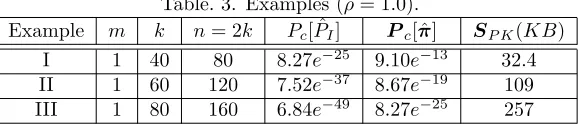
Let us show several examples in Table 3.
Table. 3. Examples (ρ= 1.0).
Example m k n= 2k Pc[ ˆPI] Pc[ ˆπ] SP K(KB)
I 1 40 80 8.27e−25 9.10e−13 32.4 II 1 60 120 7.52e−37 8.67e−19 109
III 1 80 160 6.84e−49 8.27e−25 257
As we see in Table 3, the probabilityP c[ˆπ] is 9.10×10⁻¹³∼= 10−12, which seems not a sufficiently small value. However this value of 10−12would be sufficiently small from the practical point of view, as we shall
see below.
From a very conservative point of view, let us assume that a set of quadratic equations in 80 variables can be solved with Gr¨obner bases attack within only 1 msec. Even from such conservative estimate, it would take 31.7 years, on an average, to solve 1012 sets of simultaneous equations. We conclude that the three
examples listed in Table 3 would be very secure against the Gr¨obner bases attack.
4
Conclusion
• We have presented new classes of public key cryptosystem K(XVI)SE(1)PKC based on the Reed-Solomon code overF2m and K(XVI)SE(2)PKC based on the cyclic code overF2, exactly realizing the
coding rate of ρ = 1.0, which implies that the digital signature scheme can be easily realized with K(XVI)SE(1)PKC and K(XVI)SE(2)PKC.
• We have shown that excluding the exhaustive search attack, any attacker will have to solve the set of simultaneous equations of very high degree although all the public keys in K(XVI)SE(1)PKC are represented by the linear simultaneous equations in the variablesM1, M2,· · ·, Mn.
• We have shown that the Gr¨obner bases attack will find it very hard to attack on K(XVI)SE(1)PKC and K(XVI)SE(2)PKC due to the introduction of K(II)TS when constructing the ciphertextC=CI+CII.
• We have shown that the sufficiently secure K(XVI)SE(1)PKC can be constructed over F28, which are extensively used in the various storage and transmission systems.
This work is partly supported by the NICT’s project:Research and developement for public key cryp-tosystem for secure communication between social systems and is also supported by 21st.Century Informatic Culture Center.
References
[1] M. Kasahara, “A New Class of Public Key Cryptosystems Constructed Based on Reed-Solomon Codes K(XII)SE(1)PKC”, Technical Report of IEICE, ISEC 2013-5 (2013-05).
[2] M. Kasahara and R. Sakai “A Construction of Public Key Cryptosystem for Realizing Ciphertext of size 100 bit and Digital Signature Scheme”, IEICE Trans. Vol. E87-A, 1, pp.102-109 (2004-01).
[3] M. Kasahara and R. Sakai “A Construction of Public Key Cryptosystem Based on Singular Simultaneous Equations”, IEICE Trans. Vol. E88-A, 1, pp.74-79 (2005-01).
[4] N. Koblitz “Algebraic Aspect of Cryptography”, Springer Verlag, Berlin Heidelberg.
[5] T. Mastumoto and H. Imai “Public Quadratic Polynomial-Tuples for Efficient Signature - Verification and Message-Encryption”, Advances in Cryptology, Eurocrypt’88, Springer-Verlag, pp.419-453 (1988).
[6] S.Tsujii, A.Fujioka and Y. Hirayama, “Generalization of the public-key cryptosystem based on the difficulty of solving a system of non-linear equations”, IEICE Trans. Vol.1 J-72-A, 2, pp.390-397, (1989-02).
[7] J. C. Faugere and A. Joux “Algebraic cryptanalysis of hidden field equation (HFE) cryptosystems using Gr¨obner bases”, In Advances in Cryptoglogy-CRYPTO 2003 pp.44-60 (2003).
[8] C. Wolf: “Multivariate Quadratic Polynomials in Public Key Cryptography”, Dr. Thesis, Katholieke Universiteit Leuven, (2005-11).
[9] M. Kasahara “New Classes of Public Key Cryptosystems Constructed Based on Cyclic Codes, K(XV)SE(1)PKC and K(XVI)SE(1)PKC”, Technical Report of IEICE, IT 2015-4 (2015-05).
[10] M. Kasahara “A New Class of Public Key Cryptosystems Constructed Based on Perfect Error-Correcting Codes Realizing Coding Rate of exactly 1.0”, Cryptology ePrint Archive , Report 2010/139 (2010-03).
[11] M. Kasahara “A Construction of New Class of Linear Multivariate Public Key Cryptosystem Con-structed Based on Error Correcting Codes”, Technical Report of IEICE , ISEC 2009-135 (2010-03).
[13] M. Kasahara: “A New Class of Product-sum Type Public Key Cryptosystem, K(V)ΣΠPKC, Con-structed Based on Maximum Length Code”, Cryptology ePrint Archive, Report 2013/180, (2013-03).
[14] M. Kasahara: “A New Class of Public Key Cryptosystems Construted Based on Reed-Solomon Codes, K(II)SE(1)PKC.–Along with a presentation of K(II)SE(1)PKC over the extension field extensively used for present day various storage and transmission systems”, Cryptology ePrint Archive, Report 2013/363, (2013-06).
[15] R. J. McEliece: “A Public-key Cryptosystem Based on Algebraic Coding Theory”, DSN Progress Re-port, no.42-44, pp.114-116 (1978).

![Ethyl 6 amino 5 cyano 4 phenyl 2,4 dihydropyrano[2,3 c]pyrazole 3 carboxylate dimethyl sulfoxide monosolvate](data:image/gif;base64,R0lGODlhAQABAIAAAP///wAAACH5BAEAAAAALAAAAAABAAEAAAICRAEAOw==)