A Monthly Journal of Computer Science and Information Technology
ISSN 2320–088X
IJCSMC, Vol. 2, Issue. 11, November 2013, pg.63 – 69
RESEARCH ARTICLE
© 2013, IJCSMC All Rights Reserved
63
Real time Background Suppression
Technique for Detection of Moving
Objects in Video Surveillance System
K. Swapna
Assistant Professor Department of ECE,
Malla Reddy College of Engineering & Technology, Hyderabad, India
Abstract— Background Suppression is one of the important image processing steps for video surveillance and many computer vision problems such as recognition, classification, activity analysis & tracking. Detection of moving objects in video streams is the first relevant step of information extraction in many computer vision applications. This paper deals with the performance of different techniques of Background suppression. Mainly there are three features has been extracted from each moving objects such as centroid, area, average luminance. The proposed approach compare the Frame difference, Approximate Median and Mixture of Gaussian method and this attempt proves that the chosen method has good performance under dynamic circumstances for real time tracking. Finally the similarity function is applied to tracking.
Keywords: - Background Suppression; Thresholding; Object detection
I. INTRODUCTION
Background Subtraction is commonly used in the fields of video surveillance, optical motion capture and multimedia application where it needs to be the first step to detect the moving objects in the scene. The basic idea is to classify the pixels as background or foreground by thresholding the difference between the background image Bt(x, y, t) and the current image It+1(x, y, t).The detection and segmentation of moving objects in natural video sequences is an important requirement for multimedia indexing and retrieval, but also for adaptation. With the advent of broadly available mobile video players, it has become desirable to adapt video contents to small screens by choosing a suitable compromise between scaling and cropping [1].Video surveillance of human activity usually requires people to be detected. Background Suppression is a powerful mechanism for detecting change in a sequence of images for example, if we have a statistical model of the scene, an intruding object can be detected by spotting the parts of the image that don't fit the model.
Identifying moving objects from a video sequence is a fundamental and critical task in many computer-vision applications. A common approach is to perform Background Suppression, which identifies moving objects from the portion of a video frame that differs significantly from a background model. There are many challenges in developing a good Background Subtraction algorithm. First, it must be robust against changes in illumination. Second, it should avoid detecting non-stationary background objects such as moving leaves, rain, snow, and shadows cast by moving objects. Finally, its internal background model should react quickly to changes in background such as starting and stopping of vehicles.
© 2013, IJCSMC All Rights Reserved
64
Detection. First, the videos are separated as frames and pre-processing methods are used for the colour conversion and to subtract the foreground objects from the background. Background Suppression is used to find the total or sudden change in intensity of the video. Finally the detection is performed by using Different Techniques [2].The main objective of the object tracking is to detect the moving object in a video sequence. Most of the image processing techniques covered here are about Background Subtraction and its related experimental results. The paper is organized as follows: Section 2 deals with the Methodology. Section 3 deals with the Pre- processing for colour conversion, Frame conversion and Background Suppression. Section 4 discuss about the different algorithms. Section 5 gives the need and the future work of the system.
II. METHODOLOGY
In this paper, a reference background is initialized at the start of the system with the first few frames of video and it is updated to adapt the changes during the operational period. At each new frame, foreground pixels are detected by subtracting the intensity values from the background with a dynamic threshold per pixel. The reference background and the threshold values are updated by using the foreground pixel information. The detected foreground pixels usually contain noise due to image acquisition errors, small movements like tree leaves, reflections and foreground objects with textures coloured similar to the background [4]. These isolated pixels are filtered. After this step, the individual pixels are grouped and labelled to create connected moving regions. These regions are further processed to group disconnected blobs and to eliminate relatively small sized regions. After grouping, each detected foreground object is represented with its bounding box, area, centre of mass and colour histogram which will be used in later steps.
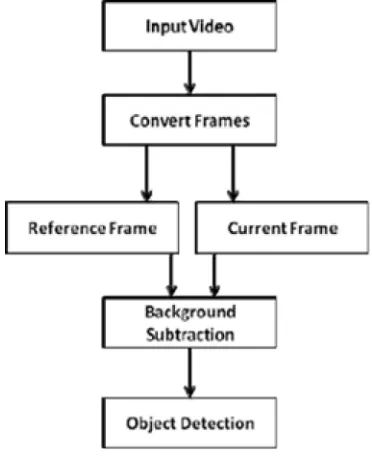
Figure. 1. Flowchart followed
Figure.1. Gives the sequence of steps followed in this project. The first Step is the input video taken for pre-processing. The pre-processing consists of colour and frame conversion, which is represented in the consecutive blocks. After that, the current frame is compared with the reference frame by considering the intensity variation. Then the Background Subtraction technique is implemented, after which the object is detected by using the Techniques like Frame Difference Algorithm, Approximate Median and Mixture of Gaussian method.
The object detection method is used in different applications in which moving object detection is needed
© 2013, IJCSMC All Rights Reserved
65
III. PRE-PROCESSING
This section describes about the steps done to improve the video or image so that it increases the chance for success of other process. It is mainly used to increase the contrast of the image, removal of noise and isolating objects of interest in the image. [7] The processing is in any form of signal processing for which the output is an image or video, the output can be either an image or a set of characteristics or parameters related to image or videos to improve or change some quality of the input [5].
A. Colour conversion
The colour conversion is also one of the pre- processing steps. It is the representation of the colour of an image from one basis to another. The key point is to make the colour converted image as similar to the converted image. A coloured image can be represented by its hue, saturation and value components. A set of routines for converting between RGB and other colour spaces is present. The image processing functions assumes on its own that all colour data are in RGB. It then processes an image that uses a different colour space by first converting it to RGB, and then converting the processed image back to the original colour space. The Colour space conversion block enables to convert colour information from the R'G'B' colour space to the Y'CbCr colour space and vice versa (i.e. from the Y'CbCr colour space to the R'G'B' colour space).
IV.BACKGROUND SUBTRACTION
It is one of the main sections of this paper, here the video which is converted to frames are compared and the foreground moving objects which are different between the frames are separated [8]. There are different methods which are for Background Subtraction. [6] These different techniques have unique strengths and their weaknesses’ in terms of performance and computational requirements. The Background Subtraction techniques are implemented using varying complexity.
1. Low complexity-using Frame difference method.
2. Medium complexity- using Approximate Median Method. 3. High complexity- using Mixture of Gaussian method.
Background Subtraction involves the comparison of the first frame and the second frame which has the moving object in it; this shows the difference in the motion of the object. In [8] a pixel is marked as foreground if
Where T is predefined Threshold The Background Update is
Where α is kept small to prevent artificial tails forming behind moving objects.
The moving objects are identified in the first few frames and are stored as foreground pixels. Then the background is identified as pixels that do not belong in the foreground pixels. This identified background pixels are incomplete which are filled as the foreground object moves. Once the complete background is identified then it is subtracted from the other frames to find the moving objects and the foreground. By thresholding and performing morphological closing on each foreground image, the model produces binary feature images.
V. PROPOSED TECHNIQUES
This section deals with the different Background Suppression techniques. Each method is analysed with the help of the results obtained and from this the most efficient algorithm is identified.
A. Frame Difference Algorithm
© 2013, IJCSMC All Rights Reserved
66
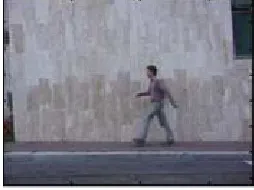
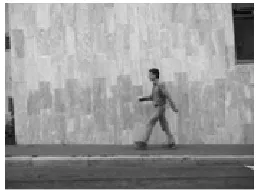
F is the frame, i is the frame number, and T is the threshold value. This allows for the consideration of slow movement updates as the scene changes. The method takes into the account the scene transforming and moving over time, this method has a better idea of what is going on in the scene, therefore being able to suppress the background motion. This is the only algorithm to correctly identify the motion of the complex background, but has problems with identifying the foreground objects correctly. This algorithm is the second fastest algorithm. It is the only algorithm which is capable of removing a complex background in which the each frame is updated and movement or motion in the frame is checked. This allows the algorithm to ignore the background motion and to identify foreground elements. The algorithm was implemented, and the frame difference as shown in Figure 1-(a), (b). (c).
Figure1.a) The original image
Figure 1.b) RGB to GRAY converted Image
Figure 1. c) Frame Difference Image
B. Approximate Median algorithm
The Approximate Median algorithm takes the median value of a set number of previous frames to construct a back plate model, and compares the pixels in the same way as the Frame Difference algorithm. As shown in Figure.2- (a), (b), (c).
© 2013, IJCSMC All Rights Reserved
67
Figure 2.a) The original image
Figure 2.b) RGB to GRAY converted Image
Figure 2. c) Background Subtracted image
C. Mixture of Gaussian
It is basically performed by using Gaussian distribution which has the most supportive function and the least variance. This model is often used for clustering of data. Clusters are assigned by selecting the component that maximizes the posterior probability. Each pixel is modelled separately by a mixture of K Gaussians,
Where K = 4 in [5] and K = 3 …. 5 in [1]. In others it is assumed that i, t = 2 i, t I. This algorithm converts each pixel into a Gaussian model and calculates the probably of the image based on the sum of the models. Figure.3-(a) Gives the original
image and Figure-3(c) Gives the background subtracted image using Mixture of Gaussian Method.
© 2013, IJCSMC All Rights Reserved
68
Figure 3.b) RGB to GRAY converted Image
Figure 3.c) Output image
VI.CONCLUSION
In this Paper, a real-time background suppression techniques which can detect moving object on a background system was implemented using MATLAB Version 7.Here the Discussion and comparison of Background Model using Frame difference, Approximate medium, and Mixture of Gaussian was obtained. It involves about subtracting a foreground and background frame , and then next algorithm takes the median value of a set number of previous frames to construct a back plate model, and Finally modeling each pixel as a separate mixture model. From this it concludes The system can successfully resolve blob extraction in Mixture of Gaussian which was shown in Figure(4).
Figure.4 Shows the performance of Background subtraction techniques compared with the noise and accuracy .Deal with the challenges of object extraction in dynamic environment, the results on several techniques show that this algorithm is efficient and robust for the dynamic environment with new objects in it.
Figure. 4 Performance of Background Subtraction methods
This system has been successfully used to track people in indoor environments, people and cars, animals in outdoor environments; this system achieves our goals of real-time performance over boundless experience of time lacking human intrusion. Future work is to resolve the cases when an object is totally occluded and an object is grouped with others.
REFERENCES
[1] F. De la Torre, E. Martinez, M. E. Santamaria and .A. Moran, “Moving Object Detection and Tracking System: a Real-time Implementation”, Proceedings of the Symposium on Signal and Image Processing GRETSI 97Grenoble, 1997.
© 2013, IJCSMC All Rights Reserved
69
[3] L. Li, W. Huang, I. Y. H. Gu, and Q. Tian.”Foreground object detection from videos containing complexbackground”. In MULTIMEDIA ’03: Proceedings of the eleventh ACM international conference on Multimedia, pages 2–10, New York, NY, USA, 2003. ACM.
[4] Zhou, Q.; Aggarwal, J. K.; “Tracking and classifying moving objects from video”, Proc of 2nd IEEE Intl Workshop on Performance Evaluation of Tracking and Surveillance (PETS’2001), Kauai, Hawaii, USA (December 2001).
[5] C. Stauffer and W. E. L. Grimson, “Adaptive background mixture models for real-time tracking,” in Proc. IEEE Conf. Computer Vision and Pattern Recognition, 1999, pp.246–252.
[6] R. T. Collins, A. J. Lipton, T. Kanade, H. Fujiyoshi, D.Duggins, Y. Tsin, D. Tolliver, N. Enomoto, O. Hasegawa, P.Burt, and L. Wixson, “A system for video surveillance and monitoring,” Tech.Rep. CMU-RI-TR-00-12, The Robotics Inst., Carnegie Mellon Univ.,
[7] L. Maddalena and A. Petrosino, “A self-organizing approach to detection of moving patterns for real-time applications,” in Proc. 2nd Int. Symp. Brain, Vision, and Artificial Intelligence, 2007, pp. 181– 190, Lecture Notes Comput. Sci. 4729.
[8] M. Piccardi, “Background subtraction techniques: a review,” in Proc. IEEE Int. Conf. Systems, Man, Cybernetics, 2004, pp. 3099–3104.