Available Online at www.ijcsmc.com
International Journal of Computer Science and Mobile Computing
A Monthly Journal of Computer Science and Information Technology
ISSN 2320–088X
IMPACT FACTOR: 6.199
IJCSMC, Vol. 8, Issue. 5, May 2019, pg.01 – 07
Analysis of Iris Detection
Technique in Image Processing
Mr. Ankur Sharma; Mr. Anurag Rana; Gagandeep Kaur
Department of Computer Science and Engineering, Arni University, Kathgarh, (Indora)-176401 Kangra Himachal Pradesh * [email protected]
Abstract: The image processing is the technique which can process information which is stored in the form of pixels. The Iris detection is the application of image processing. The Hough transformation is the technique which locates the circle in the iris. The iris detection has the various steps which are pre-processing, feature extraction and segmentation. In this paper, various techniques of iris detection are reviewed and analyzed in terms of certain parameters.
Keywords: Iris, Segmentation, feature extraction
Introduction
hypothesis. As Bayesian classifiers are statistical in nature, they can predict the probability of a given sample having a place with a particular class. A Support Vector Machine (SVM) performs classification by building a N-dimensional hyperplane that optimally separates the data into two categories. A support vector machine (SVM) is utilized as a part of computer science for a set of related supervised learning methods that dissect input data and learns from it and afterward utilize it for performing classification and regression analysis
Literature Review
Yang Hu, et.al, (2016) presented the iris code calculation from the point of view of optimization [11]. The traditional iris code is the solution of an optimization problem which minimizes the distance between the feature values and iris codes. It was investigated using two additional objective terms. The main objective term exploits the spatial relationships of the bits in different positions of an iris code. The second objective term mitigates the influence of less reliable bits in iris codes. The two objective terms can be applied to the optimization problem individually, or in a combined scheme. We lead experiments on four benchmark datasets with fluctuating image quality. The experimental results demonstrate that the iris code produced by solving the optimization problem with the two additional objective terms achieves a generally improved performance in comparison to the traditional iris code calculated by binarizing feature values based on their signs.
Peter Chondro, et.al, (2016) aimed to introduce an algorithm that particularly enhances maxillary sinuses utilizing a novel contrast enhancement technique based on the adaptive morphological texture analysis for occipitomental see radiographs [12]. As indicated by the experimental results, the proposed method can increase the diagnosis accuracy by 83.45% compared with the figured tomography methodology as the gold standard. The proposed ToMA was thoroughly tested and compared with two other representative enhancement schemes. The results revealed the proposed ToMA can improve the contrast of SXR better than prior methods while having the lowest computational complexity. To some extent, ToMA can be implemented in a parallel programming scheme to increase the software efficiency with conceivable application on the generally utilized picture archiving and communication system (PACS).
Iliana V. Voynichka, et.al, (2016) proceeded with our investigation into how certain factors influence facial recognition by investigating what are the most statistically significant pixel-features in an image that differentiate a given individual face from whatever is left of the individual faces in a given data set [13]. Specifically, we propose an algorithm to infer a mask of the pixels with the highest statistical significance levels to identify a given face based on this mask. Our investigation demonstrates that making a mask utilizing the two-sample t-test, chooses the pixels that are most representative of a given individual face physiognomy when compared to face images of whatever is left of the individuals in a given database.
Estefan Ortiz, et.al, (2015) examined a strategy to improve accuracy through a dilation-aware enrolment step that chooses one or more enrolment images based on the watched distribution of dilation ratios for that eye [14]. Additionally, they demonstrate that an image with median dilation is the optimal single eye image dilation-aware enrolment decision. The results in the multiple image enrolment likewise demonstrate that utilizing this strategy has measurable performance increases over the baseline random enrolment. The results of those subjects whose pupil dilation variance corresponded to the upper 75th percentile were studied. It was found that there still remained an improvement over the random selection strategy.
and cons. This paper will be helpful to every one of the researchers who need to apply one of the clustering methods to their research model. To the extent the various examined techniques are concerned, we understand to a confined level that each of the method have its own pros and cons.
Zhen Lei, et.al, (2015) expanded the original "shallow" face descriptors to "deep" discriminant face features by introducing a stacked image descriptor (SID) [16]. With deep structure, more complex facial information can be extracted and the discriminant and compactness of feature representation can be improved. The SID is learned in a forward optimization way, which is computational efficient compared to deep learning. Broad experiments on various face databases are conducted to demonstrate that SID can achieve high face recognition performance with compact face representation, compared with other cutting edge descriptors. Compared to deep learning, the time complexity of SID is lower when applied to large scale training data. The SID is a good decision to learn discriminative representation from large scale data, particularly when GPU device is not available.
Ryan Rakvic, et.al, (2015) studied the energy efficiency of a GPU with an application to iris recognition [17]. Utilizing GPU based code written as a part of the C++ compatible CUDA dialect, energy consumption tests are performed on basic image processing techniques including image inversion, thresholding, dilation, erosion and memory/computationally intensive calculations, for example, the template matching. We demonstrate that portions of these algorithms implemented on the GPU reduce energy consumption by as much as 272 times.
Vibhav Prakash Singh, et.al, (2015) designed an efficient content based image retrieval system is developed for normal and abnormal classes of mammograms [18]. The pre-processing steps incorporate are artifact suppression utilizing CCL and Morphological operation, automatic pectoral muscle removal, and image enhancement utilizing CLAHE. After pre-processing, the images were segmented utilizing modified region growing algorithm, and utilizing this segmented image. At long last, images are retrieved utilizing Euclidean distance similarity measure. Experiments on benchmark database confirm that the proposed segmentation and retrieval framework performs, encouraging than Fuzzy c mean, Ostu, and Region Growing based segmentation and retrieval approaches.
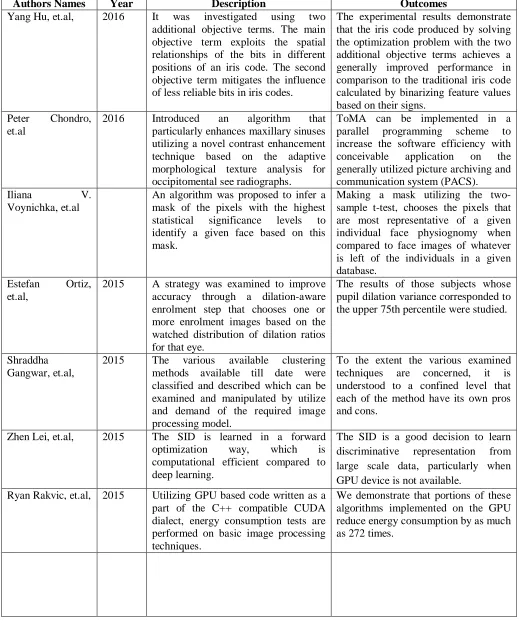
Table of Comparison
Authors Names Year Description Outcomes
Yang Hu, et.al, 2016 It was investigated using two
additional objective terms. The main objective term exploits the spatial relationships of the bits in different positions of an iris code. The second objective term mitigates the influence of less reliable bits in iris codes.
The experimental results demonstrate that the iris code produced by solving the optimization problem with the two additional objective terms achieves a generally improved performance in comparison to the traditional iris code calculated by binarizing feature values based on their signs.
Peter Chondro,
et.al
2016 Introduced an algorithm that
particularly enhances maxillary sinuses utilizing a novel contrast enhancement technique based on the adaptive morphological texture analysis for occipitomental see radiographs.
ToMA can be implemented in a
parallel programming scheme to
increase the software efficiency with
conceivable application on the
generally utilized picture archiving and communication system (PACS).
Iliana V.
Voynichka, et.al
An algorithm was proposed to infer a mask of the pixels with the highest statistical significance levels to identify a given face based on this mask.
Making a mask utilizing the two-sample t-test, chooses the pixels that are most representative of a given individual face physiognomy when compared to face images of whatever is left of the individuals in a given database.
Estefan Ortiz,
et.al,
2015 A strategy was examined to improve accuracy through a dilation-aware enrolment step that chooses one or more enrolment images based on the watched distribution of dilation ratios for that eye.
The results of those subjects whose pupil dilation variance corresponded to the upper 75th percentile were studied.
Shraddha Gangwar, et.al,
2015 The various available clustering
methods available till date were classified and described which can be examined and manipulated by utilize and demand of the required image processing model.
To the extent the various examined techniques are concerned, it is understood to a confined level that each of the method have its own pros and cons.
Zhen Lei, et.al, 2015 The SID is learned in a forward
optimization way, which is
computational efficient compared to deep learning.
The SID is a good decision to learn discriminative representation from large scale data, particularly when GPU device is not available.
Ryan Rakvic, et.al, 2015 Utilizing GPU based code written as a part of the C++ compatible CUDA dialect, energy consumption tests are performed on basic image processing techniques.
Vibhav Prakash Singh, et.al,
2015 An efficient content based image
retrieval system is developed for normal and abnormal classes of mammograms.
Experiments on benchmark database
confirm that the proposed
segmentation and retrieval framework performs, encouraging than Fuzzy c mean, Ostu, and Region Growing based segmentation and retrieval approaches.
Juan E. Tapia, et.al,
2015 This paper is the first to predict gender specifically from similar binary iris code that could be utilized for recognition.
Utilizing this approach, with a person-disjoint training and testing evaluation, one could achieve 89% correct gender prediction utilizing the fusion of the best features of iris code from the left and the right eyes.
Conclusion
In this work, it is concluded that iris detection is the most efficient application of image processing. The iris detection process can be implemented with the technique of circular detection techniques. In this paper, various techniques are detected and reviewed and analyzed. The most efficient technique is circular Hough transformation.
References
[1] Moisés Espínola, José A. Piedra-Fernández, Rosa Ayala, Luis Iribarne, and James Z. Wang,” Contextual and Hierarchical Classification of Satellite Images Based on Cellular Automata”, 2015 IEEE TRANSACTIONS ON GEOSCIENCE AND REMOTE SENSING, Vol. 53, No. 2
[2] Nikhil Rasiwasia, and Nuno Vasconcelos,” Latent Dirichlet Allocation Models for Image Classification”, 2013 IEEE TRANSACTIONS ON PATTERN ANALYSIS AND MACHINE INTELLIGENCE, Vol. 35, No. 11
[3] R.Yogamangalam, B.Karthikeyan,” Segmentation Techniques Comparison in Image Processing”, 2013 IJET
[4] Hector Vargas, Esperanza Medina, Daniel Martinez, Edson Olmedo, and Gerson Beristain,” Hybrid Algorithm to Human-Face Detection, Recognition and Unrestricted Tracking”, 2013, Image Processing & Communications Challenges 4, AISC 184, pp. 83–93
[5] John J. Weng, Daniel L. Swets,” FACE RECOGNITION”, 2007, Springer, 234-36-33, volume 6, issue 54, pp334
[6] Ana-Maria Sevcenco, Wu-Sheng Lu,” Perfect histogram matching PCA for face recognition”, 2010, Springer Science+Business Media, 11045-009-0099-y
[8] K. A. Gankin, A. N. Gneushev, and I. A. Matveev,” Iris Image Segmentation Based on Approximate Methods with Subsequent Refinements”, 2014, Journal of Computer and Systems Sciences International, 2014, Vol. 53, No. 2, pp. 224–238
[9] PENG Zhiyong, WANG Hongchen, WU Jun, LI Jun,” An Improved Daugman Method for Iris Recognition”, 2015, Wuhan University Journal of Natural Sciences Vol.20 No.3
[10] Kang Ryoung Park, Hyun-Ae Park, Byung Jun Kang, Eui Chul Lee, and Dae Sik Jeong,” A Study on Iris Localization and Recognition on Mobile Phones”, 2008, EURASIP Journal on Advances in Signal Processing, 281943
[11] Yang Hu, Konstantinos Sirlantzis, and Gareth Howells,” Optimal Generation of Iris Codes for Iris Recognition”, 2016, IEEE, 1556-6013
[12] Peter Chondro, Hao-Chun Hu, Hsuan-Yen Hung, Shin-Yuan Chang, Lieber Po-Hung Li, and Shanq-Jang Ruan,” An Effective Occipitomental View Enhancement Based on Adaptive Morphological Texture Analysis”, 2016, IEEE, 2168-2194
[13] Iliana V. Voynichka, and Dalila B. Megherbi,” Analysis of the Effect of Selecting Statistically Significant Registered Image Pixels on Individual Face Physiognomy Recognition Accuracy”, 2016, IEEE, 978-1-5090-0770
[14] Estefan Ortiz, Kevin W. Bowyer, Patrick J. Flynn,” Dilation-aware enrolment for iris recognition”, 2015, The Institution of Engineering and Technology, IET Biom., pp. 1–8
[15] Shraddha Gangwar, Dr.R.P.Chauhan,” Survey of Clustering Techniques Enhancing Image Segmentation Process”, 2015, IEEE, 978-1-4799-1734
[16] Zhen Lei, Dong Yi and Stan Z. Li,” Learning Stacked Image Descriptor for Face Recognition”, 2015, IEEE, 1051-8215
[17] Ryan Rakvic, Randy Broussard, and Hau Ngo,” Energy Efficient Iris Recognition with Graphics Processing Units”, 2015, IEEE, 2571747
[18] Vibhav Prakash Singh, Ashim Gupta, Shubham Singh, Rajeev Srivastav,” An Efficient Content Based Image Retrieval for Normal and Abnormal Mammograms”, 2015, IEEE UP Section Conference on Electrical Computer and Electronics (UPCON), 978-1-4673-8507