Pair-wise Cryptographic Models for Secure Data Exchange
in P2P Database Management Systems
Sk. Md. Mizanur
Rahman
SITE, uOttawa, Ottawa, ON, K1N6N5 Canada[email protected]
Mehedi Masud
SITE, uOttawa, Ottawa, ON, K1N6N5 Canada[email protected]
Carlisle Adams
SITE, uOttawa, Ottawa, ON, K1N6N5 Canada[email protected]
Khalil El-Khatib
FBIT, UOITOshawa, ON, L1H7K4 Canada
[email protected]
Hussein Mouftah
SITE, uOttawa,Ottawa, ON, K1N 6N5 Canada
[email protected]
Eiji Okamoto
SIE, University of Tsukuba,Tsukuba, 305-8573 Japan
[email protected]
ABSTRACT
A peer-to-peer database management system(P2PDBMS) is a collection of autonomous data sources, called peers. In this system each peer augments a conventional database man-agement system with an inter-operability layer (i.e. map-pings/policies) for sharing data and services. Peers exchange data in a pair-wise fashion on-the-fly in response to a query without any centralized control. Generally, the communi-cation link between two peers is insecure and peers create a temporary session while exchanging data. When peers exchange highly confidential data between them over an in-secure communication network, such as the Internet, the data might be trapped and disclosed by the intruders. In a P2PDBMS there is no centralized control for data exchange, hence we cannot assume any central third party security in-frastructure (e.g. PKI) to protect confidential data. So far, there is currently no available/existing security protocol for secured data exchange in P2PDBMS. In this paper we pro-pose three models for secure data exchange in P2PDBMSs and the corresponding security protocols. The proposed pro-tocol allows the peers to compute their secret session keys dynamically during data exchange based on the policies be-tween them. Our proposed protocol is robust against the man-in-the middle attack, the masquerade attack, and the reply attack.
Keywords
P2PDBMS Security Model, Secure Data Exchange, Pairing-based cryptography, Authentication
1.
INTRODUCTION
A peer-to-peer database management systems(P2PDBMS) is a collection of autonomous data sources, called peers, where each peer augments a conventional database
manage-ment system with an inter-operability layer (i.e. mappings) for sharing data and services. The local databases on peers are calledpeer databases. In a P2PDBMS, each peer chooses its own database schema and maintains data independently. Although peer databases are created independently, data in one peer may semantically relate with data in another peer. Therefore, each peer specifies pair-wise mappings with other peers to share and exchange related data.
Contrary to the traditional data integration systems where a global mediated schema is required for data exchange, in P2PDBMS, semantic relationships exist between peers, or among a small set of peers, for exchanging data. The data are accessed globally by any peer by traversing the network of peers. In the last few years, significant progress has been made in research on various issues related to P2PDBMSs, such as peer data exchange settings [1], data integration models [3], mediation methods [4], coordination mecha-nisms [5, 6], and mappings [7] among the peer databases.
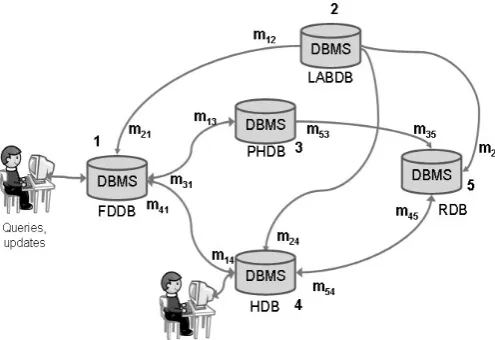
Figure 1: An example model of a peer to peer database management system
for each pair of peers. When data are exchanged through an unsecured link between acquainted peers, data are no longer secured despite the assumption that each source pro-tects its own data from malicious tampering and accessing by external intruders.
The following example illustrates the needs to use a pairing-based dynamic security policy for exchanging confidential data between peers. This scenario relates to a ’health infor-mation network’, where different parties (e.g. family physi-cians; walk-in clinics; hospitals; medical laboratories; phar-macists, and other stakeholders) are willing to share data about patients’ treatments, medications, and test results over an insecure network such as the internet.
Example 1. Consider the scenario of a P2PDBMS in Figure 1. The figure illustrates a collaborative ’health in-formation network’. In the system, family doctors (FDDB), hospitals (HDB), medical laboratories (LABDB), pharma-cists (PHDB), and other stakeholders (e.g. medical research cells (RDB)) are willing to exchange or coordinate infor-mation about patients’ treatments, medications, test results, and diseases. In the system, data in a database of a peer may need to be exchanged with other related peers accord-ing to established policies between them. For example, fam-ily doctors may want to keep track of patients’ medications for some specific diseases. Therefore, family doctors should have a link with the pharmacist database (PHDB) and any patient in PHDB diagnosed with a disease that is of inter-est to family doctors may need to be exchanged with FDDB. Moreover, family doctors may be interested in collecting test results of their patients from laboratories and the medica-tions that their patients take while staying at hospitals. The links from HDB and PHDB to RDB show that research cell database (RDB) is interested in information about certain diseases for research purposes. The links between peers in the figure are formally a set of mappings or mapping con-straints. For example, m12 represents mappings from peer
P1 toP2.
Note that the acquaintances between peers are established
with predefined policies and trust relationships without hav-ing a centralized security policy. The existhav-ing conventional public key Infrastructure (PKI) is not suitable to apply in P2PDBMS since a centralized-trusted control system is needed for the PKI. Recent progress of Elliptic Curve Cryp-tography (ECC) shows that it is feasible to implement ECC. Studies have shown that ECC consumes considerably less resources than conventional public key cryptography (PKC) for a given security level [10, 11, 12].
However, in order to effectively use ECC, it is necessary to authenticate the public keys; otherwise, the network will be vulnerable to man-in-the-middle attacks. Public key au-thentication requires a Public Key Infrastructure to issue and revoke certificates and it requires users to store, ex-change, and verify these certificates [13].
Identity-Based Cryptography (IBC) [14] is a type of public-key cryptography where a single piece of information that uniquely identifies a user (e.g. IP or email address) can be used both to exchange keys and to encrypt data. The no-tion of IBC presented in [14], has only become truly practical with the advent of Pairing-Based Cryptography (PBC) [16, 15]. In most circumstances the points on an elliptic curve form a simple cyclic group. Therefore, it is suitable to im-plement pairing-based cryptography on such elliptic curves.
In order to achieve secured data exchange in a P2PDBMS dynamic network, this paper presents a protocol based on Identity Based Encryption (IBE) and pairing-based cryptog-raphy. Using pairing-based and IBE properties, each peer in the network generates a dynamic secret session key based on the attributes mentioned in the query and the predefined data exchange policy. In this protocol, peers authenticate each other in a pair-wise fashion without a centralized au-thentication policy.
In brief, our protocol has the following properties:
(1) flexible message-oriented secure data exchange between peers (2) exchange of data between peers without any third party certificates (3) communication between peers could be as simple as a single TCP connection (4) both parties (i.e. source and target) authenticate each other during data exchange.
Organization of the paper: The next section introduces the primitives of cryptography that is necessary to describe our proposed protocol. Section 3 describes how the secure data exchange policy/mapping is established between two peers and the threats that can occur when peers exchange their data in an unsecured channel. In Section 4, the pa-per presents our cryptography solution and describes the proposed protocol for exchanging data between peers. In section 5 we discuss issues of cryptographic implementation and prevention of different attacks in our secure data ex-change protocol. Section 6 describes related work, and fi-nally Section 7 concludes and points out avenues for further research.
2.
CRYPTOGRAPHIC PRIMITIVES
un-derstand our proposed protocol.
2.1
Elliptic curves
Elliptic curves are considered interesting primarily as an al-ternative group structure. In regard to implementation of common cryptographic protocols, certain advantages come with the elliptic curve families,E(Fq) :y2 =x3+Ax+B [20]. The main advantage is that much smaller keys can be used, as there is no known polynomial-time algorithm for the discrete logarithm (DL) problem for the great majority of such curves. Given a pointP on a curveE defined over a finite fieldFq, whereq =pm, andpis a large prime, the problem is to determine “a” for given “aP”. In most cir-cumstances the points on such a curve form a simple cyclic group.
At the foundation of many cryptosystems is a hard mathe-matical problem that is computationally infeasible to solve. The DL problem is the basis for the security of many cryp-tosystems, including the elliptic curve cryptosystem. More specifically, the ECC relies upon the difficulty of the elliptic curve discrete logarithm problem (ECDLP) [21].
2.2
Bilinear maps
Let G1 be an additive group and G2 be a multiplicative
group of the same prime order q. Let P be an arbitrary generator ofG1. Note thataP denotesP added to itselfa
times. Assume that the discrete logarithm (DL) problem is hard in bothG1andG2. We can think ofG1 as a group of
points on an elliptic curve overFq, andG2 as a subgroup of
the multiplicative group of a finite fieldFqkfor somek∈Zq∗, whereZq∗={ξ|1≤ξ≤q−1}. A mappinge:G1×G1→G2,
satisfying the following properties, is called a cryptographic bilinear map.
• Bilinearity: e(aP, bQ) = e(P, Q)ab for all P, Q ∈ G1
and a, b ∈ Zq∗. This can be restated in the following way. ForP, Q, R∈G1, e(P+Q, R) =e(P, R)e(Q, R)
ande(P, Q+R) =e(P, Q)e(P, R).
• Non-degeneracy: IfPis a generator ofG1, thene(P, P)
is a generator ofG2. In other words,e(P, P)6= 1.
• Computable: A mapping is efficiently computable if e(P, Q) can be computed in polynomial-time for all P, Q∈G1.
Modified Weil Pairing [15] and Tate Pairing [16] are exam-ples of cryptographic bilinear maps.
2.3
Diffie-Hellman problems
In this section, we recall the properties of Diffie-Hellman [17] gap families. Before defining the Diffie Hellman gap families, we assume the following:
• P is a point on an elliptic curve E given by Y2 = X3+αX+βmodT whereTis a prime number.
• < P >is a subgroup ofEgenerated byP.
• |< P >|=q.
• a, b∈Z∗q
The groupG1 represents the group of points on the elliptic
curve E. Using the group G1, we can define the
follow-ing hard cryptographic problems applicable to our proposed protocol.
• Computational Diffie-Hellman (CDH) Problem: Given a triple (P, aP, bP)∈G1fora, b∈Zq∗, find the element abP ∈E.
• Decision Diffie-Hellman (DDH) problem: Given a quadruple (P, aP, bP, cP)∈G1 fora, b, c∈Zq∗, decide whetherc=abmodqor not.
• Gap Diffie-Hellman (GDH) Problem: A class of lems where the CDH problem is hard but DDH prob-lem is easy.
• Bilinear Diffie-Hellman (BDH) Problem: Given a quadruple (P, aP, bP, cP) ∈G1 for some a, b, c∈Zq∗, computee(P, P)abc.
Groups where the CDH problem is hard but DDH prob-lem is easy are called GAP Diffie-Hellman (GDH) groups. Details aboutGDH groups can be found in [15, 17].
3.
SECURE DATA EXCHANGE SETTINGS
In this section first we introduce the concept of data ex-change settings in a P2PDBMS. We then discuss different security threats that may occur while two peers exchange data through an insecure channel.
Attributes are symbols taken from a given finite set U = {A1,· · ·, Aq}called the universe. Each attributeAjis asso-ciated with a finite set of values called thedomainofAjand is denoted bydom(Aj). SupposeX ={A1, A2,· · ·, Ak} ⊆ U, with the elements Ai(1 ≤ i ≤ k) taken in the order shown, thendom(X)⊆dom(A1)×dom(A2)×· · ·×dom(Ak). A non-empty subset ofU is called arelation schema R. A
database schema is a finite collectionR= (R1,· · ·, Rm) of relation schemas.
The authors in [1] introduced a setting of data exchange between peers. In a data exchange setting, one peer is a source peer (data provider), an “authoritative” or “trusted” peer that can contribute new data, while the other peer, called the target peer (data receiver) accepts data from the source. The ultimate goal of a data exchange setting is to exchange data from a source to a target according to the mappings between the source and the target. Let S be a schema at a peerPiandT be a schema at another peerPj. If mappings are specified from S to T, then S is called a source schema andT is called a target schema. Generally, in data exchange settings mappings are constituted by a set of assertions of the forms
Σst=qS→qT
an assertionqS→qT specifies that the concept represented by the formula qS over the source schema corresponds to the concept in the target schema represented by the formula qT. The assertions are basically tuple-generating dependen-cies [2]. An example of assertions can be specified as logical expressions of the form:
∀x[∃wφ(x,w)→ ∃zψ(x,z)]
where the left hand side (LHS) of the implication, φ, is a conjunction of relation atoms over the schema ofSand the right hand side (RHS) of the implication,ψ, is a conjunc-tion of relaconjunc-tion atoms over the schema T. The mapping expresses a constraint about the appearance of a tuple in the instance satisfying the constraint of the RHS, given a particular combination of tuples satisfying the constraint of the LHS.
Basically, mappings perform structural relationship of data between source and target as well as data to be exchanged from source to target. Through the mappings, a source also exports part of its schema accessible to the target. The following is a simple example of a data exchange setting.
Example 2. Consider a family physician database (FDB) with the schema S consisting of two relations
R1(OHIP, Name, Address, Illness, DOB) and R2(OHIP, TestName, Result, Date). Also consider a database in a re-search cell database (RDB) with the schemaT consisting of a relationR3(OHIP, Name, Illness, DOB, TestName, Re-sult). Assume that a mapping is established betweenS and
T as follows:
∀ohip,name,illness,dob,testname,result∃name,addressR1(ohip,
-name, address, illness, dob), R2(ohip, testname,
-result, date)→R3(ohip, illness, dob, testname, result)
The mapping expresses that patient data (ohip, name, illness, dob, testname, result) are exchanged
from FDB to RDB by a query request q from
RDB. It also shows that FDB shares the attributes
{Ohip, Illness, DOB, T estN ame, Result} with RDB. Al-though, the attributes are shared for RDB they also contain some confidential attributes e.g. {Ohip, DOB}. Hence, during data exchange the data of the confidential attributes should not be exposed to others by any means. We can say that these attributes are more confidential compared to the attributes {T estN ame, Result}, since the values of these attributes do not have any meaning unless one knows corresponding ohip and date of birth. Note that only the source knows which attributes are confidential attributes among the shared attributes. The administrator of the source is responsible to distinguish shared and confidential attributes. Note that in this paper we only consider the schema-level mappings between a source and a target. We assume that when the mappings are created only the source and the corresponding target know the structural relationship between their schemas (i.e., correspondences between the attributes and relations). The structural relationship is not known to other peers.
We now formally define shared attributes, confidential at-tributes, Non-confidential atat-tributes, and private attributes.
Definition 1 (Shared attributes). Consider two peers Pi and Pj in a P2PDBMS. LetS be a schema with
a set of attributes Us in Pi and T be a schema with a set
of attributes Ut in Pj. Assume a mapping Σst=qS →qT
betweenPi andPj. Let att(Σst)denote the set of attributes
exposed by Pi using the mappingΣst. Therefore, the shared
attributes, denoted bySA, isSA⊆Us=att(Σst).
Definition 2 (Confidential attributes).
Consider the mapping Σst = qS → qT between two
peers Pi and Pj. Let SA be the set of shared attributes.
Therefore, the confidential attributes, denoted by CA, are
CA⊆SA.
Definition 3 (Non-confidential attributes).
Consider the mappingΣst=qS→qT between two peersPi
andPj. LetSAbe the set of shared attributes andCAbe the
set of confidential attributes. Hence, the non-confidential attributes, denoted byN CA, areSA−CA.
Definition 4 (Private attributes). Considering
the mapping Σst = qS → qT between two peers Pi and Pj, where SA is the set of shared attributes, the private
attributes, denoted byP A, isUs−SA.
Example 3. Consider the example 2. Based on the mappings, we see that the shared attributes are
{Ohip, Illness, DOB, T estN ame, Result}, the confidential attributes are {Ohip, DOB}, and the non-confidential at-tributes are{Illness, T estN ame, Result}. Note that admin-istrators of the peers define the attributes that are confiden-tial implicitly during the creation of mappings.
We now describe a scenario to justify the need of a proto-col that secures confidential information of shared attributes during exchange of data in an unsecured channel.
Assume that a user at RDB submits the following queryq.
SELECT ohip, name, dob, illness, result FROM R3
WHERE testname=“whitebloodcount”
Since RDB is connected with FDB, the query is forwarded to RDB after transformation [9, 8] with respect to the schema of FDB. Suppose the transformed query for FDB is as follows:
SELECT ohip, name, dob, illness, result FROMR1,R2
WHERE (R1.ohip=R2.ohip) and
(test-name=“whitebloodcount”)
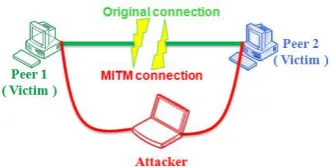
Figure 2: Illustration of man-in-the-middle attack in P2PDBMS.
threats that can occur during data exchange from a source to a target.
In the next subsection we discuss these threats.
3.1
Security threats for data exchange in
P2PDBMSs
Man-in-the middle attack (MITM):In MITM, intrud-ers can make independent connections with the source and the target and relay messages between them, making them believe that they are exchanging data directly with each other over a private connection (e.g TCP connection). In fact, the entire data exchange session is controlled by the intruders. Once the TCP connection is intercepted, the in-truder acts as a proxy. Thus the inin-truder becomes another node on the communication channel and is able to read, in-sert, and modify the data in the intercepted communication. The scenario is shown in Figure 2.
Masquerade attack: In this attack, a malicious peer may pretend to be a valid target of a source by stealing the iden-tity of the real target. Thus, a malicious peer may gain access to the data of the source. The easiest point of entry for a masquerade peer is provided by a weak authentica-tion between the source and the target. Once the malicious node passes the authentication process, it may be autho-rized by the source as a target to access its data. Similarly, a malicious node may falsely act as a source for a target. Therefore, a malicious node may be able to tamper with both exchanged data and the mappings.
Replay attack: A replay attack is an active network attack in which a valid data transmission is maliciously or fraud-ulently repeated or delayed. Suppose Alice is a target who wants to authenticate her identity to a source, Bob. For valid identification of Alice, Bob requests her password as a proof of identity, which Alice provides to Bob (possibly af-ter some transformation using a hash function). Meanwhile, an intruder, Eve, is eavesdropping on the conversation and is recording the password. After the verification phase is over, Eve connects to Bob as Alice. Now, if Bob asks Alice for proof of identity, Eve sends Alice’s password that was recorded in the verification phase.
3.2
Our contribution
In a P2PDBMS, a peer may act as a source and/or a target. For secure data exchange, source and target peers are responsible for generating the secret session key for a specific data exchange session. For exchanging data from a source peerPi to a target peer Pj,source-to-target data
exchange mappings are constituted. Thus if the target Pj requests data from the sourcePiby a query then the source provides data to the target depending on the query request. In order to provide data for the query request on-the-fly a security mechanism is needed between the source Pi and the target Pj. Since there is no pre-existing security mechanism between peers, there may be an attack on the data exchange session (see Section 3.1). Based on different trust relationships between a source and a target we define three secured data exchange models. The models are as follows:
Model 1: In this model the source and the target fully trust each other and the target peer explicitly knows which are the confidential and non-confidential attributes that are defined by the source through the mapping. This model is applicable if the source and the target mutually agree about which attributes are used to generate the session key for a query request. Hence when the target requests data through a query the source can identify which attributes are used to compute the session key for data exchange.
Model 2: In this model the source and the target fully trust each other but the target peer is not aware of the confidential and non-confidential attributes defined by the source. This model is particularly designed to make the source, the only authoritative peer to initiate the process for generating the session key in response to the query received from the target. Hence, when a source receives a query from a target the source alone dynamically selects the confidential and non-confidential attributes for generating the session key. However, the target is later informed about the attributes that are used to generate the session key by the source through some exchange of messages. In Section 4.3, we describe the process how the target is informed the confidential and non-confidential attributes that are used to generate the session key.
Model 3: In this model the source and the target may not fully trust each other and a target is unaware of the confidential and non-confidential attributes. This model is explicitly designed to prevent a situation when there could be some sort of social engineering of the exchanged data from the target as well as from the source. In order to prevent social engineering, a source has to consider some private parameters from the target and the target has to consider some private parameters from the source during exchange of data. Theses parameters are generated dynamically without any previous agrement. Hence, if the source or the target performs a social engineering attack during data exchange it is identified. The query result is enciphered by the source in such a way that only the valid target can decipher the query result. The target deciphers the query result by using some defined operations with its private parameters.
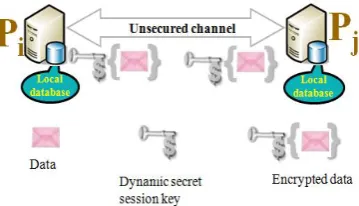
pro-Figure 3: Security Architecture for P2PDBMS.
tocols when two peers want to exchange data, each of them generates its secret session key using the shared attributes between them. Peers generate session key on-the-fly for data exchange based on the requested query. Once the genera-tion of the secret session key is complete, one peer sends a challenge to the other peer for its authentication; the other peer then sends a corresponding response as the answer to the challenge. If the challenge and response match with then the peers begin the data exchange by encrypting the data with their respective secret session key. This process is illus-trated in Figure 3. In the proposed protocol, no malicious peer can take part in the communication as they are not authenticated among the peers and cannot self-generate the secret session key. Hence a man-in-the middle, masquerade, and reply attacks are prevented. In addition, the proposed protocols do not require other trusted third-party central-ized control services for authenticated transactions between source and target. Peers generate their secret session key on-the-fly as well as authenticate each other. In the following section, we describe our protocols.
4.
DESCRIPTION OF THE PROPOSED
PROTOCOL
In this section, we describe the methods to generate secure session keys and how data is securely exchanged between the peers considering the above models. At first we describe the parameters that are used to generate the session key and message authentication code; later we describe the security mechanisms of our proposed models.
4.1
Parameters for the proposed models
In order to generate a secret session key and the message au-thentication code for data exchange in three models, differ-ent parameters are required. The parameters are discussed as follows.
System parameters: System parameters (e.g. group, bi-linear map, hash function) are used for generating a secret session key for data exchange between peers. Depending on the mutual agreement between peers, system parameters may be fixed for each data exchange session or they may be changed for each session. Depending on the situation the system parameters may be private or public.
Session parameters: Session parameters (e.g. dynami-cally generated id of peers, random number inZq∗, random numbers) are used for a specific data exchange session in order to generate the secret session key. These parameters
are dynamic for each session of data exchange. Depending on the situation the session parameters may be private or public.
Private secret parameters: Private parameters (e.g. dy-namically generated random number in Zq∗ that are based on the private attributes of the peers) are defined and only known to the peer itself.
4.2
Parameters for Model 1
Assume a source peerPi with schemaS and a target peer Pj with schema T. Also assume that based on the data exchange policy between Pi and Pj the shared attributes are classified as follows:
Confidential attributes (CA) ={CA1, CA2,· · ·, CAm} Non-confidential attributes (NCA) =
{N CA1, N CA2,· · ·, N CAp}
The purpose of the security protocol is to ensure secure data exchange when Pj requests data from Pi through a queryQthat contains confidential attributes as well as non-confidential attributes. Assume a queryQtat any instance timetis requested fromPj toPi.
In order to request data fromPi, peerPj generates the fol-lowing system and session parameters.
System parameters:
• G1, an additive group of prime orderq.
• H1 : {0,1}∗ → G1, a collision resistant
crypto-graphic hash function which maps from arbitrary-length strings to an element inG1.
Session parameters:
• A dynamically generated id of peer Pj, IDPj =
H1(Pjγ)∈G1, whereγ is a random number.
• A random numberRj−SESSION which is used for gen-erating the authentication and verification codes for the targetPj.
After generating the parameters <
G1, H1, IDPj, Rj−SESSION >, peer Pj sends the
pa-rameters with the query Qt to Pi. When Pi receives the parameters and the query, Pi identifies the confidential and non-confidential attributes. Assume Pi identifies the following confidential and non-confidential attributes from the queryQt:
Confidential attributes in Qt, denoted by CAQt={QCA1, QCA2,· · ·, QCAm0} ⊆CA
Non-confidential attributes in Qt, denoted by N CAQt =
WhenPireceives the parameters fromPj, it also generates system and session parameters for computing a secret ses-sion key for the authentication ofPj and for encryption of the query result,QR
t. The generated parameters are given below. System parameters:
• H2 : {0,1}∗ → Zq∗, a collision resistant crypto-graphic hash function which maps from arbitrary-length strings to elements inZq∗.
• H3 : {0,1}∗ → {0,1}λ, a collision resistant
crypto-graphic hash function mapping from arbitrary-length strings toλ-bit fixed length strings.
Session parameters:
• An ID IDPi = H1(P
ζ
i) ∈ G1, where ζ is a random
number.
• A random numberRi−SESSION which is used for gen-erating the authentication and verification codes for the sourcePi.
Depending on the confidential and non-confidential at-tributes, the source Pi and the target Pj generates their secret session key KSi and KSj, and authentication code
Aut0andAut1, respectively. LetSESSIONKEYAttributebe
the set of confidential and non-confidential attributes that are used to generate a session key. Therefore, in Model 1, SESSIONKEYAttribute =CAQt ∪N CAQt. To generate a
session key and an authentication code, source and target use their own parameters and the parameters received from each other. The generation and the purpose of the session keys and authentication codes for Model 1 and Model 2 are discussed in Section 4.4.
4.3
Parameters for Model 2
In this model the source peer Pi selects shared attributes from its schemaS depending on the queryQt requested by the target peer Pj at time t. The target Pj is not aware of the confidential and non-confidential attributes which are used for generating the session keysKSi. SourcePi deter-mines the confidential and non-confidential attributes after receiving the query from targetPj.
In addition to the parameters of the Model 1, the targetPj and the sourcePigenerate the following session parameters:
Session parameters:
• Target Pj and source Pi generate random num-bers Rj−AT T RIBU T E and Ri−AT T RIBU T E, respec-tively, that are used for computing the authentication codes of the attributes.
In every session,Pirandomly selects confidential and non-confidential attributes from the queryQt for computing a secret session key. The procedure of selecting the confiden-tial and non-confidenconfiden-tial attributes is presented below.
4.3.1
Attributes selection in Model 2
After receiving Qt from Pj, Pi randomly selects one confidential attribute QCA1 ∈ CAQt and another
non-confidential attribute QN CA1 ∈ N CAQt. In
addition, Pi generates attribute authentication codes SAttrAut1 = H3(QCA1||Ri−AT T RIBU T E) and SAttrAut2 = H3(QN CA1||Ri−AT T RIBU T E) and sends them toPj. The selection of the attributes that are used to generate the ses-sion key by the sourcePiis discussed as follows.
Source Pi sends the system parameters < H2, H3 > including the session parameters
< IDPi, Ri−AT T RIBU T E, Ri−SESSION > and
< SAttrAut1, SAttrAut2 > to the target Pj. Target Pj computes authentication codes of its shared attributes SAQ, whereSAQ⊆Us=att(Σst).
Let, the shared attributes of the target beSAQ={QCA1
,-QCA2, ..., QCAr, QN CA1, QN CA2, QN CAt}. Target Pj computes authentication codes of its shared attributes as follows:
TAttrAut1 =H3(QCA1||Rj−AT T RIBU T E||Ri−AT T RIBU T E); TAttrAut2=H3(QCA2||Rj−AT T RIBU T E||Ri−AT T RIBU T E);· · ·; TAttrAutr =H3(QCAr||Rj−AT T RIBU T E||Ri−AT T RIBU T E);
TAttrAutr+1 =H3(QN CA1 ||-Rj−AT T RIBU T E||Ri−AT T RIBU T E);
TAttrAutr+2 = H3(QN CA2
||-Rj−AT T RIBU T E||Ri−AT T RIBU T E);· · ·;
TAttrAutr+t = H3(QN CAt
||-Rj−AT T RIBU T E||Ri−AT T RIBU T E).
Target Pj also computes verification codes of its shared attributes as follows:
TAttrV er1 =H3(QCA1||Ri−AT T RIBU T E); TAttrV er2 =H3(QCA2||Ri−AT T RIBU T E);· · ·; TAttrV err =H3(QCAr||Ri−AT T RIBU T E); TAttrV err+1 =H3(QN CA1||Ri−AT T RIBU T E); TAttrV err+2 =H3(QN CA2||Ri−AT T RIBU T E);· · ·; TAttrV err+t =H3(QN CAt||Ri−AT T RIBU T E).
Target Pj defines a matched attributes set denoted as M atchAttr and initializes it with null. M atchAttris used to collect the authentication codes of the attributes that are matched between the source and the target. Also, target Pj defines an un-matched attributes set denoted as U nM atchAttr and initializes the set with all of the verifi-cation codes. TargetPj compares< SAttrAut1, SAttrAut2 > with the verification codes. If < SAttrAut1 > or < SAttrAut2>matches with a verification code then the cor-responding share attribute QCA1 or QN CA1 is collected,
and a new attribute authentication code N EWT Aut1 = H3(QCA1||Ri−AT T RIBU T E||Rj−AT T RIBU T E) or N EWT Aut2=H3(QN CA1||Ri−AT T RIBU T E||Rj−AT T RIBU T E) is computed. If < SAttrAut1 > and < SAttrAut2 > both match with verification codes then the corresponding share attributes QCA1 and QN CA1 are collected as
PROCEDURE attributes finding (Parameters: { au-thentication code},{verification code})
\ { }, represents the empty set.
\T EM PM atchAttr is used to collect the verification codes. \T EM PV erAttris used to collect the shared attributes.
STEP 1. M atchAttr:={};T EM PM atchAttr:={} andT EM PV erAttr:={}
STEP 2. U nM atchAttr:={TAttrV er1, TAttrV er2, ..., TAttrV err,TAttrV err+1, TAttrV err+2, ..., TAttrV err+t}
STEP 3. Compare< SAttrAut1 >inU nM atchAttr 3.a. IF < SAttrAut1 >matches inU nM atchAttr
THEN
3.a.1. T EM PM atchAttr:={SAttrAut1} 3.a.2. U nM atchAttr:=
U nM atchAttr−T EM PM atchAttr STEP 4. Compare< SAttrAut2 >inU nM atchAttr
4.a. IF < SAttrAut2 >matches inU nM atchAttr
THEN
4.a.1. T EM PM atchAttr:=
T EM PM atchAttr∪{SAttrAut2} 4.a.2. U nM atchAttr:=
U nM atchAttr−T EM PM atchAttr STEP 5. IF T EM PM atchAttr6={}THEN
5.a. T EM PV erAttr:={SHAREDAT T R}; where “SHAREDAT T R” is the share attribute of the corresponding verification code of
T EM PM atchAttr
5.b. M atchAttr:=M atchAttr∪ {H3(ElementT empV erAttr
||Rj−AT T RIBU T E||Ri−AT T RIBU T E)}; where “ElmentT empV erAttr” is the elements ofT EM PV erAttr
Target Pj sends session parameters < M atchAttr,-U nM atchAttr, Rj−AT T RIBU T E>to the sourcePi.
Source Pi checks M atchAttr; if M atchAttr is empty then source realizes that < QCA1, QN CA1 > are not
available to the targetPj. IfM atchAttris not empty then source computes new verification codes N EWSV er1 -= H3(QCA1||Ri−AT T RIBU T E||Rj−AT T RIBU T E) and N EWSV er2 = H3(QCA1||Ri−AT T RIBU T E -||Rj−AT T RIBU T E); and compares N EWSV er1 and N EWSV er2with the elements ofM atchAttr. IfN EWSV er1 and/orN EWSV er2matches with the elements ofM atchAttr then< QCA1 >and/or < QN CA1 >are collected by Pi in its temporary random attributes set ST empRandAT T R. Thus, ST empRandAT T R = {QCA1}, or {QN CA1}, or
{QCA1, QN CA1}
SourcePi generates verification codes of its confidential at-tributes CAQt and non-confidential attributes N CAQt as
follows:
SCAttrV er1 = H3(QCA1||Ri−AT T RIBU T E ||-Rj−AT T RIBU T E);
SCAttrV er2 = H3(QCA2||Ri−AT T RIBU T E ||-Rj−AT T RIBU T E);· · ·;
SCAttrV erm = H3(QCAm||Ri−AT T RIBU T E ||-Rj−AT T RIBU T E);
SN CAttrV er1 = H3(QN CA1||Ri−AT T RIBU T E ||-Rj−AT T RIBU T E);
SN CAttrV er2 = H3(QN CA2||Ri−AT T RIBU T E ||-Rj−AT T RIBU T E);· · ·;
SN CAttrV erp = H3(QN CAp||Ri−AT T RIBU T E
||-Rj−AT T RIBU T E).
Source Pi compares it’s verification codes {SCAttrV eri| ∀i,
i = 1· · ·m}; and {SN CAttrV erj| ∀j, j = 1· · ·p}; with the
elements ofU nM atchAttr, which is received from targetPj. Further,Piseparates the verification codes that are matched with the elements ofU nM atchAttrand makes a list. Source Pi collects the confidential and the non-confidential at-tributes corresponding to the verification codes that are in the separated list; and keeps the confidential and the non-confidential attributes in Pi’s temporary random at-tributes set ST empRandAT T R. Assume that Pi keeps the matched attributes {QCA1, QCA2, QCA3, QCA4
,-QN CA1, QN CA2, QN CA3, QN CA4}inST empRandAT T R. Furthermore, Pi randomly collects some attributes from ST empRandAT T R that are used for generating the ses-sion key for the current sesses-sion. Let the set of the attributes randomly collected from ST empRandAT T R by Pi, denoted SESSIONKEYAttribute, and the
car-dinality of the set SESSIONKEYAttribute, denoted `;
hence ` = |SESSIONKEYAttribute|. Assume Pi
uses SESSIONKEYAttribute ={QCA1, QCA3, QN CA1
,-QN CA4}for generating the session key KSi, thus, in this
case`=|SESSIONKEYAttribute|= 4
SourcePigenerates authentication codes of the attributes of the setSESSIONKEYAttribute, denotedSSESSIONAttrAutk, wherek= 1,2,· · ·, `, as follows and sends to the targetPj.
SSESSIONAttrAut1 = H3(QCA1||Ri−AT T RIBU T E ||-Rj−AT T RIBU T E||0);
SSESSIONAttrAut2 = H3(QCA3||Ri−AT T RIBU T E
||-Rj−AT T RIBU T E||0);
SSESSIONAttrAut3 = H3(QN CA1||Ri−AT T RIBU T E
||-Rj−AT T RIBU T E||0);
SSESSIONAttrAut4 = H3(QN CA4||Ri−AT T RIBU T E
||-Rj−AT T RIBU T E||0);
After receiving {SSESSIONAttrAuti| ∀i, i = 1· · ·`} from source Pi, target Pj generates the following verification codes as follows:
TSESSIONAttrV er1 = H3(QCA1||Ri−AT T RIBU T E
||-Rj−AT T RIBU T E||0);
TSESSIONAttrV er2 = H3(QCA2||Ri−AT T RIBU T E
||-Rj−AT T RIBU T E||0);· · ·;
TSESSIONAttrV err = H3(QCAr ||-Rj−AT T RIBU T E||Ri−AT T RIBU T E||0);
TSESSIONAttrV err+1 = H3(QN CA1||Ri−AT T RIBU T E ||-Rj−AT T RIBU T E||0);
TSESSIONAttrV err
+2 = H3(QN CA2||Ri−AT T RIBU T E ||-Rj−AT T RIBU T E||0);· · ·;
Target Pj collects ` number of verification codes from {TSESSIONAttrV eri| ∀i, i = 1· · ·(r + t)}, where the set of the collected verification codes, denoted TSESSION−COLLECTAttV er, is
TSESSION−COLLECTAttV er ={TSESSIONAttrV erj0| ∀j,
j = 1· · ·`}={SSESSIONAttrAuti| ∀i, i = 1· · ·`}. Finally, target Pj collects the shared attributes corresponding to the verification codes of the setTSESSION−COLLECTAttV er
that are used to generate the session keyKSj for the target
Pj. Thus the shared attributes corresponding to the ver-ification codes of the set TSESSION−COLLECTAttV er,
denoted SESSIONKEYAttribute−J, and
SESSIONKEYAttribute−J={QCA1, QCA3, QN CA1
,-QN CA4}=SESSIONKEYAttribute.
Target Pj further generates the following authentication codes of the shared attribute setSESSIONKEYAttribute−J
for cross authentication checking of the attributes set SESSIONKEYAttribute with the sourcePi.
TSESSIONAttrAut1 = H3(QCA1||Ri−AT T RIBU T E ||-Rj−AT T RIBU T E||1);
TSESSIONAttrAut2 = H3(QCA3||Ri−AT T RIBU T E ||-Rj−AT T RIBU T E||1);
TSESSIONAttrAut3 = H3(QN CA1||Ri−AT T RIBU T E ||-Rj−AT T RIBU T E||1);
TSESSIONAttrAut4 = H3(QN CA4||Ri−AT T RIBU T E ||-Rj−AT T RIBU T E||1);
Target sends {TSESSIONAttrAuti| ∀i, i = 1· · ·`} to the source Pi. After receiving {TSESSIONAttrAuti| ∀i, i= 1· · ·`}from targetPj, sourcePigenerates the following verification codes:
SSESSIONAttrV er1 = H3(QCA1||Ri−AT T RIBU T E ||-Rj−AT T RIBU T E||1);
SSESSIONAttrV er2 = H3(QCA3||Ri−AT T RIBU T E
||-Rj−AT T RIBU T E||1);
SSESSIONAttrV er3 = H3(QN CA1||Ri−AT T RIBU T E
||-Rj−AT T RIBU T E||1);
SSESSIONAttrV er4 = H3(QN CA4||Ri−AT T RIBU T E
||-Rj−AT T RIBU T E||1);
Finally, source Pi compares {SSESSIONAttrV eri| ∀i, i = 1· · ·`} with {TSESSIONAttrAuti| ∀i, i = 1· · ·`}; if {SSESSIONAttrV eri| ∀i, i = 1· · ·`} = {TSESSIONAttrAuti| ∀i, i = 1· · ·`}, then session key KSi is
gener-ated by using the confidential and non-confidential at-tributesSESSIONKEYAttribute={QCA1, QCA3, QN CA1
,-QN CA4}.
In the next section we discuss the generation of session key and authentication code for Model 1 and Model 2.
4.4
Generation of secret session key and
au-thentication code for Model 1 and Model
2
The sourcePicomputes a secret element inZq∗, calledshared
secret parameter, denoted byσ, that is based on the session key attribute setSESSIONKEYAttribute, as follows.
σ=H2(SESSIONKEYAttribute)∈Z
∗
q
This shared secret parameter σ is used as a shared secret session keyKSi (i.eKSi=σ) for exchanging data between
the sourcePiand the targetPj.
SourcePialso generates authentication codeAut0as follows:
Aut0 =H3(KSi||IDPi||IDPj||Ri−SESSION||0)
where Ri−SESSION is a random number generated by the source Pi to distinguish every session from others so that replay attacks cannot take place on the communication.
Finally, source Pi sends the system parameters < H2, H3 > including the session parameters
< IDPi, Ri−SESSION, Aut0 >to the targetPj.
After receiving the system parameters as well as session parameters form the sourcePi, targetPjgenerates a session keyKSj as follows:
σ=H2(SESSIONKEYAttribute)∈Z
∗
q KSj =σ
Therefore, KSj =KSi
Verification codeV er0 is computed by the targetPjas fol-lows:
V er0=H3(KSj||IDPi||IDPj||Ri−SESSION||0)
The verification codeV er0is computed to verify the
authen-tication codeAut0 ofPi.
TargetPjcomparesV er0 withAut0;if (V er0=Aut0)then
target generates another authentication code Aut1 as
fol-lows:
Aut1=
H3(KSj||IDPi||IDPj||Rj−SESSION||Ri−SESSION||1) Finally, Pj sends < Aut1 >to source Pi. Upon receiving < Aut1>from targetPj, sourcePi generates another veri-fication codeV er1 as follows, and compares it withAut1.
V er1=
H3(KSi||IDPi||IDPj||Rj−SESSION||Ri−SESSION||1)
IfV er1 matches withAut1 ,i.e(V er1=Aut1) then source
We use “0” and “1” in the generation ofAut0 andAut1 for
distinguishing the computation (session keys and authen-tication codes) as well as communication (authenauthen-tication codes) between sourcePiand targetPj.Piuses “0” for com-puting the authentication code (Aut0) and for sending toPj. Hence, the source performs both computation and commu-nication by using “0”; on the other hand, “0” is used only for verification purpose by the target. Therefore, the target performs computation only with “0”. The target uses “1” in computing the authentication code (Aut1) and for sending
to the source. Hence, the target performs both computation and communication by using “1”; on the other hand, “1” is used only for verification purposes by the source. Hence, the source performs only computation with “1”.
4.5
Secure authenticated data exchange in
Model 1 and Model 2
After authentication between the source and the target, source Pi generates a message authentication code, de-noted by M ACM ESSAGE of the query result QRt, which is computed as M ACM ESSAGE = H3(QRt). The source also encryptsQRt with its secret session key KSi, denoted
by CIP HERQR
t, which is computed as CIP HERQRt =
EKSi(QRt), whereEKSi means encryption using the session keyKSi. Finally,Pisends the following packet toPj.
< IDPi, CIP HERQR
t, M ACM ESSAGE, IDPj >
After receiving the packet, Pj decrypts CIP HERQR t with
the session key KSj denoted as DKSj(CIP HERQR t) and
generates the verification message authentication code, de-noted byV ERM ESSAGE, which is computed as follows:
V ERM ESSAGE=H3(DKSj(CIP HERQR t))
Finally,Pj comparesV ERM ESSAGE withM ACM ESSAGE. If V ERM ESSAGE = M ACM ESSAGE then the data is ac-cepted.
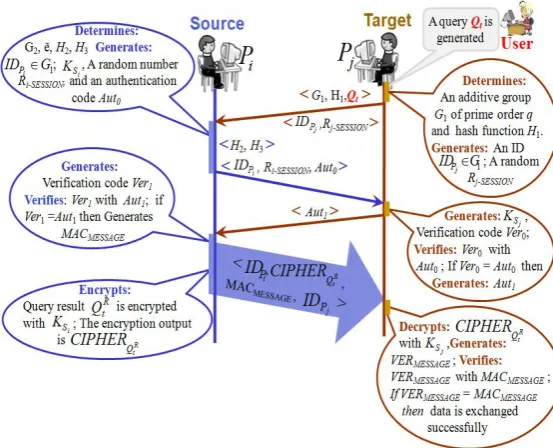
The whole process is illustrated in Figure 4 and described in the following steps.
The step-by-step procedure of the proposed proto-col goes as follows:
Key generation and message authentication code of the query result for Model 1 and Model 2 is described in the following steps. Attribute selection steps for Model 2 are not included within these steps.
STEP 1: A queryQtis generated at the targetPj. STEP 2: TargetPjdetermines groupG1, hash functionH1
and performs the following steps: 2.a: Generates an IDIDPj.
2.b: Sends< G1, H1, Qt, IDPj, Rj−SESSION >
to the sourcePi.
STEP 3: SourcePiexecutes the queryQt on its local database and performs the following steps:
3.a: Determines cryptographic hash functions H2 andH3.
Figure 4: Illustration of Key Agreement and Secure Message Communication for P2PDBMS.
3.b: Generates an IDIDPi, a random number
Ri−SESSION.
**** *: (For Model 2: AssumeSESSIONKEYAttribute is already collected)
3.c: Generates secret session keyKSi,
authentication codeAut0.
3.d: Sends< H2, H3, IDPi, Ri−SESSION, Aut0>
to the targetPj.
STEP 4: TargetPj generates secret session keyKSj,
verification codeV er0.
4.a: Generates randomRj−SESSION. 4.b: ComparesV er0withAut0
if V er0=Aut0 then
generatesAut1.
4.c: Sends< Aut1>to the sourcePi. STEP 5: SourcePi generates verification codeV er1.
5.a: ComparesV er1 withAut1 if V er1=Aut1 then
generatesmessage authentication code
M ACM ESSAGE . 5.b: Encrypts query resultQR
t, with session keyKSi denoted asCIP HERQR
t .
5.c: Sends< IDPi, CIP HERQR
t, M ACM ESSAGE,
IDPj >to the targetPj.
STEP 6: Target decryptsCIP HERQR
t with session keyKSj;
generates verification message authentication code V ERM ESSAGE; compares
V ERM ESSAGE withM ACM ESSAGE.
if V ERM ESSAGE=M ACM ESSAGE then data has been exchanged successfully.
4.6
Parameters for Model 3
works properly. In this proposed security protocol, respon-sibilities of a PKG is mutually performed by the source and the target.
In this model the targetPj requests the source Pi to send query result QRt ∈ {0,1}n−l0 in such a way that no one can accessQR
t without having the private attributes of the target. Therefore, at the beginning sourcePiverifies target’s query request. To this end the source and the target do the same sequence of tasks as in Model 2 to select the session key attribute setSESSIONKEYAttribute ={QCA1, QCA3
,-QN CA1, QN CA4}.
Source Pi computes σ as discussed in Section 4.4 and an identification authentication codeAutIDi as follows.
AutIDi =H3(σ||IDPi||IDPj||Ri−SESSION||noncei||0);
wherenoncei is a random number.
SourcePi sends < AutIDi, noncei >to the targetPj.
Af-ter receiving < AutIDi, noncei > from the source, target
Pj computesσsimilar to the source, generates verification code denotedV erIDj as follows and comparesV erIDj with
AutIDi.
V erIDj =H3(σ||IDPi||IDPj||Ri−SESSION||noncei||0);
If V erIDj =AutIDi then target Pj generates randomly aprivate secret parameter denoted β from the target’s private attributePjP vtAttr, generates an identity
authenti-cation codeAutIDj, and public keyPjP U B−Key as follows:
β=H2(PjP vtAttr)∈Z
∗
q
PjP U B−Key=βIDPi; whereIDPi ∈G1, identity of the
sourcePi.
AutIDj =
H3(σ||IDPi||IDPj||Ri−SESSION||PjP U B−Key||noncei||noncej||1)
wherenoncej is a random number.
Target Pj sends < PjP U B−Key, AutIDj, noncej > to the
sourcePi. After receiving< PjP U B−Key, AutIDj, noncej >
form the targetPj, sourcePigenerates an identity verifica-tion codeV erIDi as follows and compares with< AutIDj.
V erIDi=
H3(σ||IDPi||IDPj||Ri−SESSION||PjP U B−Key||noncei||noncej||1);
If V erIDi=AutIDj then sourcePigenerates the following
parameters in addition to the parameters of the Model 1 and Model 2.
System parameters:
• G2, a multiplicative group of the same prime orderq
as the order of the additive groupG1.
• ˜e:G1×G1→G2 is the bilinear map .
• H4, a cryptographic collision resistant hash function
defined asH4 :{0,1}n−l0× {0,1}l0 →Zq∗, whereZ
∗
q -={µ|1≤µ≤q−1}, integernandl0, 0< l0< n.
• H4, a cryptographic collision resistant hash function
defined asH5:G1×G2×G1→ {0,1}n, wheren >0.
4.6.1
Secure data exchange in the Model 3
Assume sourcePihas at least oneprivate attributeand it is denotedPiP vtAttr.Pigeneratesprivate secret parameters
ωandPi−P V T based on the private attributePiP vtAttr. Pi
also generates a public parameterPij−P U B as follows:
ω=H2(PiP vtAttr)∈Zq∗
Pi−P V T =ωIDPi;
Pij−P U B =ωIDPj; whereIDPj ∈G1, identity of the target
Pj.
Pi again generates another private secret parameter s based on the query resultQR
t ∈ {0,1}n
−l0; and generates a
random numberℵ, whereℵ ∈ {0,1}l0.
s=H4(QRt,ℵ)∈Z
∗
q
Encryption and authentication code generation of the query resultQR
t ∈ {0,1}n
−l0 by the source:
To encipher the query result QRt, source Pi generates the parameters Υ∈G2 and Ω∈G1as follows:
Υ = ˜e(Pi−P V T, IDPj)
s
= ˜e(ωIDPi, IDPj)
s;
[sandPi−P V T are the private parameters of the sourcePi]
Ω =sPjP U B−Key
The source encrypts the query result QR
t, denoted Cipher{QR
t}, and computed as follows:
Cipher{QR
t} =< Γ,∆ >; where Γ = sIDPi;
∆ = (QRt||ℵ)⊕H5(Γ,Υ,Ω); and it is simplified as:
Ciph{QR
t }=<Γ,∆> =<Γ,
QRt||ℵ
⊕H5 Γ,Υ,Ω
>
=< sIDPi
, QR
t||ℵ
⊕
H5 sIDPi,˜e(Pi−P V T, IDPj)
s
, sPjP U B−Key
>
The source computes a message authentication code M ACQR
t of the query resultQ
R
M ACQR
t =H3(Q
R
t||s||σ||noncei||0)
Finally the source sends <
Cipher{QR
t}, Pij−P U B, M ACQR
t > with the
parame-ters< G2,e, H˜ 4, H5>to the target:
Decryption and verification code generation of the query resultQR
t ∈ {0,1}n
−l0 by the target:
At first the target splits Γ fromCipher{QR
t} =< Γ,∆ > and computes ∆ ⊕ H5(Γ,Υ,˜ Ω); where,˜ Υ and ˜˜ Ω are
computed as follows:
˜
Υ = ˜e(Γ, Pij−P U B)
= ˜e(sIDPi, ωIDPj); [sandωare the private parameters
of the sourcePi] = ˜e(IDPi, IDPj)
sω
= ˜e(ωIDPi, IDPj)
s
= ˜e(Pi−P V T, IDPj)
s
= Υ
The target computes ˜Ω as follows:
˜
Ω =βΓ; [βis the private parameter for the targetPj] =βsIDPi; [sis a private parameter for the sourcePi]
=sβIDPi;
=sPjP U B−Key
= Ω
Finally, target evaluates the the following expression:
∆⊕H5(Γ,Υ,˜ Ω)˜
=(QRt||ℵ)⊕H5(Γ,Υ,Ω)
⊕H5(Γ,Υ,˜ Ω)˜
= (QRt||ℵ)⊕H5(Γ,Υ,Ω)⊕H5(Γ,Υ,Ω)
= (QR t||ℵ)
Target splitsQR
t andℵ from (QRt||ℵ); and computes a pa-rameter ∂ from QR
t; where, ∂ is used for generating the verification codeV ERQR
t ofQ
R
t as follows:
∂=H4(QRt,ℵ)∈Zq∗ V ERQR
t =H3(Q
R
t ||∂||σ||noncei||0)
if (V ERQR
t =M ACQRt)then target generates another
au-thentication code M ACj−QRt as follows and sends to the source:
M ACj−QR
t =H3(Q
R
t||∂||σ||noncei||noncej||1)
Upon receiving< M ACj−QR
t >from the targetPj, source
Pigenerates another verification codeM ACi−QR
t as follows,
and compares it withM ACj−QR t.
M ACi−QR
t =H3(Q
R
t||s||σ||noncei||noncej||1)
IfM ACi−QR
t matches withM ACj−QRt , (i.e M ACi−QRt =
M ACj−QR
t) then the data has been exchanged successfully.
5.
SECURITY ANALYSIS
In this section we discuss one cryptographic implementation of the proposed protocols and the mechanism for preventing different attacks.
5.1
Cryptographic implementation
The bilinear map ˜e can be the Tate pairing with some of the modifications and performance improvements described in [18] and the elliptic curve E can bey2 =x3+x. The
aforementioned group orderqis a large 160-bit prime based on another 512-bit prime p = 2qr−1 (for some r large enough to make pbe the correct size) such bit-length con-figurations ofpandqprovide a level of security comparable to RSA cryptography with a key size of 1024 bits [19]. Then G1 is a cyclic subgroup of the additive group of points on
the elliptic curve E over the finite field Fp, while G2 is a
cyclic subgroup of the multiplicative group associated with the finite fieldFp∗2.
If an intruder node captures public messages containing sen-sitive information AU T0, and /or AU T1, and/or M ACQR t
and/orM ACj−QR
t, still intruder cannot compute any secret
key. This is because the key generation is a pairing function operation over an elliptic curve with a secret point. Thus, an outsider node can not be authenticated as it is not capable of generating shared keys.
5.2
Prevention of attacks
Masquerade attack: In our proposed protocol, peers au-thenticate each other before exchanging data. Furthermore, in every session of data exchange between peers, parameters (session/system) are generated dynamically. The session parameters< Ri−SESSION, Aut0, Aut1, Rj−SESSION >are completely different in each session. Hence, by storing these session parameters, an intruder node cannot pass the au-thentication process. Therefore, the intruder cannot pretend to be a valid peer in the data exchange. Thus, a masquerade attack is not a threat to our proposed protocol.
Reply attack: In our proposed protocol, a malicious peer cannot pass the authentication process. We use an exam-ple to illustrate the situation. Consider a scenario with two peersPias a source andPjas a target in a P2PDBMS, and a malicious peerPkwants to mount a replay attack. Suppose that Pj sends a queryQt to Pi for data exchange and the sesssion/system parameters generated during the data ex-change session are< G1, H1, IDPj >,< G2,e, H˜ 2, H3 >,<
IDPi, Ri−SESSION, Aut0 >, and < Aut1, Rj−SESSION >.
The generation of parameters is discussed in Section 4. Assume that when Pj sends Qt to Pi, Pk makes a copy of Qt and the session/system parameters during the data exchange session for replay attack. Later, Pk sends the query Qt to the source by using the last session parame-ters< G1, H1, IDPj >for the replay attack. After receiving
these parameters,Pigenerates a new session and system pa-rameters, and sends them toPk. Now the random number Ri−SESSION is newly generated by sourcePito compute a new authentication codeAut0, denotedAutnew0 , and a new
session is overPiandPjdo not storeAut0,Aut1,V er0, and
V er1. SinceV ernew1 6=Aut1, whereAut1 is the old
authen-tication code stored byPk,Pidoes not send the query result QR
t toPk.
IfRi−SESSIONis generated repeatedly by the sourcePiand all the previous session parameters are copied byPk, still Pkcannot decrypt the query resultQRt. BecausePk cannot computesecret session key KSi orKSj, it cannot complete
the authentication process.
If malicious peerPk collectsCipher{QRt}thenPk can not decipherCipher{QR
t}to find query resultQRt, becausePk can not generates Ω. Thus, our proposed protocol is robust against replay attack.
Since our protocol is robust against reply attack, the man-in-the middle attack will also be prevented.
6.
RELATED WORK
To the best of the knowledge of the authors, our proposal is the first work for query-based secure session key genera-tion for secure data exchange between peers in P2PDBMS. The only work that is close to the proposal is the work of [22], where the authors claim secure data propagation among multiple nodes by using pre-existing friendship relationships among the nodes in the network. It is assumed that the nodes are friends with each other in real life, thus they have a pre-existing trust relationship. Furthermore, the authors also assume that the nodes have secure keys beforehand; us-ing these fixed security agreements regardus-ing private keys, nodes in the network can set up secure connections and ex-change data. This assumption is not realistic in a peer-to-peer database environment. Therefore, the assumption is eliminated from our protocol which does not require any pre-existing security agreement between the peers. The se-curity setup is completely based on query, initiated by a target peer.
7.
CONCLUSION
In this paper, we have presented novel secure data exchange protocols for P2PDBMS. The protocols are designed using one way hash function and IBE with pairing-based cryp-tography. Any two peers that need to exchange data over an insecure medium can generate on-the-fly a secret session key by exchanging some system and session parameters. An important feature of the proposed protocols is that peers al-ways generate a new session key for every new data exchange session; therefore, every session is completely independent with respect to the session key generation, and hence the proposed protocol successfully prevents different attacks. To the best of our knowledge, this is the first security protocol in the literature for secure data exchange between dynamic peers in a P2PDBMS.
8.
REFERENCES
[1] A. Fuxman, P. G. Kolaitis, R. J. Miller, and W. C. Tan, “Peer Data Exchange,” InACM Trans. Database System, 31(4):1454-1498, 2005.
[2] C. Beeri and M. Y. Vardi, “A Proof Procedure for Data Dependencies,” InJournal of the ACM, 31(4):718-741, 1984.
[3] A. Y. Halevy, Z. G. Ives, D. Suciu, and I. Tatarinov, “Schema Mediation in Peer Data Management System,” InProc. of the Int’l Conf. on Data Engineering, pages 505-516, 2003.
[4] A. Y. Halevy, Z. G. Ives, J. Madhavan, P. Mork, D. Suciu, and I. Tatarinov, “The Piazza Peer-Data Management System,” InIEEE Transactions on Knowledge and Data Engineering (TKDE), 16(7):787-798, 2004.
[5] L. Serafini, F. Giunchiglia, J. Molopoulos, and P. Bernstein, “Local Relational Model:A Logocal Formalization of Database Coordination,” Technical Report, Informatica e Telecomunicazioni, University of Trento, 2003.
[6] P. Rodriguez-Gianolli, M. Garzetti, L. Jiang, A. Kementsietsidis, I. Kiringa, M. Masud, R. Miller, and J. Mylopoulos, “Data Sharing in the Hyperion Peer Database System,” InProc. of the Int’l Conf. on Very Large Data Bases (VLDB), pages 1291-1294, 2005. [7] A. Kementsietsidis, M. Arenas, and R.J. Miller,
“Mapping Data in Peer-to-Peer Systems: Semantics and Algorithmic Issues,” InProc. of the Int’l Conf. on the Management of Data (ACMSIGMOD), pages 325-336, 2003.
[8] M. Masud, I. Kiringa, and A. Kementsietsidis, “Don’t Mind Your Vocabulary: Data Sharing Across
Heterogeneous Peers,” InProc. of the Int’l Conf. on Cooperative Information Systems (CoopIS), pages 292-309, 2005.
[9] A. Kementsietsidis and M. Arenas, “Data Sharing Through Query Translation in Autonomous Sources,” InProc. of the Int’l Conf. on Very Large Data Bases (VLDB), pages 468-479, 2004.
[10] V. Miller, “Uses of Elliptic Curves in Cryptography,” Advances in Cryptology, in Crypto’85, Lecture Notes in Computer Science, Springer-Verlag, Vol. 218, 1986, pp. 417-426.
[11] N. Koblitz, “Elliptic Curve Cryptosystems,” Mathematics of Computation, Vol.48, 1987, pp.203-209.
[12] N. Gura, A. Patel, A. Wander, H. Eberle, and S. C. Shantz, “Comparing Elliptic Curve Cryptography and RSA on 8-bit CPUs,” in Workshop on Cryptographic Hardware and Embedded Systems (CHES), 2004, pp.119-132.
[13] L. B. Oliveira, R. Dahab, “Pairing-Based Cryptography for Sensor Networks,” in 5th IEEE International Symposium on Network Computing and Applications (NCA’06), MA, USA, Jul. 2006.
[14] A. Shamir, “Identity-based Cryptosystems and Signature Schemes,”CRYPTO’84, on Advances in Cryptology, Springer-Verlag, 1984, pp. 47-53.
[15] D. Boneh and M. Franklin, “Identity-based Encryption from the Weil Pairing,”Proc. CRYPTO 2001, LNCS 2139, Springer-Verlag, Berlin Heidelberg, 2001, pp. 213-229.
[16] R. Sakai, K. Ohgishi, and M. Kasahara,
“Cryptosystems Based on Pairing,”Proc. Symposium on Cryptography and Information Security
(SCIS2000), Jan. 2000, pp. 26-28.
Groups,”Cryptology ePrint Archive, Report 2001/03, available at http://eprint.iacr.org/2001/03/.
[18] P.S.L. M. Barreto, H.Y. Kim, B. Bynn, and M. Scott, “Efficinet Algorithms for Pairing-Based
Cryptosystems”, In Proc. CRYPTO 02, Springler Verlag, August 2002.
[19] D. Balfanz, G. Durface and N. Shankar et al., “Secure Handshakes from Pairing-Based Key Agreements,” IEEE Symposium on Security and Privacy, May 2003 [20] “The Tate Pairing”, available at
http://www.computing.dcu.ie/˜ mike/tate.html [21] “Elliptic Curve Cryptography Tutorial,”
http://www.certicom.com/index.php/ecc [22] Bogdan C. Popescu, Bruno Crispo, Andrew S.