Practical Key-recovery For All Possible
Parameters of SFLASH
Charles Bouillaguet1, Pierre-Alain Fouque1, and Gilles Macario-Rat2 1 ´
Ecole normale sup´erieure, 45 rue d’Ulm, 75005 Paris, France
{charles.bouillaguet,Pierre-Alain.Fouque}@ens.fr 2 Orange Labs
38–40, rue du G´en´eral Leclerc, 92794 Issy les Moulineaux Cedex 9, France
Abstract. In this paper we present a new practical key-recovery attack on the SFLASH signature scheme. SFLASH is a derivative of the older C∗encryption and signature scheme that was broken in 1995 by Patarin. In SFLASH, the public key is truncated, and this simple countermeasure prevents Patarin’s attack. The scheme is well-known for having been considered secure and selected in 2004 by the NESSIE project of the European Union to be standardized.
However, SFLASH was practically broken in 2007 by Dubois, Fouque, Stern and Shamir. Their attack breaks the original (and most relevant) parameters, but does not apply when more than half of the public key is truncated. It is therefore possible to choose parameters such that SFLASH is not broken by the existing attacks, although it is less ef-ficient.
We show a key-recovery attack that breaks the full range of parameters in practice, as soon as the information-theoretically required amount of information is available from the public-key. The attack uses new crypt-analytic tools, most notably pencils of matrices and quadratic forms.
1
Introduction
Multivariate polynomials have been used in cryptography as early as in 1984, mostly with the purpose of designing RSA variants with faster decryption [11, 12, 5]. At about the same time, Matsumoto and Imai designed the first public-key scheme explicitly based on the hardness of MQ. In fact, they had several proposal, but only a single one (their “Scheme A”) made it to the general crypto community, and was presented at Eurocrypt’88 [10] under the name C∗. It is very similar to RSA, as its only non-linear component is a power function over a finite field. However, unlike RSA this power function is an easy-to-invert bijection, therefore in C∗it is composed with two secret invertible linear maps that destroy its algebraic structure. We therefore see C∗ as an attempt to obfuscate a power function inFqn by presenting it as a collection ofnquadratic polynomials inn
variables overFq.
Several years later, Patarin found a devastating attack against C∗, allowing to decrypt and to forge signatures in a few seconds [13]. He showed that there always are bilinear relations between the ciphertext and the plaintext, which can be easily discovered by the adversary. This allows for an efficient attack by substituting the ciphertext into the bilinear relations, which results in a system of linear equations whose solution is the plaintext.
The SFLASH signature scheme [14] is a derivative of the original C∗ that was proposed in 2001 by Courtois, Goubin and Patarin. It is famous for having been selected in 2003 by the NESSIE European project to be proposed to the standardization bodies.
The idea behind SFLASH is to take the original C∗but to throw away a part of the output. The resulting trapdoor one-way function can no longer be used for encryption, but it can still be used for signatures. This is achieved by removing a part of the public key, which is the obfuscated description of the power func-tion. The idea of removing some of the public polynomials has been originally suggested by Shamir [15], and was called the “Minus transform”. The original C∗
with the minus transform is thus often called C∗−. This countermeasure is very
effective since it avoids the reconstruction of the bilinear relations and makes it much harder to compute Gr¨obner basis of the public key.
SFLASH has in turn been very badly broken in 2007 when Dubois, Fouque, Stern and Shamir found a practical forgery attack [4, 3], and further broken in 2008 when Fouque, Macario-Rat and Stern found a practical key-recovery attack [6]. Both attacks are very practical, defeating the actual SFLASH param-eters in minutes. They are essentially polynomial in the security parameter(s), so that there is no hope that increasing them may make the scheme simultaneously secure and usable.
However, both attacks only applyas long as the number of removed polyno-mials is less than half of the total number. There are therefore unbrokenranges of parameters, even though they are less practical than the original (defeated) proposal. For instance, let us consider the parametersq= 128 andn= 257. The original C∗ public key would be made of 257 polynomial in 257 variables over
no apply. The signatures are 1799-bit long, and the public-key is 1.8Mbyte long. Forging a signature by exhaustive search requires 2448 trials, and computing a Gr¨obner basis should require even more arithmetic operations.
Our Contribution. We show that SFLASH/C∗− can be broken regardless of the fraction of the public that was thrown away, thus improving on the previ-ous attacks. We present a practical key-only attack that recovers the secret-key and applies as soon asthree polynomials from the public key are available. This happen to be the information-theoretic minimum quantity of data required to uniquely characterize the set of possible secret keys. The attack has been im-plemented and tested. It runs very efficiently, and breaks in practice all the meaningful ranges of parameters. For instance, the particular parameters men-tioned in the previous paragraph can be broken in about 10 hours using a single computer.
SFLASH had already been thrown out of the league of possible alternatives to RSA of discrete-logarithm based schemes by the previous attacks. The contri-bution of this work is not only to further break SFLASH, but also to introduce new cryptanalytic techniques. To achieve our results, we make use of mathemat-ical tools that were not previously used in multivariate cryptanalysis, such as pencils of matrices or quadratic forms, adjugate matrices, simultaneous diago-nalization of quadratic forms, kernels of quadratic forms, etc. We expect that some of these tools might apply further to other schemes, in particular those sharing some features with SFLASH, notably HFE.
1.1 Organization of the paper
In section 2, we present some mathematical background. Then, in section 3, we describe the C∗ and SFLASH signature schemes. In section 4, we investigate in great detail the mathematical properties of C∗ and find exploitable relations between the secret and public keys. Finally, we expose our key-recovery attack in section 5, and given experimental results.
2
Mathematical Background
Finite Fields. Let K the finite field with q elements, where q is a power of two, andFan extension ofKof degreen. Recall thatFis isomorphic toKn, so that we often identify the two spaces. Thetrace onFoverKis theK-linear map defined by TrF/K(x) =x+x
q +. . .+xqn−1. Thenorm on
F overK is defined by NF/K(x) =x·x
q. . .·xqn−1.Both Tr
F/K and are functions fromFto K, and
we simply note them Tr and N since there is no confusion. The map x7→xq is called the Frobenius map, and it is a field automorphism.
Lemma 1. For anyK-linear mapping L on F overK, there exists an element
Quadratic forms. A quadratic form overKis a degree 2 homogeneous poly-nomial:
Q(x1, . . . , xn) =
X
1≤i≤j≤n
aij·xixj withaij ∈K.
It is well-known that over fields of characteristic not two, a quadratic formQ
is uniquely represented by itspolar form,i.e., the symmetric bilinear form defined byψ(Q) : (x, y)7→1/2·(Q(x+y)−Q(x)−Q(y)), with the nice property that
Q(x) = φ(Q)(x, x). Over fields of characteristic two, this is however no longer possible, because the division by two is not defined. In this paper, we will slightly abuse the usual definition, and we define the polar form of a quadratic form to be the symmetric bilinear form:
ψ(Q) : (x, y)7→Q(x+y)−Q(x)−Q(y)
Given a basis b1, . . . , bn of F, ψ(Q) can be represented by a n×n symmetric matrix whose (i, j) coefficient is ψ(Q) (bi, bj). By an abuse of notation, we will often identifyψ(Q) with its matrix representation.
The Kernel of a Quadratic Form. Thekernel of a quadratic formQ, also called the radical of Q is the vector space of elements a ∈ F such that for any x∈F, ψ(Q)(x, a) = 0. It is easy to see that the kernel of a quadratic form is the kernel of the matrixψ(Q). What makes the kernel interesting is that in characteristic two, whennis odd, all quadratic forms have a non-trivial kernel. Theorem 1 ([1]).Letqbe a power of two, and letQbe a quadratic form overK. Then the rank ofφ(Q)is even.
Linear Algebra. We denote the characteristic polynomial ofM byχ(M). A minor ofM is simply the determinant of a submatrix ofM. We will use in the following the adjugate matrix adj(M) of a matrix M. We recall that it is the transpose of the comatrix, which is the matrix of the cofactors. A cofactor of
M, cofi,j(M) is the determinant of the submatrixMij, where in this notation we refer to the matrixM without theith row and thejth column. We lastly recall two well-known results connecting a matrixM and its adjugate.
Theorem 2 (Cayley-Hamilton).Ifχ(M) =Xn+c
n−1Xn−1+· · ·+c1X+c0 is the characteristic polynomialof M, then:
Mn+cn−1Mn−1+· · ·+c1M +c0·In = 0
Mn−1+cn−1Mn−2+· · ·+c2M +c1·In = adj(−M) It follows that−M·adj(−M) = adj(−M)· −M = det(−M)·In
Lemma 2. The rank of adj(M)can be deduced from the rank of M: – ifrank(M) =n, thenrank(adj(M)) =n.
3
The C
∗and SFLASH Signature Schemes
The basic idea underlying both C∗ and SFLASH is to hide an easily invertible function φin the large finite fieldFusing two secret invertible linear (or affine) mapsSandT which mix together thencoordinates ofφover the small fieldK, with PK = T ◦φ◦S. The signature of a message y is a vector x such that PK(x) = y. The legitimate signer easily computes xby successively inverting
T, φand thenS.
Letπbe the canonical isomorphism betweenKn andF, and letφbe defined by φ(X) = X1+qθ. Enforcing that gcd(1 +qθ, qn −1) = 1 makes φ bijective. Because we may writeφ(X) =X·Xqθ, we find thatφis in fact the product of two linear functions (recall that the Frobenius map and its iterates are linear). It follows thatπ◦φ◦π−1is a quadratic bijection of
Kn,i.e., that ifx∈Kn, then
π◦φ◦π−1 is a vector whose coordinates are quadratic forms in the coordinates ofx. For the sake of lighter notations, we omitπin the sequel.
The secret key of the scheme is composed by the two invertiblen×nmatrices
SandT with coefficients inK. The exponentθandπare public parameters. The public-key of the scheme is formed by the representation over Kn of T◦φ◦S. More precisely, ifTi denotes thei-th line ofT, then the public key ofC∗ is the vector ofnquadratic forms overKn:
Pi(x1, . . . , xn) = Tr
Ti·φ(S(x1, . . . , xn))
1≤i≤n
The public key of SFLASH is composed of the firstrquadratic forms P1, . . . ,Pr. Typical values of the parameter may be the ones defined for SFLASH V3:
q= 128, n= 67, r= 56 andθ= 33.
Although the public key is a vector of polynomials in (K[x1, . . . , xn])n, it is more convenient to see them as functions fromFtoK. We therefore write
Pi(x) = Tr
Ti·S(x)1+q
θ
.
Equivalent Secret Keys. Given a public-key, there are many possible cor-responding secret keys (there are “equivalent” secret keys [18]). A key-recovery attack is expected to retrieve one possible secret key amongst those generating the targeted public-key. The existence of many equivalent secret keys gives some freedom to the attacker: we may be guaranteed that there is an equivalent secret key satisfying some interesting property.
Lemma 3. If(S, T)is an SFLASH secret-key that generates the public keyPK, then for any integer k > 1 there is an equivalent secret key (S0, T0) in which
T0
i = (Ti/T1)q
k
(seeing the vectorsTi as elements ofF).
Proof. Because the functionx∈F7→a·xis linear overF, it can be represented by a matrixMa overKn. The key idea is that multiplications “commute” with the internal power function:
Pi(x) = Tr
T
i
a1+qθ ·[a×(S·x)]
Now, we pickasuch thata1+qθ =T1(this is always possible because the power function is bijective). Thus, a possible equivalent secret key is such that T0
i =
Ti/T1, andS0=Ma·S.
Next, it follows from the definition of the trace, and from the identityxqn
=x
which holds overFthat Tr
xqk= Tr(x). This shows that
Pi(x) = Tr
T
i
a1+qθ
qk
·[(a×(S·x)]qk 1+qθ!
Thus, ifF denotes the matrix representing the Frobenius, i.e., the linear map
x7→xq in
F, then a possible equivalent secret key is such thatTi0 = (Ti/T1)q
k
, andS0 =Fk·M
a·S. ut
4
Mathematical Properties of C
∗−Public Keys
The aim of this section is to exhibit relations involving the secret elements S
and the Ti’s on the one hand, and the public key on the other hand, in such a way that the secrets can be easily reconstructed given only a small number of public polynomials.
For this purpose, we consider two public polynomials Pi and Pj, and we define the pencil of quadratic forms P = λPi +µPj, with λ, µ in K. We also define thepencil of vectorsT=λTi+µTj, and because the Trace isK-linear we have:
P(X) = TrT·S(X)1+qθ. (1) We are interested in thekernelofP, which is by definition the set of vectorsa
such that for anyx,ψ(P)(a, x) = 0. In fact, it is simply the kernel of the matrix representation of the polar form ψ(P). We first relate the kernel of P to the components of the secret key in section 4.1, and then with the components of the public-key in section 4.2. This allows us, by “transitivity”, to find exploitable relations between the public key and the secret elements in section 4.3.
In the sequel, we adopt the typographic convention that any quantity that depends implicitly onλandµis written in bold.
4.1 Relations Between the Kernel and the Secret-Key
It is not very surprising that the kernel ofPadmits a relatively simple expression in terms of the components of the secret key.
Theorem 3. Given thatnis odd, andgcd(θ, n) = 1, we have:
(i) The kernel of Pisnx∈Kn |T·S(x)1+q
θ
∈K o
.
(ii) The matrix pencilφ(P)has rank n−1.
(iv) There exists δ∈Nsuch thata=S−1 Tδ
. A possible value forδ is
δ=q 2−1
·
n−1
X
i=0
qi+ n−1
X
i=(n+1)/2
q2iθ (2)
Proof. It is known that the polar forms of C∗polynomials have a special shape:
ψ(P)(x, y) = TrT·hS(x)·S(y)qθ+S(x)qθ·S(y)i
After some manipulations, by exploiting the linearity of the Frobenius, of the Trace, and the fact that they commute, we find whenx6= 0:
ψ(P)(x, y) = Tr
T·S(x)1+qθ+T·S(x)1+qθ qθ
· S(y)
S(x) qθ!
Now, inside the trace, the first term of the product depends only onx, and the second member takes all possible values inFwheny ranges acrossF, becauseS
and the Frobenius are bijective. Lemma 1 then tells us that ifx6= 0 belongs to the kernel ofP, then
T·S(w)1+qθ+T·S(w)1+qθ qθ
= 0
It remains to show that the solutions of the equation X +Xqθ
= 0 in F are precisely the elements of K. It is easy to check that any x ∈ K is a solution, because the fields are of characteristic two, which makes the equation equivalent to X = Xqθ. The other direction is not much more difficult: by induction we find that X =Xqiθ
for any i∈N. Since over F we always havex=xqn
, then when iθ is congruent to 1 modulo n, the equation implies X+Xq = 0, which shows that the solutions all lies inK. This establishes point (i).
Let us prove point (ii). The polar form φ(P) cannot be of rank n, because it is a skew-symmetric matrix andnis odd (this is well-known for matrices over fields, and is extended to the case of matrices multivariate polynomial rings in lemma 8, appendix A). Now, we show that the rank ofφ(P) is greater thann−1. If we specialize (λ, µ) to any value inK2 distinct from (0,0), then by point (i)
φ(λPi+µPj), seen as a matrix with entries inK, has a kernel of dimension 1. By the rank theorem (over K), its rank is then n−1. This shows that there is a non-zero minor of dimension (n−1). This minor (seen as a polynomial in λ
andµ) cannot be the zero polynomial, otherwise it could become non-zero for a particular choice ofλandµinK, hence the rank ofφ(P) (seen as a matrix with entries inK[λ, µ] has rank exactlyn−1.
Point (iii) follows immediately from (i) and from the factS, Tand the power function are bijective. To establish point (iv), we need to find a suitable value
δsuch thatS(a) =Tδ. By definition ofa, we should have Tδ1+qθ
·T= 1, so that δ satisfies the equation 1 +δ(1 +qθ) = 0 modulo (qn−1). Checking that the given value of δ is valid is technical and not very interesting, and we refer
The fourth point of theorem 3 makes it possible to explicitly write down the expression ofa, the kernel vector introduced in the proposition, as a function of
λandµ. Let us setd= (n−1)/2, and let us introducePN, PS∈F[λ, µ]:
pN = N(T) = n−1
Y
i=0
λ·T1q
i
+µ·T2q
i
pS =S−1
n−1
Y
i=(n+1)/2
λ·T1q
2iθ
+µ·T2q
2iθ
(3)
The idea is thatpN only depends on T, while pS depends “linearly” onS. It is fairly obvious thatpN has total degree nwhilepS has total degree d. Next, we claim that pN in fact has coefficients in K. A possible way to see this is that because it coincides with the Norm, it takes values in K when λ, µ ∈ K, and therefore it could be interpolated as a polynomial of K[λ, µ].
We have carefully chosenpN andpS so that the vectoradefined in point (iii) of proposition 3 is such that:
a= (pN)q/2−1·pS.
This fact is an easy consequence of the fourth point of proposition 3. Note that becausepN has values inK, thenpS(λ, µ) spans the kernel ofP, but unlikea,pS does nota priori satisfy the additional condition thatP(pS) = 1. It follows, by definition ofa, becauseP(λx) =λ2P(x) when λ∈Kand because x−1 =xq−2 in K, that:
P(pN)q/2−1·pS
= P(pS)
pN = 1
And we find that pN =P(pS). The two polynomials pN and pS play a crucial role in the sequel: we will show in section 5 that knowing them is sufficient to reconstruct the secret key in polynomial time. In addition, we will also show that they can be reconstructed in polynomial time from the public-key. However, doing this requires some more mathematical machinery.
4.2 Relations Between the Kernel and the Public Key
The kernel ofPcan be computed using only publicly available information, since it only depends on the public polynomials. If the values of λandµ were fixed, this could be achieved with standard linear algebra. More sophisticated computer algebra systems have functions that compute a basis of the kernel in terms ofλ
andµ. We remove the need for such sophisticated operations by explicitly giving the form of the kernel.
i) The adjugate matrix of the polar form of P can be expressed the tensor product ofk with itself:
adj(ψ(P)) = (ki·kj)1≤i,j≤n
ii) the kernel of ψ(P) is spanned by n
X
i=1 ki·bi
Proof. According to theorem 3, item (ii), the matrix pencilψ(P) is of rankn−1, and lemma 2 states that in this case adj(ψ(P)) has rank 1. We will now show that adj(ψ(P)) is the square of some other matrix, but we first require a technical lemma.
Lemma 4. LetPbe an arbitrary pencil of quadratic forms. There exists a family of bivariate polynomials p0, . . . ,pd ∈ K[λ, µ] such that pi is homogeneous of degree i, and the characteristic polynomial of the polar form ofPis:
χ(ψ(P)) = d
X
i=0
pi2·Xn−2i.
The proof of lemma 4 is postponed to appendix A. It follows from lemma 4 and theorem 2 that:
adj(ψ(P)) = d
X
i=0
pi2·ψ(P)2d−2i= d
X
i=0
pi·ψ(P)d−i
!2
.
We denote byRthe natural square-root of adj(ψ(P)) occurring on the right-hand side. It is a symmetric matrix pencil whose coefficients are bivariate polynomials of degreedinλandµ. Let us consider thei-th diagonal term of adj(ψ(P)). We find:
adj(ψ(P))i,i= n
X
j=1
Ri,j·Rj,i=
n
X
j=1
Ri,j
2
.
Consequently, let us define ki = P n
j=1Ri,j. The previous equation tells us that adj(ψ(P))i,i = ki2 for all 1 ≤ i ≤ n. This establishes point (i) for the diagonal of adj(ψ(P)) only.
Let us now consider the other terms withi6=j. Since adj(ψ(P)) is of rank 1, we know that all the minors of dimension 2 of adj(ψ(P)) obtained by keeping only the i-th row and thej-th column is null. This yields:
adj(ψ(P))i,i·adj(ψ(P))j,j+ (adj(ψ(P))i,j) 2
= 0
Let us now focus on point (ii). One of the ki’s at least is non-zero, be-cause adj(ψ(P)) is not the null matrix. We therefore assume (without loss of generality) that k1 is non-zero, and we consider the matrix relation given by theorem 2:
ψ(P)·adj(ψ(P)) = 0.
Looking at the first column of the product, we conclude that
ψ(P)·
n
X
i=1
k1ki·bi
!
= 0,
and becausek1 is non-zero, we conclude that ψ(P)·(Pn
i=1ki·bi) = 0. ut In light of theorem 4, it seems that we can derive from the public key a polynomial whose properties mimic those of pS. Keeping the notations of the theorem, we define:
e
pS = n
X
i=1
ki·bi, epN =P(peS)
We deduce from theorem 4 thatpeS has the same degree aspS, and that likepS, it spans the kernel of ψ(P). We also need to find a polynomial peN that would be an analogous ofpN and that could be derived from the public key. Note that it immediately follows from theorem 4 thatpeS spans the kernel ofP.
4.3 Relations Between the Secret-Key and the Public-Key
The last (but not least) step of our analysis is to show that the two polyno-mials pN, pS derived from the secret key in section 4.1 on the one hand, and the polynomialsepN,peS derived from the public key in section 4.2 are in general equal up to a constant multiplicative factor.
Theorem 5. If T2/T1 is primitive over F (i.e., generates the multiplicative group of F), then there exists a constant ζ 6= 0 in K such that peS = ζ·pS,
and (accordingly)peN =ζ2·pN.
Proof. The first step of the proof is to show thatpeN has degreen, just likepN. The polynomialsk1, . . . ,kndefined in theorem 4 have coefficients in K, and are homogeneous of degreed. We can therefore find a familyc0, . . . , cdof coefficients in Fsuch that:
e
pS = n
X
i=1
ki·bi= d
X
i=0
ci·λd−iµi. (4)
It turns out that this family enjoys a nice property: over the subspace ofKn that it spans, the pencil Pis in fact a diagonal form (i.e., the two public poly-nomial it is made of are simultaneously diagonal).
Lemma 6. For any family{ri}0≤i≤d of polynomials overK, we have
P d
X
i=0
ri·ci
!
= d
X
i=0
ri2·P(ci).
The proofs are postponed to appendix B. Applying lemma 6 to (4), we get:
e
pN =P(peS) =P d
X
i=0
ci·λd−iµi
!
= d
X
i=0
λP1(ci) +µP2(ci)
·λ2d−2iµ2i
From there, it is easy to see thatpeN has degree 2d+ 1 =n.
Now that it has been established thatpN andpeN have the same degree, we will use irreducibility properties ofpN to conclude the proof of theorem 5. We first claim that the univariate polynomial pN(λ,1)∈K[λ] is irreducible overK. After a few manipulations we find
pN(λ,1) = N(λT1+T2) = N(T1)·N(λ+T2/T1).
ThusT2/T1, which is primitive overF, is a root ofpN(λ,1), and this polynomial is therefore irreducible overK.
Lemma 7. There exist ζ,ζeinK[λ, µ] such that:
ζ·pS =ζe·peS and gcd
ζ,ζe
= 1.
Proof. First, the rank of the two-column matrix (pS,peS) is one. If it were two, then this matrix could be extended to an×nmatrixM of rankn. We then find that the rank ofψ(P)·M would be at mostn−2, since its two first columns are null, which contradicts the fact established earlier thatψ(P) has rankn−1. There exist polynomials{`i}such thatpS =Pni=1`i·bi. We now argue that there exists an index i0 such that ki0 6= 0 and `i0 6= 0. The reasoning is by
contradiction: assume that for alliwe haveki·`i= 0. SincepeS 6= 0 andpS 6= 0, there exist indices i, j such that ki 6= 0 and `j 6= 0. By hypothesis,kj = 0 and
`i = 0. But then, we find thatki·`j+kj·`i=ki·`j6= 0. Consequently, a minor of dimension two of (pS,peS) is non-zero, which contradict the fact that it is of rank one.
We can therefore assume without loss of generality thatk16= 0 and`16= 0. The linear combination k1·pS +`1·peS is null since by construction its first coordinate is zero, and the other coordinates are minors of dimension 2 of (pS,peS) and are also null. We can now assert that the pair
k
1 gcd (k1, `1)
, `1
gcd (k1, `1)
Let ζ,ζe
a pair of bivariate polynomials over K satisfying lemma 7. By
applying P, we get:ζ2·pN =ζe2·peN. Any irreducible factor of ζemust divide
pN since it does not divide ζ. But becausepN is irreducible, eζ is necessarily of degree 0. Andζ is also degree 0 becausepN andpfN have the same degree. This
concludes the proof of theorem 5. ut
We conclude this section by giving one last important but somewhat technical result. The polynomialpS is “designed” to reveal the image ofSon the subspace ofKn spanned by itsd+ 1 coefficients (seen as vectors of
Kn). It does actually matter whether these are linearly independent or not.
Theorem 6. The coefficients of the polynomialspS form an independent family if and only if(T2/T1)q
θ
is not a root of the polynomialsx+xq2iθ
for1≤i≤d. In particular, ifnis a prime number this condition is satisfied since by assumption
T1 andT2 are independent.
The proof is given in appendix C.
5
The Attack
We are now ready to leverage our in-depth investigation of the properties of C∗, by presenting a practical key-recovery attack that does not require any signature. The global attack strategy is to compute the polynomialspeN andpeS defined in section 4.2. Then, theorem 5 tells us that with non-negligible probability, these are equal to the polynomialspN andpS defined in section 4.1, from which the secret-key can be efficiently recovered.
Reconstructing the PolynomialspN andpS. Given a pencilP=λPi+µPj of polynomials from the public key, we first show how the polynomialspeN andpeS defined in section 4.2 can be determined. More precisely, we show how to build a functionKernel-Recovery(P) that returns the two polynomialspN andpS described in section 4.1. BecausepN =P(pS), we focus our attention on the non-obvious part consisting in recoveringpS. This can be achieved in two different ways. A first possibility is to follow the proof of theorem 4, which results in the following procedure:
1. Compute the characteristic polynomial ζ ofφ(P) and factor it into
ζ=X·
d
X
i=0
pi2·Xd−i
!2
2. Compute the matrix R=Pd
Note that computing the characteristic polynomial can be achieved over any com-mutative ring using the division-free algorithm of Mahajan and Vinay [9]. Com-puting the factorization of the characteristic polynomial is a (classical) multivari-ate factorization problem. Both functionality are available in several computer algebra systems, including (but not limited to) MAGMA [2] and SAGE [17].
Alternatively, we may directly compute a basis of kerφ(P) (which is a module overK[λ, µ]) using thead hocfunction present in some computer algebra systems. This function is for instance available in MAGMA, and seems to rely on Gr¨obner basis computations. It is apparently much faster than the previous option.
From Kernel to Secret-Key. Let us call (T0, S0) the equivalent key we try to forge. Thanks to lemma 3, we know that we may without loss of generality assume that T10 = 1 and T20 = (T2/T1)q
i
, for any i > 0. This shows that if (pN, pS) =Kernel-Recovery(λP1+µP2), then we may safely chooseT20 to be any root ofpN(λ,1) different from one. We then focus on equation (3):
pS =S−1
n−1
Y
i=(n+1)/2
λ·T1q
2iθ
+µ·T2q
2iθ
Given the values of T10 and T20, we may explicitly evaluate the product on the right-hand side. Identifying both sides coefficient-wise then reveals the image of S0 on the subspace of Kn spanned by the d+ 1 coefficients of the product. Theorem 6 tells us that this subspace is of dimensiond+ 1 with non-negligible probability.
To complete the key-recovery of the secret element, we use a third polynomial from the public-key. We compute (p0N, p0S) =Kernel-Recovery(λP1+µP3). Only one of the roots of p0N yields a valid choice for T30, therefore we pick one at random, and we will try again with another one in case of failure in the subsequent steps. Knowledge ofT10 andT30 allows to discover the image ofS0 on another subspace spanned byd+ 1 generators following the same procedure.
At this point, we have learned the image of S0 on n+ 1 vectors, and we really hope thatS0 is completely revealed. If it is not the case, we may try again withP4instead ofP3. Once S0 is known, finding the other Ti’s can be done by straightforward linear algebra. If no solution exists for any of them, then our guess forT30 was wrong.
5.1 Complexity
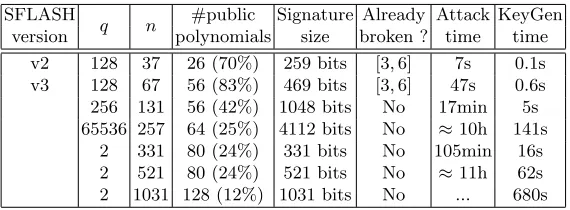
key is less than n/2. We tried various combinations of field size and variable numbers, and found out that the attack works quite well in practice, as Table 1 shows. There are thus no longer any practically unbroken set of parameters for SFLASH.
SFLASH
q n #public Signature Already Attack KeyGen
version polynomials size broken ? time time
v2 128 37 26 (70%) 259 bits [3, 6] 7s 0.1s
v3 128 67 56 (83%) 469 bits [3, 6] 47s 0.6s
256 131 56 (42%) 1048 bits No 17min 5s
65536 257 64 (25%) 4112 bits No ≈10h 141s
2 331 80 (24%) 331 bits No 105min 16s
2 521 80 (24%) 521 bits No ≈11h 62s
2 1031 128 (12%) 1031 bits No ... 680s
Table 1.Experimental results
References
1. Albert, A.A.: Symmetric and alternate matrices in an arbitrary field, i. Transac-tions of the American Mathematical Society43(3) (1938) 386–436
2. Bosma, W., Cannon, J.J., Playoust, C.: The Magma Algebra System I: The User Language. J. Symb. Comput.24(3/4) (1997) 235–265
3. Dubois, V., Fouque, P.A., Shamir, A., Stern, J.: Practical Cryptanalysis of SFLASH. In: Crypto ’07. Volume 4622 of Lecture Notes in Computer Science., Springer-Verlag (2007)
4. Dubois, V., Fouque, P.A., Stern, J.: Cryptanalysis of SFLASH with Slightly Mod-ified Parameters. In: Eurocrypt ’07. Volume 4515 of Lecture Notes in Computer Science., Springer-Verlag (2007) 264–275
5. Fell, H.J., Diffie, W.: Analysis of a public key approach based on polynomial substitution. In Williams, H.C., ed.: CRYPTO. Volume 218 of Lecture Notes in Computer Science., Springer (1985) 340–349
6. Fouque, P.A., Macario-Rat, G., Stern, J.: Key recovery on hidden monomial mul-tivariate schemes. In Smart, N.P., ed.: EUROCRYPT. Volume 4965 of Lecture Notes in Computer Science., Springer (2008) 19–30
7. Lidl, R., Niederreiter, H.: Finite Fields. Cambridge University Press (2008) 8. Macario-Rat, G.: Cryptanalyse de sch´emas multivari´es et r´esolution du probl`eme
Isomorphisme de Polynˆomes. PhD thesis, Universit´e Paris Diderot — Paris 7 (June 2010)
9. Mahajan, M., Vinay, V.: Determinant: Combinatorics, algorithms, and complexity. Chicago J. Theor. Comput. Sci.1997(1997)
11. Ong, H., Schnorr, C.P., Shamir, A.: An efficient signature scheme based on quadratic equations. In: STOC, ACM (1984) 208–216
12. Ong, H., Schnorr, C.P., Shamir, A.: Efficient signature schemes based on polyno-mial equations. In: CRYPTO. (1984) 37–46
13. Patarin, J.: Cryptoanalysis of the Matsumoto and Imai Public Key Scheme of Eurocrypt’88. In: Crypto ’95. Volume 963 of Lecture Notes in Computer Science., Springer-Verlag (1995) 248–261
14. Patarin, J., Courtois, N., Goubin, L.: SFLASH, a Fast Multivariate Signature Algorithm (2003)http://eprint.iacr.org/.
15. Shamir, A.: Efficient Signature Schemes Based on Birational Permutations. In: Crypto ’93. Volume 773 of Lecture Notes in Computer Science., Springer-Verlag (1993) 1–12
16. Shor, P.W.: Polynomial-time algorithms for prime factorization and discrete loga-rithms on a quantum computer. SIAM J. Comput.26(5) (1997) 1484–1509 17. Stein, W., et al.: Sage Mathematics Software (Version 4.6.2). The Sage
Develop-ment Team. (2011)http://www.sagemath.org.
18. Wolf, C., Preneel, B.: Equivalent Keys in HFE, C∗, and Variations. In: Mycrypt ’05. Volume 3715 of Lecture Notes in Computer Science., Springer-Verlag (2005) 33–49
A
Mathematical Results
Lemma 8. Let P=λA+µB be a matrix pencil over K, symmetric and with null diagonal, of any dimension n. Its determinant is a bivariate form of degree
n. Ifnis odd,det(M) = 0, and ifnis even, there exists a bivariate formkover Kof degreen/2such that det(M) =k2.
Proof. We will prove this result using a recurrence in a 2 by 2 step. For n= 1,
M = (0) and det(M) = 0. Forn= 2, we haveM =
0k k0
, wherekis a
bivari-ate form of degree 1 and det(M) =k2. Now, letn≥3 and assume the property is true forn−2. We will show that it is also true forn. We compute the determi-nant ofM by developing according to the first column. Since the (1,1)-coefficient ofM is null, we have det(M) =Pn
i=2Mi,1det(Mi1), whereMi,1 denote the co-efficient (i,1) ofM and det(M1
i) the (1, i) minor. We can see that in all these minors, the first row has never been removed and always the first column. We can now do a development according to the first row and using the multi-linearity of the determinant, we get det(M) =Pn
i=2
Pn
j=2Mi,1M1,jdet(M 1,j
1,i), whereM 1,j 1,i denote the matrix M by removing the rows 1 and iand the columns 1 and j. Since M is symmetric, we can add together the terms (i, j) and (j, i) fori6=j
and these terms vanish. The determinant that we compute is equal to det(M) = Pn
i=2M 2 i,1det(M
1,i
1,i). Now we can use the recurrence assumption and ifnis odd, det(M) = 0 and ifn is even, det(M) =Pn
i=2M 2 i,1k
2 i = (
Pn
i=2Mi,1ki)2, where the forms ki, fori= 2, . . . , n are of degree (n−2)/2. Consequently, the degree of the formPn
Lemma 9. Let Pλ,µ be an arbitrary pencil of quadratic forms. There exist a family of bivariate polynomials {pi}0≤i≤d in K[x, y] such that pi is of degreei, and the characteristic polynomial of the polar form ofPis:
χ(ψ(Pλ,µ)) = d
X
i=0
pi2·Xn−2i.
Proof. The result follows from lemma 8. The coefficient ofXn−iin χ(ψ(Pλ,µ)) is the sum of all M minors obtained by choosing n−i diagonal terms and removing the (n−i) corresponding rows and columns. The minors obtained are
of dimensioni. ut
B
Simultaneous Diagonalization of two Quadratic Forms
Lemma 10. ψ(P)(ci, cj) = 0 for 0≤i, j≤d.
Proof. Let (λ, µ) and (λ0, µ0) two pairs of variables inK2 such thatλµ0+λ0µ6= 0. Because peS(λ, µ) and peS(λ
0, µ0) are the kernels of λψ(P
1) +µψ(P2) and
λ0ψ(P
1) +µ0ψ(P2) respectively, we find:
(λψ(P1) +µψ(P2))(peS(λ, µ),peS(λ
0, µ0)) = 0
(λ0ψ(P1) +µ0ψ(P2))(peS(λ, µ),peS(λ0, µ0)) = 0 By linear combination, we have
(λµ0+λ0µ)ψ(P1) (peS(λ, µ),epS(λ0, µ0)) = 0 (λµ0+λ0µ)ψ(P2) (peS(λ, µ),epS(λ
0, µ0)) = 0
and since (λµ0+λ0µ)6= 0,
ψ(P1) (peS(λ, µ),peS(λ
0, µ0)) = 0
ψ(P2) (peS(λ, µ),peS(λ
0, µ0)) = 0.
Finally, thanks to the linearity ofψ(P1) andψ(P2), we get: d
X
i=0 d
X
j=0
ψ(P1) (ci, cj)·λd−iµiλ0 d−j
µ0j= 0
d
X
i=0 d
X
j=0
ψ(P2) (ci, cj)·λd−iµiλ0 d−j
µ0j= 0.ut
Lemma 11. For any family{ri}0≤i≤d of polynomials over K, we have:
P d
X
i=0
ri·ci
!
= d
X
i=0
Proof. We will prove it by induction on the number of non null polynomials in the family. We have P(r1·c1) = r12·P(c1) since P is a (pencil of) quadratic form(s) whose coefficients are bivariate polynomials overK. Let us assume that the result holds for k−1 polynomial. According to the definition of the polar form, we can write:
P
k
X
j=1
rj·cj
=
P(r1c1) +P
k
X
j=2
rj·cj
+ψ(P)
r1·c1, k
X
j=2
rj·cj
=
r12·P(c1) + k
X
j=2
rj2·P(cj) + k
X
j=2
r1·cj·ψ(P)(c1, cj).
And lemma 10 allows to conclude.
C
Showing Independence of the Coefficients of a
Polynomial
We concentrate on a simpler polynomial of the formQd−1
i=0(x+t qi
).
Definition 1. Letd≥1 a positive integer. We call elementary symmetric poly-nomials of orderd, thed+ 1polynomials withdvariablesσi,d,0≤i≤ddefined implicitly by:
d
Y
i=1
(X+Xi) = d
X
i=0
σi,d(X1, . . . , Xd)Xd−i.
We also recall the following lemma useful to prove that a family of elements in Fis independent [7].
Lemma 12. Let A={αi}0≤i≤d a family of elements of F. The elements in A are independent if and only if the determinant of the matrix(αqij)0≤i,j≤d is non null.
Lettan element ofF. In a first step we try to find an equivalent condition to the fact that the coefficients of the polynomialQd−1
i=0(x+t qi
) are independent. These coefficients can be expressed using the elementary symmetric polynomials. They are equal to{σi,d(t, tq, . . . , tq
d−1
)}0≤i≤d.
We describe some notations. We denote bysi,d and∆d the mapping overF defined by:
si,d(x) =σi,d(x, xq, . . . , xq
d−1
), ∆d(x) = det((si,d(x)q
j
Using the above lemma, and these notations, we can say that the coefficients of the polynomialQn
i=d+1(x+tq
2iθ
) are independent if and only if∆d(t)6= 0. In the following, we try to compute some simple expression for∆d.
Lemma 13. For d andi integers such that 0 ≤i≤d, the Frobenius mapping commute with the mappingssi,d, i.e. for everyx∈F,si,d(xq) =si,d(x)q. Proof. The mappingssi,d(x) are by construction sums of elementary functions
x7→xqj1+...+qji, 0≤j
1< . . . < ji≤d−1. The Frobenius mapping is linear and
commute with each of these monomials. ut
Lemma 14. Fordandi integers such that1≤i≤d, we have:
si,d(x) +si,d(xq) =si−1,d−1(xq)(x+xq
i
).
Proof. We have the following relations:
Qd−1
i=0(X+x qi
) +Qd−1
i=0(X+x qi+1
) = (x+xqi)Qd−1
i=1(X+x
qi) = (x+xqd)Qd−2
i=0(X+x qi+1)
and
d−1
Y
i=0
(X+xqi) = d
X
i=0
si,d(x)Xd−i
d−1
Y
i=0
(X+xqi+1) = d
X
i=0
si,d(xq)Xd−i
d−2
Y
i=0
(X+xqi) = d
X
i=0
si,d−1(x)Xd−1−i.
We get the desired equality by considering the coefficientXd−i. ut Lemma 15. Ford≥1, we have:
∆d(x) =∆d−1(xq)(x+xq
d
)1+q+...+qd−1.
Proof. The function∆dis a determinant of dimensiond+1. We can note that the first line is composed ofd+1 times the value 1 since for 0≤j≤d,sq0,dj = 1qj = 1. We do not change the value of the determinant by adding each column to its right neighbor. After this operation, the first line is composed of one time the value 1 and d times the value 0. After this addition and using lemma 14, the term (i+ 1, j+ 1) is:
si+1,d(x)q
j
+si+1,d(x)q
j+1
= (si,d(x) +si,d(xq))q
j
=si,d+1(xq)q
j
(x+xqd)qj,
which correspond to the term (i, j) of∆d−1(xq) times (x+xq
d
)qj. By developing the determinant using its first row, we recover∆d−1(xq) times the factors of each column, that isQd−1
j=0(x+x
Theorem 7. Ford≥1,
∆d(x) = d
Y
i=1
(x+xqi)qd−i+...+qd−1.
Proof. By induction. Indeed, the formula is straightforward ford= 1 and
∆1(x) = det
1 1
x xq
=x+xq.
Assume that it is true ford−1, on get:
∆d−1(xq) = d−1
Y
i=1
(xq+xqi+1)qd−1−i+...+qd−2
∆d−1(xq) = d−1
Y
i=1
(x+xqi)qd−i+...+qd−1.