Available online: https://journals.pen2print.org/index.php/ijr/ P a g e | 56
A Secure Cloud Storage Based Multi-Server Public Key
Encoding for Keyword Word
Mohammed Abdul Samad 1and MdAteeq Ur Rahman 2,
1Mtech Scholar, Dept. of Computer Science & Engineering,
SCET, Hyderabad
2Professor and Head, Dept. of Computer Science & Engineering,
SCET, Hyderabad
Abstract -
Accessible catchphrase is ofextraordinary enthusiasm for protecting the
data protection in secure accessible distributed
storage. In this paper, we have an attempted to
explore the security of an outstanding logical
control crude, in particular, open key encoding
with catchphrase search (PEKS) that is
incredibly useful in a few uses of distributed
storage. Unfortunately, it's been demonstrated
that the standard PEKS system experiences
partner degree natural uncertainty known as
inside watchword gauge assault (KGA)
propelled by the malevolent server. To manage
this security defenselessness, we tend to
propose a shiny new PEKS system named
double server PEKS (DS-PEKS). As another
primary commitment, we tend to diagram a
fresh out of the plastic new variation of the
smooth projective hash capacities (SPHFs)
expressed as straight and homomorphic SPHF
(LH-SPHF). we tend to then demonstrate a
conventional development of secure DS-PEKS
from LH-SPHF. for example the practicability
of our new system, we offer partner degree
affordable portrayal of the last structure from a
decision Diffie–Hellman-based LH-SPHF and
demonstrate that it can do the hearty protection
from inside the KGA. Accessible cryptography
will be cultivated in either respective or uneven
cryptography setting. In, Song et al. anticipated
watchword search on ciphertext, alluded to as
Searchable reciprocal cryptography (SSE) and
later numerous south southeast plans , were
intended for upgrades. despite the fact that
south southeast plans get joy from high power,
they experience the ill effects of modern mystery
key dispersion. Unequivocally, clients should
immovably share mystery keys that square
measure utilized for encryption.
Else they're incapable to share the encoded
data re-appropriated to the cloud. To determine
Available online: https://journals.pen2print.org/index.php/ijr/ P a g e | 57
adaptable crude, explicitly Public Key
cryptography with Keyword Search (PEKS)
that enables a client to go glimpsing encoded
data inside the uneven cryptography setting. in
an exceedingly PEKS framework, exploitation
the recipient's open key, the sender connects
some scrambled watchwords (alluded to as
PEKS ciphertexts) with the encoded data. The
collector at that point sends the trapdoor of a
to-be-scanned catchphrase to the server for
data looking. Given the trapdoor and
furthermore the PEKS ciphertext, the server
will investigate whether the watchword
fundamental the PEKS ciphertxt is up to the one
choose by the collector. Provided that this is
true, the server sends the coordinating encoded
data to the collector.
Index Terms—Servers, Encryption , Public key, Keyword search, Receivers
I.
INTRODUCTION
Distributed storage redistributing has turned
into a well-enjoyed application for undertakings
and associations to curtail the weight of keeping
up monstrous learning as of late. In any case, as
a general rule, complete clients may not by any
means trust the distributed storage servers and
will support to write their insight before
transferring them to the cloud server to protect
the data security. This normally makes the data
use more enthusiastically than the standard
stockpiling any place information is solid inside
the nonattendance of cryptography. one in
everything about regular arrangements is that
the accessible cryptography that allows the
client to recover the encoded reports that
contain the client determined watchwords,
where given the catchphrase trapdoor, the
server will understand the data required by the
client while not decipherment.
Accessible cryptography will be cultivated
in either respective or uneven cryptography
setting. In, Song et al. anticipated catchphrase
search on ciphertext, alluded to as Searchable
respective cryptography (SSE) and later
numerous south southeast plans , were intended
for upgrades. inspite of the fact that south
southeast plans get joy from high strength, they
experience the ill effects of advanced mystery
key circulation. Unequivocally, clients should
immovably share mystery keys that square
measure utilized for encryption. Else they're
inadequate to share the encoded data
redistributed to the cloud. To determine this
drawback, Boneh et al.
Available online: https://journals.pen2print.org/index.php/ijr/ P a g e | 58
Keyword Search (PEKS) that enables a
client to go glimpsing scrambled data
inside the uneven cryptography setting.
in an exceedingly PEKS framework,
exploitation the beneficiary's open key,
the sender connects some encoded
watchwords (alluded to as PEKS
ciphertexts) with the scrambled data. The
collector at that point sends the trapdoor
of a to-be-scanned catchphrase to the
server for data looking. Given the
trapdoor and furthermore the PEKS
ciphertext, the server will investigate
whether the watchword basic the PEKS
ciphertxt is up to the one choose by the
recipient. Assuming this is the case,
the server sends the coordinating encoded data tothe recipient.
In spite of being free from mystery key
conveyance, PEKS plans experience the ill
effects of partner inalienable instability
identifying with the trapdoor watchword
security, especially inside Keyword dead
retribution Attack (KGA). the method of
reasoning bringing about such a security
defenselessness is, that any individual WHO
knows about recipient's open key will create the
PEKS ciphertext of discretional catchphrase
himself. In particular, given a trapdoor, the
antagonistic server will decide on a dead
retribution catchphrase from the watchword
house thus utilize the catchphrase to get a
PEKS ciphertext. The server at that point will
test whether the dead retribution watchword is
that the one basic the trapdoor. This speculating
then-testing methodology will be consistent
until the correct watchword is found. Such a
dead retribution assault has moreover been idea
of in a few secret key based frameworks. Be
that as it may, the assault will be propelled a
great deal of with effectiveness against PEKS
plans since the watchword house is generally
consistent as a typical dictionary (e.g., all the
intentional English words),which incorporates a
bounteous littler size than a slogan vocabulary
(e.g., every one of the words containing about
six character set characters). It is cost taking
note of that in south southeast plans,
exclusively mystery key holders can produce
the catchphrase ciphertext and thereupon the
ill-disposed server can't dispatch the inside KGA.
since the watchword dependably demonstrates
the protection of the client learning, it's
Available online: https://journals.pen2print.org/index.php/ijr/ P a g e | 59 security risk for secure accessible scrambled
information re-appropriating.
II.
Related Works
2.1 Existing System
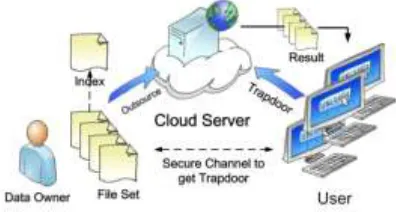
In a PEKS framework, abuse the
recipient's open key, the sender connects some
scrambled catchphrases (alluded to as PEKS
ciphertexts) with the encoded information. The
beneficiary at that point sends the trapdoor of a
to-be-scanned catchphrase to the server for
learning looking. Given the trapdoor and
accordingly the PEKS ciphertext, the server
will investigate whether the watchword basic
the PEKS ciphertxt is up to the one assigned by
the recipient. Provided that this is true, the
server sends the coordinating encoded learning
to the receiver.Baek et al. arranged an
electronic fighting PEKS subject while not
requiring a protected channel, that is named as a
safe sans channel PEKS (SCF-PEKS).Rhee et
al. later expanded Baek et al's. security model
for SCF-PEKS any place the guilty party is
permitted to get the association between the
non-challenge ciphertexts and in this manner
the trapdoor.Byun et al.introduced the
disconnected watchword estimate assault
against PEKS as catchphrases square measure
browsed a way littler territory than passwords
and clients in some cases utilize surely
understood watchwords for looking records.
2.2 Disadvantages:
Despite of being free from
mystery key appropriation, PEKS plans
experience the ill effects of partner degree
inalienable instability concerning the trapdoor
watchword security, especially inside Keyword
dead retribution Attack (KGA). the method of
reasoning bringing about such a security
defenselessness is, that any individual WHO
knows about beneficiary's open key will
produce the PEKS ciphertext of indiscreet
catchphrase himself.
Specifically, given a trapdoor,
the antagonistic server will choose a dead
retribution catchphrase from the watchword
house at that point go through the catchphrase
to accompany a PEKS ciphertext. The server at
that point will check whether the dead
retribution watchword is that the one hidden the
trapdoor. This speculating then-testing strategy
will be nonstop till the correct catchphrase is
found.
On one hand, however the server
can't definitely figure the catchphrase, it's as yet
Available online: https://journals.pen2print.org/index.php/ijr/ P a g e | 60 watchword has a place with thus the
catchphrase security isn't very much protected
from the server. On the contrary hand, their
subject is illogical on the grounds that the
beneficiary needs to territorially understand the
coordinating ciphertext by exploitation the
exact trapdoor to strain the non-coordinating
ones from the set originated from the server.
III.
PROPOSED SYSTEM
The commitments of this paper ar
four-overlap. we will in general formalize a fresh out
of the plastic new PEKS structure named
Dual-Server Public Key encoding with Keyword
Search (DS-PEKS) to deal with the wellbeing
helplessness of PEKS. a fresh out of the plastic
new variation of wash Projective Hash perform
(SPHF), refered to as direct and homomorphic
SPHF, is presented for a nonexclusive
development of DS-PEKS.
We demonstrate a nonexclusive
development of DS-PEKS abuse the arranged
Lin-Hom SPHF. for example the
practicableness of our new system, Associate in
Nursing prudent portrayal of our SPHF upheld
the Diffie-Hellman language is given during
this paper.
Advantages:
All the present topics need the matching
calculation all through the age of PEKS
ciphertext and testing and along these lines
zone unit less conservative than our plan, that
doesn't need any blending calculation.
Our topic is that the best regarding
PEKS calculation. it's because of that our
subject doesn't exemplify blending calculation.
altogether, the present subject needs the
principal calculation value attributable to a
couple of matching calculation per PEKS age.
In our subject, however we will in
general also need another phase for the testing,
our calculation cost is truly underneath that of
any current topic as we will in general needn't
bother with any blending calculation and each
one the looking work is dealt with by the
server.
IV. System Architecture
Available online: https://journals.pen2print.org/index.php/ijr/ P a g e | 61 V. Module Description:
In System Construction Module
Semantic-Security against Chosen Keyword Attack
Front Server
Back Server
System Construction Module
In the underlying module, we tend to build
up the framework with the elements expected to
provde our framework. 1) Cloud User: the
client, World Health Organization is an
individual or an organization initially putting
away their insight in cloud and getting to the
data. 2) Cloud Service provider (CSP): the CSP,
World Health Organization oversees cloud
servers (CSs) and gives a paid space to putting
away on its framework to clients as an
administration. we tend to propose a
substitution structure, especially DS-PEKS, and
blessing its formal definition and security
models. we tend to then blueprint a substitution
variation of wash projective hash perform
(SPHF). A conventional development of
DS-PEKS from LH-SPHF is appeared with formal
rightness examination and security proofs. At
last, we tend to blessing Associate in Nursing
practical mental portrayal of DS-PEKS from
SPHF.
Semantic-Security against Chosen Keyword Attack
In the module, we tend to build up the
semantic-protection from picked watchword
assault that ensures that no human is in a
situation to separate a catchphrase from another
given the relating PEKS ciphertext. That is, the
PEKS ciphertext doesn't uncover any
information with respect to the basic
catchphrase to any human.
Front Server:
In the wake of getting the inquiry from the
beneficiary, the front server pre-forms the
trapdoor and each one the PEKS ciphertexts
misuse its own key, at that point sends some
inward testing-states to the back server with the
comparing trapdoor and PEKS ciphertexts
covered up.
Back Server:
In this module, the back server will at that
point choose that archives region unit
questioned by the recipient misuse its own key
and along these lines the got inner testing-states
from the front server.
Available online: https://journals.pen2print.org/index.php/ijr/ P a g e | 62
Available online: https://journals.pen2print.org/index.php/ijr/ P a g e | 63 VII. Conclusion
In this project, we proposed another system,
namedDual-Server Public Key Encryption with
Keyword Search(DS-PEKS), that can avert
within catchphrase guessingattack which is a
characteristic defenselessness of the
Available online: https://journals.pen2print.org/index.php/ijr/ P a g e | 64 presented another Smooth ProjectiveHash
Function (SPHF) and utilized it to build a
genericDS-PEKS conspire. An effective
instantiation of the new SPHFbased on the
Diffie-Hellman issue is additionally introduced
inthe paper, which gives a productive DS-PEKS
conspire withoutpairings. To manage this
security powerlessness, we tend to propose a
shiny new PEKS structure named double server
PEKS (DS-PEKS). As another primary
commitment, we tend to plot a shiny new
variation of the smooth projective hash
capacities (SPHFs) expressed as straight and
homomorphic SPHF (LH-SPHF). we tend to
then demonstrate a nonexclusive development
of secure DS-PEKS from LH-SPHF. for
example the practicability of our new structure,
we offer partner degree efficient portrayal of
the last system from a decision
Diffie–Hellman-based LH-SPHF and demonstrate that it can do
the powerful protection from inside the KGA.
VIII. Bibliography
[1] R. Chen, Y. Mu, G. Yang, F. Guo, and X. Wang, “A new generalframework for secure public key encryption with keyword search,”in Proc. 20th Australasian Conf. Inf. Secur. Privacy (ACISP), 2015,pp. 59–76.
[2] D. X. Song, D. Wagner, and A. Perrig, “Practical techniques for searcheson encrypted data,” in Proc. IEEE Symp. Secur. Privacy, May 2000,pp. 44–55.
[3] R. Agrawal, J. Kiernan, R. Srikant, and Y. Xu, “Order preservingencryption for numeric data,” in Proc. ACM SIGMOD Int. Conf. Manage.Data, 2004, pp. 563–574.
[4] R. Curtmola, J. Garay, S. Kamara, and R. Ostrovsky, “Searchablesymmetric encryption: Improved definitions and efficient constructions,”in Proc. 13th ACM Conf. Comput. Commun. Secur. (CCS), 2006,pp. 79–88.
[5] D. Boneh, G. Di Crescenzo, R. Ostrovsky, and G. Persiano, “Publickey encryption with keyword search,” in Proc. Int. Conf. EUROCRYPT,2004, pp. 506–522.
[6] IEEE TRANSACTIONS ON INFORMATION FORENSICS AND SECURITY, VOL. 11, NO. 4, APRIL 2016 “Dual-Server Public-Key Encryption With Keyword Search for Secure Cloud Storage”
[7] B. R. Waters, D. Balfanz, G. Durfee, and D. K. Smetters, “Building an encrypted and searchable audit log,” in Proc. NDSS, 2004, pp. 1–11.
[8] M. Abdalla et al., “Searchable encryption revisited: Consistency properties, relation to anonymous IBE, and extensions,” in Proc. 25th Annu. Int. Conf. CRYPTO, 2005, pp. 205–222.
[9] D. Khader, “Public key encryption with keyword search based on K-resilient IBE,” in Proc. Int. Conf. Comput. Sci. Appl. (ICCSA), 2006, pp. 298–308.