A HANDOVER TECHNIQUE FOR INTER- AND INTRA- DOMAIN PROXY MOBILE IPv6 IN VEHICULAR NETWORK ENVIRONMENT
Haider N. Hussain
A HANDOVER TECHNIQUE FOR INTER- AND INTRA- DOMAIN PROXY MOBILE IPv6 IN VEHICULAR NETWORK ENVIRONMENT
HAIDER N. HUSSAIN
A thesis submitted in fulfilment of the requirements for the award of the degree of
Doctor of Philosophy (Computer Science)
Faculty of Computing Universiti Teknologi Malaysia
To my mother and father Professor. Dr. Noori Hussain AL-Hashimi, whom always wanted their children to get the best education and be proud of their achievements.
Their hard work, specially restless days and nights has paid them well of being proud. Thank you for your immense love, your precious, supports and for all that you
ACKNOWLEDGEMENT
First and foremost, I would like to profoundly praise The Almighty Allah, who has shown me the right path, provided me the strength and knowledge to complete this research.
I would like to thank my supervisor Associate Professor Dr. Kamalrulnizam Bin Abu Bakar and co-supervisor Professor. Dr. Shaharuddin Salleh for their excellent guidance through the labyrinths of research, helping me to clear my thoughts and grasp problems from the right sides. It would be very difficult to complete this research successfully without their suggestions, advises and thoughts.
ABSTRACT
ABSTRAK
TABLE OF CONTENTS
CHAPTER TITLE PAGE
DECLARATION ii
DEDICATION iii
ACKNOWLEDGEMENT iv
ABSTRACT v
ABSTRAK vi
TABLE OF CONTENTS vii
LIST OF TABLES xii
LIST OF FIGURES xiii
LIST OF ABBREVIATIONS xvi
LIST OF SYMBOLS xxi
LIST OF APPENDICES xxiii
1 INTRODUCTION 1
1.1 Overview 1
1.2 Problem Background 3
1.2.1 Inter-Domain PMIPv6 Mobility Support 4 1.2.2 Intra-Domain PMIPv6 Mobility Support 6 1.2.3 Obtaining MNs Context for Handover Triggering
Support
7
1.2.4 Local Mobile Anchor (LMA) Inter-domain Support
8
1.3 Problem Statement 9
1.5 Research Aim 11
1.6 Research Objectives 11
1.7 Research Scope 12
1.8 Significance of the Study 13
1.9 Research Contribution 14
1.10 Thesis Organization 14
2 LITERATURE REVIEW 16
2.1 Introduction 16
2.2 Mobility Management in Vehicular Networks 18 2.2.1 Vehicular to Infrastructure (V2I) Mobility
Management
20 2.2.2 Vehicular to Vehicular (V2V) Mobility
Management
21
2.3 Host Based Mobility 22
2.3.1 Mobile IPv6 (MIPv6) 22 2.3.1.1 Movement Detection 24 2.3.1.2 Address Configuration 25 2.3.1.3 Binding Update and
Binding Acknowledgement
26 2.3.2 Fast Mobile IPv6 27 2.3.2.1 Anticipated and Handover Initiation 28 2.3.2.2 Updating the Previous Access Router 29 2.3.3 Hierarchical Mobile IPv6 30 2.4 Mobility with IEEE 802.21 MIH Services 31 2.4.1 Media Independent Handover Architecture 33 2.4.1.1 Media Independent Handover services 34 2.4.1.2 Media Independent Event Service 35 2.4.1.3 Media Independent Command Service 37 2.4.1.4 Media Independent Information Service 37 2.4.2 Media Independent Handover protocol Frame
Format
2.5 Network Based Mobility 40 2.5.1 Proxy Mobile IPv6 40 2.5.1.1 PMIPv6 with MIPv6 for Global Mobility
Support
46
2.5.1.2 Inter-domain handover scheme using an intermediate mobile access gateway
48
2.6 Motion Classification 50
2.7 Summary 56
3 RESEARCH METHODOLOGY 57
3.1 Introduction 57
3.1.1 Comparison Framework 61 3.2 Research Design and Procedure 61 3.2.1 Inter-domain PMIPv6 62 3.2.2 Intra-domain PMIPv6 63 3.2.2.1 Mobile Access Gateway Extension 64 3.2.2.2 Vehicle Extension 65
3.2.3 Network Model 66
3.2.4 Performance Evaluation 68 3.2.4.1 Numerical Results 70 3.2.4.2 Overlap area Impact on Handover 71
3.3 Assumption and Limitations 72
3.4 Summary 73
4 DESIGN AND ANALYSIS 74
4.1 Introduction 74
4.2 Proposed inter-intra domain PMIPv6 Framework design 75 4.2.1 MIH (IEEE 802.21) Proposed Primitives and
Parameters
83
Structure
4.3 Mathematical Analysis 86
4.3.1 Inter-Intra PMIPv6 Network Mathematical Analysis 86 4.3.2 Handover Latency Analysis 90 4.3.2.1 PMIPv6 Handover Extensions 91 4.3.2.2 Inter-intra domain PMIPv6 proposed
technique
94
4.3.2 Signaling Cost Modeling 97 4.3.2.1 Proxy Mobile IPv6 (PMIPv6) 98 4.3.2.2 Inter-domain PMIPv6 100 4.3.2.3 Inter-domain PMIPv6 scheme using
I-MAG
101
4.3.2.4 Proposed inter-intra domain PMIPv6 102 4.4 Handover Estimation Engine using HNI 105 4.5 Vehicle Motion Classification 108
4.6 Summary 110
5 PROPOSED INTER-INTRA DOMAIN PMIPV6
TECHNIQUE
112
5.1 Introduction 112
5.2 Proposed Inter-Intra Domain Proxy Mobile IPv6 Technique
113
5.2.1 Proposed Inter-Domain PMIPv6 Overview 113 5.2.2 Inter-domain PMIPv6 with Logical Interface 117 5.2.3 Proposed Intra-domain PMIPv6 Overview 119 5.3 Inter-Intra domain Handover Procedure 120 5.3.1 Proposed Inter-Domain PMIPv6 Handover
Operation
121
5.3.2 Proposed Inter-Domain PMIPv6 with (LI) Handover Operation
124
5.3.3 Proposed intra-domain PMIPv6 with (LI) Handover Operation
5.4 Results and Discussion 129 5.4.1 Inter-domain PMIPv6 analytical Model 129 5.4.1.1 Experimental Setup 129 5.4.1.2 Impact of Vehicle Speed 130 5.4.1.3 Communication Overhead Impact 135 5.4.1.4 Session Arrival Rate Impact on Packet
Delivery
137
5.4.2 Inter-domain PMIPv6 Extension analytical Model 141 5.4.2.1 Numerical Results 142 5.4.3 Intra-domain PMPv6 analytical Model 145 5.4.3.1 Impact of Vehicle Speed 145 5.4.3.2 Communication Overhead Impact 146 5.4.3.3 Session Arrival Rate Impact on Packet
Delivery
147
5.5 Summary 150
6 CONCLUSION AND FUTURE WORK 152
6.1 Overview 152
6.2 Achievements 152
6.3 Research Summary 154
6.4 Future Directions and Research Opportunities 156
REFERENCES 158
LIST OF TABLES
TABLE NO. TITLE PAGE
2.1 Handover Process Parameters 51
2.2 Comparison of Mobility Protocols for MIP 55
3.1 The overall research plan 60
3.2 Parameters to calculate the performance metrics 69
3.3 Table Mobility messages sizes 70
4.1 New primitives and parameters of the proposed
inter-domain PMIPv6 technique
83
4.2 The notations used in the Handover Analytical
modeling
91
4.3 Handover Mathematical and cost Modeling Analysis 105
5.1 Binding cash entry pLMA 118
5.2 Binding cash entry nLMA 118
5.3 Handover latency results (Data Link Layer “200-400 ms”)
132
LIST OF FIGURES
FIGURE NO. TITLE PAGE
1.1 Multicast scheme in intra-domain and inter-domain 6 1.2 Inter-domain tunnel establishment issues 9 2.1 Taxonomy of the literature on mobility and handover
management protocols
17
2.2 General vehicular networks model 18
2.3 Mobility Management over Wireless Network 19 2.4 Vehicle Mobility Management Requirements 20 2.5 Taxonomy of mobility management solutions for
vehicular network
22
2.6 MIPv6 Standard Handover 23
2.7 MIPv6 Handover Latency Time Line 26
2.8 FMIPv6 Standard Handover 27
2.9 FMIPv6 Handover Latency Time Line 29
2.10 Simplified View of HMIPv6 30
2.11 HMIPv6 Handover Latency Time Line 31
2.12 Media Independent Handover Structure 32
2.13 MIH Protocol Frame Format 40
2.14 Basic PMIPv6 Domain Terminologies 41
2.15 PMIPv6 Initial Attachment Signalling Flow Phase 43 2.16 PMIPv6 Handover Procedure Signalling Flow Phase 44
2.17 PMIPv6 Handover Latency Time Line 44
2.18 PMIPv6 Deployment in VANET 45
2.19 Inter-Domain PMIPv6 Handover Procedure and Timing Diagram
47
2.21 I-MAG Network Architecture 49
2.22 Handover Analysis 50
3.1 Research framework 58
3.2 Mobility manager modules 64
3.3 Modified PBU Message 65
3.4 Proposed vehicle extension 66
3.5 Proposed Inter-Domain Network Architecture 67 3.6 Proposed Intra-Domain Network Architecture 68 3.7 Relationship between the overlapping areas 71 4.1 PMIPv6 Handover Process Modified with MIH (IEEE
802.21)
76
4.2 Proposed Extension for LMA process 77 4.3 Proposed Extension for nMAG LMA process 80 4.4 Proposed handover mechanism using MIH 84 4.5 Homogeneous Network Information (HNI) Request 85
4.6 HNI response message 85
4.7 PMIPv6 Handover timing diagram 91
4.8 Proposed Inter-domain PMIPv6 handover timing diagram 95 4.9 Handover estimation engine diagram 107 4.10 Vehicle movement within the network between PMIPv6
domains
108
4.11 Markov Model for vehicle mobility direction 109 5.1 A Proposed Process Flow for Handover in the Proposed
Inter-PMIPv6
114
5.2 PMIPv6 Overlapping Domains 115
5.3 Inter-Domain Network Architecture 118
5.4 Proposed Process Flow for handover in the Proposed Intra-PMIPv6
120
5.5 Proposed inter-domain handover signaling 122 5.6 Proposed inter-domain handover signaling with logical
interface
125
7.5 Logical Interface Implementation 127
5.9
Effect of speed on the handover latency Data Link Layer (200-400 ms)
130
5.10 Effect of speed on the handover latency Data Link Layer (40 ms)
132
5.11 Figure 5.11 Handover Latency versus Wireless Link Latency (a) DL= 200-400 ms, (b) DL= 40 ms
134
5.12 Effect of speed on the communication overhead 136 5.13 Packet loss when (a) E (S) = 10, (b) E (S) = 20 138 5.14 Packet loss when (a) E (S) = 10, (b) E (S) = 20 139
5.15 Packet delivery cost 140
5.16 Performance evaluation of the inter-domain PMIPv6 141 5.17 Effect of speed on the handover latency/with Fixed Data
Link Layer
142
5.18 Effect of speed on the handover latency Data Link Layer (200-400 ms)
143
5.19 Packet delivery cost 144
5.20 Handover Performance Evaluation 144
5.21 Effect of speed on the handover latency 145 5.22 Effect of speed on the communication overhead 146 5.23 Intra-domain Packet loss when (a) E (S) = 10,
(b) E (S) = 20
148
5.24
Intra-domain Packet loss when (a) E (S) = 10, (b) E (S) = 20
149
5.25
Intra-Domain Handover Latency versus Wireless Link Latency
LIST OF ABBREVIATIONS
AAA – Authentication Authorization and Accounting
AN – Access Network
AP – Access Point
AR – Access Router
ARP / ND – Address Resolution Protocol / Neighbor discovery BA – Binding Acknowledgement
BCE – Binding Cash Entry
BS – Base Station
BU – Binding Update
BUL – Binding Update List
CALM – Continuous Air Interface for Long and Medium Range CN – Correspondent Nodes
CoA – Care-of-Address
CoT – Care-of Test
CoTI – Care-of Test Init
CS – Command Service
DAD – Duplicate Address Detection
DHCPv6 – Dynamic Host Configuration Protocol for IPv 6 EE – Estimation Engine
ES – Event Service
FMIPv6 – Fast Mobile IPv6
FQDN – Fully Qualified Domain Name GPS – Global Positioning System
GSM – Global System for Mobile communications
HA – Home Agent
HMIPv6 – Hierarchical Mobile IPv6
HNI – Homogeneous Network Information HNP – Home Network Prefix
IE – Information Element
IEEE – Institute of Electrical and Electronics Engineers IETF – Internet Engineering Task Force
I-MAG – Intermediate Mobile Access Gateway Interface ID – Interface Identifier
IP – Internet Protocol IP – Internet Protocol I-PMIPv6 – Inter domain PMIPv6 IPv6 – Internet Protocol version 6 IPv6S – IPv6 stack
IS – Information Service ISP – Internet Service Provider
ITU-T – The International Telecommunication Union
L2 – Layer 2
L2 trigger – Information from L2 that informs L3 of particular events before and after L2 handover
L3 – Layer 3
LI – Logical Interface LI – Logical Interface LLC – Logical Link Control
LMA – Local Mobile Anchor
LMAA – Local Mobile Anchor Address LMD – Local Mobile Domain
LTE – Long Term Evolution MAC – Media Access Control
MAG – Mobile Access Gateway
MANET – Mobile Ad-Hoc Network MAP – Mobility Anchor Point
MICS – Media Independent Command Service MIES – Media Independent Event Service MIH – Media Independent Handover
MIHF – Media Independent Information Function
MIH-PrefixInfo – Media Independent Handover Prefix Information MIH-PrefixInfo – Media Independent Handover Information Prefix MIIS – Media Independent Information Service
MIPv6 – Mobile IPv6
MN – Mobile Node
MPR – Multipoint Relay
– Binding Update Message Sent from MN to HA
– Binding Acknowledgement Message
– Binding Update Message Sent from MN to CN
– Fast Binding Update Message
– Fast Binding Acknowledgment Message
– Binding Acknowledgment Message Sent by MAP
– Proxy Binding Update message sent from MAG to LMA
– Proxy Binding Acknowledgment Sent by LMA
– Route Solicitation for Proxy Message
– Proxy Rout Advertisement Message
– Handover Initiation Message – Handover acknowledge
– IPv6 Header
nCoA – New Care-of-Address NEMO – Network Mobility
NetLMM – Network-based Localized Mobility Management NGN – Next Generation Networks
NIMM – Network Information Management Module
nLMA – New LMA
nMAG – New MAG
NUD – Neighbor Unreach-ability Detection OSI – Open Systems Interconnection PAR – Previous Access Router
PBA – Proxy Binding Acknowledgment
PBU – Proxy Binding Update
pLMA – Previous LMA
pMAG – Previous MAG
PMIPv6 – Proxy Mobile IPv6 PoA – Pont of Attachment
RCoA – Regional Care of Address RR – Return Routability RS – Router Solicitation SAP – Service Access Points
TCP – Transmission Control Protocol TLV – Type Length Value
TTL – Time To Live
UDP – User Datagram Protocol V2I – Vehicle-to-Infrastructure V2V – Vhicle-to-Vehicle
VANET – Vehicular Ad-hoc Networks VMA – Virtual Mobility Anchor VoIP – Voice over IP
WiFi – Wireless-Fidelity
LIST OF SYMBOLS
– Intra-Domain Crossing Rate – Inter-Domain Crossing Rate – Inter-Intra Domain Crossing Rate – Average Number Of Intra-Cell Crossing – Average Number Of Inter-Cell Crossing – Average Number Of Cell Crossing Rate – Average Number Of Intra-Domain Handover
– Messaging Exchange
– PBU Messaging Exchange
– Data Link Layer Latency
– Delay of Delay Before Sending Initial RS Message – Location Registration
– Message Size
– Arrival Delay
– Connection Range
– RS Delay
– Authentication Delay
– Duplicate Address Detection Delay
– Inter PBU
– Route Advertisement
– Negotiation Time
– Relative Gain for Handover Performance O – Celle Overlap Area
LIST OF APPENDICES
APPENDIX TITLE PAGE
A Mathematical Analysis 163
INTRODUCTION
1.1 Overview
The International Telecommunication Union (ITU-T) recently, standardized Worldwide Interoperability for Microwave Access (WiMAX) and Long Term Evolution (LTE), for Next Generation Networks (NGN) networks, which have opened the door for deploying IP mobility support. This has laid the foundation for vehicular communications allowing vehicles to connect with the Internet while travelling roaming between networks. It is expected that Vehicular Ad-Hoc Networks (VANETs) communication will become a pressing need in the near future while providing ubiquitous connectivity over homogeneous and heterogeneous networks.
mobility protocols directly to vehicular networks. As a result, mobility protocols ratified by the Internet Engineering Task Force (IETF), (i.e. Mobile IPv6 (MIPv6), Fast Mobile IPv6 (FMIPv6), Hierarchical Mobile IPv6 (HMIPv6), and NEMO (Network Mobility)) are less preferable in vehicular environments.
Both MIPv6 and NEMO were selected by the Continuous Air Interface for Long and Medium Range (CALM) group to support host mobility and network mobility in vehicular networks (Ze-qun et al., 2009). However, the combination of protocols did not solve the Data Link Layer and Network Layer handover latency issues experienced in vehicular environments because, these protocols produced high handover latency. This led to additional problems, such as packet loss, extensive MIPv6 functionality in IPv6 stack of the Mobile Node (MN) (Kempf, 2007a) and signaling overhead. The IETF ratified PMIPv6 designed to provide network-based IP mobility management support and the MN was not required to participate in IP mobility-related signaling (Gundavelli et al., 2008).
1.2 Problem Background
In order to provide continuity of service for a MN roaming between Access Routers (ARs), the IETF has ratified various IP-based mobility management protocols such as host-based mobility management (i.e. MIPv6, FMIPv6, and HMIPv6) (Koodli, 2005; Perkins, 2002) and network-based mobility management (i.e. PMIPv6) . Even though MIPv6 is a well-known and mature standard for host-based IPv6 mobility support, it still has several problems and drawbacks, such as high handover latency, signaling overhead, packet loss, and extensive MIPv6 functionality in the MN IPv6 stack (Al-Surmi et al., 2012; Kempf, 2007b).
Host-based mobility protocols (MIPv6 and MIPv6 extensions) may partly reduce handover latency and packet loss in current mobile networks, but they cannot solve other issues related to the nature of based mobility. For example, host-based mobility protocols, in general and MIPv6, in particular, require host software stack changes that may not be compatible with other global mobility protocols (Soonghwan et al., 2009). PMIPv6 protocol was developed by IETF Network-based Local Mobility Management (NetLMM) Working Group (WG) to support IP mobility for MNs (Lee et al., 2011; Gundavelli, 2008). PMIPv6 provides service continuity for MNs in PMIPv6 domain without any IP mobility-related function. Currently, PMIPv6 cannot support inter-domain mobility management (global mobility management), because the PMIPv6 mobility protocol was originally designed for localized mobility management (Giaretta, 2012). There are many enhanced PMIPv6 schemes for supporting global mobility management (Giaretta, 2012; Jee-Hyeon et al., 2008), but none of them can support seamless mobility for an MN, due to long inter-domain handover latency and packet loss.
1.2.1 Inter-Domain PMIPv6 Mobility Support
New approaches and enhancements have been developed to provide inter-domain mobility management (Lee et al., 2009) and they can be classified into two groups:
i. The first group aims to unify PMIPv6 protocol and global mobility management protocols, such as MIPv6 (Giaretta, 2012; Weniger et al., 2008).
ii. The second group expands PMIPv6 protocol, focusing on the context transfer and the handover procedures between PMIPv6 domains (Neumann et al., 2009; Jee-Hyeon et al., 2008).
In the second approach, Neumann et al. (2009) defined a Session Mobility Anchor (SMA), Virtual Mobility Anchor (VMA) and a Steady Anchor Point in order to support seamless mobility for a MN that roamed between different PMIPv6 domains. Although Neumann’s proposal offers inter-domain mobility support to MN, there was a problem. Under Neumann’s proposal, the LMA played the role of both home LMA (HLMA) and the new LMA (NLMA). Consequently, LMA had to keep a Binding Cash Entry (BCE) for two kinds of MN. The first MN is the one that registered itself in this domain. As MN’s HLMA, LMA keeps the BCE for MN no matter what domain the MN resided. In addition, LMA also keeps the BCE for the MN that was visiting its domain. Under Neumann’s proposal, the number of BCEs increased. If there are many MN visiting the domain, the number of BCEs will become a burden for LMA and will limit the serving range of LMA. Jee-Hyeon et al., (2008) on the other hand, proposed a roaming mechanism to provide seamless
and transparent inter-domain mobility between PMIPv6 domains. Yet, it could not support seamless service continuity during the inter-domain handover because of the long handover latency.
A Mobile Access Gateway (MAG) has no functions that support inter-domain handovers and cannot maintain communication sessions with its correspondent node. Lee et al., (2007) proposed a solution that enabled a MN that lacks global mobility to support handovers between two LMA domains. In this mechanism, packet delivery cost is high because of the handover latency process. In addition, if the MN moved back into the old LMA through which it has already passed, the traffic is looped, resulting in a much higher packet delivery cost.
1.2.2 Intra-Domain PMIPv6 Mobility Support
The IETF ratified Fast PMIPv6 (FPMIPv6) extension to reduce PMIPv6 control and handover latency (Yokota et al., 2010). However, PMIPv6 provides fast handover only in intra-domains, not inter-domains. As mentioned in Section 1.2.1. The IETF was debating whether to go back to the MIPv6, which allows handovers in inter-intra domain PMIPv6 (Devarapalli et al., 2007).
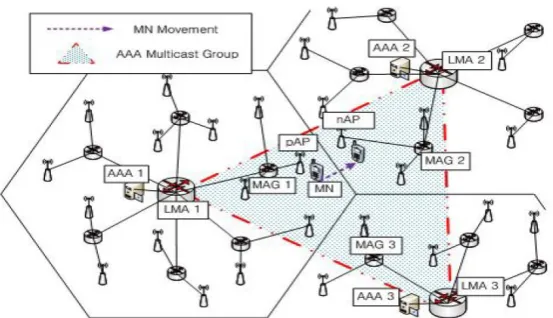
To support MN roaming between intra-inter domains, Baik et al. (2009) proposed an inter-domain handover approach. The basis of this approach was to switch the Authentication Authorization and Accounting (AAA) server, used for intra-domain handovers of PMIPv6, to an AAA cache server, then set the AAA cache server and communicate with other AAA cache servers in different PMIPv6 domains. In order to accomplish this multicast servers were implemented in each PMIPv6 domain, as shown in Figure 1.1. this led to long handover latency due to the time need for the MAG to send a request to obtain information about the MN from the AAA server. This approach performed poorly in vehicular network environments due to the high speed of the vehicles.
1.2.3 Obtaining MNs Context for Handover Triggering Support
Most inter-domain PMIPv6 mobility approaches do not consider MNs’ Authentication, Authorization, and Accounting (AAA) procedures and context transfers (Lee et al., 2009). They assume that the New Point of Service (NPoS) will maintain authentication information for the MN and can authenticate the MN when the MN enters the new PMIPv6 domain. In addition, there is no consideration as to how AAA information regarding the MN will be obtain and shared between domains. In some cases, the MAG that the MN is attached to will ensure that the MN is always on its home network and maintains its Home Address (HA) despite being in a new PMIPv6. To achieve this, the MAG must receive the MN profile using a context transfer process. However, most of the inter-domain approaches ignore the context transfer process.
Lee et al. (2009) proposed an inter-domain PMIPv6 mobility protocol based on the vehicular environment that considered the context transfer issue. In this method, the authors assumed that the intermediate MAG (I-MAG) stored all the information needed in a database. However, this solution was not suitable and did not support vehicles roaming between to different networks where two PMIPv6 domains fall in different ISPs, because the new PMIPv6 domain could not receive the stored information. Furthermore, when the vehicle roamed between the PMIPv6 domains the context informaton shoud have been shared between both networks.
Ze-qum et al. (2009) proposed an application-driven handover scheme which included a PMIPv6 handover process by using IEEE 802.21 MIH services. However, in this application-driven scheme, the authors did not mention how to share the context of the vehicle when roaming between heterogeneous networks.
1.2.4 Local Mobile Anchor (LMA) Inter-domain Support
The LMA in PMIPv6 is the topological anchor point for the MNs Home Network Prefix (HNPs) and is the entity that manages the MNs binding state. The, LMA has the functional capabilities of the Home Agent (HA) (Johnson et al., 2004) in addition to supporting PMIPv6 localized mobility. Therefore, the LMA is considered to be the HA of the MN within the PMIPv6 domain. In order for LMA to support MN roaming between different PMIPv6 domains, it must establish a tunnel with an anchor LMA to perform context transfers. This process reduces handover latency and packet loss for a MN moving between different domains.
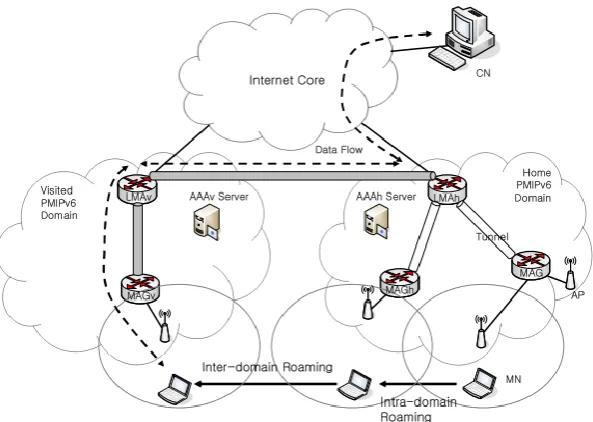
Figure 1.2 Inter-domain tunnel establishment issues (Park et al., 2010)
1.3 Problem Statement
1.4 Research Questions
The purpose of this thesis is to answer the following research questions:
(1) How can support for the inter-intra domain PMIPv6 handover technique be enhanced to reduce handover latency in realistic highway vehicular scenarios,?
(a) How can an inter-intra domain technique be developed that reduces handover latency?
(b) How can an inter-domain handover technique be developed that bridges the gap between the deattachment and attachment of vehicles within the PMIPv6 domain,?
(c) How can an analytical model be developed for an inter-intra domain PMIPv6 technique for vehicular network environments?
(2) How can a triggering technique be developed that increases the prediction of switching between inter-intra PMIPv6 domains?
(a) How can the storage and information retrieval of the Data Link Layer and the Network Layer base on MIH services and Homogeneous Network Inoformation (HNI), be facilitated?
(b) How can an handover estimation engine (EE) based on MIH information be developed?
(c) What primitives and parameters should be considered?
(3) How can the Local Mobility Anchor (LMA) be modified to reduce the total handover latency in PMIPv6?
(a) How can the mobility management of PMIPv6 be modified?
(b) How can received information be resolved using the Fully Qualified Domain Name (FQDN)?
(4) How can total handover delays be measured, including triggering, selecting and transferring between LMAs?
(a) How can a network scenario be designed to simulate the vehicular environment?
(b) How can an analytical model be developed to analyze handover latency and packet loss delivered to a specified destination?
(c) How can the inter-intra domain PMIPv6 protocol be mathematically tested and compared?
1.5 Research Aim
The aim of this study is to enhance PMIPv6 protocol in order to support inter and intra domain Proxy Mobile IPv6 Protocol (handover techniques) for seamless handover, continuous connection and efficient support in highway vehicular scenarios where there was roaming between different PMIPv6 domains.
1.6 Research Objectives
The following objectives were set to improve PMIPv6 protocols to support inter-domain roaming:
support continuous connection when vehicles travel along the highway in VANET environments.
(2) To design a handover estimation engine (EE) that supports handover dissection thereby avoiding unnecessary handover processes and improving the inter-intra domain PMIPv6 handover process.
(3) To develop an inter-intra domain handover technique that support seamless mobility roaming in high speed vehicle scenarios.
(4) To evaluate the performance of the inter-intra domain PMIPv6 handover technique in terms of handover latency, packet loss, continuous connection and address configuration time.
1.7 Research Scope
This study examines an efficient inter-intra domain PMIPv6 technique that supports inter-domain and intra-domain mobility while reducing the overall handover latency in vehicular highway scenarios. To achieve inter-domain mobility support, crucial problems with the PMIPv6 based vehicular network were addressed. For instance, to address the issue of unnecessary handover, a reliable handover estimation engine is designed. The design and development of vehicular network topology, which allowed vehicles to adopt variable speeds and random motions is investigated. Mathematical models and evaluation process are required to validate the performance of the designed inter-intra techniques and topology. This study attempted the following:
(1) The analytical model of the proposed inter-intra domain PMIPv6 techniques was evaluated using Matlab 2011.
(3) MIH services were extended in the mechanism for providing triggering information related to the Data Link Layer and to sense MN movement. (4) This study examined vehicles moving on straight highway.
(5) The study used Data Link Layer and Network Layer information to support the handover process in the proposed protocol.
(6) This study also introduced an analytical model for inter-intra domain PMIPv6.
(7) In this study, vehicle-to-infrastructure (V2I) communication was used for the highway vehicular scenarios in which the designed inter-intra domain PMIPv6 techniques were evaluated.
1.8 Significance of the Study
1.9 Research Contribution
The major contributions of this research are as follows:
1. The development of an inter-intra domain PMIPv6 handover technique for PMIPv6 protocol to support the handover process between two different PMIPv6 domains (multi-LMA domains) based vehicular networks.
2. The development of a technique for inter-intra domain handover prediction that supported continuous and seamless connections.
3. The development of an LMA extension to support information analysis that reduced the handover communication overhead.
4. The evaluation of parameters in vehicular networks, such as movement, signaling, and addressing.
1.10 Thesis Organization
The thesis is organized as follows:
Chapter 1 introduces the focus of the study including, handovers in vehicular ad hoc networks, and MIH concepts. The background of the problem was discussed, as well as the problem statement, research objectives and contributions.
solutions. A discussion on the proposed solutions is presented along with a comparison table of the protocols.
Chapter 3 explains the research methodology used in this study. It discusses simulation setup and, problem formulation based on the literature review. It presents the mobility model and the protocol design used in this study.
Chapter 4 presents the detail analytical analysis and design of the proposed inter-intra domain PMIPv6 protocol in realistic highway vehicular environments.
Chapter 5 presents the proposed inter-intra domain PMIPv6 technique using IEEE 802.21 MIH services for vehicle global mobility support based on vehicular environments for performance evaluation. The techniques were analyzed using Matlab.
802.21-2008, I. S. (2009). IEEE standard for local and metropolitan area networks—part 21 media independent handover services. IEEE.
Akyildiz, I., Janise, M., Joseph, S., Huseyin, U., & Wenye, W. (1999). Mobility management in next-generation wireless systems. Proceedings of the IEEE 1999 (pp. 1347–1384). IEEE.
Al-Surmi, I., Mohamed Othman, & Borhanuddin Mohd Ali. (2012). Mobility management for IP-based next generation mobile networks: Review, challenge and perspective. Journal of Network and Computer Applications, 295-315.
Amin, M. A. (2012). Reducing Handover Latency Using Cross Layer Protocol In MIPv6-Based Wireless Local Area Networks. Universiti Teknologi Malaysia: Thesis Doctor Philosophy.
Baik, J.-W., Ju-Hyun Kim, June Sup Lee, & Kyung-Geun Lee. (2009). Inter-domain mobility support scheme using multicast in proxy mobile. Proceedings of the 6th IEEE Conference on Consumer Communications and Networking Conference. IEEE.
Baldessari, R., Festag, A., & Abeille, J. (2007). Nemo meets vanet: A deployability analysis of network mobility in vehicular communication. In Proceedings of ITST (pp. 1-6). ITST.
Banerjee, N., Wei Wu, & Das, S. (2003). Mobility Support in Wireless Internet. IEEE Wireless Communications Magazine, 54–61.
Bargh, M., Hulsebosch, B., Eertink, H., Heijenk, G., Idserda, J., Laganier, J., et al. (June 2008). Reducing handover latency in future IP-based wireless networks: proxy mobile IPv6 with simultaneous bindings. World of Wireless, Mobile and Multimedia Networks. International Symposium (pp. 1-10). IEEE WoWMoM 2008.
Bechler, M., & L. Wolf. (2005). Mobility management for vehicular ad hoc networks. IEEE Vehicular Technology Conference (pp. 2294-2298). IEEE.
Castelluccia, & Claude. (November1998). A Hierarchical Mobile IPv6 Proposal. SIRAC Project Report.
Chen, Y.-S., Ching-Hsueh Cheng, Chih-Shun Hsu, & Ge-Ming Chiu. (2009). Network Mobility Protocol for Vehicular Ad Hoc Networks. Wireless Communications and Networking Conference, 2009. WCNC 2009. IEEE (pp. 1-6). IEEE.
Deering, S., & R. Hinden. (1998). Internet Protocolv6 Specification RFC 2460 . Devarapalli, V., Wakikawa, R., Petrescu, A., & Thubert, P. (2005, January). Network
Mobility (NEMO) Basic Support Protocol. Retrieved 2010.
Devarapalli, V., S. Gundavelli, K. Chowdhury, & A. Muhanna. (2007). Proxy Mobile IPv6 and Mobile IPv6 interworking . NETLMM Working Group.
Dommety, G., & Ed. (July 2001). Fast Handovers for Mobile IPv6.
Dutta, N., & Iti Saha Misra . (2010). Cost Analysis of Three Layered MIPv6 (TLMIPv6) Mobility Model and HMIPv6. International Journal on Computer Science, 36-46.
Eddy, W. (2004). At what layer does mobility belong. (pp. 155–159). IEEE Communications Magazine.
Ernst, T., & K, U. (2002). Connecting automobiles to the internet. 3rd International Workshop on ITS Telecommunications. ITST.
Giaretta, G. (2012). Interactions between Proxy Mobile IPv6 (PMIPv6) and Mobile IPv6 (MIPv6):Scenarios and Related Issues.
Gundavelli. (2008). Proxy Mobile IPv6.
Gundavelli, S., Ed. K. Leung, V. Devarapalli, & K. Chowdhury. (2008). Proxy Mobile IPv6.
Guo, Y. J. (2004). Advances in Mobile Radio Access Networks. Artech House Inc, Norwood, MA.
Gustafsson, E., & Jonsson, A. (2003). Always best connected. IEEE Wireless Communications Magazine, 49–55.
Hartenstein, H., & KP, L. (2008). A tutorial survey on vehicular ad hoc networks. (pp. 164–171). IEEE Communications Magazine.
Hesham, S., C. Castelluccia, K. ElMalki, & L. Bellier. (October 2008). Hierarchical Mobile IPv6 (HMIPv6) Mobility Management.
International Conference on Wireless Communications, Networking and Mobile Computing (pp. 1-4). IEEE WiCom .
IEEE. (2008). IEEE802.21 Standard and Metropolitan Area Networks: Media Independent Handover Services. IEEE.
Jee-Hyeon, N., Soochang Park, Jung-Mo Moon, Sangho Lee, Euisin Lee, & Sang-Ha Kim. (2008). Roaming Mechanism between PMIPv6 Domains.
Jeong, S., & M.K. Shin. (2008). Route Optimization Scheme for Proxy Mobile IPv6 (PMIPv6). Advanced Communication Technology ICACT.
Jiang, H., P, W., HV, P., & W, Z. (2007). Voice service support in mobile ad hoc networks. IEEE GLOBECOM, (pp. 966-970).
Johnson, D., C. Perkins, & J. Arkko. (2004). Mobility Support in IPv6..
Jordan, N., & Peter Reichl. (2006). A Fast Handover System Evaluation in an All-IPv6 Mobility Management - Wireless Broadband Access based Hotspot Network Environment. International Conference on Systems and International Conference on Mobile Communications and Learning Technologies . IEEE.
Jong-Hyouk Lee, Pack Sangheon, Ilsun You, & Chung Tai-Myoung. (2009). Enabling a paging mechanism in network-based. Journal of Internet Technology. Kempf, J., & Ed. (2007a). Problem Statement for Network-Based Localized Mobility
Management (NETLMM).
Kempf, J., & Ed. (2007b). Goals for Network-Based Localized Mobility Management (NETLMM).
Kempf, J., Daichi Funato, Karim El Malki, Youngjune Gwon, Mattias Pettersson, Phil Roberts, et al. (Nov. 2001). Supported Optimized Handover for IP Mobility - Requirements for Underlying Systems.
Kim, P., S.E. Kim, J.S. Jin, S.C. Lee, & S.H. Lee. (2007). Reducing AuthorizingRegistration Latency for Proxy Mobile IPv6 Route Optimization. International Conference onConvergence Information Technology. IEEE.
Koodli, R. (2005). Fast Handovers for Mobile IPv6.
Lee, J., Myoung, J. Young, H., & Seong, G. (2008a). A new scheme of global mobility management for inter-VANETs handover of vehicles in V2V_V2I network environments. in Proceedings of IEEE NCM (pp. 114-119). IEEE.
Lee, J., & Tai-Myoung Chung. (2010). Cost Analysis of IP Mobility Management Protocols for Consumer Mobile Devices. IEEE Consumer Electronics Society . IEEE.
Lee, J., Zhiwei Yan & Ilsun You, 2011. Enhancing QoS of Mobile Devices by a New HandoverProcess in PMIPv6 Networks. Springer Science+Business Media, LLC.. Lee, J., Hyung-Jin Lim, & Tai-Myoung Chung. (2008). A competent global mobility
support scheme in NETLMM. AEÜ - International Journal of Electronics and Communications, 950-967.
Lee, J.-H., Jong-Hyouk Lee, & Tai-Myoung Chung. (2007). A Novel Inter-LMD Handoff Mechanism for Network-Based Localized Mobility Management. international conference on Next Generation Teletraffic and Wired/Wireless Advanced Networking (pp. 356-366). Springer.
Lee, K.-W., Won-Kyeong Seo, You-Ze Cho, Jong-Woo Kim, Jin-Soo Park, & Byoung-Sub Moon. (2009). Inter-domain handover scheme using an intermediate mobile access gateway for seamless service in vehicular networks. International Journal of Communication Systems, 1127–1144.
Lei Jun, & Xiaoming Fu. (2008). Evaluating the Benefits of Introducing PMIPv6 for Localized Mobility Management. Wireless Communications and Mobile Computing Conference, 2008. IWCMC '08. International (pp. 74-80 ). IEEE.
Leung, A., Yingli Sheng, & Haitham Cruickshank. (2007). The security challenges for mobile ubiquitous services. Elsevier, , 162-171.
Magagula, L., & H. Anthony Chan . (2009). Optimized handover delay in Proxy Mobile IPv6 using IEEE802.21 MIH Services.
McNair, J., Ian F. Akyildizr, & Michael 13. Bender. (2000). An inter-system handoff technique for. IEEE Annual Joint Conference of the IEEE Computer and Communications Societies (INFOCOM) (pp. 208–216). IEEE.
Melia, T., E. Hepworth, S. Sreemanthula, S. Faccin, Y. Ohba, G. Vivek, et al. (2007). Mobility Services Transport: Problem Statement.
Mohanty, S., & Ian F. Akyildiz. (2006). A Cross-Layer (Layer 2 + 3) Handoff Management Protocol for Next-Generation Wireless Systems. IEEE TRANSACTIONS ON MOBILE COMPUTING.
Neumann, N., Fu, X., Lei, J., & Zhang, G. (2009). Inter-domain handover and data forwarding between proxy mobile IPv6 Domains.
Communication Technology, 2008. ICACT 2008. 10th International Conference. IEEE.
Park, S., Euisin Lee, Fucai Yu, Sungkee Noh, & Sang-Ha Kim. (2010). Inter-Domain Roaming Mechanism Transparent to IPv6-Node among PMIPv6 Networks. Vehicular Technology Conference (VTC 2010-Spring), 2010 IEEE 71st (pp. 1-5). IEEE.
Perkins, C. (2002). IP Mobility Support for IPv4.
Perkins, C., Jari, M., Ryuji, W., Anders, N., & Antti, T. (2002). Internet connectivity for mobile ad hoc networks. Wireless Communications and Mobile Computing, 465–482.
Patel, A., K. Leung, M. Khalil, H. Akhtar, & K. Chowdhury (2005). Mobile Node Identifier Option for Mobile IPv6 (MIPv6).
Ryu, S., Gye-Young Kim, Byunggi Kim, & Youngsong Mun. (2008). A Scheme to Reduce Packet Loss during PMIPv6 Handover considering Authentication. International Conference on Computational Sciences and Its Applications. ICCSA '08. (pp. 47 - 51). IEEE.
Ryu, S., Misun Kim, & Youngsong Mun. (2009). Enhanced Fast Handovers for Proxy Mobile IPv6 . International Conference on Computational Science and Its Applications. (pp. 39-43). IEEE ICCSA .
Socolofsky, T., & C. Kale. (1991). TCP/IP tutorial, RFC 1180.
Soliman, H., C. Castelluccia, K. El Malki, & L. Bellier. (August 2005). Hierarchical Mobile IPv6 Mobility Management (HMIPv6).
Soliman, H., Claude Castellucia, Karim El-Malki, & Ludovic Bellier. (2001). Hierarchical MIPv6 Mobility Management.
Soonghwan, R., & Nguyen Van Hanh . (2009). Global Mobility Support in Proxy Mobile IPv6 for Mobility-Unaware Hosts. IEEE 34th Conference on Local Computer Networks (LCN 2009) . IEEE.
Soonghwan, R., Nguyen, V., Van Hanh, N. Thanh, L., & Seong, G. 2012. Inter-domain Mobility Support in Proxy Mobile IPv6 Using Overlap Function of Mobile Access Gateway. Singapore, International Conference on Computer Networks and Communication Systems (CNCS 2012).
Soto, I., Carlos J. Bernardos, & María Calderón. (2010). PMIPv6: A Network-Based Localized Mobility Management Solution. The Internet Protocol journal.
Trossen, D., Govind Krishnamurthi, Hemant Chaskar, & James Kempf. (July 2001). Issues in candidate access router discovery for seamless IP handoffs.
Wafaa Bou Diab, & Samir Tohme. (2009). End-to-End Security and Seamless Handover Solution for Real-Time Communication over 3G Networks. Modelling Analysis and Simulation of Wireless and Mobile Systems. Proceedings of the 5th ACM symposium on QoS and security for wireless and mobile networks.
Weniger, K., G. Velev, & V. Devarapalli. (October 2008). Data forwarding behaviour of co-located HA/LMA in PMIP6-MIP6 nteractions scenario C.
Xie, J., & Xudong, W. (2008). A survey of mobility management in hybrid wireless mesh networks. IEEE Network, 34 -40.
Yan, Z., Huachun Zhou, & Ilsun You. (2010). N-NEMO: A comprehensive network mobility solution in proxy mobile IPv6 network. ournal of Wireless Mobile Networks, Ubiquitous Computing, and Dependable Applications, 52–70.
Yokota, H., K. Chowdhury, R. Koodli, B.Patil, & F. Xia. (2010). Fast Handovers for Proxy Mobile IPv6.
Yong, L., Su, H., Su, L., Jin, D., & Zeng, L. (2009). A Comprehensive Performance Evaluation of PMIPv6 over IP-based Cellular Networks. Vehicular Technology Conference, IEEE 69th (pp. 1-6). IEEE.
Ze-qun, H., Bai Song-nan, & Jaeil Jung . (2009). A MIH Services Based Application-Driven Vertical Handoff Scheme for Wireless Networks. Fifth International Joint Conference on INC, IMS and IDC (pp. 1428-1431). IEEE.
Zhong, F., Chai Kiat Yeo, & Bu Sung Lee. (2010). Enabling inter-PMIPv6-domain handover with traffic distributors. Journal of Network and Computer Applications, 397-409.
Zhou, H., Hongke Zhang, Yajuan Qin, Hwang-Cheng Wang, & Han-Chieh Chao. (2009). A Proxy Mobile IPv6 Based Global Mobility Management Architecture and Protocol. Springer Science + Business Media, 530–542.