Differential Cache Trace Attack Against
CLEFIA
Chester Rebeiro and Debdeep Mukhopadhyay
Dept. of Computer Science and Engineering Indian Institute of Technology Kharagpur, India
{chester,debdeep}@cse.iitkgp.ernet.in
Abstract. The paper presents a differential cache trace attack against CLEFIA, a 128 bit block cipher designed by Sony Corporation. The attack shows that such ciphers based on the generalized Feistel structures leak information of the secret key if the cache trace pattern is revealed to an adversary. The attack that we propose is a three staged attack and reveals the entire key with 243
CLEFIA encryptions. The attack is simulated on an Intel Core 2 Duo Processor with a cache architecture with 32 byte lines as a target platform.
1
Introduction
Cache memory is a small high speed memory which stores recently used data and instructions. Data present in the cache are accessed more quickly compared to data not present in cache. Additionally, power consumption while accessing data inside the cache is less than accesses outside the cache. The differential behavior in cache memory with respect to time and power have been used to attack crypto systems [1–7, 10, 11, 13, 14, 16, 17]. Such attacks are known as cache attacks. Depending on the attackers capabilities, cache attacks are classified into three : timing attacks, access attacks, and trace attacks. In cache timing
attacks[3, 5, 9, 16, 17] the attacker needs to have access to the encryption time.
Cache access attacks[8, 10] require knowledge of the cache access patterns. These
patterns are generally obtained from a spy process running on the same system as the cryptographic algorithm.
Cache trace attacks monitor the behavior of cache memory by means of its
S
S
in0 in1
k1 k0
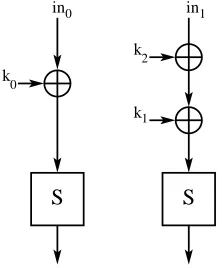
Fig. 1.Lookup Structure in AES
bits: (k0⊕k1) = (in0⊕in1). In AES, in order to obtain the actual AES key the cache trace patterns for two rounds need to be considered.
CLEFIA[15] is a 128 bit block cipher developed by Sony for copyright pro-tection and authentication. The table access pattern for CLEFIA is depicted in Figure 2. A straight forward adaptation of the existing cache trace attacks for CLEFIA is capable of revealing only the value of k0⊕k1⊕k2, and thus has more ambiguity about the actual key value than for the AES algorithm. Hence in order to obtain the CLEFIA key, one needs to modify the techniques and supplement them using the internal round structures or properties in the key scheduling algorithm of CLEFIA.
S
S
k1 k
2
in1 in0
k0
Fig. 2.Lookup Structure in CLEFIA
use of two chosen plaintexts and exploits key expansion algorithm of CLEFIA. The complexity of the attack in terms of CLEFIA encryptions is 243 on a cache with 32 byte cache line.
The outline of the paper is as follows: Section 2 has a brief description of the block cipher CLEFIA. Section 3 gives an outline of the proposed attack on the cipher. Section 4 presents the complexity of the attack. Section 5 has the experimental results. The work is concluded in section 6.
2
The CLEFIA Block Cipher
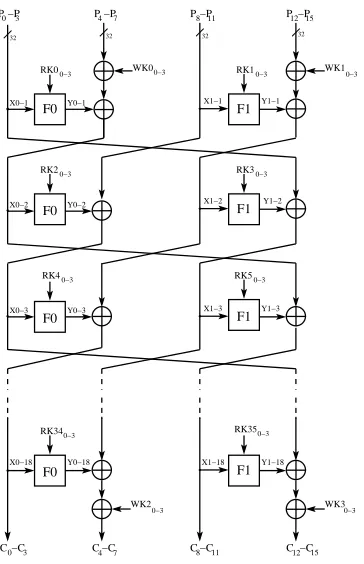
CLEFIA is a 128 bit block cipher with a generalized Feistel structure. The spec-ification [15] defines three key lengths of 128, 192, and 256 bits. For brevity, this paper considers 128 bit keys though the results are valid for the other key sizes. The structure of CLEFIA is shown in Figure 3. The input has 16 bytes P0 to P15, grouped into four 4 byte words. There are 18 rounds and in each round the first and third words are fed into nonlinear functions F0 andF1 respectively. The output ofF0 andF1, collectively known as F functions, are ex-ored with the second and fourth words. Additionally, the second and fourth words are also whitened at the beginning and end of the encryption.
The non-linearity in the F functions are created by two sboxesS0 andS1. These sboxes are in the form of 256 byte look-up tables, and are invoked twice in each F function, making a total of eight table look-ups per round and 144 (= 8∗18) look-ups per encryption. Equations for functionsF0 andF1 are shown in Equation 1.
F0 :(y0 y1y2 y3) = (z0 z1z2 z3)·M0
F1 :(y0 y1y2 y3) = (z0′ z1′ z2′ z3′)·M1
(1)
where
z0=S0[x0⊕k0] z1=S1[x1⊕k1] z2=S0[x2⊕k2] z3=S1[x2⊕k2]
and
z′
0=S1[x0⊕k0] z1′ =S0[x1⊕k1] z2′ =S1[x2⊕k2] z3′ =S0[x2⊕k2]
TheF functions take 4 input bytes,x0,x1,x2, andx3, and 4 round keys,k0,k1, k2, andk3. After the sbox look-ups, the bytes are diffused by multiplying them with (4×4) matricesM0 and M1 respectively. The M0 andM1 matrices are defined as follows:
M0 =
1 2 4 6
2 1 6 4
4 6 1 2
6 4 2 1
M1 =
1 8 2 A
8 1 A 2
2 A 1 8
A 2 8 1
(2)
WK00−3 WK1 0−3
WK2 WK3
0−3 0−3
C0−C3 C −C4 7 C8−C11 C −C12 15
P −P P−P P −P P −P
32 32
32 32
0 3 4 7 8 11 12 15
F0
RK2
RK40−3
F0 X0−3 X0−2
F0
RK340−3
Y0−18 F0
RK00−3
0−3
Y0−2
Y0−3 X0−1 Y0−1
F1
F1
F1
RK50−3 RK30−3 RK10−3
F1
RK350−3
X0−18 Y1−18
Y1−3 Y1−2 X1−2
Y1−1 X1−1
X1−3
X1−18
Fig. 3.CLEFIA Block Diagram
a 128 bit intermediate keyL is generated from the secret keyK using a GF N function [15]. From this the round keys and whitening keys are generated as shown below.
Step 1:W K0|W K1|W K2|W K3←K
Step 2:Fori←0 to 8
T ←L⊕(CON24+4i|CON24+4i+1|CON24+4i+2|CON24+4i+3)
L←Σ(L)
ifiis odd:T ←T ⊕K
RK4i|RK4i+ 1|RK4i+ 2|RK4i+ 3←T
The functionΣ, known as thedouble swap function, rearranges the bits ofLas shown in Equation 3.
Σ(L)←L(7···63)|L(121···127)|L(0···6)|L(64···120) (3)
RK3 are determined from whichLis computed. K can then be obtained from Lby the inverseGF N function.
3
The Attack
The steps involved in the attack is to first obtain the round keysRK0 andRK1 by tracing cache accesses in the first and second round. ThenRK4 andRK5 are computed using theRK0 andRK1 that were obtained. From this,RK2 and 25 bits ofRK3 are derived by exploiting CLEFIA’s key expansion algorithm.
3.1 Determining RK0 andRK1
The sbox accesses in the first round of CLEFIA have a structure (Figure 1) favourable for cache attacks. The equations for the indices to the tables in the first round is given by:
I10s0=P0⊕RK00 I10s1=P1⊕RK01 I11s0=P2⊕RK02 I11s1=P3⊕RK03 I12
s0=P9⊕RK11 I12s1=P8⊕RK10
I13s0=P11⊕RK13 I13s1=P10⊕RK12
(4)
Note thatIαi
sβ denotes the index to theithaccess to tablesβ in roundα.
If we make the assumption that no part of the table is present in cache before the start of encryption, then the first access to each table, ie. I10
s0 and I10
s1, results in cache misses. A maximum of 6 cache hits (3 in each table) can be obtained in the first round. This can be forced by starting with random values forP0 andP1, then varyingP2,P3,P8,P9, P10, andP11 in an order such that Pa is varied before Pb if and only if Pa and Pb access the same sbox and Pa
accesses the sbox beforePb.
In the second round, the indices to the tablesS0 andS1 inF0 are given by equations in (5), whereP(0,1,2,3)indicates the concatenation of P0,P1,P2, and P3.
I20s0=P4⊕W K00⊕F0(RK0, P(0,1,2,3))0⊕RK20 I20s1=P5⊕W K01⊕F0(RK0, P(0,1,2,3))1⊕RK21 I21s0=P6⊕W K02⊕F0(RK0, P(0,1,2,3))2⊕RK22 I21
s1=P7⊕W K03⊕F0(RK0, P(0,1,2,3))3⊕RK23
(5)
Four cache hits can be forced inF0 of round two by varyingP4,P5,P6, and P7in a order as previously defined. This results in a total of 5 cache hits in table S0. The indices to the table are all the same, ie.I10
s0=I11s0=I20s0=I21s0. We therefore get the following equalities.
P0⊕P4=F0(RK0, P(0,1,2,3))0⊕RK00⊕W K00⊕RK20 P2⊕P6=F0(RK0, P(0,1,2,3))2⊕RK02⊕W K02⊕RK22
Similarly the 5 cache hits in tableS1 result in the following equalities.
P1⊕P5=F0(RK0, P(0,1,2,3))1⊕RK01⊕W K01⊕RK21 P3⊕P7=F0(RK0, P(0,1,2,3))3⊕RK03⊕W K03⊕RK23
(7)
For another plaintextQ, with Q0 6=P0 and Q1 6= P1, equations similar to (6) and (7) can be obtained by tracing cache hits in the first and second rounds. These are shown in (8).
Q0⊕Q4=F0(RK0, Q(0,1,2,3))0⊕RK00⊕W K00⊕RK20 Q2⊕Q6=F0(RK0, Q(0,1,2,3))2⊕RK02⊕W K02⊕RK22 Q1⊕Q5=F0(RK0, Q(0,1,2,3))1⊕RK01⊕W K01⊕RK21 Q3⊕Q7=F0(RK0, Q(0,1,2,3))3⊕RK03⊕W K03⊕RK23
(8)
From equations in (6),(7),and (8), the fact thatP0⊕P2⊕P4⊕P6=Q0⊕Q2⊕ Q4⊕Q6, andP1⊕P3⊕P5⊕P7=Q1⊕Q3⊕Q5⊕Q7 the following equations can be generated:
P0⊕P4⊕Q0⊕Q4=F0(RK0, P(0,1,2,3))0⊕F0(RK0, Q0,1,2,3))0 P2⊕P6⊕Q2⊕Q6=F0(RK0, P(0,1,2,3))2⊕F0(RK0, Q0,1,2,3))2 P0⊕P6⊕Q0⊕Q6=F0(RK0, P(0,1,2,3))2⊕F0(RK0, Q0,1,2,3))2 P2⊕P4⊕Q2⊕Q4=F0(RK0, P(0,1,2,3))0⊕F0(RK0, Q0,1,2,3))0 P1⊕P5⊕Q1⊕Q5=F0(RK0, P(0,1,2,3))1⊕F0(RK0, Q0,1,2,3))1 P3⊕P7⊕Q3⊕Q7=F0(RK0, P(0,1,2,3))3⊕F0(RK0, Q0,1,2,3))3 P1⊕P7⊕Q1⊕Q7=F0(RK0, P(0,1,2,3))3⊕F0(RK0, Q0,1,2,3))3 P3⊕P5⊕Q3⊕Q5=F0(RK0, P(0,1,2,3))1⊕F0(RK0, Q0,1,2,3))1
(9)
RK0 can be determined by testing the 232 possibilities against the 8 condi-tions in (9). In a similar wayRK1 can be determined by analyzing cache hits in F1. The set of equations that should satisfyRK1 are in (10).
P8⊕P12⊕Q8⊕Q12=F1(RK0, P(8,9,10,11))0⊕F1(RK0, Q(8,9,10,11))0 P10⊕P14⊕Q10⊕Q14=F1(RK0, P(8,9,10,11))2⊕F1(RK0, Q(8,9,10,11))2 P8⊕P14⊕Q8⊕Q14=F1(RK0, P(8,9,10,11))2⊕F1(RK0, Q(8,9,10,11))2 P10⊕P12⊕Q10⊕Q12=F1(RK0, P(8,9,10,11))0⊕F1(RK0, Q(8,9,10,11))0 P9⊕P13⊕Q9⊕Q13=F1(RK0, P(8,9,10,11))1⊕F1(RK0, Q(8,9,10,11))1 P11⊕P15⊕Q11⊕Q15=F1(RK0, P(8,9,10,11))3⊕F1(RK0, Q(8,9,10,11))3 P9⊕P15⊕Q9⊕Q15=F1(RK0, P(8,9,10,11))3⊕F1(RK0, Q(8,9,10,11))3 P11⊕P13⊕Q11⊕Q13=F1(RK0, P(8,9,10,11))1⊕F1(RK0, Q(8,9,10,11))1
(10)
3.2 Determining RK4 andRK5
in that order, so that cache hits are obtained in the first and second round in tableS0. Cache hits inS0 in the third roundF0 are obtained by varyingP8and P10. However several cache hits may be obtained this way due to collisions with indices inF1 the second round. However, the only values ofP8 andP10that are of interest have collisions inS0 accesses of theF0 functions in the first, second, and third rounds. That is, I10
S0 = I11S0 = I20S0 =I21S0 =I30S0 = I30S1. From I10
S0=I30S0 we obtain,
RK40=P0⊕P8⊕RK00⊕F0(RK2, P(4,5,6,7)⊕W K0⊕F0(RK0, P(0,1,2,3)))0 (11) whereW K0⊕RK2 is obtained from (6) and (7).
W K0⊕RK2 =P(0,1,2,3)⊕P(4,5,6,7)⊕F0(RK0,(P(0,1,2,3))⊕RK0 (12)
SimilarlyRK42is computed.
RK42=P0⊕P10⊕RK00⊕F0(RK2, P(4,5,6,7)⊕W K0⊕F0(RK0,(P(0,1,2,3)))2 (13) The two other bytes,RK41andRK42, can be similarly computed by considering cache hits inS1 in functionF0 in the first, second, and third round.
RK41=P1⊕P9⊕RK01⊕F0(RK2, P(4,5,6,7)⊕W K0⊕F0(RK0, P(0,1,2,3)))1 RK43=P1⊕P11⊕RK01⊕F0(RK2, P(4,5,6,7)⊕W K0⊕F0(RK0, P(0,1,2,3)))3
(14)
In a similar manner, RK5 can be determined by considering cache hits in the first, second, and third rounds in functionF1. The equations for computingRK5 are presented in (15).
RK50=P0⊕P8⊕RK00⊕F1(RK2, P(12,13,14,15)⊕W K1⊕F1(RK1, P(8,9,10,11)))0 RK51=P1⊕P9⊕RK01⊕F1(RK2, P(12,13,14,15)⊕W K1⊕F1(RK1, P(8,9,10,11)))1 RK52=P0⊕P10⊕RK00⊕F1(RK2, P(12,13,14,15)⊕W K1⊕F1(RK1, P(8,9,10,11)))2 RK53=P1⊕P11⊕RK01⊕F1(RK2, P(12,13,14,15)⊕W K1⊕F1(RK1, P(8,9,10,11)))3
(15)
3.3 Determining RK2 andRK3
In the key expansion algorithm, ifi= 0 thenT =RK0|RK1|RK2|RK3, and
T =L⊕(CON24|CON25|CON26|CON27)
64 bits of the key dependent constant L can be computed using the values of RK0 andRK1, which were determined in the first stage of the attack.
The double swap operation on L places 57 known bits of L in the lower bit positions. Let the newL after double swap be denoted byL′.
L′
(0···56)=L(7···63) (17)
Again, in the key expansion algorithm, ifi= 1, thenT =RK4|RK5|RK6|RK7. This is represented in equation form as
T =L′⊕(CON
28|CON29|CON30|CON31)⊕(W K0|W K1|W K2|W K3) (18)
Therefore,
W K0|W K1(0···24)=L′(0· · ·56)⊕(CON28|CON29(0···25))⊕(RK4|RK5) (19)
Thus it is possible to ascertain W K0 and 25 bits ofW K1. W K0⊕RK2 and W K1⊕RK3 have been determined in the second step of the attack. With the knowledge ofW K0 andW K10···24 the whole ofRK2 and 25 bits ofRK3 can be determined.
4
Analysis of the Attack
Cache memories in practice have a cache line consisting ofmbytes (mis a power of 2, say 2l). Two table indices are considered equivalent if they access the same
cache line. In such cases only the (8−m) most significant bits of the indices are equal. The result is an ambiguity in the detection of cache hits. A cache hit would mean 2l possible indices for access.
DeterminingRK0 requires cache hits in the tableS0 for the accessesI11
s0, I12
s0, I13s0, I20s0, and I21s0, and in the table S1 for accesses I11s1, I12s1, I13s1, I20
s1, I21s1. Finding a cache hit is done by iterating the respective plaintext byte through the 28 possibilities. The accesses for each table S0 and S1 are independent and can be done in parallel. Obtaining all the cache hits would therefore require 5×28<211CLEFIA invocations. Hence forPandQplaintexts finding all cache hits would need 212encryptions. These cache hits define values for the plaintext bytes P2, P3, P4, P5, P6, P7 and Q2, Q3, Q4, Q5, Q6, Q7. Considering the cache line, there are 212lpossible combinations of these plaintext
bytes. Each of these combinations have to be tested in the eight equations in (9). The tests are done for each of the 232 possibleRK0 values.
For a given set of plaintext bytes, there are at-most 16 values ofRK0 that satisfy all conditions in (9). To understand why 16 values ofRK0 are obtained, consider the right hand side of (9). This can be represented in the form of the diffusion stage of theF0 function as follow:
1 2 4 6 2 1 6 4 4 6 1 2 6 4 2 1
zp0 zp1 zp2 zp3 ⊕
1 2 4 6 2 1 6 4 4 6 1 2 6 4 2 1
zpi and zqj (0 ≤ i ≤ 3, 0 ≤ j ≤ 3) are the output of the sbox for the P
and Q plaintexts respectively. Because of the injective sbox, the zp’s and zq’s uniquely identify anRK0. Moreover the result of the computation (20) is not altered if bytes of zpi are interchanged with zqj for i = j. This leads to 24
possible combinations, thus resulting in 16 different RK0 keys that satisfy all the conditions in (9).
In all there are 24+12l possible values forRK0 and an equal number of
pos-sible values for RK1. The values for RK1 are determined by an independent process requiring 212 more CLEFIA encryptions.
Determining the bytes ofRK4 requires cache hits inF0 in the first, second, and third rounds. Using the plaintext bytes found previously, required cache hits in the third round are obtained by setting appropriate values toP8,P9,P10, and P11. This requires 4×28CLEFIA encryptions and produces 24lpossible combi-nations. Solving equations (12), (13), and (14) for each of theRK0 determined in the previous step would result in 24+12l+4l possible values forRK4. Similarly
RK5 will have an equal number of options.
With the knowledge ofRK0,RK1,RK4, andRK5, the whole ofRK2 and 25 bits ofRK3 is determined. There are 24+16l+7 possible values for all bits of RK2 andRK3. The 27 additional keys are due to the unsolved 7 bits inRK3. All the possible keys have to be checked by brute force for correctness. The total complexity of the attack in terms of CLEFIA encryptions is thus of the order of 211+16l.
5
Experimental Results
The attack was simulated using an Oracle for the CLEFIA encryptions. The Oracle is queried with the plaintext and it returns the cache access patterns for each table S0 and S1. For every modification of the plaintext byte the Oracle is queried until the desired cache access pattern is obtained. The required cache access pattern is obtained with probability one.
Once the required cache hits are obtained, equations (9) and (10) are tested for different values of RK0 and RK1. There are 232 possible values for each RK, but they can be done in parallel as they are independent. Each of the possible RK0 and RK1 key values result in 24l possible RK4 and RK5 keys.
Determination of RK4 and RK5 cannot be parallelized as is seen from (12), (13), (14) and (15). From this stage in the attack, there is a singleRK2 and 128 values ofRK3 for each (RK0,RK1,RK4,RK5) tuple.
To determine the time required for the attack, we used a CLEFIA reference code where the sbox elements areunsigned int values. The objective of keeping
unsigned intis justified to increase the speed of encryptions[16]. Most embedded
6
Conclusion
In this paper we have shown that the block cipher CLEFIA can be attacked using cache trace patterns. We proposed a three staged attack to ascertain the key. We have further analyzed the attack to explain the reductions in key space achieved by the steps and corresponding equations obtained in the attack. The entire attack has been simulated on a reference CLEFIA code on an Intel Core 2 Duo machine, targeting as 32 byte cache architecture. The complexity of the attack has been shown to be 243and requires around 1 hour and 30 minutes for the complete attack.
References
1. Acıi¸cmez, O., C¸ etin Kaya Ko¸c: Trace-driven cache attacks on aes. Cryptology ePrint Archive, Report 2006/138 (2006), http://eprint.iacr.org/
2. Acii¸cmez, O., C¸ etin Kaya Ko¸c: Trace-Driven Cache Attacks on AES (Short Paper). In: Ning, P., Qing, S., Li, N. (eds.) ICICS. Lecture Notes in Computer Science, vol. 4307, pp. 112–121. Springer (2006)
3. Bernstein, D.J.: Cache-timing attacks on AES. Tech. rep. (2005)
4. Bertoni, G., Zaccaria, V., Breveglieri, L., Monchiero, M., Palermo, G.: AES Power Attack Based on Induced Cache Miss and Countermeasure. In: ITCC (1). pp. 586–591. IEEE Computer Society (2005)
5. Bonneau, J., Mironov, I.: Cache-Collision Timing Attacks Against AES. In: Goubin, L., Matsui, M. (eds.) CHES. Lecture Notes in Computer Science, vol. 4249, pp. 201–215. Springer (2006)
6. Kelsey, J., Schneier, B., Wagner, D., Hall, C.: Side Channel Cryptanalysis of Prod-uct Ciphers. J. Comput. Secur. 8(2,3), 141–158 (2000)
7. Lauradoux, C.: Collision attacks on processors with cache and countermeasures. In: Wolf, C., Lucks, S., Yau, P.W. (eds.) WEWoRC. LNI, vol. 74, pp. 76–85. GI (2005)
8. Neve, M., Seifert, J.P.: Advances on Access-Driven Cache Attacks on AES. In: Biham, E., Youssef, A.M. (eds.) Selected Areas in Cryptography. Lecture Notes in Computer Science, vol. 4356, pp. 147–162. Springer (2006)
9. Neve, M., Seifert, J.P., Wang, Z.: A Refined Look at Bernstein’s AES Side-Channel Analysis. In: Lin, F.C., Lee, D.T., Lin, B.S., Shieh, S., Jajodia, S. (eds.) ASIACCS. p. 369. ACM (2006)
10. Osvik, D.A., Shamir, A., Tromer, E.: Cache Attacks and Countermeasures: The Case of AES. In: Pointcheval, D. (ed.) CT-RSA. Lecture Notes in Computer Sci-ence, vol. 3860, pp. 1–20. Springer (2006)
11. Page, D.: Theoretical Use of Cache Memory as a Cryptanalytic Side-Channel (2002)
12. Paulo S. L. M. Barreto: The AES Block Cipher in C++, http://www.larc.usp.br/ pbarreto/AES++.zip
13. Rebeiro, C., Mondal, M., Mukhopadhyay, D.: Pinpointing Cache Timing Attacks on AES. In: VLSI Design. IEEE Computer Society (2010),To Appear
15. Sony Corporation: The 128-bit Blockcipher CLEFIA : Algorithm Specification (2007)
16. Tsunoo, Y., Saito, T., Suzaki, T., Shigeri, M., Miyauchi, H.: Cryptanalysis of DES Implemented on Computers with Cache. In: Walter, C.D., C¸ etin Kaya Ko¸c, Paar, C. (eds.) CHES. Lecture Notes in Computer Science, vol. 2779, pp. 62–76. Springer (2003)