IJEDR1504057
International Journal of Engineering Development and Research (www.ijedr.org)369
An approach for Measuring Thermal Conductivity of
Bricks using Transient Hot Wire method
1Jyoti Rani, 2K.J.Singh, 3Ramvir Singh 1Scholor, M.G.S.University of Bikaner (Raj) 2Govt College Suratgarh, Dist-Sriganganagar (Raj.)
3University of Rajasthan, Jaipur (Raj.)
________________________________________________________________________________________________________
Abstract - The methods of earth building materials are commonly classed in eco construction processes. In these objectives
the earth materials have to demonstrate ecological qualities both in their production and building techniques but also on their thermal and hydric balances. The building techniques of earth material have been largely discussed and normalized. The material cohesion is assumed by the clay mineral matrix often added of some percents of lime or cement. Mechanical resistances are due to the clay matrix cohesion which acts as cement between the sand grains and compactness of the clay sand assemblage which reduces the volume of micro porosity by decreasing the micro pore sizes.
Keywords - micro porosity, Transient Hot Wire, brick
________________________________________________________________________________________________________
1. INTRODUCTION
A brick is a block or a single unit of a Clay bearing soil, sand and lime or concrete material, fire hardened or air dried used in masonry construction. Light weight bricks are made from expanded clay aggregate. Fired brick are the most numerous types and are laid in courses and numerous patterns known as bonds collectively known as brickwork and may be laid in various kinds of mortar to hold the bricks together to make a durable structure. Brick are produced in numerous classes, types, materials, and sizes which vary with region and time period and are produced in bulk quantities. Two most basic categories of brick are fired and non fired brick [1].
The clay matrix cohesion is governed by the initial water clay ratio and compaction pressure applied during the earth material building [2,3]. The compactness of the material is also dependant of the textural continuity from the clayey to sandy components. All these parameters act on the fabrics of mineral particles and sand grains and as a consequence on the associated distribution of micro to meso porosity. The heat transfers mainly depend on the frequency of grain contacts, size of pores and air water ratio infilling the porosity. The moisture transfers mainly depend on the connectivity associated to the meso to micro porosity distribution and especially on the micro porosity of the clay matrix in clay dominant materials.
This work concerns the measurements of thermal conductivity in a clay dominant material composed of Compacted Earth Brick using the transient hot wire (THW) technique. This hot wire method has been developed for measurements in electro conducting liquid [14-15] and in highly corrosive liquids [4-5]. Actually the use of the transient hot wire method is extended to granular materials [6-7] in solid geomaterials [8,9] and in soils by pedologists [10-11]. The texture moisture and thermal conductivity relationship have been studied firstly on a model material composed of glass bead assemblages to demonstrate the role of porosity and saturation index.
Secondly the thermal conductivities were measured on a compact earth brick mainly composed of clay material. In order to validate the THW method in this very thin divided material
2. OPTIMAL DIMENSIONS, CHARACTERISTICS & STRENGTH Loose Bricks
For efficient handling and laying bricks must be small enough and light enough to be picked up by the bricklayer using one hand. Bricks are usually laid flat and as a result the effective limit on the width of a brick is set by the distance which can conveniently be spanned between the thumb and fingers of one hand normally about four inches or 100 mm. In most cases the length of a brick is about twice its width about nine inches or slightly more [12]. This allows bricks to be laid bonded in a structure which increases stability and strength. The wall is built using alternating courses of stretchers, bricks laid long ways, and headers, bricks laid crossways. The headers tie the wall together over its width. In fact this wall is built in a variation of English bond called English cross bond where the successive layers of stretchers are displaced horizontally from each other by half a brick length. In true English bond the perpendicular lines of the stretcher courses are in line with each other.
3. THE MANUFACTURING PROCESS OF BRICKS
Different steps are there in Manufacturing of Bricks. These are defined below. Winning
Heavy earth moving devices such as bulldozers, scrapers and mechanical shovels are used to extract the clay and shales. Crushing and blending
IJEDR1504057
International Journal of Engineering Development and Research (www.ijedr.org)370
The clays are fed separately by hopper or conveyor to the primary crushers. These reduce the particle size down to 3 to 5 mm or less. The mixing of clays follows, to impart the desired proper ties, such as color and strength.Grinding
Conveyors carry the mixed clay away for secondary crushing, which is usually done by means of a pan mill. The pan mill has two heavy steel wheels on an axle that is connected to a central vertical spindle around which they rotate, crushing the clay against the base of the pan. The base is per forted to allow the crushed material to fall through. This process, when done with dry clay, shatters the brittle par tickles into smaller pieces. When the pan mill is used with wet clay, the plastic material is squeezed through the perforations and then falls between high-speed rollers which complete the grinding process.
Screening dry processing
Before being shaped, the clay is screened and oversize pieces are returned to the pan mill for fur their crushing. Shaping
Bricks are hand formed, pressed or extruded into their final shape. The method used to shape the bricks affects their final appearance and texture, and sets certain limitations on the handling methods employed during manufacture.
Extruded bricks
Clay with 18-25% water content is forced by an auger into a horizontal cone shaped tube that tapers down to the die. Two compaction stages are commonly incorporated, with a vacuum chamber between them to remove any air in the clay that would reduce the strength of the end product.
The extruded clay column is cut into brick sized pieces by an arrangement of wires. Extruded bricks, although often smooth, may be mechanically patterned or textured. Most bricks of this type have anything from 3-12 perforations that, by increasing the surface area, reduce the required drying, firing, and cooling times. Any internal stresses are relieved by the perforations and prevent distortion of the bricks during firing.
Drying of bricks
In the brick making process, the clay is refined and water is added in order to mould the brick. Before the bricks can be fired, they must be dried properly, the moisture content has to be reduced to 8% of volume for the clamp kiln.
There is adequate sun for the drying operation and most clamp kiln brick makers make full use of this free source of energy by placing the bricks on open hack lines. This operation has the disadvantage that it may make the process time consuming, especially in the rainy season.
To reduce the drying cycle, brick makers have introduced some mechanical means of drying. The two most common methods are tunnel or chamber driers. The heat for the drying is produced in a supplementary coal heater or recycled off the kiln and the heated air is fed into the driers. These methods work as follows:
• Tunnel driers: The bricks are produced and then off set on flat rail trolleys or kiln cars. The cars are pushed through the tunnel. This operation can take up to 40 to 50 hours, from green to dry.
• Chamber driers: Patented chamber driers are large rooms where bricks are packed onto pallets. The chambers may have a capacity of 50000 to 60000 bricks. Hot air is fed into the chamber. Drying time is between 30 and 45 hours much quicker than the 14 to 21 days needed for solar drying.
Firing
Bricks are fired at temperatures between 1000° and 1200°C, depending on the clay Light colored clays usually require higher firing temperatures than dark colored ones. Of the many known types of ceramic kilns, four types were used
Fires are lit in fireboxes along the sides and the hot gases fire up to the curved roof, down through the bricks and from there to the chimney stack. Fires are fuelled by coal, gas or oil. When the desired temperature has been reached, the temperature is maintained for a specific period and the fires are then allowed to die. The kiln cools down, the fired bricks are removed and another batch of green bricks is placed in the kiln for firing.
Delivery
In pack systems, sign ode strapped packs of 500 bricks are arranged in a suitable stack and bound together by bands in different countries.
The packs are lifted by forklift or crane truck. Handling on site may be by hoist or brick barrows
4. METHOD OF MEASURING THERMAL CONDUCTIVITY BY TRANSIENT HOT WIRE METHOD
The transient hot wire (THW) technique is widely used for measurements of the thermal conductivity of most fluids and some attempts have also been carried out for simultaneous measurements of the thermal-diffusivity with the same hot wire. [13] This technique was also tried to determine thermal properties of soils by the mean of probes which can be considered as wire with some assumptions. The purpose of this experiment is to validate the thermal conductivity measurement by the THW technique in geomaterials composed of compacted sand and clay mineral that can be used for earth construction also called Compacted Earth Brick. The thermal transfer behaviors are mainly governed by the texture and moisture of the geomaterials
IJEDR1504057
International Journal of Engineering Development and Research (www.ijedr.org)371
brick is 62% earth, 28% sand, 5% lime and 5% water. The mineralogy of sand is quartz dominant feldspars plus accessory Fe oxides. The mineralogy of clayey fraction is Illite, Kaolinite and Smectite.All the 7 glass beads media have been tested in air dry state. To underline the effect of saturation the 2.8-3.4 mm glass bead medium has been tested with water and acetone saturation. The thermal conductivity was measured in the compacted brick from initial 17% in weight of water content to 3% of residual water content after 110 days of air drying shown in Figure1. The 17% of water content corresponds to a saturation index of 90%. The 3%
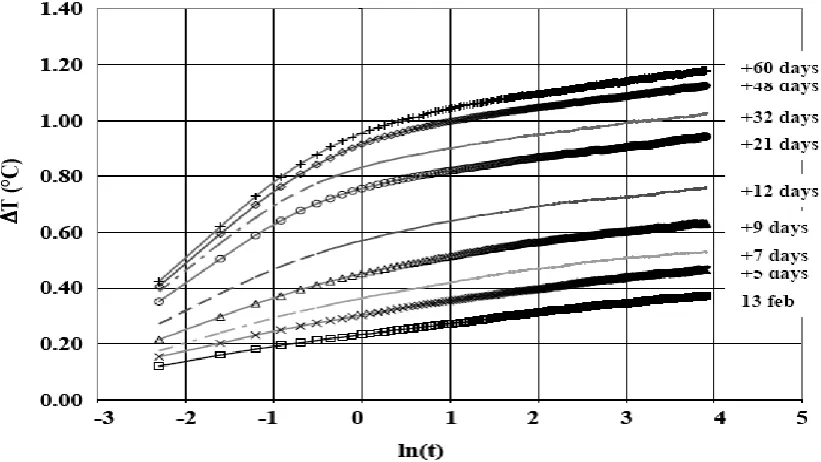
Correspond to a saturation index of 15%.The measurements were made daily during the first sixty days and with larger steps 2-3 days after. The heat transfers measurements are represented in T °C versus ln(t) diagram represented in Figures 2 and.3 .Each recorded T/ ln(t) curve presents two successive steps of temperature increasing characterized by a1 and a2 slopes which are used to calculate two associated heat conductivities 1 and 2.
Fig- 1 Water content of the earth brick during the 110 days of air drying period.
5. RESULTS FROM EXPERIMENT
For the glass bead materials all the DT / ln (t) curves show the same features For t < 1s, DT increases quickly.
For t > 1s, DT increases slowly.
These two domains are characterized by two a1 and a2 slopes respectively. In the short time domain where t < 1s the a1 increases with the increasing of bead diameters. Actually the a1 slope is dependant of the density of beads contact with the wire.
On the contrary for the successive tests performed on the different material the a2 slope is nearly constant independently of the bead sizes. According to the very low a2 evolutions, the a2 is nearly constant and independent of the pore size for a constant porosity (about 0.2 W/mK).
IJEDR1504057
International Journal of Engineering Development and Research (www.ijedr.org)372
Fig. 3 Evolution the DT / ln (t) curves for 2.8-3.4 mm glass beads in dry air state, acetone and water saturated states. The Shift down of the DT / ln (t) curves due to the saturation accord with the decreasing thermal conductivities of the air =0.025 W/mK,acetone = 0.19 W/mK and pure water = 0.6 W/mK.
The air, water substitution implies great decrease of the a1 slope on the DT / ln(t) curves and consequently a great decrease of a1 shown in Figure 3.
Fig.4 Evolution of the DT/ln(t) curves recorded on the compacted brick with time for 60 days.
The shift of the curves from the abscissa to the top of the diagram is due to the desiccation of the clay material. The consequence is the drastic evolution of the a1 slope.
For the compacted earth brick, the DT / ln(t) curves show similar features - For t < 1s, DT increases quickly.
For t > 1s, DT increases slowly.
For this material only one brick was tested, thus only one texture was tested. The evolution of the thermal conductivity is only dependant of the evolution of the brick water content. In these conditions the evolutions of a1 and a2 during the drying period characterize the decrease of moisture.
IJEDR1504057
International Journal of Engineering Development and Research (www.ijedr.org)373
Fig. 5 Evolution of a1 and a2 thermal conductivity with timeThis above figure is according to the drastic a1 increase the a1 values decrease from 0.9 to 0.2 M/mK during the 20 first days. The a2 show high dispersive values for a mean value quite constant with time.
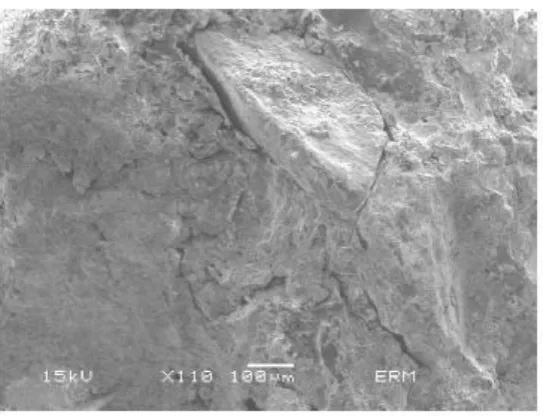
The microstructure of the compacted brick was observed on scanning electronic microscope. The clay matrix is very compact. All the porosity is constituted of micro porosity disseminated between the clay particles and almost all the micropores have sizes lower than 20 μm shown in Figure 6. Nevertheless the dT / ln (t) curves show similar pattern evolutions between saturated and unsaturated states than glass bead ones.
Fig-.6 Micro photography of the microstructure of the compacted brick
The sand grain is isolated inside the compacted clay matrix. The micro cracks are consequences of the sampling of the milimetric block from the brick. The clay matrix appears very compact and homogeneous.
6. ACKNOWLEDGEMENT
First of all, I am extremely grateful to my Supervisor, Dr. Kamaljeet Singh, Professor, Dept. of Physics, Govt. College Suratgarh, Distt- Sriganganagar (Raj.). for his guidance and all the useful discussions and brainstorming sessions, especially during the difficult conceptual development stage. His deep insights helped me at various stages of my research. I have learned a lot from him in both technical and non technical discussions. My sincere gratitude is reserved for my Co-Guide Dr.Ramveer Singh, Associate Professor, Dept. of Physics, University of Rajasthan, Jaipur for his invaluable insights and suggestions. A special thanks to my colleague Mr. Harish Kumar Sublania, N. D. B. Govt. College, Nohar, Hanumangarh (Raj.), for his kind cooperation
and suggestion..
IJEDR1504057
International Journal of Engineering Development and Research (www.ijedr.org)374
REFERENCES[1] Coomands, Thomas; VanRoyen, Harry, eds. (2008), "Novii Monasterii, 7", Medieval Brick Architecture in Flanders and Northern Europe, Koksijde: Ten Duinen
[2] P. Dudoignon, D. Gélard, S. Sammartino. Cam-Clay and Hydraulic Conductivity Diagram relations in Consolidated and Sheared Clay-Matrices. Clay Minerals, 269-279. 13 (2004)
[3] D. Gélard, and P. Dudoignon, Mécanisme de réorganisation de matrice argileuse par séchage dans un matériau terre : influence sur la cohesion AUGC (2007)
[4] J.P. Garnier, J.P. Maye, J. Saillard, G. Thévenot, A. Kadjo, S. Martemianov. A New Transient Hot-Wire Instrument for Measuring the Thermal-Conductivity of Electrically Conducting and Highly Corrosive Liquids using Small Samples, International Journal of Thermo physics, 468-482 29 (2008)
[5] A. Kadjo, J.P. Garnier, J.P. Maye, S. Martemianov A New Transient Two-Wire Method for Measuring the Thermal Diffusivity of Electrically Conducting and Highly Corrosive Liquids Using Small Samples International Journal of Thermo physics, 1267-1277 29 (2008)
[6] E. Gonzo, Estimating Correlations for the Effective Thermal Conductivity of Granular Materials Chemical Engineering Journal, 299-302 90 (2002)
[7] G.K. Batchelor, R.W. O’Brien, Thermal or Electrical Conduction through a granular material,Proc.R.Soc.Lond, 313-333 355 (1977)
[8] C. Gruescu, A. Giraud, F. Homand, D. Kondo, D.P. Do Effective Thermal Conductivity of Partially Saturated Porous Rocks International Journal of Solids and Structures, 811-833 44 (2007)
[9] A. Bouguerra, A. Ledhem, F. de Barquin, R.M. Dheilly, and M. Quéneudec Effect of Microstructure on the Mechanical and Thermal Properties of Lightweight Concrete prepared from Clay, Cement and wood aggregates Cement and Concrete Research 1179-1190 28 (1998)
[10] K.H. Bristow Measurement of Thermal properties and Water content of unsaturated Sandy soil using dual-probe Heat pulse probes Agricultural and forest meteorology, 75-84 89 (1998)
[11] K.H. Bristow, G.J. Kluitenberg, C.J. Golding, T.S. Fitzgerald A small multi-needle probe for measuring soil thermal properties, water content and electrical conductivity Computers and Electronics in Agriculture, 265-280 31 (2001) [12] Plumbridge, Andrew; Meulenkamp, Wim (2000), Brickwork. Architecture and Design, London: Seven Dials, ISBN
1-84188-039-6
[13] ASTM International. ASTM C 113: Standard Test Method for Thermal Conductivity of Refractories by Hot Wire (Platinum Resistance Thermometer Technique). West Conshohocken, PA, 2009
[14] Y. Nagasaka and A. Nagashima Absolute Measurement of the Thermal Conductivity of Electrically Conducting Liquids by the Transient Hot-Wire Method J. Phys. E: Sci. Instrum, 1435- 1440 14 (1981)