Theory of g-Tg-Maps
Khodabocus m. i. and Sookia n. u. h.
Abstract. Several specific types of generalized maps of a generalized topolog-ical space have been defined and investigated for various purposes from time to time in the literature of topological spaces. Our recent research in the field of a new class of generalized maps of a generalized topological space is reported herein as a starting point for more generalized classes.
Key words and phrases. Generalized topological space, generalized sets, generalized maps, generalized continuous maps, generalized irresolute maps, generalized homeomorphism maps
1. Introduction
The concepts1 of (TΩ,T
Σ)-map π : TΩ → TΣ [1, 2], g- (TΩ,TΣ)-map πg :
TΩ → TΣ [9, 18], (Tg,Ω,Tg,Σ)-map π : Tg,Ω → Tg,Σ [3], and g- (Tg,Ω,Tg,Σ)-map πg :Tg,Ω→Tg,Σ [21], called, respectively, ordinary and generalized maps (briefly,
T-mapandg-T-map, respectively) betweenT-spacesTΩandTΣ, and ordinary and
generalized maps (briefly, Tg-map and g-Tg-map, respectively) between Tg-spaces Tg,Ωand Tg,Σare all fundamental concepts that have been introduced and
inves-tigated by several mathematicians [12, 16, 17, 20, 21, 23, 29, 31, 33].
Other concepts called (TΩ,TΣ)-continuous and (TΩ,TΣ)-irresolute maps and
(TΩ,TΣ)-homeomorphism (briefly, T-continuous and T-irresolute maps, and T -homeomorphism, respectively) [6, 24, 32], g- (TΩ,TΣ)-continuous and g- (TΩ,TΣ )-irresolute maps andg- (TΩ,TΣ)-homeomorphism (briefly,g-T-continuous andg-T -irresolute maps, andg-T-homeomorphism, respectively) [6, 13, 14, 26], (Tg,Ω,Tg,Σ
)-continuous and (Tg,Ω,Tg,Σ)-irresolute maps, (Tg,Ω,Tg,Σ)-homeomorphism (briefly,
Tg-continuous, Tg-irresolute maps, andTg-homeomorphism, respectively) [14, 28] and g- (Tg,Ω,Tg,Σ)-continuous and g- (Tg,Ω,Tg,Σ)-irresolute maps, g- (Tg,Ω,Tg,Σ
)-homeomorphism (briefly, g-Tg-continuous and g-Tg-irresolute maps, and g-Tg
-homeomorphism, respectively) [11, 22, 34] are all derived concepts based on the properties ofT-map, g-T-map, Tg-map, andg-Tg-map. Having received extensive studies, all these ordinary and generalized mappings are at this date well-known important notions in ordinary and generalized topologies and their applications.
In this paper, we will show how further contributions can be added to the field in a unified way.
1Notes to the reader: The structuresTΩ = (Ω,TΩ) and TΣ = (Σ,TΣ) are called ordinary topological spaces (briefly,T-spaces), and the structuresTg,Ω=Ω,Tg,ΩandTg,Σ=Σ,Tg,Σ are called generalized topological spaces (briefly, Tg-spaces). The mapsπ, πg :TΩ →TΣ and
π,πg :Tg,Ω →Tg,Σ, respectively, stand for ordinary and generalized maps between T-spaces andTg-spaces; the notations (TΩ,TΣ)-map (briefly,T-map),g- (TΩ,TΣ)-map (briefly,g-T-map),
T
g,Ω,Tg,Σ-map (briefly,Tg-map), andg-Tg,Ω,Tg,Σ-map (briefly,g-Tg-map) emphasize their characters.
1
2. Theory
2.1. preliminaries. Our discussion starts by recalling some basic definitions and
notations of most essential concepts presented in the theory ofg-Tg-sets in a T g-space.
The setUstands for the universe of discourse, fixed within the framework of the theory of g-Tg-maps and containing as elements all sets (Λ-sets: Λ ∈ Ω,Σ,Υ;
TΛ, g-TΛ, TΛ, g-TΛ-sets; Tg,Λ, g-Tg,Λ, Tg,Λ, g-Tg,Λ-sets) considered in this theory,
andI0
ndef=
ν ∈N0: ν≤n; index setsI0
∞, In∗, I∞∗ are defined similarly. Let Λ∈
Ω,Σ,Υ⊂Ube a given set and letP(Λ)def= Og,ν⊆Λ : ν ∈I∞∗
be the family of all subsetsOg,1,Og,2, . . ., of Λ. Then every one-valued map of the type Tg,Λ : P(Λ) → P(Λ) satisfying Tg,Λ(∅) = ∅, Tg,Λ(Og)⊆ Og, and Tg,Λ
ν∈I∗
∞Og,ν
=
ν∈I∗
∞Tg,Λ(Og,ν) is called a g-topology on Λ, and the structure Tg,Λ
def
= (Λ,Tg,Λ)
is called aTg,Λ-space, on which no separation axioms are assumed unless otherwise
mentioned [8, 7, 27]. The operator clg,Λ : P(Λ) → P(Λ) carrying each Tg,Λ-set Sg ⊂Tg,Λ into its closure clg,Λ(Sg) =Tg,Λ−intg,Λ(Tg,Λ\ Sg)⊂Tg,Λ is called a
g-closure operator and the operator intg,Λ :P(Λ)→ P(Λ) carrying each Tg,Λ-set Sg ⊂Tg,Λ into its interior intg,Λ(Sg) = Tg,Λ−clg,Λ(Tg,Λ\ Sg)⊂Tg,Λ is called a
g-interior operator; for clarity, we will use clg(·), intg(·), respectively, instead of clg,Λ(·), intg,Λ(·).
LetTg,Λ be a Tg,Λ-space, let Λ :P(Λ) → P(Λ) denotes the absolute
comple-ment with respect to the underlying set Λ⊂U, and letSg ⊂Tg,Λ be anyTg,Λ-set.
The classes
Tg,Λ def=
Og⊂Tg,Λ: Og∈ Tg,Λ
,
¬Tg,Λ def=
Kg ⊂Tg,Λ: Λ(Kg)∈ Tg,Λ
,
(2.1)
respectively, denote the classes of allTg,Λ-open andTg,Λ-closed sets relative to the
g-topology Tg,Λ, and the classes
CsubTg,Λ[Sg] def= Og∈ Tg,Λ : Og⊆ Sg,
Csup¬Tg
,Λ[Sg]
def
= Kg∈ ¬Tg,Λ: Kg⊇ Sg
,
(2.2)
respectively, denote the classes ofTg,Λ-open subsets andTg,Λ-closed supersets
(com-plements of the Tg,Λ-open subsets) of the Tg,Λ-set Sg ⊂ Tg,Λ relative to the g
-topologyTg,Λ. To this end, theg-closure and theg-interior of aTg-set Sg⊂Tg in
aTg,Λ-space [3] define themselves as
intg,Λ(Sg)def= Og∈CsubTg,Λ[Sg]
Og, clg,Λ(Sg)def=
Kg∈Csup¬Tg ,Λ[Sg]
Kg. (2.3)
Throughout this work, by clg◦intg(·), intg◦clg(·), and clg◦intg◦clg(·), respec-tively, are meant clg(intg(·)), intg(clg(·)), and clg(intg(clg(·))); other composition operators are defined similarly. Also, the backslashTg\Sgrefers to the set-theoretic difference Tg− Sg. The mapping opg :P(Λ) → P(Λ) is called a g-operation on
P(Λ) if the following statements hold:
∀Sg∈ P(Λ)\∅, ∃(Og,Kg)∈ Tg,Λ\
∅× ¬Tg,Λ\
∅:
opg(∅) =∅
∨¬opg(∅) =∅
, Sg⊆opg(Og)∨Sg⊇ ¬opg(Kg)
,
where ¬opg :P(Λ)→ P(Λ) is called the ”complementary g-operation” onP(Λ) and, for allTg-setsSg,Sg,ν,Sg,μ∈ P(Λ)\∅, the following axioms are satisfied:
• Ax. i. Sg⊆opg(Og)∨Sg ⊇ ¬opg(Kg),
• Ax. ii. opg(Sg)⊆opg◦opg(Og)∨¬opg(Sg)⊇ ¬opg◦¬opg(Kg), • Ax. iii. Sg,ν ⊆ Sg,μ → opg(Og,ν) ⊆ opg(Og,μ)∨Sg,μ ⊆ Sg,ν ←
¬opg(Kg,μ)⊇ ¬opg(Kg,ν),
• Ax. iv. opg
σ=ν,μSg,σ
⊆σ=ν,μopg(Og,σ)∨¬opgσ=ν,μSg,σ
⊇
σ=ν,μ¬opg(Kg,σ)
,
for someTg,Λ-open sets Og, Og,ν,Og,μ∈ Tg,Λ\
∅andTg,Λ-closed setsKg,Kg,ν,
Kg,μ∈ ¬Tg,Λ [4, 19]. The class Lg Ω
=Lωg Λ× Lκg Ω, where
Lg Λdef= opg,νμ(·) =
opg,ν(·),¬opg,μ(·)
: (ν, μ)∈I30×I30 (2.5)
in the Tg,Λ-space Tg,Λ, stands for the class of all possible g-operators and their
complementaryg-operators in theTg,Λ-spaceTg,Λ. Its elements are defined as:
opg(·) ∈ Lωg Λdef= opg,0(·), opg,1(·), opg,2(·), opg,3(·) = intg(·), clg◦intg(·), intg◦clg(·), clg◦intg◦clg(·);
¬opg(·) ∈ Lκg Λdef= ¬opg,0(·), ¬opg,1(·), ¬opg,2(·), ¬opg,3(·) = clg(·), intg◦clg(·), clg◦intg(·), intg◦clg◦intg(·). (2.6)
ATg,Λ-setSg,Λ⊂Tg in aTg,Λ-space is called ag-Tg,Λ-set if and only if there exist
a pair (Og,Kg)∈ Tg,Λ× ¬Tg,Λ ofTg,Λ-open andTg,Λ-closed sets, and ag-operator opg(·)∈ Lg Λsuch that the following statement holds:
(∃ξ) (ξ∈ Sg)∧Sg ⊆opg(Og)
∨Sg ⊇ ¬opg(Kg)
.
(2.7)
Theg-Tg,Λ-setSg⊂Tg,Λis said to be of categoryν if and only if it belongs to the
following class ofg-ν-Tg,Λ-sets:
g-ν-S Tg,Λ
def
= Sg⊂Tg,Λ:
∃Og,Kg,opg,ν(·)
Sg⊆opg,ν(Og)
∨Sg ⊇ ¬opg,ν(Kg). (2.8)
It is called ag-ν-Tg,Λ-open set if it satisfies the first property ing-ν-S Tg,Λ
and a g-ν-Tg,Λ-closed set if it satisfies the second property ing-ν-S Tg,Λ
. The classes of g-ν-Tg,Λ-open andg-ν-Tg,Λ-closed sets, respectively, are defined by
g-ν-O Tg,Λ
def
= Sg⊂Tg,Λ:
∃Og,opg,ν(·)
Sg ⊆opg,ν(Og)
,
g-ν-K Tg,Λ
def
= Sg⊂Tg,Λ:
∃Kg,opg,ν(·)
Sg⊇ ¬opg,ν(Kg)
.
(2.9)
From these classes, the following relation holds: g-S Tg,Λ
= ν∈I0
3g-ν-S Tg,Λ
= ν∈I0
3
g-ν-O Tg∪g-ν-KTg
= ν∈I0
3g-ν-OTg,Λ
∪ν∈I0
3g-ν-K Tg,Λ
= g-O Tg,Λ
∪g-K Tg,Λ
.
By omitting the subscriptgin almost all symbols of the above definitions, we obtain very similar definitions but in aTΛ-space.
ATΛ-setS ⊂TΛin aTΛ-space is called ag-TΛ-set if and only if there exists a pair (O,K)∈ TΛ× ¬TΛ of TΛ-open andTΛ-closed sets, and an operatorop(·)∈ L Λ such that the following statement holds:
(∃ξ) (ξ∈ S)∧(S ⊆op (O))∨(S ⊇ ¬op (K)). (2.11)
The g-TΛ-set S ⊂ TΛ is said to be of category ν if and only if it belongs to the following class ofg-ν-TΛ-sets:
g-ν-S TΛdef= S ⊂TΛ: (∃O,K,opν(·))
(S ⊆opν(O))∨(S ⊇ ¬opν(K)). (2.12)
It is called a g-ν-TΛ-open set if it satisfies the first property in g-ν-S TΛ
and a g-ν-TΛ-closed set if it satisfies the second property in g-ν-S TΛ. The classes of g-ν-TΛ-open andg-ν-TΛ-closed sets, respectively, are defined by
g-ν-O TΛ def= S ⊂TΛ: (∃O,opν(·)) S ⊆opν(O),
g-ν-K TΛ def= S ⊂TΛ: (∃K,opν(·)) S ⊇ ¬opν(K). (2.13)
As in the previous definitions, from these classes, the following relation holds: g-S TΛ = ν∈I0
3g-ν-S TΛ
= ν∈I0
3
g-ν-O TΛ∪g-ν-K TΛ
= ν∈I0
3g-ν-OTΛ
∪ν∈I0
3g-ν-K TΛ
= g-O TΛ
∪g-K TΛ
.
(2.14)
The classes O [Tg,Λ] and K [Tg,Λ] denote the families ofTg,Λ-open andTg,Λ-closed
sets, respectively, in Tg,Λ, with S [Tg,Λ] = O [Tg,Λ]∪K [Tg,Λ]; the classes O [TΛ]
and K [TΛ] denote the families of T-open and TΛ-closed sets, respectively, in TΛ, with S [TΛ] = O [TΛ]∪K [TΛ]. (Whenever we feel that the subscript Λ∈Ω,Σ,Υ is understood from the context, it will be omitted for clarity.) We are now in a position to present a carefully chosen set of terms used in the theory ofg-Tg-maps betweenTg-spaces.
A (TΩ,TΣ)-map and a (Tg,Ω,Tg,Σ)-map, respectively, are mappings in the usual
sense betweenT-spaces andTg-spaces.
Definition2.1 ((TΩ,TΣ), (Tg,Ω,Tg,Σ)-Maps). LetTΩ= (Ω,TΩ) andTΣ= (Σ,TΣ)
be T-spaces and, letTg,Ω= (Ω,Tg,Ω) and Tg,Σ= (Σ,Tg,Σ) beTg-spaces. Then, a
map:
• i. π:TΩ→TΣis called a (TΩ,TΣ)-map fromTΩinto TΣ.
• ii. π:Tg,Ω→Tg,Σ is called a (Tg,Ω,Tg,Σ)-map fromTg,Ωinto Tg,Σ.
Ag- (TΩ,TΣ)-map is a generalization of a (TΩ,TΣ)-map and, hence, is a
distin-guished mapping betweenT-spaces which does not exhibit mapping properties in the usual sense but does exhibit mapping properties in the generalized sense.
Definition 2.2 (g-ν- (TΩ,TΣ)-Map). LetTΩ = (Ω,TΩ) and TΣ= (Σ,TΣ) be T
-spaces, and let op(·)∈ L Σ. Then, a map πg :TΩ→TΣ is called a g- (TΩ,TΣ
sets inTΩthere corresponds a pair (Oσ,Kσ)∈ TΣ× ¬TΣofTΣ-open andTΣ-closed sets inTΣsuch that the following statement holds:
πg(Oω)⊆op (Oσ)∨ πg(Kω)⊇ ¬op (Kσ). (2.15)
Ag- (TΩ,TΣ)-map is said to be of categoryνif and only if it belongs to the following class ofg-ν- (TΩ,TΣ)-maps:
g-ν-M [TΩ;TΣ]def=
πg: ∀Oω,Kω∃Oσ,Kσ,opν(·)
πg(Oω)⊆opν(Oσ)∨πg(Kω)⊇ ¬opν(Kσ). (2.16)
It is called ag-ν- (TΩ,TΣ)-open map if it satisfies the first property ing-ν-M [TΩ;TΣ]
and ag-ν- (TΩ,TΣ)-closed map if it satisfies the second property ing-ν-M [TΩ;TΣ].
The classes ofg-ν- (TΩ,TΣ)-open and g-ν- (TΩ,TΣ)-closed maps, respectively, are
defined by
g-ν-MO[TΩ;TΣ]def=
πg:∀Oω∃Oσ,opν(·) πg(Oω)⊆opν(Oσ),
g-ν-MK[TΩ;TΣ]def= πg:∀Kω∃Kσ,opν(·) πg(Kω)⊇opν(Kσ). (2.17)
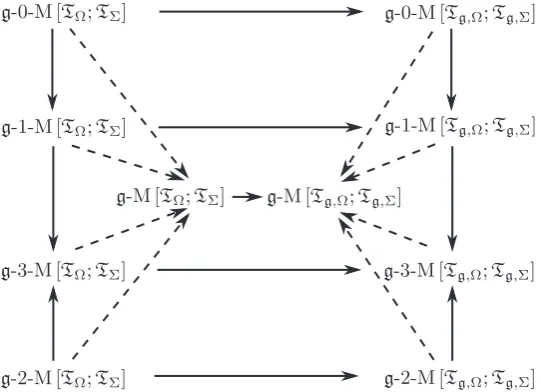
From the class g-ν-M [TΩ;TΣ], consisting of the classes g-ν-MO[TΩ;TΣ] and
g-ν-MK[TΩ;TΣ], respectively, ofg-ν- (TΩ,TΣ)-open andg-ν- (TΩ,TΣ)-closed maps,
whereν ∈I30, there results in the following definition.
Definition 2.3. Let TΩ = (Ω,TΩ) and TΣ = (Σ,TΣ) be T-spaces. If, for each ν ∈ I0
3, g-ν-MO[TΩ;TΣ] and g-ν-MK[TΩ;TΣ], respectively, denote the classes of
g-ν- (TΩ,TΣ)-open andg-ν- (TΩ,TΣ)-closed maps, then g-M [TΩ;TΣ] =
ν∈I0
3g-ν-M [TΩ;TΣ]
= ν∈I0
3
g-ν-MO[TΩ;TΣ]∪g-ν-MK[TΩ;TΣ]
= ν∈I0
3g-ν-MO[TΩ;TΣ]
∪ν∈I0
3g-ν-MK[TΩ;TΣ]
= g-MO[TΩ;TΣ]∪g-MK[TΩ;TΣ].
(2.18)
As above, theg- (Tg,Ω,Tg,Σ)-map is a generalization of the (Tg,Ω,Tg,Σ)-map and,
thus, is a distinguished mapping betweenTg-spaces which does not exhibit mapping properties in the usual sense but does exhibit mapping properties in the generalized sense.
Definition2.4 (g-ν- (Tg,Ω,Tg,Σ)-Map). LetTg,Ω= (Ω,Tg,Ω) andTg,Σ= (Σ,Tg,Σ)
be Tg-spaces, and let opg(·)∈ Lg Σ. Then, a map πg :Tg,Ω →Tg,Σ is called a
g- (Tg,Ω,Tg,Σ)-map if and only if, for every pair (Og,ω,Kg,ω)∈ Tg,Ω׬Tg,ΩofTg,Ω
-open and Tg,Ω-closed sets in Tg,Ω there corresponds a pair (Og,σ,Kg,σ) ∈ Tg,Σ× ¬Tg,Σ of Tg,Σ-open and TΣ-closed sets in Tg,Σ such that the following statement
holds:
πg(Og,ω)⊆opg(Og,σ)∨ πg(Kg,ω)⊇ ¬opg(Kg,σ). (2.19)
A g- (Tg,Ω,Tg,Σ)-map is said to be of category ν if and only if it belongs to the
following class ofg-ν- (Tg,Ω,Tg,Σ)-maps:
g-ν-M [Tg,Ω;Tg,Σ]def=
πg: ∀Og,ω,Kg,ω∃Og,σ,Kg,σ,opg,ν(·)
It is called a g-ν- (Tg,Ω,Tg,Σ)-open map if it satisfies the first property in the
class g-ν-M [Tg,Ω;Tg,Σ] and a g-ν- (Tg,Ω,Tg,Σ)-closed map if it satisfies the
sec-ond property ing-ν-M [Tg,Ω;Tg,Σ]. The classes of g-ν- (Tg,Ω,Tg,Σ)-open maps and
g-ν- (Tg,Ω,Tg,Σ)-closed maps, respectively, are defined by
g-ν-MO[Tg,Ω;Tg,Σ]def=
πg :∀Og,ω∃Og,σ,opg,ν(·)
πg(Og,ω)⊆opg,ν(Og,σ),
g-ν-MK[Tg,Ω;Tg,Σ]def=
πg:∀Kω∃Kg,σ,opg,ν(·)
πg(Kg,ω)⊇opg,ν(Kg,σ). (2.21)
From the class g-ν-M [Tg,Ω;Tg,Σ], consisting of the classes g-ν-MO[Tg,Ω;Tg,Σ]
andg-ν-MK[Tg,Ω;Tg,Σ] ofg-ν- (Tg,Ω,Tg,Σ)-open andg-ν- (Tg,Ω,Tg,Σ)-closed maps,
whereν ∈I30, respectively, there results in the following definition.
Definition 2.5. Let Tg,Ω = (Ω,Tg,Ω) andTg,Σ = (Σ,Tg,Σ) be Tg-spaces. If, for
eachν ∈I0
3, g-ν-MO[Tg,Ω;Tg,Σ] and g-ν-MK[Tg,Ω;Tg,Σ], respectively, denote the
classes ofg-ν- (Tg,Ω,Tg,Σ)-open andg-ν- (Tg,Ω,Tg,Σ)-closed maps, then
g-M [Tg,Ω;Tg,Σ] =
ν∈I0
3g-ν-M [Tg,Ω;Tg,Σ] =ν∈I0
3
g-ν-MO[Tg,Ω;Tg,Σ]∪g-ν-MK[Tg,Ω;Tg,Σ]
=ν∈I0
3g-ν-MO[Tg,Ω;Tg,Σ]
∪ν∈I0
3g-ν-MK[Tg,Ω;Tg,Σ]
=g-MO[TΩ;Tg,Σ]∪g-MK[Tg,Ω;Tg,Σ].
(2.22)
Definition 2.6 (g-ν- (Tg,Ω,Tg,Σ)-Continuous). Let Tg,Ω = (Ω,Tg,Ω) andTg,Σ =
(Σ,Tg,Σ) be Tg-spaces, and let opg(·) ∈ Lg Ω. Then, a map πg : Tg,Ω → Tg,Σ
is said to be g- (Tg,Ω,Tg,Σ)-continuous if and only if, for every pair (Og,σ,Kg,σ)∈
Tg,Σ× ¬Tg,Σ of Tg,Σ-open and TΣ-closed sets in Tg,Σ there corresponds a pair
(Og,ω,Kg,ω)∈ Tg,Ω× ¬Tg,ΩofTg,Ω-open andTg,Ω-closed sets inTg,Ωsuch that the
following statement holds:
π−1
g (Og,σ)⊆opg(Og,ω)∨ πg−1(Kg,σ)⊇ ¬opg(Kg,ω). (2.23)
Ag- (Tg,Ω,Tg,Σ)-continuous map is said to be of categoryνif and only if it belongs
to the following class ofg-ν- (Tg,Ω,Tg,Σ)-continuous maps:
g-ν-C [Tg,Ω;Tg,Σ]def=
πg: ∀Og,σ,Kg,σ∃Og,ω,Kg,ω,opg,ν(·)
π−1
g (Og,σ)⊆opg,ν(Og,ω)∨πg−1(Kg,σ)⊇ ¬opg,ν(Kg,ω). (2.24)
Definition 2.7. Let Tg,Ω = (Ω,Tg,Ω) and Tg,Σ = (Σ,Tg,Σ) be Tg-spaces. If,
for eachν ∈I0
3,g-ν-C [Tg,Ω;Tg,Σ] denotes the class ofg-ν- (Tg,Ω,Tg,Σ)-continuous
maps, then
g-C [Tg,Ω;Tg,Σ] =
ν∈I0
3g-ν-C [Tg,Ω;Tg,Σ]. (2.25)
Definition 2.8 (g-ν- (Tg,Ω,Tg,Σ)-Irresolute). Let Tg,Ω = (Ω,Tg,Ω) and Tg,Σ =
(Σ,Tg,Σ) be Tg-spaces, and let opg(·) ∈ Lg Ω. Then, a map πg : Tg,Ω → Tg,Σ
is said to be g- (Tg,Ω,Tg,Σ)-irresolute if and only if, for every pair (Og,σ,Kg,σ) ∈
(Og,ω,Kg,ω)∈ Tg,Ω× ¬Tg,ΩofTg,Ω-open andTg,Ω-closed sets inTg,Ωsuch that the
following statement holds:
π−1
g
opg(Og,σ)⊆opg(Og,ω)∨ π−g1
¬opg(Kg,σ)⊇ ¬opg(Kg,ω). (2.26)
Ag- (Tg,Ω,Tg,Σ)-irresolute map is said to be of categoryν if and only if it belongs
to the following class ofg-ν- (Tg,Ω,Tg,Σ)-irresolute maps:
g-ν-I [Tg,Ω;Tg,Σ]def=
πg : ∀Og,σ,Kg,σ∃Og,ω,Kg,ω,opg,ν(·)
π−1
g
opg,ν(Og,σ)⊆opg,ν(Og,ω)∨πg−1
¬opg,ν(Kg,σ)⊇
¬opg,ν(Kg,ω). (2.27)
Definition 2.9. Let Tg,Ω = (Ω,Tg,Ω) andTg,Σ = (Σ,Tg,Σ) be Tg-spaces. If, for
eachν ∈I0
3,g-ν-I [Tg,Ω;Tg,Σ] denotes the class ofg-ν- (Tg,Ω,Tg,Σ)-irresolute maps,
then
g-I [Tg,Ω;Tg,Σ] =
ν∈I0
3g-ν-I [Tg,Ω;Tg,Σ]. (2.28)
Definition 2.10. LetTg,Ω= (Ω,Tg,Ω) andTg,Σ= (Σ,Tg,Σ) be Tg-spaces and, let
TΩ= (Ω,TΩ) andTΣ= (Σ,TΣ) be T-spaces.
• i. The classes MO[TΩ;TΣ] and MK[TΩ;TΣ] denote the families of T
-open andT-closed maps, respectively, fromTΩintoTΣ, with M [TΩ;TΣ] =
MO[TΩ;TΣ]∪MK[TΩ;TΣ].
• ii. The classes MO[Tg,Ω;Tg,Σ] and MK[Tg,Ω;Tg,Σ] denote the families
of Tg-open and Tg-closed maps, respectively, from Tg,Ω into Tg,Σ, with
M [Tg,Ω;Tg,Σ] = MO[Tg,Ω;Tg,Σ]∪MK[Tg,Ω;Tg,Σ].
The following sections present the main results of the theory ofg-Tg-maps.
2.2. Main Results. The purpose of the following lines is to explore properties
and characterizations of g- (Tg,Ω;Tg,Σ)-maps πg : Tg,Ω → Tg,Σ belonging to the
classg-M [Tg,Ω;Tg,Σ].
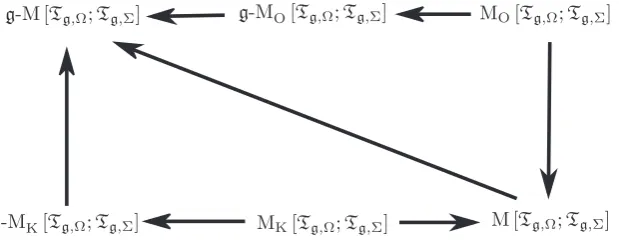
Theorem2.11. Ifπg:Tg,Ω→Tg,Σis a(Tg,Ω,Tg,Σ)-open or a(Tg,Ω,Tg,Σ)-closed map, then
πg∈g-MO[TΩ;Tg,Σ]∪g-MK[Tg,Ω;Tg,Σ].
(2.29)
Proof. Letπg:Tg,Ω→Tg,Σbe a (Tg,Ω,Tg,Σ)-map. Then, for every (Og,ω,Kg,ω)∈ Tg,Ω× ¬Tg,Ω there exists (Og,,Kg,σ)∈ Tg,Σ× ¬Tg,Σsuch that
πg(Og,ω)⊆ Og,σ∨ πg(Kg,ω)⊇ Kg,σ. But,Og,σ ⊆opg(Og,σ) andKg,σ ⊇ ¬opg(Kg,σ). Consequently,
πg(Og,ω)⊆opg(Og,σ)∨ πg(Kg,ω)⊇ ¬opg(Kg,σ).
Hence,πg∈g-MO[TΩ;Tg,Σ]∪g-MK[Tg,Ω;Tg,Σ]. Q.e.d.
The converse of Thm. 2.11 is clearly false, because the statement ”πg :Tg,Ω→
Tg,Σ is a (Tg,Ω,Tg,Σ)-map and πg : Tg,Ω →Tg,Σ is not a g- (Tg,Ω,Tg,Σ)-map” is
untrue. The following theorem states that, the image of ag-Tg-set in a Tg-space Tg,Ωis a g-Tg-set in a Tg-spaceTg,Σ if and only if the mapπg :Tg,Ω →Tg,Σ is a
Theorem 2.12. A necessary and sufficient condition for πg :Tg,Ω→Tg,Σ to be a
g- (Tg,Ω,Tg,Σ)-map is that, for every (Og,ω,Kg,ω)∈ Tg,Ω× ¬Tg,Ω, πgopg(Og,ω)⊆opg(πg(Og,ω))∨ πg¬opg(Kg,ω)⊇
¬opg(πg(Kg,ω)). (2.30)
Proof. Necessity. Letπg∈g-M [Tg,Ω;Tg,Σ]. Then for (Og,ω,Kg,ω)∈ Tg,Ω׬Tg,Ω
there corresponds (Og,,Kg,σ)∈ Tg,Σ× ¬Tg,Σsuch that
πg(Og,ω)⊆opg(Og,σ)∨ πg(Kg,ω)⊇ ¬opg(Kg,σ).
Because Og,ω ⊆opg(Og,ω)∨ Kg,ω ⊇ ¬opg(Kg,ω), it consequently follows that,
πgopg(Og,ω)⊆opg◦opg(Og,σ)∨ πg¬opg(Kg,ω)
⊇ ¬opg◦¬opg(Kg,σ). But, since
opg◦opg(Og,σ)⊆opg(πg(Og,ω)), ¬opg◦¬opg(Kg,σ)⊇ ¬opg(πg(Kg,ω)), the proof at once follows.
Sufficiency. For every (Og,ω,Kg,ω)∈ Tg,Ω× ¬Tg,Ω, let
πgopg(Og,ω)⊆opg(πg(Og,ω))∨ πg¬opg(Kg,ω)⊇
¬opg(πg(Kg,ω)). Then,
πg(Og,ω)⊆πgopg(Og,ω)⊆opg(πg(Og,ω))⊆opg(Og,σ)
∨ πg(Kg,ω)⊇πg¬opg(Kg,ω)⊇ ¬opg(πg(Kg,ω))⊇ ¬opg(Og,σ), because, Og,ω ⊆ opg(Og,ω), Kg,ω ⊇ ¬opg(Kg,ω), πg(Og,ω) ⊆ opg(Og,σ), and
πg(Kg,ω)⊇ ¬opg(Kg,σ). Therefore,
πg(Og,ω)⊆opg(Og,σ)∨ πg(Kg,ω)⊇ ¬opg(Og,σ).
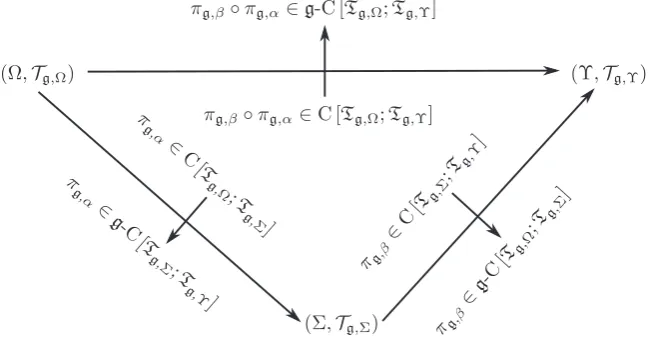
Thus,πg ∈g-M [Tg,Ω;Tg,Σ], which completes the proof. Q.e.d. Theorem 2.13. If πg,α ∈g-M [Tg,Ω;Tg,Σ]andπg,β ∈g-M [Tg,Σ;Tg,Υ], thenπg,β◦ πg,α∈g-M [Tg,Ω;Tg,Υ].
Proof. Letπg,α ∈g-M [Tg,Ω;Tg,Σ] and πg,β ∈g-M [Tg,Σ;Tg,Υ]. Then, for every
(Og,ω,Kg,ω)∈ Tg,Ω× ¬Tg,Ωthere exists (Og,σ,Kg,σ)∈ Tg,Σ× ¬Tg,Σand, for every
(Og,σ,Kg,σ)∈ Tg,Σ× ¬Tg,Σthere exists (Og,υ,Kg,υ)∈ Tg,Υ× ¬Tg,Υ such that πg,α(Og,ω)⊆opg(Og,σ)∨ πg,α(Kg,ω)⊇ ¬opg(Kg,σ),
πg,β(Og,σ)⊆opg(Og,υ)∨ πg,β(Kg,σ)⊇ ¬opg(Kg,υ).
From the first line, aided with the second, the logical statement preceding∨becomes
πg,α(Og,ω) ⊆ opg(Og,σ)
πg,β◦πg,α(Og,ω) ⊆ πg,βopg(Og,σ)⊆opg
πg,β(Og,σ)⊆opg
Og,υ, and, that following∨becomes
πg,α(Kg,ω) ⊇ ¬opg(Kg,σ)
πg,β◦πg,α(Kg,ω) ⊇ πg,β¬opg(Kg,σ)⊇ ¬opg
πg,βKg,σ⊇ ¬opg
Thus,πg,β◦πg,α∈g-M [Tg,Ω;Tg,Υ], which proves the theorem. Q.e.d. Theorem2.14. Letπg,α:Tg,Ω→Tg,Σbe a(Tg,Ω,Tg,Σ)-map and letπg,β :Tg,Σ→
Tg,Υ be a(Tg,Σ,Tg,Υ)-map. Then:
• i. πg,α∈g-M [Tg,Ω;Tg,Σ]implies πg,β◦πg,α∈g-M [Tg,Ω;Tg,Υ]. • ii. πg,β∈g-M [Tg,Σ;Tg,Υ]implies πg,β◦πg,α∈g-M [Tg,Ω;Tg,Υ].
Proof. i. Letπg,α be a (Tg,Ω,Tg,Σ)-map andπg,β a (Tg,Σ,Tg,Υ)-map. Then, for
every (Og,ω,Kg,ω) ∈ Tg,Ω× ¬Tg,Ω, there exists (Og,σ,Kg,σ) ∈ Tg,Σ× ¬Tg,Σ and,
for every (Og,σ,Kg,σ)∈ Tg,Σ× ¬Tg,Σ, there exists (Og,υ,Kg,υ)∈ Tg,Υ× ¬Tg,Υ such
that
πg,α(Og,ω)⊆ Og,σ∨ πg,α(Kg,ω)⊇ Kg,σ,
πg,β(Og,σ)⊆ Og,υ∨ πg,β(Kg,σ)⊇ Kg,υ.
The logical statements expressing the relationsπg,α ∈g-M [Tg,Ω;Tg,Σ] andπg,α ∈
g-M [Tg,Σ;Tg,Υ] are, respectively, πg,α(Og,ω)⊆opg
Og,σ ∨ πg,α(Kg,ω)⊇ ¬opg
Kg,σ,
πg,β(Og,σ)⊆opg
Og,υ ∨ πg,β(Kg,σ)⊇ ¬opg
Kg,υ. Therefore, if only the relationπg,α∈g-M [Tg,Ω;Tg,Σ] holds, then
πg,β◦πg,α(Og,ω)⊆πg,βopg
Og,σ∨ πg,β◦πg,α(Kg,ω)
⊇πg,β¬opg
Kg,σ
⇒ πg,β◦πg,α(Og,ω)⊆opg
πg,βOg,σ∨ πg,β◦πg,α(Kg,ω)
⊇ ¬opg
πg,βKg,σ
⇒ πg,β◦πg,α(Og,ω)⊆opg
Og,υ∨ πg,β◦πg,α(Kg,ω)⊇ ¬opg
Kg,υ, and, hence,πg,β◦πg,α∈g-M [Tg,Ω;Tg,Υ].
ii. If only the relationπg,β∈g-M [Tg,Σ;Tg,Υ] holds, then
πg,β◦πg,α(Og,ω)⊆πg,βOg,σ∨ πg,β◦πg,α(Kg,ω)⊇πg,βKg,σ
⇒ πg,β◦πg,α(Og,ω)⊆opg
Og,υ∨ πg,β◦πg,α(Kg,ω)⊇ ¬opg
Kg,υ,
and, hence,πg,β◦πg,α∈g-M [Tg,Ω;Tg,Υ]. Q.e.d.
Proposition 2.15. Let πg,α ∈g-M [Tg,Ω;Tg,Σ]and πg,β ∈g-M [Tg,Σ;Tg,Ω], satis-fying
πg,β◦πg,α(Og,ω)⊆opg(Og,ω)∨ πg,β◦πg,α(Kg,ω)⊇ ¬opg(Kg,ω),
πg,α◦πg,β(Og,σ)⊆opg(Og,σ)∨ πg,α◦πg,β(Kg,σ)⊇ ¬opg(Kg,σ), (2.31)
respectively. Then, there exist inverse maps π−1
g,α ∈ g-M [Tg,Ω;Tg,Σ] and π−g,β1 ∈ g-M [Tg,Σ;Tg,Ω]such that πg,β =π−g,α1 andπg,α=π−g,β1.
Proof. It is clear that, Og,μ ⊆ opg(Og,μ) or Kg,μ ⊇ opg(Kg,μ) for every μ ∈
ω, σ. But,πg,α ∈g-M [Tg,Ω;Tg,Σ] or πg,β∈g-M [Tg,Σ;Tg,Ω] satisfy
πg,β◦πg,α(Og,ω)⊆opg(Og,ω)∨ πg,β◦πg,α(Kg,ω)⊇ ¬opg(Kg,ω),
Hence, there exist π−1
g,α ∈ g-M [Tg,Ω;Tg,Σ] and πg−,β1 ∈ g-M [Tg,Σ;Tg,Ω] such that πg,β =π−g,α1 andπg,α=πg−,β1. This proves the proposition. Q.e.d.
Theorem 2.16. Letπg∈g-M [Tg,Ω;Tg,Σ]. Given any Tg,Σ-set Sg⊂Tg,Σand any pair (Og,ω,Kg,ω)∈ Tg,Ω× ¬Tg,Ω ofTg,Ω-open and Tg,Ω-closed sets satisfying
π−1
g (Sg)⊆opg(Og,ω)∨ πg−1(Sg)⊇ ¬opg(Kg,ω), (2.32)
then:
• i. πg∈g-M
K[TΩ;Tg,Σ] implies the existence of aTg,Σ-open setOg,σ ⊇ Sg
such thatπ−1
g (Og,σ)⊆opg(Og,ω).
• ii. πg∈g-M
O[TΩ;Tg,Σ]implies the existence of aTg,Σ-closed setKg,σ ⊇ Sg such thatπ−1
g (Kg,σ)⊇ ¬opg(Kg,ω).
Proof. i. LetOg,σ= Σ−πgΩ−opg(Og,ω). Then, sinceπ−g1(Sg)⊆opg(Og,ω)
and πg ∈ g-MK[Tg,Ω;Tg,Σ], there exists a Tg,Σ-open set Og,σ ∈ Tg,Σ such that Og,σ ⊇ Sg. But, since
π−1
g (Og,σ) = Ω−πg−1◦πgΩ−opg(Og,ω)
⊆ Ω−Ω−opg(Og,ω)= opg(Og,ω), the proof ofi.follows.
ii. LetKg,σ = Σ−πgΩ− ¬opg(Kg,ω). Then, becauseπ−g1(Sg)⊇ ¬opg(Kg,ω)
and πg ∈ g-MO[Tg,Ω;Tg,Σ], there exists a Tg,Σ-closed Kg,σ ∈ ¬Tg,Σ such that Kg,σ⊇ Sg. But, since
π−1
g (Kg,σ) = Ω−π−g1◦πgΩ− ¬opg(Kg,ω)
⊇ Ω−Ω− ¬opg(Kg,ω)=¬opg(Kg,ω),
the proof ofii.follows. Q.e.d.
We next investigate further properties and give characterizations of those ele-ments which belong to the classg-C [Tg,Ω;Tg,Σ].
Theorem 2.17. If πg : Tg,Ω →Tg,Σ is a (Tg,Ω,Tg,Σ)-continuous map, then πg ∈
g-C [Tg,Ω;Tg,Σ].
Proof. If πg : Tg,Ω → Tg,Σ is a (Tg,Ω,Tg,Σ)-continuous map, then, for every
(Og,σ,Kg,σ)∈ Tg,Σ× ¬Tg,Σ, there exists (Og,ω,Kg,ω)∈ Tg,Ω× ¬Tg,Ωsuch that π−1
g (Og,σ)⊆ Og,ω∨ πg−1(Kg,σ)⊇ Kg,ω. But, for every (Og,ω,Kg,ω)∈ Tg,Ω× ¬Tg,Ω,
Og,ω⊆opg(Og,ω)∨ Kg,ω ⊇ ¬opg(Kg,ω), and, consequently,
π−1
g (Og,σ)⊆opg(Og,ω)∨ πg−1(Kg,σ)⊇ ¬opg(Kg,ω).
Hence,πg∈g-C [Tg,Ω;Tg,Σ]. Q.e.d.
Theorem 2.18. If πg : Tg,Ω → Tg,Σ is a (Tg,Ω,Tg,Σ)-map satisfying, for every
(Og,σ,Kg,σ)∈ Tg,Σ× ¬Tg,Σ, π−1
g (Og,σ)⊆opg
π−1
g (Og,σ)∨ πg−1(Kg,σ)⊇ ¬opg
π−1
Proof. For every (Og,σ,Kg,σ)∈ Tg,Σ× ¬Tg,Σ, it is evident that Og,σ ⊆opg(Og,σ)∨ Kg,σ ⊇ ¬opg(Kg,σ)
⇒ π−1
g (Og,σ)⊆πg−1
opg(Og,σ)∨ πg−1(Kg,σ)⊇π−g1
¬opg(Kg,σ)
⇒ π−1
g (Og,σ)⊆opg
π−1
g (Og,σ)∨ πg−1(Kg,σ)⊇ ¬opg
π−1
g (Kg,σ). Hence, there exists (Og,ω,Kg,ω)∈ Tg,Ω× ¬Tg,Ω such thatπ−g1(Og,σ) ⊆ Og,ω and
π−1
g (Kg,σ)⊇ Kg,ω. Consequently,πg∈g-C [Tg,Ω;Tg,Σ], which completes the proof. Q.e.d. Definition 2.19 ((Tg,Ω;Tg,Σ)-Bijective Map). A (Tg,Ω,Tg,Σ)-map πg : Tg,Ω →
Tg,Σis said to be bijective if and only if it belongs the following class:
g-B [Tg,Ω;Tg,Σ]def=
πg: (∀ζ∈Tg,Σ) (∃!ξ∈Tg,Ω) πg(ξ) =ζ. (2.33)
Theorem 2.20. Ifπg∈g-B [Tg,Ω;Tg,Σ], then
πg∈g-M [Tg,Ω;Tg,Σ] ⇔ πg−1∈g-C [Tg,Σ;Tg,Ω].
(2.34)
Proof. Necessity. Letπ−g1∈g-C [Tg,Σ;Tg,Ω]. Then π−1
g −1
(Og,ω)⊆opg(Og,σ)∨ π−g1 −1
(Kg,ω)⊇ ¬opg(Kg,σ).
But πg ∈ g-B [Tg,Ω;Tg,Σ] implies
π−1
g −1
(Sg) = πg(Sg) for every Sg ∈ Tg,Ω∪ ¬Tg,Ω. Consequently,
πg(Og,ω)⊆opg(Og,σ)∨ πg(Kg,ω)⊇ ¬opg(Kg,σ).
Hence,πg∈g-M [Tg,Ω;Tg,Σ].
Sufficiency. Letπg∈g-M [Tg,Ω;Tg,Σ]. Then,
πg(Og,ω)⊆opg(Og,σ)∨ πg(Kg,ω)⊇ ¬opg(Kg,σ).
Butπg(Sg) =π−g1 −1
(Sg) for everySg ∈ Tg,Ω∪¬Tg,Ω, sinceπg ∈g-B [Tg,Ω;Tg,Σ].
Consequently,
π−1
g −1
(Og,ω)⊆opg(Og,σ)∨ π−g1 −1
(Kg,ω)⊇ ¬opg(Kg,σ).
Thus,π−1
g ∈g-C [Tg,Σ;Tg,Ω]. Q.e.d.
Theorem 2.21. If πg,α ∈g-C [Tg,Ω;Tg,Σ] and πg,β ∈g-C [Tg,Σ;Tg,Υ], then πg,β◦ πg,α∈g-C [Tg,Ω;Tg,Υ].
Proof. Let πg,α ∈ g-C [Tg,Ω;Tg,Σ] and πg,β ∈ g-C [Tg,Σ;Tg,Υ]. Then πg−1
,α ∈ g-M [Tg,Σ;Tg,Ω] andπg−,β1 ∈g-C [Tg,Υ;Tg,Σ], implying
π−1
g,α(Og,σ)⊆opg(Og,ω) ∨ πg−,α1(Kg,σ)⊇ ¬opg(Kg,ω),
π−1
respectively. Combining both logical statements, there follows that
π−1
g,β(Og,υ)⊆opg(Og,σ)∨ πg−,β1(Kg,υ)⊇ ¬opg(Kg,σ)
⇒ π−1
g,α◦πg−,β1(Og,υ)⊆πg−,α1
opg(Og,σ)∨ πg−,α1 ◦πg−,β1(Kg,υ)
⊇π−1
g,α
¬opg(Kg,σ)
⇒ π−1
g,α◦πg−,β1(Og,υ)⊆opg
π−1
g,α(Og,σ)∨ πg−,α1 ◦πg−,β1(Kg,υ)
⊇ ¬opgπ−g,α1(Kg,σ)
⇒ π−1
g,α◦πg−,β1(Og,υ)⊆opg(Og,ω)∨ πg−,α1 ◦πg−,β1(Kg,υ)⊇ ¬opg(Kg,ω). Since π−1
g,α ◦πg−,β1(Sg) = (πg,β◦πg,α)−1(Sg) for every Sg ∈ Tg,Υ∪ ¬Tg,Υ, there
follows thatπg,β◦πg,α∈g-C [Tg,Ω;Tg,Υ], which was to be proved. Q.e.d. Theorem 2.22. Let πg,α : Tg,Ω → Tg,Σ be a (Tg,Ω;Tg,Σ)-map and, let the col-lection Og,αα∈I∗
n : Ω ⊆ opg
α∈I∗
nOg,α
and the collection Kg,αα∈I∗
n :
Ω ⊆ ¬opgα∈I∗
nKg,α
, respectively, be g-Tg-open and g-Tg-closed coverings of Ω, where Og,αα∈I∗
n and
Kg,αα∈I∗
n, respectively, denote sequences of Tg-open sets and Tg-closed sets. If, for every α ∈ In∗, πg◦ιg,α ∈ g-C [Tg,Ω;Tg,Σ], where ιg,α:Og,α→Tg,Ω orιg,α:Og,α→Tg,Ω, thenπg∈g-C [Tg,Ω;Tg,Σ].
Proof. For every α ∈ In∗, let πg◦ιg,α ∈ g-C [Tg,Ω;Tg,Σ]. Then, for every pair
Og,σ(α),Kg,σ(α)
∈ Tg,Σ× ¬Tg,Σ, there exists
Og,ω(α),Kg,ω(α)
∈ Tg,Ω× ¬Tg,Ω
such that
(πg◦ιg,α)−1Og,σ(α)
⊆opgOg,ω(α)
∨ (πg◦ιg,α)−1Kg,σ(α)
⊇ ¬opg
Kg,ω(α)
⇒ α∈I∗
n(πg◦ιg,α)
−1O
g,σ(α)
⊆α∈I∗
nopg
Og,ω(α)
∨ α∈I∗
n(πg◦ιg,α)
−1K
g,σ(α)
⊇α∈I∗
n¬opg
Kg,ω(α)
⇒ α∈I∗
n(πg◦ιg,α)
−1O
g,σ(α)
⊆opgα∈I∗
nOg,ω(α)
∨ α∈I∗
n(πg◦ιg,α)
−1K
g,σ(α)
⊇ ¬opgα∈I∗
nKg,ω(α)
.
Since the following relations hold
π−1
g
Og,σ(α)
= α∈I∗
n(πg◦ιg,α)
−1O
g,σ(α)
, π−1
g
Kg,σ(α)
= α∈I∗
n(πg◦ιg,α)
−1K
g,σ(α)
,
the proof of the theorem follows. Q.e.d.
Henceforth, we investigate some properties and give some characterizations of g- (Tg,Ω,Tg,Σ)-irresolute maps.
Theorem2.23. A(Tg,Ω,Tg,Σ)-mapπg:Tg,Ω→Tg,Σis ag- (Tg,Ω,Tg,Σ)-irresolute map if and only if, for every(Og,σ,Kg,σ)∈ Tg,Σ× ¬Tg,Σ,
π−1
g
opg(Og,σ)⊆opg
π−1
g (Og,σ)∨ π−g1
¬opg(Kg,σ)⊇
Proof. Necessity. Let πg ∈ g-I [Tg,Ω;Tg,Σ]. Then, there exists (Og,ω,Kg,ω) ∈ Tg,Ω× ¬Tg,Ω such that, for every (Og,σ,Kg,σ)∈ Tg,Σ× ¬Tg,Σ,
π−1
g
opg(Og,σ)⊆opg(Og,ω)∨ π−g1
¬opg(Kg,σ)⊇ ¬opg(Kg,ω). But since π−g1
opg(Og,σ) ⊆ πg−1(Og,σ) and πg−1
¬opg(Kg,σ) ⊇ π−g1(Kg,σ), it follows that
π−1
g
opg(Og,σ)⊆opg
π−1
g (Og,σ)∨ π−g1
¬opg(Kg,σ)⊇
¬opg
π−1
g (Kg,σ).
Sufficiency. Let πg : Tg,Ω → Tg,Σ be a (Tg,Ω,Tg,Σ)-map satisfying, for every
(Og,σ,Kg,σ)∈ Tg,Σ× ¬Tg,Σ, π−1
g
opg(Og,σ)⊆opg
π−1
g (Og,σ)∨ π−g1
¬opg(Kg,σ)⊇
¬opgπ−1
g (Kg,σ). But, π−1
g
opg(Og,σ) ⊆ πg−1(Og,σ) and π−g1
¬opg(Kg,σ) ⊇ πg−1(Kg,σ). There-fore, there exists (Og,ω,Kg,ω) ∈ Tg,Ω× ¬Tg,Ω such that π−g1(Og,σ) ⊆opg(Og,ω) andπ−1
g (Kg,σ)⊇ ¬opg(Kg,ω). Consequently,
π−1
g
opg(Og,σ)⊆opg(Og,ω)∨ π−g1
¬opg(Kg,σ)⊇ ¬opg(Kg,ω).
Thus,πg ∈g-I [Tg,Ω;Tg,Σ], which completes the proof. Q.e.d. Theorem 2.24. A g- (Tg,Ω,Tg,Σ)-map πg : Tg,Ω → Tg,Σ is a g- (Tg,Ω,Tg,Σ) -irresolute map if and only if, for every(Og,ω,Kg,)∈ Tg,Ω× ¬Tg,Ω,
πgopg(Og,ω)⊇opg(πg(Og,ω))∨ πg¬opg(Kg,ω)⊆
¬opg(πg(Kg,ω)). (2.36)
Proof. Necessity. Let πg ∈ g-I [Tg,Ω;Tg,Σ]. Then, there exists (Og,ω,Kg,ω) ∈ Tg,Ω× ¬Tg,Ω such that, for every (Og,σ,Kg,σ)∈ Tg,Σ× ¬Tg,Σ,
π−1
g
opg(Og,σ)⊆opg(Og,ω)∨ πg−1
¬opg(Kg,σ)⊇ ¬opg(Kg,ω)
⇒ πgopg(Og,ω)⊇opg(Og,σ)∨ πg¬opg(Kg,ω)⊆ ¬opg(Kg,σ). But since opg(Og,σ) ⊇ πgopg(Og,ω) and ¬opg(Kg,σ) ⊆ πg¬opg(Kg,ω), it follows that
πgopg(Og,ω)⊇opg(πg(Og,ω))∨ πg¬opg(Kg,ω)⊆
¬opg(πg(Kg,ω)).
Sufficiency. Letπg :Tg,Ω→Tg,Σbe a g- (Tg,Ω,Tg,Σ)-map satisfying, for every
(Og,ω,Kg,ω)∈ Tg,Ω× ¬Tg,Ω,
πgopg(Og,ω)⊇opg(πg(Og,ω))∨ πg¬opg(Kg,ω)⊆
¬opg(πg(Kg,ω)). Then,
π−1
g
opg(πg(Og,ω))⊆opg(Og,ω)∨ π−g1
¬opg(πg(Kg,ω))⊇
But,πg∈g-M [Tg,Ω;Tg,Σ] equivalently implies the existence of (Og,σ,Kg,σ)∈ Tg,Σ×
¬Tg,Σsuch that, for every (Og,ω,Kg,ω)∈ Tg,Ω׬Tg,Ω, opg(πg(Og,ω))⊆opg(Og,σ) or¬opg(πg(Kg,ω))⊇ ¬opg(Kg,σ). Consequently,
π−1
g
opg(Og,σ)⊆opg(Og,ω)∨ π−g1
¬opg(Kg,σ)⊇ ¬opg(Kg,ω).
Thus,πg ∈g-I [Tg,Ω;Tg,Σ], which completes the proof. Q.e.d. Theorem 2.25. Letπg:Tg,Ω→Tg,Σbe a(Tg,Ω,Tg,Σ)-map. Then,
πg∈g-M [Tg,Ω;Tg,Σ]∩g-C [Tg,Ω;Tg,Σ] ⇒ πg∈g-I [Tg,Ω;Tg,Σ].
(2.37)
Proof. Let πg ∈ g-M [Tg,Ω;Tg,Σ]∩g-C [Tg,Ω;Tg,Σ]. Then, there exists a pair
(Og,ω,Kg,ω)∈ Tg,Ω× ¬Tg,Ωsuch that, for every (Og,σ,Kg,σ)∈ Tg,Σ× ¬Tg,Σ, πg(Og,ω)⊆opg(Og,σ)∨ πg(Kg,ω)⊇ ¬opg(Og,σ),
and there exists (Og,σ,Kg,σ) ∈ Tg,Σ× ¬Tg,Σ such that, for every (Og,ω,Kg,ω) ∈
Tg,Ω× ¬Tg,Ω, π−1
g (Og,σ)⊆opg(Og,ω)∨ πg−1(Kg,σ)⊇ ¬opg(Kg,ω). From the first statement, there follows that
Og,ω⊆π−g1
opg(Og,σ)∨ Kg,ω ⊇π−g1
¬opg(Kg,σ). But,
π−1
g
opg(Og,σ)⊆opg
π−1
g (Og,σ)∨ π−g1
¬opg(Kg,σ)⊇
¬opgπ−g1(Kg,σ); and, from the second statement, there follows that
opgπg−1(Og,σ)⊆opg(Og,ω)∨ ¬opg
π−1
g (Kg,σ)⊇ ¬opg(Og,ω). From these last two logical statements, it consequently follows that
π−1
g
opg(Og,σ)⊆opg(Og,ω)∨ π−g1
¬opg(Kg,σ)⊇ ¬opg(Kg,ω),
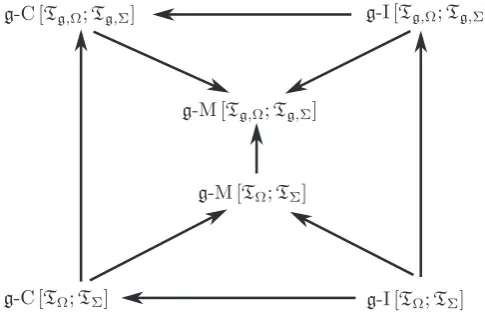
and, hence,πg∈g-I [Tg,Ω;Tg,Σ], which completes the proof. Q.e.d. Theorem 2.26. If g-C [Tg,Ω;Tg,Σ] and g-I [Tg,Ω;Tg,Σ], respectively, denote the classes ofg- (Tg,Ω,Tg,Σ)-continuous andg- (Tg,Ω,Tg,Σ)-irresolute maps, then
g-C [Tg,Ω;Tg,Σ]⊇g-I [Tg,Ω;Tg,Σ].
(2.38)
Proof. Let πg ∈g-I [Tg,Ω;Tg,Σ]. Then, there exists (Og,σ,Kg,σ)∈ Tg,Σ× ¬Tg,Σ
such that, for every (Og,ω,Kg,ω)∈ Tg,Ω× ¬Tg,Ω, π−1
g
opg(Og,σ)⊆opg(Og,ω)∨ π−g1
¬opg(Kg,σ)⊇ ¬opg(Kg,ω). But,πg∈g-I [Tg,Ω;Tg,Σ] is equivalent to
π−1
g
opg(Og,σ)⊆opg
π−1
g (Og,σ)∨ π−g1
¬opg(Kg,σ)⊇
¬opgπ−g1(Kg,σ), and, opgπ−1
g (Og,σ)⊆opg(Og,ω) and ¬opg
π−1
g (Kg,σ)⊇ ¬opg(Kg,ω). Conse-quently,πg∈g-I [Tg,Ω;Tg,Σ] implies
π−1
g (Og,σ)⊆opg(Og,ω)∨ πg−1(Kg,σ)⊇ ¬opg(Kg,ω),