
SHIFTS
LILYA BUDAGHYAN, MARCO CALDERINI, CLAUDE CARLET, ROBERT S. COULTER, AND IRENE VILLA
Abstract. Almost perfect nonlinear (APN) functions over fields of charac-teristic 2 play an important role in cryptography, coding theory and, more generally, information theory as well as mathematics. Building new APN fam-ilies is a challenge which has not been successfully addressed for more than seven years now.
The most general known equivalence relation preserving APN property in char-acteristic 2 is CCZ-equivalence. Extended to general charchar-acteristic, it also preserves planarity. In the case of quadratic planar functions, it is a particular case of isotopic equivalence. We apply the idea of isotopic equivalence to trans-form APN functions in characteristic 2 into other functions, some of which can be APN. We deduce new quadratic APN functions and a new quadratic APN family.
1. Introduction
This paper is concerned with functions, and hence polynomials, over finite fields. Letpbe a prime,n∈N, andq=pn. We useFq to denote the finite field of orderq,
and follow the well-established convention of using F?q to denote its multiplicative
group. Throughout,ζ denotes a primitive element ofFq, so thatF?q =hζi. It is an
important fact that any function defined onFq can be represented uniquely by an
element of the polynomial ring Fq[x] of degree less than q. One can easily prove
this via Lagrange interpolation, for example. Generally, we shall use function and polynomial interchangeably, unless we wish to rely specifically on the form of the polynomial, in which case we will be precise.
LetF ∈Fq[x]. The value set ofF overFq is denoted byV(F), i.e.
V(F) ={F(c) : c∈Fq}.
We also denote the set of roots of F(x) over Fq by ker(F). The polynomialF is
a permutation polynomial (PP) overFq ifV(F) =Fq, and is a complete mapping
overFq if bothF andF(x) +xare PPs.
We define thedifference operator ofF, denoted ∆F ∈Fq[x, y], by
∆F(x, y) =F(x+y)−F(x)−F(y).
When there is no ambiguity about whichF we are referring to, we simply use ∆. Note that ∆F is symmetric inxand y. We refer to DaF(x) = ∆(x, a) +F(a) as
thederivative ofF in the direction ofa.
This paper was presented in part at SETA 2018.
Fixδ∈N. A functionF is calleddifferentially δ-uniform if fora, b∈Fq, a6= 0,
the equation ∆(x, a) = b admits at most δ solutions x∈ Fq. Differential
unifor-mity measures the contribution of a function, used as a substitution box (S-box) inside a block cipher, to the resistance of the cryptosystem to differential crypt-analysis, with small values ofδ corresponding to better resistance. Consequently, 1-uniform functions are optimal; for such a function, all of its non-zero derivatives are permutations. In cryptographic applications these functions were coinedperfect nonlinear (PN) by Nyberg [20], while they were earlier introduced asplanar func-tions by Dembowski and Ostrom [15] in their seminal work on projective planes allowing a collineation group acting transitively on the affine points. The existence of an involution in the additive group means such functions cannot exist in even characteristic; here, the best resistance belongs to functions that are differentially 2-uniform. Such “(n, n)-functions” having optimal differential uniformity are called
almost perfect nonlinear (APN), see Nyberg [21]. They play a prominent role in the design of block ciphers and their study by Nyberg has allowed the Advanced Encryption Standard (AES) to have good S-boxes. Their study is also closely re-lated to important questions on error correcting codes, since it is shown in [10] that any (n, n)-function F such that F(0) = 0 is APN if and only if the linear code
admitting for parity check matrix H =
1 ζ ζ2 . . . ζ2n−2
F(1) F(ζ) F(ζ2) . . . F(ζ2n−2
)
has minimum distance 5, whereζis a primitive element of the fieldF2n, and where
each symbol stands for the column of its coordinates with respect to a basis of the
F2-vector spaceF2n. And the construction in the late 50’s of the 2-error correcting
BCH codes by Bose, Ray-Chaudhuri and Hocquenghem relies on the APNness of the power function x3 (even if, at that time, the notion had not been yet
intro-duced). Moreover, the code of generator matrix H above has Hamming weights 0,2n−1−2n−21,2n−1 and 2n−1+ 2
n−1
2 if and only if F is almost bent (a stronger
notion than APNness, see [11]).
APN functions also play a role in algebraic manipulation detection (AMD), in ap-plied cryptography and coding, see [14].
Further special classes of polynomials that play a central role in our work are defined as follows. ForF∈Fq[x]:
• F islinearifF(x) =P iaixp
i
. Also known as linearised polynomials. The set of all linear polynomials of degree less thanqis in 1-to-1 correspondence with the set End(n, p) of all linear transformations of Fq, when viewed as
a vector space over Fp. Consequently, when F is linear, both V(F) and
ker(F) are subspaces of Fq.The set of all reduced degree linear PPs under
composition moduloxq−xcorresponds to the general linear group GL(n, p),
the group of all non-singular linear transformations. One can (and we do) talk of linear functions overFq×Fq also.
• F isaffineif it differs from a linear polynomial by a constant. • F is aDembowski-Ostrom (DO)polynomial ifF(x) =P
i,jaijxp i+pj
. • F is quadratic if it differs from a DO polynomial by an affine
polyno-mial. Quadratic polynomials can be categorised as those polynomials whose derivatives are all affine, see Coulter and Matthews [13], Theorem 3.1.
Note that a quadratic function F is APN over Fq if and only if for all a ∈ F?q,
There are several equivalence relations that preserve differential uniformity; we list them below. LetF, F0 ∈Fq[x]. ThenF andF0 are:
• affine equivalent if there exist affine permutationsA1, A2∈Fq[x] for which
F0≡A1◦F◦A2mod (xq−x).
• extended affine equivalent (EA-equivalent)if there exist affine permutations A1, A2∈Fq[x] and an affine mapA∈Fq[x] for whichF0≡(A1◦F◦A2) +
Amod (xq−x).
• Carlet-Charpin-Zinoviev equivalent (CCZ-equivalent)[10] if there exists an affine permutationLof Fq×Fq that maps the graph ofF onto the graph
ofF0,L(GF) =GF0, where the graph ofF is the setGF ={(x, F(x)) :x∈
Fpn}.
These relations are related to each other. Indeed, affine equivalence is obviously a particular case of EA-equivalence, which is itself a particular case of CCZ-equivalence [10]. As the addition of a constant term does not alter the APN or PN property, for ease of discourse, we assume throughout the paper that any APN or PN function F has zero constant term, i.eF(0) = 0.
The concept of isotopic equivalence was originally defined by Albert [1] in the study of presemifields and semifields. Apresemifieldis a ring with no zero divisor, and whose operations satisfy left and right distributivity. Asemifieldis a presemi-field containing a multiplicative identity. Presemipresemi-fields need not be commutative nor associative, though in the finite case associativity implies commutativity by Wedderburn’s Theorem [22]. In [18], Section 2.4, Knuth gives a simple proof that the additive group of a finite presemifield is necessarily elementary Abelian. Con-sequently, any finite presemifield must have order a prime power q, and can be represented byS= (Fq,+, ?) with field addition and the multiplication?given by
x ? y=φ(x, y), whereφ∈Fq[x, y] is linear in each variable.
Given two presemifields S1 = (Fq,+, ?) and S2 = (Fq,+,∗), they are called isotopic if there exist three linear permutationsT, M, N ∈Fq[x] such that
T(x∗y) =M(x)? N(y),
for any x, y∈Fq. If M =N, then S1 and S2 are called strongly isotopic. It was
shown by Coulter and Henderson [12] that there is a 1-to-1 correspondence between commutative presemifields of odd order and planar DO polynomials. Indeed, given a quadratic planar functionF ∈Fq[x], a commutative presemifieldSF = (Fq,+, ?)
is defined by the multiplicationx ? y= ∆F(x, y). Conversely, given a commutative
presemifieldSF = (Fq,+, ?) of odd order, the functionF(x) = 12(x ? x) necessarily
defines a planar DO polynomial. It is natural, then, to extend the notion (at least in odd characteristic) of isotopic equivalence to quadratic PN functions, where two quadratic PN functions are isotopic if and only if their corresponding presemifields are isotopic. Furthermore, it is known that CCZ-equivalence is a particular case of isotopic equivalence. Indeed, Budaghyan and Helleseth [8] showed that two planar DO polynomials F and F0 are CCZ-equivalent if and only if the corresponding commutative semifieldsSF andSF0 are strongly isotopic.
Definition 1.1. LetF, L∈Fq[x]. Theisotopic shift ofF by L, denoted byFL, is
the polynomial given by
FL(x) = ∆F(x, L(x)) =F(x+L(x))−F(x)−F(L(x)). (1)
The paper is organized as follows. In Section 2 we show how isotopic shifts arise naturally in the study of planar functions. This result acts as motivation for studying isotopic shifts in the parallel area of APN functions. Before narrowing our scope to APN functions, we make some general observations in Section 3 concerning isotopic shifts. We then restrict ourselves to considering isotopic shifts of APN functions. Firstly, in Section 4, we consider how we may obtain the same function by isotopically shifting a given APN functionF in characteristic 2 by different L. Then, in Section 5, we begin our main study, that of isotopic shifts of quadratic APN functions by linear maps (in particular in characteristic 2). We show that only bijective or 2-to-1 linear maps can possibly produce an APN function from the isotopic shift of a quadratic APN. As an aside, we show how to construct all q-to-1 maps on Fqn. We then proceed in Section 6 to concentrate specifically on
isotopic shifts of Gold functions in characteristic 2. Highlights of our results are as follows:
• A new family of APN functions defined overF2km is determined, see
Theo-rem 6.3, and fork=m= 3, this family produces an APN function that is not equivalent to any APN function belonging to an already known class, see Section 7.2. This is the first time since seven years that such family is found (since [24]).
• We show that an isotopic shift of an APN function can lead to APN func-tions CCZ-inequivalent to the original function, even if we shift only Gold functions by linear monomials, see Lemma 6.5.
• We show that every quadratic APN function over F26 is EA-equivalent to
an isotopic shift of x3, see Table 2; and also EA-equivalent to an isotopic
shift ofx3+ζ−1Tr(ζ3x9), see Table 3.
We also provide much computational data in the last section of the paper.
2. Isotopic equivalence for planar quadratic functions revisited
Our first result shows that the concept of isotopic shifts is, in fact, a very natural concept. Recall that istopic shiftsFL are defined in (1).
Theorem 2.1. Let F, F0 ∈Fq[x] be quadratic planar functions (null at 0). If F and F0 are isotopic equivalent then F0 is EA equivalent to some isotopic shiftFL of F by a linear permutation polynomialL∈Fq[x].
Proof. By definition, quadratic planar functions are isotopic equivalent if the pre-semifields defined by them are isotopic. That is, the prepre-semifields defined by mul-tiplications? and∗, with
x ? y= ∆F0(x, y) andx∗y= ∆F(x, y),
respectively, are isotopic. Note that the linear parts of F and F0 do not play a role in these operations. In the calculations below, we replace then the quadratic functions by their DO parts (that is, we erase their linear parts, without loss of generality up to EA equivalence).
According to Fermat’s little theorem, we have 2p≡2 [modp] and therefore 2pj+pk
4 [modp] for every non-negative integersj, k, and thanks to the fact that we erased the linear parts ofF andF0, we havex ? x= 2F0(x) andx∗x= 2F(x). For some linear permutationsT, M, N∈Fq[x], we have
T(x ? y) =M(x)∗N(y), (2)
for allx, y∈Fq. Hence,
T(x ? x) =T(2F0(x)) = 2T(F0(x))
and
T(x ? x) =M(x)∗N(x) = ∆F(M(x), N(x)),
which leads to
2T(F0(M−1(x))) = ∆F(x, N(M−1(x))).
As this holds for all x∈Fq, we see that this is, in fact, a polynomial identity, and
F0 is EA equivalent toFL withL=N◦M−1, a linear permutation.
Theorem 2.1 shows that, for isotopic equivalent quadratic planar functions, what takes us beyond CCZ-equivalence is the isotopic shift by a linear permutationL. For linear shifts of APN functions, we do not restrictL to be a permutation. As with planar quadratic functions, we will see that an isotopic shift of an APN function can lead to APN functions CCZ-inequivalent to the original function.
3. Generic results on isotopic shifts
With regards to isotopic shifts, an easy first observation is that for anyF ∈Fq[x]
and any permutationL∈Fq[x], we have
FL(L[−1](x))≡FL[−1](x) mod (xq−x), (3)
whereL[−1]is the compositional inverse ofL. In particular, thanks to EA-equivalence, ifL is a linear permutation polynomial, thenFL andFL[−1] have the same
differ-ential uniformity. Along similar lines, we have the following theorem.
Theorem 3.1. Let F, F0 ∈Fq[x]be arbitrary polynomials. IfF andF0 are affine equivalent, say F(x) ≡ A1(F0(A2(x))) mod (xq −x), where A1, A2 ∈ Fq[x] are linear permutations, then forL∈Fq[x],FL is affine equivalent toFM0 whereM =
A2◦L◦A [−1] 2 .
Proof. SinceF =A1◦F0◦A2withA1, A2linear permutation polynomials, we have
FL(x) = ∆F(x, L(x))
=F(x+L(x))−F(x)−F(L(x))
=A1(F0(A2(x) +A2(L(x)))−F0(A2(x))−F0(A2(L(x))))
=A1(F0(A2(x) +M(A2(x)))−F0(A2(x))−F0(M(A2(x))))
=A1(∆F0(A2(x), M(A2(x)))) =A1(FM0 (A2(x))),
and this completes the proof.
Let GL = GL(n, p) and S be the set of all polynomials in Fq[x] of degree
acted on by L by the conjugation action). In the most general sense, we are in-terested in isotopic shifts of arbitrary polynomial F ∈ S by arbitrary polynomial L∈ S. Set NGL(L) to be the stabiliser of Lunder the action. Then Theorem 3.1
shows that isotopic shifts ofF by elements ofS splits naturally into affine equiva-lent “conjugacy classes” of the action of GL asFL andFL0 will be affine equivalent
wheneverF0 =M◦F◦M[−1] andM ∈N
GL(L). More generally, we will be
inter-ested in isotopic shifts of elements ofS by elements of End = End(Fn
p) (the larger
set of endomorphisms,i.e. linear transformations). Note that the action of GL on S may be restricted to an action on End.
We will be mainly concerned with the case whereF is a quadratic APN function andLis linear. We note that, forF a quadratic,
FL+FM =FL+M (4)
for arbitrary choices of polynomialsL, M.
4. Isotopic shifts of APN functions
Throughout this section, q = 2n for some n ∈ N. We first consider how an
isotopic shift of an APN function may generate the zero polynomial. (We remind the reader that throughout the paper, we assume any APN function has zero constant term.)
Theorem 4.1. Let F ∈ Fq[x] be an APN function and L ∈ Fq[x]. Then FL is the zero function if and only if L(a)∈ {0, a} for all a∈F?
q. Furthermore, ifL is linear, thenFL is the zero function if and only ifLis either the zero polynomial or the polynomialx.
Proof. SupposeFL(x) = 0. AsFis APN, we know that for alla∈F?q, ∆F(x, a) = 0
if and only if x ∈ {0, a}. Now FL(x) = ∆F(x, L(x)), so that for all a ∈ F?q,
L(a)∈ {0, a} is forced.
Conversely, ifL(a)∈ {0, a} for alla∈F?q, then clearly FL(a) = ∆F(a, L(a)) = 0,
whileFL(0) = ∆F(0, L(0)) = 0. HenceFL(x) = 0.
Now supposeLis linear. SinceL(a)∈ {0, a}for all a∈Fq, we have Fq =V(L)⊕
ker(L). Suppose 0<dim(ker(L))< n. Then there exist v ∈ V(L) (which implies v=L(v)) andz∈ker(L) withvz6= 0 and v+z6= 0. Thus
v=v+ 0 =L(v) +L(z) =L(v+z)∈ {0, v+z},
a contradiction. Hence ker(L) =Fq or ker(L) ={0}. In the former case,L(x) = 0,
while in the latter caseL(x) =x.
Our motivation for establishing this result is not directly related to being con-cerned with generating the zero polynomial, but with the more practical problem of understanding how distinct L can yield the same isotopic shift of a given DO APN function.
Corollary 4.2. Let F ∈ Fq[x] be a DO APN function and L, M ∈ Fq[x]. The following statements hold.
(i) FL=FM if and only ifL(a) +M(a)∈ {0, a}for all a∈F?q.
(ii) SupposeL, M are linear. ThenFL=FM if and only ifL=M or L(x) =
Proof. We have from (4) thatFL=FM if and only ifFN(x) = 0, whereN=L+M.
Both results now follow from Theorem 4.1.
A consequence of Corollary 4.2 is that there is a sort of duality that occurs among isotopic shifts, betweenL(x) andL(x) +x. That is, any conditions derived onLfor the isotopic shiftFLto be APN apply equally to bothL(x) andL(x) +x.
5. Isotopic shifts of quadratic APN functions
In this section, we restrict ourselves to isotopic shifts of quadratic APN func-tions by linear polynomials. In the planar case, for the isotopic shift to be planar we require the linear polynomial involved to be a permutation polynomial. The corresponding result for the APN case is as follows. Here we assume q = 2n for
somen∈N.
Theorem 5.1. LetF ∈Fq[x]be a quadratic APN function andL∈Fq[x]be linear. Set M(x) =L(x) +x. IfFL is APN, then the following statements hold.
(i) Lis either a permutation or 2-to-1, and Lis injective on V(L).
(ii) M is either a permutation or 2-to-1, and M is injective on V(M).
Proof. We need only establish (i), as the duality spelled out in Corollary 4.2(ii) will then imply (ii). As F is a quadratic polynomial, ∆F(x, a) is a linear operator for
alla∈F?
q. Consequently, ∆FL(x, a) is also linear, andFL being APN is equivalent
to ker(∆FL(x, a)) ={0, a} for alla∈F?q. Applying the linear operator identity to
the difference operators involved one can show that, for anya∈F?q,
∆FL(x, a) = ∆F(x, L(a)) + ∆F(a, L(x)). (5)
SupposeL is not a permutation polynomial, so that there exists some z∈ker(L) with z 6= 0. Then ∆FL(x, z) = ∆F(z, L(x)). Clearly, any x ∈ ker(L) satisfies
∆FL(x, z) = 0, so that
{0, z} ⊆ker(L)⊆ker(∆FL(x, z)) ={0, z}.
Thus ker(L) = {0, z} is forced and L is 2-to-1. Furthermore, since ∆FL(x, z) =
∆F(z, L(x)) and ∆F(z, z) = 0, we must havez6∈ V(L). Thus, viewed as a vector
space overF2, we have Fq =V(L)⊕ hzi. Since L(x+z) =L(x) for allx∈Fq, we
must haveL(V(L)) =V(L).
We have the following corollary, which eliminates some possibilities for Lwhen the field has square order.
Corollary 5.2. Setq to be an even power of 2. LetF ∈Fq[x]be a quadratic APN function and L∈F2[x]be linear. If FL is APN overFq, thenL is 2-to-1.
Proof. SetM(x) =L(x) +x. Suppose, by way of contradiction, thatFL is APN
over Fq and L is a permutation polynomial. Then L(1) = 1 is forced. Thus
M(1) =M(0) = 0. NowF4={0,1, γ, γ+ 1}is a subfield ofFq, and sinceL∈F2[x]
In light of Theorem 5.1, understanding how to construct 2-to-1 mappings would be of some utility. We therefore take a brief interlude from considering the role of isotopic shifts in the theory of APN functions to develop some theory on 2-to-1, or more generallyq-to-1, functions.
5.1. On q-to-1 Fq-linear maps. For this subsection, q is an arbitrary prime
power. We begin with a proposition.
Proposition 5.3. The number of Fq-linear q-to-1 maps overFqn is given by
qn−1
q−1
n−2
Y
i=0
(qn−qi).
Proof. Any linear map overFqncan be viewed as a linear transformation, and so to
count the number of q-to-1 maps, it suffices to determine the number of Fq-linear
maps overFqnfor which the image space has dimensionn−1. We proceed in much
the same way as one counts the number of non-singular linear transformations, but with a small twist.
Choose a basisβ1, . . . , βn forFqn over Fq. To construct a q-to-1Fq-linear map
L we proceed as follows: For β1, there are two choices: either L(β1) ∈ span(0)
or L(β1) 6∈ span(0). In the former case, span(L(β2), . . . , L(βn)) must then have
dimensionn−1, and we can do this inN ways where
N =
n−2
Y
i=0
(qn−qi). (6)
Otherwise, we haveqn−1 choices forβ
1. Now forβ2, we haveL(β2)∈span(L(β1))
or L(β2)6∈ span(L(β1)). In the former case, there areq choices for L(β2) and as
span(L(β1), L(β3), L(β4), . . . , L(βn)) must have dimensionn−1, we haveqN ways
of constructing Lin this case. Otherwise, there are qn−q choices forL(β2), and
we proceed toL(β3). The argument is now clear, and we find the number ofq-to-1 Fq-linear maps overFqn is given byN+qN+q2N+. . .+qn−1N, as claimed. Theorem 5.4. AFq-linear mapL∈Fqn[x]isq-to-1 if and only ifL(bx)≡M(xq−
x) mod (xqn
−x) for someFq-linear permutation M ∈Fqn[x]and some b∈F?qn.
Proof. Firstly, suppose L(bx)≡M(xq −x) mod (xqn
−x) for some linear permu-tation M and some b. It is clear L is a Fq-linear map. To prove L(bx) is q-to-1,
it suffices to show ker(M(xq−x)) =
Fq. The only zero inFqn of M is 0, asM is
assumed to be a linear permutation. Thus the only elements of ker(M(xq−x)) are
the roots ofxq−x, and this is precisely
Fq.
Now suppose L is a q-to-1 Fq-linear map over Fqn. Then ker(L) =hbi for some
b∈F?qn. SetL1(x) =L(bx), so that ker(L1) =Fq. Thenxq−xdividesL1(x), and
consequently,L1(x) =M(xq−x) for someFq-linear map overFqn, see for example
Lidl and Niederreiter [19], Exercise 3.68. IfM is a permutation, then there is noth-ing further to prove. So supposeM is not a permutation. Since ker(xq−x) =
Fq
and xq −xis a
Fq-linear map, the image setV(xq−x) is a subspace of Fqn over
Fq of dimension n−1. Furthermore, ker(M)∩ V(xq −x) ={0}, as otherwiseL1
would not be q-to-1. Since ker(M)⊕ V(xq−x) is a subspace of
Fqn over Fq, it
follows that ker(M) = hzi for some z ∈ F?
qn and Fqn = V(xq −x)⊕ hzi. Now
M(x) =M(y) if and only ify−x∈ hzi. Consequently,M is injective onV(xq−x).
SetS =V(M(xq −x)) = M(V(xq−x)). Then S is a subspace of
dimensionn−1. SetFqn=S⊕ hwifor somew∈F?qn\S. We define a newFq-linear
mapM1overFqn as follows:
M1(y) =
(
M(y) ify∈ V(xq−x),
cw ify=cz for somec∈Fq.
It now follows thatM1is aFq-linear permutation onFqnandM(xq−x) =M1(xq−
x) for all x ∈ Fqn. Thus L(bx) ≡ M1(xq −x) mod (xq n
−x) for some Fq-linear
permutationM1, as required.
We have the following corollary, showing it is also not particularly difficult to construct 2-to-1 linear maps satisfying Theorem 5.1(i).
Corollary 5.5. Letnbe a positive integer,Lbe a linear permutation overF2nand
z∈F?
2n. SetM(zx) =L(x2+x). The following statements hold.
(i) M is 2-to-1 with ker(M) ={0, z}.
(ii) Fory ∈F2n we haveL(y)6∈ V(M)if and only if x2+x+y is irreducible overF2n. In particular, z 6∈ V(M) if and only ifx2+x+y is irreducible overF2n, wherey∈F?2n is the unique pre-image ofz under L.
Proof. Part (i) is immediate from Theorem 5.4. For (ii),L(y)∈ V(M) if and only if there existsu∈F2n satisfyingL(u2+u) =L(y), but this is equivalent toubeing
a root ofx2+x+y.
6. Isotopic shifts of Gold functions
For the remainder of this paper we fix q= 2n. The DO monomials in charac-teristic 2 which are APN are, up to composition by Frobenius automorphism, the so-called Gold functionsGi(x) =x2
i+1
overF2nwith gcd(i, n) = 1. First studied by
Gold [17] in context of sequence design and rediscovered in 1993 by Nyberg in [21], Gold functions have played an important role in the study of APN functions, and, in particular, in understanding CCZ-equivalence [7]. ForGi and any L∈Fq[x], we
useGi,Lto denote the isotopic shift ofGi byL; that is
Gi,L(x) =x2 i
L(x) +xL2i(x). (7)
It is an easy observation thatGi andGn−i are linearly equivalent. In fact, this is a
necessary and sufficient condition for Gold functions to be linear equivalent, and if they are not linear equivalent, then they are not CCZ-equivalent [23]. This linear equivalence extends to isotopic shifts as
Gi,L(x)2 n−i
≡ Gn−i,L(x) mod (xq−x).
6.1. General restrictions onL. We expand on (7) further. Let the linear poly-nomialLbe represented asL(x) =Pnj=0−1bjx2
j
. Then expanding in (7) we have
Gi,L(x) = n−1
X
j=0
bjx2 i+2j
We first note
Gi,L(x2 n−1
)2=
n−1
X
j=0
bj2x2i+2j+bj2i+1x2i+j+1
=x2iM(x) +xM2i(x) =Gi,M(x),
whereM(x) =Pnj=0−1b2
jx2 j
. We also have, withζ a primitive element,
ζ−(2i+1)Gi,L(ζx) =ζ−(2 i+1)
n−1
X
j=0
bjζ2 i+2j
x2i+2j +b2jiζ2 i+j+1
x2i+1+1
=
n−1
X
j=0
bjζ2 j−1
x2i+2j +b2jiζ2 i(2j−1)
x2i+1+1
=
n−1
X
j=0
bjζ2 j−1
x2i+2j + (bjζ2 j−1
)2ix2i+1+1
=x2iN(x) +xN2i(x) =Gi,N(x),
whereN(x) =Pnj=0−1bjζ2 j−1
x2j.
From the above two equivalences we can perform a restriction over one non-zero coefficient of the linear functionL(x). Fixing an integerj such that 0< j≤n−1, then we can restrict the search of all possible linear functionsL(x) with bj 6= 0 to
those withbj =ζk with 0≤k <2j−1 andkeither 0 or odd. We summarise with
the following statement.
Proposition 6.1. Let q= 2n,Fq =hζiandGi =x2 i+1
be APN overFq. Suppose
Gi,L as (7) is constructed with L(x) = Pn−1
j=0bjx2 j
. Then Gi,L is linear equivalent
toGi,M, whereM(x) =Pnj=0−1(bjζk(2 j−1)
)2tx2j for anyk, t integers.
Our next result is related to Theorem 5.1 and shows that in certain situations we may obtain, for Gold functions, slightly stronger restrictions on L than those outlined in Theorem 5.1. We say Lis a q-polynomial overFqn if L(x) =Pbixq
i
. Anyq-polynomial overFqn is a linear transformation ofFqn overFq.
Theorem 6.2. Let q = 2m, with m > 1, and suppose Gi =x2 i+1
is APN over
Fqn. IfGi,L as in (7)is APN overFqn withLaq-polynomial, thenLis a complete mapping overFqn.
Proof. Set ∆a(x) = ∆Gi,L(x, a), with a∈ F ?
qn. Since Gi,L(x) is a quadratic APN
ifx∈F?q\ {0,1}, then we have
06= ∆a(ax)
=ax L(a)2i+aL(ax)2i+ (ax)2iL(a) +a2iL(ax)
=ax L(a)2i+ax2iL(a)2i+ (ax)2iL(a) +a2ixL(a)
=ax L(a) L(a)2i−1+x2i−1L(a)2i−1+a2i−1x2i−1+a2i−1
=ax L(a) L(a)2i−1+a2i−1(x2i−1+ 1).
As Gi is APN over Fqn, we know gcd(2i−1, qn−1) = 1, so that z 7→z2 i−1
is a bijection. Consequently, x2i−1 = 1 if and only if x= 1, which we have excluded. Hence, for all a∈F?qn, we must haveL(a)6= 0 andL(a)2
i−1
6
=a2i−1. This latter
condition is equivalent to L(a)6=afor all a ∈F?qn, again because z7→ z2 i−1
is a bijection. SinceLis a linear transformation, we concludeLis a complete mapping
overFqn.
We now prove a theorem that leads to new examples of APN functions.
Theorem 6.3. Let n= km and d = gcd(q−1,qqk−−11), where q = 2m. Let d0 be
the positive integer having the same prime factors as d, each being raised at the same power as in qqk−−11, hence such thatgcd(q−1,(qq−k−1)1d0) = 1. LetU =hζd
0(q−1) i
be the multiplicative subgroup of F?qk of order qk−1
(q−1)d0
and consider the set W = {yζj; j= 0, . . . , d0−1, y∈U}. LetL∈
Fqk[x]be aq-polynomial and letGi=x2 i+1
be an APN Gold function over Fqk (i.e. such thatgcd(i, n) = 1). ThenGi,L as in
(7)is APN over Fqk if and only if the following conditions are satisfied:
(i) for anyu∈W,L(u)6∈ {0, u};
(ii) ifn is even then|{L(uu):u∈W} ∩F22| ≤1;
(iii) for distinctu, v∈W satisfying u2iL(v) +vL(u)2i 6= 0, we have
v2iL(u) +uL(v)2i u2i
L(v) +vL(u)2i 6∈F ? q.
Proof. Any elementx∈F?qk can be expressed in the formx=utwithu∈W and
t ∈ F?
q. Indeed, since F?qk =hζi, we have x = ζd
0z+j
, for some integers z and j where 0≤j≤d0−1. For ease of notation, setl= (qq−k−1)1d0. Since gcd(q−1, l) = 1, for any such z, there exist integers rands such thatz =r(q−1) +sl. Hence we have
x=ζd0z+j =ζd0r(q−1)ζjζd0sl =ut, (8)
where, denotingy=ζd0r(q−1)∈U, we haveu=yζj ∈W andt=ζd0sl=ζs(qkq−−11)∈ F?q. Since|W×F?q|=|W|·|F?q|= (d0|U|)·(q−1) =d0·
qk−1
d0(q−1)·(q−1) =qk−1 =|F?qk|,
two distinct elements in F?qk cannot have the same representation, u and t are
unique. Using the representation (8) forx, we haveL(x) =tL(u). Leta∈Fqk and ∆a(x) = ∆Gi,L(x, a) so that
∆a(x) =x2 i
Then Gi,L is APN overFqk if and only if ker(∆a) = {0, a} for alla ∈ F?qk. Now
apply the representation (8) for bothx=utanda=vswithu, v∈W andt, s∈Fq.
Then
∆a(x) =u2 i
t2isL(v) +v2is2itL(u) +uts2iL(v)2i+vst2iL(u)2i
=tst2i−1u2iL(v) +vL(u)2i+s2i−1v2iL(u) +uL(v)2i.
So in this representation,Gi,L is APN overFqk if and only if the only solutions to
∆vs(ut) = 0 aret= 0, oru=v andt=s.
AssumeGi,Lis APN overFqk. ThenLis a complete mapping onFqkby Theorem
6.2; hence Condition (i) is satisfied. For showing Condition (ii), suppose that nis even and |{L(uu) : u ∈ W} ∩F22| > 1. Since L is a complete linear mapping,
the elements of {L(uu) : u∈ W} ∩F22| cannot be in F?2 and since |{L(u)
u : u ∈
W} ∩F22|>1 these elements are thenαandα2, whereαis a primitive element of F?22. There exist then two (distinct) elements u, v ∈W such thatL(u) =αu and
L(v) =α2v. In this case we haveu2i
L(v) +vL(u)2i
=u2i
α2v+vα2u2i
= 0, because ibeing odd (nbeing even), we haveα2i=α2, and similarlyv2iL(u) +uL(v)2i = 0. Hence ∆vs(ut) = 0 for any s, t ∈ Fq. Therefore Condition (ii) must hold. To
establish Condition (iii), assumeu2iL(v) +vL(u)2i 6= 0. As ker(∆
vs) ={0, vs}, we
know that for allt∈F?q, we must have
t2i−1+s2i−1 v
2iL(u) +uL(v)2i
u2i
L(v) +vL(u)2i !
6
= 0.
AsGi is APN overFqk by hypothesis, we know gcd(2i−1, q−1) = 1, and sot2 i−1
ranges over all ofF?q as tdoes. Consequently, we must have
v2iL(u) +uL(v)2i u2i
L(v) +vL(u)2i 6∈F ? q,
which is Condition (iii).
Conversely, assume that Conditions (i), (ii) and (iii) hold. SinceL(ut) =tL(u), we have thatLis a complete mapping by (i). Assume that ∆vs(ut) = 0. We must
showt= 0, oru=v andt=s. Assume thatt6= 0, we have:
t2i−1u2iL(v) +vL(u)2i+s2i−1v2iL(u) +uL(v)2i= 0. (9)
Firstly, supposeu=v. Then (9) becomes
t2i−1+s2i−1 u2iL(u) +uL(u)2i= 0.
Thust2i−1
=s2i−1
or u2i
L(u) =uL(u)2i
. By (i), L(u)6= 0, so the latter reduces further toL(u)2i−1
=u2i−1
. But this is equivalent toL(u) =u, which cannot hold by (i). Thust2i−1=s2i−1, from which we deducet=s, as required.
It remains to show that ∆vs(ut) = 0 has no solutions when t 6= 0 andu 6=v.
Suppose x = ut is a solution such that u2iL(v) +vL(u)2i = 0. Then (9) forces v2iL(u) +uL(v)2i = 0 also. So we have
L(v)
v +
L(u)2i
u2i = 0 and
L(u)
u +
Combining, we find
L(u)
u =
L(u)22i
u22i ,
so L(uu) ∈ F22i. If n is odd we have F22i ∩F2n = F2, which implies that L(u) u is
equal to 0 or 1. This is not possible due to Condition (i). On the other hand, if n is even then F22i ∩F2n = F22. Hence L(u)
u = α, primitive element in F ?
22,
and L(vv) = L(uu)2
i
= α2i = α2. This leads to a contradiction for Condition (ii). Hence, if x=utis a solution, then u2i
L(v) +vL(u)2i
6
= 0. Now dividing by u2i
L(v) +vL(u)2i
in (9) yields
t2i−1+s2i−1 v
2iL(u) +uL(v)2i
u2i
L(v) +vL(u)2i !
= 0.
However, there are no solutions to this equation by (iii). This provesGi,L is APN
overFqk.
The case wheren= 3m with m≥3 will be of particular interest. As we shall discuss later in the computational results section, applying Theorem 6.3 in this case leads to a new APN function CCZ-inequivalent to known APN families.
We conclude this section with the following result for linear function L having coefficient inF2.
Proposition 6.4. Set q= 2n withnan even integer. SupposeGi=x2 i+1
is APN overFq. Then for anyL∈F2[x]linearGi,L defined as in (7) is not APN.
Proof. LetL(x) =P j∈Jx
2j, for someJ ⊆ {0, ..., n−1}. Then
Gi,L(x) = X
j∈J
[x2j+i+1+x2j+2i].
Let ∆1(x) = ∆Gi,L(x,1) so that
∆1(x) =
X
j∈J
[(x2j+i+x) + (x2j +x2i)].
It is easy to check that F4 ⊂ ker(∆1). Indeed, let F4 ={0,1, α, α+ 1}, we have
that 0,1∈ker(∆1). SinceGi is APN theniis odd,α2 i
=α+ 1 and
(α2j+i+α) + (α2j+α2i) = ((α+ 1)2j +α) + (α2j+α+ 1) = 0.
Thus, ∆1(α) = 0, which impliesF4⊂ker(∆1).
6.2. RestrictingLto having 1 term. First we consider the case when the linear map is just a monomial,L(x) =ux2j
. It follows from (3) that we need only consider j wherej≤n/2.
Lemma 6.5. Let Gi =x2 i+1
be APN over Fq,q = 2n, L(x) =ux2 j
∈ Fq[x] and
Gi,L as in (7). The following statements hold.
(i) If j= 0andu∈F2n\F2, then Gi,L is linearly equivalent to Gi.
(iii) Ifn= 2j, thenGi,L is linearly equivalent toG|j−i|wheneverux2
i
+u2ix2j+i
is a permutation. In such cases,Gi,Lis CCZ-equivalent to Gi if and only if
j= 2i or2i−j=n.
(iv) Ifgcd(j, n) = 1, thenGi,L is not APN overFq. Except for the case whenn odd and j=i.
(v) If gcd(j+i,|j−i|, n)>1, thenGi,L is not APN over Fq. In particular, if
nis even and j is odd Gi,L is not APN.
Proof. Firstly, setL(x) =uxwithu6∈F2. ThenGi,L= (u+u2 i
)Gi, which is clearly
linearly equivalent toGi. Now letL(x) =ux2 j
,u∈F?2n. Then
Gi,L(x) =ux2 i+2j
+u2ix2i+j+1. (10)
If i = j, then (10) becomes Gi,L(x) = ux2 i+1
+u2i
G2i(x), which is APN and
equivalent toG2i provided gcd(2i, n) = 1; i.e. providedn is odd. It was shown by
Budaghyan, Carlet and Leander [4] that these two functions are CCZ-inequivalent providedn >3. This proves (ii). For (iii), it is easily checked that
Gi,L(x)≡(ux2 i
+u2ix2j+i)◦ G|j−i|(x) mod (xq−x).
The statement in (iii) on equivalence is clear. Now, let gcd(j, n) = 1. Then Gi,L(x) =ux2
j+2i
+u2ix2j+i+1. For a∈F?q, set
∆a(x) = ∆Gi,L(x, a). Then
∆a(ax) =ua2 j+2i
(x2j−i+x)2i+u2ia2j+i+1(x2j+i+x).
Now, Gi,L is APN if and only if ker(∆a(ax)) ={0,1} for alla∈F?q. LetL1(x) =
x2j−i+xandL
2(x) =x2
j+i
+x, so that
∆a(ax) =ua2 j+2i
L1(x)2
i
+u2ia2j+i+1L2(x).
If n is even, j and i are odd numbers and the obtained function cannot be APN sinceF4 ⊆ker(L1)∩ker(L2), and for allx∈ker(L1)∩ker(L2) we have thatxis
a solution of ∆a(ax) = 0. If n is odd, from (ii) we have that for j = i, Gi,L is
APN. Then, let us consider j 6=i. In this case, ker(L1) ( Fq and ker(L2) ( Fq
since 0<|j−i|< nand 0< j+i < n, so there exists some element ¯x∈F?q \ {1}
(note that F2⊆ker(L1)∩ker(L2)) such thatL1(¯x)L2(¯x)6= 0. Now ∆a(ax) = 0 is
equivalent to
L1(x)2
i
+u2i−1a(2j−1)(2i−1)L2(x) = 0.
Sincea7→a(2j−1)(2i−1) is a permutation ofFq (both iandj are coprime withn),
there exists asuch that a(2j−1)(2i−1)= L1(¯x)2
i
u2i−1L2(¯x), implying ¯x∈ker(∆a(ax)). So
Gi,L is not APN. Then, statement (iv) is proved.
Let us consider statement (v). From the proof of (iv), we have that for all x∈ker(L1)∩ker(L2),xis a solution of ∆a(ax) = 0. Then, since gcd(j+i,|j−i|, n) =
d >1, for some integerd, we haveF2d⊆ker(L1)∩ker(L2) and soGi,L cannot be
APN.
Lemma 6.6. Let mbe a positive integer, q= 2n withn= 2m, and
L(x) =ux2m+vx, (11)
with u, v ∈F?q andv 6= 1. Set z =v+v2 i
. If Gi,L is APN, then Gi,M is an APN function EA-equivalent toGi,L for the following choices of linearM ∈Fq[x]:
(i) M(x) =uζ2m−1x2m+vx.
(ii) M(x) =ux2m+wx, wherew+w2i =z2m;
(iii) M(x) =u2x2m
+wxwherew+w2i
=z2.
Proof. Given linearLas in (11), equation (7) is of the form
Gi,L(x) =u2 i
x2m+i+1+ux2m+2i+zx2i+1. (12)
We want to prove that in each case the obtained function is EA-equivalent to the original map.
Case (i). If instead ofuwe consideruζ2m−1in (12), then we obtain
Gi,M(x) =u2 i
ζ2i(2m−1)x2m+i+1+uζ2m−1x2m+2i+zx2i+1,
which is linear equivalent toGi,L as Gi,M(ζ−1x) =ζ−2 i−1
Gi,L(x).
Case (ii). ForM as specified, we have
Gi,M(x) =u2 i
x2m+i+1+ux2m+2i+z2mx2i+1,
and
Gi,M(u−2 m
x2m)2m =u−2i−1Gi,L(x).
HenceGi,M is linear equivalent toGi,L.
Case (iii). In this last case we obtain the function
Gi,M(x) =u2 i+1
x2m+i+1+u2x2m+1+w2x2i+1,
andGi,M(x2)2
2m−1
=Gi,L(x).
Lemma 6.7. Let mbe an even positive integer andq= 2n with n= 2m. Suppose
Gi is APN overFq. SetL(x) =ux2 m
+vx withv ∈Fq satisfying v+v2 i
= 1and
u=w2m−1
forw ∈F?q. Then Gi,L is an APN function over Fq EA-equivalent to
Gm−i.
Proof. In this case the isotopic shift ofGibyLis given by
Gi,L(x) =u2 i
x2m+i+1+ux2m+2i+x2i+1
=w2m+i−2ix2m+i+1+w2m−1x2m+2i+x2i+1.
Now notew−2i−1
Gi,L(xw−1) =x2 m+i+1
+x2m+2i
+x2i+1
, and this latter function was shown to be EA-equivalent tox2m−i+1 by Budaghyan, Helleseth, Li and Sun
[9].
We end this subsection by deriving a necessary condition for Gi,L in certain
Lemma 6.8. Let m be a positive integer, n= 2m, and q= 2n. Let u, v ∈F?q. If
Gi,L is APN over Fq withL(x) =ux2 m
+vx, then
u2ix2i+ux+v2i+v= 0
has no solution xsuch thatx2m+1 = 1.
Proof. From the givenLwe obtain in (7) that
Gi,L(x) =u2 i
x2m+i+1+ux2m+2i+ (v2i+v)x2i+1.
IfGi,L is APN, then
a−(2i+1)∆a(ax) = (ua2 m−1
)2i(x2m+i+x)+(ua2m−1)(x2m+x2i)+(v2i+v)(x2i+x)6= 0
for anya6= 0 andx6= 0,1. Assumex∈F2m. Then we have
a−(2i+1)∆a(ax) =
u2ia(2m−1)2i+ua2m−1+v2i+v(x2i+x)6= 0
Lety=a2m−1
. Then,
u2iy2i+uy+v2i+v6= 0 for ally∈Fq such that y2
m+1
= 1.
In particular when we consider the Gold functionG1=x3 we obtain the
follow-ing.
Lemma 6.9. Let m be an even positive integer,n= 2m, andq= 2n. Set u=ζi, with 0 ≤ i < 2m−1. If v ∈
Fq is such that v(v + 1) = ζj(2 m+1)
for some
0≤j <2m−1 andG
1,L is APN over Fq withL(x) =ux2 m
+vx, then
ζ(2m+1)(2j−i)+ζi(2m+1)6= 1.
Moreover, if there exists a positive integerlsuch thatζi+l(2m−1)+ζ2mi+l(1−2m)= 1, theni6=j.
Proof. From the givenLwe obtain in (7) that
G1,L(x) =ζ2ix2 m+1+1
+ζix2m+2+ζj(2m+1)x3.
IfG1,Lis APN, then
a−3∆a(ax) = (ζia2 m−1
)2(x2m+1+x) + (ζia2m−1)(x2m+x2) +ζj(2m+1)(x2+x)6= 0
for anya6= 0 andx6= 0,1. Assumex∈F2m. Then we have
a−3∆a(ax) = ((ζia2 m−1
)2+ζia2m−1+ζj(2m+1))(x2+x)6= 0.
Leta=ζl for a positive integerl. Then
a−3∆a(ax) = (ζ2(i+l(2 m−1))
+ζi+l(2m−1)+ζj(2m−1))(x2+x)6= 0. (13)
Suppose thatζ(2m+1)(2j−i)+ζi(2m+1)+ 1 = 0. Multiplying this equality byζi(2m+1)
and then taking its 2n−1th power we get
ζi(2m+1)+ζ2n−1i(2m+1)+ζj(2m+1)= 0.
Forl= 2n−1i, we havei+l(2m−1) =i2n−1(2m+ 1), and so we have a choice ofa
for whicha−2∆
Assume now that there exists an integerlsuch thatζi+l(2m−1)+ζ2mi+l(1−2m)= 1. Then using (13) we find
06=ζ2(i+l(2m−1))+ζ(i+l(2m−1))+ζj(2m−1)=
ζi+l(2m−1)(ζi+l(2m−1)+ 1) +ζj(2m+1)=
ζi+l(2m−1)ζ2mi+l(1−2m)+ζj(2m+1)=
ζi(2m+1)+ζj(2m+1),
implyingi6=j.
6.4. Restricting L to having 3 terms. From the computational analysis per-formed for the Gold function G1(x) = x3, see Section 7 below, we observed that,
whenLhas 3 terms andn= 3m, the linear polynomial
L(x) =ax22m+bx2m+cx (14)
is a good generator of APN functions via shifts ofG1. In this case, we have
G1,L(x) =a2x2
2m+1+1
+b2x2m+1+1+ax22m+2+bx2m+2+ (c2+c)x3. (15)
As proved in Proposition 6.1, the polynomialL(x) generates an isotopic shift ofGi
equivalent to the one generated by
M(x) = (aζ(22m−1)j)2kx22m+ (bζ(22−1)j)2kx2m+c2kx. (16)
Consideration of this case led to Theorem 6.3. The case with q = 2m, n = 3m
withmodd, in Theorem 6.3 is exactly the situation that we observed in our com-putational results that led to Theorem 6.3. As we shall note in Section 7, this specific case leads to the construction of a new APN function n = 9 which is CCZ-inequivalent to any known APN function.
7. Computational results
Using the software algebra package MAGMA [2] we studied the possible linear functionsL(x) for whichGi,L, as in (7), is an APN function overF2n. The obtained
APN functions have been compared, using CCZ-equivalence, to those presented in tables of [16]. There, the authors listed all known APN functions forn∈ {6,7,8,9}. For purposes of comparison, we will refer to the numbering given in those lists.
Due to the classification of the linear functionsLbased on the number of terms, we do not consider in the computational analysis linear function withx as term. Indeed, if a functionL(x) =Pnj=1−1bjx2
j
+xhasdterms then it will construct the same isotopic shift constructed by the functionL(x) +xthat has one term less.
7.1. Data for Gi,L where L has 1 or 2 terms. WhenL has just one term, all
possible cases with 3 ≤ n ≤ 12 considering all APN Gold functions Gi = x2 i+1
, with gcd(i, n) = 1, have been analysed and the only APN functions arising are those presented in Lemma 6.5.
WhenL has exactly two terms, we determined those isotopic shifts ofGi by L
that are APN over F2n for 6≤n≤11. Apart from the n= 6 case, we obtained
APN functions only for n = 2m and L(x) = ux2m +vx. For n ∈ {12,14,16}
we only considered L of the form ux2m
other cases,n∈ {10,14}, the obtained APN maps are all equivalent to the original Gold functionGi.
When n = 6, with F?26 = hζi, considering isotopic shifts of the Gold function
G1=x3 more cases occur:
• ForL(x) =ux8+vx=ux2m+vxit is possible to construct APN functions
equivalent toG1or to function number 2.1 in [16, Table 5] (x3+x10+ζx24).
• ForL(x) =ux16+vx, whereuis not a cube andv+v2= 1, the constructed function is APN and equivalent to number 1.2 in [16, Table 5] (x3+ζ11x6+ ζx9).
• ForL(x) =ux16+vx4, whereuis not a cube andv=u26, the constructed
function is APN and again equivalent to number 1.2 in [16, Table 5].
7.2. Data for Gi,L where L has 3 terms and new APN functions. When
the functionLhas 3 terms, none of them equal tox, we analysedGi,L for the cases
n∈ {6,7,8,9}and obtained the following results.
n= 6: for G1,L the only valid trinomial is of the form ax2
4
+bx22
+cx and can construct APN functions equivalent toG1 and to number 1.2 in [16, Table
5](x3+ζ11x6+ζx9).
n= 7: no valid trinomial was found.
n= 8: forG1,Lthe only valid trinomial is of the form ax2
6
+bx24+cx22 and can
construct APN functions equivalent to number 1.2 in [16, Table 9](x3+
Tr(x9));
forG3,Lthe only valid trinomial is of the form ax2
6
+bx24+cx22 and can
construct APN functions equivalent to number 1.11 in [16, Table 9](x9+
Tr(x3)).
n= 9: for G1,L the only valid trinomial is of the form ax2
6
+bx23+cx and can construct APN functions not equivalent to any function from the known APN families; forG2,LandG4,L no valid trinomials were found.
The cases obtained forn= 8 are instances of Theorem 6.3 where k=4 and m=2. In particular withL=ζ106x26
+ζ175x24
+ζx22
,G1,L is equivalent tox3+ Tr(x9),
function discovered by Dillon et al. in 2006 [3], and with the same L G3,L is
equivalent tox9+ Tr(x3).
Forn= 9,G1,Lleads us to an inequivalence result. For this reason we focused on
functions of this particular form and noticed that, form= 93,
L(x) =ax26+bx23+cx=ax22m+bx2m+cx.
Hence, for n = 3m, we analysed the possible APN functions G1,L as in (7)
con-structed using the linear function L(x) of the form ax22m +bx2m +cx. Due to
Proposition 6.1, we restricted the search to those linear polynomials for which b = ζt with 0 ≤t <2m−1 and t either zero or odd. Setting to d=c2+c, we
obtained the following results: n= 6: If
[a, b, d]∈
[ζ3,1, ζ35],[ζ9,1, ζ9],[ζ11,1, ζ28],[ζ, ζ, ζ39], [ζ10, ζ, ζ56],[ζ12, ζ, ζ18],[ζ18, ζ, ζ30],[ζ27, ζ, ζ28]
,
thenG1,L is equivalent toGi. Otherwise, if [a, b, d] = [ζ5, ζ,1], then G1,L is
n= 9: Just one function was found, with [a, b, d] = [ζ424, ζ, ζ34]. As mentioned above, G1,L is not equivalent to any APN function from the known APN
families. n= 12: If
[a, b, d]∈
[ζ1962, ζ3, ζ1365],[ζ290, ζ, ζ2184],[ζ904, ζ5, ζ546] ,
then G1,L is equivalent to G1. Indeed, let us denote by F1, F2 and F3
the functions relative to [ζ1962, ζ3, ζ1365], [ζ290, ζ, ζ2184] and [ζ904, ζ5, ζ546],
respectively. We have that
F1(x) =ζ3924x513+ζ1962x258+ζ6x33+ζ3x18+ζ1365x3,
andL1(x)3=L2(F1(x)/ζ1365), with
L1(x) =ζ1416x2 2m
+ζ1914x2m+x, L2(x) =ζ153x2 2m
+ζ1647x2m+x.
F2(x) =ζ580x513+ζ290x258+ζ2x33+ζax18+ζ2184x3,
andL1(x)3=L2(F2(x)/ζ2184), with
L1(x) =ζ3566x2 2m
+ζ3277x2m+x, L2(x) =ζ2508x2 2m
+ζ1641x2m+x.
F3(x) =ζ1808x513+ζ904x258+ζ10x33+ζ5x18+ζ546x3,
andL1(x)3=L2(F3(x)/ζ546), with
L1(x) =ζ1723x2 2m
+ζ824x2m+x, L2(x) =ζ1074x2 2m
+ζ2472x2m+x. Therefore, combining the computational result obtained forn= 9 with then= 3m instance of Theorem 6.3, we are able to present a new family of APN functions defined overF23m for an integerm. Indeed the function
G1,L(x) =a2x2
2m+1+1
+b2x2m+1+1+ax22m+2+bx2m+2+dx3,
with the restrictions as set out in Theorem 6.3, is APN and when m = 3 this function is not equivalent to any APN function belonging to an already known family.
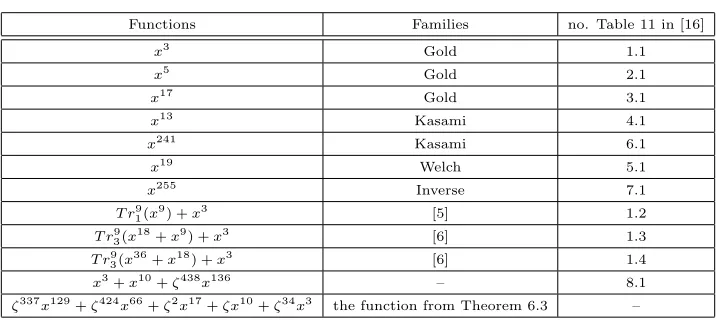
In Table 1 there are listed, up to CCZ-equivalence, the APN maps defined over
F29 belonging to known families. To this list we added the new function found with
Theorem 6.3.
Table 1. CCZ inequivalent APN polynomials overF29
Functions Families no. Table 11 in [16]
x3 Gold 1.1
x5 Gold 2.1
x17 Gold 3.1
x13 Kasami 4.1
x241 Kasami 6.1
x19 Welch 5.1
x255 Inverse 7.1
T r9 1(x
9) +x3 [5] 1.2
T r39(x18+x9) +x3 [6] 1.3
T r9
3(x36+x18) +x3 [6] 1.4
x3+x10+ζ438x136 – 8.1
Consequentially we extended the computations performed to the case of shifts of the general Gold functionGi =x2
i+1
. For 6≤n≤8 andGi not equivalent to
G1 no linear trinomialsLwere found that can construct APN functions.
7.3. The cases 3≤n≤5. Exhaustive searching was carried out for small dimen-sions. Shifts of G1 (and G2 in n = 5) that produced APN functions in all cases
produced APN functions equivalent to the Gold functions G1 (andG2 in n = 5).
We give some additional details below for completeness.
n=3: All obtained APN functions are equivalent to G1. Valid linear functions
were:
– monomials as described in Lemma 6.5 (i) and (ii), and their com-positional inverses. In this case, this amounts to all possible linear monomialsux2j withj∈ {0,1,2} andu∈
F8\F2.
– binomials resulting from the monomial examples above via Corollary 4.2 (ii).
– trinomials, there were 126 distinct linear trinomialsL for which G1,L
was APN.
There are a total of 462 linear functions that are either permutation polyno-mials or 2-to-1 maps overF8. Of these, a total of 162 yields APN functions. Of course, asnincreases the ratio of successful shifts drops sharply.
n=4: All obtained APN functions are equivalent to G1. Valid linear functions
were:
– monomials as described in Lemma 6.5 (i) and (iii).
– binomials as described in Lemma 6.6, along with those resulting from the monomials above via Corollary 4.2 (ii).
– trinomials, there were a total of 600 distinct linear trinomials L for whichG1,L was APN.
– quadrinomials, there were 2880 distinct linear quadrinomials L for whichG1,L was APN.
n=5: For shifts ofG1all obtained APN functions are equivalent toG1orG2. Valid
linear functions were:
– monomials as described in Lemma 6.5 (i) (forG1) and (ii) (forG2).
– binomials.
ForG1, of the formζix16+ζ17ix8.
ForG2, of the formux4+vx2, ux8+vx2 (31 examples in each case),
along with those resulting from the monomials above via Corollary 4.2 (ii).
– trinomials.
ForG1, of the formζix16+ζ17ix8+ζ29ix2, along with those resulting
from the binomials above via Corollary 4.2 (ii).
ForG2, of the formux8+vx4+wx2, ux16+vx4+wx2 (31 examples
in each case), along with those resulting from the binomials above via Corollary 4.2 (ii).
– quadrinomials, there were a total of 2201 distinct linear quadrinomials L for which G1,L was APN and equivalent to G1, and 3317 distinct
linear quadrinomialsLfor whichG1,Lwas APN and equivalent toG2.
– pentanomials, there were a total of 15190 distinct linear pentanomials L for whichG1,L was APN and equivalent to G1, and 11625 distinct
For shifts ofG2 all obtained APN functions are equivalent toG1 or G2.
Valid linear functions were:
– monomials as described in Lemma 6.5 (ii) (forG1) and (i) (forG2).
– binomials.
ForG1, of the formζix4+ζ21ix2,ζix8+ζ9ix2.
ForG2, of the formζix16+ζ17ix8,
along with those resulting from the monomials above via Corollary 4.2 (ii).
– trinomials.
ForG1, of the formζix8+ζ27ix4+ζ9ix2, of the formux16+vx4+wx2
(186 examples), along with those resulting from the binomials above via Corollary 4.2 (ii).
ForG2, of the formζix16+ζ17ix8+ζ29ix2, of the formux16+vx4+wx
(155 examples), along with those resulting from the binomials above via Corollary 4.2 (ii).
– quadrinomials, there were a total of 3100 distinct linear quadrinomials L for which G1,L was APN and equivalent to G1, and 2635 distinct
linear quadrinomialsLfor whichG1,Lwas APN and equivalent toG2,
along with those resulting from the trinomials above via Corollary 4.2 (ii).
– pentanomials, there were a total of 13330 distinct linear pentanomials L for whichG1,L was APN and equivalent to G1, and 13950 distinct
linear pentanomialsL for whichG1,L was APN and equivalent toG2,
along with those resulting from the quadrinomials above via Corollary 4.2 (ii).
7.4. The case n = 6. For n = 6 we checked G1,L over general linear functions
L(x) satisfying the restriction outlined in Theorem 5.1. The results obtained, up to CCZ-equivalence, are summarized in Table 2. With such a construction we were able to obtain, for every quadratic APN function listed in [16, Table 5], a CCZ-equivalent APN function G1,L. Moreover, each function in the mentioned list is
CCZ-equivalent to
• G1,Lwhere Lis a linear permutation; and
• G1,Lwhere Lis 2-to-1.
We also found that similar results can be obtained when we consider isotopic shifts of the APN functionx3+ζ−1Tr(ζ3x9); these results are summarized in Table 3.
7.5. Additional data for isotopic shifts of x3+ Tr(x9). We have also carried
out some additional analysis for the quadratic APN function
F(x) =x3+ Tr(x9). (17)
In this case, the isotopic shift ofF by a linear functionLis of the form
fL(x) =xL(x)(x+L(x)) + Tr(xL(x)(x7+L7(x))). (18)
Table 2. Linear functions L(x) for which G1,L as in (7) is APN
overF26=hζi, up to CCZ-equivalence, and their comparison with
Table 5 in [16]. We also specify ifL(x) is 1-to-1 or 2-to-1
#-to-1 L(x) no. in Table 5 [16]
1-to-1 ζx(orx16+ζ3x4+ζ17x) 1.1
2-to-1 x32+x16+x8+x4+x2+ζ21x 1.1
1-to-1 ζx16+ζ21x 1.2
2-to-1 x32+ζx16+ζ27x8+ζ46x4+ζ18x2+ζ33x 1.2
1-to-1 x32+ζ13x16+x8+ζ30x4+ζx2+ζ20x 2.5
2-to-1 x32+ζ9x16+ζ31x8+ζ16x4+ζ57x2+ζ29x 2.5
1-to-1 x16+ζ5x8+ζ8x4+ζ34x2+ζ57x 2.12
2-to-1 x16+ζ5x8+ζ8x4+ζ34x2+ζ20x 2.12
1-to-1 x8+ζ5x 2.1
2-to-1 x32+ζx16+ζ9x8+ζ39x4+ζ7x2+ζ31x 2.1
1-to-1 x32+ζx16+ζ25x8+ζ8x4+ζ42x2+ζ31x 2.2
2-to-1 x32+ζx16+ζ41x8+ζ49x4+ζ5x2+ζ5x 2.2
1-to-1 ζx16+x8+ζ50x4+x2+ζ47x 2.6
2-to-1 x32+ζx16+ζ16x8+ζ26x4+ζ14x2+ζ14x 2.6
1-to-1 x32+ζx16+ζ23x8+ζ53x4+ζ52x2+ζx 2.7
2-to-1 x32+ζx16+ζ23x8+ζ53x4+ζ52x2+ζ56x 2.7
1-to-1 x32+ζ23x8+ζ31x4+ζ46x2+ζ50x 2.3
2-to-1 x32+x16+ζ15x8+ζ42x4+ζ15x2+ζ16x 2.3
1-to-1 x32+ζx16+ζ26x8+ζ50x4+ζ57x2+ζ34x 2.8
2-to-1 x32+ζ13x8+ζ57x4+ζ36x2+ζ31x 2.8
1-to-1 x16+ζ9x8+ζ9x4+ζ47x2+ζ50x 2.9
2-to-1 x32+x16+ζ5x8+ζ50x4+ζ8x2+ζ60x 2.9
1-to-1 x32+ζx16+ζ42x8+ζ3x4+ζ14x2+ζ22x 2.4
2-to-1 x32+ζx16+ζ7x8+ζ51x4+ζ33x2+ζ14x 2.4
1-to-1 x32+ζx16+ζ20x8+ζ28x4+ζ23x2+ζ36x 2.10
2-to-1 x32+ζx16+ζ6x8+ζ8x4+ζ26x2+ζ21x 2.10
• Forneven, setL(x) =uxwithua primitive cubed root of unity inFq, so
thatu2+u+ 1 = 0. Then we have
fL(x) =u(u+ 1)x3+ Tr(u(u7+ 1)x9)
= (u2+u)x3+ Tr((u8+u)x9) =x3+ Tr((u2+u)x9)
Table 3. Linear functions L(x) for which the isotopic shift of
x3+ζ−1Tr(ζ3x9) is APN over
F26 =hζi, up to CCZ-equivalence,
and their comparison with Table 5 in [16]. We also specify ifL(x) is 1-to-1 or 2-to-1
#-to-1 L(x) no.
1-to-1 ζ9x 1.1
2-to-1 x32+ζ12x16+ζ24x8+ζ24x4+ζ30x2+ζ47x 1.1
1-to-1 ζ21x 1.2
2-to-1 ζ31x16+ζ60x4+ζ11x2+ζ30x 1.2
1-to-1 ζ10x16+ζ11x8+ζ35x4+ζ27x2+ζ26x 2.5
2-to-1 ζ10x16+ζ11x8+ζ35x4+ζ27x2+ζ6x 2.5
1-to-1 ζ19x16+ζ3x8+ζ29x4+ζ39x2+ζ24x 2.12
2-to-1 ζ28x16+ζx8+ζ31x4+ζ51x2+ζ4x 2.12
1-to-1 x8+ζ9x 2.1
2-to-1 ζ11x8+ζ61x4+ζ51x2+ζ33x 2.1
1-to-1 ζ15x16+ζ6x8+ζ47x4+ζ21x2+ζ48x 2.2
2-to-1 x16+ζ14x8+ζ49x4+ζ13x2+ζ4x 2.2
1-to-1 x32+ζ19x16+ζ23x8+ζ38x4+ζ16x2+ζ58x 2.6
2-to-1 x32+ζ19x16+ζ23x8+ζ38x4+ζ16x2+ζ25x 2.6
1-to-1 x16+ζ7x8+ζ52x4+ζ7x2+ζ25x 2.7
2-to-1 ζ2x16+ζ8x8+ζ40x4+ζ38x2+ζ5x 2.7
1-to-1 ζ3x8+ζ43x4+ζ23x2+ζ9x 2.3
2-to-1 ζx16+ζx8+ζ4x4+ζ46x 2.3
1-to-1 x16+ζ8x8+ζ7x4+ζ49x2+ζ46x 2.8
2-to-1 x16+ζ8x8+ζ7x4+ζ49x2+ζ22x 2.8
1-to-1 ζx8+ζ14x4+ζ13x2+ζ43x 2.9
2-to-1 ζx8+ζ14x4+ζ13x2+ζ37x 2.9
1-to-1 ζ11x8+ζ22x4+ζ22x2+ζ50x 2.4
2-to-1 ζ3x16+ζ15x8+ζ15x4+ζ40x2+ζ11x 2.4
1-to-1 ζ6x16+ζ16x8+ζ52x4+ζ20x2+ζ52x 2.10
2-to-1 ζx16+ζ16x8+ζ36x4+ζ61x2+ζ36x 2.10
• Forn a multiple of 3, setL(x) = uxwith ua primitive 7th root of unity. Then we have
fL(x) =u(u+ 1)x3+ Tr(u(u7+ 1)x9)
=u(u+ 1)x3.
Observation 7.1. Forna multiple of 3, the APN functionx3 can be obtained as an isotopic shift ofx3+ Tr(x9).
• When the functionLhas 1 term.
n= 7: Only two linear functions were found: L(x) =x8andL(x) =x16. Both functions obtained are CCZ-equivalent to number 2.2 in [16, Table 7] (x3+x17+x33+x34).
n= 8: Two types of linear functions yielded APN shifts:
∗ L(x) = ζ85xand L(x) = ζ170x. This is the cube root of unity
case observed above.
∗ L(x) =ζix16, i= 9·2r,85·2r,111·2r. The functions obtained
are CCZ-equivalent tox9+ Tr(x3).
n= 9: L(x) = ζix, i = 73×j. This is the 7th root of unity case observed
above.
n= 10: L(x) =ζix,i= 341,682. This is the cube root of unity case observed
above.
n= 11: No valid monomial was found.
n= 12: Two types of linear functions yielded APN shifts:
∗ L(x) = ζix,i= 1365,2730. This is the cube root of unity case observed above.
∗ L(x) = ζix64, i = 585×j. This is the 7th root of unity case observed above.
• When the functionLhas 2 terms, different fromx. n= 7: No valid binomial was found.
n= 8: L(x) = ζix16+ζjx, (j = 17 and i = 35,50,140,200), or (j = 34
and i= 25,70), or (i = 0, j = 85,170). The functions obtained are CCZ-equivalent to number 1.2 in [16, Table 9] (x9+ Tr(x3)).
7.6. Restricting the coefficients ofLtoF2. Proposition 6.4 shows that a linear
functionL with coefficients inF2 cannot generate an APN function from isotopic
shift of Gold functions over extension fields of even degree. This was investigated further computationally, over extension fields of odd degree. We looked atGi,L for
valid Gi and L ∈F2[x] to see when APN functions are obtained. The results are
presented in Table 4.
It can be seen from the table that linear 2-to-1 functions occur when n = 5 but otherwise we only obtained APN functions from Gi,L for L a permutation
polynomial.
We also looked at isotopic shifts of x3+ Tr(x9) by linear L ∈
F2[x]. For 7≤
n≤12, the only linear functions for which APN functions were obtained were for n= 7, with L(x) =x8 or L(x) =x16. In both cases, the obtained APN function
was equivalent tox3+x17+x33+x34, number 2.2 in [16, Table 7].
References
[1] A.A. Albert,Finite division algebras and finite planes, Combinatorial Analysis: Proceedings of the 10th Symposium in Applied Mathematics (Providence), Symposia in Applied Mathe-matics, vol. 10, American Mathematical Society, 1960, pp. 53–70.
[2] W. Bosma, J. Cannon, and C. Playoust,The Magma algebra system I: The user language, J. Symbolic Comput.24(1997), 235–265.
Table 4. Linear functions L(x) ∈ F2[x] for which Gi,L is APN
overF2n. The functions are divided based on the equivalence class
ofGi,L.
n= 3 Gi,Lequiv L(x)
G1 G1 x2, x4
n= 5 Gi,Lequiv L(x)
G1 G1 x16+x8, x16+x8+x2,
G1 G2 x2, x4+x2, x8+x2
x8+x4+x2, x16, x16+x4+x2
G2 G2 x16+x8, x16+x8+x2
G2 G1 x4, x4+x2, x8, x8+x2,
x8+x4+x2, x16+x4+x2
n= 7 Gi,Lequiv L(x)
G1 G2 x2, x64
G2 G3 x4, x32
G3 G1 x8, x16
n= 9 Gi,Lequiv L(x)
G1 G2 x2, x256
G2 G4 x4, x128
G3 G1 x16, x32
n= 11 Gi,Lequiv L(x)
G1 G2 x2, x1024
G2 G4 x4, x512
G3 G5 x8, x256
G4 G3 x16, x128
G4 G1 x32, x64
[4] L. Budaghyan, C. Carlet, and G. Leander, On inequivalence between known power APN functions, BFCA 2008, Proceedings of the International Workshop on Boolean Functions: Cryptography and Applications (Copenhagen, Denmark), 2008.
[5] L. Budaghyan, C. Carlet, and G. Leander, Constructing New APN Functions from Known Ones, Finite Fields and Their Applications,15(2009), pp. 150–159
[6] L. Budaghyan, C. Carlet, and G. Leander,On a Construction of Quadratic APN Functions., Proceedings of IEEE Information Theory workshop ITW’09, Oct. 2009, pp. 374–378. [7] L. Budaghyan, C. Carlet, A. Pott. New Classes of Almost Bent and Almost Perfect Nonlinear
Functions.IEEE Trans. Inform. Theory, vol. 52, no. 3, 2006, pp. 1141–1152.
[8] L. Budaghyan and T. Helleseth, New commutative semifields defined by PN multinomials, Cryptogr. Commun.3(2011), 1–16.
[9] L. Budaghyan, T. Helleseth, N. Li, and B. Sun,Some results on the known classes of quadratic APN, Codes, Cryptology and Information Security (Said El Hajji, Abderrahmane Nitaj, and El Mamoun Souidi, eds.), Springer, Cham, 2017, pp. 3–16.
[10] C. Carlet, P. Charpin, and V. Zinoviev,Bent functions and permutations suitable for DES-like cryptosystems, Des. Codes Cryptogr.15(1998), 125–156.
[11] F. Chabaud and S. Vaudenay. Links between Differential and Linear Cryptanalysis. Proceed-ings of EUROCRYPT’94, Lecture Notes in Computer Science950, pp. 356-365, 1995. [12] R.S. Coulter and M. Henderson,Commutative presemifields and semifields, Adv. Math.217
(2008), 282–304.
[14] R. Cramer, Y. Dodis, S. Fehr, C. Padro, and D. Wichs. Detection of algebraic manipulation with application to robust secret sharing and fuzzy extractors.EUROCRYPT 2008, Lecture Notes in Computer Science4965, pp. 471-488, 2008.
[15] P. Dembowski and T.G. Ostrom, Planes of order nwith collineation groups of order n2, Math. Z.103(1968), 239–258.
[16] E. Edel and A. Pott,A new almost perfect nonlinear function which is not quadratic, Adv. Math. Commun.3(2009), 59–81.
[17] R. Gold, Maximal recursive sequences with 3-valued recursive crosscorrelation functions, IEEE Trans. Inform. Theory,141968, pp. 154–156.
[18] D.E. Knuth,Finite semifields and projective planes, J. Algebra2(1965), 182–217.
[19] R. Lidl and H. Niederreiter, Finite Fields, Encyclopedia Math. Appl., vol. 20, Addison-Wesley, Reading, 1983, (now distributed by Cambridge University Press).
[20] K. Nyberg,Perfect nonlinear S-boxes, Advances in Cryptology – Eurocrypt ’91 (D.W. Davies, ed.), Lecture Notes in Computer Science, vol. 547, 1991, pp. 378–386.
[21] K. Nyberg,Differentially uniform mappings in cryptography, Advances in Cryptology – Eu-rocrypt ’93 (T. Helleseth, ed.), Lecture Notes in Computer Science, vol. 765, 1993, pp. 55–64. [22] J.H.M. Wedderburn,A theorem on finite algebras, Trans. Amer. Math. Soc.6(1905), 349–
352.
[23] S. Yoshiara,Equivalences of power APN functions with power or quadratic APN functions, J. Algebr. Comb.44, 2016, pp. 561–585.
[24] Y. Zhou and A. Pott.A New Family of Semifields with 2 Parameters. Advances in Mathe-matics, 234:43-60, 2013.
(L. Budaghyan, M. Calderini & I. Villa)Department of Informatics, University of Bergen, Bergen, Norway
(C. Carlet)LAGA, University of Paris 8, Paris, France and University of Bergen, Norway
![Table 2. Linear functionsTable 5 in [16]. We also specify ifover L(x) for which G1,L as in (7) is APN F26 = ⟨ζ⟩, up to CCZ-equivalence, and their comparison with L(x) is 1-to-1 or 2-to-1](https://thumb-us.123doks.com/thumbv2/123dok_us/7976557.1322727/22.612.168.445.161.570/table-linear-functionstable-specify-ifover-ccz-equivalence-comparison.webp)
![Table 3. Linear functionsand their comparison with Table 5 in [16]. We also specify ifx L(x) for which the isotopic shift of3 + ζ−1 Tr(ζ3x9) is APN over F26 = ⟨ζ⟩, up to CCZ-equivalence, L(x)is 1-to-1 or 2-to-1](https://thumb-us.123doks.com/thumbv2/123dok_us/7976557.1322727/23.612.188.423.169.585/table-linear-functionsand-comparison-table-specify-isotopic-equivalence.webp)
![Table 4. Linear functionsoverof L(x) ∈ F2[x] for which Gi,L is APN F2n. The functions are divided based on the equivalence class Gi,L.](https://thumb-us.123doks.com/thumbv2/123dok_us/7976557.1322727/25.612.204.410.163.440/table-linear-functionsoverof-functions-divided-based-equivalence-class.webp)
