Original Research Article
A survey of knowledge, attitude and practice of biomedical waste
management among 150 nursing staff working in All Indian
Institute of Medical Sciences, Jodhpur
Vivek Chhabra, Durga Shankar Meena*, Gopal Krishana Bohra,
Naresh Midha, Bharat Maheshwari, Amit Rohilla
INTRODUCTION
There are legal provisions (Biomedical Waste (management and handling) Rules 1998) framed to minimize the effects of hazardous and infectious biomedical waste, but there is a lack of full-fledged implementation of these rules.1 In recent times there has been a significant increase in public awareness and concern regarding biomedical waste disposal but various studies have shown that level of awareness in India is still poor.2,3 This along with insufficient financial and human
resources is a relatively big problem faced by the country with regard to hospital waste and hospitals here are becoming a source of spreading infection.
Nursing personnel being at the centre of providing all the treatment to the patient should have all the knowledge regarding the management and disposal of biomedical waste. But mostly this knowledge is lacking in the vast majority of nursing staff engaged in providing the valuable healthcare facilities to sick and ailing. Adequate knowledge regarding health hazard of biomedical waste,
ABSTRACT
Background: India as a developing country is facing a lot of health care problems, with the increase in health care facilities, there is a growing concern of hazards of biomedical waste. Since the nursing staff is at the centre of biomedical waste handling, their knowledge of adequate disposal of biomedical waste is of utmost importance. So, we conducted a study regarding knowledge, attitude and practice of nursing staff working in a premier institute of western Rajasthan with respect to biomedical waste and its management.
Methods: This was a hospital-based descriptive, observational study conducted in our institute in the month of October and November of 2018. Written consent was taken and pre-defined questionnaire was prepared based on a review of literature on the subject. Scrutiny was done for the data for any logical inconsistencies, skip patterns and missing values. Coding of the data was done and entered into a Microsoft Excel. Descriptive and inferential statistics were applied for data analysis.
Results: 150 participants took part in the questionnaire based study. The study showed that majority of participants have adequate knowledge, attitude and practice toward biomedical waste management but still, there were gaps in the knowledge and practice in essentially quite a lot of participants which should not be there.
Conclusions: There is a need for strict implementation of biomedical rules at all the tiers of healthcare. There should be regular orientation programs for nursing staff and other health personnel working in the institutes.
Keywords: Biomedical waste management, Biohazard, Nurses knowledge
Department of Medicine, All India Institute of Medical Sciences, Jodhpur, Rajasthan, India
Received: 18 April 2019
Accepted: 05 June 2019
*Correspondence:
Dr. Durga Shankar Meena, E-mail: [email protected]
Copyright: © the author(s), publisher and licensee Medip Academy. This is an open-access article distributed under the terms of the Creative Commons Attribution Non-Commercial License, which permits unrestricted non-commercial use, distribution, and reproduction in any medium, provided the original work is properly cited.
proper technique of handling and disposing the waste, and practicing safety measures can all go a long way in protecting the community from health hazards of biomedical waste.
METHODS
This was a cross-sectional study conducted in AIIMS, Jodhpur. The study was conducted in 2 months, October and November of 2018. Study participants included nursing personnel working in different departments of the hospitals. A total of 150 nursing staff consented for the interview (100% response rate) working in different wards, ICU and OPD of the institute. They were interviewed for biomedical waste management practices. Strict maintenance of confidentiality of the participants was ensured. The interviews were conducted on a predesigned and a pretested questionnaire and checklist. The questionnaire was developed based on an extensive review of literature which can include knowledge, attitude and practice with regards to biomedical waste management adequately. 15 minutes were given to each participant to finish the questionnaire. The data forms were collected and underwent scrutiny for logical inconsistencies, skip patterns, and missing values. The data was then coded and entered into Microsoft Excel. Descriptive and inferential statistics were applied for data analysis. The percentages and their 95% confidence intervals (CIs) are being presented here.
RESULTS
Out of 150 participants who took part in the study, most were of the age group 20-25 years (52%). 56% of participants were male and 44% female. Regarding their qualification, most were having a degree of B.Sc Nursing (80%), while rest were having a degree of GNM (13.3%), M.Sc nursing (6%) & Diploma nursing (0.7%). Majority of the participants were having work experience between 1-5 years (52%). So the participants in our study were of younger age group, having got the qualification degree for nursing relatively recently (Table 1).
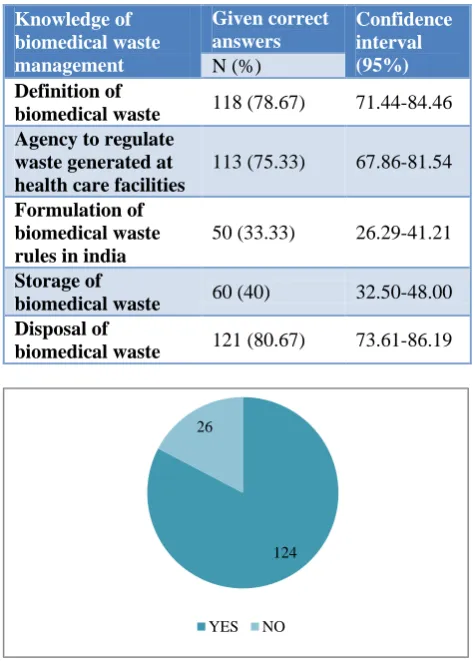
With regard to knowledge on biomedical waste management, 17.3% (n=26) of the participants denied that they have any kind of knowledge regarding biomedical waste generation (Figure 1). Most of the remaining participants gave the correct definition of biomedical waste (78.66%). 113 out of 150 (75.3%) knew about the agency regulating waste generated at health care facility. Only one third of the participants knew about biomedical waste (management and handling) rules, 1998 formulated by the government of India. Only 60 out of 150 patients (40%) have adequate knowledge of storage of biomedical waste before disposal. But most of them (80.7%) have knowledge of transport and adequate disposal of biomedical waste (Table 2).
Table 1: Demographic profile of participants of the study.
Characteristics Frequency
N (%)
Age group (in years)
20-25 78 (52)
25-30 64 (42.7)
30-35 8 (5.3)
Sex
Male 84 (56)
Female 66 (44)
Qualification
BSc Nursing 120 (80)
GNM 20 (13.3)
MSc Nursing 9 (6)
Diploma Nursing 1 (0.7)
Work experience (in years)
<1 65 (43.3)
1-5 78 (52)
5-10 7 (4.7)
Table 2: Knowledge about biomedical waste generation and legislature (n=150).
Knowledge of biomedical waste management
Given correct answers
Confidence interval (95%)
N (%)
Definition of
biomedical waste 118 (78.67) 71.44-84.46 Agency to regulate
waste generated at health care facilities
113 (75.33) 67.86-81.54
Formulation of biomedical waste rules in india
50 (33.33) 26.29-41.21
Storage of
biomedical waste 60 (40) 32.50-48.00 Disposal of
biomedical waste 121 (80.67) 73.61-86.19
Figure 1: Knowledge about biomedical waste generation.
124 26
Figure 2: Knowledge of colour-coding segregation of BM waste.
Figure 3: Knowledge on biomedical waste containers.
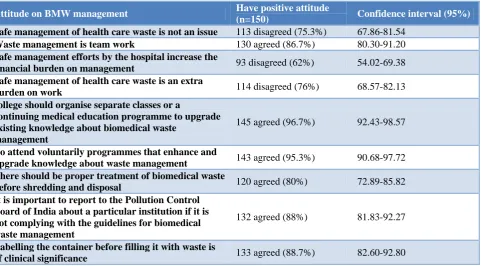
Table 3: Attitude on biomedical waste management.
Attitude on BMW management Have positive attitude
(n=150) Confidence interval (95%)
Safe management of health care waste is not an issue 113 disagreed (75.3%) 67.86-81.54
Waste management is team work 130 agreed (86.7%) 80.30-91.20
Safe management efforts by the hospital increase the
financial burden on management 93 disagreed (62%) 54.02-69.38 Safe management of health care waste is an extra
burden on work 114 disagreed (76%) 68.57-82.13 college should organise separate classes or a
continuing medical education programme to upgrade existing knowledge about biomedical waste
management
145 agreed (96.7%) 92.43-98.57
To attend voluntarily programmes that enhance and
upgrade knowledge about waste management 143 agreed (95.3%) 90.68-97.72 There should be proper treatment of biomedical waste
before shredding and disposal 120 agreed (80%) 72.89-85.82 It is important to report to the Pollution Control
Board of India about a particular institution if it is not complying with the guidelines for biomedical waste management
132 agreed (88%) 81.83-92.27
Labelling the container before filling it with waste is
of clinical significance 133 agreed (88.7%) 82.60-92.80
Table 4: Practice of biomedical waste management
Practice of biomedical waste management Good practice (n=150) Confidence intervals (95%)
Disposal of BMW waste in specified colour coded
containers 143 practice (95.33%) 90.68-97.72 Discard used needles in needle destroyer 147 practice (98%) 94.29-99.32
To fill an incident report 115 practice (76.67%) 69.28-82.72
143 out of 150 participants (95.3%) said that they have full knowledge of colour-coding segregation of BM waste (Figure 2). However, only 96 participants (64%) were able to correctly answer the questions on color coding. 90 participants (60%) knew the steps to be followed after an exposure with infected blood/body fluid and contaminated sharps (Table 3). About two third of the participants (68.67%) have accurate knowledge of biomedical waste containers and the symbols associated with it (Figure 3).
Regarding the attitude of participants on biomedical waste management, most had positive attitude towards the management of biomedical waste. Over 75% of the participants think that waste management is a critical health issue, it is a teamwork involving paramedical, medical and government officials, it is not an extra burden on their work and there should be continue medical education programme to upgrade existing knowledge about biomedical waste management. However, over one third of participants feel that safe
143
7
YES NO
0 20 40 60 80 100 120 140 160
N=150
68.67% 26.67%
7% HAS CORRECT
KNOWLEDGE
DID NOT HAS CORRECT KNOWLEDGE
management efforts by the hospital increase the financial burden on hospital management. Majority of them also feel the importance of proper treatment of biomedical waste before shredding and disposal and that of reporting the Pollution Control Board of India about a particular institution if it is not complying with the guidelines for biomedical waste management. Also, there was a positive response by majority when asked if labelling the container before filling it with waste is of clinical significance.
Lastly, regarding practicing of biomedical waste management norms, most of the participants follow fairly good practice. A significant number of participants disposes biomedical waste in a specified color coded container and discard used needles in needle destroyers. However, there is an inadequacy in filling the incident report of any contact with biomedical waste and only 115 participants (76.7%) follow this practice (Table 4).
DISCUSSION
Biomedical waste is defined as any waste which is generated during the diagnosis, treatment or immunization of human beings or animals or in research activities pertaining thereto or in the production or testing of biological as per the biomedical waste (management and handling) rules, 1998 of India.4 Now, with the advancement of technology, the sources of generation of this biomedical waste are increasing at a rapid pace. There is increasing use of antibiotics, cytotoxic agents and even radioactive agents for treatment, diagnostic and for research purpose and ultimately these forms biomedical waste.5 Even with introduction of disposables in the hospitals, there is still practice of illegal reuse of the disposables and inappropriate recycling. This all leads to worsening of the already bad situation. Although there is a legislature exclusively for the proper handling and disposal of the biomedical waste with regular amendments, still situation is not so bright as far as the implementation of these rules is considered. Knowledge, attitude and practice or “KAP” study of a community serves as a kind of educational diagnosis of the community.6 Misconceptions or misunderstandings towards a particular topic are revealed through it. Those misunderstandings or misconception may represent obstacles to the activities that if removed can lead to behaviour change. A KAP survey essentially is an “opinion” of the participants and is based on the statements of the individuals.7 There may be gaps between what is said and what is done. Finding these gaps is the first step to bring a desirable change.
We conducted this study on finding this gap by asking to the nursing staff, who are at the centre stage of giving treatment to the patients, a questionnaire on knowledge, attitude and practice of biomedical waste management. They are not only at risk of the hazards of the biomedical waste but poor knowledge of the nursing staff can act as a potential risk factor of spreading this health hazard to
public health. There is also increased risk of air and water pollution because of hospital waste.4
The study was based on a pre-formulated and pretested questionnaire. Similar protocol was adopted in various other studies.2,3,8,9 The participants of the study mostly were of younger age group and there was a preponderance of male nursing staff in our study. Knowledge regarding biomedical waste management was found to be acceptable among nursing staff except for the biomedical waste legislature in India and storage of the biomedical waste before disposal and only one-third of the participants could answer these correctly. Previous work has also shown appreciable lack of knowledge among nursing staff with regards to biomedical waste rules.10,11 Knowing the rules is essential as it helps us to know what is right and what is wrong. So our nursing staff is very much lacking in knowing what Indian law says about the management of biomedical waste and the punishments that are available if these rules are not strictly followed. There is also a lack of knowledge regarding the proper storage of the generated hospital waste. Most of the participants were firm that they had full information on color coding for segregation of biomedical waste. However, when open ended questions were asked regarding their practical knowledge on color coding segregation, only 2/3rd answered the questions correctly. Various studies had shown the knowledge among health care workers with respect to color coding range from 20% to 95%.3,12-14 Knowledge of color coding is probably the most important pivotal point in the management of biomedical waste and essential for further waste management. The attitude of most of the participants towards biomedical waste management was found to be positive in our study. Most of the nursing staff feel that waste management is a critical health issue, it is a team work involving paramedical, medical and government officials, and it is not an extra burden on their work. Similar results were there in previous studies.12,15,16 The most encouraging results were in their attitude towards learning. Majority of them feel the need of continuing medical education program to upgrade existing knowledge about biomedical waste management and also many of them are ready to volunteer such programs. There was somewhat a negative attitude towards the fact that many of the participants of the study feel that this very process of managing biomedical waste increases the financial burden on hospital administration. Their attitude regarding the financial implications of biomedical waste needs to be reframed by shedding light on the public health implications of poor management of biomedical waste. The cost of treatment for various infectious diseases due to hazardous biomedical waste is huge and has to be taken into account while judging the financial burden of proper management of hospital waste.
of used needles in needle destroyer as is also seen in various other studies.15,17,18 However, disappointing results were there in filling the incident report for any inadvertent event due to biomedical waste. Most of them were rather unaware of a formal system of reporting. Comparing this with previous studies the results are similar implying the need of better reporting system of various adverse events in the hospital so that adequate steps can be taken.19
Overall, this study showed that there are still a lot of gaps in the knowledge, attitude and practice of nursing personnel who are working at forefront of medical waste management. The condition in district and primary health centres and private hospitals in periphery is even more dismal. Moreover, the scope of this study can be widened to include other paramedical staff and class 4 workers of the institute who must be having knowledge inferior to the nursing staff.
CONCLUSION
This study revealed that although attitude of the staff working in the institute is fairly good towards the management of biomedical waste, the knowledge and practice of participants is comparatively poor. This emphasizes the role of various training programs of management of biomedical waste. It is recommended that there should be a regular organization of such programs and the health care personnel should compulsory attend such programs. There should be strict implementation of waste management rules and defaulters should be punished as per the laws. It is also recommended that all health care employees should be made aware of the fact that there is a formal system of reporting of hazard due to biomedical waste, and it should be made compulsory that one should report such injury to concerned authorities so that appropriate measures can be taken.
ACKNOWLEDGEMENTS
Authors would like to thank all nursing staff participants working in AIIMS Jodhpur, who gave their valuable time. We would like to express our gratitude to Dr Bhuvanesh Kumar for helping in data collection.
Funding: No funding sources Conflict of interest: None declared
Ethical approval: The study was approved by the Institutional Ethics Committee
REFERENCES
1. Patil AD, Shekdar AV. Health-care waste management in India. J Environ Manag. 2001;63(2):211-20.
2. Sharma A, Sharma V, Sharma S, Singh P. Awareness of biomedical waste management among health care personnel in Jaipur, India. Oral Health Dent Manag. 2013;12(1):32-40.
3. Basu M, Das P, Pal R. Assessment of future physicians on biomedical waste management in a tertiary care hospital of West Bengal. J Natural Sci Biol Med. 2012;3(1):38.
4. Mathur P, Patan S, Shobhawat AS. Need of biomedical waste management system in hospitals– An emerging issue–A review. Current World Environ. 2012;7(1):117-24.
5. Sanjeev R, Kuruvilla S, Subramaniam R, Prashant PS, Gopalakrishnan M. Knowledge, attitude, and practices about biomedical waste management among dental healthcare personnel in dental colleges in Kothamangalam: a cross-sectional study. Health Sci. 2014;1(3):1-2.
6. Kaliyaperumal KI. Guideline for conducting a knowledge, attitude and practice (KAP) study. AECS Illumination. 2004;4(1):7-9.
7. Launiala A. How much can a KAP survey tell us about people's knowledge, attitudes and practices? Some observations from medical anthropology research on malaria in pregnancy in Malawi. Anthropology Matters. 2009;11(1):1.
8. Mathur V, Dwivedi S, Hassan MA, Misra RP. Knowledge, attitude, and practices about biomedical waste management among healthcare personnel: A cross-sectional study. Indian J Community Med. 2011;36(2):143.
9. Kishore J, Goel P, Sagar B, Joshi TK. Awareness about biomedical waste management and infection control among dentists of a teaching hospital in New Delhi, India. Indian J Dent Res. 1999;11(4):157-61. 10. Panneerselvam S. Knowledge on Biomedical Waste
Management among Nurses Working in Hospital at Madurai. Int J Health Sci Res. 2016;6(8):229-33. 11. Chawla S, Verma R, Khanna P. Practices Regarding
Biomedical Waste Management Among Health Functionaries: A Rural Haryana Perspective. Natl J Community Med. 2016;7(4):252-6.
12. Madhukumar S, Ramesh G. Study about awareness and practices about health care waste management among hospital staff in a medical college hospital, Bangalore. Iranian J Basic Medical Sci. 2012;3(1):7-11.
13. Ramokate T, Basu D. Health care waste management at an academic hospital: Knowledge and practices of doctors and nurses. SAMJ: South Afr Med J. 2009;99(6):444-5.
14. Deo D, Tak SB, Munde SS. A study of knowledge regarding biomedical waste management among employees of a teaching hospital in rural area. J ISHWM. 2006;1:12-6.
15. Malini A, Eshwar B. Knowledge, Attitude and Practice of Biomedical waste management among health care personnel in a tertiary care hospital in puducherry. IJBR. 2015;6(3):172-6.
17. Saini S, Nagarajan SS, Sarma RK. Knowledge, attitude and practices of bio-medical waste management amongst staff of a tertiary level hospital in India. J Acad Hosp Adm. 2005;17(2). 18. Shafee M, Kasturwar NB, Nirupama N. Study of
knowledge, attitude and practices regarding biomedical waste among paramedical workers. Indian J Community Med. 2010;35(2):369.
19. Stein AD, Makarawo TP, Ahmad MF. A survey of doctors' and nurses' knowledge, attitudes and compliance with infection control guidelines in
Birmingham teaching hospitals. J Hospital Infection. 2003;54(1):68-73.