University of Windsor University of Windsor
Scholarship at UWindsor
Scholarship at UWindsor
Electronic Theses and Dissertations Theses, Dissertations, and Major Papers
1-1-1967
Differential effects of shock condition training procedure and
Differential effects of shock condition training procedure and
problem difficulty on human maze learning.
problem difficulty on human maze learning.
James L. Mosley
University of Windsor
Follow this and additional works at: https://scholar.uwindsor.ca/etd
Recommended Citation Recommended Citation
Mosley, James L., "Differential effects of shock condition training procedure and problem difficulty on human maze learning." (1967). Electronic Theses and Dissertations. 6488.
https://scholar.uwindsor.ca/etd/6488
TRAINING PROCEDURE AND PROBLEM DIFFICULTY
ON HUMAN MAZE LEARNING
by
JAMES L. MOSLEY
B.A., University of Windsor, 1966
A Thesis
Submitted to the Faculty of Graduate Studies through the Department of Psychology in Partial Fulfillment
of the Requirements for the Degree of Master of Arts at the University
of Windsor
UMI N um ber: E C 5 2 6 6 9
INFORMATION TO USERS
The quality of this reproduction is dependent upon the quality of the copy
submitted. Broken or indistinct print, colored or poor quality illustrations and
photographs, print bleed-through, substandard margins, and improper
alignment can adversely affect reproduction.
In the unlikely event that the author did not send a complete manuscript
and there are missing pages, these will be noted. Also, if unauthorized
copyright material had to be removed, a note will indicate the deletion.
®
UMI
UMI Microform EC52669
Copyright 2008 by ProQuest LLC.
All rights reserved. This microform edition is protected against
unauthorized copying under Title 17, United States Code.
ProQuest LLC 789 E. Eisenhower Parkway
c 7 j\ ^ u/^,yj (j£
/
ABSTRACT
This study was an attempt to assess the effect
of shock for the correct response on the learning of a
stylus maze using two levels of maze difficulty and two
maze training procedures.
The experimental sample consisted of SO male
undergraduate students. The subjects were placed ran
domly into one of eight groups each group consisting of
ten subjects.
The conditions consisted of two maze training
procedures, viz. correction and rerun non-correction;
two shock conditions, viz. shock right and no shock; and
two levels of maze difficulty. Initial errors were used
as the overall measure of performance for each of the
eight groups. An additional measure of performance con
sisting of total errors was used for the four rerun non
correction maze training procedure groups. The level of
performance was measured for each of ten test trials.
Analyses of variance produced statistically
significant overall differences between the training pro
cedures, the shock conditions and the levels of task dif
ficulty. There was also a significant difference in the
initial error measure over the ten test trials as a function
This investigation was prompted by the a u t h o r ’s
interest in the effect produced by the use of aversive
stimuli as ’’rewards” . Specifically, what is the effect
of administering shock for correct responses and what,
if any, is the influence of the type of training and the
complexity of the behaviour involved on the effect of
administering shock for correct responses?
The author wishes to express his gratitude to
Dr. S. A. Kushnick, the director, whose continued support
and constructive criticism made this study even more
meaningful. The author wishes to express his appreciation
to Dr. M. E. Bunt and to Rev. S. J. Crowley, C. Ss. R.
for their helpful suggestions.
Finally the author wishes to thank Mrs. M. Russell
for her typing assistance and his wife Sheila for her in
valuable help throughout the entire study.
TABLE OF “CONTENTS
Page
PREFACE . . . . . . . iii
LIST OF TABLES . . . . . . v
LIST O F FIGURES . . . . . . vi
Chapter
I INTRODUCTION . . . . . 1
Review o f the Literature. . . 2
Purpose of Present Research . . 14
II METHODOLOGY AND PROCEDURE . . . 16
Subjects . . . . . 16
Apparatus . . . . . 16
Procedure . . . . .
III RESULTS . . . . . . 23
Initial Error Performance . . 23
Total Error Performance . . . 36
Subjects' Verbal Reports. . . 42
IV DISCUSSION . . . . . 47
V SUMMARY . . . . . . 59
APPENDIX A MAZE DIAGRAMS . . . . 62
APPENDIX B INSTRUCTIONS . . . . 64
BIBLIOGRAPHY. . . . . . . 69
VITA AUCTORIS . . . . . . 72
Table
1 Number of Initial Errors
Per Trial Per Group .
2 Summary of Analysis of Variance
For the Number of Initial Errors b y Training Procedure, by Shock Condition, b y Task Difficulty over Test Trials
3 Analysis of Variance for Simple
Effects of Training Procedure Over Each Test Trial.
4. Analysis of Variance for Simple
Effects of Training Procedure and Task Difficulty over Each Test
Trial • • • • . «
5 Analysis of Variance for Simple
Effects of Training Procedure and Shock Condition over Test Trials.
6 Summary of Analysis of Variance
For the Number of Total Errors
by Shock Condition, by Task Difficulty over Test Trials For Rerun
non-Correction Groups .
7 Analysis of Variance for Simple
Effects of Task Difficulty over
Each Test Trial .
S Analysis of Variance for Simple
Effects of Shock Condition and Task Difficulty over Test Trials.
9 Subjective Intensity of Electric
Shock by Group. .
10 Contingency T a’ole for the Frequency
of Verbal Classifications Within
Shock Conditions .
LIST OF FIGURES
Figure
1 The Parallel Alley Maze Employed
by Towart and Boe .
2 Number of Initial Errors For
Each Training Procedure Group Over Test Trials
3 Number of Initial Errors For
Each Training Procedure Task
Difficulty Group Over Test Trials
4 Profiles for Training Procedure by
Task Difficulty on Trials 1 through 4
5 Number of Initial Errors For
Each Training Procedure Shock Condition Group Over Test Trials
6 Profiles for Shock Condition by
Training Procedure on Trials 1 through 6 .
7 Total Number of Errors For Each
Task Difficulty Group Over
Test Trials . . . .
$ Total Number of Errors For Each
Shock Condition Task Difficulty Group Over Test Trials
9 Profiles for Shock Condition by
Task Difficulty on Trials 1 through 4
vi
Page
•
9
. 2S
. 30
. 31
. 33
. 34
. 41
. 43
INTRODUCTION
The definitive statement that punishment is a rela
tively sudden and painful increase of stimulation, follow
ing a response, which provides the necessary conditions
for the establishment of a conditioned fear reaction was
offered by Mowrer in 1947. It appears that, for Mowrer,
the role of fear-learning and fear-reduction are essential
if punishment is to inhibit and/or cause a cessation of
the punished behaviour. The conditions under which a
stimulus will serve as an effective punishment may depend
on numerous factors such as: the intensity of the stimulus
the drive level of the organism; the complexity of the be
haviour involved; the amount and type of previous training,
to name a few.
Punishment is usually applied to behaviour which is
undesirable (i.e. incorrect responses under experimental con
ditions) and this behaviour usually becomes less prevalent
as a function of one or more ox1 the factors mentioned above
The question can be raised as to whether punishment in
fluences all behaviour in the same way (viz. by providing
the necessary conditions lor one establishment of a con
ditioned fear reaction). There is evidence to suggest that
if an aversive stimulus is applied to desirable behaviour
(ie. correct responses under experimental conditions) this
behaviour, rather than being inhibited, is strengthened re
lative to non-punished behaviour, when the reward for both
is the same.
This apparent contradiction with respect to the effect
of aversive stimulation prompts investigation of some of the
previously mentioned factors which may determine whether or
not a stimulus will serve as an effective punishment.
Review of the Literature
The literature is replete with experimental evidence
which indicates that electric shock can serve to decrease
the probability of occurance of a response or increase i t ’s
latency. Studies such as those by Rexroad (1926), Bunch
(192$), Jensen (1934), and Bernard, and Gilbert (1941) have
demonstrated that electric shock administered for incorrect
responses serves to facilitate the acquisition of the cor
rect responses in maze tasks by human subjects.
In some experiments, shock has been shown to have the
paradoxical effect of increasing the strength of the re
sponse to which it was applied. Tolman, Hall and Bretnall
(1932), using a punch board maze, demonstrated that shock
combined with a bell for the correct response produced
significantly better performance than shock plus bell for
the incorrect response in terms of fewer cumulative average
groups using a bolthead maze. Muenzinger (1934 b) con
cluded that the results reported by Tolman, Hall and
Bret-nall (1932) differed radically from his ovm in that T o l m a n ’s
no shock and shock right groups learned best and their
shock wrong group was decidedly the poorest.
In 1955, Freeburne and Schneider conducted a study to
investigate tne effect of shock for correct and incorrect
responses during learning and extinction in human subjects.
Seventy subjects were required to learn a pattern of 20
right-left choices in a temporal maze under four shock con
ditions: Le. shock right, shock wrong, shock both, and no
shock. A 512 cps tone was used to reinforce correct respon
ses during learning, but was omitted during extinction. The
results showed that learning under all three shock conditions
was significantly faster tnan for the no shock group. The
shock-right and shock wrong groups did not differ significantly
in the number' of trials to criterion. The snock both group
learned significantly faster (fewer trials) than the shock
right group but the shock both group did not learn signifi
cantly faster than the shock wrong group. These authors
conclude that differential secondary reinforcement occurs
when shock is given for correct or incorrect responses. But
where shock is administered for both correct and incorrect
responses the authors suggest that M u e nzinger’s concept of
general facilitation is applicable in that the shock causes
in the learning situation.
It is not clear from the results reported by Tolman,
Hall and Bretnall (1932), Muenzinger (1934 b), and
Free-burne and Schneider (1955) whether shock administered for
a particular response is facilitatory or whether it is the
shock "per se" which facilitates acquisition in maze tasks
using human subjects. In 1936 Gilbert conducted a study to
assess the non-informative value of shock upon maze learning
and retention with human subjects. In this study 52 subjects
were used as a single experimental group. These subjects
were required to trace a McGeoch and Melton (1929) medium
maze, (one of three mazes developed by McGeoch and Melton to
provide subjects with different levels of task complexity
graded as easy, medium and. difficult) the criterion being
2 out of 3 successive trials without error. A correction
training procedure was employed which permitted the subjects
to retrace after entering a blind alley (i.e. after an error).
This non-informative shock-wrong group was given shock after
every 10th error during early trials and for every 5th error
during later trials. The shock did not accompany or im
mediately follow the tenth or fifth error but was delayed
for a short interval to avoid giving the shock an informative
value. The results obtained from the non-informative shock
wrong group were compared with the data obtained from a
shock wrong; a signal-tone-wrong, and a no shock control
study by Gilbert and Crafts (1935).' The comparison re
vealed that the non-informative shock wrong group was sig
nificantly superior to the no shock group but significantly
inferior to the shock wrong and the signal-tone-wrong groups,
in terms of errors to criterion. But in terms of trials to
criterion, the non-informative shock wrong group was sig
nificantly inferior to all of the groups, including the no
shock group.
Gilbert's (1936) study seems to support the position
that it is shock given for a particular response which
facilitates acquisition in maze tasks using human subjects.
But it is still not clear from the studies of Tolman, Hall
and Bretnall (1932), Muenzinger (1934 b) and Freeburne and
Schneider (1955) whether shock for the correct response
facilitates acquisition in maze tasks. Tolman, Hall and
Bretnall (1932), found that their shock-bell-right group
was significantly superior to the shock-bell-wrong group.
Muenzinger (1934 b) was unable to find significant dif
ferences between either of his shock groups and a no shock
control group. In contrast to Muenzinger (1934 b), Free
burne and Schneider (1955) demonstrated that there was a.
significant difference between their shock groups and their
no shock group in terms of trials to criterion. But they
found no significant difference between the shock right and
the shock wrong groups although the shock wrong group did
right group.
Studies on maze learning using human subjects reveal
that there is a lack of conclusive evidence with respect to
the paradoxical effect of shock. The results of animal
studies in this area show that the same lack of conclusive
evidence, with respect to the paradoxical effect of shock,
is present.
In 1934 Muenzinger demonstrated the paradoxical effect
of shock in a dark-light discrimination task using rats,
under a correction training procedure. Muenzinger, using
three groups of 25 rats each, administered shock for the
correct response in one group, shock for the incorrect
response in the second group, with the third group receiving
no shock. Food was used as a reward for the correct re
sponse in all three groups. He found that both shock groups
produced significantly fewer errors to criterion than did
the no shock group. The difference between the two shock
groups was found to be non-significant. These results led
Muenzinger to conclude that moderate electric shock made
the animal respond more readily to the significant cues in
the learning situation, irrespective of whether it accom
panied the correct or incorrect response, by slowing the
animal down in the choice point area.
Drew (193S) in a study of brightness discrimination
using rats obtained similar results. He found that t-he
group were statistically significant in terms of errors to
criterion with the shock groups making significantly fewer
errors to criterion. Drew concluded that his results con
firmed M u enzinger1s contention that shock anywhere after
the point of choice is equally efficacious in accelerating
learning.
In 1947, Wischner conducted an experiment to study the
effect of shock on the acquisition of a visual discrimination
task b y rats, using a non-correction training procedure.
Three groups of rats: shock right; shock wrong; and a no
shock group, were trained to go to the lighted alley in a
modified Yerkes-Watson discrimination box. V/ischner found
that the shock wrong group was significantly superior to
both the no shock and the shock right groups, with respect
to the mean number of trials and errors to criterion. The
shock right group was less efficient than the no shock group
but not significantly so. V/ischner stated that his results
are seemingly in conflict with the findings of Muenzinger,
(1934) and Drew (193S ) who found that shock for the correct
response administered after the choice point produces a
facilitating effect.
The studies of Muenzinger (1934), Drew (193$) and
V/ischner (1947) differ with respect to the maze training
procedure employed. Muenzinger (1934) and Drew (1933) used
a correction procedure in which the rats were allowed to
ended in a correct, reinforced, response. Wischner (1947),
however, employed a non-correction procedure where the rats
were not allowed to retrace after making an error, ive.
entering a wrong alley. It would seem then that the pro
cedure used in maze training could account for the differ
ence between the results of W i s c h n e r fs study (1947) and
those of Muenzinger (1934) and Drew (193$). To investigate
this possibility Muenzinger and Powloski (1951) ran rats
under correction and non-correction training procedures on
a light positive T-raaze discrimination task. Within each
procedure shock right, shock wrong and no shock groups were
employed. These authors found that, in terms of reinforce
ments to criterion and errors to criterion, each correction
group was significantly superior to its equivalent non
correction group. The most important finding was that under
the correction training procedure the shock right condition
was significantly superior to the no shock condition while
under the non-correction training procedure no differences
between these two shock conditions were found. These re
sults support the view that the discrepancy between the
Muenzinger (1934) and V/ischner (1947) data can be accounted
for on the basis of the difference in training procedure
used in these two early studies.
Towart and 3oe (1965) using 20 rats in a parallel alley
maze (Fig. 1) demonstrated that there was no significant
GB GB
SB
SB-start box; G3-goal box; d-sliding door
Figure 1. The parallel alley maze employed by Towart and
Boe (1965).
correction procedure and the rerun non-correction procedure
in the acquisition of a position response. These authors
conclude that their results contrast sharply with the find
ings of Muenzinger and Powloski (1951).
Towart and Boe (1965) suggest that although their
experiment and that of Muenzinger and Fowloski (1951) were
very similar in many respects, they differed considerably
in the task. Muenzinger and Powloski (1951) studied a
brightness discrimination task employing a T-maze. Towart
and B o e ’s (1965) rats first acquired and then reversed a
10
(1965) used a correction training procedure similar to the
correction procedure of Muenzinger and Powloski (1951)
where the subjects were allowed to retrace after an error
(wrong turn for Muenzinger and P o w l oski). The rerun non
correction procedure used by Towart and Boe (1965) prevented
the subjects, after making an error, from returning to the
choice point. These subjects were restrained in the in
correct goal box for 15 seconds and then returned to the
start box for the rerun and the first errorless run com
pleted a trial. This procedure is similar to the non-cor
rection training procedure employed by Muenzinger and
Powloski (1951).
In their study Muenzinger and Powloski (1951) suggest
that their correction training procedure groups enjoyed an
advantage in the T-maze, because as the subject returned to
the choice point after experiencing frustration in the non
rewarded arm of the maze, it tended to keep moving in a
straight line away from the non-rewarded arm and thus into
the correct arm without entering the stem. Towart and 3oe
(1965) suggest that in the parallel alley maze the task
difficulty is increased because the subjects in the correc
tion group would have to turn around in the choice area and
face the left-right choice again. They could not move in a
straight line past the choice point and there-by end up in
the correct alley. Thus Towart and Boe (1965) conclude that
advantage over the correction training procedure groups.
The studies of Muenzinger and Powloski (1951) and
Towart and Boe (196$) suggest that there is a difference
in task difficulty as a function of both the training pro
cedure and the type of maze employed.
The problem of task difficulty with reference to the
effect of shock administered for the correct response was
studied by Fowler and V/ischner (1965) . These authors assessed
the effects of shock for correct or incorrect responses
under varying levels of task difficulty using rats in a
visual discrimination task. The task difficulty was manipu
lated by varying the brightness differential between positive
and negative discrimination stimuli. In this study four
levels of task difficulty were used; L e . medium easy; medium;
medium difficult; and difficult, along with three shock con
ditions; ie. shock right; shock wrong; and no shock. In
presenting their results Fowler and Wischner (1965) employed
data from the study of Wischner, Fowler and Kushnick (1963)
for comparable groups of subjects run under an easy level
of task difficulty. As expected, the combined results in
dicated that shock for the incorrect response facilitated
performance under all levels of difficulty with respect to
the no shock control groups. The results for the shock
right condition demonstrated that under each of the con
ditions of increased task difficulty, shock for the correct
12
Kushnick (1963) employed rats in a T-maze, using shock
right and no shock groups trained on a white positive visual
discrimination task, to study the task difficulty parameter.
To manipulate task difficulty this author used a procedure
in which the positive discriminative stimulus (illuminated
goal box end plate) was terminated, after the subject's
choice, at three different locations in the T-arm. The
data demonstrated that differential termination of the dis
criminative stimulus produced a graded continuum of problem
difficulty, as evidenced by increasing trials and errors to
criterion over successively longer CS-UCS intervals. There
were, however, no significant differences in trials or
errors to criterion between shock right and no shock groups.
But this author states that the trend was none the less in
the direction of fewer errors and fewer trials to criterion
for the shock right groups.
The results of these studies demonstrate the importance
of the task difficulty parameter as a significant determinant
for the paradoxical effect of shock.
With reference to training procedure and task difficulty
Von Wright (1956), in his discussion on the correction and
non-correction methods of learning in human serial learning
situations, suggested that where there are only two choices,
a correct and an incorrect choice, information showing that
one alternative is wrong is logically equivalent to informa
will learn the correct choice equally well in both cases is
a function of a number of conditions, the most important of
which seems to be task difficulty or task complexity. In
1956, Von Wright conducted a study designed to demonstrate
the relationship between task difficulty and the procedural
approach used in learning a sensory-motor task, of the
paired associates type, using human subjects. Forty-eight
subjects were divided equally into four groups: ie.
A-non-correction, serial order constant; B-A-non-correction, serial
order constant; C-non-correction, serial order variable;
and D-correction, serial order variable. The subjects were
required to learn, by trial and error, to associate a par
ticular figure or design with the left or right alley of a
simple temporal maze. Twelve such figures were used in this
study. These figures were presented to the subjects, one
at a time, through a circular window situated close to the
start position. A wrong choice was indicated by a loud
buzzer which was set off by the s u b j e c t ’s stylus hitting a
contact in the floor of the maze. Upon making an error,
subjects in the correction method groups were instructed
to return immediately to the start point where they were
given the same figure and a second run. The non-correction
method subjects always continued straight along the alle}r
chosen, whether correct or not, and returned to the start
point along the middle alley. The task difficulty was man
14
figures to the subjects. The correct choices for the serial
order constant groups were LRRLRLLRLR. The serial order
variable groups received a randomly altered order of presen
tation from trial to trial. Von Wright found that the cor
rection method proved clearly superior when the order of
the figures was varied from trial to trial (difficult t a s k ) .
The author also points out that with a constant order of
presentation the non-correction method was slightly, but
consistently more economical. This study by Von Wright (1956)
suggests that there is a relationship between task difficulty
and the training procedure employed to study serial learning
involving sensory-motor tasks.
In view of the differences reported by Tolman, Hall and
Bretnall, (1932); Muenzinger, (1934 b); and Freeburne and
Schneider, (1955), with respect to the facilitatory effect of
shock for the correct response using human subjects and in
light of the evidence from animal studies which supports the
view that both task difficulty and the maze training procedure
do have an effect on maze performance, the following study was
conducted in order to assess the effect of electric shock for
the correct response on the learning of a stylus maze using
two levels of maze difficulty and two maze training procedures.
Purpose of Present Research
It has been adequately demonstrated that shock can serve
to decrease the probability of occurrence of a response or
the paradoxical effect of increasing the strength of the
response to which it was applied.
Previous studies on human serial learning (involving
sensory-motor tasks) have demonstrated that the facilitatory
effect of electric shock administered for the correct re
sponse is, at best, tenuous.
There is evidence from animal studies which suggests
that maze performance is a function of (i) task difficulty
and (ii) the maze training procedure employed. It seems
probable then that these two parameters would also influence
human maze performance (Von Wright, 1956). It follows then
that an attempt to assess the effect of shock for the cor
rect response on a maze task must necessarily involve both
the difficulty of the maze task and the maze training pro
cedure employed.
Since little -work has been done in this area using human
subjects, the present study investigates the effect of shock
for the correct response on human stylus maze learning,
using two levels of maze difficulty and two maze training
CHAPTER II
METHODOLOGY AND PROCEDURE
Subjects
The subjects for this experiment were SO male
under-\
graduate students enrolled in the elementary psychology
courses at the University of Windsor. Participation as
a subject was voluntary and was indicated by the student's
consent on a form prepared and distributed by E approxim
ately one week prior to experimentation. Subjects were
contacted the evening prior to their respective experimental
sessions. All subjects were unfamiliar with the experiment
prior to their participation as subjects.
The SO male subjects were assigned randomly to one of
S groups, 10 subjects to a group, in a 2 x 2 x 2 factorial
design, defined by 2 maze training procedures, ie. cor
rection and rerun non-correction; 2 shock conditions, ie.
shock right and no shock; and 2 levels of maze difficulty.
Apparatus
Two 10-unit stylus mazes employing the multiple-U
pattern were used in this study (see Appendix A for figures).
Both mazes were constructed to provide for the administra
tion of electric shock mid way between the choice point and
the open arm of each U in the maze pattern. Task dif
ficulty was determined b y the regularity of the pattern
of correct turns for each maze. The difficult maze con
sisted of an irregular pattern of correct turns (ie.
LRRLRLLRLR) whereas the easy maze consisted of a regular
pattern of correct turns (ie. RLRLRLRLRL).
The subjects received shock through two Type E 1-B
Durable Disc electrodes (Grass Medical Instruments) secured
to the back of the non-stylus hand by means of adhesive tape.
To insure good surface contact the electrode cups were
filled with Type E C-2 Electrode Cream (Grass Medical Inst
ruments). The shock source consisted of a variable trans
former Powerstat Type 3PE 116 (Superior Electric Company)
set at 30 volts for all subjects with 9400 ohms fixed
resistance in series with the subjects thus producing an
intensity of approximately 3 milliamperes. The subject
received shock when his stylus touched a contact point in
the floor of the correct arm for each U in the maze pattern.
A similar but blank contact point was placed in the floor
of the incorrect alley mid way between the choice point and
the closed arm for each U in the maze pattern.
The shock contact points were connected to a Model
330-S Hunter Photo Contact Relay. The shock interval was
controlled by means of a Model 100-C Hunter Decade Interval
Timer which was set at 0.2 seconds for all subjects. A
18
the circuit by means of a micro-switch after each adminis
tration of shock. This circuit was employed to insure that
subjects would receive no more than one shock for each U
in the maze pattern.
The end of each trial was signalled by a bell, which
E operated manually, when the subject arrived at the finish
position.
A pair of adjustable translucent goggles was used for
all subjects in order to prevent visual task performance
during the experiment.
Procedure
The instructions were read to the subjects in a room
just outside the experimental room proper. Each subject
was given a copy of the instructions and asked to follow as
E read them aloud. After the first reading questions were
called for and answered. The instructions were read aloud
a second time by E and further questions were answered.
Two different sets of instructions were used in this experi
ment. There was one set of instructions for the correction
maze training procedure subjects and another set for the re
run non-correction maze training procedure subjects. The
instructions may be found in Appendix 3.
Preparation of S u b j e c t s : All subjects were prepared in the
same manner irrespective of the particular group to which
they were assigned. After receiving the instructions the
in the following manner.'
(i) The back of the non-stylus hand was held under lukewarm water for ap
proximately 30 seconds and then dried.
(ii) The area of electrode contact was then scraped with a tongue depressor until a red glow appeared.
(iii) The subject was then instructed to wash the scraped area with soap and warm water and then to dry that area.
(iv) A small amount of electrode cream (Type EC-2) was then massaged into the skin at the contact area.
(v) This area was again washed with soap
and warm water then dried.
After the above mentioned preparation the subject
was taken into the experimental room and seated in a
chair before the maze which was covered. The cups of
the metal disc electrodes were filled with electrode
cream after which the electrodes were secured to the
contact area on the back of the non-stylus hand by
means of one inch squares of adhesive tape. The area
of contact was the mid point of a line joining the base
of the middle finger to the centre- of the wrist. The
electrodes were placed vertically, approximately one
inch apart, on this line.
After the application of the electrodes all subjects
were given the following additional instructions according
20
ADDITIONAL INSTRUCTIONS FOR THE CORRECTION MAZE TRAINING PROCEDURE SU3JECTS
Once you decide on the direction to move the stylus, go as far as you can in that direct
ion before retracing. Keep the stylus moving
away from your body ie. up the board. Use
a light pressure on the stylus and try to keep the stylus perfectly upright.
ADDITIONAL INSTRUCTIONS FOR THE RERUN NON-CORRECTION MAZE TRAINING PROCEDURE SUBJECTS
Once you decide on the direction to move the stylus, go as far as you can in that direct ion. DO NOT move b a c k w a r d s . If you should come to a blind alley I will say "stop” and place you back at the start position. Keep the stylus moving away from your body ie. up the board. Use a light pressure on the stylus and try to keep the stylus perfectly upright.
Upon completion of the additional instructions the
subject was fitted with the translucent goggles. All
subjects were then given two sample shocks preceeded
by the statement:
I am now going to give you the two shocks I mentioned earlier. After the second of these two shocks I would like you to des cribe the sensation you experienced.
The two shocks were separated by a 3 second interval. All
subjects were also asked to classify the shock as to i t ’s
being noticeable, irritable or painful.
During the experiment all subjects were allowed 10
test trials on their respective mazes, each trial being
followed by a one minute rest period during which time
the maze was covered and the subjects’ goggles were re
a 3 milliamp shock for 0.2 seconds'in the correct arm of
each U in the pattern for every test trial during the ex
periment. The subjects in the no shock conditions re
ceived no shock during the' experiment proper.
Upon termination of their respective experimental
sessions subjects in the shock right conditions were
asked whether the shock hindered, helped or made any
difference during task performance and whether the shock
seemed to get weaker or stronger as the experiment progressed.
All subjects were cautioned to remain silent with
respect to the experiment upon termination of their ex
perimental sessions. After each subject completed the ex
periment the electrodes were cleaned, by S, using Isopropyl
alcohol rubbing compound in preparation for the next subject.
For the correction maze training procedure subjects
a trial consisted of one run through the entire maze. For
the rerun non-correction training procedure subjects a trial
consisted of an errorless run through the entire maze.
Following an error, subjects, in this training procedure,
were prevented from returning to the choice point and were
returned to the start position where another run commenced.
The first errorless run thus completed one trial.
The maze performance for each of the 60 subjects was
scored for (i) initial errors and (ii) repetitive errors.
Initial errors were scored for the first entry into each
2 2~
Subsequent entries into each of the blind alleys on each
RESULTS
The results of this study are presented in two sections.
Section one includes the initial error performance for both
maze training procedures. Section two includes the total
error performance for the rerun non-correction training pro
cedure groups. A supplementary section considers the verbal
reports of the subjects with respect to the intensity and
usefulness of electric shock.
Initial Error Performance
An initial error is defined in this study as the first
entry into each of the blind alleys within each o f the test
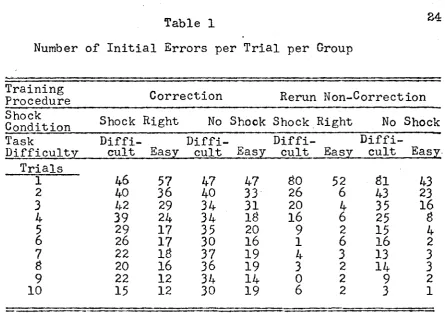
t r i a l s . The total number of initial errors for the 8 groups
under each training procedure, for each shock condition and
for each level of task difficulty is presented in Table 1.
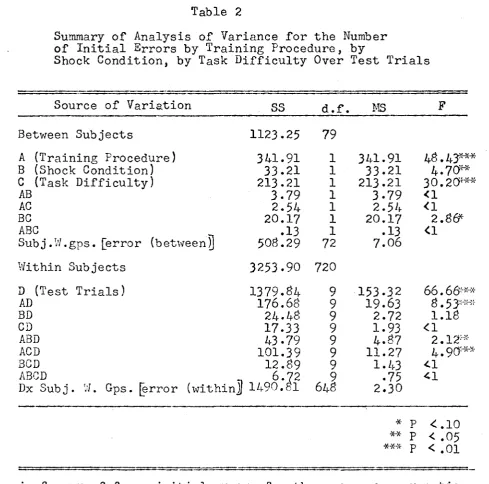
A four way analysis of variance was carried out for
the data in Table 1. A summary of this analysis of variance
is presented in Table 2.
The results of this analysis show that the F ratios for
the main effects of training procedure (A), task difficulty
(C) and test trials (D) were significant bejrond the .99 level.
The F ratio for the main effect of shock condition (B) was
Table 1
Number of Initial Errors per Trial per Group
84
Training
Procedure Correction Rerun Non-Correction
Shock
Condition Shock Right No Shook Shock Right No Shock
Task Difficulty Diffi cult Easy Diffi cult Easy Diffi cult Easy Diffi cult Easy. Trials
1 46 57 47 47 SO 52 Si 43
2 40 36 40 33 26 6 43 23
3 42 29 34 31 20 4 35 16
4 39 24 34 IS 16 6 25 S
5 29 17 35 20 9 2 15 4
6 26 17 30 16 1 6 16 2
7 22 IS 37 19 4 3 13 3
S 20 16 36 19 3 2 14 3
9 22 12 34 14 0 2 9 2
10 15 12 30 19 6 2 3 1
The F ratio for the interaction effect of training
procedure by test trials (AD) was significant beyond the
.99 level. The interaction effect of training procedure
by task difficulty by test trials (AGD) produced an F ratio
which was significant beyond the .99 level. An F ratio
significant beyond the .95 level was also obtained from
the training procedure by shock condition by test trials
(ABD) interaction. There were no other significant inter
actions, although the shock condition by task difficulty
(BC) interaction effect tended towards significance (P <-.10).
The significant main effect of training procedure (A)
indicates that there is a significant difference in the
Table 2
Summary of Analysis of Variance for the Number of Initial Errors by Training Procedure, by
Shock Condition, by Task Difficulty Over Test Trials
Source of Variation SS d . f . MS F
Between Subjects 1123.25 79
A (Training Procedure) 341.91 1 341.91 4 8.41***
B (Shock Condition) 33.21 1 33.21 4.70**
C (Task Difficulty) 2 1 3 .2 1 1 2 1 3 .2 1 3 0.20***
AB 3.79 1 3.79 <1
AC 2.54 1 2.54 <1
BC 20.17 1 20.17 2.8 6*
ABC .13 1 .13 <1
Subj.W.gps. [error (between)] 508.29 72 7 .0 6
Within Subjects 3253.90 720
D (Test Trials) 1379.84 9 153.32 6 6.66"**
AD 1 7 6 .6 8 9 19.63 8.53***
BD 24-48 9 2.72 1 .1 8
CD 17.33 9 1.93 <1
ABD 43-79 9 4.87 2.12**
ACD 101.39 9 11.27 4.90***
BCD 12.89 9 1.43 <1
ABCD 6.72 9 .75 <1
Dx Subj. W. Gps. [error (withinj 1490.81 648 2 .3 0
* P <.10 *-* P < .05 **-* P < .01
in favour of fewer initial errors for the rerun non-correction
training procedure. The significant main effect of task
difficulty (C) indicates a difference in the total number
of initial errors as a function of the level of task dif
ficulty with the easy task groups producing significantly
fewer initial errors than the difficult task groups. The
PA beyond the .95 level, suggests that significantly fewer
initial errors occur when shock is administered for the
correct response, as opposed to t h e n o shock condition.
The significant main effect of test trials (D) indicates
that a significant decrease in the number of initial
errors occurs over test trials.
The interaction effect of training procedure by test
trials (AD), which was significant beyond the .99 level,
demonstrates that the training procedure employed is a
significant factor in the determination of the rate of
decrease in initial errors over trials.
The significant training procedure by task difficulty
by test trials (ACD) interaction also suggests that the
training procedure and task difficulty in combination act
differentially to cause a significant decrease in the
number of initial errors over trials.
The combined effect of training procedure and shock
condition also act differentially to cause a significant
decrease in the number of initial errors over trials as
indicated by the significant training procedure by shock
condition by test trials (A'3D) interaction.
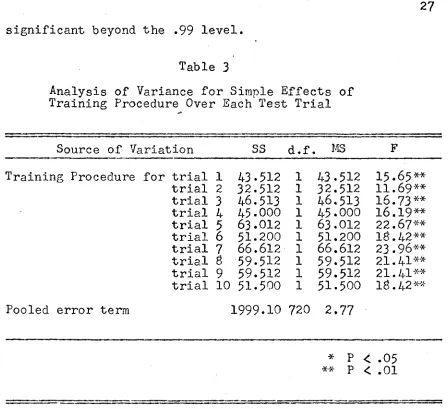
To determine the nature of the significant training
procedure by test trials (AD) interaction an analysis of
simple effects was carried out. The main effect of train
ing procedure was broken down into i t s T simple main
effects for each test trial. The results of this analysis,
significant beyond the .99 level.
Table 3
Analysis of Variance for Simple Effects of Training Procedure Over Each Test Trial
Source of Variation SS d.f . MS F
Training Procedure for trial 1 43-512 1 43.512 15.65**
trial 2 32.512 1 32.512 11.69**
trial 3 46.513 1 46.513 16.73**
trial 4 45.000 1 45.000 16.19**
trial 5 63.012 1 63.012 22.67**
trial 6 51.200 1 51.200 18.42**
trial 7 66.612 1 66.612 23.96**
trial 8 59.512 1 59.512 21.41**
trial 9 59.512 1 59.512 21.41**
trial 10 51.500 1 51.500 18.42**
Pooled error term 1999.10 720 2.77
* P < .05 *3fvr P < .01
The results of the analysis in Table 3 indicates that
the rerun non-correction training procedure subjects demon
strate a more rapid and significantly greater decrease in
the number of initial errors over every test trial than do
the correction training procedure subjects. The significant
interaction of training procedure by test trials can be
expressed as a greater overall improvement in the perform
ance of the rerun non-correction training procedure sub
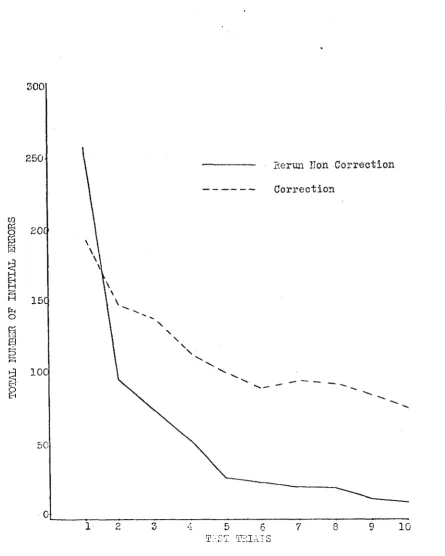
jects over trials. The training procedure curves for
2 8
300
250
Be run lion Correction
Correction
CO o 20( PS
3
H Eh
M
15C F>4 0
1
£ 1 0 0
EH
O
Eh
50
1 2 3 A 5 7 8 9 10
T:-£T GBIAIS
Figure 2, number of initial errors for each training
To determine the effect of the training procedure
in combination with task difficulty over test trials an
analysis of simple effects was carried out for the signi
ficant training procedure by task difficulty by test trials
(ACD)
interaction. In this analysis the combined effect oftraining procedure and task difficulty was broken down into
their combined simple effects for each test trial. The re
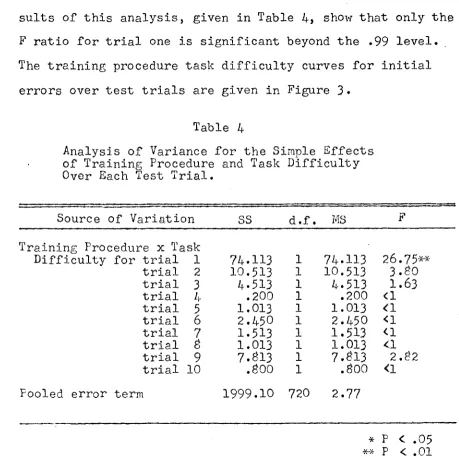
sults of this analysis, given in Table 4, show that only the
F ratio for trial one is significant beyond the .99 level.
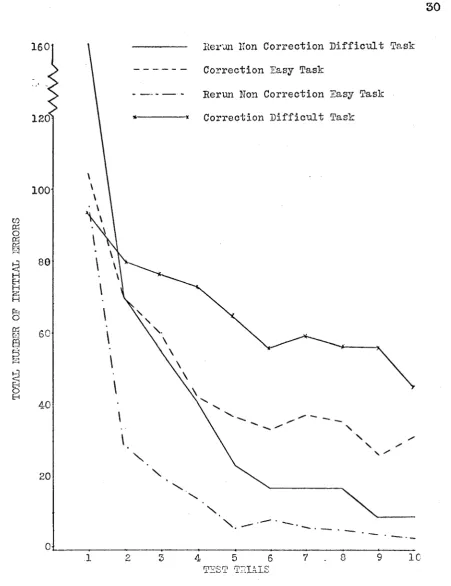
The training procedure task difficulty curves for initial
errors over test trials are given in Figure 3.
Table 4
Analysis of Variance for the Simple Effects of Training Procedure and Task Difficulty Over Each Test Trial.
Source of Variation
ss
d.f.
MS
F
Training Procedure x Task
Difficulty for trial
1
74.113
1
74.113
26.75**
trial
2
10.513
1
10.513
3.go
trial
3
4-513
1
4.513
1.63
trial
4
.200
1
.200
<1
trial
5
1.013
1
1.013
<1
trial
6
2.450
1
2.450
<1
trial
7
1.513
1
1.513
<1
trial
g
1.013
1
1.013
<1
trial 9
7.813
1
7.813
2.g2
trial
10
.goo
1
.goo
<1
Pooled error term
1999.10
720
2.77
30
1601
120
100
co
K
0
1
H EH H
H
pH O
K
tq a
§
(— io
EH
80
40
20
Rerun ITon Correction Difficult Task
Correction Easy Task
Rerun Ron Correction Easy Task
Correction Difficult Task
4 5 6
TEST TRIALS
7 8 1C
Figure 3. Number of initial errors for each training
Rerun Ron Correction Correction
170,
g 150
o
g 130
^ 1 1 0 M 53 M 90 E D ioa
g 80
§
W 60
< £ 40
£ M
20
D E
TRIAL 1 TRIAL 2
100
to 80 « o P3 0:5 CA(y 60
< £ 40 M 5? H
20
100.
D E
TRIAL 3 to w o « « H 80 60 < M 40 H IH
20
I) E
TRIAL 4
32
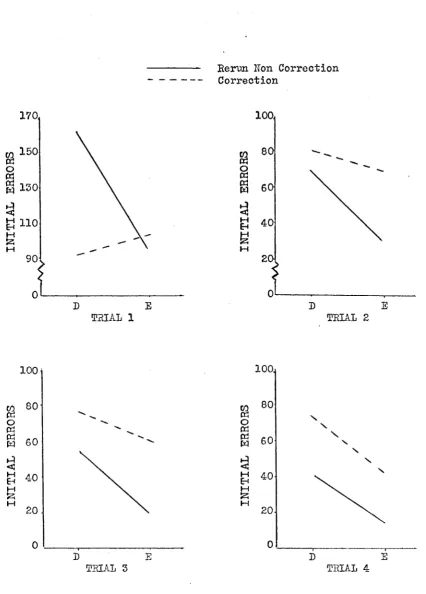
The results of the analysis in Table 4 are graphically
presented in Figure 4. The profiles in Figure 4 demonstrate
that on trial one the rerun non-correction training pro
cedure subjects made a significantly greater number of
errors on the difficult task than did the correction train
ing procedure subjects. B u t on the easy task the rerun non
correction training procedure subjects made fewer initial
errors than did the correction training procedure subjects.
On trials 2 through 10 the rerun non-correction training
procedure subjects made fev/er initial errors than did the
correction training procedure subjects on both the difficult
and the easy maze tasks. The non significance of the remain
ing F ratios may be due to an experimental bias which will be
discussed in a later chapter.
A third analysis of simple effects was carried out to
determine the effect of the training procedure in combina
tion v/ith shock condition over test trials since, the A3D
interaction was significant beyond the .95 level. The re
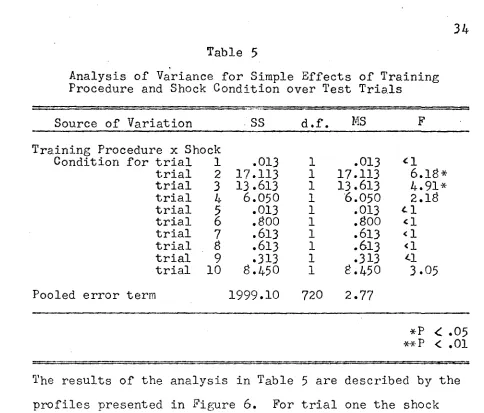
sults of this analysis, presented in Table 5, indicate that '
the effect of training procedure and shock condition v/as
significant beyond the .95 level for trials 2 and 3 alone.
The training procedure shock condition curves for
140
120
Rerun Non Correction Shock Right
Rerun Ron Correction Ro Shock
Correction Shock Right
100
Correction Ro Shock
co
§
%
^
80
HEH H H
Ph
0
1 60
I
£
o
Eh
40
20
10 TRST TRIALS
Rigure 5. Number of initial errors for each training
34
Table 5
Analysis of Variance for Simple Effects of Training Procedure and Shock Condition over Test Trials
Source of Variation SS d . f . MS F
Training Procedure x Shock
Condition for trial 1 .013 1 .013 <1
trial 2 17.113 1 17.113 6.IS*
trial 3 13.613 1 13.613 4.91*
trial 4 6.050 1 6 .0 5 0 2.IS
trial 5 .013 1 .013 c l
trial 6 .gOO 1 .300 <1
trial 7 .613 1 .613 <1
trial g .613 1 .613 <1
trial 9 .313 1 .313 Cl
trial 10 S.450 1 g.450 3.05
Pooled error term 1999.10 720 2.77
*P < .05 **P < .01
The results of the analysis in Table 5 are described by the
profiles presented in Figure 6. For trial one the shock
right condition subjects scored a greater number of initial
errors for both training procedures than did the no shock
condition subjects. On trials 2 and 3 the shock right con
dition subjects made more initial errors under the correction
training procedure and significantly fev/er initial errors
under the rerun non-correction training procedure than did
the no shock condition subjects. On trial 4 the significant
initial error difference for the shock conditions (ie.
shock right and no shock) under the rerun non-correction
training procedure was reduced to non significance. Over
No Shock 150 §130 BNC TEIAL 1 80r TEIAL 2 80 to « O 60 at at w «-} 40 < M EH
»
20 M 0 to Ot O « at w < M Eh M S3 MC Hie
TEIAL 5 80 60 40 20 0
C ENC
TEIAL 4
70
to
§ 50 05 W
^ 30 H Eh M
io
TEIAL 5 80 at 60< 40 M
C
TEIAL 6
were superior to the -no shock condition subjects but not
significantly so. The superiority of performance for the
shock right condition subjects under both training procedures
demonstrates that the shock, was eventually adopted by these
subjects as a cue for the correct response.
Total Error Performance for Rerun Non-Correction Groups
Since the rerun non-correction training procedure
subjects were replaced at the start position after every
error it was theoretically possible that these subjects
could make an infinite number of errors for each test trial
due to the fact that these subjects were required to make
an errorless run before the trial was terminated. But the
correction training procedure subjects were allowed to re
trace after making an error (entering a blind, alley) and
hence these subjects were limited as to the number of errors
they could make on each trial. For this reason it was neces
sary to devise a scoring scheme which would allow direct
comparison of the correction and the rerun non-correction
maze training procedures. The resultant scoring scheme con
sisted of initial errors and repetitive errors. The initial
errors measure was used to compare the two maze training
procedures since the maximum number of initial errors for
both procedures on every trial would be 10. 3ut this scoring
scheme raises the possibility that the significant effect of
(Table 2), were merely artifacts of the initial errors
measure and hence present only because of the necessity to
compare the two maze training procedures. In order to in
vestigate this possibility an analysis of variance for the
total errors measure (initial plus repetitive) was carried
out for the rerun non-correction training procedure groups
with shock condition, task difficulty and test trials as the
main effects. A summary of this analysis is presented in
Table 6.
Table 6
Summary of Analysis of Variance for the Number of Total Errors by Shock Condition, by Task Difficulty over Test Trials for Rerun Non-correction Groups
Source of Variation SS d.f. MS F
Between Subjects 6996.56 39
A (Shock Condition) B (Task Difficulty)
AB Subj.W.gps. [error(between)] 673.61 1370.57 413.19 4031.21 1 1 1 36 673.61 1370.57 413.19 111.93 6.06 ** 16.70 *** 3.73 *
Within Subjects 74623.30 360
C (Test Trials) 33926.61
AC 562.21
BC 6576.55
ABC 2166.04
C x sub j .V/.gps .[error (wit hi nlj 31396. 39
9 9 9 9 324 3769.62 62.47 730.73 240.67 96.90
33 . 90 vK>-w C l
7.54 2 . h3