Effects of a wood pine polypropylene compound on the soil
thermal conductivity as a function of water content
Katerina Y. Doneva1 and Carles M. Rubio2
1
Institute of Soil Science, Agrotechnology and Plant Protection Nikola Poushkarov, 1080 Sofia, Bulgaria
2
Eurecat Technology Centre of Catalonia, 08290 Cerdanyola del Valles, Spain
Abstract
Polymers changed soil physical properties and in particular soil thermal properties. In our
laboratory experiment we used loam soil and a mixture of loam soil plus polymer compound
to determine the effect of polymer on soil thermal conductivity. We measured thermal
conductivity with KD2 Pro device and the received values ranged from 0.26 to 1.27 W m-1 K
-1
for loam soil to water contents from 0.02 to 0.42 g g-1 and from 0.20 to 0.89 W m-1 K-1 for
loam soil plus polymer to water contents from 0.02 to 0.50 g g-1. Our results showed that
when the polymer was added to the loam soil its thermal conductivity decreased.
Keywords: soil physics, thermal properties, polymers, thermal resistivity
1. Introduction
Urban and suburban areas present the impact of human and natural wastes on soils. This
type of alter can vary between slightly effect and to become highly detrimental. Some typical
wastes are polymers from the industrial and human areas. Even though, polymers tend to be
used to control soil degradation and desertification, and also to improve arid and semiarid
soils (Maghchiche et al., 2010).
As regards of this topic several researchers have investigated the effects of the polymers
on soils, such as Aslam et al., 1989; Rizvi et al., 1989; Aslam, 1990. Basically, their
experimental research was focused on polymers such as cellulose xanthate, polyacrylamides,
hydrolyzed polyacrylonitrile or polyvinyl alcohols. The features of these polymers were
focused on its chemical stability and its high molecular weight for applying on paper industry,
mining, mineral and sugar industries and sewage treatment plants. Other applications have
been as a soil conditioning material and soil aggregates, although applicable to a narrower
range of soils (Aslam, 1990).
Wallace et al. (1986) presented their research about new-generation soil conditioners to
sodic soils using polymers. In flocculation tests, followed by wet-sieving, particle sizes were
approximately four to five times larger with new soil conditioners than natural soils. Water
penetration was greatly improved on a sodic soil when conditioned with the new soil
conditioner. Application of polyacrylamide in solution to all the soils increased stem
emergence and dry weights of tomato seedlings.
Other effects of the polyacrylamide could be observed on soil physical properties.
Dilkova (1972) investigated the influence of polymer Separan (hydrolysed polyacrylamide)
on soil physical properties and also on soil thermal diffusivity (Dilkova and Ilieva, 1974).
According to Dilkova (1972) there was an increase in size and water stability of soil structural
aggregates and soil porosity, respectively. Bulk density decreseased after the treatment with
Separan. Dilkova and Ilieva (1974) concluded that the polymer slightly decreased thermal
diffusivity of the investigated soils.
Terry and Nelson (1986) applied two irrigation methods, such as sprinkle irrigation and
flood irrigation, adding Polyacrylamide (PAM) only on flood irrigated plots to study the
effects on soil physical properties. For this purpose bulk density, penetrometer resistance,
aggregate stability, and infiltration rate were measured. The surface bulk densities of sprinkle
irrigated soil and PAM treated, flood-irrigated soils were significantly lower than the flood
irrigated control. The aggregate stability was improved, and infiltration rates were
approximately twice as large as those of the flood-irrigated control. Also, the polyacrylamide
cemented the aggregates together and increased their resistance to the erosion (Levy et al.,
1992).
Hence, several authors have studied the effects of the polymers on soil physical
properties, although not all physical properties. Interesting and important physical properties
are the soil thermal properties as well. Yet, only few authors have focused their research on
soil thermal properties. Such as DeBano et al. (1999, 2005) studying the irreversible damage
when the fire is not too intense and soil heating brief, which occurs during deeply penetrating
heat pulses and long-term exposures. Massman et al. (2008) studied the severity of the soil
heating during a prescribe burn and wildland fire where the impacts can be significant and
serious. Others investigations related with the soil heat transfer include the formation of a
hydrophobic layer on the surface or within the soil, destruction of most of the organic material
in the upper few centimeters of soil and the concomitant loss of soil aggregate stability
(changes in soil pH and soil chemistry, long-term differences in soil moisture content,
increases in soil bulk density with accompanying decreases in soil porosity. Therefore
changes on soil structure (Huffman et al., 2001; Neary and Overby, 2006). Thus, when
biomass on or above a soil surface burns, a heat pulse penetrates the soil. The resulting high
soil temperatures can alter soil properties and kill roots and soil microbes (Campbell et al.,
1994).
On the other hand, change in the soil thermal conductivity (λ, a measure of a soil’s
ability to conduct heat) is less obvious, but is not less significant because of its relationship to
other changes in the soil properties owing to the fire. Changes in the soil structure occur
whenever soil organic matter is burned. These changes influence soil thermal conductivity as
it is strongly determined by soil structure (Farouki, 1986) and soil composition (e.g. de Vries,
1963; Campbell and Norman, 1998). Consequently, the purpose of this research is to explore at laboratory scale the variability on the soil thermal conductivity -λ- of a Fluvisol (loam
texture) mixed with polymer pellets as a carrier and scott pine shavings as a filler.
To achieve the main goal, it was divided into two operative objectives: (i) to observe the
relationship between soil thermal conductivity and water content, (ii) to evaluate the influence
of polymer pellets on the soil thermal conductivity.
2. Materials and Methods
The soil samples were taken between 10 and 20 cm depth of alluvial-meadow soil
(Fluvisol, according to FAO2006) in the experimental field of Tsalapitsa (42o10.8’N,
24o32.6’E, 192 m a.s.l), South of Bulgaria (Figure 1). The plot represented pristine conditions
under grass association.
Figure 1. Location of soil sampling area in Tsalapitsa, Bulgaria.
Soil fractions were determined after chemical dispersion with sodium pyrophosphate
(Na4P2O7) without removal the organic matter and carbonates from the soil sample. Four
sand fractions (2-1, 1-0.5, 0.5-0.25, 0.25-0.10 mm) were determined by sieving. The particle
fractions less than 0.05, 0.02, 0.01, and 0.002 mm were determined by pipette method
according to Kohn – modification V (after De Boodt, 1967). The sand fraction 0.10-0.05 mm
was calculated after subtracting all measured fractions from 100%. Particle-size distribution
and textural class were determined according to USDA (Soil Survey Division Staff, 1993).
Total soil organic carbon (SOC) content was determined by modified Tjurin’s method such as
was indicated by Kononova (1966) and Filcheva and Tsadilas (2002). Soil water content (W,
g g-1), and bulk density (ρb, g cm-3) of undisturbed soil samples were determined with
cylinders of 100 cm3 by gravimetric method after oven drying at 105°C until constant dry
weight (Revut and Rode, 1969). Particle density (ρs, g cm-3) was measured in 100 cm3
picnometers. Consequently, total porosity (P, %) was calculated by;
100 × − =
s b s P
ρ ρ ρ
[1]
where ρs is particle density and ρb is bulk density.
Direct measurements of thermal conductivity (λ), and thermal resistivity (ρ) (the ability
to resist heat flow) were determined using KD2-Pro reader-logger device. SH-1 thermal
sensor was used to determine the thermal conductivity and resistivity of the samples. Both are
based on ASTM D5334. A Moplen polypropylene homopolymers with filler of scott pine
shavings was added (30% in weight of sample) to the loam soil to investigate its effect on soil
thermal conductivity. The main characteristics of the compounding used were to mix the
polypropylene with 20% of wood pine shavings related to weight of total sample of
polypropylene and filler. Thermal conductivity of this mixture was around 0.201 W m-1 K-1,
and its bulk density was around 0.97 g·cm-3.
According to Rubio (2013, 2014), air dry soil and also different levels of soil moisture
were achieved by adding certain amount of water to the samples and obtain a homogenous
mixture. Several rings were used to compact the compound soil samples. Loam soil and loam
soil plus polymer were wetted up and compacted to a target bulk density. This protocol
avoided discrepancies due to the variable bulk density.
One thermal sensor per core was placed in the center of the ring and middle height. It
maintained the same quantity of sample under and above the sensor to assist the accuracy of
the measurements. Five moisture scenarios were determined between air dry and close to
saturation. Water content of soil samples was measured by two different methods, (i) oven
drying the sample at 105°C during 24h (Revut and Rode, 1969), and (ii) microwave oven
(Miller et al., 1974; Routledge and Sabey, 1976; Rubio, 2014).
The several thermal properties tests were performed at room temperature, around 22 ºC.
3. Results and Discussion
The main soil characteristics of the studied alluvial-meadow soil (Kercheva, 2014) are
summarized in Table 1. The soil was classified as Loam according to USDA (Soil Survey
Division Staff, 1993), which was used in the current study to address the soil. Analyzed loam
soil had very low organic carbon content (0.51%) according to classification of Filcheva
(Raichev and Filcheva, 2011) (Table 1).
Table 1. Physical and chemical properties of the investigated A horizon (5-20 cm depth) of Fluvisol. Particle size distribution and texture class according to USDA; SOC = soil organic carbon content; BD = bulk density, W = water content at soil sampling, FC = field capacity (at -33 kPa suction); PWP = permanent wilting point (at -1500 kPa).
Sand (%) Silt (%) Clay (%) Texture class SOC (%) BD
(g.cm-3)
W
(gwater.gdry soil-1)
PD
(g.cm-3)
FC
(gwater.gdry soil-1)
WP
(gwater.gdr y soil-1)
44.0 35.8 20.2 Loam 0.51 1.53 0.12 2.64 0.20 0.09
During our laboratory experiment water content was measured by gravimetric method
after drying in oven at 105°C for 24 hours and in microwave oven. It was established very
good relevance between these two methods of drying (Fig. 2). Data measured fitted very
acceptably, with a correlation coefficient of 0.997.
Figure 2. Comparison of soil water content determined by oven and microwave drying
Results from laboratory measurements of thermal conductivity using KD2-Pro device at
several water content scenarios, and laboratory bulk densities of the investigated soil cores are
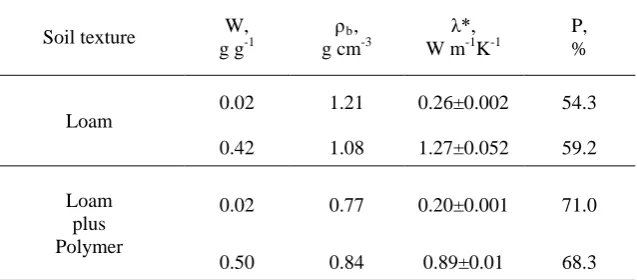
presented in Table 2. The results showed that after adding a polymer to loam soil the values of R2 = 0.9985
0.00 0.05 0.10 0.15 0.20 0.25 0.30 0.35 0.40 0.45 0.50
0.00 0.10 0.20 0.30 0.40 0.50
water content, g g-1 oven 105ºC/24H
w a te r c ont e nt
, g g
-1 m
icr
o
w
ave
bulk density decreased from 1.21 to 0.77 g cm-3 at air dry condition (W=0.02 g g-1) and from
1.08 to 0.84 g cm-3 for water content close to saturation.
Measured values of thermal conductivity ranged from 0.26 to 1.27 W m-1 K-1 for loam
soil at water contents from 0.02 to 0.42 g g-1, and from 0.20 to 0.89 W m-1 K-1 for loam soil
plus polymer at water contents from 0.02 to 0.50 g g-1.
Total porosity (P, %) was calculated according to eq.1 and the values for soil plus
polymer were higher than those for natural soil. A reasonable explanation of this phenomena
could be related with the lower particle density of the mixture between loam soil and polymer
compound. Since the bulk density of the polymer compound was around 0.97 g cm-3.
Therefore, the value of porosity for loam soil plus polymer decreased because its particle
density was lower than the natural soil.
Table 2. Moisture scenarios (dry soil and saturation) and thermal conductivity (λ) of the soil samples. W = water content, ρb = target bulk density, and P =
total porosity.
Soil texture W,
g g-1
ρb,
g cm-3
λ*, W m-1K-1
P, %
Loam 0.02 1.21 0.26±0.002 54.3
0.42 1.08 1.27±0.052 59.2
Loam plus Polymer
0.02 0.77 0.20±0.001 71.0
0.50 0.84 0.89±0.01 68.3
* Average ± standard deviations n= 4
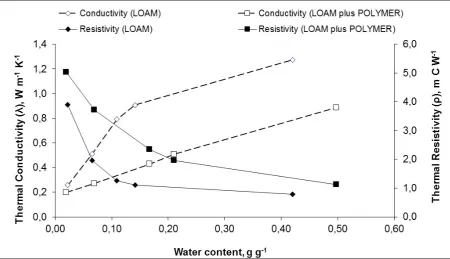
Thermal conductivity and resistivity values as a function of water content are shown in
Figure 3. Soil water content had primary and highest influence on soil thermal conductivity.
Thermal conductivity values of investigated natural loam soil increased rapidly in the range
from air dry soil to a moisture level between wilting point and field capacity. The increase in
water content caused smaller increase in thermal conductivity values. After adding the
polymer the response of thermal conductivity was very close to a straight line in comparison
with non linear relationship for natural loam soil. The results showed that when the polymer
was added to the natural soil its thermal conductivity decreased on 23% at air dry soil, and
around 45% for water contents between wilting point and field capacity, and 30% when soil
sample was close to saturation.
As regards soil thermal resistivity, it decreased when soil pores were filled with water
considering that the values of water and air resistivity are 1.7 and 40 m C W-1, respectively. In
the current study thermal resistivity had a similar curve type as for natural soil as the soil plus
polymer. There was a fast decreasing in thermal resistivity from air dry soil to water content
between wilting point and field capacity (Fig.3), especially when soil was close to saturation,
showing certain thermal equilibrium. Values of thermal resistivity for loam soil plus polymer
were higher than those for natural soil. These values could be related with the lower thermal
conductivity of polypropylene plus wood pine shavings.
Figure 3. Thermal conductivity (λ) and thermal resistivity (ρ) as a function of water content for natural soil, and
soil with compound.
4. Conclusions
As summary, the thermal behavior of natural loam soil presented the same values found
by other author. However, when the Moplen polypropylene homopolymers with filler of scott
pine shavings was added to the same soil sample the thermal conductivity decreased. The
critical point was not shown on thermal conductivity relationship, however it existed when
data was plotted in terms of thermal resistivity. The lower quantity of water absorbed by scott
pine shavings provided a smoothly curve in terms of thermal conductivity variable. On the
other hand, the variable temperature did not affect the test because was controlled on the
whole of the process.
Eventually, the effects of the compound polymer on the soil did not improve the transfer
of the heat flux inside the soil matrix, increasing the thermal conductivity value when water
content increased in the soil.
Acknowledgements
We gratefully acknowledge the financial support of ERASMUS + Programme Staff mobility
for training funded by the European Union, and also to Eurecat Technology Centre of
Catalonia for the opportunity to implement our study in Thermal Laboratory.
5. References
Aslam, M. 'Polymers as soil -conditioners and sealing agents' Part-i: State-of-Art-Study and
their potential applications in Pakistan. Pakistan Academy of Sciences, Islamabad.
Monograph, 66 pp. (1990).
Aslam, M., S. Ashhad Mehdi and Salim Akhtar, 'Research and Technology development plan
for polymers suitable for soil conditioning and sealing'. Project Report, (March 1989).
Campbell G. S., Jungbauer Jr. J.D., Bidlake W.R., Hungerford R.D., 1994. Predicting the
effect of temperature on soil thermal conductivity. Soil Sci. 158:307-313.
Campbell, G.S.; Norman, JM 1998. An introduction to environmental biophysics. 2nd ed.
Springer-Verlag: NewYork, NY
De Boodt, M. et al. (eds.) West-European method for soil structure determination, 1967.p
IV.64 Pipette-method according to Kohn (modification V) (Methodenbuch 1955). I, 3,
Aufl., p24, Berlin.
de Vries D. A. 1963 Thermal properties of soils. In: Physics of Plant Environment (ed. W. R.
van Wijk) North-Holand, Amsterdam.
DeBano, L.F.; Neary, D.G.; Ffolliott, P.F. 1999. Fire’s effects on ecosystems. JohnWiley &
Sons: NewYork, NY
DeBano, L.F.; Neary, D.G.; Ffolliott, P.F. 2005. Chapter 2: Soil physical properties. In
Wildland fire in ecosystems: effects of fire on soil and water. USDA Forest Service,
RockyMountain Research Station General Technical Report RMRS-GTR-42-vol.4. (Eds
DG Neary, KC Ryan, LF DeBano) pp. 29–51. Ogden, UT, USA
Dilkova, R. 1972. The effect of conditioners on the aggregate composition and certain
physical properties of leached smolnitza and leached cinnamonic forest soil. Soil science
and agrochemistry, vol. VII, № 1, pp. 11-28 (in Bulgarian)
Dilkova, R. and V. Ilieva. 1974. Changes in the temperature-conductivity coefficient and
temperatures in leached smolnitza and leached cinnamonic forest soils under conditioning.
Soil science and agrochemistry, vol. IX, № 2, pp. 34-42 (in Bulgarian)
FAO. 2006. Guidelines for soil description. Fourth edition. Rome: Food and Agriculture
Organization of the United Nations, 97 p.
Farouki, O.T. 1986. Thermal properties of soils. Trans. Tech. Publications:
Clausthal-Zellerfeld, Germany)
Filcheva E., C. Tsadilas. 2002. Influence of Cliniptilolite and Compost on Soil Properties.
Commun. Of Soil Sci. and Plant Analysis, 33, 3-4, 595-607
Huffman E.L.; MacDonald L.H.; Stednick J.D. 2001. Strength and persistence of fire-induced
soil hydrophobicity under ponderosa and lodgepole pine, Colorado Front Range.
Hydrological Processes 15, 2877–2892. doi:10.1002/HYP.379
Kercheva, M. 2014. Final report of project POZM 158. Task 1.2"Assessment of spatial
variability of soil physical properties in the region of the experimental field of Tsalapitsa".
Archives of the Institute of Soil Science, Agrotechnology and Plant Protection "N.
Poushkarov", Sofia (in Bulgarian)
Kononova M. 1966. Soil Organic Matter. 2nd ed. Pergammon press, Inc., M. V., 544p.
Levy, G. J.; J.Levin, M. Gal, M. Ben-Hur, I.Shainberg (1992). Polymers' Effects on
Infiltration and Soil Erosion during Consecutive Simulated Sprinkler Irrigations. Soil Sci.
Soc. Am. J., 56, 3, 902-907.
Maghchiche A., Haouam A., Immirzi, B. 2010. Use of polymers and biopolymers for water
retaining and soil stabilization in arid and semiarid regions. J. Taibah university for Sci., 4,
9-16.
Massman, W.J.; Frank, J.M.; Reisch, N.B. 2008. Long-term impacts of prescribed burns on
soil thermal conductivity and soil heating at a Colorado Rocky mountain site: a
data/model fusion study. International J. Wildland Fire, 17, 131-146
Miller, RJ, Smith, RB, Biggar, JW. 1974. Soil water content-microwave oven method. Soil
Sci. Soc. Am. Proc., 38, 535-537.
Neary, D. G.; Overby, S. T. 2006. Wildfire and post-fire erosion impacts on forest ecosystem
carbon and nitrogen: An analysis. Forest Ecology and Management. 234S: S162.
Raichev, T. and E. Filcheva. 2011. Soil organic matter. Small terminological dictionary.
Avangard Prima Publishers, Sofia, p. 99 (in Bulgarian)
Revut I. B. and A. A. Rode. 1969. Guideline on studying soil structure. Leningrad p. 527 (in
Russian)
Rizvi, S.S.H., Dabir Ahmad &Ahmad Saghir, 'Methodology for laboratory evaluation of
synthetic soil conditioners - a review'. Project Report, (March 1989).
Routledge,DB, Sabey, BR. 1976. Use of a microwave oven for moisture determination in a
soil science laboratory. J Nat. Res. Life Sci. Education, 5, 25-27.
Rubio, C.M. 2013. A laboratory procedure to determine the thermal properties of silt loam
soils, based on the ASTM D 5334. Applied Ecology and Environmental Sciences. Vol. 1,
4, 45-48.
Rubio, C.M. 2014. An approach to make more technical thermal properties measure in porous
media. Applied Ecology and Environmental Sciences, Vol. 2, 2, 60-65, (2014).
Soil Survey Division Staff. 1993. Soil survey manual. Soil Conservation Service. U.S.
Department of Agriculture Handbook 18
Terry, R. E. and Nelson, S. D. 1986. Effects of polyacrylamide and irrigation method on soil
physical properties. Soil Science, 141, 5, 317-320.
Wallace, A.; Wallace, G. A.; Abou-Zamzam, A. M. 1986. Amelioration of sodic soils with
polymers. Soil Science, 141, 5, 359-362.