Approximating Private Set Union/Intersection
Cardinality with Logarithmic Complexity
Changyu Dong, Grigorios Loukides
Abstract—The computation of private set union/intersection cardinality (PSU-CA/PSI-CA) is one of the most intensively studied problems in Privacy Preserving Data Mining (PPDM). However, existing protocols are computationally too expensive to be employed in real-world PPDM applications. In response, we propose efficient approximate protocols, whose accuracy can be tuned according to application requirements. We first propose a two-party PSU-CA protocol based on Flajolet-Martin sketches. The protocol has logarithmic computational/communication complexity and relies mostly on symmetric key operations. Thus, it is much more efficient and scalable than existing protocols. In addition, our protocol can hide its output. This feature is necessary in PPDM applications, since the union cardinality is often an intermediate result that must not be disclosed. We then propose a two-party PSI-CA protocol, which is derived from the PSU-CA protocol with virtually no cost. Both our two-party protocols can be easily extended to the multiparty setting. We also design an efficient masking scheme for(1
n)-OT. The scheme is used in optimizing the two-party protocols and is of
independent interest, since it can speed up(1
n)-OT significantly whennis large. Last, we show through experiments the effectiveness
and efficiency of our protocols.
F
1
I
NTRODUCTIONWe are in an era where data becomes increasingly important. On one hand, data drives scientific research, business analytics, and government decision making. Advanced technologies for dis-covering interesting knowledge from large amounts of data have become an indispensable part of nearly everything. On the other hand, data privacy becomes of paramount importance as evidenced by the increasingly tighter legal obligation imposed by legislation (e.g. HIPAA, COPPA, and GLB in the US, European Union Data Protection Directive, and more specific national privacy regulations). Driven by both, recently we have seen a significant advancement in privacy preserving data mining (PPDM). In many scenarios, mining the union of data held by two or more parties could deliver a clear benefit. For example, online retailers want to find correlations between products bought by their common customers to boost sales, policy makers want to link healthcare data held by public and private healthcare providers to develop better public policies, and geneticists want to associate mutations in human genomes with diagnoses in medical records to identify genetic causes of cancers. In all these scenarios, privacy concerns and/or privacy regulations prohibit the sharing of data between parties. Thus, the application of conventional data mining methods
• Changyu Dong is with the School of Computing Science, Newcastle University, Newcastle Upon Tyne, UK. Email: [email protected].
• Grigorios Loukides is with the Department of Informatics, King’s College London, London, UK. Email: [email protected].
• This paper has supplementary downloadable material available at http://ieeexplore.ieee.org, provided by the authors. The material includes the appendices of this paper. Contact [email protected] for further questions about this work.
• Accepted to be published in IEEE Transactions on Information Forensics and Security ( Volume: 12, Issue: 11, Nov. 2017 )
• DOI: 10.1109/TIFS.2017.2721360 c 2017 IEEE. Personal use of this material is permitted. Permission from IEEE must be obtained for all other uses, in any current or future media, including reprinting/republishing this material for advertising or promotional purposes, creating new collective works, for resale or redistribution to servers or lists, or reuse of any copyrighted component of this work in other works.
is not possible, and PPDM methods are needed to perform data mining in a distributed fashion, without disclosing or pooling the data of any party.
This paper investigates a long-established problem in PPDM: how to securely compute the cardinality of the union or the in-tersection of some private sets (PSU-CA/PSI-CA). More formally, consider two parties each holding a private setSi. The PSU-CA problem is to securely compute the union cardinality|S1∪S2|, and the PSI-CA problem is to securely compute the intersection cardi-nality|S1∩S2|. At the end, parties should obtain the cardinality of the union/intersection but nothing else about other parties’ sets. PSU-CA and PSI-CA can be defined similarly in the multiparty (>2) case. PSU-CA and PSI-CA are closely related: often solving one problem leads to an easy solution to the other problem. Thus they can be treated as one problem. The problem is of practical importance because protocols for solving the problem are important building blocks in PPDM. For example, PSU-CA/PSI-CA protocols have been used as subroutines in privacy preserving association rule mining [1], privacy preserving classification (e.g. decision trees [2] and Support Vector Machine [3]), and privacy preserving mining of social network data [4].
the protocol can be large because a user may have thousands of friends. Even with the most efficient protocol to date, finding the union cardinality would need tens or even hundreds of seconds. Furthermore, there are millions of users registered in both social networks. Thus, the protocol needs to run millions of times, and the task may take months or even years. This is clearly impractical. Recently, there has been much interest in approximate PSU-CA and PSI-CA protocols [13], [14], [15]. It is well-known that in data mining, a close approximation is often as good as the exact result [16]. Approximation is widely used in data mining to handle extremely large datasets when the exact answer is hard to compute [17]. With a bounded loss of accuracy, it is possible to make the whole data mining process much more efficient. The same principle applies to PPDM. That is, approximation can simplify protocol design and reduce the size of input to the protocol which both could help making the protocol more efficient. Unfortunately, the current approximate PSU-CA and PSI-CA protocols are either insecure ([13], [14]) or not very efficient ([15]), as we discuss in Section 2.
A more subtle problem of most of existing protocols ([7], [8], [1], [11], [14], [9], [10], [13], [15], [12]) is that they output the intersection/union cardinality directly to one or all parties. This is perfectly fine as per the definition of the problems. However, the cardinalities may not be the end result the parties want. Especially in PPDM, these protocols are often used as subroutines and the cardinalities are only intermediate results. Outputting cardinalities increases the leakage of the PPDM protocol: ideally intermediate results should be hidden and the only output should be the data mining result. For instance, in the social network example above, the two providers want to find out thek most influential users. The union cardinality that represents the number of friends is only a feature to be used in finding such users. It is too excessive if the total number of friends of every user has to be revealed in the mining process. Often what we need is, rather than outputting the cardinalities directly, to keep the cardinalities secret and run a secure sorting protocol on the secret cardinalities to output the users who have the most friends, or run a secure comparison protocol to output the users who have more friends than a pre-defined threshold. Avoiding this leakage is not easy, due to the design of the protocols. To find the cardinalities, those protocols all depend on a party (or all parties) in the protocol to count either the number of matches among some ciphertexts [7], [8], [1], [11], [14] or the occurrences of a specific value (e.g. 0) [9], [10], [13], [15], [12]. Then the party that does the counting inevitably learns the cardinalities.
Contributions Our main contribution is a secure two-party approximate PSU-CA protocol. The protocol is based on the Flajolet-Martin (FM) sketch [18], which is a space efficient data structure for cardinality estimation. The parties use their FM sketches as inputs to the protocol and compute the union cardinality. At the end each party gets a share that can be used to reconstruct the cardinality, but none of them learns the cardinality directly. The protocol has the following important features:
• Highly efficient and accurate. The protocol is efficient for two reasons. First, unlike all existing protocols, our protocol has computational and communication complexities logarithmic in
N, the maximum possible cardinality of the private sets1. This is achieved by using FM sketches. Second, our protocol is mainly based on symmetric key operations, while most existing protocols (except generic protocols) are based on much slower public key operations. The accuracy of the estimation of our protocol is adjustable with a public parameter m. In practice, largermvalues improve the estimation accuracy. More precisely, by setting m to a large enough value, the protocol can guarantee the relative error (|Ne−N|)/N is at most with
probability at least1−δfor any arbitrary, δ∈(0,1), where
Nis the true cardinality andNeis the estimated cardinality. The minimum allowable value for m depends on the parameters
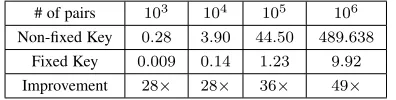
δ and , as it will be explained in Section 4.1. We evaluated the protocol based on our prototype implementation and found that, to compute the union cardinality of two sets with size up to 1 million, it only needed 2.97 seconds when = 1%
and δ = 0.001. In contrast, the state-of-the-art two-party approximate protocol [15] took 488.48 seconds to do the same computation with the same accuracy.
• Eliminates unwanted information leakage. We design the pro-tocol such that by default, no party learns the cardinality at the end of the protocol. The result is split into secret shares and each party holds one share. The shares leak no information about the result. If the cardinality is the final result, the parties can reconstruct it from the shares easily and reveal the cardinality. Or if the protocols are used as subroutines in a larger PPDM protocol, the shares can be fed into the next step of the PPDM protocol without leaking the cardinality. We decided to output the result as secret shares for three reasons: (1) it is simple and incurs virtually no cost to produce the shares; (2) it allows local computation on the shares (e.g. summing the output of Protocol 1); (3) the shares can be easily converted into other encrypted forms using existing techniques (e.g. to Boolean shares or garbled bit strings [19], to ciphertexts of homomorphic encryption schemes [20], and to ciphertexts of other encryption schemes [21]). The last reason is important because the subsequent protocol that will use the cardinality is dependent on the application and may require input other than secret shares. Being able to convert shares into other encrypted form makes our protocol flexible in such a situation.
• Extensible. We extend the PSU-CA protocol into a PSI-CA protocol with virtually no cost using the inclusion-exclusion principle. This is similar to the approach in [11], where the authors extend a PSI-CA protocol into a PSU-CA protocol using the same principle. We also extend the two-party PSU-CA and PSI-CA protocols to the multiparty setting. The multiparty extensions retain the good properties and can be implemented easily using generic secret-sharing based multiparty secure computation frameworks.
A second contribution is the design of a fixed-key masking scheme for(1
n)-OT. In the past, the computation cost of(1n)-OT was dominated by thelog(n)invocations of(1
2)-OT. Now since
(1
2)-OTcan be obtained by OT extension, the cost of masking the
nstrings becomes dominating. The idea of the fixed-key masking scheme is similar to previous work in fixed-key garbling schemes [22]. That is, we use a block cipher with a fixed key as a random
permutation, and apply the fixed-key block cipher to mask the strings. The benefit of the fixed-key masking is significant: it reduces the number of invocations of the encryption function from
log(n)per string to 1 per string; it can take advantage of the AES-NI set that is widely available on recent X86 CPUs; and using fixed-key avoids costly key scheduling so the encryption can be fully pipelined. The efficiency of masking is improved by more than one order of magnitude compared to the previous masking scheme.
2
R
ELATEDW
ORKSince the groundbreaking work of [23], [24], there has been extensive research in PPDM. Much research focuses on the development of a few primitive protocols. This is because there are many data mining techniques, and it is infeasible or not cost-effective to develop solutions for individual ones. One observation is that data mining techniques often perform similar computations at various stages. Therefore a more viable strategy [7] is to build a “toolkit” of primitive protocols that can be assembled to solve specific real-world problems. PSI-CA/PSU-CA is one of the primitive protocols identified in [7] and is widely used in PPDM. Exact ProtocolsThere are several exact PSI-CA/PSU-CA proto-cols. However they all require at leastO(N)public key opera-tions, whereN is the maximum possible cardinality of the private sets. Thus they are less efficient than our protocol.
Both [7] and [8] proposed a PSI-CA protocol based on commutative encryption. The ideas of the two protocols are very similar. The main difference is that [7] was presented in the multiparty setting and [8] in the two-party setting. Both protocols requireO(N)public key operations. In [9], a PSI-CA protocol was proposed based on oblivious polynomial evaluation. The computation requiresO(Nlog logN)public key operations. In [1], a multiparty PSI-CA protocol was proposed based on commutative one-way hash functions that can be constructed from public key encryption schemes such as Pohlig-Hellman. Each party needs to hash τ · N times where τ is the number of parties. In [10], a multiparty PSI-CA protocol was proposed based on oblivious polynomial evaluation. The computation requires
O(N2)public key operations. In [11] a PSI-CA protocol based on an ElGamal like encryption was proposed. The protocol requires
O(N) public key operations and can be trivially extended to a PSU-CA protocol. In [12], the authors proposed PSI-CA/PSU-CA protocols based on Bloom filter and homomorphic encryption. These protocols also requireO(N)public key operations. Approximate ProtocolsIn data mining, approximation is widely used when mining extremely large datasets. Approximate PSI-CA/PSU-CA protocols were proposed in the hope that they can be more efficient. However, unlike our protocol, they are either insecure or still have complexityO(N).
In [13] a multiparty PSI-CA protocol was designed but it is not secure. Adversaries can easily guess any other party’s set elements, as explained in [15]. In [14], a two-party PSI-CA protocol was proposed. The protocol uses [11] as a subprotocol and is based on Minwise sketches [25]. The protocol estimates Jaccard index from Minwise sketches and then approximates the intersection cardinality from Jaccard index. However, this protocol is not secure because party 2 in the protocol leaks the cardinality of its private set to party 1. Our multiparty PSI-CA protocol also estimates intersection cardinality from Jaccard index. The differences are: (1) We use the Min-Max sketch [26], which is
more efficient than the Minwise sketch. The use of Min-Max sketches also reduces the offline computation by a factor of 2 compared to Minwise sketches [26]. (2) The parties do not need to reveal the cardinality of their own sets. In [15] the authors proposed PSU-CA/PSI-CA protocols that use Bloom filters to estimate the cardinalities. However, the protocols in [15] need
O(N) time. The reason is that Bloom filters were originally designed for set membership queries, and thus they have to encode much more information than needed to estimate cardinality. From PSI to PSI-CA A related line of work is on Private Set Intersection (PSI) which requires computing the intersection of private sets (see e.g. [9], [10], [27], [28], [29], [30]). Intersection cardinality can be obtained from PSI output, but PSI also reveals the elements in the intersection. Thus PSI protocols cannot be used as a replacement for PSI-CA in applications where only the cardinality of a set must be revealed.
It is possible in some cases to extend PSI to PSI-CA. For example, the PSI-CA protocols in [8], [9], [10], [11], [12] we mentioned earlier are all extended from PSI protocols. However, their underlying PSI protocols are public key based, which makes the above protocols inefficient. There are PSI protocols that require mostly symmetric key operations ([31], [27], [28], [29]). Specifically [31], [28], [29], [30] propose Boolean circuits for the PSI function that can be evaluated securely using generic secure computation protocols. It is always possible to extend the PSI Boolean circuits to support PSI-CA. The extended circuits would have similar complexity as the PSI circuits, which is at least
O(N). On the other hand, the garbled Bloom filter [27] and OT based [28], [29], [30] PSI protocols cannot be easily extended to PSI-CA because one party always learns the intersection due to the way the intersection is obtained. In the garbled Bloom filter based PSI protocol, one party receives a garbled Bloom filter that encodes the intersection and allows set membership query. The party then queries the garbled Bloom filter using every element in its own set. If the element is in the intersection, the query returns a fixed string, otherwise it returns a random string. Similarly in the OT-based PSI protocols, one party first gets some random-looking strings for each element in its set by running OT. Then the other party sends a set of strings that are mapped from its set elements. Next, the first party checks, for each element, whether there is a string associated with it in the set. If so this element is in the intersection. The only obvious solution to extend [27], [28], [29], [30] to support PSI-CA is to interactively blind and randomly permute the set (of the party who obtains the intersection) at the start of the protocol, so that at the end the party can query to check whether a blinded element is in the intersection, without knowing which element is being queried. This however seems to require at leastO(N)public key operations and cannot hide the cardinality from the party.
3
P
RELIMINARIES3.1 Notation
3.2 Oblivious Transfer (OT)
Oblivious transfer [32], [33] is a protocol between a sender and a receiver. The most basic type of OT is 1-out-of-2 OT, which will be denoted as(1
2)-OT. In(12)-OT, the sender holds a pair of strings(x0, x1)and the receiver holds a bitb. The goal is for the receiver to receivexbsuch that the receiver learns nothing about the other string and the server learns nothing about b. The idea can be extended naturally to 1-out-of-nOT, denoted as(1
n)-OT, in which a sender holds a vector ofnstrings(x0, . . . , xn−1)and the receiver holds an index0≤I≤n−1. At the end the receiver only learnsxI and the server learns nothing aboutI. A(1n)-OT protocol can be constructed by invoking a(1
2)-OTprotocollog(n) times [34] as follows:
• The sender holds a vector of messagesP = (x0, ..., xn−1)and the receiver holds an index0≤I≤n−1.
• The sender chooses l pairs of uniformly random keys
(k0,0, k0,1), . . . ,(kl−1,0, kl−1,1)for a pseudorandom function
F, wherel =dlog(n)e. For theith message inP, the sender masks the message Pe[i]=(Llj−1=0Fkj,b
j(i))⊕P[i] where bj is the jth bit in the binary representation of i and⊕is the bitwise XOR operation. The sender sendsPeto the receiver.
• LetI0...Il−1 ∈ {0,1}lbe the binary representation of I, then
l (1
2)-OT are performed, where during thejth OT, the sender sends(kj,0, kj,1)and the receiver usesIj to receivekj,Ij.
• The receiver now has k0,I0, ..., kl−1,Il−1, then can unmask
P[I]=(Ll−1
j=0Fkj,Ij(I))⊕Pe[I].
OT protocols inevitably require public key operations, thus computing a large number of OTs is expensive. Fortunately, it has been shown by Beaver [35] that it is possible to obtain a large number oblivious transfers given only a small number of actual oblivious transfer calls. This is called OT extension. The first practical OT extension scheme was proposed by Ishai et. al. [36]. Recently more efficient OT extension schemes were proposed [37], [38], [39], [40]. In short, in those schemes only a small number (a few hundred) of (1
2)-OT (“base OTs”) are required at the bootstrapping phase, then the subsequent(1
2)-OT can be obtained with the cost of just a few cheap symmetric key operations. Therefore those schemes can significantly improve the performance of protocols based on OT. Our two-party protocols rely heavily on OT. Thus they can benefit from OT extension schemes. To be clear, in the rest of paper when we write OT we mean OT obtained though an OT extension scheme.
3.3 Secret Sharing
Secret sharing is widely used in secure computation protocols. In general, in a(t, n)-secret sharing scheme, a dealer splits a secret
sintonshares. The scheme is correct if scan be reconstructed efficiently with any subset of t or more shares. The scheme is secure if given any subset of less than t shares, the secret is unrecoverable and the shares give no information about the secret. Some secret sharing schemes have homomorphic properties, i.e. certain operations on the secret can be performed with the shares as input. For example, Shamir’s secret sharing scheme [41] is additively homomorphic.
In our two-party protocols, we will use a simple additively homomorphic (2,2)-secret sharing scheme. In this scheme, the secret and shares are integers in the additive groupZq for some integerq≥2. Noteqcan be any integer and does not need to be a prime number. To share a secrets, choose a uniformly random
rfromZq, and the two shares areJsK1 =randJsK2 =s−r.
To reconstruct the secret, simply add the two shares togethers= JsK1+JsK2. The correctness of the scheme is easy to verify and the scheme is unconditionally secure ifr is chosen uniformly at random. The homomorphic property is obvious: letJaK1,JaK2be the two shares ofa andJbK1,JbK2 be the two shares ofb, then
JcK1=JaK1+JbK1andJcK2=JaK2+JbK2are the two shares of
csuch thatc=a+b.
3.4 Security Model
All protocols in this paper are secure in the semi-honest model [42]. In this model, adversaries are honest-but-curious, i.e. they will follow the protocol specification but try to get more information about the honest party’s input. The semi-honest model is weaker than the malicious model, in which the adversaries can deviate from the protocol in arbitrary ways. However, designing protocols in the semi-honest model is still very meaningful as it captures many realistic scenarios. For example, when the parties’ behaviors are monitored or audited. Also, protocols for the semi-honest setting are often the stepping-stones towards protocols with stronger security guarantees. There exist generic ways of obtaining full security against malicious adversaries from protocols for the semi-honest setting, e.g. by using zero-knowledge proofs. The formal definitions can be found in Appendix B.
4
T
WO-P
ARTYP
ROTOCOLSIn this section, we present the PSU-CA and PSI-CA protocols in the two-party setting. In this setting, there are two partiesP1and
P2each holding a private set (S1andS2respectively). Our focus is on computing the union cardinality because the intersection cardinality can be obtained trivially by applying the inclusion-exclusion principle:|S1∩S2| = |S1|+|S2| − |S1∪S2|. We will start by reviewing the FM sketches, then present protocols designed around this data structure, as well as a few optimizations.
4.1 Flajolet-Martin (FM) Sketches
We briefly review FM sketches. More details and analysis can be found in [18]. An FM sketch is a probabilistic counter of the number of distinct elements in a multiset2. The data structure is a
w-bit binary vector. We will useFSto denote an FM sketch built from a setS, andFS[i] (0≤ i ≤w−1)to denote theith bit inFS. An FM sketch comes with a hash functionh:{0,1}∗ →
{0,1}wthat maps an input uniformly tow-bit output. A function
ρ:{0,1}w
→[0, w]is defined that takes aw-bit string as input and returns the number of trailing zeroes in the string. Initially, all bits inFS are set to 0. To count a multisetS, for each element
x ∈ S, we hash xand setFS[ρ(h(x))] = 1ifρ(h(x)) < w. The number of distinct elements inS can be estimated using an estimatorzthat is the index of the first 0 bit inFS, i.e.FS[z] = 0 and∀0 ≤i < z,FS[i] = 1. The expected value ofzis close to
log(φN), whereφ= 0.77351is a correction factor andN is the number of distinct element inS. Givenz, we can estimateN by
e N = 2z
φ. It is clear that the size of the sketchwmust be larger thanlog(φN), otherwise we might not be able to obtainz. It was suggested in [18] thatw≥log(N) + 4should suffice.
The standard deviation of the estimatorzis 1.12, which is too high. An estimateNeusingzwill typically be one binary order of
magnitude offn. To remedy this problem, we can usemsketches each with an independent hash function. We obtainmestimators
zh0i, ..., zhm−1iand sum themZ=zh0i+. . .+zhm−1i. We can then use the average mZ to estimaten. The standard deviation of
Z mis
1.12√
m, which is much smaller.
Another problem of FM sketches is that they give bad esti-mates for small sets. This has been studied in [43] and the authors suggested a modified formula to correct the small set bias:
e
N=2
Z
m −2−κ·mZ
φ (1)
whereNe is the cardinality estimate from msketches, andκ= 1.75is a correcting factor. Equation (1) gives very good estimates for both small sets and large sets [43].
In Theorem 1, we show that the relative error between the true and estimated cardinality does not exceed with probability at least 1−δ, when m is sufficiently large. This implies that the accuracy of the estimation can be adjusted to the desired level, by choosing a suitablem. The proof of Theorem 1 is in Appendix A.
Theorem 1. LetS1, S2 be two sets andN =|S1∪S2|. LetNe be the estimate obtained from computed using Equation (1). For any, δ∈(0,1), it holds that:
P r[|Ne−N|
N ≤]≥1−δ (2)
whenm≥2.5088·(min(−erflog(1−),log(1+))−1(1−δ) )2, whereerf−1 is the inverse error function3.
An important property of FM sketches that we use in the design of our algorithms is that they can be merged. If we have two FM sketchesFS1 andFS2built with the same hash function,
then bit-wisely ORing the two sketches produces a new FM sketch
FS1∪S2 that counts the union of the two sets S1 andS2. This
process is lossless:FS1∪S2 is exactly the same as the sketch built
using the union from the scratch. This extends to the union of multiple sets easily. However, an FM sketch of set intersection cannot be obtained by combining sketches. This is because there are no known estimators for the intersection cardinality of two sets that can be applied to a combined FM sketch, which is derived from the two sketches by any bit-wise operation. In other words, the bit patterns that appear in the combined sketch cannot be used to derive an estimate of the set intersection cardinality. In fact, union is the only supported set operation that can be performed by combining FM sketches [44].
4.2 Secure Estimator Computation
To securely compute the cardinality of the union of two private sets using FM sketches, the first step is to securely compute the estimator of the union cardinality. The two parties each holdFS1
andFS2 that are FM sketches built from their private sets using
the same hash function and same sketch sizew. As we have seen in Section 4.1, the union sketchFS1∪S2 can be then computed by
bit-wisely ORingFS1 andFS2in a secure way. However, how to
securely extract the estimator fromFS1∪S2 is a non-trivial task.
4.2.1 Data Oblivious Algorithm
Recall that the estimator z is the index of the first 0 bit in the sketch FS1∪S2. When computing in the clear,z can be trivially
3. The inverse error function: erf−1(x) = P∞ k=0
ck 2k+1(
√ π 2 x)
2k+1, whereck=Pk−1
m=0
cmck−1−m
(m+1)(2m+1)and−1< x <1.
obtained by checking whether FS1∪S2[i] = 0from i = 0and
return the indexiwhen hits the first 0 bit in the sketch. However, this algorithm is not data oblivious (i.e. the control flow and access pattern are dependent on the data). Thus the algorithm execution leaks information about the data and cannot be used in secure computation. In fact this is one of the biggest challenges when porting data structures to secure computation: most data structure based algorithms are not data oblivious and generic approaches for achieving data obliviousness incur a substantial cost.
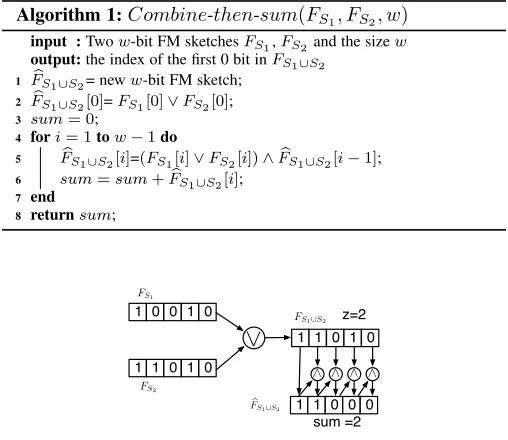
To solve this problem, we design a data oblivious algorithm to combine the sketches and extract the estimator. The algorithm is shown in Algorithm 1 and a small example is shown in Figure 1. Conceptually, the algorithm does 3 things: (1) it createsFS1∪S2
by bitwisely ORing FS1 andFS2; (2) it sets all bits in FS1∪S2
after the first 0 bit to 0; (3) it then adds up all bits. The sum equals the estimatorz.
Algorithm 1:Combine-then-sum(FS1, FS2, w)
input :Twow-bit FM sketchesFS1,FS2and the sizew
output:the index of the first 0 bit inFS1∪S2
1 FSb1∪S2= neww-bit FM sketch;
2 FSb1∪S2[0]=FS1[0]∨FS2[0];
3 sum= 0;
4 fori= 1tow−1do
5 FSb1∪S2[i]=(FS1[i]∨FS2[i])∧FSb1∪S2[i−1];
6 sum=sum+FSb 1∪S2[i];
7 end
8 returnsum;
1 0 0 1 0
1 1 0 1 0
1 1 0 1 0
1 1 0 0 0
FS1
FS2
∨
FS1∪S2
∧ ∧ ∧ ∧
z=2
sum =2 !
FS1∪S2
Fig. 1: Example ofCombine-then-sumalgorithm
The correctness of the algorithm is easy to prove. Let
FS1∪S2 = FS1 ∨FS2 andz be the estimator. If z > 0, then
by the definition ofz, for all0≤i < zwe haveFS1∪S2[i] = 1.
In Algorithm 1, FbS1∪S2[0]=FS1∪S2[0]=1 and for 1 ≤ i < z,
b
FS1∪S2[i]=(FS1[i]∨FS2[i])∧FbS1∪S2[i−1]=FS1∪S2[i]∧FbS1∪S2[i−1]. By
induction, for all 0 ≤ i < z, we have FbS
1∪S2[i]=1 as well.
Therefore, Pz−1 i=0FbS
1∪S2[i]=z. For i ≥ z, since FbS
1∪S2[z]=0, we
haveFbS1∪S2[z+1]=FS1∪S2[z+1]∧FbS1∪S2[z]=0, and similarly all the
bits after are 0. Then the sum of the whole FbS
1∪S2 is still z. If z= 0, then all bits inFbS
1∪S2 are 0 and the sum equalsz= 0.
It is also easy to verify that the algorithm is data oblivious: for any two input tuples (FS1, FS2, w) and (FS01, F
0
S2, w), the
memory access pattern and the control flow are exactly the same when executing the algorithm.
4.2.2 Efficient Protocol
The protocol is presented as Protocol 1. In the protocol,P1andP2 jointly computeFbS1∪S2 and share each bit in it, then they use the
homomorphic property to sum their shares locally to get a share ofPw−1i=0 FbS1∪S2[i], i.e.z. The key idea in the protocol design is
secret sharing, the result can be obtained but is kept secret at the end of the protocol.
Protocol 1Secure Estimator Computation Protocol
InputsThe private inputs ofP1andP2 are the FM sketchesFS1
andFS2respectively. Each sketch encodes the party’s private set.
The auxiliary inputs include the security parameterλ, the sketch sizewand a groupZqwhereq=m(w−1) + 1for some integer m.
OutputsLetz be the index of the first 0 bit in the union sketch
FS1∪S2 that will be used later to estimate the union cardinality
(see Section 4.1).P1 andP2obtainJzK1,JzK2∈Zqrespectively.
Each party’s output is a secret share ofzsuch thatJzK1+JzK2=z.
1) In round 0,P1 chooses a random number rh0i R
← Zq, then sets r0h0i = −rh0i and r1h0i = 1−rh0i. Then P1 and P2 run a
(12)-OT in whichP2 usesFS2[0]as the selection bit andP1 uses
(rh00i, r1h0i)as input ifFS1[0] = 0or(r
h0i 1 , r
h0i
1 )ifFS1[0] = 1.
2) Then in roundi(1≤i < w), the two parties do the following: a) P1 chooses a random numberrhii
R
← Zq, then setsr hii
0 =
−rhiiandrhii1 = 1−rhii. b) P1prepares 4 strings to send:
(rhii0 , r hii 0 , r
hii 0 , r
hii 1 ) ifr
hi−1i
0 is even∧FS1[i] = 0
(rhii0 , r hii 0 , r
hii 1 , r
hii 1 ) ifr
hi−1i
0 is even∧FS1[i] = 1
(rhii0 , r hii 1 , r
hii 0 , r
hii 0 ) ifr
hi−1i
0 is odd∧FS1[i] = 0
(rhii1 , r hii 1 , r
hii 0 , r
hii 0 ) ifr
hi−1i
0 is odd∧FS1[i] = 1
c) Letxhi−1ibe the string received byP2in roundi−1. Let bit b0 = 0ifxhi−1iis even andb0 = 1ifxhi−1iis odd, let bit b1=FS2[i].P2gets a 2-bit integerj=b0||b1.
d) P1 and P2 run a (14)-OT in which P1 uses the 4 strings
prepared in step 2b as input and P1 usesj obtained in step
2c as input. 3) P1 outputsJzK1 =
Pw−1
i=0 r hii
, P2 outputsJzK2 =
Pw−1
i=0 x hii
wherexhiiis the string (an integer) received in roundi.
In the following, we explain the protocol. Let’s start from step 1 which computesFbS1∪S2[0] =FS1[0]∨FS2[0], the first bit in
b
FS1∪S2. In this step,P1 generates the shares for 0 and 1 in a
correlated way. Observe thatrh0i+r0h0i= 0andrh0i+rh 0i 1 = 1, therefore(rh0i, rh0i
0 )is a pair of shares for bit 0 and(rh0i, r1h0i) is a pair of shares for bit 1. Although the shares are correlated, this does not affect security becauseP2can only get one ofrh0i0 ,
rh10ithrough OT. In any case,P1always keepsrh0iand the actual shared value then is determined by which shareP2receives. Now ifFS1[0] = 1then P1 knows the value FS1[0]∨FS2[0] = 1
regardless of whetherFS2[0]is 0 or 1. Thus in the OT,P1can use (rh10i, rh
0i
1 )as input so thatP2 always gets the share of bit 1. If
FS1[0] = 0then the value ofFS1[0]∨FS2[0]depends onFS2[0].
So in the OT,P1uses(rh00i, rh 0i
1 )as input so thatP2always gets the share of 0 ifFS2[0] = 0or the share of 1 ifFS2[0] = 1. Take
the example in Fig. 1:FS1[0] = 1 so in the protocolP1 sends (rh10i, rh10i)andP2always getsrh10ithat is the share of bit 1.
In step 2, the two parties compute FbS1∪S2[i] = (FS1[i]∨ FS2[i])∧FbS1∪S2[i−1]. At the end of each round in this step, P2 should receive a share xhii. If FbS1∪S2[i] = 0, P2 should
receive a share of bit 0, i.e. xhii = rhii
0 ; otherwise P2 should receive a share of bit 1, i.e.xhii=rh1ii. This step is much more difficult than ORing two bits becauseFbS1∪S2[i−1]is required in
the computation but may not be known by any party. Our insight is that we can solve this problem by utilizing the parity of the correlated shares. The two shares rhii0 , rhii1 always differ by 1,
therefore it is guaranteed that one of the shares is even and the other is odd. Thus the two parties can carry out the computation by matching parities of some shares which they can observe locally. In step 2b of the protocol,P1prepares strings to send by observing the parity of the share of bit 0 generated in the last round (rhi−1i0 ) and its current sketch bit FS1[i], and later P2 receives a string
by observing the parity of the share received in the last round (xh0i−1i) and its current sketch bitFSs[i]. Again take the example
in Fig. 1: for the second bit,FS1[1] = 0, thus ifr
h0i
0 is even,P1 will send (r0h1i, r0h1i, r0h1i, rh11i). Now since FS2[1] = 1andP2
receivedxh0i=r1h0iin the last round that must be odd (because
rh00iis even), thenj = (1||1)b = 3. So in this round P2 will receive the last stringrh11ithat is a share of bit 1. Ifrh
0i 0 is odd,
P1will send(r0h1i, rh 1i 1 , rh
1i 0 , rh
1i
0 ). Nowrh 0i
1 must be even, then
j = (0||1)b = 1. So in this roundP2 will receive the second stringr1h1ithat is a share of bit 1.
The parity of rh0i−1i, the parity of xhi−1i, the bit in FS1[i]
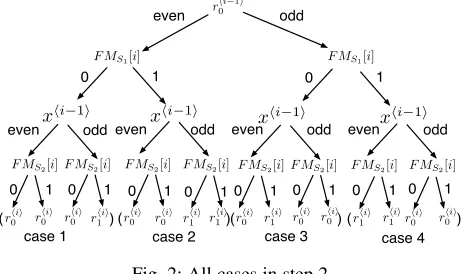
and the bit inFS2[i]each have two possible values, thus there are 24 = 16 combinations. The correctness of the protocol can be shown through Figure 2 that depicts the correspondence between each combination and the share received by P2 in round i. In each branch of the tree in the figure, if rh0i−1i andxhi−1i have the same parity then xhi−1i must equalrhi−1i
0 which is a share of bit 0, thusFbS1∪S2[i−1] = 0. OtherwiseFbS1∪S2[i−1] = 1.
b
FS1∪S2[i] = (FS1[i]∨FS2[i])∧FbS1∪S2[i−1]can be computed
along the branch and the leaf nodes is the share thatP2 receive. For example, in the leftmost branchrh0i−1i andxhi−1i have the same parity (even) soFbS1∪S2[i−1] = 0andFS1[i],FS2[i]both
are 0, soFbS1∪S2[i] = (0∨0)∧0 = 0. Corresponding to this
branch, in the protocol step 2bP1prepares four strings in case 1 becauser0hi−1iis even andFS1[i] = 0, andP2receives the first
of the four strings because xhi−1i is even and F
S2[i] = 0. The
string received byP2isrh0iiwhich is a share ofFbS1∪S2[i] = 0.
r!0i−1#
F MS1[i]
x!i−1#
F MS1[i]
x!i−1# x!i−1# x!i−1#
F MS2[i]F MS2[i]
r!0i" r! i"
0 r!1i" r!0i" r! i"
1 r!0i" r! i"
1 r!
i"
0 r!1i" r! i"
0
F MS2[i] F MS2[i] F MS2[i]F MS2[i] F MS2[i] F MS2[i]
even odd
0 1 0 1
even odd even odd even odd even odd
0 1 0 1 0 1 0 1 0 1 0 1 0 1 0 1
r!i"
0 r!
i"
0 r!0i" r!1i"
r!0i" r!1i"
( ) ( )( ) ( )
case 1 case 2 case 3 case 4
Fig. 2: All cases in step 2
In step 3,P1andP2locally sum the shares. Eachrhiiheld by
P1and eachxhiiheld byP2are the two shares ofFbS1∪S2[i]. By
the homomorphic property, the sumsPwi=0−1rhiiandPw−1 i=0 xhii are the shares ofz.
Our final remark is regarding the choice of q, which ism· (w−1) + 1. The reason is that in order to increase accuracy, we need to average estimators extracted frommsketches. The value ofzhiiis at mostw−1, then the sum ofmestimators is at most
4.2.3 Efficiency Comparison to the Generic Approach
It is possible to implement Algorithm 1 using generic techniques such as garbled circuits (GC). The cost of the GC protocol consists of two parts:
1) Transferring input wires: This requires w invocations of
(1
2)-OT, which can use the C-OT optimization in [37]. 2) Building, transferring and evaluating a garbled Boolean
cir-cuit: The circuit consists of w OR-gates, w−1 AND-gates and a circuit to compute the Hamming weight of a w-bit string. The most efficient Hamming weight circuit [45] requires
w −HW(w) AND-gates, where HW(w) is the Hamming weight of the binary representation of the integerw. In total, the number of non-free gates is3w−1−HW(w). However, the
wOR-gates can be evaluated at the wire transferring step using OT (similar to what we do in step 1 of Protocol 1), thus the number of non-free gates can be reduced to2w−1−HW(w). In comparison, our protocol (Protocol 1) requires1invocations of
(1
2)-OT and w−1 invocations of (14)-OT. We can use the C-OT optimization for the(1
2)-OT and the R-OT optimization (also from [37]) for the(1
4)-OT (See Appendix D for details).
Fig. 3: Efficiency comparison
Computational Cost: We estimate the computational cost by counting the number of cryptographic operations. Each(1
2)-OT requires 3 symmetric key operations when obtained from OT extension. The cost of each non-free gate is dependent on which optimization technique is used. At present, the most popular strategy for optimizing GC is to make the XOR gates free. To do so, one can use either the Free XOR [46] with point-and-permute [47] and garbled row reduction [48] technique (Free XOR for short) or the Half Gates technique [49]. Free XOR requires 4 symmetric key operations to garble and 1 symmetric key operations to evaluate a non-free gate, while Half Gates requires 4 and 2 symmetric key operations respectively.
The total number of symmetric key operations required by the GC protocol is then3w+ 5·(2w−1−HW(w)) = 13w−5−5·
HW(w)when using Free XOR or3w+ 6·(2w−1−HW(w)) = 15w−6−6·HW(w)when using Half Gates. The total number of symmetric key operations in our protocol is3·(2w−1) + 4· (w−1) = 10w−7. In practice, wis a small integer and the computational cost of our protocol is about 80% of that of the GC protocol if it uses Free XOR, or about 70% if it uses Half Gates. Fig. 3(a) plots the number of symmetric key operations in each protocol whenwvaries from 1 to 64.
Communication Cost:The total communication cost of the GC protocol again depends on the optimization technique. Using Free XOR, each non-free gate has 3 entries. Using Half Gates, each non-free gate has 2 entries. The size of each entry isλbits, where
λis the security parameter. The cost for transferring input wires is2λbits per wire (using C-OT) in both cases.
In total, the communication cost of the GC protocol is(2w− 1−HW(w))·3λ+w·2λ= 8wλ−3λ−3·HW(w)λbits if Free
XOR is used, or(2w−1−HW(w))·2λ+w·2λ= 6wλ−2λ− 2·HW(w)λbits if Half Gates is used. The total communication of our protocol isλ+ logqbits for the first(1
2)-OT(using C-OT), and(2w−2)·λ+ 4(w−1)·logqbits for the followingw−1
invocations of(1
4)-OT(using R-OT), whereq=m·(w−1) + 1. Roughly, for reasonableλ(128 or 256),w(1 to 64) andm(4,096 to 1,048,576), the communication cost of our protocols is about 35% of that of the GC protocol if it uses Free XOR, or 45% if it uses Half gate. Fig. 3(b) plots the communication cost in each protocol when fixingλ= 128, m= 65,536and varyingwfrom 1 to64.
4.3 Secure Cardinality Estimation
4.3.1 The Protocol
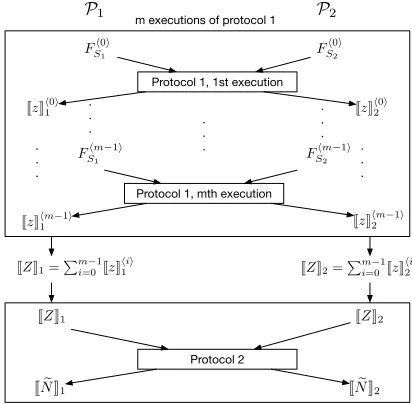
In Section 4.2.2, we showed how to compute the estimatorz of the union cardinality from a pair of FM sketches. As mentioned in Section 4.1, in order to increase accuracy, we need to compute
mestimators frommdifferent pairs of sketches. This requiresm
executions of Protocol 1. As illustrated in Fig. 4, in theith run,P1 andP2each obtains a share JzKhii1 ,JzKhii2 respectively. Then the two parties can locally sum the shares to getJZK1=Pmi=0−1JzKh
ii 1 andJZK2 = Pm−1i=0 JzKh
ii
2 , whereJZK1 andJZK2 are shares of
Z = Pm−1i=0 zhii. The two parties can then use Protocol 2 to compute Equation 1 and estimate the union cardinality.
P1 P2
Protocol 1, 1st execution
FS!01" F
!0"
S2
. . . .
. .
FS!m1−1# F
!m−1#
S2
Protocol 1, mth execution
!z"!10" !z"!
0" 2 .
. .
!z"!m−1#
1 !z"
!m−1# 2 .
. .
. . .
!Z"1=!mi=0−1!z"" i#
1 !Z"2=
!m−1 i=0!z""
i# 2
Protocol 2
!N"1! !N"2!
m executions of protocol 1
!Z"1 !Z"2
Fig. 4: Connection between Protocol 1 to Protocol 2
Our idea is to use a lookup table. A lookup table is a data structure that encodes a function with a small input domain to speed up computation. As we can see, in Equation 1, m, κ, φ
are all public constants. So the equation is a function with a single argumentZwhich is an integer fromZqwhereq=m·(w−1)+1. In practical cases,mneeds to be of the order of103
−104so the standard deviation ofZ is about10−2, andw is unlikely to be greater than 50. Thenm·(w−1)is of the order of104
−105 which is small enough for a lookup table. Our lookup table based protocol is presented below (Protocol 2).
Protocol 2Secure Cardinality Estimation Protocol
Inputs The private input of P1 is a secret shareJZK1 and the
private input ofP1is a secret shareJZK2such thatJZK1+JZK2= Z = Pm−1
i=0 z hii
, i.e. Z is the sum of m union cardinality estimators. The auxiliary inputs include the security parameterλ, the public parametersm, w, κ, φ, q=m(w−1) + 1, andZ2w. OutputsLetNebe the estimate to be computed,P1andP2obtain JNeK1,JNeK2 ∈ Z2w respectively. Each party’s output is a secret
share ofNeand satisfiesJNeK1+JNeK2=Ne.
1) P1computes a lookup tableTwhich is a vector that hasqentries.
P1first computes for0≤i≤q−1 T[i] =d2
i
m −2−κ·mi
φ c
P1then picks a singler R
←Z2wand for all0≤i≤q−1computes
T0[i]≡T[i]−r mod 2w.P1then circularly shiftsT0to the left JZK1places, i.e. letT
00
[i] =T0[j]wherej≡i+JZK1modq.
2) P1 andP2 run a(1q)-OT in whichP1usesT00as input,P2 uses JZK2as input and receivesT
00 [JZK2].
3) P1outputsJNeK1=randP2outputsJNeK2=T 00
[JZK2].
in Z2w because the way we choosew ensures that2w is larger
than any possible cardinality. ThenP1picks a singlerand creates correlated shares of all entries inT. Again, since later the protocol uses OT and P2 is guaranteed to receive only one share, this is secure. The next thing P1 does is to ensure thatP2can receive the correct entry T0[Z]. None of the parties knows Z but each holds a share. The combined effect of shifting and OT is that
P2 will receive T00[JZK2] = T0[JZK2 +JZK1] = T0[Z], and
T00[JZK
2] +r=T0[Z] +r=T[Z]. So each party indeed obtains a share of the estimated cardinality.
4.3.2 Efficiency Comparison to the Generic Approach
The computation of Equation 1 needs to be done in floating point numbers. More concretely, Equation 1 requires 2 divisions, 2 exponentiations and 1 subtraction operations in floating point numbers. In the past, secure floating point computation was both complex and inefficient [50], [51], [52]. Recently, it has been shown that optimized floating point circuits can be generated using hardware circuits synthesis tools [53] and the GC protocol using the optimized circuits can be quite efficient. We now compare the efficiency of Protocol 2 against that of the GC protocol.
Computational Cost: The sizes of the floating point operation circuits are dependent on the bit size of the floating point number. For 32-bit single precision floating point operations, the addition circuit has 1,820 gates, the division circuit has 5,395 AND-gates and the base 2 exponentiation gate has 9,740 AND-AND-gates. For 64-bit double precision floating point operations, the gate numbers are 4,303, 22,741 and 21,431 respectively. For building and evaluating a 32-bit circuit to compute the estimation, the total number of symmetric key operations is 160,450 if the circuit uses Free XOR, or 192,540 if it uses Half Gate. For building and evaluating a 64-bit circuit to compute the estimation, the total number of symmetric key operations is 463,235 if the circuit uses Free XOR, or 555,882 if it uses Half Gate. There will also be some other costs, e.g. converting the arithmetic shares from Protocol 1 to Boolean shares [20], and OT for transferring input wires. However the additional costs are small (a few hundreds symmetric key operations) and can be safely omitted. Our protocol requires one invocation of(1
q)-OT, in which the computation is dominated by theq symmetric key operations for masking the strings. The
numberqequals m·(w−1) + 1. Therefore depending on the value of the parametersmandw, one can decide whether to use Protocol 2 or the GC protocol. In Table 1, we show some concrete examples. In Table 1, each row corresponds to a fixed value form, and each cell in the row shows the largest value ofw, for which Protocol 2 is computationally more efficient than the GC protocol based on Free XOR or Half Gates. For example, ifm= 4096and single precision (32-bit) is enough, then we should use Protocol 2 wheneverw ≤40(or equivalently if the set cardinality will not exceed236); but ifm= 65536, we should use a GC protocol in almost all cases becausew≤3is too small to be useful.
m
GC 32-bit 64-bit
Free XOR Half Gates Free XOR Half Gates
4096 40 48 114 136
16384 10 12 29 34
65536 3 3 8 9
TABLE 1: Each cell contains the largest value of w for which Protocol 2 is computationally more efficient than the GC protocol with Free XOR or with Half Gates.
Communication Cost:For the GC protocol that uses a circuit ofc
gates, the communication cost isc·3λbits if Free XOR is used, or
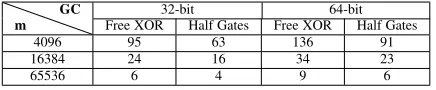
c·2λbits if Half Gates is used. For Protocol 2, the communication cost is dominated by transferring theqmasked strings, which is in totalq·`where`is the bit-size of the floating point numbers. Then which one is more efficient depends on the parameters and the optimization technique. Again we worked out the largest value ofwfor which Protocol 2 is more efficient than the GC protocol with Free XOR and the GC protocol with Half Gates (see Table 2).
m
GC 32-bit 64-bit
Free XOR Half Gates Free XOR Half Gates
4096 95 63 136 91
16384 24 16 34 23
65536 6 4 9 6
TABLE 2: Each cell contains the largest value of w for which Protocol 2 is more efficient than the GC protocol with Free XOR or with Half Gates, in terms of communication cost.
4.4 Fixed-key Masking
The efficiency of Protocol 2 depends on the underlying(1 n)-OT (n = q in our protocol). As we have already shown in Section 3.2, the cost of(1
n)-OT consists of two parts:log(n)invocations of(1
2)-OT andnlog(n)pseudorandom function invocations for masking the sender’s strings. In the past when (1
2)-OT had to be based on public key operations, the first part dominated the cost. But now we can obtain(1
2)-OT through OT extension, then the second part becomes dominating. A more efficient masking scheme then implies more efficient(1
n)-OT.
In this section, we present an efficient fixed-key masking scheme. Our design is in line with the fixed-key garbling schemes that have led to a significant improvement in the computation of garbled circuits [22]. In the new masking scheme, the cost of masking in(1
for the cipher and is public. We will model Eck(·) as a random permutationπ andDck(·)as the inverse permutationπ−1 [55]. The masking scheme has four algorithms:
• Gen(n, λ): given n the algorithm uniformly generates a l× 2 key matrix K where l = dlog(n)e and each cell Ki,j is a uniformly random λ-bit key. Without loss of generality, we assume the block size of the cipher is alsoλbits.
• Key(K, i): given the key matrix K and an integer 0 ≤ i ≤ n−1, return theith masking key. Let the binary representation of i be b0b1, ..., bl−1, the masking key mk = Llj=0−1Kj,bj,
wherebj is thejth bit ofi.
• Mask(K, P): Mask ann-vectorPsuch that each element inP
is a bit string ofλ-bit. For each elementP[i], computemki= Key(K, i). The masked elementPe[i] =π(mki)⊕mki⊕P[i]
• Unmask(P , ie ): given the masked vector Pe and an index i,
unmaskP[i]=P[i]⊕π(mke i)⊕mki
This masking scheme is to be used with(1
n)-OT. The sender runsGen,Key,Maskto mask thenstrings that will be sent to the receiver. The receiver will use its selection number I to receive
log(n)keys inlog(n) (1
2)-OT. The keys will allow the receiver to reconstruct mkI but not the other masking keys. With mkI, the receiver can unmask the sender’sIth stringP[I]. The formal security definition and proof can be found in Appendix C. At a high level, the masking scheme is secure if an adversary who knows thelog(n)keys corresponding toIandPecan learnP[I]
but nothing about all otherP[j], j6=I, even if the adversary has oracle access toπandπ−1.
A remark on (1
n)-OT extension In our paper, we implement
(1
n)-OTby invoking(12)-OTextensionlog(n)times and masking the n strings to be sent. Alternatively, one can use (1
n)-OT extension with the masking scheme to implement(1
n)-OT. In [38], a(1
n)-OT extension protocol was presented such that the log(n)invocations of(1
2)-OT extension can be replaced by one invocation to the(1
n)-OTextension (the masking part remains the same). This protocol works whenn≤2·λ, whereλis the se-curity parameter. The cost of one invocation of(1
n)-OT extension is about the same as 2 invocations of(1
2)-OTextension. In [56], a new protocol for(1
n)-OTextension based on pseudorandom code was presented. The new protocol works for arbitraryn. The cost of one invocation is about the same as the cost of 4 invocations of
(1
2)-OT extension.
We present some analysis regarding whether (1
n)-OT exten-sion could improve the efficiency of our protocols:
• The(1
n)-OTextension protocol requires an additional2λ([38]) or3λto4λ([56]) base OTs to setup. Since we use OT extension already, these base OTs can obtained through OT extension. • In Protocol 1, we need(1
4)-OT. If we use [38], the cost of 1 invocation is the same as 2 invocations of (1
2)-OT extension. If we use [56], the cost of 1 invocation is actually higher. Thus, using(1
n)-OT extension will not improve the efficiency of Protocol 1.
• In Protocol 2, we need(1
q)-OT. The parameter qis too large for [38]. We can use [56] in this case. If so, we will use 1 invocation of the (1
n)-OT extension instead of log(q) invoca-tions of(12)-OT extension. However, since Protocol 2 is only invoked once in the PSU-CA protocol, this improvement will be offset by the increased number of base OT. Recall that q
equals m·(w−1) and in most practical cases, q is of the order of104−105. Thereforelog(q)is usually no more than 20. In comparison, when λ = 128, the(1
n)-OT extension in
[56] requires at least 384 more invocations of base OT (that can be obtained using the same(1
2)-OTextension). Thus, using
(1
n)-OTextension will not improve the efficiency of Protocol 2.
4.5 PSU-CA and PSI-CA Protocols
We now present the PSU-CA and PSI-CA protocols. As we men-tioned earlier, the PSI-CA protocol can be obtained from the PSU-CA protocol. The PSU-PSU-CA protocol is presented in Protocol 3 and the security analysis of the protocol can be found in Appendix B. Building sketches does not involve cryptographic operations and can be done offline, as this does not require interacting with the other party. Thus we assume the parties have pre-computed the sketches before running the protocol and they use the sketches as the input to the protocol.
Protocol 3PSU-CA Protocol
InputsThe private inputs ofP1 andP2 are themFM sketches FSh01i, ..., FShm−1 1iandFSh02i, ..., FShm−2 1irespectively. Each pair of sketches(FShii1, FShii2)encodes the private sets of the parties, using the same hash functionhi. The auxiliary inputs include the security
parameter λ, the sketch sizew = log(N) + 4 whereN is the max possible cardinality of the private sets, the parametermthat controls accuracy, and constantsκ, φ.
Outputs P1 and P2 obtain JNeK1,JNeK2∈Z2w respectively. Each
party’s output is a secret share ofNe and satisfiesJNeK1+JNeK2=Ne,
whereNeis the estimated union cardinality.
1) P1andP2run Protocol 1 exactlymtimes. In theith run, they use
(FShii1, FShii2)and obtainJzKhii1 ,JzK hii
2 respectively.
2) P1 and P2 compute locallyJZK1 = Pm−i=01JzKhii1 and JZK2 =
Pm−1
i=0 JzK hii 2 .
3) P1andP2run Protocol 2 withJZK1andJZK2as input and obtain JNeK1andJNeK2respectively.
4) P1outputsJNeK1,P2outputsJNeK2.
For the PSI-CA protocol, the only difference is that in the last step P1 outputs JIeK1 = |S1| −JNeK1, P2 outputs JIeK2 =
|S2| −JNeK2. In this step each party converts its own share of the union cardinality to a share of the intersection cardinality using the cardinality of its own set. This step is done locally and the parties do not need to know the cardinality of the other party’s set. The output ofP1andP2in PSI-CA adds up to|S1| −JNeK1+|S2| −
JNeK2=|S1|+|S2| −Ne ≈ |S1|+|S2| − |S1∪S2|=|S1∩S2|. Complexity: In both the PSU-CA and PSI-CA protocols, the parties first run m times of Protocol 1, whose cost is 2w−1
invocations of (1
2)-OT. Then the parties run Protocol 2 whose cost is one(1q)-OT andq=m·(w−1) + 1. The parametermis a constant once the desirable error bound is fixed. The parameter
w= log(N) + 4whereN is the maximum possible cardinality of the private sets. So the computational and communication complexities are bothO(log(N)). Note thatN is the maximum possible cardinality instead of the actual cardinalities of the private sets. This is because the parties do not and should not know the cardinality of the other party’s private set. They can set a large enoughwso that the sketches can encode any set that is smaller than 2w−4. For example, to encode any sets with size up to 1 million, we setw= 24.
Relative Error of PSI-CA: In the PSI-CA protocol we obtain the intersection cardinality from the estimated union cardinality. The relative error then is in terms of the union cardinality|Ne−|S1∪S2||
|S1∩S2| .
condition often holds and intersection cardinality can be estimated fairly well based on the inclusion-exclusion principle [57], [58].
5
M
ULTIPARTYP
ROTOCOLSSince Protocol 1 and Protocol 2 require OT, they cannot be directly migrated to the multiparty setting. However, the protocols can be re-implemented with standard secret sharing-based multiparty secure computation schemes e.g. [59], [60], [61]. Computing the estimator requires bitwise OR and AND protocols, and an integer addition protocol. Those are standard building blocks that are readily available in all schemes mentioned above. We use a lookup table in estimating union cardinality, and secure lookup tables are also available [62]. Then the PSU-CA protocol can be easily built after the two building blocks are built. Note here our intention is to show feasibility. More efficient protocols are possible but we do not intend to do any optimization now and leave this for future investigation. Working with standard secure computation building blocks implies that the protocol is secure (by the composition theorem [63]), thus the security proof for the multiparty protocols is omitted.
However, migrating the PSI-CA protocol to multiparty setting is not easy. This is because computing the intersection cardi-nality of τ sets using the inclusion exclusion principle requires exponential time in τ. For example, in the three-parties setting,
|S1∩S2∩S3|=|S1∪S2∪S3|−|S1|−|S2|−|S3|+|S1∩S2|+
|S1∩S3|+|S2∩S3|. Therefore in the multiparty setting we do not use the inclusion and exclusion principle. Instead we use Min-Max sketches [26] to compute the intersection cardinality from shared union cardinality. This reduces the complexity to linear inτ. In the following, we introduce Min-Max sketches and then present the protocol.
5.1 Min-Max Sketches
A Min-Max sketch [26] is a summary of a set that can be used for estimating Jaccard index of sets. In this paper, we use it to obtain the cardinality of the intersection of multiple sets.
A Min-Max sketch consists of 2 vectors ofkhash values. Let
Sbe a set andh0, . . . , hk−1bekindependent collision resistant hash functions that map inputs uniformly to l bit integers. We definehmin
i (S)as the element inSthat has the lowest hash value, i.e.hmin
i (S) =xsuch thatx∈Sand∀y∈S∧y6=x, hi(x)<
hi(y). Similarly, we definehmaxi (S)as the element inSthat has the highest hash value. A k-Min-Max sketch of S (denoted by
MS) consists of two vectors:MSmin = (hmin0 (S), ..., hmink−1(S)) andMmax
S = (hmax0 (S), ..., hmaxk−1(S)).
For two sets S1 and S2, the Jaccard index is defined as
J = |S1∩S2|
|S1∪S2|. Given two k-Min-Max sketches MS1 and MS2
built with the same set of k hash functions, it is clear that
P r[hmin
i (S1) =hmini (S2)] =J sincehmini (S1) =hmini (S2) only happens when the element is in the intersection and the probability that this element is the minimal is |S 1
1∪S2|. Similarly, P r[hmax
i (S1) = hmaxi (S2)] = J follows the same line of reasoning
Thus we have an unbiased estimator ofJ:
e J= 1
2k k−1 X
i=0
(eq(MSmin1 [i], M
min
S2 [i]) +eq(M
max S1 [i], M
max
S2 [i])) (3)
whereeqis the equality function such thateq(x, y) = 1ifx= y andeq(x, y) = 0 otherwise. The standard deviation of Jeis
q
J 2k ·
|S1∪S2|+|S1∩S2|−2
|S1∪S2|−1 −
J2
k ≤
q
J(1−J)
2k ≤
q
1 8k.
This can be generalized toτ sets case where thegeneralized
Jaccard index is defined as Jτ = |
Tτ i=1Si|
|Sτ
i=1Si|. Now Jeτ with τ
sketchesMS1, . . . , MSτ is defined similarly as:
e Jτ =
Pk
i=0(eq(MSmin1 [i], . . . , M min
Sτ [i]) +eq(MSmax1 [i], . . . , M max Sτ [i]))
2k (4)
where eq now is the equality function over multiple values such that eq(x1, . . . , xτ) = 1 if x1 = . . . = xτ and
eq(x1, . . . , xτ) = 0 otherwise. The accuracy of the estimation using Min-Max sketches can be adjusted by changing k. More specifically:
Theorem 2. Let S1. . . , Sτ be sets and Jτ be the generalized Jaccard index. Let Jeτ be the estimate obtained from computed
using Equation (4). For any, δ∈(0,1), it holds that:
P r[|Jeτ−Jτ| Jτ ≤
]≥1−δ (5)
whenk≥(erf−12(12J−2δ))2
τ whereerf
−1is the inverse error function.
The proof of Theorem 2 is similar to that of Theorem 1 and is omitted. As we can see, the threshold forkdepends onJτ. For example, if we fixδ = 0.001, then when = 0.04,kshould be at least 364J2
τ ; when= 0.01,kshould be at least
5817 J2
τ .
5.2 Multiparty PSI-CA Protocol
Given the generalized Jaccard index (GJI) over τ sets and the union cardinality of theτ sets, we can compute the intersection cardinality|Tτi=1Si|=Jτ·|Sτi=1Si|. We can estimate the union cardinality using FM sketches, then what is left is to estimate the GJI over the sets. To estimate GJI and then compute the intersection cardinality, we only need secure equality test, integer multiplication and floating point division protocols, which are also basic building blocks in secret sharing-based multiparty schemes (e.g. [64], [65]). We can just use them as black boxes. The protocol is shown in Protocol 4.
Protocol 4Multiparty PSI-CA Protocol
Inputs The private inputs of P1, ...,Pτ are the Min-Max
sketchesMS1, ..., MSτ and shares of estimated union cardinality
JNeK1,...,JNeKτ respectively. The sketches are generated using the
same set of hash function h0, ..., hk−1. The auxiliary inputs
include the security parameterλ, the sketch sizek.
Outputs P1, ...,Pτ obtain the shares JIeK1,...,JIeKτ respectively,
whereIeis the estimated intersection cardinality, i.e.JIeK1+···+JIeKτ=
e
I=Je·Nf
2k .
1) For 0 ≤ i ≤ k − 1, P1, ...,Pτ run the
equal-ity test protocol to compute eq(Mmin
S1 [i], . . . , M
min Sτ [i]) and
eq(Mmax
S1 [i], . . . , M
max
Sτ [i]). The two equality test results are
output as shares to each party and the party can sum the shares locally. At the end of each iteration, each party holds a share
Jt hii
K1, ...,Jt hii
Kτ of the result ofeq(M min
S1 [i], . . . , M
min Sτ [i]) +
eq(MSmax1 [i], . . . , M
max Sτ [i]).
2) For eachPj, the party computes the sum of shares locallyJuKj=
Pk−1 i=0Jt
hii
Kj. EachJuKjis a share of u=
k−1 X
i=0
(eq(Mmin
S1 [i], . . . , M
min
Sτ [i]) +eq(M
max
S1 [i], . . . , M
max Sτ [i]))
3) P1, ...,Pτ run the multiplication protocol and the floating point
division protocol to compute eI =
u·Ne
Note if the cardinality is the final output, then in the last step the multiparty division can be omitted. The parties can compute just u·Ne using their shares and output the result. Then each party can locally compute u·Ne
2k sincekis public. This makes the protocol more efficient.
6
P
ERFORMANCEE
VALUATIONIn this section, we show performance figures for our two-party protocol. We implemented the two-party protocol. We did not implement the multiparty protocols because the performance relies largely on the implementation of the underlying secret sharing-based multiparty secure computation framework. Our prototype is written in C and uses TCP sockets for communication between two distributed parties. We used OpenSSL for the underlying crypto-graphic operations. We implemented the OT extension protocol in [36] with the C-OT and R-OT optimizations from [37]. The base OT protocol is the Naor-Pinkas OT [34]. In all experiments, we set the security parameter to 128 and chose key size and cryptographic functions accordingly as recommended by NIST [66]. This should provide adequate security for most applications in median and long term (2031 and beyond) [66]. All experiments were run on two commodity computers: party 1 ran on a Ubuntu PC with an Intel Core i7 3.4 GHz CPU (i7-3770) and 8 GB RAM, party 2 ran on a Macbook pro (2011) with an Intel Core i7 2.2 GHz CPU (i7-2720QM) and 16 GB RAM. Switching computers for the parties did not cause significant difference in performance. The two computers are connected by switched 1 Gbit Ethernet. Our prototype is single-threaded, although the computation is fairly easy to parallelize.
We first show the accuracy of the estimates obtained from FM sketches. The sketches were built using Murmurhash 3 that has been widely used in large systems like Hadoop and Cassandra. Our initial tests showed that the difference in accuracy using sketches built from Murmurhash and SHA-1 is negligible and Murmurhash is much faster (3.3 ns per hash) than SHA-1 (170 ns per hash). We tested with sets of random 64-bit integers whose union cardinality ranges from 10 to106(1 million). For each union size, we tested with differentm= 4096,16384, and65536to guarantee that the relative error does not exceed= 4%,2%and1%respectively with a probability at least 1 −δ = 0.999 4. All experiments
were repeated 100 times. Figure 5 shows the mean and the ranges of the estimation errors measured from our experiments5. The accuracy is good for both small and large sets. In all cases the mean of estimation error is less than 0.3% and falls within the desired range (±4%,±2%, and±1%). For extremely small sets (union cardinality = 10), we observed no errors. This shows that the formula with correction (Equation 1) is very effective.
Then we show the pre-computation performance, i.e. the time for generating the FM sketches. The result is shown in Table 1. In the experiment, we set w = 24 and used random sets with different cardinalities from10to106. For each set, we measured the time for generatingm = 4096,16384 and 65536 sketches from it. Note that sketch generation does not require cryptographic operations. Thus the sketches can be generated once and reused many times. This is often not possible in protocols that take sets
4. Themvalues are slightly larger than the required values for the(, δ) pairs calculated from the formula in Theorem 1. We rounded them to the nearest powers of 2 for the ease of implementation.
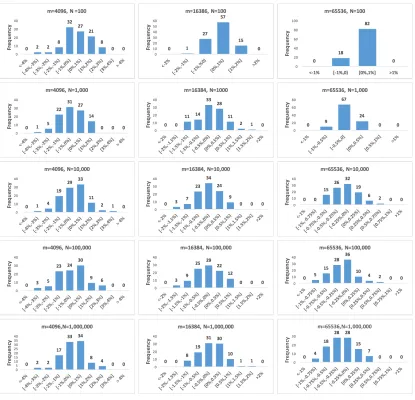
5. Appendix E includes histograms showing more detailed error distribu-tions.
Fig. 5: Mean and range for estimation error N−Ne
N . For m =
4096,16384,65536, the estimation error is in [-4%,4%], [-2%, 2%], [-1%,1%] with probability 0.999.
Card. m
4096 16384 65536
10 1.53×10⁻⁴ 6.42
×10−4 2.61
×10−3
102 1.40
×10−3 6.01
×10−4 2.32
×10−2
103 1.37×10⁻² 5.62×10⁻² 2.25×10⁻¹
104 1.32
×10−1 5.58
×10−1 2.21
105 1.26 5.50 2.19×101
106 1.25
×101 5.45
×101 2.19
×102
TABLE 1:Performance: FM sketches generation (in seconds).
as input. Although parties may be able to encrypt the sets before engaging in such protocols, the encrypted sets cannot be re-used because fresh randomness is needed to keep the protocol secure. Our pre-computation is also different from offline computation in some protocols that generate data independent values, which will be consumed in protocol execution and need to be regenerated for each protocol execution. We consider pre-computation as a one-off cost and do not include it in the protocol running time that will be shown later.
Next, we compare the performance of our protocol to existing protocols. The result is shown in Table 2. All numbers in the table are obtained by averaging 100 executions, except for the test of the exact protocol with 106-element private sets which was too slow (an execution took about 1 hour). The protocols we compared to are the two-party exact PSI-CA protocol in [11] and the two-party approximate PSU-CA protocol in [15], the state-of-the-art in each kind. We implemented these two protocols in C and use OpenSSL for the cryptographic operations. For the ease of implementation, we did not implement socket communication for these two protocols. Instead, we simply ran both parties on the Linux PC and let the two parties communicate through shared memory. This clearly favors [11] and [15] in terms of running time. In the experiment, both parties’ private sets have the same cardinality. The running time of the approximate protocol in [15] does not include the time for building Bloom filters (as they can be pre-computed). Adding this time, as well as the times from Table 1 for our protocol, does not change the results qualitatively (our protocol is still faster). In the experiment, we use random sets with cardinality ranging from 10 to106. For our protocol we set
w = dlog(N)e+ 4, so that the sketches are large enough for the cardinalityN, e.g.w= 24forN = 106. As we can see in Table 2, for small sets (cardinality in the order of102 or less), the exact protocol in [11] is a better choice. But for larger sets (cardinality≥103) which are commonly encountered in PPDM, the approximate protocols are better and the difference becomes larger when the sets get larger. We tested withm= 4096,16384
and65536so that the relative error bounds are= 1%,2%and
![Fig. 5: Mean and range for estimation errorN− N�N. For m =4096, 16384, 65536, the estimation error is in [-4%,4%], [-2%,2%], [-1%,1%] with probability 0.999.](https://thumb-us.123doks.com/thumbv2/123dok_us/7980919.1323761/11.612.314.564.44.135/fig-mean-range-estimation-errorn-estimation-error-probability.webp)