c e-ISSN: 2348-6848, p- ISSN: 2348-795X Volume 3, Issue 05, March 2016
International Journal of Research (IJR)
Available at http://internationaljournalofresearch.org
Removal of Reactive Orange 13 (RO13) onto Rice Husk in
Aqueous Solution
Subir Chowdhury & Tapan Kumar Saha
Jhangirnagar University, Department of Chemistry Savar, Dhaka-1342 EMAIL: [email protected]
Abstract
The present study shows that rice husk which is easy to get can be used as a low-cost adsorbent. Rice husk can remove harmful ReativeOrange13 (RO13) from aqueous solution. In dyeing industries RO13 is used in a large quantity and when those industries dispose the untreated effluent to the open water it creates serious water pollution. Rice husk can remove the dye staff from the aqueous solution and may help to keep water comparatively clean and safe. This study helps to know that rice husk as natural adsorbent can remove dyes by adsorption process and the process was endothermic in nature. Adsorption process was spontaneous too. Experimental data shows the nature of adsorption was physical in type and feasible.
Key Words: Adsorption; Adsorbent; Reactive
Orange 13; Removal; Spontaneous;
1 Introduction
Chemical pollution of waste water via a huge range of pollutants is an important environmental problem now-a-days. Huge amount of synthetic dye are now using in textile industry [1]. The textile wastewaters possess high color and other
substances [2]. Without proper treatment,
discharge of dye wastewaters into water bodies affect aquatic environment by reducing light penetration and photosynthesis, and being hazardous and toxic to aquatic life [3,4]. This contaminated water also harmful to human because of its carcinogenic nature [5]. There are many traditional methods for removing dyes include removal, electrocoagulation, ozonation,
ultrafiltration, reverse osmosis, flocculation, oxidation, ion-exchange, etc. [6]. Adsorption has been found to be satisfactorily efficient for the removal of colour in terms of ease of operation, initial cost, simplicity of design [7] and sludge free process [8]. Many research groups applied this removal method for removal of different pollutants [9-18]. Activated carbon is commonly used adsorbent for colour removal, because of its capability for efficiently adsorbing a wide range of different types of adsorbate. But activated carbon is expensive. Many low-cost adsorbents have been investigated on dye removal, such as fly ash [19-21] bottom ash , clay, zeolite, calcine alunite [22] etc .
In this study untreated rice husk was used as a low-cost adsorbent to adsorb a dye from aqueous solution. The influence of pHs, solution temperature, concentration effect, ionic strength effect, desorption and reuse were studied in batch mode. Various models were tested to investigate the removal kinetics and equilibrium removal behavior.
2 Experimental
2.1 Materials
c e-ISSN: 2348-6848, p- ISSN: 2348-795X Volume 3, Issue 05, March 2016
International Journal of Research (IJR)
Available at http://internationaljournalofresearch.org
Figure: 1 Chemical Structure of RO13
All other reagents and solvents were
commercially available and highest grade of purity; hence they were used without purification. Deionized water was prepared by passing distilled water through a deionizing column (Branstead, Syboron Corporation, boston. USA).
2.2 FTIR Spectra
The Fourier transformation infrared (FTIR) spectra of Reactive orange13 (RO13) and rice husk before and after removal of amaranth (RO13) were recorded in the frequency range 400-4000cm-1 using FTIR spectrometer (IR
Prestige-21 FTIR Spectrophotometer,
Simadzu, Japan).
2.3 Batch removal experiments
Batch removal experiments were carried out to determine the extent of removal at various pH, concentrations, ionic strengths and temperatures.
3 Results and discussion
3.1 Point of zero charge measurements
Point zero charge of rice husk was found to be 5.85.
3.2 FTIR Analysis
The FTIR spectrum (Figure is not shown)
displays peak at 3440.1 cm-1 for the
intramolecular hydrogen bonding aromatic –OH and –O-H stretching, peak at 1622.7 cm-1 and
1555.4 cm-1 for –C=C stretching of aromatic rings, 1466.5 cm-1 and 1394.6 cm-1 –C-H stretching of alkyl acetals, peak at 1329.8 cm-1 and 1187.5 cm-1 for –C-N stretching due to amines, peak at 845.2 cm-1, 799.9 cm-1, 763.3 cm-1 for –C-H stretching, 617.8 cm-1 –C-Cl stretching.
The FTIR spectra of Rice husk (before removal) (Figure is not shown) peaks at 3414.67 cm-1 for surface –OH stretching, peak at 2923.37 cm-1 for aliphatic C-H stretching, peak at 2852.62 cm-1 for aldehyde C-H stretching, peak at 1653.98 cm-1 for unsaturated group like alkene, peak at
1560.17 cm-1 for aromatic C-NO2 cm-1
stretching, peak at 1077.57 cm-1 for Si-O stretching [23].
The FTIR spectra of Rice husk (after removal) (Figure is not shown) the peaks at 3414.67 cm-1 for surface –OH stretching shifted to 3422.55cm
-1
, peak at 2923.11 cm-1 for aliphatic C-H stretching, peak at 2852.66 cm-1 for aldehyde
C-H stretching, peak at 1653.33 cm-1 for
unsaturated group like alkene, peak at 1560.38 cm-1 for aromatic C-NO2 cm-1 stretching, peak at
1077.57 cm-1 for Si-O stretching shifted to 1050.77cm-1, sharp peak at 1253.62 cm-1, 1185.99 cm-1 and 1140.66 cm-1 in reactive orange 13 (RO13) for S=O stretching is absent in the FTIR spectra of rice husk after removal.
FTIR analysis suggested that there is some sort of interaction among OH and Si-Ogroups of rice husk and -SO
3H groups of dyes.
3.3 Effect of pH on the removal process
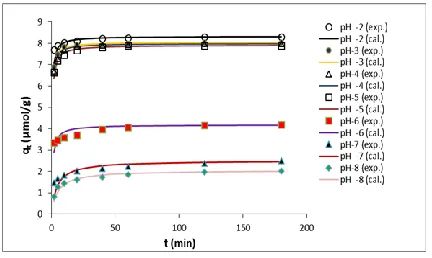
The pH is an important parameter for removal studies that affects not only the removal capacity but also the color and solubility of the adsorbate solutions. The effect of pH on the removal of RO-13 by rice husk was studied in aqueous solution within pH range 2-8 as shown in Fig: 2. The rate of uptake of RO-13 on rice husk indicated that about 120 min was taken to N
N
N
N N
N Cl
NH2
CH3 NaO3S
SO3Na
c e-ISSN: 2348-6848, p- ISSN: 2348-795X Volume 3, Issue 05, March 2016
International Journal of Research (IJR)
Available at http://internationaljournalofresearch.org
reach the equilibrium time for all pHs. However the data was taken for 180 min. to make sure that full equilibrium was established. Before the equilibrium time, it was observed that the initial rate of removal (h) of RO-13 increases significantly with decreasing solution pH. Lower initial rate of removal observed at basic pH values is due to competition between the excess hydroxyl ions and the negatively charged RO-13 ions for the sorption sites.
Figure: 2 Effect of pH on dye removal
Hence the pH of aqueous solution plays on important role on the initial rate of RO-13 removal onto rice husk powder. We know removal of cations is favored at pH > pHPZC , while the removal of anions is favored at pH < pHPZC . After 180 min. of removal, the equilibrium sorption capacity (qe) was found to be 8.31 – 2.02 μmol/g at pH 2-8. These results suggest that the initial rate of removal (h) as well as the equilibrium removal capacity of rice husk is suitable at pH- 2 among the observed pH ranging from 2-8 and the initial concentration of RO-13 solution was 34.22µmol/. Similar result observed in the case of adsorption of reactive red 198 onto ZnCl2 activated pistachio hull waste [24]. The percentage of removal was illustrated in Table -1 which indicated the percentage of removal decreased with the increase in pH.
3.4 Effect of initial dye concentration on the removal process
The initial concentration provides an
important driving force to overcome all mass transfer resistances of all molecules between
the aqueous and solid phases [25].
Concentration effect was evaluated by taking
different initial dye concentrations (91.44-1500µmol/L) at pH-2 of the dye solution and a constant system at temperature 30°C. It was observed that increase in the initial dye concentration leads to an increase in the removal capacity of the dye onto rice husk. It
was found that as the initial dye
concentration was increased relative to a fixed sorbent dosage, the extent of removal increased (Figure is not shown) as the initial dye concentration was increased, the amount absorbed (qt) increased for RO-13. Similar phenomenon were also observed in the removal of reactive black 5 (RB5) onto chitosan in aqueous solution.
This result suggests that the rate of removal for lower initial dye concentration was faster than that of higher one. The removal capacity (qe,exp) increases with increasing the initial dye concentration. The rapid uptake of dye particles at the beginning is due to the occurrence of solute transfer only due to sorbate and sorbent interactions with negligible interference due to solute–solute interactions. The percentage of removal was illustrated in Table: 1 which indicated the percentage of removal decreased with the increase in concentration of dye solution.
3.5 Effect of ionic strength on dye removal
c e-ISSN: 2348-6848, p- ISSN: 2348-795X Volume 3, Issue 05, March 2016
International Journal of Research (IJR)
Available at http://internationaljournalofresearch.org
The result indicated that the higher the KCl concentration is, the lower the removal capacity (Figure is not shown) (Table:1) since the addition of KCl reduces the electrostatic interaction between rice husk and dye. The addition of salts allows the neutralization of the negative sites of dye molecules which help to lower the attraction force between surface of rice husk and dye molecule results decrease the removal.
3.6 Effect of temperature on the removal process
Temperature is an important parameter that can influence the equilibrium and rates of sorption processes. The effects of temperature on the removal kinetics of RO13 onto rice husk were observed in aqueous solution at pH 2 and initial concentration of dye solution was 35.11µmol/L. The results are shown in Fig: 7. which indicates the removal increased with increasing solution temperatures. Adsorption onto Rice husk increased from 8.31 to 8.36 µmole/g by increasing the temperature of the solution from 303 to 318K, indicating that the process is endothermic. Similar endothermic nature observed in the case of adsorption of acid red 37 onto the modified laccase-modified red mud [26]. This may be attributed to increased mobility of the reactive dye molecules at higher temperature. This may be due to the fact that increasing the temperature may produce a swelling effect within the initial structure of rice husk. Dye removal increased with temperature (Table: 1).
Table: 1 % of removal of reactive orange 13 (RO13) by 0.1g rice husk at various pH, concentrations of RO13 aqueous solution
At various pH, Initial concentration of RO13 solution 34.22 µmol/L
pH % of removal of Dye
2 97.40
3 94.16
4 93.51
5 92.53
6 49.03
7 29.22
8 23.70
At various concentrations (µmol/L)
Concentration µmol/L % of removal of Dye
91.44 97.33
388.89 68.57
666.67 65.00
1044.44 52.13
1500.00 36.30
Table-1 % of removal of reactive orange 13 (RO13) by 0.1g rice husk at various ionic strength and temperature of RO13 aqueous solution
At various ionic strength (M), Initial concentration of RO13 solution 62.33 µmol/L
M % of removal of Dye
0.01 97.33
0.05 96.61
0.10 96.43
0.15 96.08
0.20 95.72
At various temperature (°C), Initial concentration of RO13 solution 34.11 µmol/L
Temp. (°C) % of removal of Dye
30 97.39
35 97.72
40 98.05
c e-ISSN: 2348-6848, p- ISSN: 2348-795X Volume 3, Issue 05, March 2016
International Journal of Research (IJR)
Available at http://internationaljournalofresearch.org
3.7 Rate Constant Studies
To study the rate constant The pseudo-first-order,
Pseudo-Second-Order Kinetic and Elovich
Kinetic Models were used. The removal rate constant k1 was determined from the slope of the plot of log(qe-qt) vs t. The values of k2 and qe was determined from the intercept and slope of the plot of t/qt versus t respectively (Figures are not shown). The Elovich coefficients can be calculated from the plot of qtvs lnt. It is found that the experimental data fitted well to the second-order kinetics than that for the pseudo-first-order and Elovich kinetics model. Similar type of kinetic was shown in the adsorption of acid red 27 on TiO2-P25 nanoparticles [27].
3.8 Adsorption mechanism
To determine the rate limiting intraparticle diffusion and film diffusion models were used. It was found that none of the linear plots at any concentration pass through the origin which means both intraparticle diffusion and film diffusion may involve in the rate limiting steps of the removal onto rice husk. The above conclusion suggests that all three mechanisms: intrinsic surface reaction, film mass transfer and intraparticle diffusion are rate-limiting steps.
3.9 Activation Parameters of the removal process
The activation energy (Ea) for the sorption
RO-13 dye on rice husk can be estimated by using Arhenius equation.
When lnk2 is plotted versus 1/T (Figure is not
shown), a straight line with slope (-Ea/R is obtained). The values of Ea is presented in
Table: 2.
Low activation energies (5–40 kJ/mole) are characteristics for physisorption, while higher
activation energies (40–800 kJ/mole) suggest
chemisorption .The values of Ea from the
slopes of the plots are 18.50 kJ/mole for RO-13 dye. Which indicating the rate-limiting step in the removal process, might be a physically
controlled type. To calculate the
thermodynamic parameters such as enthalpy of activation (H†), entropy of activation (S†)
and free energy of activation
(G†) the equation
ln(k2 /T) = -H† /R(1/T) + ln (kB /hp ) + S†
was used. The slope and y-intercept of the plot
ln(k2 /T) versus 1/T (Figure is not shown). The
value of H† was found to be 15.92 kJ/mole, which is consistent with endothermic nature of the diffusion process. The value of S† was estemated to be -215.29 J/mole/K, which reflects no significant change occurs in the internal structure of the absorbent material during removal. Negative value of S† is familear in removal. The positive value of G† (Table: 2) indicate the presence of an energy barrier in the removal process which is supported by many previous work.
Table: 2 Activation Parameters
3.10 Adsorption isotherms
Tempkin isotherm, Freundlich adsorption
isotherm and Langmuir Isotherm Model were
used. By plotting equilibrium removal
Name of dye Parameters
Reactive Orange (RO-13)
Ea 18.50 (kJ/mol)
H† 15.92 (kJ/mol)
S† -215.29 (J/mole/K)
Temperature (0C) (kJ/mol)
30
G†
81.15
35 82.23
40 83.31
c e-ISSN: 2348-6848, p- ISSN: 2348-795X Volume 3, Issue 05, March 2016
International Journal of Research (IJR)
Available at http://internationaljournalofresearch.org
capacity (qe) of rice husk versus equilibrium concentration of dye in aqueous phase (Ce) (Figures are not shown). It shows removal
capacity increases with increasing
temperature. This observation agrees with the temperature effect. The rise in removal capacity is due to the increase in collision frequency between adsorbent and adsorbate, which results in the enhanced removal onto
the surface of the adsorbent. This
enhancement may be due to the creation of new reaction sites or increased rate of inparticle diffusion of adsorbate molecules into the pores of the adsorbent at higher temperature.
Experimental data shows that the Langmuir removal isotherm provides a good description of data for RO-13 dye over the whole temperature range studied in single systems since R2 values from Langmuir isotherms are always greater than that of Freundlich isotherms and Tempkin isotherm. Thus, it can be concluded that monolayer removal is occurred in this study. This also suggests that the intermolecular forces decrease rapidly with distance and consequently predicts the existence of monolayer coverage of the adsorbate at the outer surface of the adsorbent. Thus, the equilibrium constants or binding
constants (aL) obtained from Langmuir
isotherms are used to calculate the
thermodynamic parameters for the removal process. Similar result was observed in the case of adsorption of methylene blue on hybrid-SiO2 alginate [28].
3.11 Thermodynamic parameters
To determine the thermodynamic parameters
like ∆G, H and ∆S following equations were
used
and
The values of H, ∆S were calculated from the slope and y-intercept of Van’t Hoff plot of
lnaL vs. 1/T (Fig: 3). Generally a value of H in between 5-40 kJ/mol is consistent with electrostatic interaction between removal sites and adsorbing ion (physical removal) while a value ranging from 40-800 kJ/mol suggests chemisorption.
Figure: 3 Thermodynamic Parameters
The results showed the changes in enthalpy ∆H for the removal of RO-13 by rice husk were 23.35kJ/mol. A positive enthalpy change (∆H) suggests that the interaction of dye adsorbed by rice husk is endothermic which is supported by the increasing removal of the dye with the increasing in temperature while a negative removal standard free energy change (∆G) and a positive standard entropy change (∆S) indicate (Table: 3) that the removal reaction is a spontaneous process. ∆H for physical removal ranges from 4 to 40 kJ/mol, compared to that of chemical removal ranging from 40 to -800 kJ/mol.
c e-ISSN: 2348-6848, p- ISSN: 2348-795X Volume 3, Issue 05, March 2016
International Journal of Research (IJR)
Available at http://internationaljournalofresearch.org
responsible for making the ∆G negative so that the removal process is spontaneous. The positive value of ∆S also indicates that the randomness increases at the solid--solution interface during the removal of dye onto the rice husk.
Table: 3 Thermodynamic Parameters
3.12 Desorption studies
Desorption studies help to understand the nature of removal and recycling of the spent adsorbent and the dye.RO13 desorbs in alkaline solution which suggests the ion exchange mechanism involved in the removal. This desorption study supported that the removal process was physical type in nature.
3.13 Reuse
This step is performed to test the feasibility of Rice husk as a reusable adsorbent. Certain concentration of dye solution was agitated with certain amount of the adsorbent powder for the equilibrium time. After shaking the supernatant dye solution was discarded and the adsorbent was separated and allow to wash with deionized water and then dried. Then it was taken in to a shaking bottle with 0.1M NaOH solution and was agitated for the equilibrium time and adsorbent was separated and allow to wash with deionized water and then dried. For reuse study 0.1g of that was taken in to a shaking bottle with 25ml of 1044.44µmol/L of dye solution also maintained pH2 and batch removal process was followed. It is found that Rice husk can be used as reusable absorbent.
4 Conclusion
Present study shows that the rice husk can be used as an adsorbent for the removal of Reactive Orange (RO-13) from its aqueous solution. FTIR analysis suggested that OH and Si-O groups of rice husk and -SO
3H groups of
dyes are mainly involved in removal. The amount of dye sorbed was found to vary with pH, initial dye concentration, contact time, ionic strength and temperature. The amount of dye uptake (µmol/g) was found to increase with increase in contact time, initial dye con-centration and solution temperature, and found to decrease with increase in ionic strength. The results demonstrate a highly significant linear relationship between t/qt Vs t in this study with high correlation coefficients. This suggests that the removal system studied belongs to the second-order kinetic model. Thermodynamic activation parameter shows that the process is endothermic. The negative value of the Gibbs energy change of the removal indicates that the removal is spontaneous. The positive value of the enthalpy change of the removal shows that the removal is endothermic process. Thus, raising the temperature leads to higher Reactive Orange (RO-13) removal at equilibrium. This study showed that rice husk has a high potential to adsorb RO-13 from aqueous solutions. Therefore, it can effectively be used as an adsorbent for the removal of Reactive Orange (RO-13) from waste waters.
References:
[1] S.K. Alpat, O. Ozbayrak, S. Alpat, H. Akcay, J. Hazard. Mater. 151, 213–220, 2008.
[2] P. Janos, H. Buchtova, M.
RyznarovaWater Res.37, 4938–4944. 2003.
[3] A. Aguedach, S. Brosillon, J. Morvan, E.K. Lhadi, Appl. Catal. B, 57, 55–62, 2005. Temperature
((K) 303 308 313 318
G (kJ/mole) -27.69 -28.94 -30.69 -31.49
H (kJ/mole) 23.35
S(J/mole/K) 168.85
c e-ISSN: 2348-6848, p- ISSN: 2348-795X Volume 3, Issue 05, March 2016
International Journal of Research (IJR)
Available at http://internationaljournalofresearch.org
[4] A.R. Dincer, Y. Gunes, N. Karakaya, E.
Gunes, Bioresource Technol., 98, 834–839,
2007.
[5] Hameed, B.H., D.K Mahmoud and A.L.
Ahmad. J.Hazard. Mater., 158,65-72, 2008.
[6] Nevine Kamal Amin, Elsevier
Desalination. 223,152-161, 2008.
[7] O. Yavuz, AH. Aydin, Polish Journal of
Environmental Studies. 15(1),155-161, 2006.
[8] Sajjala Sreedhar Reddy, Bijjam Kotaiah,
Nanaga Siva Prasad Reddy, Chem. Soc. Ethiop.
2008,22:369-378, International Research
Journal of Pure & Applied Chemistry, 4(5): 568-577, 2014 577,2008.
[9] K. Ravikumar , S. Ramalingam ,S.
Krishnan , K. Balu , Dyes Pigment, 70,18–26,
2006.
[10] M. Auta ,BH. Hameed, Chem Eng. J., 175,233–243,2011.
[11] Y. Liu , J Wang ,Y Zheng ,A Wang,
Chem. Eng. J.184,248–255. 2012.
[12] S Chatterjee ,A Kumar , S Basu , S Dutta, Chem Eng J.,181:289–299, 2012.
[13] M.N Rashed, Int.J. Environ. And Waste
Management, 7(1/2),175-191, 2011.
[14] F. Rozada, M. Otero, A. Moran, A.I. Garcia, Biosou. Technol. 99,6332-6338,2009.
[15] S. Rio, F.B Catherine, L.C Laurence, C.
Philippe and L.C. Pierre, Chemosphere, 58
,423-437, 2005.
[16] M.J. Martin. A. Artola, M.D. Balaguer and M. Rigola, J. Chem. Technol. Biotechnol.,
77,825-833,2002.
[17] O. Gulnaz, A. Kayaa, F. Matyar and B.
Arikan, J. Hazard. Mater.,108,183-188, 2004.
[18] M. Otero, F. Rozada, L.F. Calvo, A.I. Garcia, A. Moran, Dyes and Pigments, 57 ,55-65, 2003.
[19] Z. Eren, F.N. AcarJ. Hazard. Mater.,
143, 226– 232, 2007.
[20] S. Wang, Z.H. Zhu, J. Hazard.
Mater.126, 91–95, 2005
[21] M. Rachakornkij, S. Ruangchuay, S.
Teachakulwiroj J. Sci. Technol. 26 (1), 13–24 (in Thai),2004.
[22] M. Ozacar, I.A. Sengil, J. Hazard.
Mater, ,98, 211–224,2003.
[23] T.K. Saha, N. C. Bhoumic, S.
Karmaker, M.G. Ahmed, H. Ichikawa, Y. Fukumori, Clean-Soil,Air, Water, 39 (100), 984-993, 2010.
[24] E. Bazrafshan, F. Kord mostafapour, A.
Hossain Mahvi, Int. J. Environ. Health
Engineering,.2(6),38-45, 2013.
[25] T. K. Saha, N.C. Bhoumik, S.
Karmaker, M. G. Ahmed, H. Ichikawa, Y. Fukumori, Clean: Soil.Air, Water, 39, 984-993, 2011.
[26] H. Nadaroglu, E. Kalkan and N. Celebi,
Annual Research & Review in Biology, ,4(17),2730-2754,2014.
c e-ISSN: 2348-6848, p- ISSN: 2348-795X Volume 3, Issue 05, March 2016
International Journal of Research (IJR)
Available at http://internationaljournalofresearch.org
[28] J A Barron Zambrano, A J Lopez-Perez,
A avila Ortega, D Munoz Rodriguez, C Carrera Figueiras, IOP Conf. Series: Materials Science and Engineering,45,012018,2003.