An Efficient Spectrum Sensing Method for
Cognitive Radio Networks using Multiple
Techniques
Nirosha R.
1, Anoop S.
2Assistant Professor, Department of ECE, CAARMEL Engineering College, Pathanamthitta, Kerala
,
India1PG Scholar, Department of ECE, CAARMEL Engineering College, Pathanamthitta, Kerala
,
India2ABSTRACT:A cognitive radio(CR) is a transceiver which automatically detects available channels in wireless
spectrum and accordingly changes its transmission or receptionparameters. In this paper, it proposes combined technique for sensing the spectrum for cognitive radios. Here we make use of the main two sensing techniques called ED (Energy Detection) method and MF (Matched Filter) method to simultaneously sense the wireless environment and produce better detection performance.
KEYWORDS: Cognitive Radio, Spectrum Sensing, Energy Detection Method, Matched Filter Method.
I.INTRODUCTION
COGNITIVE RADIO (CR) enables dynamic spectrum access (DSA) and opportunistic transmission of the secondary user (SU) in authorized primary frequency bands, which is of great promise to promote the efficiency of frequency utilization and hence alleviate the scarcity of spectrum resources. Based on a real-time awareness of operation surroundings and the bandwidth availability, CR can intelligently adapt its functionalities to best accommodate the current wireless environment and simultaneously best serve its users. One of the most fundamental issues to be considered in CRs is spectrum sensing, which aims to identify the unknown working states (i.e., active or sleep) of primary user (PU) and, therefore, makes the SUs ready for the opportunistic use of vacant primary band.ED excludes any a priori information of PU signals and, therefore, is robust and simple, which yet has an uncompetitive sensing performance, In coherent MF detection, pilot signals are employed to achieve the optimum detection performance, which, however, may impractically require the perfect timing and the complete waveform (or sequence) information of PUs.In this paper, it proposes efficient communication between CR nodes and spectrum utilization. Secondly the security concerns of spectrum sensing to ensure trustworthiness. It uses two selection schemes called node selection scheme (NSS) and channel selection scheme (CSS).. This paper proposes an adaptive local spectrum sensing scheme, in which cognitive radio can adopt one-order matched filter or energy detector for spectrum sensing on the basis of estimated SNR, which is calculated in advance for available channels. Simulation results indicate that we can achieve reliable results equal to one-order matched filter detection with less mean detection time.
II.RELATED WORK
ISSN (Print) : 2320 – 3765 ISSN (Online): 2278 – 8875
I
nternational
J
ournal of
A
dvanced
R
esearch in
E
lectrical,
E
lectronics and
I
nstrumentation
E
ngineering
(An ISO 3297: 2007 Certified Organization) Vol. 4, Issue 8, August 2015
III.SPECTRUM HOLES
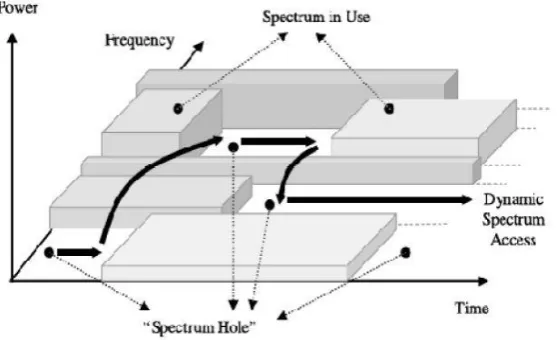
The CR enables the usage of temporally unused frequency bands which are commonly known as spectrum holes. Usually spectrum holes are generally categorized into temporalspectrumholes and spatial spectrum holes. A temporal spectrum hole is unoccupied by the PUduring the time of sensing. Hence, this band can be used by SUs in the current time slot. Spectrum sensing of this kind does not require complex signal processing. A spatial spectrumhole is a band which is unoccupied by the PU at some spatial areas; and therefore can be occupied by SUs As well asoutside this area. Spatial sensing of a PUneeds complex signal processing algorithms [6], [7].Fig 1 shows the spectrum holes in the active user region.
Fig 1: Spectrum Holes
In terms of power spectra of incoming RF is classifying the spectrum holes into three broadly defined types [8]
1. Black spaces, which are dominated by high-power “local “interfere some of the time.
2. Grey spaces, which are partially dominated by low-power interference.
3. White spaces, which are free of RF interference except for white Gaussian noise.
Among these three, white spaces and grey spaces can be used by unlicensed operators if accurate sensing technique is designed, and Black spaces cannot be used because usage of this space will cause interference to the PU.
IV.COMBINED METHOD FOR SPECTRUM SENSING
Here we are combining the two well-known sensing techniques explained above for the better sensing results [1]. The block diagram representation of such an idea is shown below in Fig 2.
Fig 2: Combined Method CHANNEL
DATA
ENERGY DETECTION
METHOD
In this combined method, signal is passed through band pass filter of the bandwidth W and is integrated over time interval. The output from the integrator block is then compared to a predefined threshold. This comparison is used to discover the existence of absence of the primary user [7]. The threshold value can set to be fixed or variable based on the channel conditions. The ED is said to be the Blind signal detector because it ignores the structure of the signal. It estimates the presence of the signal by comparing the energy received with a known threshold ν derived from the statistics of the noise. A matched filter (MF) is a linear filter designed to maximize the output signal to noise ratio for a given input signal [3]. When secondary user has a priori knowledge of primary user signal, matched filter detection is applied. Matched filter operation is equivalent to correlation in which the unknown signal is convolved with the filter whose impulse response is the mirror and time shifted version of a reference signal [6].
Matched filter need any prior information to sense the spectrum efficiently. In this combined method first the data is fed to the ED detector and after the preliminary threshold comparison the sensed data is fed to MF detector. Thus the prior information to the MF filter is achieved. Thus according to the postulates established the detectors decides whether there is an active user or not and if not the SU is made access to the channel.
V. RESULT AND DISCUSSION
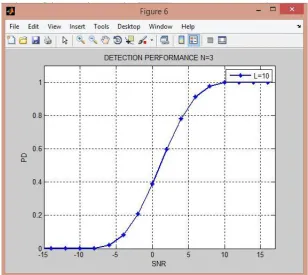
In the fig 1, it shows the graph of SNRVs.Probability of detection. It shows the detection performance of ED method only with a channel gain L=10.
Fig. 1 Detection performance of ED method only.(With Channel Gain L=10)
ISSN (Print) : 2320 – 3765 ISSN (Online): 2278 – 8875
I
nternational
J
ournal of
A
dvanced
R
esearch in
E
lectrical,
E
lectronics and
I
nstrumentation
E
ngineering
(An ISO 3297: 2007 Certified Organization) Vol. 4, Issue 8, August 2015
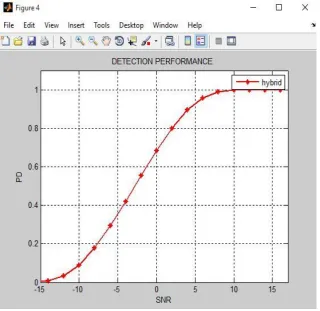
In the fig 2, it shows the graph of SNR Vs. Probability of detection. It shows the detection performance of hybrid ED and MF methods.
Fig. 2 Detection performance of hybrid ED and MF methods.
This shows the detection performance when we use both ED and MF method together. It shows the increment in the probability of detection for SNR value -15 onwards. Hats an improvement which can improve the efficiency of accurate sensing.
V.CONCLUSION
In order to sense the spectrum holes consistently and resourcefully, in this paper we propose matched filter and ED method based cooperative spectrum sensing in CR networks. Here we adapt the advantages of both Energy detection methods and Matched Filter Detection method. Initially we are taking the signal data and fed it to both these detectors and by acting as a combined unit the resultant detection process stands out among the individual performances.
REFERENCES
[1] J. Mitola and G. Q. Maguire, Cognitive Radio: Making Software Radios More Personal,IEEE Personal Communications, vol. 6, no. 4, Aug. 1999, pp. 13-18.
[2] S. Haykin, Cognitive Radio: Brain-Empowered Wireless Communications, IEEE Journal on Selected Areas in Communications, vol. 23, no. 2, Feb. 2005, pp. 201-220.Q.
[6] H. S. Chen, W. Gao, and D. G. Daut, Signature Based Spectrum Sensing Algorithms for IEEE 802.22 WRAN, in Proc. of IEEE International Conference on Communications(ICC), Glasgow, Scotland, Jun. 2007, pp. 6487-6492. [4]
[7] H. Khalife, N. Malouch, S. Fdida, “Multihop cognitive radio networks: to route or not to route,” IEEE Network, vol. 23, no. 4, pp. 20-25, 2009.