21 - Bringing Down the Complexity:
Fast Composable Protocols for
Card Games Without Secret State
Bernardo David13?, Rafael Dowsley23??, and Mario Larangeira13? 1 Tokyo Institute of Technology, Japan
{bernardo,mario}@c.titech.ac.jp 2 Aarhus University, Denmark
[email protected] 3 IOHK, Hong Kong
Abstract. While many cryptographic protocols for card games have been proposed, all of them focus on card games where players have some state that must be kept secret from each other, e.g closed cards and bluffs in Poker. This scenario poses many interesting technical challenges, which are addressed with cryptographic tools that introduce significant computational and communication overheads (e.g.zero-knowledge proofs). In this paper, we consider the case of games that do not require any secret state to be maintained (e.g.Blackjack and Baccarat). Basically, in these games, cards are chosen at random and then publicly advertised, allow-ing for players to publicly announce their actions (before or after cards are known). We show that protocols for such games can be built from very lightweight primitives such as digital signatures and canonical ran-dom oracle commitments, yielding constructions that far outperform all known card game protocols in terms of communication, computational and round complexities. Moreover, in constructing highly efficient proto-cols, we introduce a new technique based on verifiable random functions for extending coin tossing, which is at the core of our constructions. Be-sides ensuring that the games are played correctly, our protocols support financial rewards and penalties enforcement, guaranteeing that winners receive their rewards and that cheaters get financially penalized. In or-der to do so, we build on blockchain-based techniques that leverage the power of stateful smart contracts to ensure fair protocol execution.
1
Introduction
Cryptographic protocols for securely playing card games among mutually dis-trustful parties have been investigated since the seminal work of Rivest, Shamir ?This work was supported by the Input Output Cryptocurrency Collaborative
Re-search Chair, which has received funding from Input Output HK.
?? This project has received funding from the European research Council (ERC) under
and Adleman [23] in the late 1970s, which initiated a long line of research [14, 15, 21, 3, 27, 26, 12, 22, 25, 24, 20, 5, 16, 17]. Not surprisingly, all of these previous works have focused on obtaining protocols suitable for implementing a game of Poker, which poses several interesting technical challenges. Intuitively, in order to protect a player’s “poker face” and allow him to bluff, all of his cards might need to be kept private throughout (and even after) protocol execution. In previous works, ensuring this level of privacy required several powerful but expensive cryptographic techniques, such as the use of zero-knowledge proofs and threshold cryptography. However, not all popular card games require a se-cret state (e.g.private cards) to be maintained, which is the case of the popular games of Blackjack (or 21) and Baccarat. In this work, we investigate how to exploit this fundamental difference to construct protocols specifically for games without secret state that achieve higher efficiency than those for Poker.
Games Without Secret State: In games such as Baccarat and Blackjack, no card is privately kept by any player at any time. Basically, in such games, cards from a shuffled deck of closed cards (whose values are unknown to all players) are publicly opened, having their value revealed to all players. We say these are
games without secret state, since no player possesses any secret state (i.e.private cards) at any point in the game, as opposed to games such as Poker, where the goal of the game is to leverage private knowledge of one’s card’s values to choose the best strategy. An immediate consequence of this crucial difference is that the heavy cryptographic machinery used to guarantee the secrecy and integrity of privately held cards can be eliminated, facilitating the construction of highly efficient card game protocols.
Security Definitions: Even though protocol for secure card games (and spe-cially Poker) have been investigated for several decades, formal security defini-tions have only been introduced very recently in Kaleidoscope [16] (for the case of Poker protocols) and Royale [17] (for the case of protocols for general card games). The lack of formal security definitions in previous works has not only made their security guarantees unclear but resulted in concrete security issues, such as the ones in [27, 26, 3, 12], as pointed out in [22, 16]. Hence, it is impor-tant to provide security definitions that capture the class of protocols for card games without secret state. Adapting the approach of Royale [17] for defining security of protocols for general card games with secret state in the Universal Composability framework of [8] is a promising direction to tackle this problem. Besides clearly describing the security guarantees of a given protocol, a secu-rity definition following the approach of Royale also ensures that protocols are
composable, meaning that they can be securely used concurrently with copies of themselves or other protocols.
while preventing cheaters to keep the protocol from reaching an outcome. This problem was recently solved by Andrychowiczet al.[2, 1] through an approach based on decentralized cryptocurrencies and blockchain protocols. They con-struct a mechanism that ensures that honest players receive financial rewards and financially punishes cheaters (who abort the protocol or provide invalid messages). The main idea is to have all players provide deposits of betting and collateral funds, forfeiting their collateral funds if they are found to be cheat-ing. A cheater’s collateral funds are then used to compensate honest players. Their general approach has been subsequently improved and applied to poker protocols by Kumaresan et al. [20] and Bentov et al. [5]. However, protocols for Poker (resp., for general card games) using this approach have only been formally analysed in Kaleidoscope [16] (resp., Royale [17]), where fine tuned
checkpoint witnessesof correct protocol execution are also proposed as means of improving the efficiency of the mechanism for enforcing rewards/penalties. Such an approach can be carried over to the case of games without secret state.
1.1 Our Contributions
We introduce a general model for reasoning about the composable security of protocols for games without secret state and a protocol that realizes our secu-rity definitions with support to financial rewards/penalties. We also introduce optimizations of our original protocol that achieve better round and communi-cation complexities at the expense of a cheap preprocessing phase (in either the Check-in or Create Shuffled Deck procedures). Our protocols do not require ex-pensive card shuffling operations that rely on zero-knowledge proofs, achieving much higher concrete efficiency than all previous works that support card games with secret state (e.g.Poker). Our contributions are summarized below:
– The first ideal functionality for general card games without secret state:FCG.
– An analysis showing that that Baccarat and Blackjack can be implemented by our general protocol ,i.e.in theFCG-hybrid model (Sections 3.2 and 3.3).
– A highly efficient protocolπCGfor card games which realizesFCGalong with
optimized ProtocolsπCG−PRE andπCG−VRF (Theorems 1, 2 and 3).
– A novel technique for coin tossing “extension” based on verifiable random functions (VRF) that is of independent interest (Section 5.2).
We start by defining FCG, an ideal functionality that captures only games
without secret state, which is adapted from the functionality for general card games with secret state proposed in Royale [17]. In order to show that such a re-stricted functionality still finds interesting applications, we show that the games of Blackjack and Baccarat can be implemented by FCG. Leveraging the fact the
FCGonly captures games without secret state, we construct protocols that rely
proofs of shuffle correctness. In fact, no card shuffling procedure is needed in Protocol πCG and Protocol πCG−VRF, where card values are selected on the fly
during the Open Card procedure. Our basic protocol πCG simply selects the
value of each (publicly) opened card from a set of card values using randomness obtained by a simple commit-and-open coin tossing, which requires two rounds. Later we show that we perform the Open Card operation in one sigle round given a cheap preprocessing phase. In order to perform this optimization, we introduce a new technique that allows for a single coin tossing performed during the Check-in procedure to be later “extended” in a single round with the help of a verifiable random function, obtaining fresh randomness for each Open Card operation.
1.2 Related Works
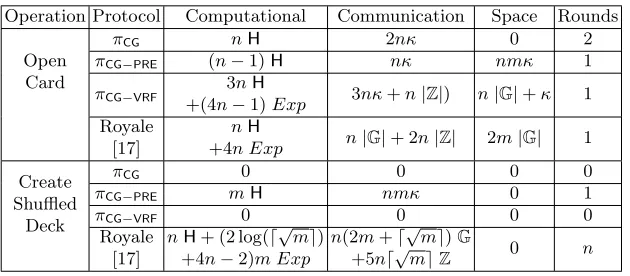
Our results are most closely relate to Royale [17], the currently most efficient protocol for general card games with secret state, which employs a mechanism for enforcing financial rewards and penalties following the stateful contract approach of Bentovet al.[5]. In our work, we restrict the model of Royale to capture only games without secret state but maintain the same approach for rewards/penal-ties enforcement based on stateful contracts. As an advantage of restricting our model to this specific class of games, we eliminate the need for expensive card suffling procedures while constructing very cheap Open Card procedures. More-over, we are able to construct protocols that only require digital signatures and simple random oracle based commitments (as well as VRFs for one of our opti-mizations), achieving much higher efficiency than Royale, as shown in Section 6. Due to significant improvements in communication complexity, our protocols en-joy much better efficiency for the recovery phase than Royale, since we employ the same compact checkpoint witnesses but the protocol messages that must be sent to the stateful contract (i.e.posted on a blockchain) are much shorter than those of Royale.
2
Preliminaries
In this section we introduce the notation and definitions that will be used throughout the paper. We denote the security parameter by κ. For a random-ized algorithm F, y ←$ F(x) denotes running F with input x and its random coins, obtaining an output y. If we need to specify the coins r, we will use the notation y ←F(x;r). We denote sampling an element xuniformly at random from a setX byx← X$ . For a distributionY, we denote samplingy according to the distributionY byy← Y. We say that a function$ f is negligible innif for every positive polynomialpthere exists a constantcsuch thatf(n)< p(n)1 when
n > c. We denote bynegl(κ) the set of negligible functions inκ. Two ensembles
X ={Xκ,z}κ∈N,z∈{0,1}∗ and Y ={Yκ,z}κ∈N,z∈{0,1}∗ of binary random variables
holds that|Pr[D(Xκ,z) = 1]−Pr[D(Yκ,z) = 1]|is negligible inκfor every prob-abilistic distinguisher D. In case this only holds for non-uniform probabilistic polynomial-time (PPT) distinguishers we say thatX andY arecomputationally indistinguishable and denote it byX ≈cY.
2.1 Universal Composability
We prove our protocols secure in the Universal Composability (UC) framework introduced by Canetti in [8]. In this section, we present a brief description of the UC framework originally given in [11] and refer interested readers to [8] for further details. In this framework, protocol security is analyzed under the real-world/ideal-world paradigm, i.e., by comparing the real world execution of a protocol with an ideal world interaction with the primitive that it implements. The model includes a composition theorem, that basically states that UC se-cure protocols can be arbitrarily composed with each other without any security compromises. This desirable property not only allows UC secure protocols to effectively serve as building blocks for complex applications but also guaran-tees security in practical environments, where several protocols (or individual instances of protocols) are executed in parallel, such as the Internet.
The UC framework gives that the entities involved in both the real and ideal world executions are modeled as PPT Interactive Turing Machines (ITM) that receive and deliver messages through their input and output tapes, respectively. In the ideal world execution, dummy parties (possibly controlled by an ideal adversary S referred to as the simulator) interact directly with the ideal func-tionality F, which works as a trusted third party that computes the desired primitive. In the real world execution, several parties (possibly corrupted by a real world adversaryA) interact with each other by means of a protocolπthat realizes the ideal functionality. The real and ideal executions are controlled by theenvironment Z, an entity that delivers inputs and reads the outputs of the individual parties, the adversary A and the simulator S. After a real or ideal execution,Z outputs a bit, which is considered as the output of the execution. The rationale behind this framework lies in showing that the environment Z (that represents everything that happens outside of the protocol execution) is not able to efficiently distinguish between the real and ideal executions, thus implying that the real world protocol is as secure as the ideal functionality.
We denote byREALπ,A,Z(κ, z,¯r) the output of the environmentZin the real-world execution of a protocol π between n parties with an adversary Aunder security parameter κ, inputz and randomness ¯r= (rZ, rA, rP1, . . . , rPn), where (z, rZ), rA and rPi are respectively related to Z, A and party i. Analogously, we denote by IDEALF,S,Z(κ, z,r¯) the output of the environment in the ideal interaction between the simulatorS and the ideal functionalityF under security parameter κ, input z and randomness ¯r = (rZ, rS, rF), where (z, rZ), rS and
rF are respectively related to Z, S and F. The real world execution and the ideal executions are respectively represented by the ensembles REALπ,A,Z = {REALπ,A,Z(κ, z,r¯)}κ∈N and IDEALF,S,Z ={IDEALF,S,Z(κ, z,r¯)}κ∈N with z ∈
The UC framework also considers theG-hybrid world, where the computa-tion proceeds as in the real-world with the addicomputa-tional assumpcomputa-tion that the parties have access to an auxiliary ideal functionalityG. In this model, honest parties do not communicate with the ideal functionality directly, instead the adversary delivers all the messages to and from the ideal functionality. We consider the communication channels to be ideally authenticated, so that the adversary may read but not modify these messages. Unlike messages exchanged between parties, which can be read by the adversary, the messages exchanged between parties and the ideal functionality are divided into apublic header and aprivate header. The public header can be read by the adversary and contains non-sensitive informa-tion (such as session identifiers, type of message, sender and receiver). Whereas the private header cannot be read by the adversary and contains information such as the parties’ private inputs. We denote the ensemble of environment out-puts the execution of a protocolπin aG-hybrid model asHYBRIDGπ,A,Z (defined analogously toREALπ,A,Z). UC security is then formally defined as:
Definition 1. An n-party (n ∈ N) protocol π is said to UC-realize an ideal functionality F in the G-hybrid model if, for every adversary A, there exists a simulator S such that, for every environment Z, the following relation holds: IDEALF,S,Z≈cHYBRIDGπ,A,Z.
Adversarial Model: Our protocols are secure againststatic maliciousadversaries, who can arbitrarily deviate from the protocol but must corrupt parties before execution starts, having the corrupted (or honest) parties remain so throughout the execution.
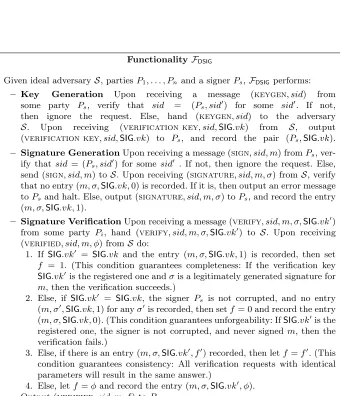
Setup Assumptions: It is a well-known fact that UC-secure two-party and mul-tiparty protocols for non trivial functionalities require a setup assumption [10]. The main setup assumption for our protocols is random oracle model [4], which can be modelled in the UC framework by giving parties access to a random oracle functionality FRO, which is defined in Figure 2. Moreover, in order to obtain a generic and modular construction, we will write our protocols in terms of a digital signature functionalityFDSIG (defined in Figure 3), a verifiable
ran-dom function functionalityFVRF(defined in Figure 1 and discussed below) and
a smart contract functionality (defined in Section 2.2). In Figure 3, we present functionalityFDSIGas defined in [9], where it is shown that anyEUF-CMA
signa-ture scheme realizesFDSIG. Notice that this fact implies that our protocols can
be realized based on practical digital signature schemes such as ECDSA.
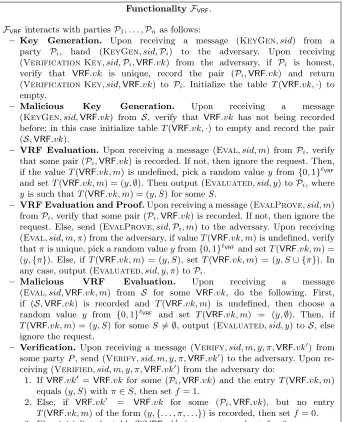
Verifiable Random Functions: Verifiable random functions (VRF) are a key in-gredient of one of our optimized protocols. In order to provide a modular con-struction in the UC framework, we model VRFs as an ideal functionalityFVRF
that captures the main security guarantees for VRFs, which are usually modeled in game based definitions. In Figure 1, we present functionalityFVRFas defined
FunctionalityFVRF.
FVRF interacts with partiesP1, . . . ,Pn as follows:
– Key Generation. Upon receiving a message (KeyGen, sid) from a party Pi, hand (KeyGen, sid,Pi) to the adversary. Upon receiving (Verification Key, sid,Pi,VRF.vk) from the adversary, if Pi is honest, verify that VRF.vk is unique, record the pair (Pi,VRF.vk) and return (Verification Key, sid,VRF.vk) to Pi. Initialize the table T(VRF.vk,·) to empty.
– Malicious Key Generation. Upon receiving a message (KeyGen, sid,VRF.vk) from S, verify that VRF.vk has not being recorded before; in this case initialize tableT(VRF.vk,·) to empty and record the pair (S,VRF.vk).
– VRF Evaluation. Upon receiving a message (Eval, sid, m) from Pi, verify that some pair (Pi,VRF.vk) is recorded. If not, then ignore the request. Then, if the valueT(VRF.vk, m) is undefined, pick a random valuey from{0,1}`VRF and setT(VRF.vk, m) = (y,∅). Then output (Evaluated, sid, y) toPi, where
yis such thatT(VRF.vk, m) = (y, S) for someS.
– VRF Evaluation and Proof.Upon receiving a message (EvalProve, sid, m) fromPi, verify that some pair (Pi,VRF.vk) is recorded. If not, then ignore the request. Else, send (EvalProve, sid,Pi, m) to the adversary. Upon receiving (Eval, sid, m, π) from the adversary, if valueT(VRF.vk, m) is undefined, verify thatπis unique, pick a random valueyfrom{0,1}`VRF
and setT(VRF.vk, m) = (y,{π}). Else, ifT(VRF.vk, m) = (y, S), setT(VRF.vk, m) = (y, S∪ {π}). In any case, output (Evaluated, sid, y, π) toPi.
– Malicious VRF Evaluation. Upon receiving a message (Eval, sid,VRF.vk, m) from S for some VRF.vk, do the following. First, if (S,VRF.vk) is recorded and T(VRF.vk, m) is undefined, then choose a random value y from {0,1}`VRF and set T(VRF.vk, m) = (y,∅). Then, if
T(VRF.vk, m) = (y, S) for someS 6=∅, output (Evaluated, sid, y) toS, else ignore the request.
– Verification. Upon receiving a message (Verify, sid, m, y, π,VRF.vk0) from some partyP, send (Verify, sid, m, y, π,VRF.vk0) to the adversary. Upon re-ceiving (Verified, sid, m, y, π,VRF.vk0) from the adversary do:
1. If VRF.vk0 =VRF.vk for some (Pi,VRF.vk) and the entry T(VRF.vk, m) equals (y, S) withπ∈S, then setf= 1.
2. Else, if VRF.vk0 = VRF.vk for some (Pi,VRF.vk), but no entry
T(VRF.vk, m) of the form (y,{. . . , π, . . .}) is recorded, then setf= 0. 3. Else, initialize the tableT(VRF.vk0,·) to empty, and setf= 0. Output (Verified, sid, m, y, π, f) toP.
Fig. 1.FunctionalityFVRF.
simulatable VRF notion of [13] is not sufficient to realizeFVRF, it has been shown
Functionality FRO
FRO is parameterized by a rangeD.FROkeeps a listLof pairs of values, which is initially empty, and proceeds as follows:
– Upon receiving a value (sid, m) from a party Pi or fromS, if there is a pair (m,ˆh) in the listL, set h= ˆh. Otherwise, choose h← D$ and store the pair (m, h) inL. Reply to the activating machine with (sid, h).
Fig. 2.FunctionalityFROfor the random oracle.
FunctionalityFDSIG
Given ideal adversaryS, partiesP1, . . . , Pnand a signerPs,FDSIG performs:
– Key Generation Upon receiving a message (keygen, sid) from some party Ps, verify that sid = (Ps, sid0) for some sid0. If not, then ignore the request. Else, hand (keygen, sid) to the adversary S. Upon receiving (verification key, sid,SIG.vk) from S, output (verification key, sid,SIG.vk) to Ps, and record the pair (Ps,SIG.vk).
– Signature GenerationUpon receiving a message (sign, sid, m) fromPs, ver-ify that sid = (Ps, sid0) for somesid0 . If not, then ignore the request. Else, send (sign, sid, m) toS. Upon receiving (signature, sid, m, σ) from S, verify that no entry (m, σ,SIG.vk,0) is recorded. If it is, then output an error message toPsand halt. Else, output (signature, sid, m, σ) toPs, and record the entry (m, σ,SIG.vk,1).
– Signature VerificationUpon receiving a message (verify, sid, m, σ,SIG.vk0) from some party Pi, hand (verify, sid, m, σ,SIG.vk0) to S. Upon receiving (verified, sid, m, φ) fromS do:
1. If SIG.vk0 = SIG.vk and the entry (m, σ,SIG.vk,1) is recorded, then set
f = 1. (This condition guarantees completeness: If the verification key
SIG.vk0is the registered one andσis a legitimately generated signature for
m, then the verification succeeds.)
2. Else, if SIG.vk0 = SIG.vk, the signer Ps is not corrupted, and no entry (m, σ0,SIG.vk,1) for anyσ0is recorded, then setf= 0 and record the entry (m, σ,SIG.vk,0). (This condition guarantees unforgeability: IfSIG.vk0is the registered one, the signer is not corrupted, and never signed m, then the verification fails.)
3. Else, if there is an entry (m, σ,SIG.vk0, f0) recorded, then letf=f0. (This condition guarantees consistency: All verification requests with identical parameters will result in the same answer.)
4. Else, letf=φand record the entry (m, σ,SIG.vk0, φ). Output (verified, sid, m, f) toPi.
FunctionalityFSC
The functionality is executed with players P1, . . . ,Pn and is parametrized by a timeout limitτ, and the values of the initial staket, the compensationq and the security depositd≥(n−1)q. There is an embedded programGR that represents the game’s rules and a protocol verification mechanismpv.
Players Check-in: When execution starts, FSC waits to receive from each
playerPi the message (checkin, sid,Pi,coins(d+t),SIG.vki) containing the nec-essary coins and its signature verification key. Record the values and send (checkedin, sid,Pi,SIG.vki) to all players. If some player fails to check-in within the timeout limitτor if a message (checkin-fail, sid) is received from any player, then send (compensation,coins(d+t)) to all players who checked in and halt. Player Check-out: Upon receiving (checkout-init, sid,Pj) from Pj, send (checkout-init, sid,Pj) to all players. Upon receiving (checkout, sid,
Pj,payout, σ1, . . . , σn) from Pj, verify that σ1, . . . , σn are valid signatures by the playersP1, . . . ,Pnon (CHECKOUT|payout) for the payout vector with respect to FDSIG. If all tests succeed, for i= 1, . . . , n, send (payout, sid,Pi,coins(w)) toPi, wherew=payout[i] +d, and halt.
Recovery: Upon receiving a recovery request (recovery, sid) from a player Pi, send the message (request, sid) to all players. Upon getting a message (response, sid,Pj,Checkpointj,procj) from some player Pj with checkpoint wit-nesses (which are not necessarily relative to the same checkpoint as the ones received from other players) and witnesses for the current procedure; or an acknowledge-ment of the witnesses previous submitted by another player, forward this message to the other players. Upon receiving replies from all players or reaching the timeout limitτ, fix the current procedure by picking the most recent checkpoint that has valid witnesses (i.e.the most recent checkpoint witness signed by all players Pi). Verify the last valid point of the protocol execution using the current procedure’s witnesses, the rules of the gameGR, andpv. If some playerPi misbehaved in the current phase (by sending an invalid message), then send (compensation,coins(d+
q+balance[j] +bets[j])) to each Pj 6=Pi, send the leftover coins toPi and halt. Otherwise, proceed with a mediated execution of the protocol until the next check-point using the rules of the gameGRandpvto determine the course of the actions and check the validity of the answer. Messages (nxt-stp, sid,Pi,proc,round) are used to request from player Pi the protocol message for round round of proce-dureprocaccording to the game’s rules specified inGR, who answer with messages (nxt-stp-rsp, sid,Pi,proc,round,msg), wheremsg is the requested protocol mes-sage. All messages (nxt-stp, sid, . . .) and (nxt-stp-rsp, sid, . . .) are delivered to all players. If during this mediated execution a player misbehaves or does not an-swer within the timeout limitτ, penalize him and compensate the others as above, and halt. Otherwise send (recovered, sid,proc,Checkpoint), to the parties once the next checkpointCheckpoint is reached, whereprocis the procedure for which
Checkpointwas generated.
2.2 Stateful Contracts
We employ an ideal functionalityFSC that models astateful contract, following
the approach of Bentov et al. [6]. We use the functionality FSC defined in [17]
and presented in Figure 4. This functionality is used to ensure correct protocol execution, enforcing rewards distribution for honest parties and penalties for cheaters. Basically, it provides a “check-in” mechanism for players to deposit funds for betting and collateral, as well as registering signature verification keys that will be used throughout the protocol for verifying authenticity of players messages and generating checkpoint witnesses. After check-in, if a player sus-pects cheating, it can complain to FSC by requesting the Recovery mechanism
to be activated, during which FSC mediates protocol execution, verifying that
each player generates valid protocol messages. Instead of re-executing the whole protocol, the Recovery phase of FSC requires the players to provide checkpoint
witnesses proving that the protocol has been correctly executed up to a certain point, only requiring FSC to mediate protocol execution from that point on. If
any player is found to be cheating,FSCpenalizes the cheaters, distributing their
collateral funds among the honest players and finalizing the protocol. Finally, FSCprovides a “Check-out” mechanism, which ensures that players receive their
rewards according to the game outcome.
Implementation of FSC. It is important to emphasize that the FSC
function-ality can be easily implemented via smart contracts over a blockchain, such as Ethereum [7]. Moreover, our construction (for protocolπCG) requires only simple
operations,i.e.verification of signatures and random oracle outputs. The regular operation of our protocol is performed entirely off-chain, without intervention of the contract. However in the event that any problem happen or in the case that any participant in the game claim problems in the execution, any player can publish their agreed status of the game in the chain, via short witnesses (to be detailed in the protocol description).
3
Modeling Card Games Without Secret State
Before presenting our protocols, we must formally define security for card games without secret state. We depart from the framework introduced in Royale [17] for modeling general card games (which can include secret state), restricting the model to the case of card games without secret state. In order to showcase the applicability of our model to popular games, we further present game rule programs for Blackjack and Baccarat, which paramterize our general card game functionality for realizing these games. Both Blackjack and Baccarat games re-quire a special player that acts as the “dealer” or “house”, providing funds that will be used to reward the other players in case they win bets. We remark that the actions taken by this special player are pre-determined in both GRblackjack
and GRblackjack, meaning that the party representing the “dealer” or “house”
this special player as an individual party (which would be required to provide the totality of such funds), these programs can be trivially modified to require each player to provide funds that will be pooled to represent the “dealer’s” or “house’s” funds, since all of their actions are deterministic and already captured byGRblackjackandGRblackjack.
3.1 Modeling General Games Without Secret State
We present an ideal functionalityFCGfor card games without secret state in
Fig-ure 5. Our ideal functionality is heavily based on theFCGfor games with secret
state presented in Royale [17]. We define a version of FCG that only captures
games without secret state, allowing us to realize it with a lightweight proto-col. This version has the same structure and procedures as the FCG presented
in Royale, except for the procedures that require secret state to be maintained. Namely, we model game rules with an embedded programGRthat encodes the rules of the game to be implemented.FCG offers mechanisms for GRto specify
the distribution of rewards and financially punish cheaters. Additionally, it offers a mechanism forGRto communicate with the players in order to request actions (e.g. bets) and publicly register their answers to such requests. In contrast to the model of Royale and previous protocols focusing on poker,FCG only offers
two main card operations: shuffling andpublicopening of cards. RestrictingFCG
to these operations captures the fact that only games without secret state can be instantiated and allows for realizing this functionality with very efficient pro-tocols. Notice that all actions announced by players are publicly broadcast by FCGand that players cannot draw closed cards (which might never be revealed
in the game, constituting a secret state). As in Royale, FCG can be extended
with further operations (e.g.randomness generation), incorporating ideal func-tionalities that model these operations. However, differently from Royale, these operations cannot rely on the card game keeping a secret state.
3.2 Blackjack and its Formalization
Before detailing our proposed formalization, we briefly review the rules of the most played version of the Blackjack game. These rules are captured by the rules
GRblackjackto be introduced later in this section.
Game Overview: The game has two types of parties: thedealer and the play-ers. Before the dealer distributes the cards, the players place their respective bets. Next, the dealer starts by handing two face up cards to each player in a pre-established order. The dealer receives only one card, and therefore its hand is not complete yet. On turns, each player places its action, which can be:
– hit: The player asks for another card from the deck, and he can ask for more cards until he thinks that it is a good hand;
FunctionalityFCG
The functionality is executed with players P1, . . . ,Pn and is parameterized by a timeout limitτ, and the values of the initial staket, the security depositdand of the compensationq. There is an embedded programGRthat represents the rules of the game and is responsible for mediating the execution: it requests actions from the players, processes their answers, and invokes the procedures ofFCG. FCG
pro-vides a check-in procedure that is run in the beginning of the execution, a check-out procedure that allows a player to leave the game (which is requested by the player viaGR) and a compensation procedure that is invoked byGRif some player misbe-haves/aborts. It also provides a channel forGRto request public actions from the players and card operations as described below.GRis also responsible for updating the vectorsbalanceandbets. Whenever a message is sent toS for confirmation or action selection,S should answer, but can always answer (abort, sid), in which case the compensation procedure is executed; this option will not be explicitly mentioned in the functionality description henceforth.
Check-in: Executed during the initialization, it waits for a check-in message (checkin, sid,coins(d+t)) from eachPi and sends (checkedin, sid,Pi) to the re-maining players andGR. If some player fails to check-in within the timeout limitτ, then allow the players that checked-in to dropout and reclaim their coins. Initialize vectorsbalance= (t, . . . , t) andbets= (0, . . . ,0).
Check-out:WheneverGRrequests the players’s check-out with payouts specified by vectorpayout, send (checkout, sid,payout) toS. IfS answers (checkout, sid, payout), send (payout, sid,Pi,coins(d+payout[i])) to eachPiand halt.
Compensation: This procedure is triggered whenever S answers a request for confirmation of an action with (abort, sid). Send (compensation, sid,coins(d+
q+balance[i] +bets[i])) to each active honest playerPi. Send the remaining locked coins toS and stop the execution.
Request Action: Whenever GR requests an action with description act−desc
fromPi, send a message (action, sid,Pi, act−desc) to the players. Upon receiving (action-rsp, sid,Pi, act−rsp) fromPi, forward it to all other players andGR.
Create Shuffled Deck:WheneverGRrequests the creation of a shuffled deck of cards containing cards with values v1, . . . , vm, choose the next m free identifiers
id1, . . . ,idm, representing cards as pairs (id1, v1), . . . ,(idm, vm). Choose a random permutationΠthat is applied to the values (v1, . . . , vm) to obtain the updated cards (id1, v10), . . . ,(idm, v0m) such that (v
0
1, . . . , v
0
m) = Π(v1, . . . , vm). Send the message (shuffled, sid, v1, . . . , vm,id1, . . . ,idm) to all players andGR.
Open Card:Whenever GRrequests to reveal the card (id, v) in public, read the card (id, v) from the memory and send the message (card, sid,id, v) to S. If S answers (card, sid,id, v), forward this message to all players andGR.
Fig. 5.Functionality for card games without secret stateFCGbased on [17].
– split: If there are two card equal cards in the set, the player has the option to separate the sets and play them independently. The player has to bet the same amount for the new hand;
– insurance bet: In case the dealer has an Ace as its first card, before the players’ actions, the dealer gives them an option of betting at most half of its already bet amount as aninsurance for the case the second card is one with value 10.
Each card has a value associated: the cards from 2 to 10 have their face value, while the Jacks, Kings and Queens each have value 10. Finally, the Ace card can be considered 1 or 11 at the player discretion. The combined value of a player’s cards is referred to as the player’s hand. The goal is to get a hand as close as possible to 21, in other words to obtain ablackjack: the unbeatable hand. Over this value the player is said to be bust and out of the hand, i.e.looses its bet. Each player decides how many cards they ask. Note that all the cards are visible to all players.
Cases for pay-out. The hand is over when a player wins,i.e., player’s hand is 21, or the dealer looses,i.e.the dealer’s cards combined value is over 21. In the first case, the amount bet by the winner player is doubled by the dealer, while the dealer collects the bets of all the players whose hand has a value lower than the dealer cards. Otherwise the dealer also pays the double to other players. In the case the dealer hits ablackjack, and no other player does it, it collects all the bets. In the case of paying an insurance bet, it is treated independently of the main bet. That is, the player looses the latter, but is rewarded with the double of the former.
Game Rules for Blackjack: We describe the rulesGRblackjackfor the Blackjack
game in Figures 6 and 7. It captures all the actions and dynamics of the game.
3.3 Baccarat
Before detailing our proposed formalization for the game, we briefly review the most played version of Baccarat. The actions of the players and dynamics of the game are captured by the rulesGRbaccarat to be introduced later in this section.
Game Overview: Similarly to Blackjack, the cards have values associated with each one: the numbered cards have their face value, while Kings, Jacks and Queens have value 0, and finally the Ace card has value of 1. The goal of the game is to get a hand as close as possible to 9, and the hand value is computed modulo 10. The game starts by the players deciding their respective bets. As mentioned earlier the player has the option of betting in thebanker’sorplayer’s
Game rules for Baccarat: We describe the game rulesGRbaccaratfor Baccarat
in Figures 8. Later we show thatGRbaccaratis used inFCG. Similarly to the case of GRblackjack, the game actions that must be taken by each participant are requested
and announced through the action mechanism of FCG, while card openings are
Game RulesGRblackjack
The rules have parameters for the minimalminand maximummaxbet amounts, the security depositd, the initial staket, the compensation amountq, and an upper limit of sampled cardsu. Moreover, the rules keep a counter for drawn cardssampled
initially set for 0. The game is played amongn players (P1, . . . ,Pn) and a virtual dealerPd whose actions are performed by GRblackjack.GRblackjack creates a shuffled deck of cardsshoeconsisting of 6 regular card decks and uses a vector for side bets
sideswhich are particular to Blackjack.
Betting Round:Keep track of the chronological order of actions.
– Execute a round of bets starting with the closest active successor of the dealer, by requesting the actionpayto eachpi, 0< i≤n. Upon receiving the answer
bifrompiincreasebets[i] bybiand decreasebalance[i] by the same amount. – For each player thatPiand the dealerPnopen a single cardpci,1for 0< i≤n
andi=d, next, open another round of cardspci,2, but only for 0< i≤n. For every card sampled, increasesampledby 1.
Action round: Proceed with the ordered sequence of the players, and each one ends its round of actions by calling theStandaction, unless its cards sum 21 or above (according to the card values described in Section 3.2). InPi’s turn,GRblackjack
requests is to indicate its action. The playerPi is expected to answer with one of the following actions:
– stand: The player does not receive any new card. The next player in the se-quence is called to act.
– hit: Open a card. After the card is drawn, if the sum of all cards of Pi is over 21,GRblackjackdoes not open more cards to the player and sends an action request to the next player in the sequence. Otherwise, request an action again to the same player. For every card opened increment by 1 the countersampled. – double: if balance[i]−bets[i] < 0, do not accept the action. Otherwise set
bets[i] = 2·bets[i], decreasebalance[i] bybets[i], and open new cardpc, updating
sampled. Do not accept any more actions, and proceed to the next player. – split: Ifpci,1 andpci,2 are of the same type, Pi is allowed to request a split.
In that case, check the following and proceed to the Dealer Action Phase: • ifbalance[i]≥min, then set an extra slot on vectorbets, saybets[i0], and
setbets[i0] =bets[i], and decrease balance by another bet amount, that is
balance[i] =balance[i]−bets[i]. Finally setpci0,1 =pci,2, open two cards pci0,2 andpci,2 fromshoeupdating accordingly the the countersampled.
Proceed as a independent hand, pci0,1, pci0,2 and bets[i0] with respect to
balancebalance[i] forPi;
• if balance[i]< min,Pi is not allowed to split andGRblackjack performs the Compensation procedure.
Side bets round: Before the Action round, if pcd,1 is the Ace card, all the players in sequence are requested to choose if they want to make a singleinsurance bet. If the playerPiwants to make the bet it answers with a valuebi>0, otherwise it answers with 0. In the case of bet, check ifb≤bets[i]/2 andbalance[i]−b >0, then updatesides[i] =sides[i] +b, andbalance[i] =balance[i]−b, and accept the bet. Otherwise, perform the Compensation procedure.
Dealer Actions:Open a cardpcd,2fromshoeforPdand setsampled=sampled+1. Ifpcd,1 andpcd,2 sum 17 or above, no extra card is opened. Otherwise open a new cardpcfromshoe, and setsumto the sum of the values associated withpcd,1,pcd,2
andpc.
1. Ifsumis 17 or above, proceed to the Pay-out phase. Otherwise,Pdhas tohit, then;
2. Sample a new cardpc, add the value of it tosum, and go to step 1.
Pay-out:Using bets, and the sum of the opened cards for each player, compare the outcomes and computes the amount of money thatPireceives or looses for the following cases, according to the hand and actions:
– Tie: if the Pi’s hand sums the same value of the dealer’s hand, then set
balance[i] =balance[i] +bets[i] (i.e., no payment is done);
– Insurance bet: if pcd,1 is an ace, and pcd,2 is a figure card, set balance[i] =
balance[1] + 2 · sides[i] and balance[d] = balance[d] − sides[i]. Otherwise
balance[d] =balance[d] +sides[i].
– Winner hand: ifPi’s initial cards are a Ace (value 11) and a figure (value 10), then set the valuex=5
2. Otherwise, check ifPihas acted with (double, sid), then set x = 3, if not, then set x = 2. If Pi’s hand is strictly higher than the dealer’s hand, then setbalance[i] =balance[i] +x·bets[i] andbalance[d] =
balance[d]−x·bets[i]. If it is strictly lower, then setbalance[d] =balance[d] +
bets[i].
Restore the usual size ofnfor thebetsandsidesvectors (for the case ofn players still player) and reset them to its initial state. Ifsampled≥u, request a re-shuffle of the cards, andsampled= 0, otherwise does nothing.
Fig. 7.Rules for the Blackjack game (Part 2 of 2).
implemented by calling the card opening operation ofFCGon the cards specified
by the game rules.
Player’s Hand Actions. First the dealer acts on behalf of the player’s hand. Values between 1 and 5 will make the dealer draw a third card for the hand. In the case of 6 or 7 the player’s handstands, that is, no card is drawn. Furthermore, a natural is the hand of 8 and 9, the highest hands. Such high hand prevents the banker’s hand to draw an extra card and the comparison is done with the cards initially drawn.
Game RulesGRbaccarat
The rules have parameters as the minimalminand maximummax bet amounts, and a upper limit of sampled cardsu. Moreover, the rules keep a counter for drawn cardssampledinitially set for 0. The game is played amongnplayers and a single dealer, respectively (P1, . . . ,Pn,Pd). The rule also assumes the existence of the
n+ 1 andnsize vectors for balances and bets respectively,balance, for each player Pi and Pd, and bets for each Pi only. Furthermore, keep a n-size vector hands, which is particular to Baccarat, forhandi ∈ {player, banker, tie} of each player Pi.GRbaccaratcreates a shuffled deck consisting of 12 regular card decks.
Betting Round: Each player is requested to place their respective bet bi on handi∈ {player, banker, tie}. That is, each playerPi fori= 1, . . . , nis requested to place a betbi. For each betbi, if bi ≥ min, bi ≤ max, proceed to the Com-pensation procedure. Otherwise, updatebalanceandbetsvectors accordingly, that isbalance[i] = balance[i]−bi andbets[i] =b1, andhands[i] =handi. Proceed to Dealer Actionsphase.
Dealer Actions:Two cardspcp,1andpcp,2are opened forPdas the Player’s hand. Next, two more cards are opened as the Banker’s hand,pcb,1 andpcb,2, updating thesampledcounter for each drawn card. Accordingly to the rules and card values described in the early Section 3.3, it may be necessary to draw the card pcp,3, the extra card for the Player’s hand, again, updatingsampled. Depending on the values and the rule described in Table 1, it may be necessary to draw the Banker’s extra card. In that case, requestPdto drawpcb,3, and updatesampledaccordingly. Proceed toPay-outphase.
Pay-out:There are three possible outcomes,Piwins whenever it has bet on one of the three possible outcome. Otherwise it looses its bet entirely, namelybalance[d] =
balance[d] +bets[i] andbets[i] = 0. ConsiderPiis rewarded according to one of the following three cases:
– Tie: Setbalance[i] =balance[i]+8·bets[i] andbalance[d] =balance[d]−8·bets[i]; – Banker’s hand: Set balance[i] = balance[i] + 1.95·bets[i] and balance[d] =
balance[d]−1.95·bets[i];
– Player’s hand: Setbalance[i] =balance[i]+2·bets[i] andbalance[d] =balance[d]− 2·bets[i].
After making the payments, allow the entrance and exit of players. Ifsampled≥u, then request a re-shuffle and set the sampled cards counter to its original state
sampled= 0. Next, set the vector betsand hands to its original state. Finally, if there is a single player still playing, then proceed to theBetting round. Otherwise, end the game.
Fig. 8.Rules for the Baccarat game.
draw an extra card independently of the current hand value, and the comparison of the hands are done with the cards that are on the table.
above, the hand stands. The rule for the values in between, that is 3, 4, 5 and 6, depends on the third card drawn for the player’s hand if there is one. For completeness, the rule is described in Table 1.
4
The Framework
Our framework can be used to implement any card game without secret state where cards that were previously randomly shuffled are publicly revealed. Instead of representing cards as ciphertexts as in previous works, we exploit the fact that publicly opening a card from a set of previously randomly shuffled cards is equivalent to randomly sampling card values from an initial set of card values. The main idea is that each opened card has its value randomly picked from a list of “unopened cards” using randomness generated by a coin tossing protocol executed by all parties. This protocol requires no shuffling procedure per se and requires 2 rounds for opening each card (required for executing coin tossing). Later on, we will show that this protocol can be optimized in different ways, but its simple structure aids us in describing our basic approach.
When the game rules GRspecify that a card must be created, it is added to a list of cards that have not been opened CC. When a card is opened, the parties execute a commit-and-open coin tossing protocol to generate random-ness that is used to uniformly pick a card from the list of unopened cards CC, removing the selected card fromCC and adding it to a list of opened cardsCO. This technique works since every card is publicly opened and no player gets to privately learn the value of a card with the option of not revealing it to the other players, which allows the players to keep the list of unopened cards up-to-date. We implement the necessary commitments with the canonical efficient random oracle based construction, where a commitment is simply an evaluation of the
Banker’s Player’s Third Card (pcp,3) Hand N 0 1 2 3 4 5 6 7 8 9
9 S S S S S S S S S S S 8 S S S S S S S S S S S 7 S S S S S S S S S S S 6 S S S S S S S D D S S 5 D S S S S D D D D S S 4 D S S D D D D D D S S 3 D D D D D D D D D S D 2 D D D D D D D D D D D 1 D D D D D D D D D D D 0 D D D D D D D D D D D
Table 1.Rules for drawing a third card for the Banker depending on the values of the Banker’s hand and the Player’s third card (pcp,3), where “N” denotes that a third card
random oracle on the commitment message concatenated with some randomness and the opening consists of the message and randomness themselves. This simple construction achieves very low computational and communication complexities as computing a commitment (and verifying and opening) requires only a single call to the random oracle and the commitment (and opening) can be represented by a string of the size of the security parameter. Besides being compact, these commitments are publicly verifiable, meaning that any third party party can verify the validity of an opening, which comes in handy for verifying that the protocol has been correctly executed.
In order to implement financial rewards/penalties enforcement, our protocol relies on a stateful contract functionalityFSCthat provides a mechanism for the
players to deposit betting and collateral funds, enforcing correct distribution of such funds according to the protocol execution. If the protocol is correctly executed, the rewards corresponding to a game outcome are distributed among the players. Otherwise, if a cheater is detected, FSC distributes the cheater’s
collateral funds among honest players, who also receive a refund of their betting and collateral funds. After each game action (e.g. betting and card opening), all players cooperate to generate a checkpoint witness showing that the pro-tocol has been correctly executed up to that point. This compact checkpoint witness is basically a set of signatures generated under each player’s signing key on the opened and unopened cards lists and vectors representing the players’ balance and bets. In case a player suspects cheating, it activates the recovery procedure ofFSCwith its latest checkpoint witness, requiring players to provide
their most up-to-date checkpoint witnesses to FSC (or agree with the one that
has been provided). After this point, FSC mediates protocol execution,
receiv-ing from all players the protocol messages to be sent after the latest checkpoint witness, ensuring their validity and broadcasting them to all players. If the pro-tocol proceeds until next checkpoint witness is generated, the execution is again carried out directly by the players without involvingFSC. Otherwise, if a player
is found to be cheating (by failing to provide their messages or providing invalid ones),FSC refunds the honest parties and distributes among them the cheater’s
collateral funds. ProtocolπCG is presented in Figures 9, 10 and 11.
4.1 Security Analysis
The security of protocol πCG in the Universal Composability framework is
for-mally stated in Theorem 1. In order to prove this theorem we construct a sim-ulator such that an ideal execution with this simsim-ulator and functionality FCG
is indistinguishable from a real execution of πCG with any adversary. The main
idea behind this simulator is that it learns fromFCG the value of each opened
ProtocolπCG (Part 1)
Protocol πCG is parametrized by a security parameter 1κ, a timeout limit τ, the
values of the initial staket, the compensationq, the security depositd≥(n−1)q
and an embedded programGRthat represents the rules of the game. In all queries (sign, sid, m) toFDSIG, the message mis implicitly concatenated with NONCEand
cnt, whereNONCE← {0$ ,1}κ
is a fresh nonce (sampled individually for each query) and cnt is a counter that is increased after each query. Every player Pi keeps track of usedNONCE values (rejecting signatures that reuse nonces) and implicitly concatenate the correspondingNONCEandcntvalues with messagemin all queries (verify, sid, m, σ,SIG.vk0) toFDSIG. ProtocolπCG is executed by playersP1, . . . ,Pn interacting with functionalitiesFSC,FRO andFDSIGas follows:
– Checkpoint Witnesses:After the execution of a procedure, the players store a checkpoint witness that consists of the listsCO and CC, the vectorsbalance
andbetsas well as a signature by each of the other players on the concatenation of all these values. Each signature is generated usingFDSIGand all players check
all signatures using the relevant procedure ofFDSIG. Old checkpoint witnesses
are deleted. If any check fails forPi, he proceeds to the recovery procedure.
– Recovery Triggers:All signatures and proofs in received messages are verified by default. Players are assumed to have loosely synchronized clocks and, after each round of the protocol starts, players expect to receive all messages sent in that round before a timeout limit τ. If a player Pi does not receive an expected message from a playerPjin a given round before the timeout limitτ, Pi considers thatPj has aborted. After the check-in procedure, if any player receives an invalid message or considers that another player has aborted, it proceeds to the recovery procedure.
– Check-in:Every playerPiproceeds as follows:
1. Send (keygen, sid) toFDSIG, receiving (verification key, sid,SIG.vki). 2. Send (checkin, sid,Pi,coins(d+t),SIG.vki) toFSC.
3. Upon receiving (checkedin, sid,Pj,SIG.vkj) from FSC for all j6=i, j =
1, . . . , n, initialize the internal lists of open cardsCO and closed cardsCC. We assume parties have a sequence of unused card id values (e.g.a counter). Initialize vectors balance[j] = tand bets[j] = 0 forj = 1, . . . , n. Output (checkedin, sid).
4. If Pi fails to receive (checkedin, sid,Pj,SIG.vkj) from FSC for another
partyPjwithin the timeout limitτ, it requestsFSCto dropout and receive
its coins back.
– Compensation: This procedure is activated if the recovery phase ofFSC
de-tects a cheater, causing honest parties to receive refunds plus compensation and the cheater to receive the remainder of its funds after honest parties are com-pensated. Upon receiving (compensation, sid,Pi,coins(w)) fromFSC, a player
Pioutputs this message and halts.
ProtocolπCG (Part 2)
– Check-out: A player Pj can initiate the check-out procedure and leave the protocol at any point thatGRallows, in which case all players will receive the money that they currently own plus their collateral refund. The players proceed as follows:
1. Pjsends (checkout-init, sid,Pj) toFSC.
2. Upon receiving (checkout-init, sid,Pj) from FSC, each Pi (for i =
1, . . . , n) sends (sign, sid,(CHECKOUT|payout)) toFDSIG (wherepayout is a
vector containing the amount of money that each player will receive accord-ing to GR), obtaining (signature, sid,(CHECKOUT|payout), σi) as answer. PlayerPisendsσitoPj.
3. For all i 6= j, Pj sends (verify, sid,(CHECKOUT|payout), σi,SIG.vki) to FDSIG, where payout is computed locally by Pj. If FDSIG answers all
queries (verify, sid,(CHECKOUT|payout), σi,SIG.vki) with (verified, sid, (CHECKOUT|payout),1),Pjsends (checkout, sid,payout, σ1, . . . , σn) toFSC.
Otherwise, it proceeds to the recovery procedure.
4. Upon receiving (payout, sid,Pi,coins(w)) fromFSC,Pi outputs this
mes-sage and halts.
– Executing Actions:EachPifollowsGRthat represents the rules of the game, performing the necessary card operations in the order specified byGR. IfGR
request an action with descriptionact−desc fromPi, all the players output (act, sid,Pi, act−desc) andPi executes any necessary operations.Pi broad-casts (action-rsp, sid,Pi, act−rsp, σi), where act−rspis his answer andσi his signature onact−rsp, and outputs (action-rsp, sid,Pi, act−rsp). Upon receiving this message, all other players check the signature, and if it is valid output (action-rsp, sid,Pi, act−rsp). If a playerPjbelieves cheating is hap-pening, he proceeds to the recovery procedure.
– Tracking Balance and Bets: Every player Pi keeps a local copy of the vectorsbalanceandbets, such thatbalance[j] andbets[j] represent the balance and current bets of each playerPj, respectively. In order to keepbalanceand
betsup to date, every player proceeds as follows:
• At each point thatGRspecifies that a betting action fromPitakes place, playerPi broadcasts a message (bet, sid,Pi, beti), wherebetiis the value of its bet. It updatesbalance[i] =balance[i]−biandbets[i] =bets[i] +bi. • Upon receiving a message (bet, sid,Pj, betj) from Pj, player Pi sets
balance[j] =balance[j]−bj andbets[j] =bets[j] +bj.
• When GRspecifies a game outcome where player Pj receives an amount
payj and has its bet amount updated to b0j, player Pi sets balance[j] =
balance[j] +payjandbets[j] =b0j.
– Create Shuffled Deck: When requested by GRto create a shuffled deck of cards containing cards with valuesv1, . . . , vm, each playerPichooses the next
mfree identifiers id1, . . . ,idm and, forj= 1, . . . , m, stores (idj,⊥) inCO and
vjinCC.Pioutputs (shuffled, sid, v1, . . . , vm,id1, . . . ,idm).
ProtocolπCG (Part 3)
– Open Card:Every playerPiproceeds as follows to open card with idid: 1. Organize the card values inCC in alphabetic order obtaining an ordered
listCC={v1, . . . , vm}. 2. Sample a randomri
$
← {0,1}κand send (sid, ri) toF
RO, receiving (sid, hi) as response. Broadcast (sid, hi).
3. After all (sid, hj) forj6=iandj= 1, . . . , nare received, broadcast (sid, ri). 4. For j = 1, . . . , n and j 6= i, send (sid, rj) toFRO, receiving (sid, h0j) as response and checking that hj =h0j. If all checks succeed, compute k = P
iri modm, proceeding to the Recovery phase otherwise. Define the opened card value as vk, removevk from CC and update (id,⊥) inCO to (id, vk).
– Recovery:PlayerPi proceeds as follows:
• Starting Recovery: PlayerPisends (recovery, sid) toFSC if it starts the
procedure.
• Upon receiving a message (request, sid) fromFSC, every playerPisends
(response, sid,Pi,Checkpointi,proci) toFSC, whereCheckpointiisPi’s lat-est checkpoint witness andprociarePi’s witnesses for the protocol proce-dure that started after the latest checkpoint; or acknowledges the witnesses sent by another party if it is the same as the local one.
• Upon receiving a message (nxt-stp, sid,Pi,proc,round) fromFSC, player
Pi sends (nxt-stp-rsp, sid,Pi,proc,round,msg) toFSC, wheremsg is the
protocol message that should be sent at roundroundof procedureprocof the protocol according toGR.
• Upon receiving a message (nxt-stp-rsp, sid,Pj,proc,round,msg) from FSC, every player Pi considersmsgas the protocol message sent by Pj in roundof procedureprocand take it into consideration for future messages. • Upon receiving a message (recovered, sid,proc,Checkpoint) fromFSC,
ev-ery player Pi records Checkpoint as the latest checkpoint and continues protocol execution according to the game rulesGR.
Fig. 11.Part 3 of ProtocolπCG.
simulation for the mechanisms for requesting players actions and enforcing finan-cial rewards/penalties follows the same approach as in Royale [17]. Namely, the simulator follows the steps of an honest user and makesFCGfail if a corrupted
party misbehaves, subsequently activating the recovery procedure that results in cheating parties being penalized and honest parties being compensated.
Theorem 1. For every static active adversary A who corrupts at most n− 1 parties, there exists a simulator S such that, for every environment Z, the following relation holds:
IDEALFCG,S,Z ≈c HYBRID
Proof. In order to prove the security of πCG, we construct a simulator S such
that no environmentZ can distinguish between interactions with an adversary A running Protocol πCG in the real world and with S and FCG in the ideal
world. The basic operations that implement financial rewards/penalties enforce-ment (i.e.Checkpoint Witnesses, Recovery Trigger, Tracking Balance and Bets, Executing Actions, Check-in, Check-out, Recovery and Compensation) are sim-ulated using the same approach as in Royale [17], where the simulator executes the procedures of an honest player in the simulated execution with its internal copy of the adversary, allowing FCG to proceed if the adversary acts honestly.
For the sake of completeness, we describe the procedures for simulating these op-erations as presented in Royale [17]. The new techniques introduced in this work are reflected in the simulation of the Shuffle Cards and Open Card operations, which are discussed at length.
We now describe the simulatorS, which interacts with an internal copy of the adversaryA, the environmentZand the ideal functionalityFCG.Swrites all the
messages received fromZ inA’s input tape, simulatingA’s environment. Also, S writes all messages fromA’s output tape to its own output tape, forwarding them to Z. Let H denote one of honest parties (any arbitrary one), for which S will execute special procedures during the simulation. As in the protocol, S is parameterized by a security parameter 1κ, a timeout limit τ, the values of the initial stake t, the compensation q, the security depositd ≥ (n−1)q and an embedded programGRthat represents the rules of the game.S simulates an execution with an internal copy of the adversaryA(that controls the malicious parties), and generates the protocol messages from the honest parties.Sproceeds as follows to simulate each procedure of ProtocolπCG:
– SimulatingFRO:Ssimulates the answers to the random oracle queries from A exactly as FRO would (and stores the lists of queries/answers), except when stated otherwise inS’s description.
– Simulating FDSIG: S simulates queries from A to FDSIG exactly as FDSIG
would.
– Simulating FSC:S simulates queries fromAtoFSC exactly asFSC would.
– Checkpoint Witnesses, Recovery Trigger, Tracking Balance and Bets, Executing Actions, in, Create Shuffled Deck, Check-out, Compensation:S simulates the execution of the respective steps of
πCGfor the honest parties. If the procedure finishes correctly in this internal
simulation, thenSforwards the necessary messages toFCGto let it continue.
– Recovery: When the recovery phase is activated, S proceeds by following the steps of an honest party inπCGby sending its most up to date checkpoint
and current procedure witnesses to the simulated FSC and proceeding by
sending the next messages of the honestly simulated execution of πCG to
FSC instead of sending them directly toA. However, when a card operation
(shuffling or opening of cards) is required while execution is mediated by the simulated FSC, the messages required by such operation are simulated
allowing the execution to proceed normally and, if it fails,S sends a failure message toFCG notifying that the operation has failed as described below
in the steps for simulating each operation. In case of a failure,S proceeds to simulate the compensation phase.
– Open Card:Upon receiving (card, sid,id, v) fromFCG,Ssimulates honest
parties’ behavior exactly as inπCGbut proceeds as follows forH:
1. Organize the card values inCCin alphabetic order obtaining an ordered listCC={v1, . . . , vm}.
2. Sample a random hH
$
← {0,1}κ and, if no pair (q, h
H) exists in the simulated FRO’s internal list of queries/answers, broadcast (sid, hH). Otherwise, outputfailand halt.
3. After all (sid, hj) for j 6=H and j = 1, . . . , n are received, check that there exist pairs (rj, hj) in the list of queries and answers of the simulated FRO. If one such pair does not exist (meaning thatAdid not obtainhj from the simulated FRO), S sends (abort, sid) to FCG and proceeds
to the Recovery procedure after the adversary sends (or fails to send) a (sid, rj), as this message will be invalid. Otherwise, S computes rH such that rH+Pn, jj=16=Hrj modm =k where vk = v (for v provided by FCG). If a pair (rH, h) exists in the simulated FRO’s internal list of queries/answers,S outputsfail and halts. Otherwise, upon receiving a query (sid, rH) to the simulated FRO, S answers with (sid, hH). S broadcasts (sid, rH), forcing the open card operation to result in the valuevprovided by FCG for that card identified byid.
4. If all messages (sid, r0
j) from Aare received before timeout τ,S checks that there exist pairs (r0j, hj) in the list of queries/answers of the sim-ulated FRO, where (sid, hj) are the messages received from A in the previous step. If all checks succeed, S sends (card, sid,id, v) to FCG.
Otherwise, it sends (abort, sid) to FCG and proceeds to simulate the
Recovery phase.
Simulation Indistinguishability: Notice that, unless S does not output fail, it behaves exactly as an honest player in πCG and proceeds in such a way that,
for every card value revealed by FCG, the same card value is set in the internal
execution with the copy of the adversaryA. SinceSis able to observe the queries of all the other players in the simulated execution with A, it can computerH such that any honest player executing the steps of πCG will obtain the value v
associated withid as provided byFCG. Moreover,S can program the answer to rHin such a way that (rH, hH) is a valid query/answer pair forFRO, passing the checks executed by other players. Notice that, once S computes rH, A cannot provide a rj such thatrH+Pj=1n, j6=Hrj mod|CC| 6=id, since this value would not pass the verification where other players queryFROwith (sid, rj) and verify that its answer (sid, h0j) matches thehjpreviously received, causing the protocol to proceed to the Recovery phase (whichS also simulates). Hence, the execution withS proceeds exactly as in ProtocolπCGunless it outputsfail. We will show
failif a pair (q, hH) (resp. (rH, h)) exists in the simulated FRO’s internal list of queries/answers for a valuehH
$
← {0,1}κ(resp.r H
$
← {0,1}κ) chosen at random in Step 2 (resp. Step 3) of the Open Card operation simulation. Since throughout the simulationSpicks all answershfor the simulatedFROuniformly at random, the probability that hH
$
← {0,1}κ has already been picked is negligible in the security parameter κ. An analogous argument shows that the probability that
rH
$
← {0,1}κ has already been queried to FRO is negligible in κ. Hence, the ideal world execution withS and FCG is indistinguishable from an execution of πCGwithA.
5
Optimizing Our Protocol
In this section, we construct optimized protocols that improve on the round complexity of the open card operation, which represents the main efficiency bottleneck of our framework. The basic protocol constructed in the previous section requires a whole “commit-then-open” coin tossing to be carried out for each card that is opened. Even though this coin tossing can be implemented efficiently in the random oracle model, its inherent round complexity implies that each card opening requires 2 rounds. We show how the open card operation can be executed with only 1 round while also improving communication complexity but incurring a higher local space complexity (linear in the number of cards) for each player in the Shuffle Card operation. Next, we show how to achieve the same optimal round complexity with a low constant local space complexity.
5.1 Lower Round and Communication Complexities
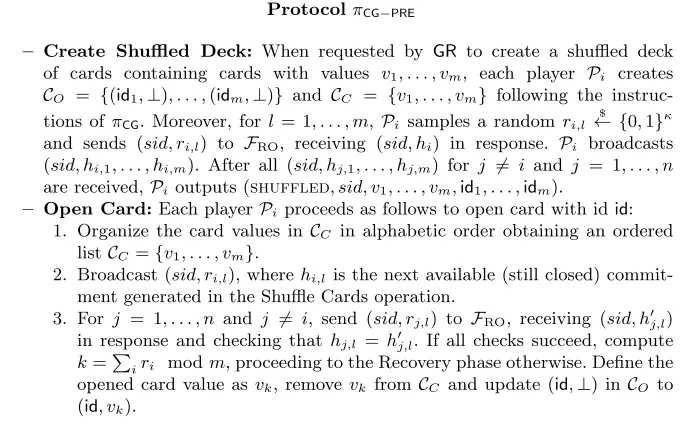
A straightforward way to execute the Open Card operation in one round is to pre-process the necessary commitments during the Shuffle Cards operation. Basically, in order to pre-process the opening ofmcards, all players broadcastm
commitments to random values in the Shuffle Cards phase. Later on, every time the Open Card operation is executed, each player broadcasts an opening to one of their previously sent commitments. Besides making it possible to open cards in only one round, this simple technique reduces the communication complexity of the Open Card operation, since each player only broadcasts one opening per card (but no commitment). However, it requires each player to store (n− 1)m commitments (received from other players) as all well as mopenings (for their own commitments). ProtocolπCG−PREis very similar to ProtocolπCG, only
differing in the Shuffle Card and Open Card operations, which are presented in Figure 12. The security of this protocol is formally stated in Theorem 2. Theorem 2. For every static active adversary A who corrupts at most n− 1 parties, there exists a simulator S such that, for every environment Z, the following relation holds:
IDEALFCG,S,Z ≈c HYBRID
ProtocolπCG−PRE
– Create Shuffled Deck: When requested by GR to create a shuffled deck of cards containing cards with values v1, . . . , vm, each player Pi creates CO = {(id1,⊥), . . . ,(idm,⊥)} and CC = {v1, . . . , vm} following the instruc-tions ofπCG. Moreover, for l= 1, . . . , m,Pi samples a randomri,l
$
← {0,1}κ and sends (sid, ri,l) to FRO, receiving (sid, hi) in response. Pi broadcasts (sid, hi,1, . . . , hi,m). After all (sid, hj,1, . . . , hj,m) for j 6= i and j = 1, . . . , n are received,Pioutputs (shuffled, sid, v1, . . . , vm,id1, . . . ,idm).
– Open Card:Each playerPi proceeds as follows to open card with idid: 1. Organize the card values inCC in alphabetic order obtaining an ordered
listCC={v1, . . . , vm}.
2. Broadcast (sid, ri,l), wherehi,lis the next available (still closed) commit-ment generated in the Shuffle Cards operation.
3. For j = 1, . . . , n and j 6= i, send (sid, rj,l) to FRO, receiving (sid, h0j,l) in response and checking that hj,l =h0j,l. If all checks succeed, compute
k=P
iri modm, proceeding to the Recovery phase otherwise. Define the opened card value as vk, removevk from CC and update (id,⊥) inCO to (id, vk).
Fig. 12.ProtocolπCG−PRE (only phases that differ from ProtocolπCG are described).
Proof. (Sketch) In order to prove this theorem we adapt the simulator con-structed for πCG (in the proof of Theorem 1) to take into consideration the
preprocessing of commitments that takes place in the Shuffle Cards phase. Our adapted simulator S proceeds exactly as the simulator for πCG except in the
following operations:
– Create Shuffled Deck: Upon receiving (shuffle, sid, v1, . . . , vm,id1, . . . ,
idm) from FCG (meaning that GR requests a shuffling operation), S
pro-ceeds exactly as an honest party in protocolπCGexcept for a special honest
party H. When simulating H, S creates CO ={(id1,⊥), . . . ,(idm,⊥)} and CC ={v1, . . . , vm}following the instructions ofπCGbut, forl= 1, . . . , m, S
samples a randomhH,l
$
← {0,1}κ. If no pair (q, h
H,l) exists in the simulated FRO’s internal list of queries/answers, S broadcasts (sid, hH,1, . . . , hH,l). Otherwise, S outputs fail and halts. If messages (sid, hj,1, . . . , hj,l) are re-ceived from all (corrupted) parties before timeoutτ,Ssends (shuffle, sid, id1, . . . ,idm) to FCG. Otherwise, it sends (abort, sid) to FCGand proceeds
to simulate the Recovery procedure.
– Open Card:Upon receiving (card, sid,id, v) fromFCG,Ssimulates honest
parties’ behavior exactly as inπCG but proceeds as follows for the special
honest partyH:
2. Check that there exist pairs (rj,l, hj,l) in the list of queries and answers of the simulatedFRO, wherehi,lis the next available (still closed) com-mitment generated in the Shuffle Cards operation. If one such pair does not exist (meaning thatAdid not obtainhj,l from the simulatedFRO), S sends (abort, sid) to FCG and proceeds to the Recovery procedure
after the adversary sends (or fails to send) a (sid, rj,l), as this message will be invalid. Otherwise,S computesrH,l such thatrH,l+P
n, j6=H j=1 rj,l modm = k where vk = v (for v provided by FCG). If a pair (rH,l, h) exists in the simulatedFRO’s internal list of queries/answers,S outputs
failand halts. Otherwise, upon receiving a query (sid, rH,l) to the sim-ulatedFRO,S answers with (sid, hH,l).S broadcasts (sid, rH,l), forcing the open card operation to result in the valuevprovided byFCGfor that
card identified byid.
3. If all messages (sid, rj,l0 ) fromAare received before timeoutτ,S checks that there exist pairs (rj,l0 , hj,l) in the list of queries/answers of the sim-ulated FRO, where (sid, hj,l) are the messages received from A in the Shuffle Cards operation. If all checks succeed,S sends (card, sid,id, v) toFCG. Otherwise, it sends (abort, sid) toFCGand proceeds to simulate
the Recovery phase.
Simulation Indistinguishability: Notice that the simulator S proceeds as the simulator constructed in proving Theorem 1, with the sole difference that it receives (resp. generates) a batches of commitments (sid, hj,1, . . . , hj,l) (resp. (sid, hH,1, . . . , hH,l)) in during the Shuffle Cards operations instead of during the Open Card operation. As before, S behaves exactly as an honest player and proceeds in a way that the Open Card operation outputs the same card value as in πCG−PRE, unless it outputs fail. The same argument of the proof
of Theorem 1 can be used to show that S only outputs fail with negligible probability in the security parameterκand that the ideal execution withS and FCGis indistinguishable from the execution ofπCG withA.
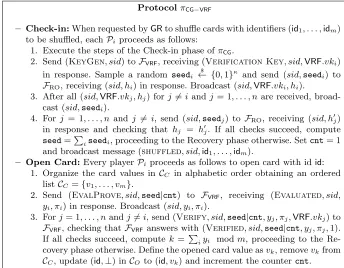
5.2 Lower Round and Space Complexities via Coin Tossing Extension
Even though the previous optimization reduces the round complexity of our original protocol, it introduces a high local space complexity overhead, since each party needs to store the preprocessed commitments. In order to achieve low round complexity without a space complexity overhead, we show that a single coin tossing can be “extended” to open an unlimited number of cards. With this technique, we first run a coin tossing in the Check-in phase, later extending it to obtain new randomness used to pick each card that is opened.