and Key Exchange
?Yunlei Zhao
Department of Computer Science, Fudan University, Shanghai, China
Abstract. Identity concealment and zero-round trip time (0-RTT) connection are two of current research focuses in the design and analysis of secure transport protocols, like TLS1.3 and Google’s QUIC, in the client-server setting. In this work, we introduce a new primitive for identity-concealed authenticated encryption in the public-key setting, referred to as higncryption, which can be viewed as a novel monolithic integration of public-key encryption, digital signature, and identity concealment. We present the security definitional framework for higncryption, and a conceptually simple (yet carefully designed) protocol construction.
As a new primitive, higncryption can have many applications. In this work, we focus on its applications to 0-RTT authentication, showing higncryption is well suitable to and compatible with QUIC and OPTLS, and on its applications toidentity-concealed authen-ticated key exchange (CAKE) and unilateral CAKE (UCAKE). In particular, we make a systematic study on applying and incorporating higncryption to TLS. Of independent in-terest is a new concise security definitional framework for CAKE and UCAKE proposed in this work, which unifies the traditional BR and (post-ID) frameworks, enjoys composabil-ity, and ensures very strong security guarantee. Along the way, we make a systematically comparative study with related protocols and mechanisms including Zheng’s signcryption, one-pass HMQV, QUIC, TLS1.3 and OPTLS, most of which are widely standardized or in use.
1
Introduction
Identity concealment and zero-round trip time (0-RTT) option are two of current research focuses in design and analysis of cryptographic systems (particularly, se-cure transport protocols for the client-server setting). By identity concealment, we mean that the transcript of protocol run should not leak participants’ iden-tity information, which is now deemed to be an important privacy concern and is mandated or recommended by a list of widely standardized and deployed cryp-tographic protocols like TLS1.3 [16], QUIC [40], EMV [8], etc. Furthermore, in-formally speaking, a player enjoys forward ID-privacy if its ID-privacy preserves even when its static secret-key is compromised. By 0-RTT option, we mean that when the client has a previously retrieved or cached public key of the server, it can optionally transmit encrypted information already in the first flow of the pro-tocol run. 0-RTT connection is highly desirable because of its significant impact on connection latency, a critical issue in most HTTP(S) content acquisitions. This
option is supported by QUIC and is now under discussion by the IETF TLS1.3 working group.
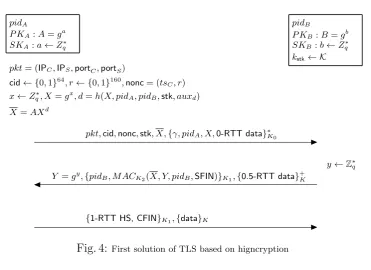
The QUIC protocol, developed by Google and already implemented with Chrome in 2013, currently stands as one of the most promising solutions to decreasing latency while intending to provide security properties similar with TLS [30]. Ac-cording to Google’s measurement, currently at least 75% of all QUIC connections use 0-RTT mode. Unfortunately, QUIC and TLS1.3 (which is underway) are now only supporting 0-RTT modewithout client authentication. One of the major ob-stacles (among others) hindering the deployment of 0-RTT client authentication, from our point of view, is that the literature lacks a cryptographic mechanism that soundly and practically integrates public-key encryption, entity authentication and ID-concealment into a single primitive. It has become a consensus that, in order for QUIC to be ubiquitous, a suitable mechanism for 0-RTT client authentication is needed.
A straightforward solution for 0-RTT client authentication is to encrypt client’s 0-RTT data and signature using server’s public-key. However, this approach has several drawbacks and is unsatisfactory.
– Firstly, such a direct composition may not be sound enough and may bring some security concerns. For example, consider the DHIES-based solution:{X =
gx, EncK(m,sig)}, where the receiver has public-key B = gb, Enc is a
CCA-secure symmetric encryption with K being derived from CDH(X, B), sig is sender’s signature on message m. If an adversary learns (m,sig), or learns the DH-exponent x (that is allowed to be exposed in our security model), it can re-encrypt (m,sig), potentially leading to sender impersonation or causing two un-matching sessions to share the same 0-RTT data and peer view. The underlying reason is that the composition of ID-concealment, encryption and entity authentication is quite loose.
– Secondly, directly composing public-key encryption and digital signature may not be efficiency economic. On the other hand, a tailored protocol construction usually not only has efficiency improvements, but also can have much more advantageous features, as witnessed by the ongoing CAESAR competition [9] on authenticated encryption (AE) even though AE can be generally achieved by composing CPA-secure encryption and MAC.
– Fourthly, sender’s signature leaves to the receiver an undeniable proof of session participance, while in many application scenarios certain kind of deniability is more desirable for privacy considerations.
In the public-key setting, authenticated encryption refers to signcryption [48], which is also standardized by ISO-29150. It is shown that signcryption is function-ally equivalent to one-pass authenticated key-exchange [35,13,20], which in turn has applications in asymmetrical key-wrapping [21]. Zheng’s signcrytion [48,2,17] and one-pass HMQV (HOMQV) [24,21] are briefly described in Appendix A. There, it is clear that sender’s public identity information (including its certificate) has to be sent in clear, as otherwise the receiver cannot derive the shared key. It would be interesting to note that, even though signcryption (1997) and one-pass MQV (1995) have been invented for about two decades, the issue of ID conceal-ment was not considered for them up to now, whether for protocol construction or for security definition. It is also interesting to note that HOMQV enjoys “receiver deniability”, in the sense that the session transcript (in particular, the authenti-cation valueσ) can be simulated from public parameters and receiver’s secret-key. In comparison, the session transcript of Zheng’s signcryption is undeniable, as the authentication valuescorresponding to sender’s signature cannot be generated by the receiver. In addition, Zheng’s signcryption suffers from the x-security defined in [21]:1 the leakage of the DH-exponent x causes the exposure of sender’s static secret-key a or the pre-shared secrecy P S (for Zheng’s signcryption, both a and
P S are exposed). This leads us to the following motivation question.
Can we come up with a cryptographic mechanism, simultaneously enjoying: (1) forward ID-privacy, (2) being relatively as efficient as HOMQV, (3) receiver deniability, and (4)
x-security?
Motivating Question 1
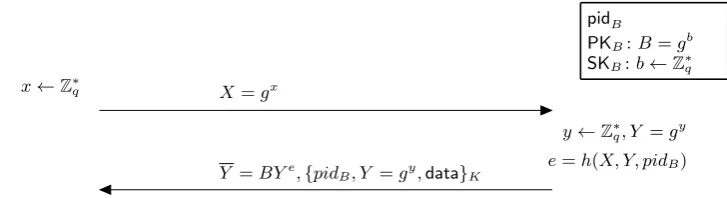
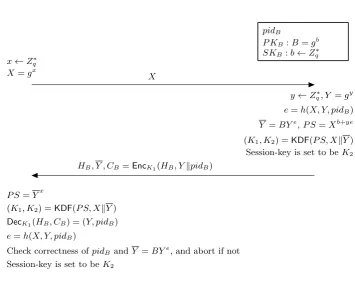
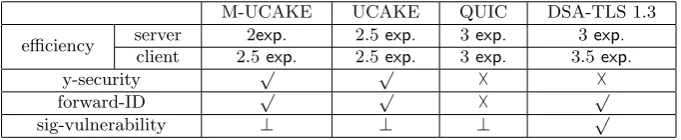
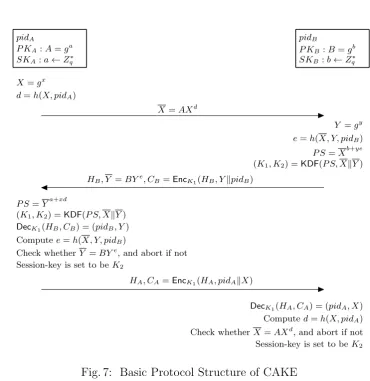
Authenticated key-exchange (AKE), in particular Diffie-Hellman (DH), plays a fundamental role in modern cryptography, bridging public-key cryptography and symmetric-key cryptography, and is the backbone of a list of network security protocols that are widely standardized and used. Up to now, the most efficient AKE protocols are (H)MQV [35,26] and OAKE [46], but none of them consid-ers ID-concealment. For AKE protocols in the client/server setting, both TLS1.3 and QUIC mandate ID-concealment. The protocol structure of QUIC, briefly de-scribed in Appendix A, is conceptually simple and enjoys the advantages of effi-ciency, receiver deniability, and deployment flexibility. However, QUIC (without 0-RTT connection) does not enjoy forward ID-privacy. Specifically, the compro-mising of server’s static secret-key will expose the shared-key K1 for encrypting
1 This is actually named asy-security in [21], where the playerpid
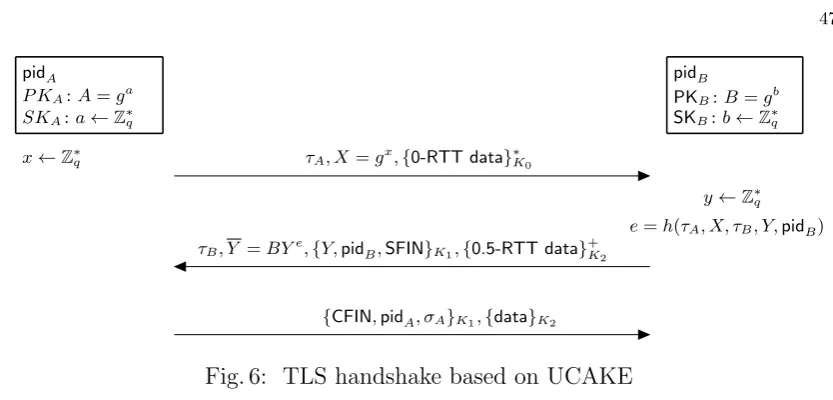
server’s DH-component Y, consequently losing server’s ID-privacy. The core au-thentication mechanism of TLS1.3 is based on the SIGMA scheme [25], which is also briefly described in Appendix A. For presentation simplicity, by TLS1.3 we mean the core authentication mechanism presented there. TLS1.3 uses signature for server authentication, which brings the following effects. On the one hand, when implementing with DSA, it can be less efficient than QUIC, and suffers from the shortcoming of DSA-type signature (i.e., the exposure of random nonce, which can be offline generated and stored for online signature generation, will cause exposure of static secret-key). On the other hand, the use of signature loses receiver denia-bility. Since its sixth version, TLS1.3 incorporates the OPTLS protocol [28], which is actually an dual version of basic mechanism of the deniable IKE (DIKE) pro-tocol proposed in [45,47]. Both DIKE and OPTLS are also described in Appendix A. Briefly speaking, DIKE/OPTLS is as efficient as QUIC, but enjoys forward ID-privacy. But none of QUIC, TLS1.3 and DIKE/OPTLS enjoys x-security, in the sense that the exposure of DH-exponent in a session exposes the session-key (for QUIC and TLS1.3) or server’s ID (for OPTLS). By comparison, (H)MQV and OAKE have x-security. This leads to the following motivation question.
Can we come up with new AKE schemes, simultaneously enjoying: (1) forward ID-privacy, (2) efficiency comparable to (H)MQV/OAKE and even better than QUIC/OPTLS, (3)x-security, (4) receiver deniability, and (5) being free of signatures?
Motivating Question 2
1.1 Contributions
In this work, we systematically solve the above two motivating questions, with novel ID-concealed authentication mechanism and new security definitional frame-works.
exposure of intermediate state, and enjoys flexible implementations and deploy-ments.
For the second motivating question, we first observe that existing security defi-nitional frameworks for AKE cannot be well applied to ID-concealed authenticated key-exchange, on the following grounds. On the one hand, traditional AKE secu-rity definition critically relies upon users’ identities to define session matching, which lies at the heart of AKE security definition. On the other hand, existing security frameworks usually do not consider ID-privacy or treat it separately from AKE security. This motivates us to present a new security definition framework, for both ID-concealed key-exchange with mutual authentication (referred to as CAKE for presentation simplicity) and ID-concealed key-exchange with unilateral authentication (referred to as UCAKE), and make in-depth discussions and clar-ifications. Then, we present protocol constructions for both CAKE and UCAKE, along with detailed discussions and comparisons with QUIC, TLS1.3 and HMQV. All the protocols developed in this work are provably secure under standard assumptions in the random oracle model. In order to support more efficient and flexible deployments while still preserving provable security, we introduce a new family of problems and assumptions related to a variant of the DL-problem, re-ferred to as flexible DL (FDL) problem, which are proven to hold in the generic group model and might be of independent interest (e.g., to leakage-resilient cryp-tography).
2
Preliminaries
IfS is a finite set then |S| is its cardinality, andx← S is the operation of picking an element uniformly at random from S. If S denotes a probability distribution,
x ← S is the operation of picking an element according to S. We overload the notion for probabilistic or stateful algorithms, writing C ← Alg to mean that algorithm Alg runs and outputs value named C. If α is neither an algorithm nor a set then x ←α is a simple assignment statement. A string or value α means a binary one, and|α|is its binary length. For two strings x, y ∈ {0,1}∗,x||ydenotes
their concatenation.
Let G0 be an abelian group of order N, and G = hgi be a unique subgroup of G0 generated by the generator g of prime order q. Throughout this work, the group law is written multiplicatively, and the length of q, i.e., |q|, serves as the security parameter. Denote by 1G the identity element ofG0, by G\1G the set of
elements of G except 1G, and by t = N/q the cofactor value. When instantiated
with groups based on elliptic curves, G0 is the group of points E(L) on an elliptic curve E defined over a finite fieldL, and G is a subgroup of E(L) of prime order
The discrete logarithm (DL) assumption over G says that given X = gx, for
x ← Zq∗, no probabilistic polynomial-time (PPT) DL-solver algorithm can out-put x with non-negligible probability. The computational Diffie-Hellman (CDH) assumption says that given X = gx, Y = gy, for x, y ← Z∗
q, no probabilistic
polynomial-time CDH-solver algorithm can computeCDH(X, Y) = gxy with non-negligible probability. The Gap Diffie-Hellman (GDH) assumption [36] says that the CDH assumption holds, even if the CDH solver is equipped with a decisional Diffie-Hellman (DDH) oracle forGandg, where on arbitrary input (U, V, Z)∈G3
the DDH oracle outputs 1 if and only if Z =CDH(U, V).
2.1 Authenticated Encryption with Associated Data
Briefly speaking, anauthenticated encryption with associated data (AEAD) scheme transforms a messageM and a public header informationH(e.g., a packet header, an IP address, etc) into a ciphertextCin such a way thatC provides both privacy (ofM) and authenticity (ofC andH) [38]. In practice, when AEAD is used within cryptographic systems, the associated data is usually implicitly determined from the context (e.g., the hash of the transcript of protocol run or some pre-determined states).
AEAD security. Let SE = (Kse,Enc,Dec) be a symmetric encryption scheme.
The probabilistic polynomial-time algorithm Kse takes a security parameter κ as
input and samples a keyKfrom a finite and non-empty setKT{
0,1}κ. For
presen-tation simplicity, we assume K ← K = {0,1}κ. The polynomial-time encryption
algorithm Enc : κ× {0,1}∗ × {0,1}∗ → {0,1}∗ ∪ {⊥} and the (deterministic)
polynomial-time decryption algorithm Enc:κ× {0,1}∗× {0,1}∗ → {0,1}∗∪ {⊥}
satisfy: for any K ← K, any associate data H ∈ {0,1}∗ and any message M ∈ {0,1}∗, if Enc
K(H, M) outputs C 6= ⊥, then DncK(C) always outputs M. Here,
we assume the ciphertext C bears the associate dataH in plain.
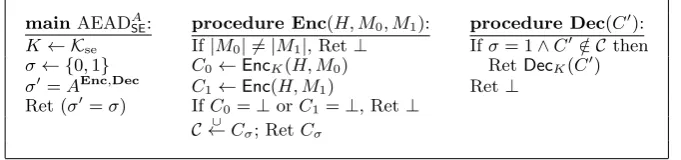
LetAbe an adversary. Table 1 describes a security game for AEAD. We define the advantage of A to be AdvaeadSE (A) = 2·Pr[AEADASE returns true]−1
. We
say that theSEscheme is AEAD-secure, if for all sufficiently largeκthe advantage of any probabilistic polynomial-time adversary is negligible.
mainAEADASE: procedure Enc(H, M0, M1): procedure Dec(C0):
K← Kse If|M0| 6=|M1|, Ret⊥ Ifσ= 1∧C0∈ C/ then
σ← {0,1} C0←EncK(H, M0) RetDecK(C0)
σ0=AEnc,Dec C1←Enc(H, M1) Ret⊥
Ret (σ0=σ) IfC0=⊥orC1=⊥, Ret⊥
C←∪ Cσ; RetCσ
The above AEAD security is quite strong. In particular, it means that, after adaptively seeing a polynomial number of ciphertexts, an efficient adversary is infeasible to generate a new valid ciphertext in the sense its decryption is not “⊥”. Also, for two independent keys K, K0 ← Kse and any message M and any
header information H, Pr[DecK0(EncK(H, M))6=⊥] is negligible.
The AEAD security definition is based on that in [39,37], with the following modifications: the length-hiding requirement is removed while header information integrity property is added. In this work, we assume users’ identities and public-key information to be of equal length; otherwise, we need length-hiding AEAD as defined in [37,27].
In general, AEAD schemes can be built upon the composition of a CPA-secure symmetric encryption scheme and a MAC scheme [3]. But until recently, authenti-cated encryption has been recognized as an importantdistinct cryptographic prim-itive both in cryptographic research and in cryptographic standardizations (e.g., the ongoing CAESAR competition [9]). The reasons are as follows [14]. Firstly, there are inappropriate composition of symmetric encryption and MACs that re-sult in insecure AEAD schemes [3,24]. Secondly, there are constructions of AEAD that escape the generic composition paradigm, and in most cases a tailored solu-tion can be noticeably more efficient or have other advantages compared to the generic composition paradigm. Finally, recognizing authenticated encryption as a distinct cryptographic primitive may conceptually simplify the design of complex protocols that require both privacy and authenticity, as witnessed by the design and analysis of secure channel establishment with AEAD in TLS/SSL [27], QUIC [30], EMV [8], etc. Currently, the most popular AEAD scheme in use may be GCM-AES [34].
2.2 General Forking Lemma
Lemma 1 (General forking lemma [4]). Fix an integer qˆ ≥ 1 and a set O
of size λ. Let C be a randomized algorithm that on input U, d1,· · · , dqˆ returns a pair, the first element of which is an integer in the range 0,· · ·,qˆand the second element of which we refer to as a side output. Let IG be a randomized algorithm that we call the input generator. The accepting probability of C, denoted acc, is defined as
Pr[J ≥1 :U ←IG;d1,· · · , dqˆ← O; (J, σ)← C(U, d1,· · · , dqˆ)]
The forking algorithmFC associated with C is the randomized algorithm that takes
Algorithm 1The Forking Algorithm FC(U)
1: Pick coinsρforC at random 2: d1,· · ·, dqˆ← O
3: (J, σ)← C(U, d1,· · ·, dq;ˆ ρ)
4: if J= 0then
5: return(0,⊥,⊥) 6: end if
7: d0J,· · ·, d 0
ˆ
q← O
8: (J0, σ0)← C(U, d1,· · ·, dJ−1, d0J,· · ·, d 0
ˆ
q;ρ) 9: if J=J0∧dJ6=d0J then
10: return(1, σ, σ0) 11: else
12: return(0,⊥,⊥) 13: end if
Let
frk = Pr [b = 1 :U ←IG; (b, σ, σ0)←FC(U)].
Then
frk ≥acc
acc ˆ
q −
1
λ
.
3
Flexible Discrete Logarithm (FDL) and Related
Problems
In this section, we introduce a class of problems that generalize the traditional DL and related problems, study their complexity in the generic group model, and discuss their applications and consequences.
We first prove the following lemma, which could be viewed as a generalized version of the Schwartz-Shoup lemma [42,43,33,31].
Lemma 2. Let Xi, 1≤i≤k, be a well-spread distribution over a subset Si ⊆Zq∗
with min-entropy λi = −log(maxx∈Si(Pr[Xi = x])) > ω(log|q|), which means Pr[Xi = x] is negligible for any x ∈ Zq (when the security parameter |q| is
suffi-ciently large). Let P(X1,· · · , Xk) be a non-zero multivariate polynomial over Zq
of total degree d, where d and k are polynomials in |q| (usually, they are small constants). The probability P(x1,· · · , xk) = 0, when xi taken independently from
Xi (i.e., xi ← Xi) for 1≤i≤k, is at most d(2−λ1 +· · ·+ 2−λk).
Proof. We prove this lemma by induction on k. Firstly, a univariate polynomial (i.e., for the case of k= 1) over the Zq has at most d roots, and thus Pr[P(x1) =
0]≤d2−λ1 forx
1 ← X1.
Secondly, consider the case of k = 2. Let e ≥ 1 be the maximal degree of x2
polynomial of degree e: P2(x2) = cexe2 + ce−1xe2−1 +· · · +c1x2 +c0, where ci,
1 ≤ i ≤ e, is a univariate polynomial in x1 of degree at most d −i, and ce is
non-zero. There are at most d−e solutions of x1 for ce = 0. Accordingly, there
are at most d−e solutions of x1 for ce = ce−1 = · · · = c0 = 0, which causes P2 to be a zero polynomial. This event occurs with probability (d−e)2−λ1. On
the other hand, if this event does not occur (i.e., for any value x1 under which P2(x2) is non-zero), there are at most e solutions of x2 for P2(x2) = 0. Thus, for x1 ← X1 and x2 ← X1, Pr[P(x1, x2) = 0]≤(d−e)2−λ1 + (1−(d−e)2−λ1)e2λ2 ≤
(d−e)2−λ1 +e2λ2 < d(2−λ1 + 2−λ2).
Now, supposing this lemma holds for case of k −1, we consider the case of
k. Let ϑ ≥ 1 be the maximal degree of xk in any term in P(x1,· · · , xk). The
polynomial P(x1,· · · , xk) can be viewed as a univariate polynomial Pk(xk) of
degree ϑ, where the coefficient of the term xϑ is a polynomial e
ϑ(x1,· · · , xk−1)
of degree at most d − ϑ. According to the assumption, Pr[eϑ(x1,· · · , xk−1) =
0]≤ (d−ϑ)(2−λ1 +· · ·+ 2−λk−1)), which is also the probability upper-bound for
causingPk to be a zero polynomial. On the other hand, conditioned on this event
does not occur (i.e., for all values (x1,· · · , xk) under whichPk is non-zero), there
are at most ϑ solutions of xk for Pk(xk) = 0. As λi > ω(log|q|), 1 ≤ i ≤ k,
and d and k are polynomial in |q|, we have d(2−λ1 +· · · + 2−λk < 1 (when |q| is sufficiently large). In summary, for xi ← Xi, 1 ≤ i ≤ k, Pr[P(x1,· · · , xk) =
0] ≤ (d−ϑ)(2−λ1 +· · ·+ 2−λk−1)) + (1−(d−ϑ)(2−λ1 +· · ·+ 2−λk−1)))ϑ2λk ≤ (d−ϑ)(2−λ1 +· · ·+ 2−λk−1)) +ϑ2λk < d(2−λ1 +· · ·+ 2−λk). LetX and Y (resp.,Z) be well-spread distributions over some subsets of ofZq∗
(resp., the uniform distribution overZq∗) with min-entropyλX andλY respecitvely.
The flexible discrete logarithm (FDL) problem is to compute x from X = gx for
x ← X. The flexible CDH (FCDH) problem is to compute CDH(X = gx, Yy) for x ← X and y ← Y. The flexible DDH (FDDH) problem is to distinguish (X =gx, Y =gy, gxy) and (X, Y, gz), for x← X,y ← Y andz ←Z∗
q. The flexible
gap Diffie-Hellman (FGDH) problem is to compute CDH(X = gx, Y = gy) for
x ← X and y ← Y with the aid of a DDH oracle. The flexible gap DL (FGDL) problem is to distinguish between gxy and gz, for x ← X, y ← Y and z ← Z∗
q,
with the aid of a DDH oracle. Notice the difference between FGDL and FDDH, where for solving FGDL the values gx and gy are not given as input.
Clearly, traditional problems of DL, CDH, DDH, GDH are special cases of their flexible counterparts, when X and Y are constrained to the uniform distribution overZq∗ with min-entropy log(q−1). The work [10] introduces a variant of the DDH problem, referred to as hybrid DDH (HDDH) for presentation simplicity, where
X is a well-spread distribution over Zq∗ while Y is the uniform distribution over
(HGDH), where X is a well-spread distribution over Zq∗ while one of X and Y is the uniform distribution overZq∗. Actually, as shall see, what we need in this work,
only for flexible efficient deployment of protocols, are the HGDH assumption and the FGDL assumption, where FGDL assumption is used only for proving forward ID-privacy of the flexible implementations.
Next, we study the complexity of FDL and related problems in the generic group model [43,31]. Roughly speaking, an algorithm is generic if it does not use the encoding of the group elements. It can only use group elements for group operations and relation verifications. There are many groups for which the fastest DL solver algorithms are generic. For example, general elliptic curves; general hyper-elliptic curves of genus 2; and subgroups of prime order q in Zp∗ when (p−
1)/q is so large that sieving methods are inefficient [41].
For presentation simplicity, in the following analysis we use Maurer’s generic group model [31] that is actually equivalent to Shoup’s model [43,22], and only count the complexity of generic steps where each generic step corresponds to an access to the generic group oracle for performing one group operation or one re-lationship verification. Also, we disregard the probability of simply and correctly guessing x ory, which happens with probability of max{2−λX,2−λY} that is neg-ligible.
Theorem 1. For an algorithm of τ generic steps for solving the FGDH problem, its success probability is upper bounded by τ3(2−λX + 2−λY) in the generic group
model.
Proof.In Maurer’s generic group model for solving the FGDH problem, the generic group oracle (GG-oracle)Ooriginally keeps three internal states (1, x, y) in a listL, wherex(resp.,y) is taken independently according to the well-spread distribution
X (resp.,Y). For presentation simplicity, we denote byL[i] the value stored in the
i-th entry of L, and we assume L[1] = 1, L[2] = x and L[3] = y. The adversary is given the indices of (1, x, y) inL, i.e., (1,2,3), and has black-box access to the GG-oracle O. For the i-th GG-oracle access corresponding to a group operation, the value computed by the GG-oracle O can be viewed as a linear polynomial of the formFi(x, y) =aix+biy+ci, where ai, bi, ci ∈Zq are determined by previous
GG-oracle accesses. The value Fi is not returned to A directly, but is stored into
a position in the internal listLwhere the position index for storingFi is indicated
by A. A is always given the ability of verifying equality relation, by which A
queries O with (i, j) and gets result whether L[i] = L[j] or not. For adversary against FGDH problem, the adversaryAis additionally allowed to query the GG-oracle with (i, j, k), and GG-oracle returns 1 if and only if L[i]L[j] = L[k] which corresponds to the DDH oracle.
than simply guessing x or y that is disregarded in the analysis). One is to cause two different Fi and Fj to collide, in the sense that aix+biy+ci =ajx+bjy+cj
where (ai, bi, ci)= (6 aj, bj, cj). In other words, (ai−aj)x+ (bi−bj)y+ (ci−cj) = 0.
By Lemma 2, this event can occur with probability at most C2
τ(2
−λX + 2−λY). Another approach for A to succeed is to cause, for some (i, j, k), thenon-zero
polynomialFiFj−Fk = 0 (if the polynomialFiFj−Fkis a zero-polynomial, it leaks
nothing). That is, (aix+biy+ci)(ajx+bjy+cj)−(akx+bky+ci) = 0 forx← X
and y← Y. Note thatFiFj−Fk is a quadratic polynomial. According to Lemma
2 by settingd = 2, this event occurs with probability at mostCτ3(2(2−λX + 2−λY)). Note that C2
τ(2
−λX + 2−λY) +C3
τ(2(2
−λX + 2−λY))< τ3(2−λX + 2−λY).
Corollary 1. For an algorithm of τ generic steps for solving the FCDH, resp., FDL, problem, its success probability is upper bounded by τ2(2−λX + 2−λY), resp.,
τ22−λX, in the generic group model.
Proof. For solving FCDH problem in the generic group model, as no DDH oracle is rendered to the adversary, A can only perform equality verification via oracle access (besides group operations). In this case, we only need to consider the proba-bility that two different polynomialsFi =aix+biy+ciandFj =ajx+bjy+cjcollide
forx← X andy← Y. This event occurs with probability at mostτ2(2−λX+2−λY). For solving FDL problem in the generic group model, the GG-oracle O origi-nally keeps (1, x) in its internal list, where x ← X. The adversary succeeds only when two different polynomialsFi =aix+ci andFj =ajx+cj collide. This event
occurs with probability at mostτ22−λX according to Lemma 2.
Theorem 2. For an algorithm of τ generic steps for solving the FDDH problem, its success probability is upper bounded by 12+τ2(2−λX+ 2−λY+ 1
q−1)in the generic group model.
Proof. In Maurer’s generic group model for solving the FDDH problem, the GG-oracle O originally keeps (1, x, y, T0, T1) in its internal list, where x (resp., y)
is taken independently according to the well-spread distribution X (resp., Y),
z ← Zq∗ and Tb =xy and T1−b = z for a random bit b ← {0,1}. The goal of the
adversary A is to guess the random bit b.
For the i-th GG-oracle access corresponding to a group operation, the value computed byOcan be viewed as a quadratic polynomial of the formFi(x, y, xy, z) =
aix+biy+cixy+diz+ei, whereai, bi, ci, di, ei ∈Zqthat are determined by previous
GG-oracle accesses. DefineGi(x, y, z) =Fi(x, y, xy, z). The advantage obtained by
A (over simply guessing the random bit b) is the probability of making two dif-ferent polynomials Gi(x, y, z) and Gj(x, y, z) colliding. The non-zero polynomial
Gi(x, y, z)−Gj(x, y, z) is of degree 2. According to Lemma 2, A succeeds with
probability at most 12 +τ2(2−λX + 2−λY + 1
Theorem 3. For an algorithm of τ generic steps for solving the FGDL problem, its success probability is upper bounded by 12+τ3(2−λX+ 2−λY+ 1
q−1)in the generic group model.
Proof. In Maurer’s generic group model for solving the FGDL problem, the GG-oracle O originally keeps (1, T0, T1) in its internal list for Tb = xy and T1−b = z,
whereb ← {0,1},x (resp.,y) is taken independently according to the well-spread distribution X (resp., Y) and z ← Zq∗. Note that O does not directly keep the value x or y. The goal of the adversary A is to guess the random bit b, with the aid of a DDH oracle.
For the i-th GG-oracle access corresponding to a group operation, the value computed by O can be viewed as a quadratic polynomial of the form Fi(xy, z) =
aixy+biz +ci, where ai, bi, ci ∈ Zq that are determined by previous GG-oracle
accesses. DefineGi(x, y, z) = Fi(xy, z). The advantage obtained byA(over simply
guessing the random bit b) is the probability of: (1) for some (i, j), making two different quadratic polynomialsGi(x, y, z) andGj(x, y, z) colliding (i.e.,Gi−Gj =
0); or (2) for some (i, j, k), making the (non-zero)quartic polynomialGiGj−Gk=
0. According to Lemma 2, the advantage is at most 12+C2
τ(2(2
−λX+ 2−λY+ 1
q−1)) + Cτ3(4(2−λX + 2−λY + 1
q−1))< 1 2 +τ
3(2−λX + 2−λY + 1
q−1).
Remark.The complexity of FDL and related problems shows that they are hard for polynomial-time algorithms at least in the generic group model. We remark that the upper-bounds proved in the above theorems and corollaries are quite loose, where we have given the solver algorithms the benefit of the doubt, and have assumed that the algorithm will succeed with any collision. In a related work by Schnorr [41], it is shown that if x is drawn uniformly at random from a subset
H ⊂ Zq∗ of size |H| ≤ p
|q|, the success probability upper-bound of a τ generic-step DL-solver is about |Hτ| (not |τH2| as established with usual analysis), which implies that DL defined over a random subset of sizep|q|is as hard as traditional DL defined over Zq∗! But the result [41] critically relies on uniform distribution over the subset H, while our result is for any distribution with super-logarithmic min-entropy.
4
Strong Security Model for Higncryption
An identity-hiding sign encryption (higncryption) scheme HC, with associated data, is specified by four polynomial-time algorithms: setup,keygen,higncrypt and
unhigncrypt.
setup: is a PPT algorithm that takes the security parameter κ as input and outputs the system parameter params to be used in the scheme. We assume the security parameter is always (maybe implicitly) encoded in params.
key-gen: is a PPT algorithm that takes the system parameter params as input and outputs a public-private key pair (pk, sk) used for higncryption and un-higncryption. For presentation simplicity, we assumeparamsis included inpk.
In this work, we assume each user has a single key pair (pk, sk), which is used both for higncryption and for unhigncryption.
higncrypt: is a PPT algorithm that takes, as input, a sender’s private key sks,
the sender’s public identity information pids = (ids, pks, certs) where certs is
sender’s certificate issued by a certificate authority (CA), a receiver’s public identity information pidr = (idr, pkr, certr), message M ∈ {0,1}∗ and
asso-ciated data H ∈ {0,1}∗ to be higncrypted. It returns a higncryptext C, or
symbol ⊥ indicating higncryption failure. The associated data H, if any, ap-pears in clear in the higncryptext C 6= ⊥. In this work, we allow a user to highcrypt a message to itself; that is, pids = (ids, pks, certs) may be equal to
pidr = (idr, pkr, certr). Also, we assume that someoffline-computable
interme-diate randomness, e.g., DH-exponents, used in generating the higncryptest C
is specified and stored in a variable STC that could be exposed to allow for a
more robust security definition.
unhigncrypt: is a deterministic polynomial-time algorithm that takes, as input, a receiver’s private key skr, the receiver’s public identity information pidr =
(idr, pkr, certr), and a higncryptext C. It outputs either (pids, M) or an error
symbol ⊥. Note that, unlike in traditional unsigncryption, unhigncrypt does not take sender’s public identity information pids as input.
The correctness for a higncryption scheme requires that, for all sufficiently large security parameterκ, any key pairs (pks, sks) and (pkr, skr) output bykey-gen(1κ),
it holds unhigncrypt(skr, pidr,higncrypt(sks, pids, pidr, H, M)) = (pids, m) for any
H, M ∈ {0,1}∗ such that higncryption(sk
s, pids, pidr, H, M)6=⊥.
We now present the strong security model for higncryption in the multi-user setting, where each user possesses a single key pair for both higncryption and unhigncrypton and can higncrypt messages to itself, and the adversary is allowed to adaptively register (dishonest) users.
by the challenger according to the specified key generation algorithm. The ad-versary is given the public keys of all the honest users initially, and can register arbitrary public keys (for dishonest parties) on its own. Denote byHONEST(reps.,
DISHONEST) the set of public identity information for all the honest (resp., dis-honest) parties in the system. Throughout this work, denote by pidi, 1 ≤ i ≤ n,
the pubic identity information of user idi, and by pids (resp., pidr) the public
identity information of the sender (resp., the receiver). The adversary is also given access to HO, UHO, EXO and Corruptoracles, as specified below.
HO: On input (pids, pidr, H, M) where pidr ∈HONESTSDISHONEST and pidr
may be equal topids,H, M ∈ {0,1}∗,HOreturnshigncrypt(sks, pids, pidr, H, M))
if pids∈HONEST, otherwise, returns⊥.HOalso stores, in private, some
spec-ified offline-computable intermediate randomness (in generating C) into STC
in order to allow for later EXO query against C.
UHO: On input (pidr, C),UHOreturnsunhigncrypt(skr, pidr, C)) ifpidr ∈HONEST,
otherwise, returns ⊥.
EXO(exposure oracle): On input C 6=⊥, EXOreturns the value stored in STC,
i.e., the offline-computable intermediate randomness used in generating C, ifC
was output by an earlierHO query. Otherwise,⊥is returned. This renders the adversary additional power, in contrast to traditional security definition of sign-crypiton, and reflects the reality of bad randomness, various side-channel at-tacks and deployment in hostile environments (plagued with spyware or virus) where offline-computable values are more vulnerable to adversarial exposure.
Corrupt: On inputpidi ∈HONEST, 1≤i≤n, this oracle returns the private key
ski of user idi.
Outsider unforgeability. Informally, the goal of an outsider unforgeability ad-versaryAOU againstHCis to forge a valid higncryptext created by anuncorrupted
honest user pids∗ for another uncorrupted honest user pidr∗, where pids∗ may be equal topidr∗, 1≤r∗, s∗ ≤n. Toward this goal,AOU is allowed to issue HO, UHO,
EXOand Corrupt queries. At the end of its execution,AOU outputs (pid
r∗, C∗) as its forgery, where pidr∗ ∈ HONEST and the associated data contained in C∗ in clear is denoted H∗. The advantage of AOU for breaking outsider unforgeability,
denoted AdvAOU,HC, is defined to be the probability of the following conditions hold:
–unhigncrypt(skr∗, pidr∗, C∗) = (pids∗, M∗), where pids∗ ∈HONEST. – AOU has not issued Corrupt(pid
s∗) query or Corrupt(pidr∗) query. But AOU is allowed to query EXO(C∗) to expose the intermediate randomness used in generating C∗.
–C∗ was not the output of HO(pids∗, pidr∗, H∗, M∗) issued byAOU. But AOU is
in particular (pids∗, pidr∗, H0, M∗) whereH0 6=H∗, and can even queryHO(pids∗, pidr∗, H∗, M∗) as long as the output returned is not equal to C∗. Also, parts of C∗ (e.g., H∗)
may appear in previous outputs of HO.
In traditional definitions of unforgeability for signcryption, AOU is required to
output (pids∗, pidr∗, M∗, C∗) as its forgery at the end of its execution, which im-plies that it “knows” the victim userpids∗ and the messageM∗ being signcrypted. By comparison, our formulation does not make such a requirement. That is, AOU
may know neitherpids∗ nor M∗, even if (pidr∗, C∗) is a valid forgery. Our security definition allows the exposure of STC∗, i.e., the intermediate randomness used for generating the target higncryptext C∗, which is also not allowed in traditional security definitions of signcryption. In addition, security of associated data was not considered in traditional security definitions of signcryption, while strong un-forgeability for the associated data is ensured by our definition. Consequently, our unforgeability formulation provides much more comprehensive and stronger security guarantee.
A higncryption scheme HC has outside unforgeability, if for any PPT adversary
AOU its advantage Adv
AOU,HC is negligible for all sufficiently large security pa-rameters. The definition of inside unforgeability is identical to that of outside unforgeability, except that oracle query Corrupt(pidr∗) is allowed to the adversary.
Insider confidentiality. Informally, the goal of an insider confidentiality adver-saryAIC is to break the confidentiality of the message as well as the public identity
information higncrypted to an uncorrupted honest target receiver by any (pos-sibly corrupted) honest sender, even if AIC is allowed to corrupt the sender and
to expose the intermediate randomness used for generating other highcyptexts. For presentation simplicity, throughout this work we assume that all the users in the system have public identity information of equal length. But our security model and protocol constructions can be extended to the general case of different lengths of identities, by incorporating length-hiding authenticated encryption in the underlying security model and protocol constructions.
–Phase 1: AIC is allowed to issue HO, UHO, EXO and Corrupt queries.
– Challenge: At the end of phase 1, AIC outputs two equal length messages
(M0, M1), an associated data H∗, and two pairs of public identity
informa-tion of equal length (pids∗
0, pidr∗) and (pids∗1, pidr∗) where pids∗0, pids∗1, pidr∗ ∈ HONEST, and submits them to the challenger. The challenger chooses a ran-dom bitσ← {0,1}, and givesAIC the challenge higncryptextC∗ =higncrypt(sk
s∗
σ, pids∗σ, pidr∗, H
∗, M
σ).
–Phase 2:AIC can continue executing as in phase 1, except askingUHO(pid r∗, C∗) or EXO(C∗) or Corrupt(pidr∗) that will cause AIC to trivially win the game.
But AIC is allowed to issue Corrupt(pid s∗
–Guess: Finally, AIC outputs a bit σ0.AIC wins the game, if σ0 =σ.
A higncryption scheme HC has insider confidentiality, if for any PPT adver-sary AIC and all sufficiently large security parameters, the adversary’s advantage
defined below is negligible:
AdvAIC,HC =|2·P r[σ0 =σ]−1|. In the above security definition, if it is required to holdpid∗s
0 =pid
∗
s1 it is
degen-erated to the traditional insider confidentiality of signcryption, which is referred to asinsider message confidentiality here. The definition of outside confidentiality is identical to that of inside confidentiality, except that neither Corrupt(pid∗s
0) nor Corrupt(pid∗s1) is allowed.
5
Protocol Construction of Higncryption
In this section, we present a practical and conceptually simple (yet carefully de-signed) scheme integrating both higncryption and one-pass identity-Concealed Au-thenticated Key-Exchange (CAKE, for short), which consists of the following four algorithms, setup,keygen, higncrypt and unhigncrypt.
Setup. On a security parameter κ, setup(1κ) returns params = (G0, N, G, g, q)
specifying the underlying group over which the GDH assumption holds (as defined in Section 2).
Key generation.On the parametersparams, for each honest useri,1≤i≤n, keygen takes xi ← Zq∗, sets pki = gxi ∈ G and ski = xi, and outputs the
key-pair (pki, ski). The binding between user identity idi and its public-key pki is
authenticated by a certificate certi issued by CA. Throughout this paper, unless
otherwise stated, we assume that CA does not mandate proof-of-possession or proof-of-knowledge (POP/POK) of secret key during public key registration, but it performs sub-group membership check for each registered public key, i.e., checking
pki ∈G\1G.2
Higncryption. LetSE = (Kse,Enc,Dec) be an AEAD scheme, where K is the
key space ofKse,h:{0,1}∗ → {0,1}l∩Zq∗ be a cryptographic hash function where
l =d|q|/2e,M ∈ {0,1}∗be the message to be higncrypted with associated dataH,
and KDF : G× {0,1}∗ → {0,1}∗ be a key derivation function. For presentation
simplicity, we denote by Alice the sender who possesses public identity information
pidA= (idA, pkA=A=ga∈G, certA) and secret-key skA=a←Zq∗, and by Bob
the receiver who possesses public identity information pidB = (idB, pkB = B =
gb ∈ G, cert
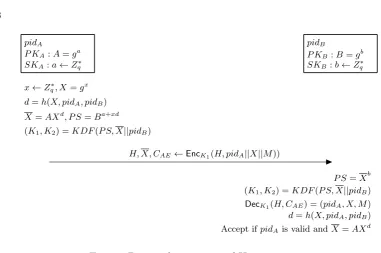
B) and secret-key skB = b ← Zq∗. higncrypt(skA, pidA, pidB, H, M)
works as follows:
2
– Take x← Zq∗, and compute X =gx ∈G, d =h(X, pid
A, pidB), and X0 =Xd.
The DH-exponent x can be generated offline, and is specified to be stored into
STC that may suffer from adversarial exposure.
– Compute X = AX0 = AXd,3 and pre-shared secrecy P S = CDH(X, B) = Ba+xd ∈G.
– Derive keys (K1, K2) =KDF(P S, X||pidB),4 where K1 ∈ K, K2 is empty for
higncryption, or K2 ∈ Kfor one-pass CAKE and in this case the joint
distribu-tion of (K1, K2) is computationally indistinguishable from uniform distribution
over K × K.
– Compute CAE ←EncK1(H, pidA||X||M). Notice that the DH-component X is
sent being encrypted.
– Finally, send the higncryptext C = (H, X, CAE) to the receiver.
Unhigncryption.After receivingC = (H, X, CAE),unhigncrypt(skB=b, pidB, C)
works as follows:
– Compute the pre-shared secrecy P S =CDH(B, X) =Xb ∈G, and derive the keys (K1, K2) =KDF(P S, X||pidB).
– RunDecK1(H, CAE). IfDecK1(H, CAE) returns⊥, abort; otherwise, get{pidA=
(idA, A, certA), X, M)}.
– Computed=h(X, pidA, pidB). IfX =AXdandpidAis valid, accept (pidA, M);
otherwise, abort.
This integrated scheme of higncryption and one-pass CAKE is also presented in Fig. 1 (page 18). Below, we make some clarifications about the construction.
Note on subgroup test ofX. In the above protocol description, we have assumed the receiver checks thatXis in the subgroupGof orderqinG0. The basic technique for performing such a subgroup test is to verifyX ∈G0\1GandX
q
= 1G. However,
if the cofactor t is small, e.g., G0 = Zp∗ such that p = 2q+ 1 is a prime, or G is the subgroup of an elliptic curve over a finite field where the cofactortis typically a small constant or just 1, the subgroup test of X can be essentially reduced to check X ∈ G0 and Xt 6= 1G, which guarantees X is not in a small subgroup of
G0 of the order being a factor of t (though it may not fully ensure X ∈ G). In practice, we recommend the following protocol variant with embedded subgroup test, whereP S =Bt(a+xd)=Xtband the receiver will abort ifX 6∈G0 orP S = 1
G.
We note that subgroup test can be waived, if the EXO queries are disallowed in security definition.
3
An alternative way is to set X = AdX, which does not sacrifice provable security. We prefer to setting X = AXd, for the reason that, as we shall see in Sectioin 7, it allows more flexible and efficient implementations.
4
Other ways to set the session-keyK2 for one-pass CAKE:K2=KDF(P S, X||pidA||pidB) orK2=
pidA
P KA:A=ga
SKA:a←Zq∗
pidB
P KB:B=gb
SKB:b←Zq∗
x←Zq∗, X=gx
d=h(X, pidA, pidB)
X =AXd, P S=Ba+xd
(K1, K2) =KDF(P S, X||pidB)
H, X, CAE ←EncK1(H, pidA||X||M))
P S=Xb
(K1, K2) =KDF(P S, X||pidB)
DecK1(H, CAE) = (pidA, X, M)
d=h(X, pidA, pidB) Accept ifpidA is valid andX=AXd Fig. 1: Protocol structure of Higncryption
On the computation of d. In order to prevent or mitigate replay attack (which is nevertheless inevitable for any signcryption or one-pass AKE), a solution is to put a time-stamptAinto the input ofd, i.e.,d=h(X, pidA, pidB, tA), and lettAbe a part
of the associated dataHor the messageM. In addition, it appears that putting the messageM into the input ofdcould possibly relax the security requirement on the underlying symmetric encryption used; but we wouldn’t prefer to such a variant on the following grounds: (1) it may damage the modularity and independence of computing X from computing C, e.g., the offline pre-computability of X without knowingM; (2) AEAD already exists in most systems for secure communications.
One-pass CAKE. It is shown in [21,20] that signcryption implies one-pass AKE by setting the message M just to be the random key. But the session-key derived this way is dependent of the session-key generated for signcryption. When casting our higncryption scheme into one-pass identity-concealed authenticated key-exchange (CAKE), we set the session-key to be K2 that is computationally
independent of the keyK1 used for higncryption; that is, the exposure ofK1 does
not affect the session-key security.5The analysis in [21,20] can be straightforwardly extended to show that this is a secure one-pass AKE. Compared to one-pass HMQV (HOMQV) [21], all the security properties of HOMQV remain with our higncrypiton-based one-pass CAKE, but our one-pass CAKE provides identity concealment.
5 Another variant is to set the session-key of one-pass CAKE to be KDF(K
1, X||pidA||pidB) or
Flexible implementation. Our higncryption scheme allows much flexible imple-mentations, according to priorities and tradeoffs among security and efficiency in different application scenarios. Let X be a well-spread distribution over some subsets of of Zq∗ with min-entropy λX > ω(log|q|). For flexible implementations
of higncryption, the only modification is: X = gx where x is taken according to
X (rather than Zq∗). As we shall show, provable security still holds with such a flexible implementation of higncryption.
In practice, at one’s own discretion according to task criticality and applica-tion scenarios, the sender can take x ← {0,1}d|q|/4e ∩Z∗
q (referred to as light
-higncryption), or x ← {0,1}d|q|/2e∩Z∗
q (referred to as medium-higncryption), or
just x← Zq∗ (referred to as full-higncryption). For example, if |q|= 512, we sug-gest |x| = 128 =|q|/4, i.e., light-higncryption, may suffice for many applications, e.g., those based on low-power devices like smart-phones where efficiency takes priority over security, or those based on devices with a trusted module to protect sender’s static secret-key. In this case, the sender only performs about 1.75 expo-nentiations, compared to 2.5 (resp., 2) exponentiations in full- (resp., medium-) higncryption. For applications based on low-power devices like smart-phones, we may recommend to use medium-higncryption, where x ← {0,1}d|q|/2e∩Z∗
q. Note
that the security of medium-higncrption, even if sender’s static secret-keyskA=a
is exposed to adversary, is not reduced to solving half a DL-problem. Actually, computingX, letting along the exponentx, fromX0 =Xh(X) seems already to be hard.
6
Security Proof of Higncryption
Assume KDF be a pseudorandom function with the following RO property, to get a value KDF(P S, $) where P S ∈ G and $ ∈ {0,1}∗ the only way is to
query the oracle KDF with input (P S, $). For presentation simplicity, in the security analysis, we simply assume KDF to be a random oracle. The security analysis can be straightforwardly extended to the case that the output of the
KDF oracle is pseudorandom (i.e., KDF is an RO with pseudorandom output). We assume the hash function halso to be a random oracle. As we concentrate on the security of the higncryption scheme, for presentation simplicity, for now we assume K1 =KDF(P S, X||pidB) (i.e., the session-key K2 for one-pass CAKE is
set to be empty). Throughout this work, for presentation simplicity, we also write
CDH(U,·) simply as CDH(pid,·) when U denotes the public-key of user pid.
Security proof of outsider unforgeability Suppose that, after a series of adaptive oracle queries to HO, UHO, EXO and Corrupt, the forger AOU outputs,
with non-negligible probability, a tuple (pidr∗, C∗) where C∗ contains in clear the associated data H∗, satisfying:
–unhigncrypt(skr∗, pidr∗, C∗) = (pids∗, M∗), butC∗was not the output ofHO(pids∗, pidr∗, H∗, M∗) issued byAOU. Note that AOU is still allowed to query HO(pid
s0, pidr0, H0, M0)
for (pids0, pidr0, H0, M0)6= (pids∗, pidr∗, H∗, M∗), and can even queryHO(pids∗, pidr∗, H∗, M∗) as long as the output returned is not equal to C∗.
–pids∗, pidr∗ ∈HONEST, andAOUhas not issuedCorrupt(pids∗) orCorrupt(pidr∗). But EXO(C∗) is allowed.
We assume the pair of honest users (pids∗, pidr∗), for which successful forgery occurs with non-negligible probability, are fixed in advance, which can actually be correctly guessed with probability at least n12 where n is the number of users
in the system. We also assume that (pidr∗, C∗) is the first successful forgery out-put by AOU; that is, it did not query UHO(pid
r, C) such that (pidr, C) is also
a valid forgery before outputting (pidr∗, C∗). All these assumptions are only for presentation simplicity.
Given (pids∗, pidr∗), the goal is to computeCDH(pks∗, pkr∗), conditioned on that unforgeability is broken with non-nelgigible probability, wherepks∗ (resp.,pkr∗) is the public-key of the sender (resp., receiver) included in pids∗ (resp., pidr∗). We present the proof directly for the case ofpids∗ =pidr∗, which is commonly viewed as the relatively harder case. The proof can be straightforwardly extended to the case of pids∗ 6=pidr∗.
Specifically, the simulatorS takes (params, pidA) as input, where the public-key
included in pidA is denoted as A = ga for a ← Zq∗ that is unknown to S, and
its goal is to compute CDH(A, A) = ga2
with the help of a DDH oracle. Note that computingCDH(A, A) is as hard as breaking the standard CDH assumption [32]. Toward this goal, S sets the public-key for user s∗ = r∗ to be A, and sets the public and secret keys for all the other honest users in the system on its own. As a consequence, S can act on behalf of all the honest users except pidA. Below
we focus on the simulation of pidA byS to deal with oracle queries made by the
forger AOU against pid A.
We first note thatScan perfectly handle allCorruptqueries allowed in the security game, whereCorrupt(pids∗) or Corrupt(pidr∗) is disallowed.
Consider a query HO(pids, pidr, H, M), where pidr is the public identity
infor-mation of an arbitrary user in the system with public-key pkr. First note that, if
pids ∈ DISHONEST, the output of HO(pids, pidr, H, M) is simply defined to be
“⊥”. Also, if pids ∈ HONEST but pids 6=pidA, this oracle query can be perfectly
handled by the simulator itself. Hence, we only consider the case of pids = pidA,
whereb←Zq∗ is the secret-key actually set by the simulator itself. For this case,S
works as the honestpidAdoes, except thatP S=CDH(X, B) is computed asX b
. Otherwise (i.e., pidr 6∈ HONEST or pidr = pidA), S computes X = gx and X =
AXd, where x←Z∗
q and d=h(X, pidA, pidr);S then setsK1 to be a string taken
uniformly at random from K of AEAD, computes CAE = EncK1(H, pidA||X||M),
and returnsC = (H, X, CAE) as the output ofHO(pidA, pidr, H, M).S also stores
the tuple (X||pidr, K1) into a list LDDH maintained by S itself and initiated to
be empty. Note that in the later case, S cannot compute the pre-shared secrecy
P S = CDH(X, pkr) and consequently KDF(P S, X||pidr). In order to keep the
consistency of the random oracleKDF, from now on whenever the adversaryAOU
makes an oracle query of the formKDF(P S0, X||pidr), based on the list LDDH S
checks whether P S0 = CDH(X, pkr) with the DDH oracle; if yes, it returns the
pre-set value K1.
In any case, the DH-exponent x ← Zq∗ stored in STC is generated by the
sim-ulator S itself. As a consequence, S can perfectly handle all the EXO queries. So far, all the simulation for HO, Corruptand EXO is perfect.
For a queryUHO(pidr, C = (H, X, CAE)) made byAOU, we only consider the case
of pidr ∈HONEST and pidr =pidA, as the rest cases can be perfectly handled by
the simulator (note that, ifpidr∈DISHONEST,UHOsimply outputs “⊥”).S first
checks whether C was ever output by HO(pids, pidA, H, M) for some M ∈ {0,1}∗
and pids ∈ HONEST, and outputs (pids, M) if so. Otherwise, for each KDF
oracle query of the form KDF(P S, X||pidA) made by AOU, the simulator checks
whether P S = CDH(X, A) by the aid of the DDH oracle. If so, the simulator gets K1 = KDF(P S, X||pidA), uses K1 to decrypt CAE, and returns the result
to AOU. Otherwise, S returns “⊥” indicating C is an invalid higncryptext (for
user pidr). Denote by “failure” the event that, for some (pidA, C = (H, X, CAE))
queried to UHO by AOU, the simulator outputs “⊥” while UHO(pid
A, C) does
not. Conditioned on the “failure” event does not occur, the simulation for UHO is perfect. Below, we show that the “failure” event can occur with at most negligible probability.
Note that the failure event has already ruled out the possibility that C was the output of HO(pidi, pidA, H, M) for arbitrary pidi ∈ HONEST and arbitrary
(H, M). We now consider the possibility that C = (H, X, CAE) is the output of
HO(pidi, pidj, H, M) made by AOU for pidj 6= pidA (and arbitrary pidi, H, M).
For this case, as X||pidj 6= X||pidA, it means that the shared-key generated
by the random oracle KDF for computing CAE and that for decrypting CAE
(when dealing with UHO(pidA, C) in defining the “failure” event) are
indepen-dent. By the security of AEAD as discussed in Section 2.1,UHO(pidA, C) outputs
⊥ with overwhelming probability. Thus, when the “failure” event occurs w.r.t.
prob-ability it holds: (1)Cwas not ever output by theHOoracle; (2)AOU did not make
the KDF(P S, X||pidA) query for P S=CDH(X, A); and (3) (H, CAE) make up
a valid AEAD ciphertext w.r.t. K1 =KDF(CDH(X, A), X||pidA).
We further consider two cases. (1)K1 =KDF(CDH(X, A), X||pidA) was set by
the simulator S when dealing with a query HO(pidA, pidA, H0, M0). In this case,S
sets K1 without querying theKDF oracle (but using its DDH oracle to ensure
in-consistency ofKDF). This implies that by theKDF security, with overwhelming probability, X is part of the output of HO(pidA, pidA, H0, M0) generated by the
simulator. Denote by (H0, X, CAE0 ) the output of the simulator S when dealing with HO(pidA, pidA, H0, M0). Note that (H0, CAE0 ) is the only AEAD ciphertext
output by S w.r.t. K1. As we assume C = (H, X, CAE)) was not ever output by
the HOoracle, it means that (H0, CAE0 )6= (H, CAE). This implies AOU has output
a new valid AEAD ciphertext (H0, CAE0 ) w.r.t.K1, which can occur with negligible
probability by the AEAD security. (2) Otherwise, with overwhelming probability,
K1 was neither set byS nor ever defined for the KDF oracle. In this case, also by
the AEAD security, “failure” occurs with negligible probability. We conclude that the failure event can occur with at most negligible probability, and consequently the view ofAOU in the simulation is computationally indistinguishable from that
in the real attack game. Thus, successful forgery occurs also with non-negligible probability in the simulation.
Denote by (pidr∗, C∗ = (H∗, X
∗
, CAE∗ )) the successful forgery output by AOU,
satisfyingunhigncrypt(skr∗, pidr∗, C∗) = (pids∗, M∗) andC∗was not ever output by
HO(pids∗, pidr∗, H∗, M∗), where pids∗ and pidr∗ are the uncorrupted honest users that are assumed to have been correctly guessed by the simulator for presentation simplicity. Recall that we are consideringpids∗ =pidr∗ =pidA.
For (pidr∗, C∗ = (H∗, X
∗
, CAE∗ )) to be a successful forgery,AOU must have made
the RO query h(X∗, pids∗, pidr∗) = d∗ such that X
∗
= pks∗X∗d ∗
= AX∗d∗ that
will be checked in computing unhigncrypt(skr∗, pidr∗, C∗), where X∗ may be gen-erated by the adversary itself. Otherwise, unhigncrypt(skr∗, pidr∗, C∗) returns ⊥ with overwhelming probability in the random oracle model. Then, similar to the above argument for showing failure occurs with negligible probability in the UHO
simulation, by the underlying AEAD securityAOU must have made the RO query
to get KDF(CDH(X∗, pkr∗), X
∗
||pidr∗) =KDF(CDH(X
∗
, A), X∗||pidA) =K1∗.
The intuitive next idea is to rewind AOU to the point that it just made the
RO queryh(X∗, pids∗, pidr∗) =h(X∗, pidA, pidA), and returns back a new random output d∗0. Then, by the general forking lemma [4], with non-negligible proba-bility AOU will also output a successful forgery (pid
r∗, C∗0 = (H∗0, X
∗0
, CAE∗0 )) in the second run after re-winding, where X∗0 = AX∗d∗0, and will make the query
KDF(CDH(X∗
0
, pkr∗), X
∗0
||pidr∗) = KDF(CDH(X
∗0
, A), X∗
0
||pidA). It means
that the simulator S can get α =CDH(X∗, pkr∗) =CDH(X
∗
AaX∗d∗a, and β = CDH(X∗0, pk
r∗) = (AX∗d ∗0
)a = AaX∗d∗0a. From (α, β), S can
compute γ =CDH(X∗, pidr∗) =CDH(X∗, A) = (α/β)(d
∗−d∗0)−1
. Finally, S com-putes CDH(A, A) =α/(γd∗), which violates the GDH assumption.
Unfortunately, a subtlety for correctly applying the forking lemma [4] is buried, and has been overlooked, in the above reasoning. The subtlety is specific to our higncryption construction, and its clarification might be of independent in-terest and be instrumental in analyzing future constructions of higncryption or other identity-hiding cryptographic schemes. Specifically, to apply the forking lemma, we need to ensure that the RO queryKDF(CDH(X∗, pkr∗), X
∗
||pidr∗) =
KDF(CDH(X∗, A), X∗||pidA) must be posterior to the RO queryd∗ =h(X∗, pids∗, pidr∗) =
h(X∗, pidA, pidA).
Denote by P S∗ = CDH(X∗, pkr∗) = CDH(X
∗
, A), where X∗ = AX∗d∗ is the
value appeared in the successful forgery. In the random oracle model, there is only one approach for AOU to make KDF(P S∗, X∗||pid
r∗) prior toh(X∗, pids∗, pidr∗). In more detail, suppose (H, X∗, CAE) = higncrypt(pidi, pidr∗, H, M), wherepidr∗ =
pidA, pidi ∈ DISHON EST or pidi ∈ HON EST but corrupted. Denote by
pki = C = gc, X
∗
= CXdi
i = Cgxidi where di = h(Xi, pidi, pidr∗). That is, the target X∗ (appeared in the successful forgery) has already appeared in a former output of higncrypt(pidi, pidr∗, H, M) for some pidi 6= pids∗, satisfying
X∗ = CXdi
i = AX∗d
∗
. Such an event is referred to as collision event. With this event, prior to the oracle queryh(X∗, pids∗, pidr∗) = d∗, theKDF(P S∗, X
∗
||pidr∗) oracle query was either made by the adversaryAOU itself or by the honest yet
cor-rupted userpidi. In either case, the adversary can compute P S∗ =CDH(X
∗
, A), where X∗ is either generated directly by AOU (on behalf dishonest or corrupted
user pidi) or derived by corrupting pidi and exposingxi.
The observation here is that, in the RO model, the collision event can occur with at most negligible probability. Specifically, for any pair of (pidi, pidj, X) 6=
(pidi0, pidj0, X0), the probability Pr[pkiXh(X,pidi,pidj) = pki0X0h(X 0,pid
i0,pidj0)] ≤ 2−l, where l is the output length of h. As the adversaryAOU is of polynomial-time t,
the probability thatA could cause thecollision event to occur during its attack is negligible (specifically, at most C2
t ·2
−l < t2·2−(l+1)). This saves the applicability
of the forking lemma to higncryption, and then finishes the proof of outsider unforgeability.
Security proof of insider confidentiality For presentation simplicity, we as-sume the challengerC has already correctly guessed the target receiverpidr∗, which happens with probability 1n. The input of C is (B, X∗), where B, X∗ ← G\1G.
Denote by B = gb and X∗ = gx∗, where b, x∗ ← Z∗
q that are however unknown
to C. The goal of the challenger C is to compute CDH(B, X∗) with the aid of a DDH oracle. Towards this goal, C sets the public-key of the target receiver to be
users in the system by itself, and will act on behalf of them. As a consequence,C
can perfectly handle the oracle queries made by the adversary AIC against all the
users other than pidr∗ = pidB. Similar to the proof of outsider unforgeability, C well simulates the target receiver pidB with the aid of its DDH oracle.
When AIC outputs two equal length messages (M
0, M1), the associated data H and two pairs of public identity information of equal length (pid∗s0, pidr∗) and (pids∗1, pidr∗), where pids∗
0, pids
∗
1, pidr∗ ∈ HONEST and it is assumed that pidr∗ = pidB, the challenger C chooses a random bit σ← {0,1} and sets the target
hign-cryptextC∗ as follows. For presentation simplicity, denote byA =pks∗
σ the public-key of the user s∗σ. Notice that it may be the case that pids∗
σ = pidr∗ and thus
A=B. C makes oracle query to get d∗ =h(X∗, pids∗
σ, pidr∗) =h(X
∗, pid
A, pidB),
where X∗ is the input of C, and computes X∗ = AX∗d∗. C checks whether the
oracle query KDF(CDH(X∗, pkr∗), X
∗
||pidr∗) = KDF(CDH(X
∗
, B), X∗||pidB)
has been made, with the aid of its DDH-oracle. If so, it outputs “failure”. Oth-erwise, it chooses K1 uniformly at random from the key space K of AEAD,
stores the tuple (X∗||pidB, K1) into the list LDDH, computes and returns CAE∗ =
EncK1(H, pids∗σ||X
∗||M
σ). From this point on, with the aid of its DDH oracle and
the listLDDH, wheneverCfindsAIC makes the queryKDF(CDH(X
∗
, B), X∗||pidB)
it just returns K1 and recordsCDH(X
∗
, B).
First observe that, in the random oracle model, X∗d∗ =gx∗d∗ is distributed uni-formly at random over G\1G, where x∗ ← Zq∗ and h is assumed to be an RO.
Consequently,X∗ =AX∗d∗ is distributed uniformly overG\1
G, even ifAIC knows
sks∗0 and sks∗1 by user corruptions. This ensures that, on the one hand, C outputs
“failure” with negligible probability; and on the other hand, X∗ perfectly hides the sender’s identity information, even if both of pids∗
0 or pids∗1 are corrupted.
Then, by the AEAD security, to win the insider confidentiality game in the RO model, AIC has to make the oracle query KDF(CDH(X∗, B), X∗||pid
B) with
non-negligible probability. We remark that X∗ being of distribution computation-ally indistinguishable from uniform distribution over G\1G suffices for the proof
here. For flexible implementations of higncryption where x is taken over a well-spread distribution with min-entropy greater than ω(log|q|), by the flexible gap DL (FGDL) assumption introduced in Section 3,X∗d∗ (and consequentlyX∗) has
distribution computationally indistinguishable from the uniform distribution over
G\1G in the RO model.
Then,C rewindsAIC to the point of making the oracle query h(X∗, pid
A, pidB),
and redefinesd∗0 =h(X∗, pidA, pidB), whered∗0is taken uniformly at random from
the range ofh that is different fromd∗ with overwhelming probability, and re-runs
AIC from this rewinding point. By the forking lemma, with also non-negligible
probability, AIC will make the oracle query KDF(CDH(X∗0, B), X∗0||pid B) in
β =CDH(X∗0, B) =AbX∗bd∗0,C computesCDH(X∗, B) = (α/β)(d∗−d∗0)−1
, which violates the GDH assumption.
7
Discussion and Applications of Higncryption
7.1 Brief Comparison
A brief comparison, among m-higncrypton (referring to medium higncryption), higncryption, (Zheng’s) signcryption, and HOMQV, is given in Table 2. There, we only count the number of modular exponentiations (denoted “exp.” in the table) for efficiency comparison.
m-higncryption higncryption signcryption HOMQV efficiency sender 2exp. 2.5exp. 1exp. 2exp.
receiver 1.5exp. 1.5exp. 2exp. 1.5exp.
forward-ID √ √ " "
x-security √ √ " √
receiver-deniability √ √ " √
Table 2:Comparison with Zheng’s signcrypton and HOMQV
7.2 Application to QUIC
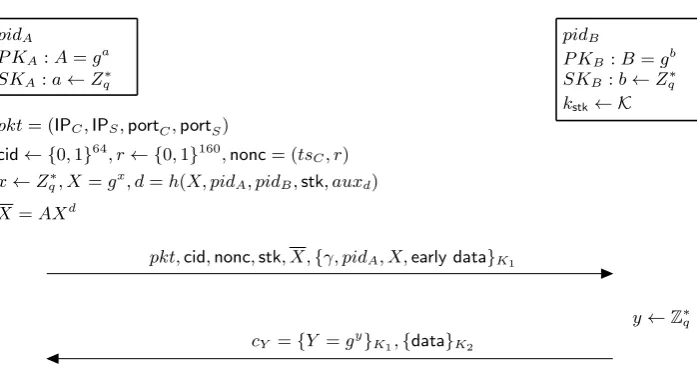
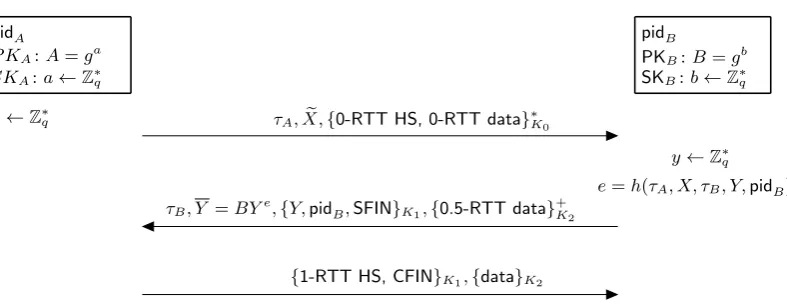
We note that higncryption is well compatible with the 0-RTT mode of QUIC, and can be easily implemented. Below, we first review the QUIC protocol according to the specifications given in [30]. Here, for presentation simplicity, the following protocol description does not fully coincide with (and omits many of) the technical details of QUIC.
QUIC supports two connection modes [30]: 1-RTT handles the case when the client tries to achieve a connection with a server for the first time in a particular time period. 0-RTT considers the case when the client is trying to connect to a server that it has already established at least one connection within that time period. In the initial connection within a time period, the server generates and sends to the client a state information stk, which is an AEAD encryption of the concatenation of the client’s IP address (IPC,IPS,portC,portS) and the time-stamp
of the servertsS.stkplays a role similar to that of the session ticket in TLS, which
can be used by the client in later 0-RTT connection (as long as it does not expire and the client does not change its IP-address).
After getting stkand server’s public identity information denotedpidB here, the