PROCESSING-INDUCED MODIFICATIONS OF NATIVE
BOVINE MILK PROTEINS IN RELATION TO
IMMUNOGENICITY
A thesis submitted in fulfilment of the requirements of the degree of
Doctor of Philosophy
by
Dimuthu Kumara Bogahawaththa Hewa Bogahawaththage
B.Sc. (Hons), M.Sc.
College of Health and Biomedicine
Victoria University
Melbourne, Australia
Dedicated to my beloved parents,
i
Abstract
Bovine milk proteins are a source of high-quality proteins in the human diet. Raw milk
is subjected to different processing treatments prior to human consumption to ensure food
safety and extend the shelf life. However, the thermal processing including high-temperature
short-time (HTST) pasteurization and ultra-high temperature (UHT) treatment and alternative
nonthermal methods including application of high pressure (HP) appear to modify the native
properties of milk proteins. The processing induced modifications in protein structure, mainly
denaturation and aggregation, and associated changes in epitopes can modulate the
immunogenicity and potential allergenicity of milk proteins. The severity of some processing
conditions appears to alter the native minor proteins including immunoglobulins (Ig), which
may otherwise exert immunomodulatory properties in such a way as to prevent occurrence of
allergies. Bovine or cow’s milk protein allergy (CMPA) is an abnormal immunological reaction
to one or more milk proteins and it is the most prevalent food allergy among infants globally.
Hence, the overall aim of this study was to identify the modification of native milk proteins
induced by selected thermal (heating at 72 for 15 s and 100 °C for 30 s) and nonthermal
processing conditions (application of HP at 400, 500, or 600 MPa for 15 min at 30 °C) and to
establish their impact on modulation of in vitro immunogenicity as a means of envisaging
potential allergenicity.
Processing induced changes in secondary structure of proteins were studied by Fourier
transform infrared spectroscopy (FTIR), and protein denaturation and aggregation were mainly
examined using sodium dodecyl sulphate polyacrylamide gel electrophoresis (SDS-PAGE) and
size exclusion chromatography (SEC). Changes in antigenicity of milk proteins followed by
processing was studied by enzyme-linked immunosorbent assay (ELISA). Modulation of in
ii
by human peripheral blood mononuclear cells (PBMCs) in response to native and processed
milk proteins.
Thermal denaturation of bovine IgG was studied alone and in the presence of major
whey proteins. The two heating regimes studied provided the simulated thermal effect
compared to HTST (72 °C/ 15 s) and UHT (100 °C/ 30 s equivalent to 140 °C/ 5 s in terms of
denaturation of β-lactoglobulin) conditions. Simulated HTST conditions least impacted on the
secondary structure of IgG and other whey proteins when they were present either alone or in
mixtures of whey proteins. The heating at 100 °C for 30 s caused formation of covalent
complexes of IgG alone, as well as in the mixtures, mainly through thiol-disulfide reactions.
Under 100 °C /30 s treatment, bovine serum albumin (BSA) did not interact with IgG through
thiol-disulfide reactions in a binary mixture of proteins (IgG+BSA). α-Lactalbumin (ALA)
appeared to preferentially lead denaturation of whey proteins over β-lactoglobulin (BLG), in a
protein mixture (BLG+ALA+IgG+BSA), while native whey contains another component that
can inhibit this effect. The presence of other whey proteins did not contribute to thermal
stability of IgG at 100 °C for 30 s.
Residual antigenicity of a processed proteinis a marker of potential allergenicity. Other
milk proteins affect thermal denaturation of bovine BLG and modulate its antigenicity.
Denaturation of BLG and altered antigenicity were studied in protein mixtures during 72 °C/
15 s and 100 °C/ 30 s treatments. BLG denaturation, affected by other proteins, correlated with
altered antigenicity. The treatment at 72 °C/ 15 s enhanced antigenicity in BLG+ALA mixture
possibly due to exposed epitopes in unfolded structure, while it did not affect other protein
mixtures. The treatment at 100 °C/ 30 s resulted in BLG-led protein aggregation by
thiol/disulphide interactions and declined antigenicity by fragmentation and masking of
epitopes to a different extent depending on the mixture. IgG contributed to diminish
iii
ALA over BLG in BLG+ALA+IgG+BSA mixture, was possibly catalysed by BSA at 100
°C/30 s, resulting in a higher retention of antigenicity than other mixtures.
In vitro immunogenicity of various native and thermally processed (72 °C / 15 s and
100 °C /30 s) bovine milk protein fractions, their mixtures, whey, and skim milk, was studied
by analysing the immune response of T helper (Th) cells in human PBMCs. The secretion of
Th types cytokines induced by the protein stimulants was quantified, while determining the
heat-induced protein denaturation. Purified whey proteins, caseins and whey fraction, and skim
milk, provoked substantial immune responses at various degrees, indicating their potent
immunogenicity. The protein mixtures prepared using the fractionated whey proteins with or
without caseins appeared less immunogenic in both native and heat-treated forms, implying
their potential of producing less immunogenic dairy products. The treatment at 100 °C/ 30 s
significantly altered the immunogenicity of most of the potent protein stimulants, which mostly
coincided with their levels of protein denaturation. The treatment at 72 °C / 15 s caused least
protein denaturation but altered the immunogenicity of several protein stimulants notably
including heat-stable caseins and ALA.
High pressure processing (HPP), conducted at 400, 500 or 600 MPa for 15 min at 30
°C, of raw skim milk was studied in comparison to HTST pasteurization (72 °C/ 15 s),
considering protein denaturation and in vitro immunogenicity. HTST pasteurization least
impacted denaturation of native proteins leading to mostly unchanged milk immunogenicity.
HPP resulted in denaturation of whey proteins, mostly BLG and IgG, and disturbed structure
of the casein micelle. HPP at 600 MPa caused protein aggregation, involving mainly BLG and
κ-casein, through thiol disulphide interactions. ALA was least denatured subjected to all HPP
conditions. The balance between expression of Th1 and Th2 type cytokines, which is believed
to regulate adverse immune response, was initially shifted toward Th1 with increase in HP,
iv
to exposure of T cell-specific linear epitopes followed by unfolding of protein structure firstly
and masking of them by protein aggregation subsequently with increase in high pressure.
In overall, the conditions applied in raw milk processing should be further optimised in
considering modifications of native milk proteins and subsequent modulation of their
immunogenicity, in addition to ensuring the food safety, to make the final dairy product both
hygienic and hypoallergenic. Mild heat treatments (< 72 °C) or combined mild processing, for
instance application of HP below 400 MPa in combination with low temperature (< 50 °C),
vii
Acknowledgements
First and foremost, I would like to express my sincere gratitude to my principal
supervisor, Professor Todor Vasiljevic, for his guidance, patience, motivation, and immense
knowledge throughout the course of study. I am proud and honoured to be supervised by a
scholar of his calibre.
My sincere thank also goes to my co-supervisor, Dr. Jayani Chandrapala, for her
advices, inspiration, and contribution in conducting the research. I am thankful to Dr. Ossana
Donkor, Dr. Roman Buckow, Dr. Lata Ramchandran, Dr. Muditha Dissanayake, Dr. Samantha
Liyanaarachchi, Dr. Rabia Ashraf, Dr. Senaka Ranadheera, Dr. Asitha Siriwardhana, Dr. A.
W. Wijeratne and Dr. Pushpa Malkanthi for their support and valuable contribution.
I deeply appreciate the technical support and guidance provided by the technical staff
at Werribee campus, Stacey Lloyd, Joseph Pelle, Chairmane DiQuattro, Min Nguyen, Mary
Marshall and Larruceo Bautista.
I would also be grateful to my fellow colleagues, Tohedar Rahaman, Mohamad Nur, Baidya
Sah, Md. Faisal, Fateh Ahtesh, Anbharasi Vanangamudi, Kavitha Sreehari, Vaishali Chavan,
Swati Garg, Anthony Ike, Vasambal Manikkam, Manjula Nishanthi, Nuwan Vithanage,
Manpreet Grewal, Gangani Uduwerella, Anushka Mediwaththe, Chathuri Piyadasa, Robin
Wilson, Zeinab Ahamed, Tatijana Markoska, Biljana Trajkovska, and all others for their
support and friendship.
I sincerely thank Australian Postgraduate Award (APA) scheme for granting funds for
this study and Murray Goulburn Co-operative (VIC, Australia) for providing the raw milk
samples.
Finally, I would like to express my heartiest regards to my wife, daughter, and son for
ix
Table of contents
Abstract i
Certificate v
Declaration vi
Acknowledgements vii
Details of included papers viii
Table of contents ix
List of abbreviations and units x
Chapter 1: Introduction 1
Chapter 2: Review of literature 13
Chapter 2A: Modulation of milk immunogenicity by thermal processing 14
Chapter 2B: Supplementary literature review 27
Chapter 3: Thermal denaturation of bovine immunoglobulin G and its
association with other whey proteins
68
Chapter 4: Thermal denaturation of bovine β-lactoglobulin in different
protein mixtures in relation to antigenicity
79
Chapter 5: In vitro immunogenicity of various native and thermally
processed bovine milk proteins and their mixtures
91
Chapter 6: Comparison between thermal pasteurization and high pressure
processing of bovine skim milk in relation to denaturation and
immunogenicity of native milk proteins
105
x
List of abbreviations and units
˚C = degree Celsius
ALA = alpha-lactalbumin
BLG = beta-lactoglobulin
BSA = bovine serum albumin
CCP = colloidal calcium phosphate
CD = circular dichroism
CMPA = cow’s milk protein allergy
CNS = caseins
Cys = cysteine
DSC = differential scanning calorimetry
ELISA = enzyme-linked immunosorbent assay
Fab = facilitated allergen binding
FTIR = fourier transform infrared spectroscopy
g = gram
GLM = general linear model
h = hour
HCl = hydrochloric acid
HP = high pressure
HPP = high pressure processing
HTST = high-temperature short-time
Ig = immunoglobulin
IL= interleukin
kDa = kilodalton
kg = kilogram
xi
L = litre
LF = lactoferrin
MHC = major histocompatibility complex
min = minute
mL = millilitre
mM = millimolar
MPa = mega pascal
MW = molecular weight
ng = nanogram
PAGE = polyacrylamide gel electrophoresis
pH = hydrogen ion concentration
RFI = relative fluorescence intensity
RT = room temperature
s = second
SAS = statistical analysis software
SDS = sodium dodecyl sulphate
SEM = standard error of the mean
SH = thiol group
SS = disulphide
TEM = transmission electron microscopy
UHT = ultra-high temperature
V = volts
v/v = volume per volume
w/w = weight per weight
W = watt
xii
WPC = whey protein concentrate
α = alpha
β = beta
κ = kappa
μ = micro
μg = microgram
μL = microliter
Chapter 1: Introduction
This chapter presents an introduction to the thesis including background information, aim and
1.1 Background
Bovine or cow’s milk is considered a balanced and nutritive food in human diet. It is
also an important food source for infants, being a substitute for human breast milk (Pereira,
2014). The production of whole fresh cow’s milk in the world has been reported to be about
660 million tonnes in 2016 (FAO stat, 2016). Apart from the nutritional importance,
epidemiological studies frequently reported the potential contribution of cow’s milk
consumption in preventing several chronic conditions in human health including
cardiovascular diseases, some cancers, obesity, and diabetes. Cow’s milk protein allergy
(CMPA) and lactose intolerance are the commonly prevalent adverse reactions to cow’s milk
consumption (Downs, Kabourek, Baumert, & Taylor, 2013; Pereira, 2014).
Cow’s milk is a major source of proteins, containing approximately 3-4 % (w/w), which
are regarded as high-quality proteins in terms of the human amino acid requirement,
digestibility, and bioavailability. The essential amino acid score and protein-digestibility
corrected amino acid score frequently classify milk protein as the best source of proteins. Apart
from the nutritive value, milk proteins and their peptides perform various favourable biological
functions in human body including antibacterial, antiviral, antifungal, anticancer, antioxidant,
antihypertensive, and immunomodulatory roles. Caseins and whey proteins are the major
proteins fractions present in cow’s milk, approximately representing 80 and 20% of total
proteins, respectively, which possess different physicochemical properties (Downs et al., 2013;
Mills, Ross, Hill, Fitzgerald, & Stanton, 2011; Pereira, 2014; Sah, Vasiljevic, McKechnie, &
Donkor, 2015).
Processing of raw milk is a well-established practice in the present dairy industry, as
well it is a mandatory requirement of many countries, to ensure the food safety and extend the
shelf life prior to human consumption, considering the presence of pathogenic microorganism
including pasteurization and ultra-high temperature (UHT) treatment, is the traditional and
commonly applied method in processing of raw milk (O’Connell & Fox, 2003). High pressure
processing (HPP) is an emerging nonthermal technology, which is also considered an
alternative for thermal processing (Georget et al., 2015). However, the processing of raw milk
can modify the native properties of milk proteins. In native proteins, depending on the sequence
of amino acids and various intramolecular forces (e.g., hydrophobic interactions, hydrogen
bonding, electrostatic interactions, and disulfide bonds), primary structure folds into several
secondary and tertiary structures and subsequently form a uniquely folded native conformation,
which is usually present in a stable form at minimum energy status. However, the processing
conditions including application of heat and HP usually create an imbalance among
intramolecular forces resulting in structural modifications leading to protein denaturation and
aggregation (Bu, Luo, Zheng, & Zheng, 2009; Davis & Williams, 1998; Huppertz, Fox, de
Kruif, & Kelly, 2006; Huppertz, Kelly, & Fox, 2002).
The structural modifications of milk proteins induced by heating have been extensively
studied especially in considering major proteins such as caseins, BLG, and ALA, as well their
interactions. However, the structural modifications of minor proteins including
immunoglobulin (Ig) and their association with other major proteins during heating are
relatively less researched (Considine, Patel, Anema, Singh, & Creamer, 2007; Huppertz, 2016;
Wijayanti, Bansal, & Deeth, 2014). Although several studies have considerably investigated
the impact of HPP on milk proteins, their focus were largely on main milk proteins (Huppertz
et al., 2006; Patel, Singh, Anema, & Creamer, 2006).
Epitopes are present in the structure of almost all the milk proteins, which render them
antigenic and/ or allergenic, or commonly immunogenic (Wal, 2002). Immunogenicity is the
ability of a substance to elicit an immune response (Abbas, Pillai, & Lichtman, 2014). Epitope
complementary site of an antibody (Wal, 2002). CMPA is an abnormal immunological reaction
to one or more milk proteins (El-Agamy, 2007). CMPA is the most prevalent food allergy
among infants approximately 2-6 % (Host & Halken, 2014; Kim et al., 2011) and milk protein
is one of the eight food allergens, which account for about 90% of food allergenic incidents
frequently reported in the world (Downs et al., 2013). Although the complete elimination of
milk consumption is considered as a reliable approach to reduce the risk of milk allergy, it
would result in malnutrition especially in infants. The nutritional quality of the infant formulae
(containing hydrolysed milk proteins) recommended for milk allergic infants also appears to
be compromised (Clemente, 2000; Crittenden & Bennett, 2005; Hernell & Lönnerdal, 2003;
Sathe, Teuber, & Roux, 2005).
Processing induced structural changes in a protein can modify the immunogenic
epitopes in many ways including fragmentation, modification, masking, and unmasking, which
in turn result in either decreased, increased, or unchanged allergenicity (Rahaman, Vasiljevic,
& Ramchandran, 2016). Hence, the investigations are directed toward modulation of the
potential allergenicity of milk proteins through the application of various processing methods
and conditions (Bu, Luo, Chen, Liu, & Zhu, 2013; Shriver & Yang, 2011; Verhoeckx et al.,
2015). For instance, the antigenicity of bovine β-lactoglobulin (BLG), one of the major protein
allergen, can be modulated through the application of heat and HP. The antigenicity of BLG
was gradually enhanced with increase in temperature up to 80-90 °C and decreased rapidly
with further increase in temperature, which corresponded to the unfolding of native
conformation initially and subsequent protein aggregation at higher temperatures, respectively
(Kleber & Hinrichs, 2007; Kleber, Krause, Illgner, & Hinrichs, 2004). The application of HP
resulted in modification of protein structure leading to enhanced antigenicity at 400-600 MPa
The modification of native proteins and thereby modulation of their immunogenicity
and potential allergenicity appear to depend on several factors including the type of processing
method (e.g., heating and HP), severity of the treatment, treatment duration, physicochemical
properties of the protein, nature of the medium (e.g., milk, whey, and buffer) and other
environmental factors (e.g., pH) and importantly influence of the other milk proteins present
in the medium (Bu et al., 2013; Rahaman, Vasiljevic, & Ramchandran, 2015; Rahaman et al.,
2016; Shriver & Yang, 2011). Although many studies have investigated the processing induced
modifications of the major milk proteins (e.g., caseins, BLG, ALA), mostly one at a time, in
relation to modulation of antigenicity or immunogenicity (Bloom et al., 2014; Bu et al., 2009;
Kleber et al., 2007), most of them have not considered how other milk proteins, especially
minor whey proteins including Ig present in the medium, influence these changes. Moreover,
the existing literature still fails to establish as to how processing methods and conditions
modulate the immunogenicity of various isolated protein fractions and how they can be applied
in milk processing for the benefit of milk protein sensitive people (Bu et al., 2013; Shandilya,
Kapila, Haq, Kapila, & Kansal, 2013).
Apart from the antigenic and allergenic properties of the milk proteins, cow’s milk as a
biologically active fluid plays various immunomodulatory roles in human immune system
(Cross & Gill, 2000; Madureira, Pereira, Gomes, Pintado, & Malcata, 2007; Perdijk, van
Splunter, Savelkoul, van Neerven, & Brugman, 2018), which could, however, alter upon
subjecting to different processing conditions including thermal pasteurization (Høst &
Samuelsson, 1988; McCarthy, Ross, Fitzgerald, & Stanton, 2015). A several epidemiological
studies reported the potential contribution of raw milk (not heated to 72 °C) consumption
toward development of protection against allergies and asthma (Loss et al., 2011; MacDonald
et al., 2011; Sozanska, Pearce, Dudek, & Cullinan, 2013; Waser et al., 2007). Further studies
these positive health outcomes (Loss et al., 2011; van Neerven, Knol, Heck, & Savelkoul,
2012). Moreover, the minor whey proteins including IgG, BSA and lactoferrin (LF) are
suggested to play a vital role (Brick et al., 2017; Loss et al., 2011; Perdijk et al., 2018; van
Neerven et al., 2012). However, it is not yet clear which protein fraction contributes to what
and how since no controlled human studies (in vivo) have been conducted due to ethical
concerns in ingestion of raw milk (Perdijk et al., 2018; van Neerven et al., 2012; Verhoeckx et
al., 2015). This highlights the necessity of conducting in vitro studies to examine the ability of
native and processed milk proteins to modulate the human immune system differently.
1.2 Research aim and objectives
The overall aim of this study was to identify modifications of native milk proteins
induced by selected thermal and nonthermal processing methods and to establish their impact
on modulation of in vitro immunogenicity.
The specific objectives were:
i. To establish the impact of thermal processing on the modification of native protein
fractions and their interactions.
ii. To relate the modification of native protein fractions induced by thermal processing to
their antigenicity.
iii. To examine in vitro immunogenicity of various native and thermally processed milk
protein fractions and their mixtures in envisaging potential allergenicity.
iv. To assess the HPP as an alternative method for thermal pasteurization in terms of
modification of the native milk proteins and modulation of in vitro immunogenicity.
1.3 Thesis outline
This thesis contains 7 chapters. Chapter 1 presents an introduction to the thesis including
critically reviews the literature relating to the study and highlights the fundamental concepts
and key research findings. Chapter 3 details the thermal denaturation of bovine IgG and its
association with other milk proteins. Chapter 4 explains the effect of other milk proteins on
thermal denaturation and antigenicity of bovine BLG. Chapter 5 examines in vitro
immunogenicity of various native and thermally processed milk protein fractions and their
mixtures. Chapter 6 assesses the HPP as an alternative method for thermal pasteurization based
on processing induced changes in native proteins and in vitro immunogenicity. Chapter 7
delivers conclusions of the entire project and the scope for future work.
References
Abbas, A. K., Pillai, S., & Lichtman, A. H. (2014). Basic Immunology : Functions and Disorders of the Immune System (Vol. 4th ed. Abul K. Abbas, Andrew H. Lichtman,Shiv Pillai ; illustrations by David L. Baker, Alexandra B). Philadelphia, Pa:
Saunders.
Bloom, K. A., Huang, F. R., Bencharitiwong, R., Bardina, L., Ross, A., Sampson, H. A., &
Nowak-Wegrzyn, A. (2014). Effect of heat treatment on milk and egg proteins
allergenicity. Pediatric Allergy and Immunology, 25(8), 740-746.
Brick, T., Ege, M., Boeren, S., Böck, A., Von Mutius, E., Vervoort, J., & Hettinga, K. (2017).
Effect of processing intensity on immunologically active bovine milk serum proteins.
Nutrients, 9(9), 963.
Bu, G., Luo, Y., Chen, F., Liu, K., & Zhu, T. (2013). Milk processing as a tool to reduce cow’s
milk allergenicity: a mini-review. Dairy Science & Technology, 93(3), 211-223. Bu, G., Luo, Y., Zheng, Z., & Zheng, H. (2009). Effect of heat treatment on the antigenicity of
bovine α-lactalbumin and β-lactoglobulin in whey protein isolate. Food and
Claeys, W. L., Cardoen, S., Daube, G., De Block, J., Dewettinck, K., Dierick, K., . . . Herman,
L. (2013). Raw or heated cow milk consumption: Review of risks and benefits. Food
Control, 31(1), 251-262.
Clemente, A. (2000). Enzymatic protein hydrolysates in human nutrition. Trends in Food
Science & Technology, 11(7), 254-262.
Considine, T., Patel, H. A., Anema, S. G., Singh, H., & Creamer, L. K. (2007). Interactions of
milk proteins during heat and high hydrostatic pressure treatments — A Review.
Innovative Food Science & Emerging Technologies, 8(1), 1-23.
Crittenden, R. G., & Bennett, L. E. (2005). Cow’s Milk Allergy: A Complex Disorder. Journal
of the American College of Nutrition, 24(sup6), 582S-591S.
Cross, M. L., & Gill, H. (2000). Immunomodulatory properties of milk. British Journal of Nutrition, 84(S1), 81-89.
Davis, P., & Williams, S. (1998). Protein modification by thermal processing. Allergy, 53(s46), 102-105.
Downs, M. L., Kabourek, J. L., Baumert, J. L., & Taylor, S. L. (2013). Milk protein allergy.
Milk and Dairy Products in Human Nutrition: Production, Composition and Health, 111-128.
El-Agamy, E. I. (2007). The challenge of cow milk protein allergy. Small Ruminant Research,
68(1-2), 64-72.
FAO stat. (2016). Retrieved from http://www.fao.org/faostat/en/#data.
Georget, E., Sevenich, R., Reineke, K., Mathys, A., Heinz, V., Callanan, M., Rauh, C. and
Knorr, D. (2015). Inactivation of microorganisms by high isostatic pressure processing
in complex matrices: A review. Innovative Food Science & Emerging Technologies,
Hernell, O., & Lönnerdal, B. (2003). Nutritional evaluation of protein hydrolysate formulas in
healthy term infants: plasma amino acids, hematology, and trace elements. The
American journal of clinical nutrition, 78(2), 296-301.
Holsinger, V., Rajkowski, K., & Stabel, J. (1997). Milk pasteurisation and safety: a brief history
and update. Revue Scientifique et Technique-Office International des Epizooties, 16(2),
441-466.
Host, A., & Halken, S. (2014). Cow’s Milk Allergy: Where have we Come from and where are
we Going? Endocrine, Metabolic & Immune Disorders-Drug Targets (Formerly
Current Drug Targets-Immune, Endocrine & Metabolic Disorders), 14(1), 2-8. Høst, A., & Samuelsson, E. G. (1988). Allergic reactions to raw, pasteurized, and
homogenized/pasteurized cow milk: a comparison. Allergy, 43(2), 113-118.
Huppertz, T. (2016). Heat stability of milk Advanced dairy chemistry (pp. 179-196): Springer.
Huppertz, T., Fox, P. F., de Kruif, K. G., & Kelly, A. L. (2006). High pressure-induced changes
in bovine milk proteins: a review. Biochimica et Biophysica Acta (BBA)-Proteins and
Proteomics, 1764(3), 593-598.
Huppertz, T., Kelly, A. L., & Fox, P. F. (2002). Effects of high pressure on constituents and
properties of milk. International Dairy Journal, 12(7), 561-572.
Kim, J. S., Nowak-Wegrzyn, A., Sicherer, S. H., Noone, S., Moshier, E. L., & Sampson, H. A.
(2011). Dietary baked milk accelerates the resolution of cow’s milk allergy in children.
Journal of Allergy and Clinical Immunology, 128(1), 125-131.
Kleber, N., & Hinrichs, J. (2007). Antigenic response of β-lactoglobulin in thermally treated
bovine skim milk and sweet whey. Milchwissenschaft, 62(2), 121-124.
Kleber, N., Krause, I., Illgner, S., & Hinrichs, J. (2004). The antigenic response of
β-lactoglobulin is modulated by thermally induced aggregation. European Food Research
Kleber, N., Maier, S., & Hinrichs, J. (2007). Antigenic response of bovine β-lactoglobulin
influenced by ultra-high pressure treatment and temperature. Innovative Food Science
& Emerging Technologies, 8(1), 39-45.
Loss, G., Apprich, S., Waser, M., Kneifel, W., Genuneit, J., Büchele, G., Weber, J., Sozanska,
B., Danielewicz, H., Horak, E. & van Neerven, R.J. (2011). The protective effect of
farm milk consumption on childhood asthma and atopy: the GABRIELA study. Journal
of Allergy and Clinical Immunology, 128(4), 766-773.
MacDonald, L. E., Brett, J., Kelton, D., Majowicz, S. E., Snedeker, K., & Sargeant, J. M.
(2011). A systematic review and meta-analysis of the effects of pasteurization on milk
vitamins, and evidence for raw milk consumption and other health-related outcomes.
Journal of Food Protection®, 74(11), 1814-1832.
Madureira, A. R., Pereira, C. I., Gomes, A. M., Pintado, M. E., & Malcata, F. X. (2007). Bovine
whey proteins–overview on their main biological properties. Food Research
International, 40(10), 1197-1211.
McCarthy, R. J., Ross, R. P., Fitzgerald, G. F., & Stanton, C. (2015). The immunological
consequences of pasteurisation: Comparison of the response of human
intestinally-derived cells to raw versus pasteurised milk. International Dairy Journal, 40, 67-72.
Mills, S., Ross, R., Hill, C., Fitzgerald, G., & Stanton, C. (2011). Milk intelligence: Mining
milk for bioactive substances associated with human health. International Dairy
Journal, 21(6), 377-401.
O’Connell, J., & Fox, P. (2003). Heat-induced coagulation of milk Advanced Dairy
Chemistry—1 Proteins (pp. 879-945): Springer.
Patel, H. A., Singh, H., Anema, S. G., & Creamer, L. K. (2006). Effects of heat and high
hydrostatic pressure treatments on disulfide bonding interchanges among the proteins
Perdijk, O., van Splunter, M., Savelkoul, H. F., van Neerven, R., & Brugman, S. (2018). Cow’s
milk and immune function in the respiratory tract: potential mechanisms. Frontiers in
immunology, 9, 143.
Pereira, P. C. (2014). Milk nutritional composition and its role in human health. Nutrition, 30(6), 619-627.
Rahaman, T., Vasiljevic, T., & Ramchandran, L. (2015). Conformational changes of
beta-lactoglobulin induced by shear, heat, and pH-Effects on antigenicity. Journal of Dairy
Science, 98(7), 4255-4265.
Rahaman, T., Vasiljevic, T., & Ramchandran, L. (2016). Effect of processing on
conformational changes of food proteins related to allergenicity. Trends in Food Science & Technology, 49, 24-34.
Sah, B. N. P., Vasiljevic, T., McKechnie, S., & Donkor, O. N. (2015). Identification of
Anticancer Peptides from Bovine Milk Proteins and Their Potential Roles in
Management of Cancer: A Critical Review. Comprehensive Reviews in Food Science
and Food Safety, 14(2), 123-138.
Sathe, S. K., Teuber, S. S., & Roux, K. H. (2005). Effects of food processing on the stability
of food allergens. Biotechnology Advances, 23(6), 423-429.
Shandilya, U. K., Kapila, R., Haq, R. M., Kapila, S., & Kansal, V. K. (2013). Effect of thermal
processing of cow and buffalo milk on the allergenic response to caseins and whey
proteins in mice. Journal of the Science of Food and Agriculture, 93(9), 2287-2292.
Shriver, S. K., & Yang, W. W. (2011). Thermal and Nonthermal Methods for Food Allergen
Control. Food Engineering Reviews, 3(1), 26-43.
Sozanska, B., Pearce, N., Dudek, K., & Cullinan, P. (2013). Consumption of unpasteurized
milk and its effects on atopy and asthma in children and adult inhabitants in rural
van Neerven, R. J., Knol, E. F., Heck, J. M., & Savelkoul, H. F. (2012). Which factors in raw
cow’s milk contribute to protection against allergies? Journal of Allergy and Clinical
Immunology, 130(4), 853-858.
Verhoeckx, K.C., Vissers, Y.M., Baumert, J.L., Faludi, R., Feys, M., Flanagan, S.,
Herouet-Guicheney, C., Holzhauser, T., Shimojo, R., van der Bolt, N. & Wichers, H. (2015).
Food processing and allergenicity. Food and Chemical Toxicology, 80, 223-240.
Wal, J.-M. (2002). Cow’s milk proteins/allergens. Annals of Allergy, Asthma & Immunology,
89(6), 3-10.
Waser, M., Michels, K.B., Bieli, C., Flöistrup, H., Pershagen, G., Von Mutius, E., Ege, M.,
Riedler, J., Schram‐Bijkerk, D., Brunekreef, B. & Van Hage, M. (2007). Inverse
association of farm milk consumption with asthma and allergy in rural and suburban
populations across Europe. Clinical and Experimental Allergy, 37(5), 661-670.
Wijayanti, H. B., Bansal, N., & Deeth, H. C. (2014). Stability of Whey Proteins during Thermal
Processing: A Review. Comprehensive Reviews in Food Science and Food Safety,
Chapter 2: Review of literature
This chapter critically reviews the literature relating to the study and highlights the fundamental
Chapter 2A: Modulation of milk immunogenicity by thermal
processing
This chapter has been published as a review paper entitled “Modulation of milk
immunogenicity by thermal processing” by Dimuthu Bogahawaththa, Jayani Chandrapala and
Todor Vasiljevic in the peer-reviewed journal, International Dairy Journal, 69 (2017) 23–32.
Review
Modulation of milk immunogenicity by thermal processing
Dimuthu Bogahawaththa, Jayani Chandrapala, Todor Vasiljevic*
Advanced Food Systems Research Unit, College of Health and Biomedicine, Victoria University, Werribee Campus, Victoria 3030, Australia
a r t i c l e i n f o
Article history:
Received 24 November 2016 Received in revised form 16 January 2017 Accepted 18 January 2017 Available online 10 February 2017
a b s t r a c t
Bovine milk proteins, apart from provision of essential amino acids, impact on the human immune system. Heat treatments applied in processing of bovine milk directly influence milk protein structure and changes in associated epitopes, altering the immunogenic and antigenic potential of milk proteins, and thus modulating the human immune system in different ways. The severity of some processing technologies impact on important minor proteins that may exert immunomodulatory properties, in such a way as to prevent occurrence of allergies. In this review, heat-induced modifications of milk protein structure, associated changes in epitopes, alteration of immunomodulatory properties of milk and their effects on immunogenic and antigenic potential of milk proteins are discussed. Thermal processing in the dairy industry could be further optimised in a way to preserve and utilise the favourable immuno-modulatory properties of milk, in addition to ensuring food safety, eventually making thefinal dairy product both hygienic and hypoallergenic.
©2017 Elsevier Ltd. All rights reserved.
Contents
1. Introduction . . . 23 1.1. The effect of breast-feeding on allergies in infants . . . 23 1.2. Cows' milk protein allergenicity . . . 24 1.3. The impact of thermal processing of bovine milk on development of allergies . . . 24 2. Allergenic properties of bovine milk proteins . . . 25 3. Structures of epitopes and heat-induced modifications . . . .. . . 25 4. Modifications of milk protein structures and associated epitopes and immunogenicity by heat . . . 25 5. Immunomodulatory properties of milk proteins affected by heat and their consequences for milk protein allergenicity . . . 27 6. Conclusions . . . 30 Acknowledgement . . . 30 References . . . 30
1. Introduction
1.1. The effect of breast-feeding on allergies in infants
Susceptibility to infections and allergies has become a crucial health concern in early life of infants. Globally, around 3 million infants die within thefirst month of their birth each year; 50% of these of deaths are caused by infectious diseases. Moreover, al-lergies develop during early childhood in parallel with infectious
diseases. Bronchial asthma, allergic rhinitis, atopic dermatitis, food allergy, and acute urticaria are the most prevalent allergic diseases that predominantly affect children, far more than adults. The occurrence of these allergies has been on the rise for the last few decades. The immune deficiencies and defects, especially in mucosal immunity, cause mainly infections and allergies in early life (Hendaus, Jomha,&Ehlayel, 2016; Oza, Lawn, Hogan, Mathers,
&Cousens, 2015; Turfkruyer&Verhasselt, 2015).
Breast-feeding is regarded as the perfect and preferred mode of nourishing neonates due to its nutritional, immunological and physiological benefits. Human milk contains not only macro- and *Corresponding author. Tel.:þ61 3 9919 8062.
E-mail address:[email protected](T. Vasiljevic).
Contents lists available atScienceDirect
International Dairy Journal
j o u r n a l h o m e p a g e : w w w . e l s e v i e r . c o m / l o c a t e / i d a i r y j
http://dx.doi.org/10.1016/j.idairyj.2017.01.010
micro-nutrients but also living cells, antibodies and immunologi-cally active factors, including immunoglobulins (Ig), that poten-tially compensate for neonatal immune deficiencies and also stimulate maturation of the immune system, leading to immune autonomy after weaning (Friedman&Zeiger, 2005; Hoyt, Medico,
& Commins, 2015; Turfkruyer & Verhasselt, 2015). Apart from
transferring passive immunity against infections from mother to neonate, mainly through secretary IgA (SIgA) antibodies and lac-toferrin, studies have suggested that breast-feeding plays a pro-tective role against the development of childhood allergic diseases, including food allergy, although this impact might be either non-protective or neutral in some instances (Friedman&Zeiger, 2005; Hoyt et al., 2015; Iyengar & Walker, 2012; Turfkruyer & Verhasselt, 2015). These controversial conclusions of different studies can be attributed to the heterogeneity of the study designs, methodological limitations, and complex interactions of breast milk with the infant's immune system (Friedman&Zeiger, 2005; Iyengar & Walker, 2012). Studies have found that postnatal maturation of the gut epithelium is governed by a combination of genetics, microbial colonisation, and nutrition, including con-sumption of breast milk, which could potentially suppress the al-lergy development through restricting the permeability of the gut barrier and subsequently regulating passage of antigens. The maturation of gut epithelium also controls the selective transfer of antigens in the small intestine that aid in developing oral tolerance to food antigens (Tawia, 2015; Turfkruyer&Verhasselt, 2015; Udall et al., 1981). Paediatrics associations widely recommend breast-feeding as the best practice for prevention of allergy (Friedman& Zeiger, 2005).
1.2. Cows' milk protein allergenicity
Food allergy is a serious global health concern that affects 4e6% of children and 1e3% of adults. The number of incidents of food allergies has been rising at an alarming rate in the last two decades (Rahaman, Vasiljevic, &Ramchandran, 2016). The prevalence of reported food allergy among children has increased by 18% from 1997 to 2007 in the USA (Branum&Lukacs, 2008). While more than 160 different foods have been reported to be allergic in the medical literature, bovine or cows' milk is one of so called“Big-8”food al-lergens (hens' eggs, peanuts, tree nuts,fish, crustacean shellfish, soybean and wheat) that cause about 90% of the occurrences of food allergies (Crittenden & Bennett, 2005; Downs, Kabourek, Baumert,&Taylor, 2013). Bovine milk protein allergy, or the more widely accepted term e cows' milk protein allergy (CMPA), is clinically an abnormal immunological reaction to one or more milk proteins (El-Agamy, 2007) that is distinct from intolerances (e.g., lactose intolerance) (Downs et al., 2013). CMPA is the most preva-lent food allergy among infants (2e6%) and is rarely found in adults (0.1e0.5%), since tolerance develops with age in most cases (Host& Halken, 2014; Kim et al., 2011). Immunoglobulin E-(IgE-) mediated allergy is a classic immediate allergic reaction, and is comprised of two main phases, called sensitisation and reaction. When an indi-vidual is exposed to an offending food, the immune system pro-duces allergen-specific IgE antibodies that attach to the surface of mast cells during the sensitisation phase. On subsequent exposure to the same allergens, IgE cross-linking occurs on the surface of mast cells, resulting in releasing of inflammatory mediators (e.g., histamine and leukotrienes). These mediators cause allergic re-actions and manifest symptoms in various parts of the body such as oral allergy syndrome, urticaria, asthma, rhinitis, and generalised symptoms like anaphylactic shock (El-Agamy, 2007; Kaminogawa
& Totsuka, 2003). From a clinical point of view, the complete
elimination of milk consumption is the only reliable solution currently available to avoid the risk of milk allergy. However,
elimination of bovine milk proteins from infants' and children's diets in particular may cause health issues due to malnutrition and poor growth. The wide application of milk proteins as food in-gredients also makes complete elimination of these proteins practically difficult. Even though numerous formulae with hydro-lysed proteins are recommended as substitutes for infants with cows' milk allergy, certain nutritional issues with such products, such as poor growth and developments of formula fed infants, remain unresolved (Clemente, 2000; Crittenden&Bennett, 2005; Hernell&L€onnerdal, 2003; Sathe, Teuber,&Roux, 2005).
1.3. The impact of thermal processing of bovine milk on development of allergies
A number of epidemiological studies have reported that con-sumption of raw (unheated) bovine milk may contribute to devel-opment of protection against asthma and allergies (Loss et al., 2011; MacDonald et al., 2011; Sozanska, Pearce, Dudek,&Cullinan, 2013). It can thus be reasonably hypothesised that raw or minimally processed bovine milk could also play a similar protective role against the development of allergy that human milk provides, as discussed above, regardless of compositional variations in these types of milk. The various immunomodulatory components present in breast milk, such as Ig, oligosaccharides, and saturated fatty acids, are believed to contribute to developing protection against allergy (Friedman&Zeiger, 2005; Iyengar&Walker, 2012).
In comparison, bovine whey proteins, including Ig, are capable of modulating the immune system in humans in different ways (Madureira, Pereira, Gomes, Pintado,&Malcata, 2007). Application of bovine Ig as a nutraceutical or functional food has been suc-cessful for alleviation of a variety of diseases, including rotavirus-induced diarrhoea in infants, chronic diarrhoea in HIV patients, and human dental caries (Bagwe, Tharappel, Kaur,&Buttar, 2015; Hurley& Theil, 2011; Korhonen, Marnila,&Gill, 2000). Though the most abundant Ig types in human and bovine milk are IgA and IgG, respectively, IgG from bovine milk is able to influence immu-nomodulatory functions in the human body effectively (Gapper, Copestake, Otter, & Indyk, 2007; Hurley & Theil, 2011). Hence, bovine whey proteins, including Ig, may perform an immuno-modulatory role against the same milk protein allergens or other potent allergens. Though this mechanism can be hindered by thermal processing either by inactivating or altering immuno-modulatory properties of milk (Loss et al., 2011; van Neerven, Knol, Heck,&Savelkoul, 2012), consumption of raw unprocessed bovine milk cannot be recommended, as it may contain pathogens pre-senting serious human health risks (Claeys et al., 2013). Some his-torical milestones, such as the commencement of bovine milk consumption by humans (8000 BC), industrial application of pas-teurisation (1890) (Holsinger, Rajkowski,&Stabel, 1997), and re-ported medical evidence of CMPA (1930) (Host&Halken, 2014) may also suggest that thermal processing could be associated with increased prevalence of CMPA in conjunction with other dynamic environmental factors.
It is also well established that heat treatments applied in milk processing can potentially alter protein structures and subse-quently modify milk protein immunogenicity, depending on tem-perature, processing time, native properties of the protein and the properties of the physicochemical environment, such as pH. Such altered immunogenicity could potentially influence the expressed antigenicity and allergenicity differently, such as increasing, decreasing or remaining unchanged (Rahaman et al., 2016; Shriver
&Yang, 2011; Verhoeckx et al., 2015; Wal, 2003). Thermal
1997). Furthermore, pasteurisation has been established as the minimum standard for raw milk processing in the vast majority of countries to improve safety, extend the shelf-life and improve the quality by reducing the pathogen load and microbial and enzymatic activities prior to human consumption (Lewis&Deeth, 2009). In addition, thermal processing methods are also applied to alter the texture, flavour and digestibility of dairy products (Davis & Williams, 1998; Wal, 2003).
Thus far, many review articles have discussed the potential use of various thermal processing methods to modify the milk protein structures purposefully (e.g., denaturation and aggregation) and subsequently achieve a reduced risk of milk allergenicity. This approach is mainly based on the application of heat treatments as a tool to reduce the CMPA, which has not yet been successful (Bu, Luo, Chen, Liu, &Zhu, 2013; Davis&Williams, 1998; Lee, 1992; Sathe&Sharma, 2009; Verhoeckx et al., 2015). It is known that heat treatments applied in milk processing (e.g., pasteurisation) are severe enough to alter the heat-labile immunomodulatory factors (e.g., Ig) (Kummer et al., 1992), but they cannot completely elimi-nate the immunoreactivity of heat-stable milk protein structures (e.g., linear epitopes of whey proteins and caseins) (Bu et al., 2013), which could potentially progress the protein sensitisation response towards allergenicity, especially in an atopic subject. The present article therefore reviews both structural changes in proteins and alteration of immunomodulatory properties induced by various heat treatments, leading to modified immunogenicity of bovine milk, and its consequences for milk protein allergenicity. This could support consideration of the potential use of appropriate process-ing methods that would ensure the preservation of native immu-nomodulatory properties of bovine milk, as a means of reducing the risk of milk protein allergenicity.
2. Allergenic properties of bovine milk proteins
Typical bovine milk contains 3.0e3.5% (w/w) proteins, which are divided into two main categories based on the solubility at pH 4.6. Caseins, the insoluble fraction under such conditions, represent approximately 80% of the total proteins while whey proteins, the soluble fraction, account for the rest of 20%. Both of these fractions are regarded as high-quality proteins in terms of human amino acid requirements, digestibility, and bioavailability. Furthermore, milk proteins and their peptides perform various biological functions that could contribute to protective mechanisms in human health, including antibacterial, antiviral, antioxidant, antihypertensive, and immunomodulatory roles (Pereira, 2014).
Less favourably, many bovine milk proteins are found to be capable of inducing immunological responses, being either anti-gens or alleranti-gens, or frequently both. Alleranti-gens are recognised and bound by IgE antibodies, causing allergenicity in atopic individuals, while antigens bind with IgG antibodies, inducing antigenicity (Verhoeckx et al., 2015; Wal, 2002). Although about 20 different milk proteins can potentially be involved in the allergic sensitisa-tion, their degree of involvement differs from one protein fraction to another (Restani, Ballabio, Di Lorenzo, Tripodi,&Fiocchi, 2009). The most abundant protein fractions in bovine milk, such as ca-seins,b-lactoglobulin (BLG) anda-lactalbumin (ALA), are consid-ered the major allergens. However, bovine serum albumin (BSA), lactoferrin (LF) and immunoglobulins (Igs) also contribute to milk hypersensitivity, although they are present in minor quantities (Monaci, Tregoat, van Hengel,&Anklam, 2006), mostly leading to polysensitisation (Wal, 2004). BLG is usually considered to be the most allergenic protein, probably due to its attributes such as resistance to digestion, stability at low pH, and being a foreign substance to human infants as it is not present in human milk (Kaminogawa & Totsuka, 2003). In contrast, caseins have been
identified as the main allergenic and antigenic milk protein by some other investigations (Docena, Fernandez, Chirdo,&Fossati, 1996). Furthermore, aS1-casein, the most abundant casein
frac-tion, showed the highest allergenicity compared with the other caseins (Bernard, Creminon, Yvon,&Wal, 1998). These contradic-tory results and associated methodologies thus explain the fact that identification of principal protein allergens depends on the method applied and individuals tested (Kaminogawa & Totsuka, 2003).
Table 1summarises the allergenic properties and biological roles of the main milk proteins.
3. Structures of epitopes and heat-induced modifications
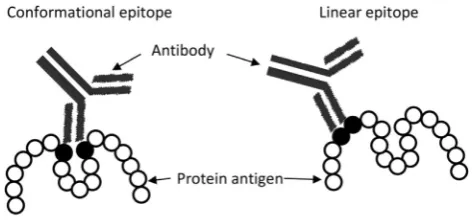
Epitopes (antigen determinants) are the portions of immuno-genic molecules, mainly proteins, which can bind with a comple-mentary site (paratope) of an antibody. The presence of epitopes in a protein structure renders the protein antigenic and/or allergenic (Wal, 2002). There are two main types of epitopes, which differ in their structure. Continuous or linear epitopes consist of a contin-uous sequence of amino acid residues based on the primary structure of the protein, while discontinuous or conformational epitopes constitute a discontinuous sequence of amino acid resi-dues that are brought together by folding of the protein due to its native secondary or tertiary structure (Konstantinou&Kim, 2012).
Fig. 1illustrates the basic structures of main two types of epitopes. A protein may contain different or similar kinds of epitopes in several locations in its structure, but only a few are immunodo-minant, being easily recognised by the immune system (Restani et al., 2004). The structure of an epitope and the physicochemical properties of the constituent amino acids determine the antigenic specificity of that epitope (Konstantinou&Kim, 2012).
Different heat treatments can modify milk protein structure in various ways, which can directly impact on the immunogenicity of the protein through alterations of immunoreactive epitopes pre-sent in the protein structure (Verhoeckx et al., 2015). Heat-induced protein structural modifications mostly cause changes in the epi-topes such as fragmentation, modification, masking, and unmask-ing. These changes, occurring in the epitopes, can result in either decreased, increased, or unchanged antigenicity and/or allerge-nicity of a particular protein (Konstantinou&Kim, 2012). Further-more, new epitopes (neotopes) can also be formed through these changes in some instances (Davis & Williams, 1998). Generally, conformational epitopes are more susceptible to heat-induced modifications such as denaturation and aggregation than linear epitopes, because of the nature of their structures (Konstantinou& Kim, 2012). However, extreme processing conditions (e.g., Maillard reactions) could modify linear epitopes (Rahaman et al., 2016).
4. Modifications of milk protein structures and associated epitopes and immunogenicity by heat
caseins contain many linear epitopes and a few conformational epitopes (Spuergin, Mueller, Walter, Schiltz,&Forster, 1996). The presence of numerous linear epitopes and the lack of conforma-tional epitopes may explain the ability of caseins to retain their antigenicity even after severe heat treatment (Mills, Sancho, Rigby, Jenkins,&Mackie, 2009). These characteristics of caseins explain well why hypoallergenic dairy products (containing caseins) could not be produced only by thermal processing (Kilshaw, Heppell,& Ford, 1982; Lee, 1992). It has so far been reported that different casein fractions possess about 60 IgE-binding epitopes, 20, 17, 13 and 10 inaS1-,aS2-,b- andk-casein, respectively (Matsuo, Yokooji,
&Taogoshi, 2015). In terms ofaS1-casein, a study revealed that
IgE-binding epitopes are structurally identical to IgG-IgE-binding epitopes (Spuergin et al., 1996).
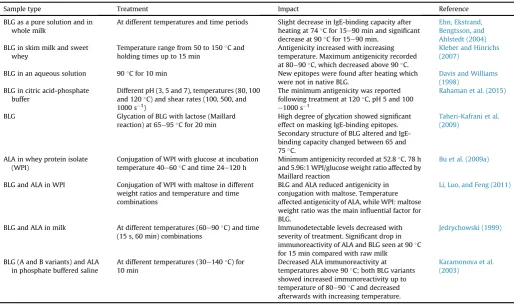
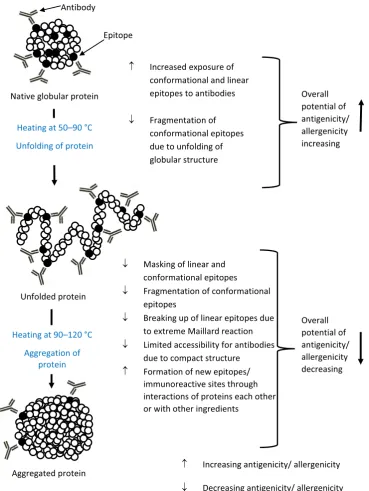
In contrast to the caseins, the two main whey protein fractions, BLG and ALA, change their antigenicity in a similar manner when subjected to heating (Bu, Luo, Zheng,&Zheng, 2009b). Each pro-tein increases antigenicity gradually with increasing temperature from 50 to 90C and then decreases rapidly between 90 and 120C (antigenicity was measured after cooling) (Bu et al., 2009b; Kleber, Krause, Illgner, & Hinrichs, 2004; Rahaman, Vasiljevic, & Ramchandran, 2015; Rahaman et al., 2016). Elevated antigenicity of BLG (from 50C to 90C) can be attributed to the exposure of epitopes buried in the native protein due to unfolding during the denaturation stage. Furthermore, eSH/S-S exchange reactions potentially promote conformational changes and causes exposure of more antigenic epitopes on the surface of the BLG structure at this stage. Decreasing antigenicity (between 90 and 120C) can be ascribed to further denaturation and aggregation of BLG, that could break up or mask the conformational epitopes, followed by S-S mediated aggregations (Bu et al., 2009b; Kleber et al., 2004; Kleber & Hinrichs, 2007;). Generally, a similar pattern of anti-genic behaviour can also be observed in ALA with increasing
temperature, despite its heat stability. However, the rate and de-gree of the change in antigenicity with temperature can vary. This could be ascribed to the fact that antigenicity of BLG is associated with both linear and conformational epitopes, whereas antige-nicity of ALA is predominantly determined by conformational epitopes (Bu et al., 2009b).
Furthermore, in a protein mixture, BLG and ALA can form ag-gregates of high molecular mass at temperatures around 80e90C, which would result in diminished antigenicity due to masking of antigenic epitopes on the molecular surfaces (Bu et al., 2009b). Moreover, extended high temperature treatments together with presence of lactose could reduce antigenicity, which can be related to initiation of the Maillard reactions and subsequent conforma-tional modifications of the structures of both BLG and ALA, which would obstruct antibodies from accessing antigenic epitopes (Bu, Lu, Zheng,&Luo, 2009a; Bu et al., 2009b; Taheri-Kafrani et al., 2009). In addition, the keyfindings of several studies conducted on effects of heating on immunogenicity/antigenicity of BLG and ALA are summarised inTable 2, whileFig. 2elaborates on the common phenomena associated with structural modifications of BLG and ALA, and subsequent changes in antigenicity/allergenicity during heat treatment. The studies have mapped out the amino acid se-quences of various IgE-binding epitopes of both BLG and ALA. In principle, each protein contains at around 10 IgE-binding epitopes (Matsuo et al., 2015). In addition, another investigation identified 6 and 3 of IgG-binding regions in BLG and ALA protein structures, respectively, using a peptide synthesis method (J€arvinen, Chatchatee, Bardina, Beyer,&Sampson, 2001).
BSA is one of the allergenic minor whey proteins, for which heat-induced modifications of immunogenicity are not well known. It has been reported that BSA subjected to severe heat treatment (100C for 5 min) showed a minor allergic sensitisation compared with unheated BSA (Fiocchi et al., 1998). BSA fragmen-tation, due to reduction of disulphide bonds, prevented reactions with anti-BSA antibodies (Habeeb&Atassi, 1976). Since BSA is ar-ranged as three homologous domains linked by 17 disulphide bridges, the presence of disulphide bonds predominantly de-termines antigenic epitopes of the native BSA (Monaci et al., 2006; Restani et al., 2004). For this reason, it can be assumed that the decrease in allergenicity is due to break up and/or masking of epitopes followed by cleavage of disulphide bonds and subsequent aggregation. However, the conflictingfindings suggest that anti-genicity of BSA is only partially associated with its native three-dimensional structure, as the IgE-binding ability of BSA was not affected by either heat treatment or chemical denaturation (sodium dodecylsulphate treatment) (Restani et al., 1998). It appears that
Table 1
Allergenic properties and biological functions of the main milk proteins.a
Protein Allergen name Concentration
(g L1)
Percentage of total proteins
Molecular mass (kDa) Number of amino acids Biological functions Caseins
aS1-Casein Bos d 8aS1 12e15 29 23.6 199 Mineral transport (Ca, PO4,Fe, Zn, Cu)
aS2-Casein Bos d 8aS2 3e4 8 25.2 207
b-Casein Bos d 8b 9e11 27 24.0 209
k-Casein Bos d 8k 3e4 10 19.0 169
Whey proteins
b-Lactoglobulin Bos d 5 3e4 10 18.3 162 Retinol carrier, fatty acid binding,
antioxidant, passive immunity
a-Lactalbumin Bos d 4 1e1.5 5 14.2 123 Immunomodulator, anticarcinogen,
Ca transport
Immunoglobulins Bos d 6 0.6e1.0 3 150.0 e Immunomodulator, passive immunity
Bovine serum albumin Bos d 7 0.1e0.4 1 66.3 582 Immunomodulator, anticarcinogen
Lactoferrin Bos d Lactoferrin 0.09 Traces 80.0 689 Antimicrobial, antioxidant,
immunomodulator, iron absorption
aAdapted fromPereira (2014)andRestani et al. (2009).
BSA contains at least one linear epitope and many conformational epitopes, but these have not been identified yet due to the incon-sistency of conditions applied in different studies (Monaci et al., 2006; Restani et al., 2004).
Ig and LF are immunologically important minor whey proteins present in bovine milk (Monaci et al., 2006). However, scientific
findings on the impact of heat-induced protein structural modifi -cations on immunogenicity of Ig and LF are less frequently reported. This could probably be due to lower research priority, as they are considered minor allergens, and patients allergic to Ig and LF are also allergic to other major proteins. Furthermore, as bioactive proteins, Ig and LF are mainly assessed in relation to loss of their bioactivity upon exposure to heat treatment, although the heat-induced modification of immunogenicity is also considerably important in terms of CMPA. In addition, it appears that IgE/IgG-binding epitopes of both of these proteins have not been yet fully identified (Chen, Tu,&Chang, 2000; Matsuo et al., 2015; Steijns& Van Hooijdonk, 2000).
Moreover, other covalent modifications of proteins caused by heat treatments, such as reactions with oxidised lipids, disulphide bond scrambling, and deamination of asparagine can also contribute to alteration of antigenicity (Davis, Smales, &James, 2001; Monaci et al., 2006). Besides the effect of proteins, some other milk constituents can also modify the immunogenicity of milk products subjected to heat treatments. For instance, the end products produced through the Maillard reaction, commonly called advanced glycation end products (AGE), lead to generation of AGE-modified protein derivatives containing major immunological epitopes that can cause allergy (Davis et al., 2001; Wal, 2003).
It is thus evident that exposure of milk proteins to different heat treatments can alter their immunogenicity in various ways, while these alterations are interdependent. More comprehensive
investigations are required to identify the precise effects of heat treatments on modifications of milk protein antigenicity and expressed allergenicity (Bu et al., 2013; Monaci et al., 2006; Verhoeckx et al., 2015). However, the existing literature can reasonably show that traditional pasteurisation temperatures (70e80C) could increase the overall antigenicity of bovine milk by enhancing the antigenicity of major whey proteins such as BLG and ALA.
5. Immunomodulatory properties of milk proteins affected by heat and their consequences for milk protein allergenicity
A systematic review and meta-analysis conducted byMacDonald et al. (2011)found that a few epidemiological studies have estab-lished the inverse association between raw bovine milk consump-tion and development of allergy, which can also be supported by farming-related factors. Another study, however, concluded that this inverse association is independent of the place of residence and farming status (Sozanska et al., 2013). Accordingly, it can be antic-ipated that consumption of raw bovine milk contributes to devel-opment of an immunological phenotype that establishes the protective effect or tolerance in the human body against allergy and asthma (Loss et al., 2011; van Neerven et al., 2012). The GABRIELA study (Loss et al., 2011) examined this protective effect in relation to childhood asthma and atopy, and further looked into the influential milk constituents that potentially contribute to this mechanism. This study found that consumption of raw bovine milk (not heated to 72C) was consistently inversely correlated with asthma and food allergen sensitisation, but not with atopy. Early exposure and daily consumption of raw milk complement this effect. Further-more, variables such as total fat content, total viable bacteria count, total protein content, somatic cell count, and lactose level had no
Table 2
Summary offindings on heat-induced changes in antigenicity/immunogenicity ofb-lactoglobulin (BLG) anda-lactalbumin (ALA).
Sample type Treatment Impact Reference
BLG as a pure solution and in whole milk
At different temperatures and time periods Slight decrease in IgE-binding capacity after heating at 74C for 15e90 min and significant
decrease at 90C for 15e90 min.
Ehn, Ekstrand, Bengtsson, and Ahlstedt (2004)
BLG in skim milk and sweet whey
Temperature range from 50 to 150C and
holding times up to 15 min
Antigenicity increased with increasing temperature. Maximum antigenicity recorded at 80e90C, which decreased above 90C.
Kleber and Hinrichs (2007)
BLG in an aqueous solution 90C for 10 min New epitopes were found after heating which
were not in native BLG.
Davis and Williams (1998)
BLG in citric acid-phosphate buffer
Different pH (3, 5 and 7), temperatures (80, 100 and 120C) and shear rates (100, 500, and
1000 s1)
The minimum antigenicity was reported following treatment at 120C, pH 5 and 100
e1000 s1
Rahaman et al. (2015)
BLG Glycation of BLG with lactose (Maillard
reaction) at 65e95C for 20 min High degree of glycation showed signieffect on masking IgE-binding epitopes.ficant
Secondary structure of BLG altered and IgE-binding capacity changed between 65 and 75C.
Taheri-Kafrani et al. (2009)
ALA in whey protein isolate (WPI)
Conjugation of WPI with glucose at incubation temperature 40e60C and time 24e120 h
Minimum antigenicity recorded at 52.8C, 78 h
and 5.96:1 WPI/glucose weight ratio affected by Maillard reaction
Bu et al. (2009a)
BLG and ALA in WPI Conjugation of WPI with maltose in different weight ratios and temperature and time combinations
BLG and ALA reduced antigenicity in conjugation with maltose. Temperature affected antigenicity of ALA, while WPI: maltose weight ratio was the main influential factor for BLG.
Li, Luo, and Feng (2011)
BLG and ALA in milk At different temperatures (60e90C) and time
(15 s, 60 min) combinations
Immunodetectable levels decreased with severity of treatment. Significant drop in immunoreactivity of ALA and BLG seen at 90C for 15 min compared with raw milk
Jedrychowski (1999)
BLG (A and B variants) and ALA in phosphate buffered saline
At different temperatures (30e140C) for
10 min
Decreased ALA immunoreactivity at temperatures above 90C; both BLG variants
showed increased immunoreactivity up to temperature of 80e90C and decreased
afterwards with increasing temperature.
apparent impact on asthma and allergy, but an increased level of whey proteins was found to be the main contributing factor towards positive health outcomes. Moreover, ALA, BLG, and a high level of BSA showed a statistically significant inverse correlation with asthma and allergy while, Ig and LF showed no significant correla-tion (Loss et al., 2011). Thesefindings can be ascribed to the ability of bovine milk whey proteins to modulate the human immune system (Table 1), although the underlining mechanisms still remain unclear.
van Neerven et al. (2012) proposed a model to elaborate a relationship between consumption of raw bovine milk and devel-opment of protection against allergy in infants. This model hypothesises that most abundant milk proteins, such as caseins,
BLG and ALA, could act as the basic protein sources for neonates, while the minor proteins, such as Ig, LF, and cytokines perform immunomodulatory functions against allergy. Though the presence of native proteins in bovine milk correlates with this protective mechanism, commercial milk processing, especially heating, causes denaturation of some of these proteins to varying degrees, which in turn suppresses this mechanism. The GABRIELA study concluded that consumption of heated bovine milk (72C) had no inverse association with allergy (Loss et al., 2011). An immunological study also found that the immunomodulatory potential of raw milk can significantly be affected by the pasteurisation process, and that raw milk consumption could influence the alteration of allergic sensi-tisation (McCarthy, Ross, Fitzgerald,&Stanton, 2015). It has also