Observations on the Dynamic Cube Attack of
855-Round Trivium from Crypto'18
Yonglin Hao1, Lin Jiao1, Chaoyun Li2, Willi Meier3, Yosuke Todo4, and
Qingju Wang5
1 State Key Laboratory of Cryptology, P.O. Box 5159, Beijing 100878, China 2 imec-COSIC, Dept. Electrical Engineering (ESAT), KU Leuven, Leuven, Belgium
3 FHNW, Windisch, Switzerland
4 NTT Secure Platform Laboratories, Tokyo 180-8585, Japan 5 SnT, University of Luxembourg, Luxembourg
[email protected], [email protected], [email protected] willi.meier@fhnw, [email protected], [email protected]
Abstract. Recently, another kind of dynamic cube attack is proposed by Fu et al.. With some key guesses and a transformation in the output bit, they claim that, when the key guesses are correct, the degree of the transformed output bit can drop so signicantly that the cubes of lower dimension can not exist, making the output bit vulnerable to the zero-sum cube tester using slightly higher dimensional cubes. They applied their method to 855-round Trivium. In order to verify the correctness of their result, they even proposed a practical attack on 721-round Trivium claiming that the transformed output bit after 721-rounds of initializa-tion does not contain cubes of dimensions 31 and below. However, the degree evaluation algorithm used by Fu et al. is innovative and com-plicated, and its complexity is not given. Their algorithm can only be implemented on huge clusters and cannot be veried by existing theoretic tools.
In this paper, we theoretically analyze the dynamic cube attack method given by Fu et al. using the division property and MILP modeling tech-nique.
Firstly, we draw links between the division property and Fu et al.'s dy-namic cube attack so that their method can be described as a theoreti-cally well founded and computationally economic MILP-aided division-property-based cube attack. With the MILP model drawn according to the division property, we analyzed the 721-round Trivium in detail and nd some interesting results:
1. The degree evaluation using our MILP method is more accurate than that of Fu et al.'s. Fu et al. prove that the degree of purez721 is 40
while our method gives 29. We practically proved the correctness of our method by trying thousands of random keys, random 30-dimensional cubes and random assignments to non-cube IVs nding that the summations are constantly 0.
violating the principle of Fu et al.'s work: after the transformation in the output bit, when the key guesses are correct, the degree of the transformed output bit has not dropped but risen.
3. Now that the degree theoretic foundation of the 721-round attack has been violated, we also nd out that the key-recovery attack can-not be carried out either. We theoretically proved and practically veried that no matter the key guesses are correct or incorrect, the summation over 32-dimensional cube are always 0. So, no key bit can be recovered at all.
All these analysis on 721-round Trivium can be veried practically and we open our C++ source code for implementation as well.
Secondly, we revisit their 855-round result. Our MILP model reveal that the 855-round result suers from the same problems with its 721-round counterpart. We provide theoretic evidence that, after their transfor-mation, the degree of the output bit is more likely to rise rather than drop. Furthermore, since Fu et al.'s degree evaluation is written in an unclear manner and no complexity analysis is given, we rewrite the al-gorithm according to their main ideas and supplement a detailed com-plexity analysis. Our analysis indicates that a precise evaluation to the degree requires complexities far beyond practical reach. We also demon-strate that further abbreviation to our rewritten algorithm can result in wrong evaluation. This might be the reason why Fu et al. give such a degree evaluation. This is also an additional argument against Fu et al.'s dynamic cube attack method.
Thirdly, the selection of Fu et al.'s cube dimension is also questionable. According to our experiments and existing theoretic results, there is high risk that the correct key guesses and wrong ones share the same zero-sum property using Fu et al.'s cube testers. As a remedy, we suggest that concrete cubes satisfying particular conditions should be identied rather than relying on the IV-degree drop hypothesis.
To conclude, Fu et al.'s dynamic cube attack on 855-round Trivium is questionable. 855-round as well as 840-and-up-round Trivium should still be open for further convincible cryptanalysis.
Keywords: Dynamic Cube attack, Division Property, MILP, Stream Cipher, Trivium
1 Introduction
Cube attack, as well as its variants, is one of the general cryptanalytic techniques of analyzing symmetric-key cryptosystems. It can be regarded as a generalization of the chosen IV statistical attack on stream ciphers [1,2,3] or a combination of higher order dierential cryptanalysis and AIDA [4]. Cube attack is based on the algebraic essence of ciphers. For a cipher with n secret variables x = (x1, x2, . . . , xn)and m public variables v = (v1, v2, . . . , vm), we can regard the
can be represented uniquely as
f(x,v) =tI·p(x,v) +q(x,v),
wheretI =vi1· · ·vi|I|,p(x,v)only relates tovs's (s /∈I) and the secret key bits
x, and q(x,v) misses at least one variable in tI. Whenvs's (s /∈I) andx are
assigned statically, the value ofp(x,v)can be computed by summing the output
bitf(x,v)over a structure called cube, denoted asCI, consisting of2|I|dierent
v vectors withvi, i∈I being active (traversing all 0-1 combinations) and
non-cube indicesvs, s /∈Ibeing static constants. Due to the close link betweenIand
CI, the index setI is also referred as cube without causing ambiguity. p(x,v),
also referred as the superpoly [5], may have non-random properties that can be utilized for cryptanalysis. A direct key-recovery attack can be launched when the superpoly is linear [5]. Other non-randomness such as constantness, neutrality, linearity, bias et al. can also be used for distinguishing attacks [6]. After years' development, various cube-based cryptanalysis methods have been proposed and successfully applied to all kinds of ciphers, including stream ciphers [6,7,8,9,10], hash functions [11,12,13], and authenticated encryptions [14,15].
At the beginning, the non-random properties of the superpoly can only be de-tected with practical experiments, which largely limits its widespread. At Crypto 2017, Todo et al. draw links among integral property, higher-order dierential and cube attack, and further introduced the bit-based division property, a tool for conducting integral attacks, into the realm of cube attack [16]. The division property enable us to evaluate the non-random properties of the superpoly even if largeI's of sizes far beyond practical computation are used.
Division property is a generalization of the integral property and was rst proposed at EUROCRYPT 2015 [17]. With division property, the propagation of the integral characteristics can be deduced more accurately and thus result in the rst theoretic key recovery attack on full MISTY1 [18]. The original di-vision property in [17,18] can only be applied to word-oriented primitives. At FSE 2016, the bit-based division property [19] was proposed. It enables the rst theoretic proof to the integral characteristics for bit-based block ciphers namely SIMON32 and Simeck32. With division property, the propagation of the integral characteristics can be represented by the operations on a set of 0-1 vectors iden-tifying the bit positions with the zero-sum property. However, the sizes of the 0-1 vector sets are exponential to the block size of the ciphers making the deduc-tion of the bit-based division property quite memory-consuming. Such a storage crisis has been solved by Xiang et al. [20] at ASIACRYPT 2016 by utilizing the MILP model. The operations on 0-1 vector sets are transformed to imposing division property values (0 or 1) to MILP variables, and the corresponding in-tegral characteristics are acquired by solving the models with MILP solvers like Gurobi [21]. With this method, they are able to give integral characteristics for block ciphers with large block sizes. Xiang et al.'s method has now been applied to many other ciphers for improved integral attacks [22,23,24,25].
set of key indices J ={j1, j2, . . . , j|J|} ⊂ {1, . . . , n} is deduced for the cube I
s.t. its corresponding superpoly p(x,v) can only be related to the key bitsxj's
(j ∈J). With the knowledge of I and J, the ANF as well as the whole truth
table of the superpoly can be recovered in the oine phase with complexity
2|I|+|J|. Then, in the online phase, the adversary only need to sum over the cube
and identify the candidate secret keys by referring to the precomputed truth table. Due to division property and the power of MILP solver, cubes of larger dimension can now be used for key recoveries. By using a 72-dimensional cube, Todo et al. propose a theoretic cube attack on 832-round Trivium. They also largely improve the previous best attacks on other primitives namely Acorn, Grain-128a and Kreyvium [16,26]. Based on Todo et al.'s work, Wang et al. exploite several algebraic properties of superpoly which are useful for better key-recovery cube attacks [27]. More specically, they proposed three new techniques namely: ag technique, degree evaluation and term enumeration. With these new techniques, the results in [27] are largely improved in comparison with those in [26]. Besides the division property based cube method, it is also noticeable that Liu et al. has also invented a new key recovery scenario on Trivium referred as the on Trivium using a method referred as correlation cube attack [10]. Their method can mount to 835-round Trivium using small dimensional cubes. Since our work is based on the work of [27] so we will give more detailed descriptions later.
The division property based cube attack, correlation cube attack as well as most of the traditional method are purely cultivating the property of the stream cipher. There is another kind of cube attack named the dynamic cube attack where the non-random property of the transformed output is utilized. The most famous dynamic cube attack results are aiming on full-round Gran-128 [28] and 855-round Trivium [29]. However, the theoretic foundation of the dynamic cube attack is not so steady as that of the division property. Both [28] and [29] are acquired by pure experiments, and there are plenty of theoretically unsolved questions in them. In this paper, we only focus on [29].
specic stream ciphers. For the method of [29], we describe its procedure using division property and MILP model, which enable us to evaluate the degree of the (transformed) output bit in a theoretically reliable manner. We give a detailed analysis to their practical result on 721-round Trivium. It is surprising that the practical example provided by themselves are violating almost all of their claims. 1. The transformed output bit has an algebraic degree higher than the original one, violating the degree drop claim. This also reveals that their strategy for constructing the transformation is questionable.
2. The degree evaluation towards the original output bit is wrong making the degree evaluation algorithm questionable (this is also the reason why they regarded the 721-round result as a support).
3. The key recovery is a complete failure: both correct and incorrect key guesses have the same zero-sum property using their cube tester.
All of the disproofs listed above are veried practically with C++ programs and we open the source codes6 for verications.
Besides anatomizing the practical 721-round result, we revisit Fu et al.'s dynamic cube attack on 855-round Trivium. Our division property method in-dicate that no degree drop occurs. In addition to the division property based evaluations, we also provide other arguments against the 855-round result. Con-sidering that the degree evaluation algorithm in [29] is described in a compli-cated and unclear manner so that the complexity of IV-monomial enumeration is unable to determined. As an additional contribution, we provide a detailed description to the general process of the IV-monomial enumeration algorithm. We provide detailed analysis and available reduction to the complexities. Ac-cording to detailed analysis, the enumeration requires complexities far beyond practical reach. We also demonstrate that further abbreviation will result in er-ror in degree evaluation. This is also an argument against the method of [29]. Such arguments along with the failure of the 721-round result indicates that the dynamic cube attack on 855-round Trivium is unlikely to be true. Since the previous best theoretically reliable key-recovery result on Trivium has mount to 839 rounds, the key recoveries on 840 and more rounds should still be open for further cryptanalysis unless other theoretic evidence are provided by the authors of [29].
In addition, according to our experiments and the existing theoretic ndings in [30], the selection of cube dimension in [29] is also questionable. The correct key guess might share the same zero-sum property with the wrong ones following the cube dimension selecting strategy in [29]. We also propose our remedy of nding concrete cubes whose summations have dierent properties before and after particular transformations. This can be regarded as a special case of IV-degree drop.
Organizations. Section 2 provides the basic description to the division property. For the Fu et al.'s dynamic cube method, we rst introduce the idea of IV-degree in Section 3. With the concept of IV-IV-degree, the theoretic foundation of
their method can be described in a formal manner in Section 4. Based on such a theoretic foundation, the MILP model derived from the propagation of the division property is constructed in Section 4. With such theoretic preparations, we give detailed analysis to [29]'s practical attacks on 721-round Trivium in Section 6. We also detail their degree evaluation algorithm and analyze their result on 855-round Trivium in Section 7. The discussion on cube dimension selection strategy is in Section 8. Finally, we conclude the paper and point out some future work in Section 9.
2 Preliminaries
2.1 Static Cube Attacks and Cube Testers
Considering a stream cipher with nsecret key bitsx= (x1, x2, . . . , xn)and m
public initialization vector (IV) bitsv= (v1, v2, . . . , vm). Then, the rst output
keystream bit can be regarded as a polynomial of x andv referred as f(x,v).
For a set of indicesI={i1, i2, . . . , i|I|} ⊂ {1,2, . . . , n}, which is referred as cube
indices and denote bytI the monomial astI =vi1· · ·vi|I|, the algebraic normal
form (ANF) off(x,v)can be uniquely decomposed as
f(x,v) =tI·p(x,v) +q(x,v),
where the monomials ofq(x,v)miss at least one variable from{vi1, vi2, . . . , vi|I|}.
Furthermore,p(x,v), referred as the superpoly in [5], is irrelevant to{vi1, vi2, . . . , vi|I|}.
The value ofp(x,v)can only be aected by the secret key bitsxand the assign-ment to the non-cube IV bitsvs(s /∈I). For a secret keyxand an assignment
to the non-cube IVsIV ∈Fm
2, we can dene a structure called cube, denoted as
CI(IV), consisting of2|I| 0-1 vectors as follows:
CI(IV) :={v∈F2m:v[i] = 0/1, i∈I
^
v[s] =IV[s], s /∈I}. (1)
It has been proved by Dinur and Shamir [5] that the value of superpoly p
cor-responding to the keyxand the non-cube IV assignmentIV can be computed by summing over the cubeCI(IV)as follows:
p(x,IV) = M
v∈CI(IV)
f(x,v). (2)
According to [5], some secret key bits can be recovered when the superpoly
p(x,IV)is linear and the cube dimension|I| is small enough so that the cube
In order to launch successful key-recovery attackes, the division-property-based cube attacks only requires the superpoly to be suciently simple: only being related to very few key bits and having a comparatively lower algebraic degree. But even if the superpoly becomes complicated, according to [6], some non-random properties (such as zero-sum, bias, presence of neutral bits etc) are also detectable using cube summations in (2) and can be used as ecient distinguishers, referred as the cube testers.
It is noticeable that the both original cube attack and the latest division-property-based versions are only extracting properties in pure output stream bits. Such kinds of cube attacks are sometimes referred as the static cube attack. It is also possible to impose some transformations to the output s.t. the successfully transformed output bits are vulnerable to particular cube testers. The success of the transformation is decided by the correct guess of some key guesses while for wrong guesses, no randomness can be detected. Such kinds of cube attacks are referred as the dynamic cube attack. There are only 2 currently formally published applications of this method: on full Grain-128 given by Dinur et al. in [28]; on 855-round Trivium given by Fu et al. in [29]. The transformation used in the former application is by nullifying crucial state bits with dynamic IV assignments while that of the latter is just multiply the output bit with intermediate state bit itself. We focus on Fu et al.'s method in this paper.
In the remainder of this paper, we refer to the value of the superpoly cor-responding to the assignmentIV in Eq. (2) as pIV(x) for short. We useCI as
the cube corresponding to arbitrary IV setting in Eq. (1). SinceCI is dened
according to I, we may also refer I as the cube without causing ambiguities.
The size ofI, denoted as|I|, is also referred as the dimension of the cube.
2.2 Bit-Based Division Property and its MILP Representation
The (Bit-Based) Division Property At 2015, the division property, a gener-alization of the integral property, was proposed in [17] with which better integral characteristics for word-oriented cryptographic primitives have been detected. Later, the bit-based division property was introduced in [19] so that the prop-agation of integral characteristics can be described in a more precise manner. The denition of the bit-based division property is as follows:
Denition 1 ((Bit-Based) Division Property). LetX be a multiset whose
elements take a value ofFn2. LetKbe a set whose elements take ann-dimensional
bit vector. When the multiset X has the division property D1
n
K , it fulls the fol-lowing conditions:
M x∈X
xu=
(
unknown if there existk∈Ks.t. uk,
0 otherwise,
whereuk if ui≥ki for alli, andxu=Qni=1x ui
When the basic bitwise operations COPY, XOR, AND are applied to the el-ements in X, transformations should also be made following the propagation
corresponding rules copy, xor, and proved in [17,19]. Since round functions of cryptographic primitives are combinations of bitwise operations, we only need to determine the division property of the chosen plaintexts, denoted by D1n
K0.
Then, after r-round encryption, the division property of the output
cipher-texts, denoted by D1n
Kr, can be deduced according to the round function and the propagation rules. More specically, when the plaintext bits at index posi-tionsI ={i1, i2, . . . , i|I|} ⊂ {1,2, . . . , n} are active (the active bits traverse all
2|I|possible combinations while other bits are assigned to static 0/1 values), the
division property of such chosen plaintexts is D1n
k , where ki = 1 ifi ∈ I and
ki = 0 otherwise. Then, the propagation of the division property from D1
n k is evaluated as
{k}:=K0→K1→K2→ · · · →Kr,
where DKi is the division property after i-round propagation. If the division
propertyKrdoes not have an unit vectorei whose onlyith element is 1, theith
bit ofr-round ciphertexts is balanced.
However, when round r gets bigger, the size of Kr expands exponentially
towardsO(2n)requiring huge memory resources. So the bit-based division
prop-erty has only been applied to block ciphers with tiny block sizes, such as Simon32 and Simeck32 [19]. This memory-crisis has been solved by Xiang et al. [20] using the MILP modeling method.
Mixed Integer Linear Programming MILP is an optimization or feasibility program whose variables are restricted to integers. A MILP modelM consists
of variablesM.var, constraintsM.con, and an objective functionM.obj. MILP
models can be solved by solvers like Gurobi [21]. If there is no feasible solution at all, the solver simply returns infeasible. If no objective function is assigned, the MILP solver only evaluates the feasibility of the model.
The application of MILP model to cryptanalysis dates back to the year 2011 [31], and has been widely used for searching characteristics correspond-ing to various methods. Besides integral characteristics with division property [20], there are also dierential [32,33], linear [33], impossible dierential [34,35], zero-correlation linear [34] characteristics etc.
Represent the Propagation of Division Property with MILP. In order to describe the bit-based division property with an MILP model, Xiang et al. rst introduced a new concept division trail dened as follows:
Denition 2 (Division Trail [20]). Let us consider the propagation of the division property {k} def
= K0 → K1 → K2 → · · · → Kr. Moreover, for any
vector k∗i+1 ∈Ki+1, there must exist a vectork∗i ∈Ki such thatk∗i can
(k0,k1, . . . ,kr) ∈ (K0 ×K1 × · · · ×Kr) if ki can propagate to ki+1 for all
i∈ {0,1, . . . , r−1}, we call (k0→k1→ · · · →kr)an r-round division trail.
Let Ek be the target r-round iterated cipher. Then, if there is a division trail
k0 Ek
−−→ kr = ej (j = 1, ..., n), the summation of jth bit of the ciphertexts is
unknown; otherwise, if there is no division trial s.t. k0 Ek
−−→ kr =ej, we know
theith bit of the ciphertext is balanced (the summation of theith bit is constant
0). Therefore, we have to evaluate all possible division trails to verify whether each bit of ciphertexts is balanced or not. Xiang et al. proved that the basic propagation rules copy, xor, and of the division property can be translated as some variables and constraints of an MILP model. With this method, all possible division trials can be covered with an MILP modelMand the division property
of particular output bits can be acquired by analyzing the solutions of the M.
After Xiang et al.'s work, some simplications have been made to the MILP descriptions of copy, xor, and in [22,16]. Recently, Wang et al. [27] improve copy, xor, and by introducing the ag technique and name their improved versions as copyf, xorf, andf. We only use copyf, xorf, andf in this paper and they are detailed in Section 2.3.
2.3 The Bit-Based Division Property for Cube Attack
When the number of initialization rounds is not large enough for a thorough diusion, the superpolyp(x,v)dened in Eq. (1) may not be related to all key
bitsx1, . . . , xncorresponding to some high-dimensional cubeI. Instead, there is
a set of key indicesJ ⊆ {1, . . . , n}s.t. for arbitraryv∈Fm2,p(x,v)can only be
related to xj's (j ∈J). In CRYPTO 2017, Todo et al. proposed a method for
determining such a setJ using the bit-based division property [16]. They further
showed that, with the knowledge of such J, cube attacks can be launched to
recover some information related to the secret key bits. More specically, they proved the following Lemma 1 and Proposition 1.
Lemma 1. Let f(x) be a polynomial from Fn2 to F2 and afu ∈F2(u∈ Fn2) be
the ANF coecients of f(x). Let k be an n-dimensional bit vector. Assuming
there is no division trail such that k−→f 1, thenaf
u is always 0 for uk. Proposition 1. Let f(x,v)be a polynomial, where x and v denote the secret and public variables, respectively. For a set of indices I = {i1, i2, . . . , i|I|} ⊂
{1,2, . . . , m}, letCIbe a set of2|I|values where the variables in{vi1, vi2, . . . , vi|I|}
are taking all possible combinations of values. Let kI be an m-dimensional bit
vector such that vkI =t
I =vi1vi2· · ·vi|I|, i.e. ki = 1 if i ∈I and ki = 0
oth-erwise. Assuming there is no division trail such that (eλ,kI) f
−→ 1, xλ is not
involved in the superpoly of the cubeCI.
When f represents the rst output bit after the initialization iterations, we
can identify J by checking whether there is a division trial (eλ,kI) f
λ = 1, . . . , n using the MILP modeling method introduced in Sect. 2.2. If the division trial(eλ,kI)
f
−→1 exists, we haveλ∈J; otherwise,λ /∈J.
WhenJ is determined, we know that for some proper assignment to the
non-cubeIV ∈Fm2, the corresponding superpolypIV(x)is a polynomial ofxj, j∈J
rather than constant 0. In order to nd such a proper IV, Wang et al. [27] introduce the ag technique so that the dierent models are constructed for dierentIV and the proper one can be determined by solving the corresponding MILP model.
Flag Technique. In the ag technique of [27], the intermediate state bit s
correspond to 2 parameterss.val ands.F:
s.val∈ M.varis the bit-based division property value described as a binary
variable of the MILP model.
s.F ∈ {0c,1c, δ}is the ag value where0c,1c, δ species whether the state
bit is constant 0, constant 1 or variable (active IV, unknown key bits, cube IV's or non-cube IV bits with arbitrary value are all corresponding to ag valueδ).
Corresponding to the bitwise EQUAL, XOR and AND operations, the ag values
0c,1c, δhas=,⊕and×operations. The=operation is natually1c= 1c,0c = 0c
andδ=δ. The⊕operation follows the rules:
1c⊕1c= 0c
0c⊕x=x⊕0c=x
δ⊕x=x⊕δ=δ
for arbitraryx∈ {1c,0c, δ} (3)
The×operation follows the rules:
1c×x=x×1c =x
0c×x=x×0c = 0c
δ×δ=δ
for arbitraryx∈ {1c,0c, δ} (4)
Considering the eect of ag, the MILP model description to the division prop-erty propagation rules corresponding to COPY, XOR and AND operations have become copyf, xorf, andf dened as follows:
Proposition 2 (MILP Model for COPY with Flag [27]). Let a −−−−→COP Y (b1, b2, . . . ,
bm) be a division trail of COPY. The following inequalities are sucient to
describe the propagation of the division property for copyf.
M.var←a.val, b1.val, . . . , bm.val as binary.
M.con←a=b1.val+· · ·+bm.val
a.F =b1.F =. . .=bm.F
Proposition 3 (MILP Model for XOR with Flag [27]). Let(a1, a2, . . . , am)−−−→XOR
b be a division trail of XOR. The following inequalities are sucient to describe
the propagation of the division property for xorf.
M.var←a1.val, . . . , am.val, b.val as binary.
M.con←a1.val+· · ·+am.val=b.val
b.F =a1.F ⊕a2.F⊕ · · · ⊕am.F
We denote this process as(M, b)←xorf(M, a1, . . . , am).
Proposition 4 (MILP Model for AND with Flag [27]). Let(a1, a2, . . . , am)−−−→AN D
b be a division trail of AND. The following inequalities are sucient to describe
the propagation of the division property for andf.
M.var←a1.val, . . . , am.val, b.valas binary.
M.con←b.val≥ai.val for alli∈ {1,2, . . . , m}
b.F =a1.F×a2.F × · · ·am.F
M.con←b= 0 if b.F = 0c
We denote this process as(M, b)←andf(M, a1, . . . , am).
With copyf, xorf, andf, the propagations of the division property correspond-ing to any cryptographic primitives can be described in a precise manner.
Degree Evaluation. Another contribution of [27] is the degree evaluation technique using the division property and MILP modeling. For anIV ∈Fm2 s.t.
pIV(x)6= 0, the ANF ofpIV(x)can be represented as
pIV(x) = X u∈Fn2
auxu (5)
whereau is determined by the values of the non-cube IVs. [27]'s degree evalua-tion technique can determine an integerds.t. for allu's with Hamming weight satisfying hw(u) > d, there is constantly au = 0. Such a degree evaluation is based on the following Proposition 5, which can be regarded a generalization of Proposition 1.
Proposition 5. [27] Letf(x,v)be a polynomial, wherexandv denote the se-cret and public variables, respectively. For a set of indicesI={i1, i2, . . . , i|I|} ⊂
{1,2, . . . , m}, letCIbe a set of2|I|values where the variables in{vi1, vi2, . . . , vi|I|}
are taking all possible combinations of values. Let kI be an m-dimensional bit
vector such thatvkI =t
I =vi1vi2· · ·vi|I|. LetkΛ be ann-dimensional bit vector.
Assuming there is no division trail such that (kΛ||kI) f
With such theoretic basis, the degree dof the superpoly pIV(x), can be eval-uated using Algorithm 1. Note that IV can be concrete 0-1 vectors or NULL indicating arbitraryIV ∈Fm
2 . Therefore, forIV =NULL, Algorithm 1 will give
the largest possibledfor allIV ∈Fm
2 (d= maxIV∈Fm2 {deg(pIV(x))}). Such
de-gree evaluation technique plays an important role in constructing the theoretic foundation of dynamic cube attacks.
Algorithm 1 Evaluate upper bound of algebraic degree on the superpoly [27] 1:procedure DegEval(Cube indicesI, specic assignment to non-cube IVsIV orIV =NULL)
2: Declare an empty MILP modelM.
3: DeclarexbenMILP variables ofMcorresponding to secret variables. 4: DeclarevbemMILP variables ofMcorresponding to public variables. 5: M.con←vi.val= 1and assign the agsvi.F =δfor alli∈I 6: M.con←vi.val= 0fori∈({1, . . . , m} −I)
7: if IV =NULLthen
8: Assign the agsvi.F=δfori∈({1, . . . , m} −I) 9: else
10: Assign the ags ofvi,i∈({1,2, . . . , m} −I)as:
vi.F= (
1c ifIV[i] = 1
0c ifIV[i] = 0
11: end if
12: Set the objective functionM.obj←max{Pn i=1xi}
13: UpdateMaccording to round functions and output functions 14: Solve MILP modelM
15: return The solution ofM. 16: end procedure
2.4 Unify the Specication of Trivium
In [29], the description of Trivium is slightly dierent from the traditional one. In this part, we rst unify the symbols of traditional Trivium description with that of [29]. We rst introduce Trivium in a traditional manner.
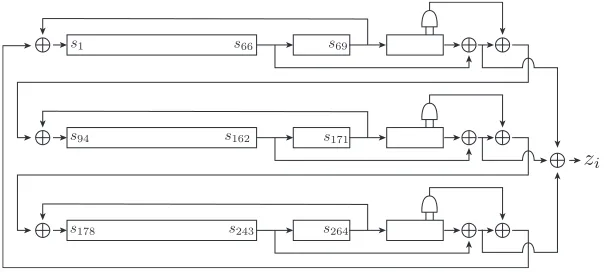
Trivium is an NLFSR-based stream cipher, and the internal state is repre-sented by 288-bit state(s1, s2, . . . , s288). Fig. 1 shows the state update function
of Trivium. The 80-bit key is loaded to the rst register, and the 80-bit IV is loaded to the second register. The other state bits are set to 0 except the least three bits in the third register. Namely, the 288-bit initial state, denoted ass0, is represented as
(s0 1, s
0 2, . . . , s
0
93) = (x0, x1, . . . , x79,0, . . . ,0),
(s094, s 0 95, . . . , s
0
177) = (v0, v1, . . . , v79,0, . . . ,0),
(s0
z
iFig. 1. Structure of Trivium
For round number r = 1,2, . . ., the state sr is computed from sr−1 by calling
the updating function, denoted assr=Upd(sr−1)and dened as (6):
tr−1
1 ←s
r−1 91 ·s
r−1 92 ⊕s
r−1 66 ⊕s
r−1 93 ⊕s
r−1 171
tr2−1←s r−1 175 ·s
r−1 176 ⊕s
r−1 162 ⊕s
r−1 177 ⊕s
r−1 264
tr−1
3 ←s
r−1 286 ·s
r−1 287 ⊕s
r−1 243 ⊕s
r−1 288 ⊕s
r−1 69
(sr1, s r 2, . . . , s
r 93)←(t
r−1 3 , s
r−1 1 , . . . , s
r−1 92 )
(sr
94, sr95, . . . , sr177)←(t r−1 1 , s
r−1 94 , . . . , s
r−1 176)
(sr178, s r
279, . . . , s r
288)←(t r−1 2 , s
r−1 178, . . . , s
r−1 287)
(6)
AfterRinitialization rounds, Trivium output 1 key stream bit denoted aszR= Output(sR)and computed fromsR according to the output function as
zR=sR66⊕s R 93⊕s
R 162⊕s
R 177⊕s
R 243⊕s
R
288 (7)
Full version of Trivium hasR= 1152initialization rounds. After the
initializa-tion, one bit key stream is produced by every update function. For [29], thesr
0, sr1, sr2 for specifying the three bits newly generated at round
r, which are denoted as sr
1, sr94, sr178 in (6). Therefore, the updating functions of
sr
0, sr1, sr2, as is given in [29], are as follows:
sr0=s r−66
2 +s
r−109
2 s
r−110
2 +s
r−111
2 +s
r−69 0
sr1=sr− 66
0 +s
r−91
0 s
r−92
0 +s
r−93
0 +s
r−78 1
sr2=s r−69
1 +s
r−82
1 s
r−83
1 +s
r−84
1 +s
r−87 2
(8)
In most parts in this paper, we unify the symbol back to the traditional man-ner and use sr
1, sr94, sr178 to represent the sr0, sr1, sr2 of [29] respectively. We only
temporarily use the notations sr
0, sr1, sr2 of [29] in Section 7.1 for easier
demon-stration. It is also noticeable that the 80 key/IV bits are indexed as0, . . . ,79in
3 The Concept of IV-Degree
For a cryptographic primitive with secret key bitsx= (x1, . . . , xn)and IV bits
v = (v1, . . . , vm), all its intermediately generated bits (including intermediate
state bits and output bits) can be regarded as polynomials on ring F2[x,v]
whose ANF can be represented as (9)
f(x,v) = X
u∈Fm2
auvu (9)
whereau∈F2[x] =F2[x1, . . . , xn]is the coecient of the IV monomialvu. We
dene the IV-degree off(x,v)as Denition 3.
Denition 3. (IV-Degree) Let x= (x1, . . . , xn) andv = (v1, . . . , vm)be key
and IV variables. Dene the polynomial f(x,v) as (9). The IV-degree of f,
denoted asdegIV(f), is dened as the minimum integer s.t. for arbitraryu∈Fm2
with hamming weighthw(u)>degIV(f), the corresponding coecient au's are constant 0 (au≡0).
Apparently, for a monomiala1a2· · ·aj, its IV-degree satises that
degIV(a1a2· · ·aj)≤ j
X
t=1
degIV(at) (10)
We'll show in the following part how such a denition can grasp the idea of [29].
4 Describing the Theoretic Foundation of Fu et al.'s
Method using IV-Degree
In [29], the output bitzR is regarded as the form as follows:
zR=stiP1+P2 (11)
where st
i refers to an intermediate state bit newly generated at round t (the
position i can only have 3 choices i∈ {1,94,178}) andP1, P2 are other terms
with complicated ANF. They nd that by multiplying(1 +st
i)withzR, the term
P1can be eliminated since
(1 +sti)zR= (1 +sti)P2 (12)
If the IV-degree ofP1is much higher than that of(1 +sti)·P2 and saties
degIV((1 +sti)P2)<degIV(stiP1), (13)
arbitrary cube I's of dimension |I| ≥ degIV((1 +st
i)·P2) + 1 can be used as
zero-sum distinguishers for(1 +st i)·zR.
because some wrong key guesses will share the same zero-sum property as the correct ones. We will later show that once such an inequality is violated, the key-recovery attack in [29] is no longer available because some particular wrong key guesses can share the same zero-sum property as the correct ones.
Let the outputzR dened as (11) and the transformed output is dened as
(12). We assume that the state bitst
i is of IV-degreedegIV(sti) =λso the ANF
ofst
i can be represented in the form of (9) as:
sti=
X u∈Fm2,hw(u)≤λ
guvu (14)
and the secret information need to be guessed are simply a set of coecient
gu satisfyinggu ∈Fn2[x1, . . . , xn]\{0,1}. We dene the secret information as a
vector
G=ngu:Dened as (14) ^
gu∈Fn2[x1, . . . , xn]\{0,1}
o
. (15)
Each element ofGis simply indexed by the subindexuasG[u] =gu. In the key recovery attack, the adversary should rst guessGasG0. IfG0=G, the state bit
st
ican be correctly computed as (14) and the transformed output is exactly (12).
For the wrong guess, this simply means that the dierence∆ :=G⊕G0 6=0,
or in other words, the setU(G0)dened as (16) is not empty.
U(G0) ={u∈Fm2 :G0[u] =G[u] + 1}. (16)
Therefore, for the wrong guessG0, the state bit recovered can be expressed as
ˆ
sti=sti+
X u∈U(G0)
vu=sti+ξ. (17)
Apparently, degIV(ξ)≤degIV(st
i) =λand all the IV-monomial vu inξshould
also appear in the ANF ofst
i. With thesˆtidened in (17), the transformed output
bit has become
(1 + ˆsti)zR= (1 +sti)P2+ξP2+ξstiP1 (18)
According to the denition of ξ in (17), we know that the IV-degree of ξP2
satises
degIV(ξP2)≤degIV((1 +sti)P2)
Therefore, comparing the wrong-key-guess derived transformed output bit in (18) with that derived from the correct key guess in (12), the correct key can only be distinguished when the IV-degrees satsify
degIV((1 +sti)P2)<degIV(ξsitP1)≤λ+ degIV(stiP1) (19)
Proposition 6. Supposing that (13) is violated so that
degIV((1 +sti)P2)≥degIV(stiP1). (20)
Let the integerη dened as
η = degIV((1 +sti)P2)−degIV(stiP1) (21)
and assume thatη≥0. Then, all the wrong guess G0's satisfying
max{hw(u) :u∈ U(G0)} ≤η (22)
will share the same zero-sum property with the correct key guessG when using cubes of dimension degIV((1 +st
i)P2) + 1.
Proof. According to the denition ofU(G0)in (16), (22) simply means that the
IV-degree ofξsatisfy thatdegIV(ξ)≤η. Therefore, we know that
degIV(ξstiP1)≤degIV(ξ) + degIV(stiP1)≤degIV((1 +sti)P2)
Therefore, the degree of transformed output bit corresponding to the wrong key guess G0 share the same IV-degree with the correct guess G. Therefore, such
wrong guessG0's cannot be distinguished from the correct ones, which complete
the proof. ut
In fact,st
iP1is simply part of the pure output bitzRaccording to (9). Therefore,
in practice, as long as we can prove degIV(zR) ≤ deg
IV((1 +sti)P2), we have
already proved (20) and violated (13) because degIV(st
iP1)≤degIV(zR). We'll
use this later in Section 6.
5 MILP Modeling for Fu et al.'s Dynamic Cube Method
As can be seen, the original outputzRis generated the initial states0by taking
the following steps:
1. Forj = 1, . . . , R, call the updating function for new state sj=Upd(sj−1);
2. Call the output function forzR=Output(sR).
We prove that the degree of(1 +st
i)·zR(i∈ {1,94,178}) is equal to(1 +sti)·zˆR
where zˆR is alternative output bit generated in a dierent manner dened in
Proposition 7.
Proposition 7. The evaluated output (1 +st
i)·zR can be regarded as the
fol-lowing:
1. Forj = 1, . . . , t, call the updating function for new state sj=Upd(sj−1);
2. Store st
i in an additional register and replace st with ˆst, where sˆti = 0 and
ˆ
stj=stj forj6=i.
4. Call the output function for zˆR=
Output(ˆsR)and multiply it with(1 +st i).
Proof. According to (11), after replacingst
i with constant 0, the outputzˆR has
now becomezˆR= 0·P
1+P2=P2. Therefore, the multiplication(1 +sti)·zR=
(1 +st
i)·ˆzR= (1 +sti)·P2. ut
The division property propagation corresponding to this procedure can be de-scribed with a MILP model generated from Algorithm 3. It takes as inputs initial round R and the integers(t, i) decided byst
i, and returns the MILP modelM
along with MILP variablesv= (v0, . . . , v79)ando, corresponding to the division
property values of the IV bits and output bit (1 +st
i)·ˆzR respectively. So we
denote the procedure of Algorithm 3 as(M,v, o) =TriviumModel(R, i, t).
With(M,v, o), we should further add constraints and objective functions to
the modelMaccording to dierent cube selections. The detailed procedure can
be summarized as follows:
1. We rst check whether the ag o.F =δ. Ifo.F = 0c or1c, the transformed
output(1 +st
i)·zR is constant which has zero-sum property for arbitrary
cubes. Ifo.F =δ, we need to further add constraintM.con←o.val= 1.
2. We construct a set of IV indices I whose elements are available for
con-structing cubes. In other words, the cubeI's should always satisfy I ⊆ I.
We assign the ag valuesvj.F =δ for j ∈ I and update the MILP model
Mby dening the objective function:
M.obj←maxX
j∈I
vj.val (23)
3. For the remaining IV indicesj ∈ I, update the model byM.con←vj.val=
0and assign the ag vj.F's to0c or1c according to a 0-1 vectorIV ∈F802
decided by dierent attacking scenarios.
Finally, we solve the modelMand acquire the IV-degreedegIV((1 +st
i)·zR) =
M.obj dened in (23). For Trivium, the whole process can be summarized as
Algorithm 4.
Algorithm 2 MILP model of division property for the core function of Trivium. 1:procedure Core(M,x, i1, i2, i3, i4, i5)
2: (M, yi1, z1)←copyf(M, xi1) 3: (M, yi2, z2)←copyf(M, xi2)
4: (M, yi3, z3)←copyf(M, xi3)
5: (M, yi4, z4)←copyf(M, xi4)
6: (M, a)←andf(M, z1, z2)
7: (M, yi5)←xorf(M, a, z2, z3, z4, xi5)
8: for alli∈ {1,2, . . . ,288}w/oi1, i2, i3, i4, i5do
9: yi=xi 10: end for 11: return(M,y)
Algorithm 3 MILP model of division property for Trivium with transformed output(1 +st
i)·zR
1:procedure TriviumModel(roundR, integers(t, i)corresponding tost
iwherei∈ {1,93,178}) 2: Prepare empty MILP ModelM
3: M.var←vj.valforj∈ {0,1, . . . ,79}. .Declare Public Modiable IVs 4: M.var←xj.valforj∈ {0,1, . . . ,79}. .Declare Secret Keys 5: M.var←s0
j.valforj∈ {1,2, . . . ,288} 6: s0
j=xj−1.val,s0j+93=vj−1.valfori= 1, . . . ,80.
7: M.con←s0
j.val= 0forj= 1, . . . ,93,174, . . . ,288. .All non-active bits are assigned to division property value 0
8: s0
j.F=δforj= 1, . . . ,80. .Assign the ags for key bits 9: s0
j.F= 0cforj= 81, . . . ,285andsj0.F= 1cforj= 286,287,288. .Assign the ags for constant state bits
10: forr= 1totdo
11: (M,x) = Core(M,sr−1,66,171,91,92,93)
12: (M,y) = Core(M,x,162,264,175,176,177)
13: (M,z) = Core(M,y,243,69,286,287,288) 14: sr=z≫1
15: end for
16: Declare a new variableM.var←ˆst
i.valand assign its ag value asˆs t i.F= 0c. 17: Impose constraint asM.con←ˆst
i.val= 0. 18: Storest
iand denesˆ tas
ˆ stj=
(st j, j6=i
ˆ sti, j=i 19: forr=t+ 1toRdo
20: (M,x) = Core(M,sˆr−1,66,171,91,92,93)
21: (M,y) = Core(M,x,162,264,175,176,177)
22: (M,z) = Core(M,y,243,69,286,287,288) 23: sˆr=z≫1
24: end for
25: for allj∈ {1,2, . . . ,288}w/o66,93,162,177,243,288do
26: M.con←sˆR j.val= 0 27: end for
28: (M, o0)←xorf(M,ˆsR
66,ˆsR93,sˆR162,sˆR177,ˆsR243,ˆsR288)
29: Declare a new variableM.var←b.valand assign its ag value asb.F = 1c.
30: Impose constraint asM.con←b.val= 0.
31: (M, c)←xorf(M, st i, b) 32: (M, o)←andf(M, c, o0)
33: return(M, o,v)
34: end procedure
6 Application to the 721-Round Attack in [29]
In this part, we apply our method in Section 5 to the practical dynamic cube attack on 721-round given in [29]. According to [29], all 40 IV bits with odd indices 1,3, . . . ,79and the 3 IV bits even indices 58,64,72 should be assigned
to constant 0 and should not be selected as cube indices so we haveI of size 37
dened as
I ={0,2, . . . ,56,60,62,66,68,70,74,76,78} (24)
andIV = (0,0, . . . ,0). They claimed that the IV-degree ofz721isdeg
IV(z721) =
36and after the transformation in the output bit, the IV-degree drops todegIV((1+
s290
94 )·z721) = 31. Note that the I for evaluating degIV(z721)in [29] is slightly
dierent from that ofdegIV((1+s290
94 )·z721), we will detail this later and pointing
Algorithm 4 Evaluating the IV-degreedegIV((1 +st
i)·zR)of Trivium
1:procedure IVDegTrivium(roundR, integers(t, i)corresponding tost
iwherei∈ {1,94,178}, the available cube index candidatesI, the assignment to non-cube IV bitsIV ∈F802)
2: (M,v, o) =TriviumModel(R, i, t). .Call Algorithm 3 3: if o.F= 0cor1cthen
4: returndegIV((1 +st i)·z
R) = 0. 5: end if
6: forj∈ Ido
7: Assign the ag value ofvj asvj.F=δ 8: end for
9: Update the modelM.obj←P
j∈Ivj.val. 10: forj∈ {0, . . . ,79}\Ido
11: Assign the ag value ofvjas
vj.F= (
0c, IV[j] = 0
1c, IV[j] = 1
12: end for
13: SolveMand get the value of the objective functionM.obj. 14: returndegIV((1 +st
i)·z
R) =M.obj 15: end procedure
6.1 Compare the Preciseness of IV-Degree Evaluation
Before they go into the IV-degree evaluation to the dynamic cube attack, the authors of [29] rst give an evaluation to the IV degree of pure output bit of
z721 I and IV. The evaluation they gave deg
IV(z721) = 36 withI containing
all the even IV indices as:
I0={0,2, . . . ,78} (25)
In order to compare the bounds drawn with their method and the with ours, we propose the IV-degree evaluation algorithm to pure zR ofR-round without
the transformation in the output bit as Algorithm 5. In fact, the setting of IV bits (both division property values and ag values) in Algorithm 5 and objective function setting is identical to that of Algorithm 4. It only diers in the sub-routine Algorithm 3 where the eect of st
i is eliminated. In fact, for evaluating
degIV(z721)is equivalent to proving that the zero-sum property exist for allI's
with dimension|I|>degIV(z721).
WithI0 dened as (25) and IV = (0, . . . ,0), we call Algorithm 5 that
re-turnsdegIV(z721) = 31, lower than [29]'s 36. In order to verify the correctness of
our evaluation, we randomly picked thousands of 32-dimensional cubeI's using
indices in I0 (along with random keys and random assignments to IV[j] for
j ∈ I0\I) and sum z721. We nd that all 32-dimensional cubes have zero-sum
property when sumz721 over them under randomly chosen keys and randomly
assigned non-cube IV bit values. This evaluation has proved that our MILP mod-eling method can provide sharper IV-degree upper bound than the complicated degree evaluation algorithms of [29].
Of course, in order to verify the theoretic foundation (13), we need to verify the degree drop for the sameIandIV settings. WithIdened as (24) andIV = (0, . . . ,0), we call Algorithm 5 that returns degIV(z721) = 29. We verify the
30-dimensional cubeI's using indices inI and sumz721. All the random settings
have given zero-sum property proving the correctness of our degree evaluation
degIV(z721) = 29. But for 29-dimensional cubeI⊆ I, there exist 1-summations
for some random keys. This evaluation has not only proved our sharper upper bound, but also violate the theoretic belief in (13). In other words, after the transformation in the output bit, the IV-degree has not decreased but increased. So the 721-round example is not supporting the correctness of [29] but standing against it.
Algorithm 5 Evaluating the IV-degreedegIV((1 +st
i)·zR)Trivium
1:procedure IVDegTriviumPure(roundR, the available cube index candidatesI, the assignment to non-cube IV bitsIV ∈F802 )
2: Prepare empty MILP ModelM
3: M.var←vj.valforj∈ {0,1, . . . ,79}. .Declare Public Modiable IVs 4: M.var←xj.valforj∈ {0,1, . . . ,79}. .Declare Secret Keys 5: forj∈ {0, . . . ,79}\Ido .Initialize the ags of IV bits 6: Assign the ag value ofvj as
vj.F= (
0c, IV[j] = 0
1c, IV[j] = 1
7: end for
8: Update the modelM.obj←P
j∈Ivj.val. 9: M.var←s0
j.valforj∈ {1,2, . . . ,288} 10: s0
j =xj−1,s0j+93=vj−1fori= 1, . . . ,80.
11: M.con←s0
j.val= 0forj= 1, . . . ,93,174, . . . ,288. .All non-active bits are assigned to division property value 0
12: s0
j.F=δforj= 1, . . . ,80. .Assign the ags for key bits 13: s0
j.F= 0cforj= 81, . . . ,285andsj0.F= 1cforj= 286,287,288. .Assign the ags for constant state bits
14: forr= 1toRdo
15: (M,x) = Core(M,sr−1,66,171,91,92,93)
16: (M,y) = Core(M,x,162,264,175,176,177)
17: (M,z) = Core(M,y,243,69,286,287,288) 18: sr=z≫1
19: end for
20: for allj∈ {1,2, . . . ,288}w/o66,93,162,177,243,288do
21: M.con←sR j = 0 22: end for
23: (M, o)←xorf(M, sR
66, sR93, sR162, sR177, sR243, sR288)
24: ifo.F= 0cor1cthen 25: returndegIV((1 +st
i)·zR) = 0. 26: end if
27: forj∈ Ido
28: Assign the ag value ofvjasvj.F =δ 29: end for
30: SolveMand get the value of the objective functionM.obj. 31: returndegIV((1 +st
6.2 Revisiting Key-Recovery Attack on 721-Round Trivium Given in [29]
By calling Algorithm 4, we are able to prove the same IV-degree evaluation
degIV((1 +s290
94 )z721) = 31. But the degree drop assumption (13) has already
been violated, the theoretic foundation to the key-recovery attack is no longer steady. We further show that the 721-round result cannot recovery any key bit because all wrong key guess G0's share the same zero-sum property with the correct Gwhen using 32-dimensional cubes. This is a direct application to Proposition 6.
We regardz721 according to (9) asz721=s290
94 P1+P2. As has been proved
in Section 6.1, we havedegIV(z721) = 29. By calling Algorithm 4, we know that
degIV((1 +s290
94 )z721) = 31. Apparently, we have
degIV(s29094 P1)≤degIV(z
721) = 29
≤degIV((1+s29094 )z
721) = deg
IV((1+s 290
94 )P2) = 31
Therefore, we know that theη= 2according to its denition as (21) in
Proposi-tion 6. By analyzing the ANF ofs290
94 , its IV-degree is exactlydegIV(s29094 ) =η=
2. Therefore, according to Proposition 6, all of the wrong key guesses and
indis-tinguishable using 32-dimensional cubes. The key-recovery attack on 721-round Trivium in [29] is a complete failure with no key bit recovered at all. We verify this with suciently many experiments. Their claim for wrong guesses, the result is 1 with probability 1
2 is denitely delusional as can be experimentally
disproved7.
Although [29]'s method draws the correct evaluationdegIV((1+s290 94 )·z
721) =
31, we believe it's only a coincidence and that the IV-degree of purez721is
su-ciently low. We'll show in Section 7.2 that when the IV-degree grows susu-ciently high, a precise evaluation to the IV-degree following [29]'s idea requires imprac-tical complexities and further abbreviations can result in serious mistakes.
7 Analyze the 855-Round Trivium Result of [29]
According to the analysis in Section 6, three lessons should be learnt: 1. The strategy used in [29] for pickingst
i is incorrect. The selectedsti cannot
bring decrease but increase to the IV-degree of output bit.
2. The degree evaluation algorithm of [29] is questionable. The evaluation to pure output is wrong.
3. The availability of key-recovery attack is questionable. Because the IV-degree drop assumption has been violated, wrong keys guesses can have the same zero-sum property as the correct ones.
Therefore, the 855-round Trivium has already become doubtful. For 855-round Trivium, [29] selects210
94 for output bit transformation. The cube index
candi-dates areI={0, . . . ,79}\{30,48,60,74,75}so we have|I|= 75. The assignment
to {30,48,60,74,75}is also constant 0 soIV = (0, . . . ,0). With such settings,
we run Algorithm 4 only to nddegIV((1 +s210
94 )·z885) = 75. We also run
Algo-rithm 5 and nddegIV(z885) = deg
IV((1 +s21094 )·z885) = 75. Both evaluations,
along with the three lessons learnt from Section 6, indicate that the 855-round attack in [29] is unlikely to be true.
In subsection 7.1, we give theoretic evidence that, for 855-round Trivium, the IV-degree of the output bit is likely to increase rather than decrease with their transformation. In subsection 7.2, we revisit Fu et al.'s degree evaluation algorithm and rewrite it in a more clear manner, showing that a precise evalua-tion requires complexities far beyond practical reach and further abbreviaevalua-tions will bring incorrect evaluation.
7.1 The IV-Degree is More Likely to Increase Rather than Decrease We temporarily use the notations of [29] (also in Section 2.4) in this part for simpler demonstration. Since s210
1 is used to transform z
855, we can represent
z855according to (11) as follows:
z855=s210
1 P2+P3
Therefore, we should focus on the propagation ofs210
1 . According to (8),s 210 1 can
only propagate to 5 intermediate state bits generated in further rounds, namely
s288
1 ,s2792 ,s2922 ,s2932 , ,s2294. Among the 5 bits, s2101 propagate tos1288,s2792 ,s2942
through XOR operation and s292
2 ,s2932 through AND operation. Therefore, we
can denote them asV = (V0, . . . , V4)dened as follows:
V0=s2791 =s 210
1 +L0, V1=s2882 =s 210
1 +L1, V2=s2942 =s 210 1 +L2,
V3=s2922 =a·s 210
1 +L3, V4=s2932 =b·s 210 1 +L4
(26)
where a, b, L0, . . . , L4 are all functions of intermediate state bits whose ANFs
can be explicitly expressed according to (8). Furthermore, with detailed study of their ANFs, we nd that we nd thata, b, L1, . . . , L4 have higher IV-degrees
thans210
1 (Lemma 2).
Lemma 2. When IV bits at positions 30,48,60,74,75, the IV-degrees ofa, b, L0, . . . , L4
dened in (26) are all larger than that ofs210 1 .
Proof. We explicitly deduced the ANFs ofa, b, L0, . . . , L4, s2101 using Sage
pro-gram [36] and evaluate their IV-degrees. We nd thatdegIV(a) = 3,degIV(b) = 4,degIV(L0) = 5,degIV(L1) = 6,degIV(L2) = 8, degIV(L3) = 5,degIV(L4) =
5 anddegIV(s210
1 ) = 2, which complete the proof. ut
WithV dened as (26), we can denote the ANF ofz885 as follow:
z855= X u∈F52
where the coecient Qu's are irrelevant to V0, . . . , V4 and since s2101 is only
propagated toV1, . . . , V4, it is equivalent to say thatQu's are irrelevant tos2101 .
We denoteL= (L0, . . . , L4)and, according to Proposition 7, after the
trans-formation, the output becomes
(1 +s210 1 )·z
855= (1 +s210 1 )·
X u∈F52
Qu·Lu (28)
With Lemma 2 and detailed analysis to the ANFs, we nd that for allu∈F52,
the IV-degree of each monomial satisesdegIV((1 +s210
1 )·Lu)≥degIV(Vu).
Therefore, the transformation in [29] is unlikely to lower the IV-degree of z855
due to the well designed updating function of Trivium. On the contrary, since
Qu's are irrelevant to s2101 , the IV-degree is more likely to increase rather than
decrease after the transformation of [29].
7.2 The Precise IV-Degree of 855-Round Cannot be Practically Evaluated
In this part, we analyze the degree evaluation algorithms in [29]. We prove that the precise evaluation to the IV-degree of 855-round Trivium is much higher than practical reach and further abbreviations will result in false evaluations.
In fact, in [29], the IV-degree is evaluated by enumerating all the monomial vu appearing in the ANF of the output bit denoted as z (either z = zR or
z = (1 +st
i)·zR) hereafter. When we read [29], the description of the degree
evaluation process is too complicated to follow and there are a lot of important details omitted by simply using ambiguous sentences such as
Further degree reduction fort >4 is hard to be obtained using PC for
loop executing Algorithm 3. Some man-made work should be involved to obtain further degree reduction.
Furthermore, the enumeration of monomials require huge memory to store the IV-monomials and a lot of time to evaluate the IV-monomials in the newly gen-erated bits. But [29] did not provide the exact upper bound to the memory/time complexity and how many IV-monomials are computed. They simply claim that a huge cluster is used. The source code of their experiment is also unavailable making it hard to verify the correctness of their implementation.
According to the idea of [29]'s degree evaluation algorithms, we provide a clearer description to how to do the IV-monomial enumeration and give the cor-rect IV-degree. Furthermore, the time/memory complexities of the enumeration can be evaluated in a theoretic way. According to the theoretic analysis, the enumeration cost is far beyond practical reach for 855-round Trivium. We also provide example that further abbreviation towards our described method will result in ignorance to particular high degree monomials and therefore wrongly evaluated IV-degrees.
Since the ANF ofzis extremely complicated, we have to represent it as the
IV-degree evaluations can be carried out on each monomials independently. For example, whenzis represented as
z=b1b2b3+c1c2c3c4 (29)
wherebi, cjare all intermediate state bits and their IV monomials are practically
computable.8 Then, we have deg
IV(z) = max{degIV(b1b2b3),degIV(c1c2c3c4)}
So the evaluation of degIV(z) is equivalent to evaluating degIV(b1b2b3) and
degIV(c1c2c3c4)separately. Note that forzafter suciently many rounds of
ini-tializations, some monomials will contain more than 20 practically representable state bits (such asz=b1· · ·b20+c1· · ·c21+. . .). But in this part, we only use
(29) to demonstrate the main ideas of IV-monomial enumeration.
In [29], instead of direct evaluation to degIV(z), an targeted integer d is
predened so that the following proofs can concentrate on degIV(b1b2b3) ≤ d
and degIV(c1c2c3c4) ≤d.9 To be more specic, they used= 69 for 855-round
Trivium. We take the evaluation ofdegIV(b1b2b3)≤das an example. When the
ANF of the monomialb1b2b3is practically computable, the IV-degree is acquired
explicitly. WhenP3
i=1degIV(bi)≤d, we knowdegIV(b1b2b3)≤daccording to
(10). When P3
i=1degIV(bi) > d, a more precise evaluation to degIV(b1b2b3),
as well as an IV-degree reduction are required. This is the critical technique but [29] simply state as Some man-made work should be involved to obtain further degree reduction. Therefore, we provide a detailed description here on how degree reduction can be carried out with as low complexity as possible.
Let the number of available IV bits ism. Denote the IV bits asv= (v1, . . . , vm).
The state bitsb1, b2, b3 are rst represented as a list of 0-1 strings inFm2,
corre-sponding to the IV-monomialvu's in (9) satisfyinga
u6= 0. We dene the list of 0-1 strings corresponding to state bit b=f(x,v)as
T(b) :={u∈Fm2 :the coecient au in (9) is non-zero} (30) Apparently, the IV-degreedegIV(b)is equivalent to the largest hamming weight
ofu∈ T(b):
degIV(b) = max
u∈T(b){hw(u)} (31)
The the multiplication of two state bitsb1 andb2, the correspondingT(bc)can
be computed fromT(b1)andT(b2)as
T(b1·b2) ={u∈Fm2 :u=u1∨u2 whereu1∈ T(b1),u2∈ T(b2)} (32)
As can be seen, if there is u1,u01∈ T(b1)satisfyingu1u01, then for arbitrary
u2 ∈ Fm2, there is (u1∨u2)(u01∨u2). Since degIV(b1b2)only relate to the
8 If the ANF ofbi(orcj) is too complicated so that the IV monomials are not prac-tically computable, they will further representbi (cj) as superpoly of intermediate
state bits generated in earlier stages of initialization. After such a representation, the number of intermediate state monomials ofz increases but each monomial can be
regarded as the multiplication of practically representable intermediate state bits. 9 Thedfor two degree monomialb
1b2 here is equivalent to theDEG(b1) +DEG(b2)−
elements with larger hamming weight, it is safe for us to remove u01 and only keep u1 in T(b1)so that the size of the T can be reduced. This is done by Fu
et al. with the Repeated-IV term Removing Algorithm (Algorithm 4 in [29]). We can rewrite such Repeated-IV term Removing Algorithm as Algorithm as 6. Apparently, the complexity of Algorithm 6 isO(|T |2).
Algorithm 6 Reducing the size of the listT(b)
1:procedure ReduceT(The listT =T(b)corresponding to state bitbdened as (30))
2: Reorder the elements in T as T = {u1,u2. . . ,uL} according to hamming weight s.t.
hw(u1)≥hw(u2)≥. . .uL.
3: Assignu1, . . . ,uLa ag initially assigned to value 0:ui.F= 0,i= 1, . . . , L. 4: fori= 1, . . . ,(s−1)do
5: ifui.F6= 0then 6: continue. 7: end if
8: forj=i+ 1, . . . , Ldo
9: Ifuiuj, assign the ag valueuj.F= 1. 10: end for
11: end for
12: Eliminate alluj∈ T having non-zero ag values
T0← T \{u∈ T :u.F= 1}
13: return T0.
14: end procedure
[29] has only considered (or at least only explicitly demonstrated) the situa-tion when two state bits are multiplied believing the multiplicasitua-tion of more state bits are the same thing, which result in the mistake in degree evaluation. We nd that when more bits are multiplied, we many evaluations can be ignored T0s.
For example, when computingT(b1b2b3)and the predened degree evaluationd
satises that
d−degIV(b2)−degIV(b3)≥0
then, all elements u∈ T(b1)with hamming weight lower thand−degIV(b2)−
degIV(b3)can be safely ignored. Therefore, for the general situation, we show in
Algorithm 7 how to make the correct judgement to whetherdegIV(b1· · ·bs) =d
with the knowledge of predened evaluationdand (size reduced)10listsT(b1), . . . ,T(bs).
Here, we require that s≥2. With theT0
s computed by Algorithm 7, we know
that
degIV(b1· · ·bs) = max{hw(u) :u∈ Ts0}
so the judgement f is correct. In fact, Algorithm 7 can not only make the
cor-rect judgement on whether degIV(b1· · ·bs) = d but obtaining a proportion of
T(b1· · ·bs)containing the largest hamming weight elements as well.
However, the complexities of the term enumeration are still high even with the size reductions above. For arbitrary m, when the degree of a intermediate
Algorithm 7 Computation ofT(b1b2· · ·bs)fromT(b1), . . . ,T(bs)
1:procedure CompT(predened integerdregarded as the evaluation todegIV(b1· · ·bs); the (size reduced) listsT(b1), . . . ,T(bs))
2: Compute the IV-degreesdegIV(bj)forj= 1, . . . , sasdj= maxu∈T(bj){hw(u)}
3: InitializeT0
1← T(b1).
4: forj= 1, . . . ,(s−1)do
5: InitializeT0
j+1←φ
6: for(u,w)∈ Tj0× T(bj+1)do
7: Computeu0=u∨w.
8: if j+ 2≤sandhw(u∨w)≥max{0, d−Ps
t=j+2dt}then
9: UpdateT0
j+1← T 0
j+1
S{u0}
10: end if
11: if j+ 2> sandhw(u0)≥dthen 12: UpdateTj0+1← T
0
j+1
S
{u0}
13: end if
14: end for
15: Reduce the sizeT0
j+1←ReduceT(T 0
j+1)by calling Algorithm 6.
16: end for
17: Dene a ag{,f = 1ifmaxu∈T 0
s{hw(u)} ≤dandf = 0otherwise. 18: return (Ts0,f).
19: end procedure
state bitb grows tocm/2b, the size of T(b)can grow to its peak of cm/2m b(all
cm/2b-degree monomials are involved). For the 855-round [29], we havem= 75
and the peak is 271.55. When higher degree terms are generated afterwards,
Algorithm 6 still requires the same time complexity to remove the redundant IV monomials. Therefore, a precise evaluation of IV-degree using IV-monomial enumeration as Fu et al. seems impractical in the rst sight, and further evidence are required to verify the correctness of their degree evaluation algorithms, or man-made work in their own words .
Although [29] does not reveal their man-made work to further lowering the complexities, according to the evaluation in the 721-round attack, we believe that it involves the removal of low-degree monomials. However, once low-degree monomials are removed in earlier stage, the number of high-degree monomials generated in later rounds will decrease. For the 721-round version where the original output has not reached the highest degree, the degree evaluation may still be correct because the correct judgement can be made as long as 1 31-degree monomial is generated and there are 37
31
candidates to choose from. But for 855-round version, the original output has already reached the highest degree so there is only 1 highest degree candidate to choose from. Therefore, the low-degree monomial removal will become wrong judgement to the nal IV-low-degree. For example, we consider the situation whend= 70,b1, b2, b3are dened as:
b1=x1v0v1· · ·v66v69+x2v1v2· · ·v68, b2=x3v0, b3=x4v67v68 So the corresponding listT's are
T(b1) ={( 66
M
j=0
ej)⊕e69, 68
M
j=1
ej}, T(b2) ={e0}, T(b3) ={e67⊕e68}
Apparently, we havedegIV(b1b2b3) = 70 =dandT(b1b2b3)contains an element
of hamming weight 70: L69
69-degree IV-monomialv0v1· · ·v68and a 68-degree termv0· · ·v66v69. If the
low-degree term is removed for saving memory complexity, the nal T(b1b2b3) will
result in only 1 elementL68
j=0ej making the degree evaluationdegIV(b1b2b3)<
d= 70. Therefore, further size reduction to listT's will result in risk of wrong
evaluation to the IV-degree. This might be the reason why the authors of [29] thought the key-recovery attack on 855-round were to be available.
Note that the analysis of the part has not only made the degree evaluation in [29] questionable. It is also noticeable that such degree evaluation technique has also been used in another dynamic cube attack result in [37]. Therefore, the result of [37] might be equally questionable.
8 Other Comments on Fu et al..'s Dynamic Cube Method
Besides the problems demonstrated in Section 6 and 7, the randomly picking cubes of dimension λ = degIV((1 +st
i)zR) + 1 for ltering wrong key guesses
is also a questionable practice, even if (13) were satised. Following the nota-tions in Section 4, for correct guessG and wrong guessG0, we can rewrite the transformed output in (18) as (33) and (34) as follows:
(1 +sti)z R
=f(x,v) = X u∈Fm2
auvu (33)
(1 + ˆsti)z R
= ˆf(x,v) = X u∈Fm2
ˆ
auvu (34)
Even ifdegIV((1 + ˆˆst
i)zR)≥λ, it only means that for some of the mλ
possible u ∈Fm2 of hamming weight hw(u) =λsatisfying ˆau 6= 0. It is quite probable that aˆu = 0 for most λ-hamming-weight u's in (34). In this case, randomly picked λ-dimensional cubes will have zero-sum property with high probability
for both wrong and correct key guesses. Such a phenomenon has already been pointed out and studied in [30] where the proportion of λ-degree monomial
vu's having non-zero coecients are dened as the density of λ-dimensional
cubes. The authors of [30] proved theoretically and practically that the higher-dimensional cubes have lower density than the lower-higher-dimensional ones. Take the 721-round Trivium as an example: even if the wrong guess make the transformed output having IV-degree reaches 32, the randomly chosen 32-dimensional cube summations should make zero-summations with probability much larger than 1
2.
Therefore, when (13) is satised anddegIV((1 + ˆst
i)zR)is only slightly higher
thanλ= degIV((1 +st
i)zR) + 1, the density ofλ-dimensional cube in 34 is likely
to be low and there is high probability that the correct key guess cannot be dis-tinguished from the wrong ones. The best solution is to specify suciently many cubes satisfying the following conditions simultaneously:
1. For the correct guess, the cube summation of the transformed output is constant 0.
This is equivalent to prove that there isu∈Fm
2 satisfyingau= 0in (33) and
ˆ
au6= 0 in (34). Such a phenomenon can be regarded as a algebraic degree drop in the superpoly corresponding to a concrete cube rather than a IV-degree drop: once an IV-degree drop happen, all cubes of particular dimensions can be used for zero-sum distinguishers in key-recovery attacks; for algebraic degree drop in superpoly, we need to nd such good cubes one by one and there should be evidence showing that the algebraic degree drop do happen in the superpolies, for example, using the degree evaluation of [27] (Algorithm 1). Our remedy can only be regarded as a special case of IV-degree drop when all IV candidates are involved in a cubeI.
9 Conclusion
In this paper, we describe the dynamic cube attack on Trivium given in [29] using division property and MILP model. We detail the practical example given in [29] on 721-round Trivium only to nd that such a practical example is not supporting but violating the theoretic basis of their dynamic cube method. It also prove that the new complicated degree evaluation technique with some man-made work given in [29] is questionable. In order to simplify the degree evaluation technique in [29], we rewrite the main algorithms in a more readable manner revealing that the theoretic complexities of their method is higher than practical reach. Therefore, unless further evidence are provided, the key-recovery attack on 855-round (as well as lower-round) Trivium should still be open for further cryptanalysis. Furthermore, future works should focus on specic cube selections making correct key guesses distinguishable from wrong ones, rather than simply analyzing the IV-degrees.
Acknowledgments. We would like to thank the authors of [29], namely Xi-aoyang Dong, Ximing Fu and Xiaoyun Wang for their helpful sharing. Although it's a pity that they do not agree all of our deductions and refuse to be co-authors, we are still willing to convey our sincere gratefulness to them.
References
1. Saarinen, M.O.: Chosen-iv statistical attacks on estream ciphers. In Malek, M., Fernández-Medina, E., Hernando, J., eds.: SECRYPT 2006, Proceedings of the International Conference on Security and Cryptography, Setúbal, Portugal, August 7-10, 2006, SECRYPT is part of ICETE - The International Joint Conference on e-Business and Telecommunications, INSTICC Press (2006) 260266