Article
1
The PYY/Y2R-deficient mouse responds normally to
2
high-fat diet and gastric bypass surgery
3
Brandon Boland 1, 3, Michael B. Mumphrey 2, 3,Zheng Hao 2, Benji Gill 1, R. Leigh Townsend 2, ,
4
Sangho Yu 2, Heike Münzberg 2, Christopher D. Morrison 2, James L. Trevaskis 1, 4, and
Hans-5
Rudolf Berthoud 2, 4 *
6
1 Cardiovascular, Renal & Metabolic Diseases, MedImmune, Gaithersburg, MD 20878, USA;
7
8
2 Neurobiology of Nutrition & Metabolism Department, Pennington Biomedical Research
9
Center, Louisiana State University System, Baton Rouge, LA, USA; [email protected]
10
3These authors share first authorship
11
4These authors share senior authorship
12
*Correspondence: [email protected]
13
14
Abstract: Background/Goals: The gut hormone PYY secreted from intestinal L-cells has been
15
implicated in the mechanisms of satiation via Y2-receptor (Y2R) signaling in the brain and periphery
16
and is a major candidate for mediating the beneficial effects of bariatric surgery on appetite and
17
body weight. Methods: Here we assessed the role of Y2R signaling in the response to low- and
high-18
fat diets and its role in the effects of Roux-en-Y gastric bypass (RYGB) surgery on body weight, body
19
composition, food intake, energy expenditure and glucose handling, in global Y2R-deficient
20
(Y2RKO) and wildtype mice made obese on high-fat diet. Results: Both male and female Y2RKO
21
mice responded normally to low- and high-fat diet in terms of body weight, body composition,
22
fasting levels of glucose and insulin, as well as glucose and insulin tolerance for up to 30 weeks of
23
age. Contrary to expectations, obese Y2RKO mice also responded similarly to RYGB compared to
24
WT mice for up to 20 weeks after surgery, with initial hypophagia, sustained body weight loss, and
25
significant improvements in fasting insulin, glucose tolerance, HOMA-IR, and liver weight
26
compared to sham-operated mice. Furthermore, non-surgical Y2RKO mice weight-matched to
27
RYGB showed the same improvements in glycemic control as Y2RKO mice with RYGB that were
28
similar to WT mice. Conclusions: PYY signaling through Y2R is not required for the normal
appetite-29
suppressing and body weight-lowering effects of RYGB in this global knockout mouse model.
30
Potential compensatory adaptations of PYY signaling through other receptor subtypes or other gut
31
satiety hormones such as GLP-1 remain to be investigated.
32
.
33
Keywords: obesity; diabetes; body weight; body composition; glucose tolerance; insulin tolerance;
34
incretin; energy expenditure.
35
36
1. Introduction
37
Roux-en-Y gastric bypass surgery and vertical sleeve gastrectomy are the most effective tools to
38
treat severe obesity and its many comorbidities such as diabetes, cardiovascular disease, and cancer
39
[1-4]. However there are significant barriers preventing bariatric surgeries from being performed on
40
a much larger scale, including irreversibility of the invasive surgery, complications [5], weight regain
41
[6], loss of bone mineral density [7], increased alcohol and drug abuse [8], high initial cost, and lack
42
of trained surgeons. Therefore, understanding the mechanism(s) responsible for the greatly beneficial
43
effects of bariatric surgeries could accelerate the development non-surgical, less invasive alternatives
44
or improved surgical techniques.
45
Altered secretion and circulating levels of key gut hormones have been proposed as one of the
46
major mechanisms driving metabolic disease resolution following RYGB and other bariatric surgeries
47
[9; 10]. Specifically, postprandial circulating levels of both glucagon-like peptide-1 (GLP-1) and
48
Peptide YY (PYY) show a rapid and sustained increase after both RYGB and vertical sleeve
49
gastrectomy (VSG) in humans [11-17], as well as in rodent models [18; 19]. A large body of literature
50
has demonstrated the ability of these gut hormones and stable receptor agonists to suppress food
51
intake and lower body weight [20-25] and see [26], for recent review).
52
Furthermore, acute administration of octreotide, a non-specific inhibitor of gut hormone
53
secretion, 3 months after RYGB in humans increased food intake, suggesting that increased levels of
54
satiety hormones are involved in food intake suppression after bariatric surgery [27]. Also, activity
55
in reward-related brain areas in response to viewing palatable food pictures that was reduced after
56
RYGB was restored with GLP-1 receptor blockade [28], suggesting that increased GLP-1 receptor
57
signaling to the brain may be important for the decreased appetite and weight loss after RYGB.
58
However, in three independent animal studies, long-term interference with GLP-1 signaling in whole
59
body GLP-1 receptor-deficient mice was unable to change the ability of RYGB [29; 30] or VSG [31] to
60
reduce body weight and improve glycemic control of both surgeries, suggesting that increased
61
circulating PYY may be more important than GLP-1 for the long-term beneficial effects of RYGB and
62
VSG. Indeed, agonism of the PYY Y2R receptor with PYY3-36 or more selective Y2R agonism with
63
modified peptide analogs of PYY3-36 produced robust weight loss in obese rodents, replicating some
64
of the benefits of RYGB/VSG [32; 33].
65
The longer-term effects of interference with PYY/Y2R-signaling after gastric bypass surgery have
66
been tested in two rodent models. Entero-gastro anastomosis with pyloric ligature produced less
67
body weight loss over 10 days in PYY-deficient mice compared to WT mice [34]. In contrast,
RYGB-68
induced weight loss was not reversed by intracranial PYY/Y2R blockade for 2 weeks in a rat model
69
[30]. The failure to see an effect with central blockade of the Y2R may indicate the importance of
70
peripheral actions of PYY such as promotion of GLP-1 secretion [35].
71
The aim of this study was to generate and metabolically characterize a whole body
Y2R-72
knockout (Y2RKO) mouse and to test the role of Y2R-deficiency in the long-term beneficial effects of
73
RYGB on body weight and glycemic control.
74
75
2. Materials and Methods
76
2.1. Animals and diets
77
Animal studies were conducted at MedImmune (Gaithersburg, MD, USA), according to
78
protocols reviewed and approved by the Institutional Animal Care and Use Committee (IACUC) at
79
MedImmune in line with the AstraZeneca Animal Welfare and Bioethics policies, or at the
80
Pennington Biomedical Research Center under approved IACUC protocols.
81
Constitutive Y2R-knockout mice (C57BL/6NTac-Npy2rem3978Tac; Y2RKO) were generated at
82
Taconic (San Diego, CA) by embryonic pronuclear microinjection of Cas9 mRNA with a proximal
83
and distal guide RNA (gRNA) targeting regions either side of exon 2 which contains the entire open
84
reading frame of Npy2r (Ensemble gene ID: ENSMUST00000029633). Cas9-mediated gene editing
85
resulted in complete excision of the open reading frame, part of the 5’ untranslated region and all of
86
the 3’ untranslated region. The proximal gRNA spacer sequence was
ACATAAGTCGA-87
TTAACAACT and distal gRNA was CACTTTTCCCACGAGTGTTGT. PCR products from 6 putative
88
founders were subcloned and confirmed by Sanger sequencing (not shown). Genotyping was
89
performed using the following primers: oligo 1-F (5′→3′) TTGATCTCACTCATTGTGGAGC and
90
oligo 2-R (5′→3′) CATCAATTGATGAAGATACAGGC to detect the deleted Npy2r locus. Oligo 1-F
91
was used with oligo 3-R (5′→3′) TCTACAGTTTGATTCTCATCTGCC to amplify the wildtype (WT)
92
locus. Study animals were obtained from heterozygous breeding pairs housed at Jackson Labs (Bar
93
Harbor, ME, USA) and were housed in standard caging at 22°C in a 12-h light:12-h dark cycle at
94
standard temperature and humidity conditions with ad libitum access to water and food (except
95
97
2.2. Experimental overview
98
Three cohorts of mice were used in this study. The first cohort consisted of male WT and Y2RKO
99
mice arriving at 10-12 weeks of age. Following one-week of acclimatization, baseline characteristics
100
including %HbA1c were recorded and used to randomize the mice. Mice were then single-housed
101
and transitioned to either a 10% LF diet or a 60% HF diet to yield four groups: WT LF, WT HF,
102
Y2RKO LF, and Y2RKO HF. Body weight was measured weekly for 6 months. Six-hour fasting
103
insulin and glucose were determined at monthly intervals for 5 months of the study. Body
104
composition was determined at monthly intervals. At month 3, an intraperitoneal glucose tolerance
105
test (1.5 g/kg) was performed following 6 hours of fasting. One week later, in one group of WT and
106
Y2RKO mice, a mixed-meal tolerance test (10 uL Ensure®/g) following 6 hours of fasting;
107
acetaminophen was added to the Ensure® mixture to allow assessment of gastric emptying (10 g/L).
108
One week later, an additional mixed meal tolerance test was performed to assess baseline and
meal-109
stimulated peptide release. Three days later, animals were terminated and body length determined
110
by measuring the length between the nose and anus of the animal. The proximal duodenum was
111
removed and snap frozen for subsequent gene expression analysis.
112
The second cohort consisted of normal male and female WT mice, mice heterozygous for the
113
Y2R deletion (HET), and mice homozygous for the Y2R deletion (HOM). After one week of
114
acclimatization on chow diet, baseline characteristics (body weight, 6 h fasting insulin and glucose,
115
and body composition) were recorded and used to randomize the mice. Then, mice were
single-116
housed and transitioned to either a 10% low-fat (LF) diet (info) or a 60% high-fat (HF) diet (info) to
117
yield four groups: WT LF, WT HF, HET HF, and HOM HF. Body weight was measured weekly for
118
6 months. Six-hour fasting insulin and glucose were determined at monthly intervals for the first 3
119
months of the study period. Body composition was determined at monthly intervals. At month 4,
120
an intraperitoneal glucose tolerance test (1.5 g/kg) was performed following 6 hours of fasting. At
121
month 6, an intraperitoneal insulin tolerance test (1.0 U/kg) was performed following 6 hours of
122
fasting.
123
A third cohort consisting of 30 male WT and 26 male Y2RKO mice arrived at the Pennington
124
Biomedical Research Center at 10-12 weeks of age. Starting at about 6 weeks of age, some mice were
125
exposed to a high-fat or a two-choice diet consisting of high-fat (Kcal%: Carb, 20; Fat, 60; Prot, 20,
126
Diet D12492, Research Diets, New Brunswick, NJ) and low-fat regular laboratory chow (Kcal%: Carb,
127
58; Fat, 13; Prot, 28.5, Diet 5001, Purina LabDiet, Richmond, IN) for the duration of the experiment,
128
except for periods in the metabolic chamber when they were exposed to only high-fat diet. The
129
rationale for the two-choice diet was two-fold: one, it better mimics the human situation; secondly,
130
we found that mice eat relatively more chow immediately after RYGB to maintain motility of the
131
small gastric pouch. Mice were kept individually on corncob bedding except for the periods of food
132
intake measurements, when they were on grid floors. All animals were kept in climate-controlled
133
rooms at a slightly elevated room temperature of 23-24°C and a 12/12 hour light-dark cycle (lights on
134
at 07:00), except for periods near thermo-neutrality (29° C) in metabolic chambers.
135
Mice of each genotype were then stratified into 3 groups, Roux-en-Y gastric bypass surgery
136
(RYGB, n = 10/11), sham surgery (Sham, n = 10/11), weight-matched to RYGB by calorie-restriction
137
(WM, n = 6/8). Body weight was measured before and after surgery every 2-3 days for a total of 20
138
weeks when the animals were euthanized and tissues harvested. Body composition was measured
139
with NMR before and every 2 weeks after surgery. Food intake was measured before surgery, and
140
on days 1-10 and 60-74 after surgery. Energy expenditure was measured at 2-3 weeks and 16-17 weeks
141
after surgery. Glucose tolerance was measured at 4 weeks and insulin tolerance at 6 weeks after
142
surgery. No other invasive tests such as large volume blood sampling were performed so as not to
143
perturb body weight. All mice used for the study were genotyped at the end of the experiment to
144
verify their WT or Y2RKO genotype (Supplementary Fig. S1).
145
146
2.3. Plasma parameters and tolerance tests in cohorts 1 and 2
147
2.3.1. Fasting blood glucose and insulin
For the six-hour fasting blood glucose values in all cohorts and the blood glucose values
149
indicated for the intraperitoneal GTTs and ITTs, a glucometer was used (Ascensia Breeze, Bayer,
150
Germany) with tail-vein blood. For all other tests, plasma glucose was determined via colorimetric
151
glucose oxidase kit (Cayman Chemical, Ann Arbor, MI). Six-hour fasting plasma insulin was
152
determined via ELISA (MSD, Rockville, MD).
153
154
2.3.2. Glucose and insulin tolerance tests
155
Intraperitoneal glucose tolerance tests were performed at either month 3 or 4 in all cohorts, as
156
indicated. Mice were 6 h fasted and injected intraperitoneally with 1.5 g/kg glucose in saline. Blood
157
glucose was determined at 0, 15, 30, 60, 120, and 180 min for cohort 1; 0, 15, 30, 60, and 120 min for
158
cohort 2; and 0, 15, 30, 60, 90, and 120 min for cohort 3. In Supplementary Figure 1m-n, some values
159
in the HF groups exceeded the glucometer threshold and were removed from the analysis.
160
Intraperitoneal insulin tolerance tests were performed at month 6 in cohort 2. Mice were fasted for
161
6 h and injected intraperitoneally with 1.0 U/kg insulin. Blood glucose was determined at 0, 15, 30,
162
60, and 120 min. In Supplementary Figure 1s, 4 animals in the WT LF group required rescue from
163
hypoglycemia at 30 min, and one animal at 60 min.
164
165
2.4. Measurements in cohort 3 (RYGB mice)
166
2.4.1. RYGB, sham surgery, and weight matching
167
RYGB was performed according to a protocol described previously [36]. Briefly, in a
jejuno-168
gastric anastomosis, the cut end of the mid jejunum was connected with a very small gastric pouch
169
and the other end of the cut jejunum was anastomosed to the lower jejunum, resulting in a 5-6 cm
170
long Roux limb, a 9-11 cm long biliopancreatic limb, and a 20-25 cm long common limb. Sham surgery
171
consisted of laparotomy only, without transection of jejunum and stomach. Mice weight-matched to
172
the RYGB group were restricted to about 50-70% of the caloric intake of the RYGB group. Pre-weighed
173
amounts of food (Kcal: ~93% high-fat, ~7% chow) were given once per day during the light period.
174
Two Y2RKO mice subjected to RYGB surgery were euthanized at 6 and 14 days after surgery
175
due to complications with the surgery. One WT mice with RYGB was euthanized 3 weeks after
176
surgery after rapid excessive weight loss and one WT mouse with RYGB died unexpectedly 4 weeks
177
after surgery. These 4 mice were not included in any analysis.
178
179
2.4.2. Measurement of body weight, body composition, and food intake
180
Body weight was measured every 2-3 days for RYGB and sham mice, and every day for WM
181
mice. Body composition was measured before and every 2 weeks (± 4 days) after surgery with a
182
Minispec LF 90 NMR Analyzer (Bruker Corporation, The Woodlands, TX). Adiposity index was
183
defined as fat mass divided by lean mass.
184
Food intake was measured for 4-7 days before and 4-10 days after surgery, as well as for 10
185
consecutive days at 9 weeks after surgery. Total food intake in kcal was derived from intake of
high-186
fat diet (5.24 kcal/g) and regular chow diet (3.02 kcal/g) and by taking spillage into account. Chow
187
preference was calculated as the percentage of total food intake in kcals obtained from regular chow
188
diet.
189
190
2.4.3. Measurement of energy expenditure, RER, and locomotor activity
191
Energy expenditure, RER, and locomotor activity were measured at the end of the weight loss
192
period (12-25 days after surgery, referred to as 3 weeks) and during the stable weight phase (111-125
193
days after surgery, referred to as 17 weeks) in metabolic chambers (Phenomaster/Labmaster, TSE
194
Systems, Germany). All mice were first adapted to eating food from hanging baskets in training
195
cages for 4-6 days. Mice that had difficulty eating from hanging baskets were floor-fed. Energy
196
expenditure was measured at two ambient temperatures, normal room temperature at 23°C for 3 days
197
and near thermoneutrality at 29°C for 3 days. Mice were adapted for at least one day to each condition
198
adjusted for lean and total body mass. Locomotor activity was measured in numbers of beam breaks
200
in the X and Y planes (7mm spatial resolution, 10ms temporal resolution).
201
202
2.4.4. Glucose and insulin tolerance tests, fasting insulin and leptin
203
Glucose tolerance was assessed at 30 ± 4 days (referred to as 4 weeks) after surgery by injecting
204
α-D-glucose (1.5 mg/kg, 30% w/v in sterile saline, i.p.) and measuring blood glucose from the tail vein
205
before and at 15, 30, 60, and 120 minutes after injection, with glucose strips and a glucometer
206
(Onetouch Ultra Strips and Onetouch Ultra Glucometer, LifeScan INC, Milpitas, CA). Glucose
207
tolerance tests were conducted between 09:00 and noon, after 3-5 h of food deprivation. Insulin
208
tolerance was assessed at 43 ± 4 days (referred to as 6 weeks) after surgery by injecting insulin (0.6
209
U/kg in sterile saline, i.p., Novolin R, Novo Nordisk, Bagsvaerd, Denmark) and measuring blood
210
glucose as above.
211
212
2.4.5. Final plasma and tissue harvest
213
At 143 ± 4 days after surgery mice were food deprived for 3-5 hours and euthanized by
214
decapitation. A few drops of trunk blood were collected and blood glucose was immediately tested
215
using glucose strips as above. An additional 500 µl of trunk blood was collected, treated with 83.5 µl
216
EDTA (Sigma, St. Louis, MO) and a protease inhibitor cocktail (1.5 µl of each of the following:
217
Protease inhibitor, Sigma, St. Louis, MO; DPP-IV inhibitor, EMD Millipore, St. Charles, MO; Prefabloc
218
SC, Roche, Indianapolis, IN), and immediately centrifuged at 4°C and 3000 RPM for 10 min to
219
separate the plasma from the whole blood. Plasma aliquots were frozen in liquid nitrogen and stored
220
at - 80°C prior to processing. Plasma was subjected to ELISA for measurement of insulin
221
concentrations (MADKMAG-71K Milliplex map mouse adipokine magnetic bead panel – endocrine
222
multiplex assay, EMD Millipore, St. Charles, MO).
223
224
2.5. Statistical analysis
225
For high-fat diet growth curves, data normality was determined by the D’Agnostino and
226
Pearson test. Parametric data were analyzed by one-way or two-way ANOVA followed by Tukey’s
227
test. Data are presented as mean ± SEM. All data were analyzed using GraphPad Prism software
228
version 7.02 (San Diego, CA). Statistical significance was set at p ≤ 0.05.
229
Differential changes in weight, fat mass, and adiposity index between RYGB and sham were
230
analyzed with ANOVA, followed by Students t-tests and considered significant at p < 0.05. Food
231
intake, energy expenditure, locomotor activity, RER, insulin and glucose tolerance AUC, and fasting
232
plasma assays were analyzed with two-way ANOVA using treatment group and genotype as
233
between subject variables. Benjamini-Hochberg corrected pairwise t-tests with false discovery rate
234
set at 0.05 were used for specific group comparisons. All data are reported as mean ± SEM.
235
236
3. Results
237
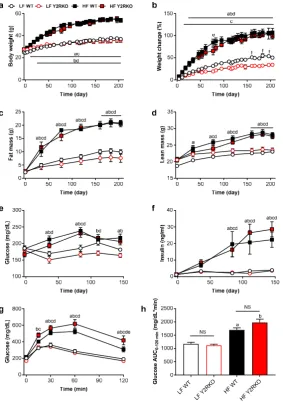
3.1. Y2R-deficient mice grow normally on regular chow diet and respond normally to high-fat diet
238
Male WT and homozygous Y2RKO mice at the age of 6 weeks where fed either a low-fat (10%
239
kcal/fat) or a high-fat (60% kcal/fat) diet for 30 weeks. On low-fat diet, Y2RKO mice grew normally
240
but with a tendency to exhibit slightly less weight gain and fat mass gain after about 20 weeks (Fig.
241
1a-c). On high-fat diet, Y2RKO gained body weight, lean mass, and fat mass at similar rates as WT
242
mice, with no significant differences at any time point up to 30 weeks (Fig. 1a-d). Although body
243
length at termination was significantly increased in high-fat fed mice, there were no significant
244
differences between genotypes in either low- or high-fat fed mice (Supplementary Fig. S2r).
245
Fasting blood glucose was similarly increased by high-fat diet in both WT and Y2RKO mice, with a
246
peak at around 14 weeks and slight moderation thereafter (Fig. 1e). Fasting plasma insulin was also
247
similarly increased by high-fat feeding in both genotypes, with a steady increase (Fig. 1f). Similarly,
248
250
Figure 1. Body weight, body composition, fasting glucose and insulin and glucose tolerance of male
251
WT and Y2RKO mice on either low-fat (10%; LF) or high-fat (60%; HF) diet. Absolute (a) and percent
252
change (b) in body weight; total fat mass (c) and lean mass (d); fasting blood glucose (e) and plasma
253
insulin (f) and intraperitoneal glucose tolerance test (1.5 g/kg) (g) with associated area under the curve
254
analysis (h). N = 10/group. a p ≤ 0.05 LF WT vs. HF WT, b p ≤ 0.05 LF Y2RKO vs. HF Y2RKO, c p ≤ 0.05
255
HF WT vs. LF Y2RKO, d p ≤ 0.05 LF WT vs. HF Y2RKO, e p ≤ 0.05 HF WT vs. HF Y2RKO, f p ≤ 0.05 LF
256
WT vs. LF Y2RKO.
257
groups, with a tendency for Y2RKO mice exhibiting slightly higher impairment compared to WT
258
mice (Fig. 1g, h).
259
The response to a 60% high-fat diet was also assessed in female and male heterozygous and
260
homozygous Y2RKO mice in a separate cohort. In general, the effects of high-fat diet were very
261
similar, with no major differences between WT and Y2RKO or Y2R heterozygous (HET) mice
262
(Supplementary Fig. S2a). Weight gain and body composition changes were similar in Y2R HET and
263
Y2RKO mice compared to WT mice for both males with the typical convex (Supplementary Fig.S1a,
264
b), and females with the typical concave slope of the weight gain curve (Supplementary Fig. S2c, d).
265
Weight gain was mostly due to fat mass gain and this was also similar for the two genotypes
266
(Supplementary Fig. S2e-h).
267
268
LF W T
LF Y2 RKO
HF W T
HF Y 2RKO
Glu
co
se
A
U
C
0-12
0
min
(
mg
/d
L
*mi
269
270
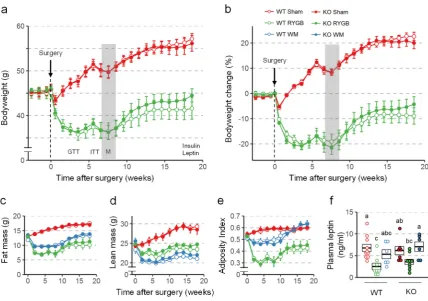
Figure 2. Effect of RYGB or sham surgery, or weight matching to RYGB by caloric restriction (WM)
271
on body weight, body composition, and leptin levels of Y2RKO and WT mice. a, b: Effect on absolute
272
body weight and percent body weight change over the 18 week observation period. Body weight of
273
WM mice was, by design, similar to RYGB and is not shown. Timing of glucose tolerance test (GTT),
274
insulin tolerance test (ITT), and metabolic chamber exposure (M, gray bar) are shown in A. c, d, e:
275
Effect on fat mass (c), lean mass (d), and adiposity index (e) over the 18 week observation period. f:
276
Plasma leptin levels at termination of the study. Data in a-e are shown as means ± SEM. Data in f are
277
presented as individual data points over a box showing means ± SEM. Groups that do not share the
278
same letters are significantly different from each other (p < 0.05, pairwise t-tests with
Benjamini-279
Hochberg correction, FDR = 0.05).
280
281
Fasting blood glucose levels in males were significantly elevated at 60 days on the high-fat diet
282
compared to the low-fat controls in WT, HET and Y2RKO mice (Supplementary Fig. S2i), while
283
fasting plasma insulin levels were significantly elevated at 90 days (Supplementary Fig. S2j). Fasting
284
blood glucose in females was not significantly elevated except for the Y2RKO mice at 30 days
285
(Supplementary Fig. S2k), while fasting plasma insulin was significantly increased to a similar extent
286
in all groups on high-fat diet at 90 days (Supplementary Fig. S2l).
287
In both males and females, glucose tolerance assessed at ~120 days after the start of high-fat diet
288
was significantly impaired to a similar extent in all three groups on high-fat diet compared to the
289
low-fat controls (Supplementary Fig. S2m-p). Finally, insulin’s ability to lower blood glucose,
290
assessed at ~180 days after initiation of high-fat diet, was significantly reduced in all three groups of
291
male mice on high-fat diet, with no difference in genotype (Supplementary Fig. S2q). Although there
292
was a similar trend for female mice, only Y2RKO and WT, but not HET mice, on high-fat diet showed
293
a significant deterioration of insulin tolerance (Supplementary Fig. S2s).
294
295
3.2. Similar effects of RYGB on body weight and body composition in Y2RKO and WT mice
296
Body weight was similarly affected by RYGB and sham surgery in WT and Y2RKO mice (Fig.
297
2a, b). After an initial body weight nadir reached at about 3-4 weeks after RYGB, there was significant
298
300
301
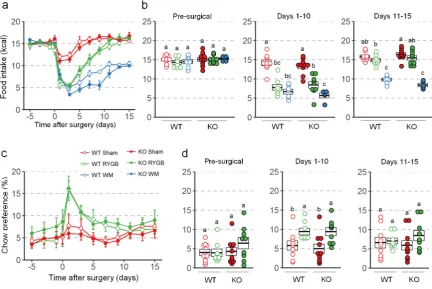
Figure 3. Effect of RYGB, sham surgery, or weight matching to RYGB by caloric restriction (WM) on
302
food intake and diet preference in Y2RKO and WT mice. All mice were on a two choice diet consisting
303
of high-fat and regular (low-fat) chow. a: Daily food intake before and for 15 days after surgery. b:
304
Average daily food intake over three distinct periods: pre-surgical (5 days before surgery), recovery
305
(days 1-10 after surgery), and stable period (days 11-15 after surgery). c: Daily chow preference before
306
and for 15 days after surgery. Preference is expressed as percent calories obtained from chow diet.
307
WM mice were given a fixed percent of calories from chow so their data is not shown. d: Average
308
daily chow preference over the same periods as in b. Data in a and c are presented as means ± SEM.
309
Data in b and d are presented as individual data points over a box showing means ± SEM. Groups
310
that do not share the same letters are significantly different from each other (p < 0.05, pairwise t-tests
311
with Benjamini-Hochberg correction, FDR = 0.05).
312
313
a slight tendency for Y2RKO mice with RYGB to regain more body weight during the last 8 weeks,
314
so that the final body weight loss was only 4% below pre-surgical body weight compared to 9% in
315
WT mice with RYGB, but this difference was not statistically significant. In contrast, mice with sham
316
surgery of both genotypes had only a small and transient reduction and then continued to gain body
317
weight. Body weight changes were mostly due to changes in fat mass and there were no significant
318
differences between WT and Y2RKO mice (Fig. 2c-e). Interestingly, calorie restriction for
weight-319
matching resulted in significantly greater loss of lean mass and a higher adiposity index compared
320
to RYGB. While RYGB significantly reduced the size of inguinal, mesenteric, perirenal, and
321
retroperitoneal and interscapular brown fat pads compared to sham surgery in both genotypes, it
322
unexpectedly did not decrease gonadal fat (Supplementary Fig. S3). The effects on total fat mass and
323
fad pad weights were generally reflected by leptin levels at termination (Fig. 2f). Notably, leptin levels
324
in Y2RKO mice were higher compared to WT mice with RYGB. Although not significant, this
325
difference is consistent with the larger weight regain of Y2RKO mice with RYGB.
326
327
3.3. Similar effects of RYGB on food intake and metabolism in Y2RKO and WT mice
328
There were no differences in total energy intake between any groups before surgery (Fig. 3a, b).
329
331
Figure 4. Effect of RYGB, sham surgery, or weight matching to RYGB by caloric restriction (WM) on
332
ANCOVA adjusted energy expenditure using body weight as a covariate (a), respiratory exchange
333
ratio (b), and locomotor activity (c) in Y2RKO and WT mice. Measurements were taken both at room
334
temperature (23°C) and at thermoneutrality (29°C) at about 7-8 weeks after surgery. Data are
335
expressed as individual data points over a box showing means ± SEM. Data that do not share the
336
same letters are significantly different from each other (p < 0.05, pairwise t-tests with
Benjamini-337
Hochberg correction, FDR = 0.05).
338
days compared to sham surgery and pre-surgical levels. In weight-matched mice, the amount of food
339
necessary to maintain body weight of the respective RYGB groups was significantly less than food
340
intake of RYGB mice for the first 15 days after surgery, and similar for the two genotypes.
341
Preference for chow, which was very low before surgery, significantly increased during the first 10
342
days after surgery for both genotypes (Fig. 3c, d).
343
Total daily energy expenditure (TEE; ANCOVA-adjusted for body weight) determined 7-8
344
weeks after surgery at thermoneutrality (29°C) was significantly higher in mice subjected to RYGB
345
compared with weight-matched mice but was not different compared to sham-operated mice (Fig.
346
4a). Respiratory exchange rate (RER) measured at thermoneutrality, was significantly higher after
347
RYGB compared to weight-matching and sham surgery in Y2RKO mice (Fig. 4b). Although the same
348
trend was observed in WT mice, it was not significantly different. There were no significant
349
differences between any groups in locomotor activity assed in the metabolic chambers at
350
thermoneutrality (Fig. 4c).
351
At termination, liver weight was significantly lower after RYGB and weight-matching compared
352
to sham surgery in both genotypes (Supplementary Fig. S4a). However, liver weight was significantly
353
lower in Y2RKO mice with sham surgery compared to their WT counterparts. Both heart and kidney
354
weights were significantly lower in weight-matched compared to RYGB and sham mice of both
355
significantly different between sham, RYGB, and weight-matched mice, with RYGB highest and
357
weight-matched lowest, irrespective of genotype (Supplementary Fig. S5).
358
359
360
Figure 5. Effect of RYGB, sham surgery, or weight matching to RYGB by caloric restriction (WM) on
361
glucose tolerance (a) and Insulin tolerance (b) in Y2RKO and WT mice. Data are presented as means
362
± SEM, or as individual data points over a box showing means ± SEM. Data that do not share the same
363
letters are significantly different from each other (p < 0.05, pairwise t-tests with Benjamini-Hochberg
364
correction, FDR = 0.05).
365
3.4. Similar RYGB-induced improvements of glycemic control in Y2RKO and WT mice
366
Intraperitoneal glucose tolerance assessed 3 weeks after surgery revealed better glucose
367
tolerance in mice with RYGB and weight-matching compared to sham surgery in both genotypes
368
(Fig. 5a). However, the difference in AUC between RYGB and sham was only statistically significant
369
in Y2RKO but not in WT mice. Insulin tolerance assessed 6 weeks after surgery showed significantly
370
better ability of insulin to lower blood glucose after RYGB and weight-matching compared to sham
371
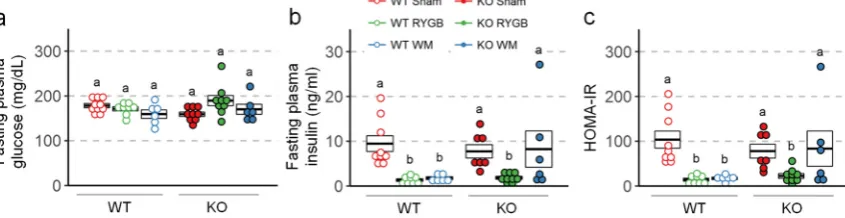
surgery in both genotypes (Fig. 5b). Furthermore, fasting plasma insulin and HOMA-IR measured at
372
termination was significantly lower after RYGB compared to sham surgery in both genotypes (Fig.
373
6). Although weight-matching resulted in the same significant improvements in WT mice, it did not
374
do so in Y2RKO mice.
375
4. Discussion
376
Given the strong anorexigenic and body weight lowering effects of PYY and Y2R-agonists [37;
377
20; 38; 39; 32; 33], it could be expected that Y2R-deficient mice eat more and gain more weight than
378
WT mice. Previous findings in Y2R-KO mice are inconsistent. On one hand, global Y2R-KO in male
379
mice resulted in slightly higher body weight that normalized after about 20 weeks of age, and
380
decreased locomotor activity [40]. On the other hand, conditional knockout of the Y2R in the
381
hypothalamus resulted in transiently decreased body weight in the face of increase food intake [41].
382
In our Y2R-KO model, food intake and body weight on regular chow or high-fat diet were similar in
383
both male and female Y2R-KO and WT mice. If anything, body weight gain after 20 weeks on
low-384
between Y2R-KO and WT mice in fasting blood glucose and insulin and in glucose and insulin
386
tolerance. We cannot rule out that compensatory mechanisms during early development may be
387
responsible for the lack of effect in these germline knockout mice, however our data suggest a lack of
388
tonic anorexigenic tone mediated via Y2R.
389
390
391
Figure 6. Effect of RYGB, sham surgery, or weight matching to RYGB by caloric restriction (WM) on
392
fasting plasma glucose (a), fasting plasma insulin (b), and HOMA-IR (c), in Y2R-KO and WT mice, as
393
measured at termination of the experiment. Data are presented as individual data points over a box
394
showing means ± SEM. Data that do not share the same letters are significantly different from each
395
other (p < 0.05, pairwise t-tests with Benjamini-Hochberg correction, FDR = 0.05).
396
Given the robustly increased secretion and circulating levels of PYY after both RYGB and VSG in
397
humans as well as rodent models [11; 13-17], we further hypothesized that at least some of the
398
appetite and body weight-lowering effects of these surgeries are mediated by increased PYY/Y2R
399
signaling and that they would be abolished or attenuated in Y2R-KO mice. However, contrary to our
400
expectations, RYGB was similarly effective in reducing body weight and improving impaired glucose
401
handling in high-fat diet-induced obese Y2R-KO and WT mice, suggesting that neither central nor
402
peripheral PYY/Y2R signaling is required for these beneficial effects of RYGB. Our findings are in
403
contrast to one previous report in mice with duodenal bypass surgery [34], but are consistent with
404
another report in rats with RYGB [30]. The body weight-lowering effect of duodenal bypass surgery
405
over the first 10 days after surgery seen in WT mice was greatly reduced in mice with PYY-deficiency
406
[34]. The different outcome may be due to the different surgery, the short observation period after
407
duodenal bypass, or deficiency in ligand vs. receptor. It is possible that in our Y2R-KO mice, PYY
408
retained its ability to signal through other Y-receptors, such as Y1R, and Y5R, while this was
409
abolished in the PYY-deficient mice. However, Y2R is the preferred receptor for PYY and there is
410
little evidence for anorexigenic and body weight lowering actions of Y1R and Y5R agonism. PYY Y5R
411
may even counteract the anorectic effects mediated by the Y2R [42]. Our findings are, however,
412
consistent with a previous study in rats, in which two weeks of intracranial infusion of the Y2R
413
antagonist BIIE 0246 did not increase food intake and body weight in obese rats that had undergone
414
RYGB four month earlier and had settled at a lower body weight [30]. By infusing the Y2R-antagonist
415
into the brain, that study may have missed important actions of PYY in the periphery. For example,
416
PYY has been shown to stimulate GLP-1 secretion [35], and via Y1R on pancreatic β-cells, insulin
417
secretion [43]. However, the present findings do not suggest that PYY actions through peripheral Y2R
418
is important for the beneficial effects of RYGB.
419
Y2R is also expressed in a subpopulation of vagal afferents innervating the lower gastrointestinal
420
tract, where it might be involved in vagal afferent satiety signaling [44; 45]. Since integrity of vagal
421
afferents innervating the small intestine through the celiac branches are partially required for the
422
beneficial effects of RYGB in rats [46], a case for Y2R on vagal afferents could be made. However, the
423
present results with global Y2R-KO do not support such a role.
424
425
Supplementary Materials: The following are available, Supplementary Figures S1, S2, S3, S4, and S5.
Author Contributions: Project conception: BB, JLT, HRB; experimental design and interpretation: BB, JLT, MBM,
427
HRB, SY, CDM, HM; data acquisition and analysis: BB, MBM, RLT, BG, JLT, HRB, CDM, HZ; wrote and edited
428
the manuscript: BB, JLT, HRB, SY, CDM, HM.
429
Funding: Partially supported by National Institutes of Health grants DK 047348 (HRB), DK105032 (CDM),
430
DK092587 (HM), and P30 GM118430 (TWG),
431
432
Acknowledgments:
433
Conflicts of Interest: BB, BG, SW, CJR and JLT are, or were at the time these studies were performed, employees
434
and/or stockholders of MedImmune/AstraZeneca. None of the other authors declares any conflict of interest.
435
436
Appendix A
437
438
439
Supplementary Figure S1. Genotyping of the 22 WT (W) and 22 Y2R-/-/GLP1R-/- double-knockout
440
mice used for the final analysis. Tail biopsies, taken at time of tissue harvest, were incubated at 95 °C
441
in lysis solution for 1hr. Neutralization buffer was added, and tails were stored at -20 °C until time
442
of genotyping. The PCR sample consisted of a 25µl volume containing 1µl of each of three primers
443
(11982_3: TTGATCTCACTCATTGTGGAGC ; 11982_4: CATCAATTGATGAAGATACAGGC ;
444
11982_7: TCTACAGTTTGATTCTCATCTGCC). Each reaction also contained AmpliTaq Gold 360
445
Master Mix and 360 GC Enhancer (Applied Biosystems by Thermo Fisher Scientific). The following
446
PCR conditions were applied: 5 min, 95 °C initial denaturation; 30 s, 95 °C cyclic denaturation; 30 s,
447
60 °C cyclic annealing; 1 min, 72 °C cyclic elongation for a total of 35 cycles, followed by a 10 min 72
448
°C elongation step. PCR amplification products were analyzed by agarose gel electrophoresis. KO
449
band are detected at 206 base pairs and WT band is detected at 357 base pairs.
450
451
460
Supplementary Figure S2. Physiological parameters of male and female wildtype (WT),
461
heterozygous (HET) and homozygous Y2RKO mice on 60% high-fat (HF) diet, compared to WT mice
462
on 10% low-fat (LF) diet. (a-d) Absolute and percent change in body weight. (e-h) Total lean and fat
463
mass. (i-l) Fasting blood glucose and fasting plasma insulin. (m-p) Intraperitoneal glucose tolerance
464
test (1.5 g/kg) and associated area under the curve (AUC). (q, s) Intraperitoneal insulin tolerance test
465
(1.0 U/kg). N = 7-13 for all groups. a p ≤ 0.05 LF WT vs HF WT, b p ≤ 0.05 LF WT vs HF HET, c p ≤ 0.05
466
LF WT vs HF HOM, d p ≤ 0.05 HF WT vs HF HET, e p ≤ 0.05 HF HET vs HF HOM. r: Terminal body
467
length in a different cohort of male mice, the same cohort as that shown in Figure 1 (N = 9-10/group).
468
^ p ≤ 0.0001).
469
470
471
472
0 50 100 150 200 0 20 40 60 Time (day) LF WT HF WT HF HET HF HOM abc
0 50 100 150 200 0 20 40 60 80 100 120 Time (day) abc
0 50 100 150 200 0 20 40 60 Time (day) B o dy w e ig h t (g) ac d b
0 50 100 150 200 0 50 100 150 200 250 Time (day) a
0 50 100 150 0 5 10 15 20 25 Time (day) Fat ma ss ( g ) ab abc abc abc L e an mass (g ) F a t mas s (g)
0 50 100 0 100 200 300 400 Time (day) d ac abc
0 50 100 0 5 10 15 Time (day) abc
0 50 100 100 150 200 250 Time (day) c In su lin (ng/ mL )
0 50 100 150 200 0 200 400 600 Time (min) ac ac abc bc
LF W T
HF WT HF HE T
HF HO
M 0 50 100 150 200
0 100 200 300 400 500 Time (min) c ab abc abc
0 40 80 120 0 50 100 150 200 250 Time (min) ac ac abc bc
0 40 80 120 0 50 100 150 200 250 Time (min) c ac
Male
Female
a
b
c
d
473
474
Supplementary Figure S3. Effect of RYGB, sham surgery, or weight matching to RYGB by caloric
475
restriction (WM) on weight of gonadal (a), retroperitoneal (b), perirenal (c), mesenteric (d), and
476
inguinal white fat (e), as well as interscapular brown fat pads (f) in Y2RKO and WT mice at
477
termination of the experiment. Data are expressed as individual data points over a box showing
478
means ± SEM. Data that do not share the same letters are significantly different from each other (p <
479
0.05, pairwise t-tests with Benjamini-Hochberg correction, FDR = 0.05).
480
481
482
483
484
485
Supplementary Figure S4. Effect of RYGB, sham surgery, or weight matching to RYGB by caloric
486
restriction (WM) on liver (a), heart (b), and kidney (c) weights in Y2RKO and WT mice at termination
487
of the experiment. Data are expressed as individual data points over a box showing means ± SEM.
488
Data that do not share the same letters are significantly different from each other (p < 0.05, pairwise
489
t-tests with Benjamini-Hochberg correction, FDR = 0.05).
497
Supplementary Figure S5. Effect of RYGB, sham surgery, or weight matching to RYGB by caloric
498
restriction (WM) on length (a, c) and weight (b, d) of small and large intestine, respectively in
499
Y2RKO and WT mice at termination of the experiment. Data are expressed as individual data points
500
over a box showing means ± SEM. Data that do not share the same letters are significantly different
501
from each other (p < 0.05, pairwise t-tests with Benjamini-Hochberg correction, FDR = 0.05).
502
503
References
504
[1] Fisher, D.P., Johnson, E., Haneuse, S., Arterburn, D., Coleman, K.J., O'Connor, P.J., et al., 2018.
505
Association Between Bariatric Surgery and Macrovascular Disease Outcomes in Patients With
506
Type 2 Diabetes and Severe Obesity. JAMA 320:1570-1582.
507
[2] Gadde, K.M., Martin, C.K., Berthoud, H.R., Heymsfield, S.B., 2018. Obesity: Pathophysiology
508
and Management. Journal of the American College of Cardiology 71:69-84.
509
[3] Schauer, P.R., Bhatt, D.L., Kashyap, S.R., 2017. Bariatric Surgery or Intensive Medical Therapy
510
for Diabetes after 5 Years. New England Journal of Medicine 376:1997.
511
[4] Wiggins, T., Antonowicz, S.S., Markar, S.R., 2018. Cancer Risk Following Bariatric
Surgery-512
Systematic Review and Meta-analysis of National Population-Based Cohort Studies. Obesity
513
Surgery.
514
[5] Schulman, A.R., Thompson, C.C., 2017. Complications of Bariatric Surgery: What You Can
515
Expect to See in Your GI Practice. American Journal of Gastroenterology 112:1640-1655.
516
[6] Adams, T.D., Davidson, L.E., Litwin, S.E., Kim, J., Kolotkin, R.L., Nanjee, M.N., et al., 2017.
517
Weight and Metabolic Outcomes 12 Years after Gastric Bypass. New England Journal of
518
Medicine 377:1143-1155.
519
[7] Ko, B.J., Myung, S.K., Cho, K.H., Park, Y.G., Kim, S.G., Kim do, H., et al., 2016. Relationship
520
Between Bariatric Surgery and Bone Mineral Density: a Meta-analysis. Obesity Surgery
521
[8] King, W.C., Chen, J.Y., Courcoulas, A.P., Dakin, G.F., Engel, S.G., Flum, D.R., et al., 2017.
523
Alcohol and other substance use after bariatric surgery: prospective evidence from a U.S.
524
multicenter cohort study. Surg Obes Relat Dis 13:1392-1402.
525
[9] le Roux, C.W., Aylwin, S.J., Batterham, R.L., Borg, C.M., Coyle, F., Prasad, V., et al., 2006. Gut
526
hormone profiles following bariatric surgery favor an anorectic state, facilitate weight loss, and
527
improve metabolic parameters. Annals of Surgery 243:108-114.
528
[10] le Roux, C.W., Welbourn, R., Werling, M., Osborne, A., Kokkinos, A., Laurenius, A., et al., 2007.
529
Gut hormones as mediators of appetite and weight loss after Roux-en-Y gastric bypass. Annals
530
of Surgery 246:780-785.
531
[11] Chan, J.L., Mun, E.C., Stoyneva, V., Mantzoros, C.S., Goldfine, A.B., 2006. Peptide YY levels
532
are elevated after gastric bypass surgery. Obesity (Silver Spring) 14:194-198.
533
[12] Jorgensen, N.B., Dirksen, C., Bojsen-Moller, K.N., Jacobsen, S.H., Worm, D., Hansen, D.L., et al.,
534
2013. Exaggerated glucagon-like peptide 1 response is important for improved beta-cell
535
function and glucose tolerance after Roux-en-Y gastric bypass in patients with type 2 diabetes.
536
Diabetes 62:3044-3052.
537
[13] Karamanakos, S.N., Vagenas, K., Kalfarentzos, F., Alexandrides, T.K., 2008. Weight loss,
538
appetite suppression, and changes in fasting and postprandial ghrelin and peptide-YY levels
539
after Roux-en-Y gastric bypass and sleeve gastrectomy: a prospective, double blind study.
540
Annals of Surgery 247:401-407.
541
[14] Korner, J., Bessler, M., Cirilo, L.J., Conwell, I.M., Daud, A., Restuccia, N.L., et al., 2005. Effects
542
of Roux-en-Y gastric bypass surgery on fasting and postprandial concentrations of plasma
543
ghrelin, peptide YY, and insulin. Journal of Clinical Endocrinology and Metabolism 90:359-365.
544
[15] Laferrere, B., Heshka, S., Wang, K., Khan, Y., McGinty, J., Teixeira, J., et al., 2007. Incretin
545
levels and effect are markedly enhanced 1 month after Roux-en-Y gastric bypass surgery in
546
obese patients with type 2 diabetes. Diabetes Care 30:1709-1716.
547
[16] Morinigo, R., Moize, V., Musri, M., Lacy, A.M., Navarro, S., Marin, J.L., et al., 2006.
Glucagon-548
like peptide-1, peptide YY, hunger, and satiety after gastric bypass surgery in morbidly obese
549
subjects. Journal of Clinical Endocrinology and Metabolism 91:1735-1740.
550
[17] Pournaras, D.J., Osborne, A., Hawkins, S.C., Mahon, D., Ghatei, M.A., Bloom, S.R., et al., 2010.
551
The gut hormone response following Roux-en-Y gastric bypass: cross-sectional and
552
prospective study. Obesity Surgery 20:56-60.
553
[18] Hansen, C.F., Bueter, M., Theis, N., Lutz, T., Paulsen, S., Dalboge, L.S., et al., 2013.
554
Hypertrophy Dependent Doubling of L-Cells in Roux-en-Y Gastric Bypass Operated Rats.
555
PLoS ONE 8:e65696.
556
[19] Shin, A.C., Zheng, H., Townsend, R.L., Sigalet, D.L., Berthoud, H.R., 2010. Meal-induced
557
hormone responses in a rat model of Roux-en-Y gastric bypass surgery. Endocrinology
558
151:1588-1597.
559
[20] Batterham, R.L., Cohen, M.A., Ellis, S.M., Le Roux, C.W., Withers, D.J., Frost, G.S., et al., 2003.
560
Inhibition of food intake in obese subjects by peptide YY3-36. New England Journal of
561
[21] Chelikani, P.K., Haver, A.C., Reidelberger, R.D., 2007. Intermittent intraperitoneal infusion of
563
peptide YY(3-36) reduces daily food intake and adiposity in obese rats. Am J Physiol Regul
564
Integr Comp Physiol 293:R39-46.
565
[22] Davis, H.R., Jr., Mullins, D.E., Pines, J.M., Hoos, L.M., France, C.F., Compton, D.S., et al., 1998.
566
Effect of chronic central administration of glucagon-like peptide-1 (7-36) amide on food
567
consumption and body weight in normal and obese rats. Obesity Research 6:147-156.
568
[23] De Silva, A., Salem, V., Long, C.J., Makwana, A., Newbould, R.D., Rabiner, E.A., et al., 2011.
569
The gut hormones PYY 3-36 and GLP-1 7-36 amide reduce food intake and modulate brain
570
activity in appetite centers in humans. Cell Metab 14:700-706.
571
[24] Hayes, M.R., Kanoski, S.E., Alhadeff, A.L., Grill, H.J., 2011. Comparative effects of the
long-572
acting GLP-1 receptor ligands, liraglutide and exendin-4, on food intake and body weight
573
suppression in rats. Obesity (Silver Spring) 19:1342-1349.
574
[25] Schmidt, J.B., Gregersen, N.T., Pedersen, S.D., Arentoft, J.L., Ritz, C., Schwartz, T.W., et al.,
575
2014. Effects of PYY3-36 and GLP-1 on energy intake, energy expenditure, and appetite in
576
overweight men. Am J Physiol Endocrinol Metab 306:E1248-1256.
577
[26] Aroda, V.R., 2018. A review of GLP-1 receptor agonists: Evolution and advancement, through
578
the lens of randomised controlled trials. Diabetes Obes Metab 20 Suppl 1:22-33.
579
[27] Fenske, W.K., Bueter, M., Miras, A.D., Ghatei, M.A., Bloom, S.R., le Roux, C.W., 2012.
580
Exogenous peptide YY3-36 and Exendin-4 further decrease food intake, whereas octreotide
581
increases food intake in rats after Roux-en-Y gastric bypass. Int J Obes (Lond) 36:379-384.
582
[28] Ten Kulve, J.S., Veltman, D.J., Gerdes, V.E.A., van Bloemendaal, L., Barkhof, F., Deacon, C.F., et
583
al., 2017. Elevated Postoperative Endogenous GLP-1 Levels Mediate Effects of Roux-en-Y
584
Gastric Bypass on Neural Responsivity to Food Cues. Diabetes Care 40:1522-1529.
585
[29] Mokadem, M., Zechner, J.F., Margolskee, R.F., Drucker, D.J., Aguirre, V., 2014. Effects of
586
Roux-en-Y gastric bypass on energy and glucose homeostasis are preserved in two mouse
587
models of functional glucagon-like peptide-1 deficiency. Mol Metab 3:191-201.
588
[30] Ye, J., Hao, Z., Mumphrey, M.B., Townsend, R.L., Patterson, L.M., Stylopoulos, N., et al., 2014.
589
GLP-1 receptor signaling is not required for reduced body weight after RYGB in rodents. Am J
590
Physiol Regul Integr Comp Physiol 306:R352-362.
591
[31] Wilson-Perez, H.E., Chambers, A.P., Ryan, K.K., Li, B., Sandoval, D.A., Stoffers, D., et al., 2013.
592
Vertical sleeve gastrectomy is effective in two genetic mouse models of glucagon-like Peptide 1
593
receptor deficiency. Diabetes 62:2380-2385.
594
[32] Niida, A., Kanematsu-Yamaki, Y., Asakawa, T., Ishimura, Y., Fujita, H., Matsumiya, K., et al.,
595
2018. Antiobesity and emetic effects of a short-length peptide YY analog and its PEGylated
596
and alkylated derivatives. Bioorganic and Medicinal Chemistry 26:566-572.
597
[33] Nishizawa, N., Niida, A., Masuda, Y., Kumano, S., Yokoyama, K., Hirabayashi, H., et al., 2017.
598
Antiobesity Effect of a Short-Length Peptide YY Analogue after Continuous Administration in
599
Mice. ACS Med Chem Lett 8:628-631.
600
[34] Chandarana, K., Gelegen, C., Karra, E., Choudhury, A.I., Drew, M.E., Fauveau, V., et al., 2011.
601
Diet and gastrointestinal bypass-induced weight loss: the roles of ghrelin and peptide YY.
602
[35] Chandarana, K., Gelegen, C., Irvine, E.E., Choudhury, A.I., Amouyal, C., Andreelli, F., et al.,
604
2013. Peripheral activation of the Y2-receptor promotes secretion of GLP-1 and improves
605
glucose tolerance. Mol Metab 2:142-152.
606
[36] Hao, Z., Zhao, Z., Berthoud, H.R., Ye, J., 2013. Development and verification of a mouse
607
model for Roux-en-Y gastric bypass surgery with a small gastric pouch. PLoS ONE 8:e52922.
608
[37] Abbott, C.R., Small, C.J., Kennedy, A.R., Neary, N.M., Sajedi, A., Ghatei, M.A., et al., 2005.
609
Blockade of the neuropeptide Y Y2 receptor with the specific antagonist BIIE0246 attenuates
610
the effect of endogenous and exogenous peptide YY(3-36) on food intake. Brain Research
611
1043:139-144.
612
[38] Batterham, R.L., Cowley, M.A., Small, C.J., Herzog, H., Cohen, M.A., Dakin, C.L., et al., 2002.
613
Gut hormone PYY(3-36) physiologically inhibits food intake. Nature 418:650-654.
614
[39] Batterham, R.L., ffytche, D.H., Rosenthal, J.M., Zelaya, F.O., Barker, G.J., Withers, D.J., et al.,
615
2007. PYY modulation of cortical and hypothalamic brain areas predicts feeding behaviour in
616
humans. Nature 450:106-109.
617
[40] Naveilhan, P., Hassani, H., Canals, J.M., Ekstrand, A.J., Larefalk, A., Chhajlani, V., et al., 1999.
618
Normal feeding behavior, body weight and leptin response require the neuropeptide Y Y2
619
receptor. Nature Medicine 5:1188-1193.
620
[41] Sainsbury, A., Schwarzer, C., Couzens, M., Fetissov, S., Furtinger, S., Jenkins, A., et al., 2002.
621
Important role of hypothalamic Y2 receptors in body weight regulation revealed in conditional
622
knockout mice. Proceedings of the National Academy of Sciences of the United States of
623
America 99:8938-8943.
624
[42] Shi, Y.C., Ip, C.K., Reed, F., Sarruf, D.A., Wulff, B.S., Herzog, H., 2017. Y5 receptor signalling
625
counteracts the anorectic effects of PYY3-36 in diet-induced obese mice. Journal of
626
Neuroendocrinology 29.
627
[43] Guida, C., McCulloch, L.J., Godazgar, M., Stephen, S.D., Baker, C., Basco, D., et al., 2018.
628
Sitagliptin and Roux-en-Y gastric bypass modulate insulin secretion via regulation of intra-islet
629
PYY. Diabetes Obes Metab 20:571-581.
630
[44] Burdyga, G., de Lartigue, G., Raybould, H.E., Morris, R., Dimaline, R., Varro, A., et al., 2008.
631
Cholecystokinin regulates expression of Y2 receptors in vagal afferent neurons serving the
632
stomach. Journal of Neuroscience 28:11583-11592.
633
[45] Whited, K.L., Tso, P., Raybould, H.E., 2007. Involvement of apolipoprotein A-IV and
634
cholecystokinin1 receptors in exogenous peptide YY3 36-induced stimulation of intestinal
635
feedback. Endocrinology 148:4695-4703.
636
[46] Hao, Z., Townsend, R.L., Mumphrey, M.B., Patterson, L.M., Ye, J., Berthoud, H.R., 2014. Vagal
637
innervation of intestine contributes to weight loss After Roux-en-Y gastric bypass surgery in