
Eclipse Attacks on Bitcoin’s Peer-to-Peer Network
∗
Ethan Heilman
∗Alison Kendler
∗Aviv Zohar
†Sharon Goldberg
∗∗
Boston University
†Hebrew University/MSR Israel
Abstract
We present eclipse attacks on bitcoin’s peer-to-peer net-work. Our attack allows an adversary controlling a suffi-cient number of IP addresses to monopolize all connec-tions to and from a victim bitcoin node. The attacker can then exploit the victim for attacks on bitcoin’s mining and consensus system, includingN-confirmation double spending, selfish mining, and adversarial forks in the blockchain. We take a detailed look at bitcoin’s peer-to-peer network, and quantify the resources involved in our attack via probabilistic analysis, Monte Carlo simu-lations, measurements and experiments with live bitcoin nodes. Finally, we present countermeasures, inspired by botnet architectures, that are designed to raise the bar for eclipse attacks while preserving the openness and decen-tralization of bitcoin’s current network architecture.
1
Introduction
While cryptocurrency has been studied since the 1980s [22, 25, 28], bitcoin is the first to see widespread adoption.A key reason for bitcoin’s success is its baked-in decentralization. Instead of usbaked-ing a central bank to regulate currency, bitcoin uses a decentralized network of nodes that use computational proofs-of-work to reach consensus on a distributed public ledger of transactions,
aka.,theblockchain. Satoshi Nakamoto [52] argues that bitcoin is secure against attackers that seek to shift the blockchain to an inconsistent/incorrect state, as long as these attackers control less than half of the computa-tional power in the network. But underlying this security analysis is the crucial assumption ofperfect information; namely, that all members of the bitcoin ecosystem can observe the proofs-of-work done by their peers.
∗
This is the full version of a paper that
ap-peared at 24th USENIX Security Symposium,
Washington, DC., August 2015. First posted
March 20, 2015; updated July 2, 2015.
While the last few years have seen extensive research into the security of bitcoin’s computational proof-of-work protocole.g., [14, 29, 36, 37, 45, 49, 50, 52, 58, 60], less attention has been paid to the peer-to-peer network used to broadcast information between bitcoin nodes (see Section 8). The bitcoin peer-to-peer network, which is bundled into the core bitcoind implementation,aka.,
the Satoshi client, is designed to be open, decentralized, and independent of a public-key infrastructure. As such, cryptographic authentication between peers is not used, and nodes are identified by their IP addresses (Section 2). Each node uses a randomized protocol to select eight peers with which it forms long-livedoutgoing connec-tions, and to propagate and store addresses of other po-tential peers in the network. Nodes with public IPs also accept up to 117unsolicited incoming connectionsfrom any IP address. Nodes exchange views of the state of the blockchain with their incoming and outgoing peers.
attacker-controlled addresses, and the attacker also mo-nopolizes the victim’s 117 incoming connections.
Our eclipse attack uses extremely low-rate TCP con-nections, so the main challenge for the attacker is to obtain a sufficient number of IP addresses (Section 4). We consider two attack types: (1) infrastructure attacks, modeling the threat of an ISP, company, or nation-state that holds severalcontiguousIP address blocks and seeks to subvert bitcoin by attacking its peer-to-peer network, and (2) botnet attacks, launched by bots with addresses in
diverseIP address ranges. We use probabilistic analysis, (Section 4) measurements (Section 5), and experiments on our own live bitcoin nodes (Section 6) to find that while botnet attacks require far fewer IP addresses, there are hundreds of organizations that have sufficient IP re-sources to launch eclipse attacks (Section 4.2.1). For ex-ample, we show how an infrastructure attacker with 32 distinct /24 IP address blocks (8192 address total), or a botnet of 4600 bots, can always eclipse a victim with at least 85% probability; this is independent of the number of nodes in the network. Moreover, 400 bots sufficed in tests on our live bitcoin nodes. To put this in context, if 8192 attack nodes joined today’s network (containing
≈7200 public-IP nodes [4]) and honestly followed the peer-to-peer protocol, they could eclipse a target with probability about(72008192+8192)8=0.6%.
Our attack is only for nodes with public IPs; nodes with private IPs may be affected if all of their outgoing connections are to eclipsed public-IP nodes.
Countermeasures. Large miners, merchant clients and online wallets have been known to modify bit-coin’s networking code to reduce the risk of network-based attacks. Two countermeasures are typically rec-ommended [3]: (1) disabling incoming connections, and (2) choosing ‘specific’ outgoing connections to well-connected peers or known miners (i.e., use whitelists). However, there are several problems with scaling this to the full bitcoin network. First, if incoming connections are banned, how do new nodes join the network? Sec-ond, how does one decide which ‘specific’ peers to con-nect to? Should bitcoin nodes form a private network? If so, how do they ensure compute power is sufficiently decentralized to prevent mining attacks?
Indeed, if bitcoin is to live up to its promise as an open and decentralized cryptocurrency, we believe its peer-to-peer network should be open and decentralized as well. Thus, our next contribution is a set of countermeasures that preserve openness by allowing unsolicited incom-ing connections, while raisincom-ing the bar for eclipse attacks (Section 7). Today, an attacker with enough addresses can eclipseanyvictim that accepts incoming connections and then restarts. Our countermeasures ensure that, with high probability, if a victim stores enough legitimate ad-dresses that accept incoming connections, then the
vic-tim be cannot eclipsedregardless of the number of IP addresses the attacker controls.Our countermeasures 1, 2, and 6 have been deployed in bitcoind v0.10.1; we also developed a patch [40] with Countermeasures 3,4.
1.1
Implications of eclipse attacks
Apart from disrupting the bitcoin network or selectively filtering a victim’s view of the blockchain, eclipse attacks are a useful building block for other attacks.
Engineering block races. A block race occurs when two miners discover blocks at the same time; one block will become part of the blockchain, while the other “or-phan block” will be ignored, yielding no mining rewards for the miner that discovered it. An attacker that eclipses many miners can engineer block races by hording blocks discovered by eclipsed miners, and releasing blocks to both the eclipsed and non-eclipsed miners once a com-peting block has been found. Thus, the eclipsed miners waste effort on orphan blocks.
Splitting mining power. Eclipsing anx-fraction of miners eliminates their mining power from the rest of the network, making it easier to launch mining attacks (e.g.,the 51% attack [52]). To hide the change in min-ing power under natural variations [19], miners could be eclipsed gradually or intermittently.
Selfish mining. With selfish mining [14, 29, 37, 60], the attacker strategically withholds blocks to win more than its fair share of mining rewards. The attack’s success is parameterized by two values: α, the ratio of mining power controlled by the attacker, andγ, the ratio of hon-est mining power that will mine on the attacker’s blocks during a block race. Ifγis large, thenαcan be small. By eclipsing miners, the attacker increasesγ, and thus de-creasesαso that selfish mining is easier. To do this, the attacker drops any blocks discovered by eclipsed miners that compete with the blocks discovered by the selfish miners. Next, the attacker increasesγ by feeding only the selfish miner’s view of the blockchain to the eclipsed miner; this coopts the eclipsed miner’s compute power, using it to mine on the selfish-miner’s blockchain.
Attacks on miners can harm the entire bitcoin ecosys-tem; mining pools are also vulnerable if their gateways to the public bitcoin network can be eclipsed. Eclipsing can also be used for double-spend attacks on non-miners, where the attacker spends some bitcoins multiple times:
to for a block confirmation [20],e.g.,in retail point-of-sale systems like BitPay [5], or online gambling sites like Betcoin [57]. To launch a double-spend attack against the merchant [46], the attacker eclipses the merchant’s bitcoin node, sends the merchant a transaction T for goods, and sends transaction T0 double-spending those bitcoins to the rest of the network. The merchant releases the goods to the attacker, but since the attacker controls all of the merchant’s connections, the merchant cannot tell the rest of the network aboutT, which meanwhile confirmsT0. The attacker thus obtains the goods with-out paying. 0-confirmation double-spends have occurred in the wild [57]. This attack is as effective as a Finney attack [39], but uses eclipsing instead of mining power.
N-confirmation double spend. If the attacker has eclipsed an x-fraction of miners, it can also launch
N-confirmation double-spending attacks on an eclipsed merchant. In anN-confirmation transaction, a merchant releases goods only after the transaction is confirmed in a block of depthN−1 in the blockchain [18]. The attacker sends its transaction to the eclipsed miners, who incor-porate it into their (obsolete) view of the blockchain. The attacker then shows this view of blockchain to the eclipsed merchant, receives the goods, and sends both the merchant and eclipsed miners the (non-obsolete) view of blockchain from the non-eclipsed miners. The eclipsed miners’ blockchain is orphaned, and the attacker ob-tains goods without paying. This is similar to an attack launched by a mining pool [10], but our attacker eclipses miners instead of using his own mining power.
Other attacks exist,e.g., a transaction hiding attack on nodes running in SPV mode [16].
2
Bitcoin’s Peer-to-Peer Network
We now describe bitcoin’s peer-to-peer network, based on bitcoind version 0.9.3, the most current release from 9/27/2014 to 2/16/2015, whose networking code was largely unchanged since 2013. This client was origi-nally written by Satoshi Nakamoto, and has near univer-sal market share for public-IP nodes (97% of public-IP nodes according to Bitnode.io on 2/11/2015 [4]).
Peers in the bitcoin network are identified by their IP addresses. A node with a public IP can initiate up to
eight outgoing connectionswith other bitcoin nodes, and accept up to 117incoming connections.1 A node with a private IP only initiates eight outgoing connections. Con-nections are over TCP. Nodes only propagate and store public IPs; a node can determine if its peer has a public IP by comparing the IP packet header with the bitcoin
VERSIONmessage. A node can also connect via Tor; we
1This is a configurable. Our analysis only assumes that nodes have
8 outgoing connections, which was confirmed by [51]’s measurements.
do not study this, see [16, 17] instead. We now describe how nodes propagate and store network information, and how they select outgoing connections.
2.1
Propagating network information
Network information propagates through the bitcoin net-work via DNS seeders andADDRmessages.
DNS seeders. A DNS seeder is a server that re-sponds to DNS queries from bitcoin nodes with a (not cryptographically-authenticated) list of IP addresses for bitcoin nodes. The size of the list is limited by constraints on DNS; it turns that the maximum possible number of IP addresses that can be returned by a single DNS query is around 4000 [41]. The seeder obtains these addresses by periodically crawling the bitcoin network. The bitcoin network has six seeders which are queried in two cases only. The first when a new node joins the network for the first time; it tries to connect to the seeders to get a list of active IPs, and otherwise fails over to a hardcoded list of about 600 IP addresses. The second is when an exist-ing node restarts and reconnects to new peers; here, the seeder is queried only if 11 seconds have elapsed since the node began attempting to establish connections and the node has less than two outgoing connections.
ADDR messages. ADDR messages, containing up to 1000 IP address and their timestamps, are used to obtain network information from peers. If more than 1000 ad-dresses are sent in aADDRmessage, the peer who sent the message is blacklisted. Nodes accept unsolicited ADDR
messages. AnADDR message is solicitedonlyupon es-tablishing a outgoing connection with a peer; the peer responds with up to threeADDRmessage each containing up to 1000 addresses randomly selected from its tables.2 Nodes push ADDR messages to peers in two cases. Each day, a node sends its own IP address in a ADDR
message to each peer. Also, when a node receives an
ADDR message with no more than 10 addresses, it for-wards theADDRmessage to two randomly-selected con-nected peers.3 To choose these peers, the node takes the hash of each connected peer’s IP address and a secret nonce associated with the day, selects the peers with the lexicographically first and second hash values. Finally, to prevent staleADDRmessages from endlessly propagat-ing, each node keeps aknownlist of the addresses it has sent to or learned from each of its connected peers, and never sends address on theknown list to its peer. The
knownlists are flushed daily.
2The peer sends a total ofnrandomly selected addresses from the
peer’striedandnewtables, wherenis a random number betweenx
and 2500, wherexis 23% of the addresses the peer has stored.
3Actually, if the ADDR message contains addresses that are
2.2
Storing network information
Public IPs are stored in a node’striedandnewtables. Tables are stored on disk and persist when a node restarts.
Thetriedtable. Thetriedtable consists of 64 buck-ets, each of which can store up to 64 unique addresses for peers to whom the node has successfully established an incoming or outgoing connection. Along with each stored peer’s address, the node keeps the timestamp for the most recent successful connection to this peer.
Each peer’s address is mapped to a bucket intriedby taking the hash of the peer’s (a) IP address and (b)group, where the group defined is the /16 IPv4 prefix containing the peer’s IP address.4A bucket is selected as follows:
SK = random value chosen when node is born. IP = the peer’s IP address and port number. Group = the peer’s group
i = Hash( SK, IP ) % 4
Bucket = Hash( SK, Group, i ) % 64 return Bucket
Thus, every IP address maps to a single bucket intried, and each group maps to up to four buckets.
When a node successfully connects to a peer, the peer’s address is inserted into the appropriate tried
bucket. If the bucket is full (i.e.,contains 64 addresses), then bitcoin eviction is used: four addresses are ran-domly selected from the bucket, and the oldest is (1) replaced by the new peer’s address in tried, and then (2) inserted into thenewtable. If the peer’s address is already present in the bucket, the timestamp associated with the peer’s address is updated. The timestamp is also updated when an actively connected peer sends a
VERSION,ADDR,INVENTORY,GETDATAorPINGmessage and more than 20 minutes elapsed since the last update.
Thenewtable. Thenewtable consists of 256 buck-ets, each of which can hold up 64 addresses for peers to whom the node has not yet initiated a successful con-nection. A node populates thenewtable with informa-tion learned from the DNS seeders, or fromADDR mes-sages. Addresses in the newtable also have an asso-ciated timestamp; addresses learned from DNS seeders are stamped with a random timestamp between 3 and 7 days old, while addresses learned fromADDRmessages are stamped with their timestamp from theADDR mes-sage plus two hours.
Every addressainserted innewbelongs to (1) agroup, defined in our description of thetriedtable, and (2) a
4For IPv6 addresses matching prefix 2001:0470* (which is
allo-cated to Hurricane Electric), the group is the /36 IP prefix that contains IPv6 address of the peer. For all other IPv6 addresses,the group is the /32 IP prefix that contains IPv6 address of the peer. For OnionCat Tor addresses, the group is the first 4 bits of the OnionCat address.
source group, the group the contains the IP address of the connected peer or DNS seeder from which the node learned addressa. The bucket is selected as follows:
SK = random value chosen when node is born.
Group = /16 containing IP to be inserted.
Src_Group = /16 containing IP of peer sending IP.
i = Hash( SK, Src_Group, Group ) % 32 Bucket = Hash( SK, Src_Group, i) % 256 return Bucket
Each (group,source group) pair hashes to a singlenew
bucket, while eachgroupselects up to 32 buckets innew. Each bucket holds unique addresses. If a bucket is full, then a function calledisTerribleis run over all 64 ad-dresses in the bucket; if any one of the adad-dresses is ter-rible, in that it is (a) more than 30 days old, or (b) has had too many failed connection attempts, then the terri-ble address is evicted in favor of the new address; other-wise,bitcoin evictionis used with the small change that the evicted address is discarded. A single address can map to multiple buckets if it is advertised by multiple peers; because it is unnecessary for our attacks, we omit description of the elaborate routine is used to insert du-plicate addresses.
2.3
Selecting peers
New outgoing connections are selected if a node restarts or if an outgoing connection is dropped by the network. A bitcoin node never deliberately drops a connection, ex-cept when a blacklisting condition is met (e.g.,the peer sendsADDRmessages that are too large).
A node with ω ∈[0,7] outgoing connections selects theω+1thconnection as follows:
(1) Decide whether to select fromtriedornew, where
Pr[Select fromtried] =
√
ρ(9−ω)
(ω+1) +√ρ(9−ω) (1)
andρis the ratio between the number of addresses stored intriedand the number of addresses stored innew. Fig-ure 1 plots the relationship betweenpandωfor different values ofρ. The address is more likely to be selected fromtriedwhen there are few outgoing connections or thetriedtable is large.
(2) Select a random address from the table, with a bias towards addresses with fresher timestamps: (i) Choose a random non-empty bucket in the table. (ii) Choose a random position in that bucket. (ii) If there is an address at that position, return the address with probability
Figure 1: Plot of Pr[Select fromtried]vs.ω (the num-ber of outgoing connections) for different values of ρ (the ratio between the number of addresses intriedand the number of addresses stored innew) per equation (1).
else, reject the address and return to (i). The acceptance probability p(r,τ)is a function ofr, the number of ad-dresses that have been rejected so far, and τ, the dif-ference between the address’s timestamp and the current time in measured in ten minute increments.5
(3) Connect to the address. If connection fails, go to (1).
3
The Eclipse Attack
Our attack is for a victim with a public IP. Our attacker (1) populates thetriedtable with addresses for its at-tack nodes, and (2) overwrites addresses in thenew ta-ble with “trash” IP addresses that are not part of the bitcoin network. The “trash” addresses are unallocated (e.g., listed as “available” by [56]) or as “reserved for future use” by [43] (e.g.,252.0.0.0/8). We fillnewwith “trash” because, unlike attacker addresses, “trash” is not a scarce resource. The attack continues until (3) the victim node restarts and chooses new outgoing connec-tions from thetriedandnewtables in its persistant stor-age (Section 2.3). With high probability, the victim es-tablishes all eight outgoing connections to attacker ad-dresses; all eight addresses will be fromtried, since the victim cannot connect to the “trash” innew. Finally, the attacker (5) occupies the victim’s remaining 117 incom-ing connections. We now detail each step of our attack.
3.1
Populating
tried
and
new
The attacker exploits the following to filltriedandnew: 1. Addresses from unsolicited incoming connections are stored in thetriedtable; thus, the attacker can in-sert an address into the victim’striedtable simply by
5The algorithm also considers the number of failed connections to
this address; we omit this because it does not affect our analysis.
connecting to the victim from that address. Moreover, thebitcoin evictiondiscipline means that the attacker’s fresher addresses are likely to evict any older legitimate addresses stored in thetriedtable (Section 2.2).
2. A node accepts unsolicited ADDRmessages; these addresses are inserted directly into thenewtable without testing their connectivity (Section 2.2). Thus, when our attacker connects to the victim from an adversarial ad-dress, it can also sendADDRmessages with 1000 “trash” addresses. Eventually, the trash overwrites all legitimate addresses innew. We use “trash” because we do not want to waste our IP address resources on overwritingnew.
3. Nodes only rarely solicit network information from peers and DNS seeders (Section 2.1). Thus, while the at-tacker overwrites the victim’striedandnewtables, the victim almost never counteracts the flood of adversarial information by querying legitimate peers or seeders.
3.2
Restarting the victim
Our attack requires the victim to restart so it can con-nect to adversarial addresses. There are several reasons why a bitcoin node could restart, including ISP outages, power failures, and upgrades, failures or attacks on the host OS; indeed, [16] found that a node with a public IP has a 25% chance of going offline after 10 hours. An-other predictable reason to restart is a software update; on 1/10/2014, for example, bitnodes.io saw 942 nodes running Satoshi client version 0.9.3, and by 29/12/2014, that number had risen to 3018 nodes, corresponding to over 2000 restarts. Since updating is oftennotoptional, especially when it corresponds to critical security issues; 2013 saw three such bitcoin upgrades, and the heartbleed bug [53] caused one in 2014. Also, since the community needs to be notified about an upgrade in advance, the at-tacker could watch for notifications and then commence its attack [2]. Restarts can also be deliberately elicited via DDoS [47, 65], memory exhaustion [16], or packets-of-death (which have been found for bitcoind [6,7]). The bottom line is that the security of the peer-to-peer net-work should not rely on 100% node uptime.
3.3
Selecting outgoing connections
Our attack succeeds if, upon restart, the victim makes all its outgoing connections to attacker addresses. To do this, we exploit the bias towards selecting addresses with fresh timestamps fromtried; by investing extra time into the attack, our attacker ensures its addresses are fresh, while all legitimate addresses become increasingly stale. We analyze this with few simple assumptions:
1. An f-fraction of the addresses in the victim’stried
1−f-fraction are legitimate. (Section 4 analyzes how many addresses the adversary therefore must control.)
2. Alladdresses inneware “trash”; all connections to addresses innewfail, and the victim is forced to connect to addresses fromtried(Section 2.3).
3. The attack proceeds inrounds, and repeats each round until the moment that the victim restarts. During a single round, the attacker connects to the victim from each of its adversarial IP addresses. A round takes timeτa, so all
adversarial addresses intriedare younger thanτa.
4. An f0-fraction addresses intriedare actively con-nected to the victim before the victim restarts. The times-tamps on these legitimate addresses are updated every 20 minute or more (Section 2.2). We assume these times-tamps are fresh (i.e.,τ=0) when the victim restarts; this is the worst case for the attacker.
5. Thetime invested in the attackτ`is the time elapsed from the moment the adversary starts the attack, until the victim restarts. If the victim did not obtain new le-gitimate network information during of the attack, then, excluding the f0-fraction described above, the legitimate addresses intriedare older thanτ`.
Success probability. If the adversary owns an f -fraction of the addresses intried, the probability that an adversarial address is accepted on the first try is
p(1,τa)·f wherep(1,τa)is as in equation (2); here we
use the fact that the adversary’s addresses are no older thanτa, the length of the round. Ifr−1 addresses were
rejected during this attempt to select an address from
tried, then the probability that an adversarial address is accepted on therthtry is bounded by
p(r,τa)·f r−1
∏
i=1
g(i,f,f0,τa,τ`)
where
g(i,f,f0,τa,τ`) = (1−p(i,τa))·f+ (1−p(i,0))·f0
+ (1−p(i,τ`))·(1−f−f0)
is the probability that an address was rejected on theith
try given that it was also rejected on thei−1th try. An adversarial address is thus accepted with probability
q(f,f0,τa,τ`) =
∞
∑
r=1
p(r,τa)·f r−1
∏
i=1
g(i,f,f0,τa,τ`)
(3) and the victim is eclipsed if all eight outgoing connec-tions are to adversarial addresses, which happens with probabilityq(f,f0,τa,τ`)8. Figure 2 plotsq(f,f0,τa,τ`)8 vs f for τa=27 minutes and different choices of τ`; we assume that f0=64×648 , which corresponds to a full
triedtable containing eight addresses that are actively connected before the victim restarts.
Figure 2: Probability of eclipsing a nodeq(f,f0,τa,τ`)8 (equation (3)) vs f the fraction of adversarial addresses intried, for different values of time invested in the at-tackτ`. Round length isτa=27 minutes, andf0=64×648 .
The dotted line shows the probability of eclipsing a node if random selection is used instead.
Random selection. Figure 2 also shows success proba-bility if addresses were just selected uniformly at random from each table. We do this by plotting f8vs f. Without random selection, the adversary has a 90% success prob-ability even if it only fills f =72% oftried, as long as it attacks forτ`=48 hours withτa=27 minute rounds.
With random selection, 90% success probability requires
f=98.7% oftriedto be attacker addresses.
3.4
Monopolizing the eclipsed victim
Figure 2 assumes that the victim has exactly eight out-going connections; all we require in terms ofincoming connectionsis that the victim has a few open slots to ac-cept incoming TCP connections from the attacker.
While it is often assumed that the number of TCP connections a computer can make is limited by the OS or the number of source ports, this applies only when OS-provided TCP sockets are used; a dedicated attacker can open an arbitrary number of TCP connections us-ing a custom TCP stack. A custom TCP stack (seee.g.,
zmap [35]) requires minimal CPU and memory, and is typically bottlenecked only by bandwidth, and the band-width cost of our attack is minimal:
Attack connections. To fill the tried table, our attacker repeatedly connects to the victim from each of its addresses. Each connection consists of a TCP hand-shake, bitcoin VERSION message, and then disconnec-tion via TCP RST; this costs 371 bytes upstream and 377 bytes downstream. Some attack connections also send oneADDRmessage containing 1000 addresses; these
ADDR messages cost 120087 bytes upstream and 437 bytes downstream including TCP ACKs.
the victim has eight outgoing connections to the attack nodes, and the attacker must occupy the victim’s remain-ing incomremain-ing connections. To prevent others from con-necting to the victim, these TCP connections could be maintained for 30 days, at which point the victim’s ad-dress isterribleand forgotten by the network. While bitcoin supports block inventory requests and the send-ing of blocks and transactions, this consumes significant bandwidth; our attacker thus does not to respond to in-ventory requests. As such, setting up each TCP connec-tion costs 377 bytes upstream and 377 bytes downstream, and is maintained by ping-pong packets and TCP ACKs consuming 164 bytes every 80 minutes.
We experimentally confirmed that a bitcoin node will accept all incoming connections from the same IP ad-dress. (We presume this is done to allow multiple nodes behind a NAT to connect to the same node.) Main-taining the default 117 incoming TCP connections costs
164×117
80×60 ≈4 bytes per second, easily allowing one
com-puter to monopolize multiple victims at the same time. As an aside, this also allows for connection starvation attacks[32], where an attacker monopolizes all the in-coming connections in the peer-to-peer network, making it impossible for new nodes to connect to new peers.
4
How Many Attack Addresses?
Section 3.3 showed that the success of our attack depends heavily onτ`, the time invested in the attack, and f, the fraction of attacker addresses in the victim’stried ta-ble. We now use probabilistic analysis to determine how many addresses the attacker must control for a given value of f; it’s important to remember, however, that even if f is small, our attacker can still succeed by in-creasingτ`. Recall from Section 2.2 that bitcoin is care-ful to ensure that a node does not store too many IP addresses from the same group (i.e., /16 IPv4 address block). We therefore consider two attack variants:
Botnet attack (Section 4.1). The attacker holds several IP addresses, each in adistinct group. This models at-tacks by a botnet of hosts scattered in diverse IP address blocks. Section 4.1.1 explains why many botnets have enough IP address diversity for this attack.
Infrastructure attack (Section 4.2). The attacker con-trols several IP address blocks, and can intercept bitcoin traffic sent to any IP address in the block, i.e., the at-tacker holds multiple sets of addresses in the samegroup. This models a company or nation-state that seeks to un-dermine bitcoin by attacking its network. Section 4.2.1 discusses organizations that can launch this attack.
We focus here ontried; Appendix B considers how to send “trash”-filledADDRmessages that overwritenew.
Figure 3: Botnet attack: the expected number of ad-dresses stored in tried for different scenarios vs the number of addresses (bots) t. Values were computed from equations (4), (7) and (8), and confirmed by Monte Carlo simulations (with 100 trials/data point).
4.1
Botnet attack
The botnet attacker holdstaddresses in distinct groups. We model each address as hashing to a uniformly-random bucket in tried, so the number of addresses hashing to each bucket is binomally distributed6 as B(t, 641). How many of the 64×64 entries in tried
can the attacker occupy? We model various scenarios, and plot results in Figure 3.
1. Initially empty. In the best case for the attacker, all 64 buckets are initially empty and the expected number of adversarial addresses stored in thetriedtable is
64E[min(64,B(t,641))] (4)
2. Bitcoin eviction.Now consider the worst case for the attacker, where each bucketiis full of 64 legitimate ad-dresses. These addresses, however, will beolderthan all Ai distinct adversarial addresses that the adversary
attempts to insert into to bucketi.7 Since the bitcoin eviction discipline requires each newly inserted address to select four random addresses stored in the bucket and to evict the oldest, if one of the four selected addresses is a legitimate address (which will be older than all of the adversary’s addresses), the legitimate address will be overwritten by the adversarial addresses.
Fora=0....Ai, letYabe the number of adversarial
ad-dresses actually stored in bucketi, given that the adver-sary insertedaunique addresses into bucketi. LetXa=1
if theathinserted address successfully overwrites a
legit-imate address, andXa=0 otherwise. Then,
E[Xa|Ya−1] =1−(Ya64−1)4
6B(n,p)is a binomial distribution counting successes in a sequence
ofnindependent yes/no trials, each yielding ‘yes’ with probabilityp.
7Actually, the addresses of the nodes that are actively connected to
and it follows that
E[Ya|Ya−1] =Ya−1+1−(Ya64−1)4 (5)
E[Y1] =1 (6)
where (6) follows because the bucket is initially full of legitimate addresses. We now have a recurrence relation forE[Ya], which we can solve numerically. We find that
E[Ya]>63 for a≥101, so the adversary can expect to
overwrite 63 of the 64 legitimate addresses in the bucket after inserting 101 unique addresses. The expected num-ber of adversarial addresses in all buckets is thus
64
t
∑
a=1
E[Ya]Pr[B(t,641) =a] (7)
3. Random eviction. We again consider the attacker’s worst case, where each bucket is full of legitimate ad-dresses, but now we assume that each inserted address evicts a randomly-selected address. (This is not what bit-coin does, but we analyze it for comparison.) Applying Lemma A.1 (Appendix A) we find the expected number of adversarial addresses in all buckets is
4096(1−(40954096)t) (8)
4. Exploiting multiple rounds. Our eclipse attack pro-ceeds inrounds; in each round the attacker repeatedly in-serts each of histaddresses into thetriedtable. While each address always maps to the same bucket intried
in each round, bitcoin eviction maps each address to a
different slotin that bucket in every round. Thus, an ad-versarial address that is not stored into itstriedbucket at the end of one round, might still be successfully stored into that bucket in a future round. Thus far, this section has only considered a single round. But, more addresses can be stored intriedby repeating the attack for multi-ple rounds. After sufficient rounds, the expected number of addresses is given by equation (4),i.e.,the attack per-forms as in the best-case for the attacker!
4.1.1 Who can launch a botnet attack?
The ‘initially empty’ line in Figure 3 indicates that a bot-net exploiting multiple rounds can completely filltried
with≈6000 addresses. While such an attack cannot eas-ily be launched from a legitimate cloud service (which typically allocates <20 addresses per tenant [1, 8, 9]), botnets of this size and larger than this have attacked bitcoin [45, 47, 65]; the Miner botnet, for example, had 29,000 hosts with public IPs [54]. While some botnet in-festations concentrate in a few IP address ranges [63], it is important to remember that our botnet attack re-quires no more than≈6000 groups; many botnets are or-ders of magnitude larger [59]. For example, the Walow-dac botnet was mostly in ranges 58.x-100.x and 188.x-233.x [63], which creates 42×28+55×28 =24832
Figure 4: Infrastructure attack. E[Γ] (expected number of non-empty buckets) intriedvss(number of groups).
Figure 5: Infrastructure attack withs=32 groups: the expected number of addresses stored intriedfor differ-ent scenarios vs the number of addresses per groupt. Re-sults obtained by taking the product of equation (9) and equation (16) or (17), and confirmed by Monte Carlo simulations (100 trials/data point). The horizontal line assumes allE[Γ]buckets per (9) are full.
groups. Randomly sampling from the list of hosts in the Carna botnet [26] 5000 times, we find that 1250 bots gives on average 402 distinct groups, enough to at-tack our live bitcoin nodes (Section 6). Furthermore, we soon show in Figure 4 that an infrastructure attack with
s>200 groups easily fills every bucket intried; thus, withs>400 groups, the attack performs as in Figure 3, even if many bots are in the same group. .
4.2
Infrastructure attack
The attacker holds addresses insdistinctgroups. We de-termine how much oftriedcan be filled by an attacker controllingsgroupsscontainingtIP addresses/group.
How many groups? We model the process of pop-ulatingtried (per Section 2.2) by supposing that four independent hash functions map each of the s groups to one of 64 buckets in tried. Thus, if Γ∈[0,64] counts the number of non-empty buckets intried, we use Lemma A.1 to find that
E[Γ] =64 1−(6364)4s≈(1−e− 4s
64) (9)
Figure 4 plotsE[Γ]; we expect to fill 55.5 of 64 buckets withs=32, and all but one bucket withs>67 groups.
Figure 6: Histogram of the number of organizations with
sgroups. For the /24 data, we requiret=256 addresses per group; for /23, we requiret=512.
the first three scenarios described in Section 4.1; the ex-pected fractionE[f] of triedfilled by adversarial ad-dresses is plotted in in Figure 5. The horizontal line in Figure 5 show what happens if each ofE[Γ]buckets per equation (9) is full of attack addresses.
The adversary’s task is easiest when all buckets are initially empty, or when a sufficient number of rounds are used; a single /24 address block of 256 addresses suffices to fill each bucket whens=32 grouips is used. Moreover, as in Section 4.1, an attack that exploits mul-tiple rounds performs as in the ‘initially empty’ scenario. Concretely, with 32 groups of 256 addresses each (8192 addresses in total) an adversary can expect to fill about
f =86% of thetriedtable after a sufficient number of rounds. The attacker is almost as effective in the bitcoin-eviction scenario with only one round; meanwhile, one round is much less effective with random eviction.
4.2.1 Who can launch an infrastructure attack?
Which organizations have enough IP address resources to launch infrastructure attacks? We compiled data mapping IPv4 address allocation to organizations, using CAIDA’s AS to organization dataset [23] and AS to pre-fix dataset [24] from July 2014, supplementing our data with information from the RIPE database [55]. We de-termined how many groups (i.e.,addresses in the same /16 IPv4 address block) and addresses per group are al-located to each organization; see Figure 6. There are 448 organizations with overs=32 groups and at leastt=256 addresses per group; if these organizations investτ`=5 hours into an attack with aτa=27-minute round, then
they eclipse the victim with probability greater than 80%. National ISPs in various countries hold a sufficient number of groups (s≥32) for this purpose; for exam-ple, in Sudan (Sudanese Mobile), Columbia (ETB), UAE (Etisalat), Guatemala (Telgua), Tunisia (Tunisia Tele-com), Saudi Arabia (Saudi Telecom Company) and Do-minica (Cable and Wireless). The United States Depart-ment of the Interior has enough groups (s=35), as does the S. Korean Ministry of Information and Communica-tion (s=41), as do hundreds of others.
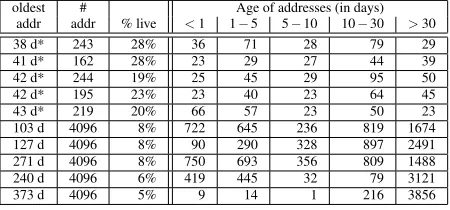
oldest # Age of addresses (in days)
addr addr % live <1 1−5 5−10 10−30 >30
38 d* 243 28% 36 71 28 79 29
41 d* 162 28% 23 29 27 44 39
42 d* 244 19% 25 45 29 95 50
42 d* 195 23% 23 40 23 64 45
43 d* 219 20% 66 57 23 50 23
103 d 4096 8% 722 645 236 819 1674
127 d 4096 8% 90 290 328 897 2491
271 d 4096 8% 750 693 356 809 1488
240 d 4096 6% 419 445 32 79 3121
373 d 4096 5% 9 14 1 216 3856
Table 1: Age and churn of addresses intriedfor our nodes (marked with *) and donated peers files.
4.3
Summary: infrastructure or botnet?
Figures 5, 3 show that the botnet attack is far superior to the infrastructure attack. Filling f =98% of the vic-tim’striedtable requires a 4600 node botnet (attack-ing for a sufficient number of rounds, per equation (4)). By contrast, an infrastructure attacker needs 16,000 ad-dresses, consisting ofs=63 groups (equation (9)) with
t=256 addresses per group. However, per Section 3.3, if our attacker increases the time invested in the attack τ`, it can be far less aggressive about fillingtried. For example, per Figure 2, attacking forτ`=24 hours with τa=27 minute rounds, our success probability exceeds
85% with justf=72%; in the worst case for the attacker, this requires only 3000 bots, or an infrastructure attack of
s=20 groups andt=256 addresses per group (5120 ad-dresses). The same attack (f =72%, τa=27 minutes)
running for just 4 hours still has>55% success proba-bility. To put this in context, if 3000 bots joined today’s network (with<7200 public-IP nodes [4]) and honestly followed the peer-to-peer protocol, they could eclipse a victim with probability≈(72003000+3000)8=0.006%.
5
Measuring Live Bitcoin Nodes
We briefly consider how parameters affecting the success of our eclipse attacks look on “typical” bitcoin nodes. We thus instrumented five bitcoin nodes with public IPs that we ran (continuously, without restarting) for 43 days from 12/23/2014 to 2/4/2015. We also analyze several peers files that others donated to us on 2/15/2015. Note that there is evidence of wide variations in metrics for nodes of different ages and in different regions [46]; as such, our analysis (Section 3-4) and some of our experi-ments (Section 6) focus on the attacker’s worst-case sce-nario, where tables are initially full of fresh addresses.
while our node can accommodate 125 connections, we never see more than 60 at a time. Similar measurements in [17] indicate that 80% of bitcoin peers allow at least 40 incoming connections. Our node saw, on average, 9.9 connections to public IPs over the course of its lifetime; of these, 8 correspond to outgoing connections, which means we rarely see incoming connections from public IPs. Results for our other nodes are similar.
Connection length. Because public bitcoin nodes rarely drop outgoing connections to their peers (except upon restart, network failure, or due to blacklisting, see Section 2.3), many connections are fairly long lived. When we sampled our nodes on 2/4/2015, across all of our nodes, 17% of connections had lasted more than 15 days, and of these, 65.6% were to public IPs. On the other hand, many bitcoin nodes restart frequently; we saw that 43% of connections lasted less than two days and of these, 97% were to nodes with private IPs. This may explain why we see so few incoming connections from public IPs; many public-IP nodes stick to their ma-ture long-term peers, rather than our young-ish nodes.
Size oftriedandnewtables. In our worst case attack, we supposed that thetriedandnewtables were com-pletely full of fresh addresses. While our Bitcoin nodes’
newtables filled up quite quickly (99% within 48 hours), Table 1 reveals that theirtriedtables were far from full of fresh addresses. Even after 43 days, the tried ta-bles for our nodes were no more than 300/4096≈8% full. This likely follows because our nodes had very few incoming connections from public IPs; thus, most ad-dresses intried result from successful outgoing con-nections to public IPs (infrequently) drawn fromnew.
Freshness of tried. Even those few addresses in
triedare not especially fresh. Table 1 shows the age distribution of the addresses intriedfor our nodes and from donated peers files. For our nodes, 17% of ad-dresses were more than 30 days old, and 48% were more than 10 days old; these addresses will therefore be less preferred than the adversarial ones inserted during an eclipse attack, even if the adversary does not invest much timeτ`in attacking the victim.
Churn. Table 1 also shows that a small fraction of addresses intriedwere online when we tried connect-ing to them on 2/17/2015.8 This suggests further vul-nerability to eclipse attacks, because if most legitimate addresses intriedare offline when a victim resets, the victim is likely to connect to an adversarial address.
8For consistency with the rest of this section, we tested our nodes
tables from 2/4/2015. We also repeated this test for tables taken from our nodes on 2/17/2015, and the results did not deviate more than 6% from those of Table 1.
Figure 7: (Top) Incoming + outgoing connections vs time for one of our nodes. (Bottom) Number of addresses intriedvs time for all our nodes.
6
Experiments
We now validate our analysis with experiments.
Methodology. In each of our experiments, the vic-tim (bitcoind) node is on a virtual machine on the at-tacking machine; we also instrument the victim’s code. The victim node runs on the public bitcoin network (aka,
mainnet). The attacking machine can read all the vic-tim’s packets to/from the public bitcoin network, and can therefore forge TCP connections from arbitrary IP addresses. To launch the attack, the attacking machine forges TCP connections from each of its attacker ad-dresses, making an incoming connection to the victim, sending aVERSIONmessage and sometimes also anADDR
message (per Appendix B) and then disconnecting; the attack connections, which are launched at regular inter-vals, rarely occupy all of the victim’s available slots for incoming connections. To avoid harming the public bit-coin network, (1) we use “reserved for future use” [43] IPs in 240.0.0.0/8-249.0.0.0/8 as attack addresses, and 252.0.0.0/8 as “trash” sent inADDRmessages, and (2) we drop anyADDR messages the (polluted) victim attempts to send to the public network.
At the end of the attack, we repeatedly restart the vic-tim and see what outgoing connections it makes, drop-ping connections to the “trash” addresses and forging connections for the attacker addresses. If all 8 outgo-ing connections are to attacker addresses, the attack suc-ceeds, and otherwise it fails. Each experiment restarts the victim 50 times, and reports the fraction of successes. At each restart, we revert the victim’s tables to their state at the end of the attack, and rewind the victim’s system time to the moment the attack ended (to avoid dating times-tamps intriedandnew). We restart the victim 50 times to measure the success rate of our (probabilistic) attack; in a real attack, the victim would only restart once.
Initial conditions. We try various initial conditions:
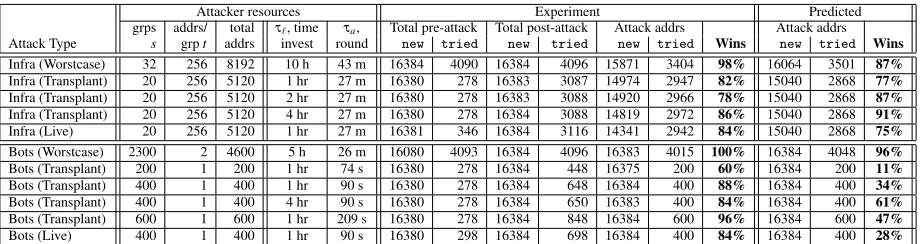
Attacker resources Experiment Predicted
grps addrs/ total τ`, time τa, Total pre-attack Total post-attack Attack addrs Attack addrs
Attack Type s grpt addrs invest round new tried new tried new tried Wins new tried Wins
Infra (Worstcase) 32 256 8192 10 h 43 m 16384 4090 16384 4096 15871 3404 98% 16064 3501 87%
Infra (Transplant) 20 256 5120 1 hr 27 m 16380 278 16383 3087 14974 2947 82% 15040 2868 77%
Infra (Transplant) 20 256 5120 2 hr 27 m 16380 278 16383 3088 14920 2966 78% 15040 2868 87%
Infra (Transplant) 20 256 5120 4 hr 27 m 16380 278 16384 3088 14819 2972 86% 15040 2868 91%
Infra (Live) 20 256 5120 1 hr 27 m 16381 346 16384 3116 14341 2942 84% 15040 2868 75%
Bots (Worstcase) 2300 2 4600 5 h 26 m 16080 4093 16384 4096 16383 4015 100% 16384 4048 96%
Bots (Transplant) 200 1 200 1 hr 74 s 16380 278 16384 448 16375 200 60% 16384 200 11%
Bots (Transplant) 400 1 400 1 hr 90 s 16380 278 16384 648 16384 400 88% 16384 400 34%
Bots (Transplant) 400 1 400 4 hr 90 s 16380 278 16384 650 16383 400 84% 16384 400 61%
Bots (Transplant) 600 1 600 1 hr 209 s 16380 278 16384 848 16384 600 96% 16384 600 47%
Bots (Live) 400 1 400 1 hr 90 s 16380 298 16384 698 16384 400 84% 16384 400 28%
Table 2: Summary of our experiments.
completely full of legitimate addresses with fresh times-tamps. To set up the initial condition, we run our at-tack for no longer than one hour on a freshly-born vic-tim node, fillingtriedandnewwith IP addresses from 251.0.0.0/8, 253.0.0.0/8 and 254.0.0.0/8, which we des-ignate as “legitimate addresses”; these addresses are no older than one hour when the attack starts. We then restart the victim and commence attacking it.
2. Transplant case. In our transplant experiments, we copied thetried andnewtables from one of our five live bitcoin nodes on 8/2/2015, installed them in a fresh victim with a different public IP address, restarted the victim, waited for it to establish eight outgoing connec-tions, and then commenced attacking. This allowed us to try various attacks with a consistent initial condition.
3. Live case. Finally, on 2/17/2015 and 2/18/2015 we attacked our live bitcoin nodes while they were con-nected to the public bitcoin network; at this point our nodes had been online for 52 or 53 days.
Results (Table 2). Results are in Table 2. The first five columns summarize attacker resources (the number of groupss, addresses per groupt, time invested in the attackτ`, and length of a roundτaper Sections 3-4). The
next two columns present the initial condition: the num-ber of addresses intried andnewprior to the attack. The following four columns give the size oftriedand
new, and the number of attacker addresses they store, at the end of the attack (when the victim first restarts). The
winscolumns counts the fraction of times our attack suc-ceeds after restarting the victim 50 times.
The final three columns give predictions from Sec-tions 3.3, 4. Theattack addrscolumns give the expected number of addresses in new(Appendix B) and tried. Fortried, we assume that the attacker runs his attack for enough rounds so that the expected number of ad-dresses intriedis governed by equation (4) for the bot-net, and (9) multiplied by (16) for the infrastructure at-tack. The final column predicts success per Section 3.3 usingexperimental valuesofτa,τ`, f, f0.
Observations. Our results indicate the following:
1. Success in worst case. Our experiments confirm that an infrastructure attack with 32 groups of size /24 (8192 attack addresses total) succeeds in the worst case with very high probability. We also confirm that botnets are superior to infrastructure attacks; 4600 bots had 100% success even with a worst-case initial condition.
2. Accuracy of predictions. Almost all of our attacks had an experimental success rate that washigher than the predicted success rate. To explain this, recall that our predictions from Section 3.3 assume that legitimate ad-dresses are exactlyτ`old (whereτ`is the time invested in the attack); in practice, legitimate addresses are likely to be even older, especially when we work withtried
tables of real nodes (Table 1). Less importantly, our pre-dictions also assume that adversarial addresses are ex-actlyτaold; in practice, an adversarial address inserted
at the end of a round could be even younger. Thus, Sec-tion 3.3’s predicSec-tions are a lower bound on the success rate.
Our experimental botnet attacks were dramatically more successful than their predictions (e.g.,88% actual vs. 34% predicted), most likely because the addresses initially intriedwere already very stale prior to the at-tack (Table 1). Our infrastructure atat-tacks were also more successful then their predictions, but here the difference was much less dramatic. To explain this, we look to the
new table. While our success-rate predictions assume thatnewis completely overwritten, our infrastructure at-tacks failed to completely overwrite thenewtable;9thus, we have some extra failures because the victim made out-going connections to addresses innew.
Finally, note that we decided our attack failed even if the victim tried to connect to a legitimate address that was offline. With high churn rates (per Table 1), our suc-cess rates could be even higher than that in Table 2.
3. Success in a ‘typical’ case. Our attacks are suc-cessful with even fewer addresses when we test them on our live nodes, or on tables taken from those live nodes.
9Thenewtable holds 16384 addresses and from 6thlast column of
Most strikingly, a small botnet of 400 bots succeeds with very high probability; while this botnet completely over-writesnew, it fills only 400/650=62% oftried, and still manages to win with more than 80% probability.
7
Countermeasures
We have shown how an attacker with enough IP ad-dresses and time can eclipse any target victim, regardless of the state of the victim’stried andnewtables. We now present countermeasures that make eclipse attacks more difficult. Our countermeasures are inspired by bot-net architectures (Section 8), and designed to be faithful to bitcoin’s network architecture.
The following five countermeasures ensure that: (1) If the victim hashlegitimate addresses intriedbefore the attack, and ap-fraction of them accept incoming connec-tions during the attack when the victim restarts, then even an attackerwith an unbounded number of addresses can-not eclipse the victim with probability exceeding equa-tion (10). (2) If the victim’s oldest outgoing connecequa-tion is to a legitimate peer before the attack, then the eclipse at-tackfailsif that peer accepts incoming connections when the victim restarts.
1. Deterministic random eviction. Replace bitcoin eviction as follows: just as each address deterministically hashes to a single bucket intriedandnew(Section 2.2), an address also deterministically hashes to a single slot in that bucket. This way, an attacker cannot increase the number of addresses stored by repeatedly inserting the same address in multiple rounds (Section 4.1). Instead, addresses stored intriedare given by the ‘random evic-tion’ curves in Figures 3, 5, reducing the attack addresses stored intried.
2. Random selection. Our attacks also exploit the heavy bias towards forming outgoing connections to addresses with fresh timestamps, so that an attacker that owns only a small fraction f =30% of the victim’s
triedtable can increase its success probability (to say 50%) by increasing τ`, the time it invests in the attack (Section 3.3). We can eliminate this advantage for the attacker if addresses are selected at random fromtried
andnew; this way, a success rate of 50% always requires the adversary to fill√80.5=91.7% oftried, which re-quires 40 groups in an infrastructure attack, or about 3680 peers in a botnet attack. Combining this with deter-ministic random eviction, the figure jumps to 10194 bots for 50% success probability.
These countermeasures harden the network, but still allow an attacker with enough addresses to overwrite all oftried. The next countermeasure remedies this:
3. Test before evict. Before storing an address in its (deterministically-chosen) slot in a bucket intried, first
check if there is an older address stored in that slot. If so, briefly attempt to connect to the older address, and if connection is successful, then the older address isnot
evicted from thetriedtable; the new address is stored intriedonly if the connection fails.
We analyze these three countermeasures. Suppose that there arehlegitimate addresses in thetriedtable prior to the attack, and model network churn by supposing that each of theh legitimate addresses intriedis live (i.e.,accepts incoming connections) independently with probabilityp. With test-before-evict, the adversary can-not evictp×hlegitimate addresses (in expectation) from
tried, regardless of the number of distinct addresses it controls. Thus, even if the rest oftriedis full of adver-sarial addresses, the probability of eclipsing the victim is bounded to about
Pr[eclipse] = f8<1−64×64p×h 8 (10)
This is in stark contrast to today’s protocol, where at-tackers with enough addresses haveunboundedsuccess probability even iftriedisfullof legitimate addresses.
We perform Monte-Carlo simulations assuming churn
p,h legitimate addresses initially stored intried, and a botnet insertingaaddresses intotriedvia unsolicited incoming connections. The area below each curve in Fig-ure 8 is the number of botsa that can eclipse a victim with probability at least 50%, given that there are initially
hlegitimate addresses intried. With test-before-evict, the curves plateau horizontally ath=4096(1−√8
0.5)/p; as long ash is greater than this quantity, even a botnet
with an infinite number of addresseshas success proba-bility bounded by 50%. Importantly, the plateau is ab-sent without test-before-evict; a botnet with enough ad-dresses can eclipse a victimregardlessof the number of legitimate addresseshinitially intried.
There is one problem, however. Our bitcoin nodes saw high churn rates (Table 1). With a p=28% churn rate, for example, bounding the adversary’s success probabil-ity to 10% requires abouth=3700 addresses intried; our nodes hadh<400. Our next countermeasure thus adds more legitimate addresses totried:
4. Feeler Connections. Add an outgoing connection that establish short-lived test connections to randomly-selected addresses in new. If connection succeeds, the address is evicted fromnewand inserted intotried; oth-erwise, the address is evicted fromnew.
Feeler connections clean trash out of newwhile in-creasing the number of fresh address intriedthat are likely to be online when a node restarts. Our fifth coun-termeasure is orthogonal to those above:
Figure 8: The area below each curve corresponds to a number of botsathat can eclipse a victim with probabil-ity at least 50%, given that the victim initially hash legit-imate addresses intried. We show one curve per churn ratep. (Top) With test before evict. (Bottom) Without.
between restarts. Thus, we add ananchortable, record-ing addresses of current outgorecord-ing connections and the time of first connection to each address. Upon restart, the node dedicates two extra outgoing connections to the oldestanchor addresses that accept incoming connec-tions. Now, in addition to defeating our other counter-measures, a successful attacker must also disruptanchor
connections; eclipse attacks fail if the victim connects to ananchoraddress not controlled by the attacker.
Apart from these five countermeasures, a few other ideas can raise the bar for eclipse attacks:
6. More buckets. Among the most obvious coun-termeasure is to increase the size of thetriedandnew
tables. Suppose we doubled the number of buckets in thetriedtable. If we consider the infrastructure attack, the buckets filled bysgroups jumps from(1−e−464s)(per
equation (9) to(1−e−1284s ). Thus, an infrastructure at-tacker needs double the number of groups in order to ex-pect to fill the same fraction oftried. Similarly, a botnet needs to double the number of bots. Importantly, how-ever, this countermeasure is helpful only when tried
already contains many legitimate addresses, so that at-tacker owns a smaller fraction of the addresses intried. However, iftriedis mostly empty (or contains mostly stale addresses for nodes that are no longer online), the attacker will still own a large fraction of the addresses in tried, even though the number of tried buckets has increased. Thus, this countermeasure should also be accompanied by another countermeasure (e.g.,feeler connections) that increases the number of legitimate ad-dresses stored intried.
7. More outgoing connections. Figure 7 indicates
our test bitcoin nodes had at least 65 connections slots available, and [17] indicates that 80% of bitcoin peers allow at least 40 incoming connections. Thus, we can require nodes to make a few additional outgoing con-nections without risking that the network will run out of connection capacity. Indeed, recent measurements [51] indicate that certain nodes (e.g.,mining-pool gateways) do this already. For example, using twelve outgoing con-nections instead of eight (in addition to the feeler connec-tion and two anchor connecconnec-tions), decreases the attack’s success probability from f8to f12; to achieve 50% suc-cess probability the infrastructure attacker now needs 46 groups, and the botnet needs 11796 bots. While this im-provement is not as dramatic Countermeasures 1-5, it is still a simple way to raise the bar for eclipse attacks.
8. Ban unsolicited ADDR messages. A node could choose not to accept large unsolicited ADDR messages (with>10 addresses) from incoming peers, and only so-licitADDRmessages from outgoing connections when its
newtable is too empty. This prevents adversarial incom-ing connections from floodincom-ing a victim’snewtable with trash addresses. We argue that this change is not harmful, since even in the current network, there is no shortage of address in thenewtable (Section 5). To make this more concrete, note that a node request ADDRmessages upon establishing an outgoing connection. The peer responds withnrandomly selected addresses from itstriedand
newtables, wherenis a random number betweenxand 2500 andxis 23% of the addresses the peer has stored. If each peer sends, say, aboutn=1700 addresses, then
newis already 8n/16384=83% full the moment that the bitcoin node finishing establishing outgoing connections.
9. Diversify incoming connections. Today, a bit-coin node can have all of its incoming connections come from the same IP address, making it far too easy for a sin-gle computer to monopolize a victim’s incoming connec-tions during an eclipse attack or connection-starvation at-tack [32]. We suggest a node accept only a limited num-ber of connections from the same IP address.
10. Anomaly detection. Our attack has several spe-cific “signatures” that make it detectable including: (1) a flurry of short-lived incoming TCP connections from di-verse IP addresses, that send (2) largeADDRmessages (3) containing “trash” IP addresses. An attacker that sud-denly connects a large number of nodes to the bitcoin network could also be detected, as could one that uses eclipsing per Section 1.1 to dramatically decrease the network’s mining power. Thus, monitoring and anomaly detection systems that look for this behavior are also be useful; at the very least, they would force an eclipse at-tacker to attack at low rate, or to waste resources on over-writingnew(instead of using “trash” IP addresses).
0 0.5 1 1.5 2 2.5 3 3.5 4 4.5 5 x 10⁵ 0
0.2 0.4 0.6 0.8 1
Number of Addresses Inserted
Pr[Eclipse]
Figure 9: Probability of eclipsing a node vs the number of addresses (bots)t for bitcoind v0.10.1 (with Counter-measures 1,2 and 6) whentriedis initially full of legit-imate addresses per equation (11).
results to the bitcoin core developers in 02/2015. They deployed Countermeasures 1, 2, and 6 in the bitcoind v0.10.1 release, which now uses deterministic random eviction, random selection, and scales up the number of buckets intriedandnewby a factor of four. To illus-trate the efficacy of this, consider the worst-case scenario for the attacker wheretriedis completely full of legiti-mate addresses. We use Lemma A.1 to estilegiti-mate the suc-cess rate of a botnet withtIP addresses as
Pr[Eclipse]≈ 1−(1638316384)t8 (11)
Plotting (11) in Figure 9, we see that this botnet requires 163K addresses for a 50% success rate, and 284K ad-dress for a 90% success rate. This is good news, but we caution that ensuring thattriedis full of legitimate address is still a challenge (Section 5), especially since there may be fewer than 16384 public-IP nodes in the bitcoin network at a given time. Countermeasures 3 and 4 are designed to deal with this, and so we have also de-veloped a patch with these two countermeasures; see [40] for our implementation and its documentation.
8
Related Work
The bitcoin peer-to-peer (p2p) network. Recent work considers how bitcoin’s network can delay or prevent block propagation [31] or be used to deanonymize bit-coin users [16, 17, 48]. These works discuss aspects of bitcoin’s networking protocol, with [16] providing an ex-cellent description ofADDRmessage propagation; we fo-cus instead on the structure of thetriedandnewtables, timestamps and their impact on address selection (Sec-tion 2). [17] shows that nodes connecting over Tor can be eclipsed by a Tor exit node that manipulates both bit-coin and Tor. Other work has mapped bitbit-coin peers to au-tonomous systems [38], geolocated peers and measured churn [34], and used side channels to learn the bitcoin network topology [16, 51].
p2p and botnet architectures. There has been extensive research on eclipse attacks [27, 61, 62] in
structured p2p networks built upon distributed hash ta-bles (DHTs); see [64] for a survey. Many proposals defend against eclipse attacks by adding more struc-ture; [61] constrains peer degree, while others use con-straints based on distance metrics like latency [42] or DHT identifiers [13]. Bitcoin, by contrast, uses an un-structured network. While we have focused on exploiting specific quirks in bitcoin’s existing network, other works
e.g., [11, 15, 21, 44] design new unstructured networks that are robust to Byzantine attacks. [44] blacklists mis-behaving peers. Puppetcast’s [15] centralized solution is based on public-key infrastructure [15], which is not ap-propriate for bitcoin. Brahms [21] is fully decentralized, and instead constrains the rate at which peers exchange network information—a useful idea that is a significant departure from bitcoin’s current approach. Meanwhile, our goals are also more modest than those in these works; rather than requiring that each node isequally likelyto be sampled by an honest node, we just want to limit eclipse attacks on initially well-connected nodes. Thus, our countermeasures are inspired by botnet architectures, which share this same goal. Rossowet al.[59] finds that many botnets, like bitcoin, use unstructured peer-to-peer networks and gossip (i.e.,ADDRmessages), and describes how botnets defend against attacks that flood local ad-dress tables with bogus information. The Sality botnet refuses to evict “high-reputation” addresses; ouranchor
countermeasure is similar (Section 7). Storm uses test-before-evict [30], which we have also recommended for bitcoin. Zeus [12] disallows connections from multiple IP in the same /20, and regularly clean tables by testing if peers are online; our feeler connections are similar.
9
Conclusion
Acknowledgements
We thank Foteini Baldimtsi, Wil Koch, and the USENIX Security reviewers for comments on this paper, various bitcoin users for donating their peers files, and the bitcoin core devs for discussions and for implementing Counter-measures 1,2,6. E.H., A.K., S.G. were supported in part by NSF award 1350733, and A.Z. by ISF Grants 616/13, 1773/13, and the Israel Smart Grid (ISG) Consortium.
References
[1] Amazon web services elastic ip. http://aws.amazon.com/
ec2/faqs/#elastic-ip. Accessed: 2014-06-18.
[2] Bitcoin: Common vulnerabilities and exposures. https:
//en.bitcoin.it/wiki/Common_Vulnerabilities_and_ Exposures. Accessed: 2014-02-11.
[3] Bitcoin wiki: Double-spending. https://en.bitcoin.it/
wiki/Double-spending. Accessed: 2014-02-09.
[4] Bitnode.io snapshot of reachable nodes. https://getaddr. bitnodes.io/nodes/. Accessed: 2014-02-11.
[5] Bitpay: What is transaction speed? https:
//support.bitpay.com/hc/en-us/articles/
202943915-What-is-Transaction-Speed-. Accessed: 2014-02-09.
[6] Bug bounty requested: 10 btc for huge dos bug in all current bitcoin clients. Bitcoin Forum.https://bitcointalk.org/ index.php?topic=944369.msg10376763#msg10376763. Accessed: 2014-06-17.
[7] CVE-2013-5700: Remote p2p crash via bloom filters. https: //en.bitcoin.it/wiki/Common_Vulnerabilities_and_ Exposures. Accessed: 2014-02-11.
[8] Microsoft azure ip address pricing. http://
azure.microsoft.com/en-us/pricing/details/ ip-addresses/. Accessed: 2014-06-18.
[9] Rackspace: Requesting additional ipv4
ad-dresses for cloud servers. http://www.
rackspace.com/knowledge_center/article/
requesting-additional-ipv4-addresses-for-cloud-servers. Accessed: 2014-06-18.
[10] Ghash.io and double-spending against betcoin dice, October 30 2013.
[11] ANCEAUME, E., BUSNEL, Y.,ANDGAMBS, S. On the power of the adversary to solve the node sampling problem. In Transac-tions on Large-Scale Data-and Knowledge-Centered Systems XI. Springer, 2013, pp. 102–126.
[12] ANDRIESSE, D.,ANDBOS, H. An analysis of the zeus peer-to-peer protocol, April 2014.
[13] AWERBUCH, B.,ANDSCHEIDELER, C. Robust random number generation for peer-to-peer systems. InPrinciples of Distributed Systems. Springer, 2006, pp. 275–289.
[14] BAHACK, L. Theoretical bitcoin attacks with less than half of the computational power (draft).arXiv preprint arXiv:1312.7013
(2013).
[15] BAKKER, A.,ANDVANSTEEN, M. Puppetcast: A secure peer sampling protocol. InEuropean Conference on Computer Net-work Defense (EC2ND)(2008), IEEE, pp. 3–10.
[16] BIRYUKOV, A., KHOVRATOVICH, D., ANDPUSTOGAROV, I.
Deanonymisation of clients in Bitcoin P2P network. In Proceed-ings of the 2014 ACM SIGSAC Conference on Computer and Communications Security(2014), ACM, pp. 15–29.
[17] BIRYUKOV, A.,ANDPUSTOGAROV, I. Bitcoin over tor isn’t a good idea.arXiv preprint arXiv:1410.6079(2014).
[18] BITCOIN WIKI. Confirmation. https://en.bitcoin.it/
wiki/Confirmation, February 2015.
[19] BITCOIN WISDOM. Bitcoin difficulty and hash rate chart.
https://bitcoinwisdom.com/bitcoin/difficulty, February 2015.
[20] BLOCKCHAIN.IO. Average transaction
confirma-tion time. https://blockchain.info/charts/
avg-confirmation-time, February 2015.
[21] BORTNIKOV, E., GUREVICH, M., KEIDAR, I., KLIOT, G.,AND
SHRAER, A. Brahms: Byzantine resilient random membership sampling.Computer Networks 53, 13 (2009), 2340–2359. [22] BRANDS, S. Untraceable off-line cash in wallets with observers
(extended abstract). InCRYPTO(1993).
[23] CAIDA. AS to Organization Mapping Dataset, July 2014.
[24] CAIDA. Routeviews prefix to AS Mappings Dataset for IPv4 and IPv6, July 2014.
[25] CAMENISCH, J., HOHENBERGER, S.,ANDLYSYANSKAYA, A.
Compact e-cash. InEUROCRYPT(2005).
[26] CARNABOTNET. Internet census 2012. http:
//internetcensus2012.bitbucket.org/paper.html, 2012.
[27] CASTRO, M., DRUSCHEL, P., GANESH, A., ROWSTRON, A.,
ANDWALLACH, D. S. Secure routing for structured peer-to-peer overlay networks.ACM SIGOPS Operating Systems Review 36, SI (2002), 299–314.
[28] CHAUM, D. Blind signature system. InCRYPTO(1983).
[29] COURTOIS, N. T., AND BAHACK, L. On subversive miner
strategies and block withholding attack in bitcoin digital cur-rency.arXiv preprint arXiv:1402.1718(2014).
[30] DAVIS, C. R., FERNANDEZ, J. M., NEVILLE, S., AND
MCHUGH, J. Sybil attacks as a mitigation strategy against the storm botnet. In3rd International Conference on Malicious and Unwanted Software, 2008.(2008), IEEE, pp. 32–40.
[31] DECKER, C.,ANDWATTENHOFER, R. Information propagation in the bitcoin network. InIEEE Thirteenth International Confer-ence on Peer-to-Peer Computing (P2P)(2013), IEEE, pp. 1–10. [32] DILLON, J. Bitcoin-development mailinglist: Protecting bitcoin
against network-wide dos attack. http://sourceforge.net/ p/bitcoin/mailman/message/31168096/, 2013. Accessed: 2014-02-11.
[33] DINGLEDINE, R., HOPPER, N., KADIANAKIS, G.,ANDMATH
-EWSON, N. One fast guard for life (or 9 months). In7th Work-shop on Hot Topics in Privacy Enhancing Technologies (HotPETs 2014)(2014).
[34] DONET, J. A. D., P ´EREZ-SOLA, C., AND HERRERA
-JOANCOMART´I, J. The bitcoin p2p network. InFinancial Cryp-tography and Data Security. Springer, 2014, pp. 87–102.
[35] DURUMERIC, Z., WUSTROW, E., AND HALDERMAN, J. A.
ZMap: Fast Internet-wide scanning and its security applications. InProceedings of the 22nd USENIX Security Symposium(Aug. 2013).
[36] EYAL, I. The miner’s dilemma.arXiv preprint arXiv:1411.7099
(2014).
[37] EYAL, I.,ANDSIRER, E. G. Majority is not enough: Bitcoin mining is vulnerable. InFinancial Cryptography and Data Secu-rity. Springer, 2014, pp. 436–454.
![Figure 1: Plot of Pr[(the ratio between the number of addresses inthe number of addresses stored inSelect from tried] vs](https://thumb-us.123doks.com/thumbv2/123dok_us/7941434.1318314/5.612.86.301.78.209/figure-plot-number-addresses-number-addresses-stored-inselect.webp)


![Figure 4: Infrastructure attack. E[Γ] (expected numberof non-empty buckets) in tried vs s (number of groups).](https://thumb-us.123doks.com/thumbv2/123dok_us/7941434.1318314/8.612.315.545.77.159/figure-infrastructure-attack-expected-numberof-buckets-number-groups.webp)



![Figure 10: Efor different choices ofgroup) when overwriting the[N] vs s (the number of source groups) g (number of groups per source new table per equation (13).](https://thumb-us.123doks.com/thumbv2/123dok_us/7941434.1318314/17.612.74.302.75.163/figure-different-choices-ofgroup-overwriting-groups-source-equation.webp)
