IJEDR1302012 INTERNATIONAL JOURNAL OF ENGINEERING DEVELOPMENT AND RESEARCH | IJEDR Website: www.ijedr.org | Email ID: [email protected] 55
Fly Ash Concrete - A comparative Study
Mohd Akeeb Dar
1, Shujaat Hussain Buch
2, Rameez Raja Malik
3B.Tech.(Civil)1, Assistant Professor2, B.Tech.(Civil)3
Civil Engineering Department, Islamic University of Science and Technology, Awantipora, Kashmir [email protected], [email protected]2, [email protected]3
Abstract—The utility of flyash as partial replacement in concrete mixes is on rise these days. Flyash is a waste product which is generated in thermal power stations. The quantity of fly ash produced from thermal power plants in India is approximately 110 million tons each year, and its percentage utilization is less than 20%. Majority of fly ash produced is of Class F typ . Such type of fly ash is produced by burning of anthracite or bituminous coal and possess pozzolanic properties. The use of these materials would reduce the disposal problems now faced by the thermal power stations and industrial plants. During the last few years, some cement companies have started using fly ash in manufacturing cement, known as 'Pozzolana Portland cement', but the overall percentage utilization remains very low, and most of the fly ash is dumped at landfills. Fly ash is generally used as replacement of cement, as an admixture in concrete, and in manufacturing of cement. For a variety of reasons ,the concrete construction industry is not sustainable .First ,it consumes huge quantities of virgin materials .Second ,the principal binder in concrete is Portland cement ,the production of which is a major contributor to greenhouse gas emission that are implicated in global warming and climate change .Third ,many concrete structures suffer from lack of durability which has an adverse effect on the resource productivity of the industry. Because the fly ash concrete system addresses all three sustainability issues, its adoption will enable the concrete construction industry to become more sustainable .In this research strength and durability of fly ash concrete are addressed after conducting tests on various specimens. Increase in strength as well as workability is achieved for upto certain values of replacement of fly-ash. For countries like China and India, this technology can play an important role in meeting the huge demand for infrastructure in a sustainable manner.
Index Terms—Component, formatting, style, styling, insert. (key words)
I.INTRODUCTION
Scientists, engineers and technologists are continuously on the lookout for materials which can be used as substitutes for con-ventional materials or which possess such properties which would enable their use for new designs and innovations. Concretes containing alternative materials as constituents fall under the first category. The raw materials for making cement and concrete are essentially limitless, since practically all of earth’s crust can be utilized, if associated cost and energy requirements can be complied with. This course of action cannot be taken as there are other constraints that demand closer examination.
The successful utilization of a waste material depends on its use being economically competitive with the conventional natural material. These costs are primarily made up of handling, processing and transportation. The form in which they are used is wide and varied; they may be used as a binder, as a partial replacement of conventional Portland cement or directly as aggregates in their natural or processed states. The
stability and durability of products made of concrete using waste materials over the expected life-span is of utmost importance, particularly in relation to building and structural applications. Keeping all these considerations in mind and taking note of all required standard specifications, wherever possible, our project aims at determining the usefulness of Fly-Ash as a partial replacement of cement in concrete. The research work will explore several relevant issues that will be vital when using fly-ash in concrete. The research work will also examine ways to optimize the use of fly-ash so that it will give maximum benefits to concrete.
In the recent times, the importance and use of fly-ash in concrete has grown so much that it has almost become a common in-gredient in concrete, particularly for making high strength and high performance concrete. Extensive research has been done all over the world on the benefits that could be accrued in the utilization of fly-ash as a supplementary cementitious material. High volume fly ash concrete is a subject of current interest all over the world. In view of global warming, efforts are on to reduce the emission of CO2 to the environment. Cement industry is a major contributor in the emission of CO2 as well as using up high levels of energy resources in the production of cement. By replacing cement with a material of pozzolanic characteristic, such as the fly ash, the cement and concrete industry together can meet the growing demand in the construction industry as well as help in reducing the environmental pollution.
India is a resourceful country for fly ash generation with an annual output of over 110 million tones, but utilization is still be-low 20% in spite of quantum jump in last three to four years. Availability of consistent quality fly ash across the country and awareness of positive effects of using fly ash in concrete are pre requisite for change of perception of fly ash from a 'A waste material' to 'A resource material'.
Technological efforts have been made to improve the quality of fly ash. At present most of the power plants are using Electro Static Precipitators (ESP) through which fly ash is collected in different chambers according to its particle size. Hence a uniform good quality fly ash can be collected from these power plants. Some of the power plants have gone a step further by developing a collection system, in which the fly ash collected from different fields is combined and the final product is taken to an air classifying plant where coarse particles are removed. The final beneficial product is then stored in a silo to be used in cement and concrete industry. 1.1 Sensitivity analysis of Fly ash as a replacement for cement
IJEDR1302012 INTERNATIONAL JOURNAL OF ENGINEERING DEVELOPMENT AND RESEARCH | IJEDR Website: www.ijedr.org | Email ID: [email protected] 56 1. Workability - Fly ash particles are almost totally spherical
in shape, allowing them to flow and blend freely in mixtures. The “ball – bearing” effect of fly ash particles creates a lubricating action when concrete is in its plastic state. Concrete is easier to place with less effort, responding better to vibration to fill forms more completely. Ease of Pumping, pumping requires less energy and longer pumping Distances are possible. 2. Water Demand Reduction - Water demand depends on
particle size distribution, particle packing and voids present. The conventional concrete mixes do not have an optimum particle size distribution and hence their water requirement is high. Moreover, the portland cement particles have surface charges, which form flocs, thus trapping large volumes of water. Thus the water that is actually added to concrete mixes to achieve the desired consistency is much higher than actually required for the normal hydration reactions.
By use of fly-ash we can achieve a 20 % reduction in amount of water added. This phenomenon is attributable to three mechanisms:
Finer fly-ash particles get adsorbed on oppositely charged surfaces of cement particles and thus flocs are not formed. Consequently cement particles will be dispersed and large amounts of water will not be trapped.
Fly-ash particles have a smooth and glassy surface due to which the interparticle friction is less. Mobility is high and thus the desired workability is achieved at relatively low water content.
Fly-ash has a lower density and higher volume per unit mass, thus is more efficient void filler than Portland cement. Since the particle packing effect is increased a lesser volume of cement paste is needed for plasticizing, thus de-creasing the water employed. 3. Contribution to strength of concrete - Fly-ash when used in
concrete, contributes to the strength of concrete due to its pozzolanic reactivity. However, since the pozzolanic reaction proceeds slowly, the initial strength of fly-ash concrete tends to be lower than of normal concrete. Due to continued pozzolanic reactivity concrete develops greater strength at later age which may exceed that of normal concrete.
4. Decreased Permeability - Increased density and long term pozzolanic action of fly ash, which ties up free lime, results in fewer bleed channels and decreases permeability. The pozzolanic reaction also contributes to making the texture of concrete dense resulting in de-crease of water permeability and gas permeability.
5. Increased Durability - Dense fly ash concrete helps keep aggressive compounds on the surface, where destructive action is lessened. Fly ash concrete is also more resistant to attack by sulphate, mild acid, soft water, and seawater.
6. Reduced Sulphate Attack - Fly ash ties up free lime that can combine with sulfate to create destructive expansion. So it helps in reducing sulphate attack.
7. Reduced Efflorescence - Fly ash chemically binds free lime and salts that can create efflorescence and dense concrete holds efflorescence producing compounds on the inside.
8. Reduced Shrinkage- The largest contributor to drying shrinkage is water content. The lubricating action of fly ash reduces water content and drying shrinkage.
9. Reduced Heat of Hydration - The pozzolanic reaction between fly ash and lime generates less heat, resulting in reduced thermal cracking when fly ash is used to replace Portland cement.
10. Reduced Alkali Silica Reactivity - Fly ash combines with alkalis from cement that might otherwise combine with silica from aggregates, causing destruc-tive expansion. 11. Improved Finishing - Sharp, clear architectural definition
is easier to achieve.
12. Reduced Bleeding - Fewer bleed channels decreases porosity and chemical attack. Improved paste to aggregate contact results in enhanced bond strengths.
13. Reduced Segregation - Improved cohesiveness of fly ash concrete reduces segregation that can lead to rock pockets and blemishes.
1.2 Objectives of the Research
In this research, Fly-ash has been used for partial replacement of cement in concrete at 10%, 20% and 30% by weight and a comparative study has been done between normal concrete and fly ash concretes so as:
To explore and assess the possibility of using fly ash in concrete in terms of its cementitious properties. To compare the 7 days and 28 days compressive
strengths of plain concrete and fly ash concrete. To compare the 7 days and 28 days flexural strengths
of normal concrete and fly ash concrete.
To compare the 7 days and 28 days splitting tensile strengths of normal concrete and fly ash concrete. To compare workability of normal concrete and fly ash
concrete.
II.PROCEDURESANDEXPERIMENTALREPORTS Materials obtained for making concrete (cement, sand and aggregate) were tested for their respective properties according to the respective IS codes.
IJEDR1302012 INTERNATIONAL JOURNAL OF ENGINEERING DEVELOPMENT AND RESEARCH | IJEDR Website: www.ijedr.org | Email ID: [email protected] 57 (Universal Testing Machine) and Compression Testing
Machine (CTM). 2.1. System Parameters
Grade of cement used= 43 Grade(Khyber Cement) Fly-ash Class used=F-Type
Aggregate size used=20mm
Mix of concrete = 1: 1.5: 3 (nominal mix) (M 20) Water / Cement ratio = 0.45
Size of specimens:
1. Cube : (150 × 150 × 150) mm3. 2. Beam : (100 × 100 × 500) mm3
3. Cylinder : (150mm ø, 300mm height) Characteristics of Fly-Ash (IS: 3812-1989)
Fly-ash was obtained from JK Cements at Khrew, who procured it from NTPC’s thermal power plant at Ropar, Punjab.
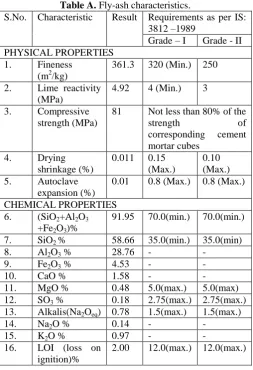
Table A. Fly-ash characteristics.
S.No. Characteristic Result Requirements as per IS: 3812 –1989
Grade – I Grade - II PHYSICAL PROPERTIES
1. Fineness (m2/kg)
361.3 320 (Min.) 250 2. Lime reactivity
(MPa)
4.92 4 (Min.) 3 3. Compressive
strength (MPa)
81 Not less than 80% of the
strength of
corresponding cement mortar cubes
4. Drying shrinkage (%)
0.011 0.15 (Max.)
0.10 (Max.) 5. Autoclave
expansion (%)
0.01 0.8 (Max.) 0.8 (Max.) CHEMICAL PROPERTIES
6. (SiO2+Al2O3 +Fe2O3)%
91.95 70.0(min.) 70.0(min.) 7. SiO2 % 58.66 35.0(min.) 35.0(min)
8. Al2O3 % 28.76 - -
9. Fe2O3 % 4.53 - -
10. CaO % 1.58 - -
11. MgO % 0.48 5.0(max.) 5.0(max)
12. SO3 % 0.18 2.75(max.) 2.75(max.) 13. Alkalis(Na2Oeq) 0.78 1.5(max.) 1.5(max.)
14. Na2O % 0.14 - -
15. K2O % 0.97 - -
16. LOI (loss on ignition)%
2.00 12.0(max.) 12.0(max.)
The mentioned properties in Table A of Fly-ash were obtained from the JK Cements factory at Khrew.
2.2. Tests conducted on fresh concrete (in-situ tests): Following in-situ tests to measure workability of fresh concrete were conducted:
Slump test
Slump Test:
Slump test is the most commonly used method of measuring consistency of concrete which can be employed either in laboratory or at site of work (Fig.2.1).
Fig. 2.1 Slump Test.
2.3. Tests Conducted On Hardened Concrete: 1.Compressive strength test.
2.Flexural strength test. 3.Split cylinder test. 1. Compressive strength test:
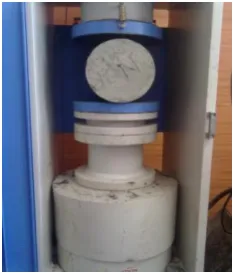
This test is conducted on cubes which are loaded on their opposite faces in a Compression Testing Machine (CTM) (Fig. 2.2,2.3). Six samples were cast, three of which were tested after 7 days and rest three after 28 days. The load at which first crack appears is considered as the failure load and the compressive strength is calculated corresponding to this particular value of load.
Compressive strength = Load of failure / (Cross –Sectional Area)
Where, cross-sectional area = (150 × 150) mm2
Fig. 2.2 Compressive strength test in a CTM
IJEDR1302012 INTERNATIONAL JOURNAL OF ENGINEERING DEVELOPMENT AND RESEARCH | IJEDR Website: www.ijedr.org | Email ID: [email protected] 58 2. Flexural strength test
Flexural strength test of concrete is performed on beams. The loading applied on the beam is a two point loading in which loads are applied at (1/3) rd points of the beam (Fig.2.4).The beam is placed in the testing machine in such a way that the load points are 13.3 cm apart from each other as well as from each support. The load is increased until the specimen fails and this load is noted as failure load . Flexural strength is then calculated from the following formula:
Flexural strength = where,
P= (load at failure)/2
l= length of beam between supports (clear span) (400 mm) b= breadth of beam (100 mm)
d= depth of beam (100 mm)
Fig. 2.4 Two-point loading arrangement for Flexural strength test
3.Split cylinder test
The test is carried out by placing a cylindrical specimen, horizontally between the loading surfaces of a Compression Testing Machine and the load is applied until failure of the cylinder, along the vertical diameter (Fig.2.5, 2.6 ).
The loading condition produces a high compressive stress below the two surfaces to which the load is applied. But the larger portion corresponding to depth is subjected to a uniform tensile stress acting horizontally. It is estimated that the compressive stress is acting for about (1/6)th depth and the remaining (5/6)th depth is subjected to tension.
The horizontal tensile stress is given by the following equation:
Horizontal tensile stress =
where, P= load at failure
L= length or height of cylinder (300 mm) D= diameter of cylinder (150 mm)
Fig. 2.5 Splitting tensile strength test in a CTM.
Fig. 2.6 Formation of crack along the diameter of cylinder.
diameter of cylinder. Procedure of testing illustrated by Figures:
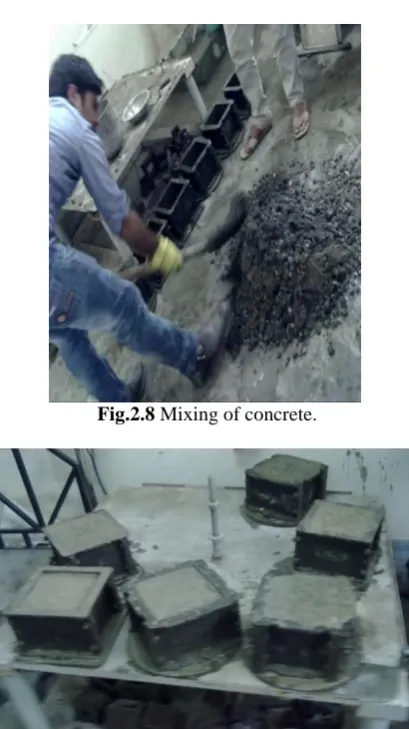
IJEDR1302012 INTERNATIONAL JOURNAL OF ENGINEERING DEVELOPMENT AND RESEARCH | IJEDR Website: www.ijedr.org | Email ID: [email protected] 59 Fig.2.8 Mixing of concrete.
Fig. 2.9 Vibration of concrete cubes being done on a table vibrator.
2.4 Comparative Test Report of Normal and Fly-ash replaced concrete
A. Normal Concrete test Report:
Six specimens each of cube, cylinder and beam were cast. Three of each were tested after 7 days and 28 days. The test results obtained are shown in the following observation table: 1. Compressive strength cube test:
TABLE B Compressive Strength results.
Sampl e no.
Slum p (mm )
Load at failure (kN) 7 days
Load at failur e (kN) 28 days
7 day compressiv e strength N/mm2
28 day compressiv e strength N/mm2
01. 25 394 601 17.51 26.71
02. 25 406 606 18.04 26.93
03 25 386 566 17.16 25.16
Result:
Average 7 days compressive strength = 17.57 N/mm2 Average 28 days compressive strength = 26.27 N/mm2
2. Flexural strength:
Table C. Flexural strength results. Samp
le no. Slum p (mm)
Load at failure (kN) 7 days
Load at failure (kN) 28 days
7 day Flexural strength N/mm2
28 day Flexural strength N/mm2
01. 25 11.50 14.50 4.60 5.80
02. 25 8.50 11.00 3.40 4.40
03 25 10.00 14.00 4.00 5.60
Result:
Average 7 days Flexural strength = 4 N/mm2 Average 28 days Flexural strength = 5.27 N/mm2 3. Splitting tensile strength (cylinder test):
Table D. Splitting tensile strength results. Sample
no.
Slump (mm)
Load at failure (kN) 7 days
Load at failure (kN) 28 days
7 day splitting tensile strength N/mm2
28 day splitting tensile strength N/mm2
01. 25 118.00 177.00 1.67 2.50
02. 25 137.00 158.00 1.93 2.23
03 25 130.00 164.00 1.84 2.32
Result:
Average 7 days splitting tensile strength = 1.81 N/mm2 Average 28 days splitting tensile strength = 2.35 N/mm2 Slump of normal concrete = 25 mm B. Fly Ash replaced-Concrete Test Report:
Fly ash was used as 10%, 20% and 30% replacement of cement by weight after pulverizing and sieving it to remove any impurities. The fly ash was thoroughly mixed with cement manually before using for making concrete for casting fly ash concrete specimens. 18 specimens were cast for each trial consisting of 6 cubes, 6 beams and 6 cylinders. 9 specimens (3 each) were cured for 7 days and rest 9 for 28 days. In-situ tests were carried out for each trial.
1. Trial No. 1 (10% cement replacement by fly ash): a. Compressive strength cube test:
Table E. Compressive strength results. Sample
No.
Slump (mm)
Load at failure (kN) 7 days
Load at failure (kN) 28 days
7 day
compressive strength N/mm2
28 day
IJEDR1302012 INTERNATIONAL JOURNAL OF ENGINEERING DEVELOPMENT AND RESEARCH | IJEDR Website: www.ijedr.org | Email ID: [email protected] 60
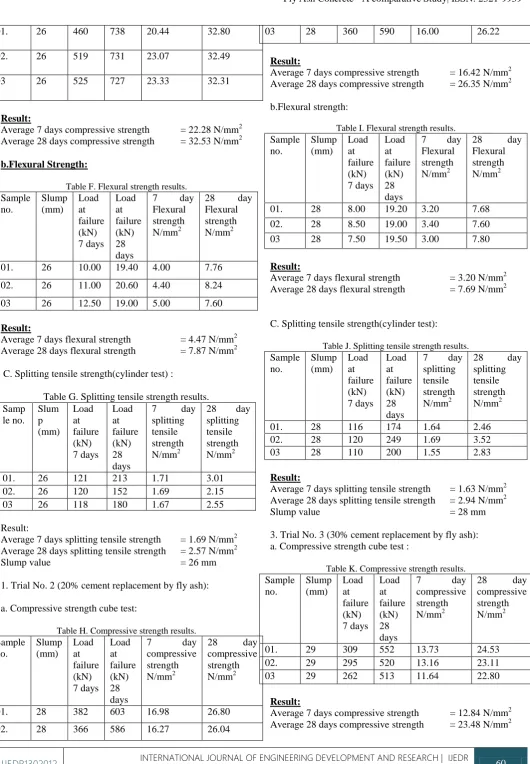
01. 26 460 738 20.44 32.80
02. 26 519 731 23.07 32.49
03 26 525 727 23.33 32.31
Result:
Average 7 days compressive strength = 22.28 N/mm2 Average 28 days compressive strength = 32.53 N/mm2 b.Flexural Strength:
Table F. Flexural strength results. Sample no. Slump (mm) Load at failure (kN) 7 days Load at failure (kN) 28 days
7 day
Flexural strength N/mm2
28 day Flexural strength N/mm2
01. 26 10.00 19.40 4.00 7.76
02. 26 11.00 20.60 4.40 8.24
03 26 12.50 19.00 5.00 7.60
Result:
Average 7 days flexural strength = 4.47 N/mm2 Average 28 days flexural strength = 7.87 N/mm2 C. Splitting tensile strength(cylinder test) :
Table G. Splitting tensile strength results. Samp le no. Slum p (mm) Load at failure (kN) 7 days Load at failure (kN) 28 days
7 day
splitting tensile strength N/mm2
28 day splitting tensile strength N/mm2
01. 26 121 213 1.71 3.01
02. 26 120 152 1.69 2.15
03 26 118 180 1.67 2.55
Result:
Average 7 days splitting tensile strength = 1.69 N/mm2 Average 28 days splitting tensile strength = 2.57 N/mm2
Slump value = 26 mm
1. Trial No. 2 (20% cement replacement by fly ash): a. Compressive strength cube test:
Table H. Compressive strength results. Sample no. Slump (mm) Load at failure (kN) 7 days Load at failure (kN) 28 days
7 day
compressive strength N/mm2
28 day
compressive strength N/mm2
01. 28 382 603 16.98 26.80
02. 28 366 586 16.27 26.04
03 28 360 590 16.00 26.22
Result:
Average 7 days compressive strength = 16.42 N/mm2 Average 28 days compressive strength = 26.35 N/mm2 b.Flexural strength:
Table I. Flexural strength results. Sample no. Slump (mm) Load at failure (kN) 7 days Load at failure (kN) 28 days
7 day Flexural strength N/mm2
28 day
Flexural strength N/mm2
01. 28 8.00 19.20 3.20 7.68
02. 28 8.50 19.00 3.40 7.60
03 28 7.50 19.50 3.00 7.80
Result:
Average 7 days flexural strength = 3.20 N/mm2 Average 28 days flexural strength = 7.69 N/mm2
C. Splitting tensile strength(cylinder test): Table J. Splitting tensile strength results. Sample no. Slump (mm) Load at failure (kN) 7 days Load at failure (kN) 28 days
7 day splitting tensile strength N/mm2
28 day
splitting tensile strength N/mm2
01. 28 116 174 1.64 2.46
02. 28 120 249 1.69 3.52
03 28 110 200 1.55 2.83
Result:
Average 7 days splitting tensile strength = 1.63 N/mm2 Average 28 days splitting tensile strength = 2.94 N/mm2
Slump value = 28 mm
3. Trial No. 3 (30% cement replacement by fly ash): a. Compressive strength cube test :
Table K. Compressive strength results. Sample no. Slump (mm) Load at failure (kN) 7 days Load at failure (kN) 28 days
7 day
compressive strength N/mm2
28 day
compressive strength N/mm2
01. 29 309 552 13.73 24.53
02. 29 295 520 13.16 23.11
03 29 262 513 11.64 22.80
Result:
IJEDR1302012 INTERNATIONAL JOURNAL OF ENGINEERING DEVELOPMENT AND RESEARCH | IJEDR Website: www.ijedr.org | Email ID: [email protected] 61 b. Flexural strength:
Table L. Flexural strength results. Sample
no.
Slump (mm)
Load at failure (kN) 7 days
Load at failure (kN) 28 days
7 day
Flexural strength N/mm2
28 day Flexural strength N/mm2
01. 29 9.00 9.00 3.60 3.60
02. 29 8.50 10.00 3.40 4.00
03 29 8.00 10.00 3.20 4.00
Result:
Average 7 days flexural strength = 3.20 N/mm2 Average 28 days flexural strength = 3.87 N/mm2
C. Splitting tensile strength (Cylinder test ) : Table M. Splitting tensile strength results. Sample
no.
Slump (mm)
Load at failure (kN) 7 days
Load at failure (kN) 28 days
7 day splitting tensile strength N/mm2
28 day
splitting tensile strength N/mm2
01. 29 104 225 1.47 3.18
02. 29 110 206 1.56 2.91
03 29 108 210 1.53 2.97
Result:
Average 7 days splitting tensile strength = 1.52 N/mm2 Average 28 days splitting tensile strength = 3.02 N/mm2 Slump value = 29 mm
I.COMPARATIVEANALYSISOFTESTRESULTS The comparative analysis of Test reports is done for already mentioned objectives:
A comparative study can be performed from the results achieved in different trials of normal concrete and fly ash concrete at different percentages of fly ash.
A comparative study of the results is shown by the following bar charts:
1. Comparative study of Compressive strength:
17.57 22.28
32.53
16.42
26.35
12.84
23.48
0 5 10 15 20 25 30 35
7 days 28 days
COM
P
RE
S
S
IV
E
S
T
RE
NGT
H
→
Normal Concrete Concrete with 10% Fly-ash Concrete with 20% Fly-ash Concrete with 30% Fly-ash
Fig. 3.1. Comparison of 7 and 28 days compressive strengths of
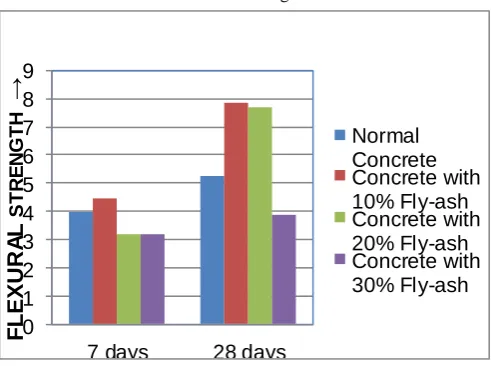
normal concrete and Fly-ash concrete 2 Comparative study of Flexural Strength.
0 1 2 3 4 5 6 7 8 9
7 days 28 days
F
L
EXU
R
A
L
S
T
R
E
N
G
T
H
→
Normal Concrete Concrete with 10% Fly-ash Concrete with 20% Fly-ash Concrete with 30% Fly-ash
Fig. 3.2. Comparison of 7 and 28 days Flexural strengths of normal concrete and Fly-ash concrete.
IJEDR1302012 INTERNATIONAL JOURNAL OF ENGINEERING DEVELOPMENT AND RESEARCH | IJEDR Website: www.ijedr.org | Email ID: [email protected] 62
0
1
2
3
4
7 days
28 days
S
P
L
IT
T
ING
T
E
NS
ILE
ST
RENG
T
H
→
Normal
Concrete
Concrete with
10% Fly-ash
Concrete with
20% Fly-ash
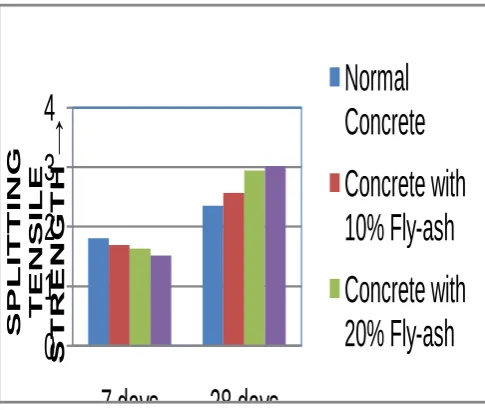
Fig. 3.3. Comparison of 7 and 28 days splitting tensile strengths
4. Comparative study of slump value/workability:
23 24 25 26 27 28 29 30
S
L
UM
P
(
mm
)
→
Normal concreteConcrete with 10% Fly-ash
Concrete with 20% Fly-ash
Concrete with 30% Fly-ash
Fig. 3.4. Comparison of workability of normal concrete and fly ash concrete.
III.CONCLUSION
After careful and elaborate study of the use of fly-ash for replacement of cement in concrete at different percentages, it can be concluded that:
1. 7 days compressive strength of Fly-ash concrete has decreased (except for 10% Fly-ash concrete), but 28 days compressive strength has increased (except for 30% Fly-ash concrete).
2. 7 days flexural strength of Fly-ash concrete has decreased (except for 10% Fly-ash concrete), but 28 days flexural strength has increased (except for 30% Fly-ash concrete 3. Splitting tensile strength at 7 days decreases progressively
as the percentage of Fly-ash increases, but 28 days strength increases progressively as the percent-age of Fly-ash increases.
4. There is a progressive increase in workability with increase in %age of Fly-ash in concrete.
5. Utilization of Fly-ash in concrete has provided us an excellent means of dis-posal of Fly-ash which is a big environmental nuisance.
The project work has also led us to the conclusion that in order to achieve best results in use of ash concrete, the Fly-ash used for replacing cement in concrete should have the required properties as specified by the standards and proper techniques of processing Fly-ash as well as mixing of Fly-ash with cement must be employed.
FUTURE SCOPE
From the results obtained throughout the project use of Fly-ash can be recommended in the civil engineering areas such as: Mass concreting works e.g. dams where low
permeability and low heat of hydra-tion is required. Under water structures such as bridge piers, docks,
harbours etc.
Structures near coastal and humid areas.
Precast and pre-stressed structures to make them light in weight.
Use of fly-ash in these structures results in considerable economy without compromis-ing on strength.
At last we can say that, “If Fly-ash is properly and scientifically used in concrete it can give other materials a run for their money and take concrete world to a higher echelon.”
REFERENCES
[1] IS codes - IS: 456-2000 Section 2 Materials, Workmanship, Inspection and Testing Page 13-14. [2] IS: 3812-Part 1-2003 Physical and Chemical Properties . [3] Breeze Glazer ,Craig Graber, Peter Syrett, Chris Youssef “
Fly Ash in Concrete”.
[4] MS Shetty Concrete Technology “ Effect of Fly Ash on Fresh Concrete page 179-182”.
[5] Fly Ash for concrete Ash Utilization Division NTPC Page 1-30
[6] Development and Application of High Volume Fly Ash Concrete (HVFAC) (Case Studies of Some Demonstration Projects - Grasim).