Article
1
Guideline-enabled data driven clinical knowledge
2
model for the treatment of oral cavity cancer acquired
3
through a refined knowledge acquisition method
4
Maqbool Hussain1,2,*,Muhammad Afzal1, Khalid M. Malik2,*,Taqdir Ali3,Wajahat A. Khan3 ,
5
Muhammad Irfan4,5, Arif Jamshed4, and Sungyoung Lee3,*
6
1 Department of Software, Sejong University, South Korea; {maqbool.hussain, mafzal}@sejong.ac.kr
7
2 Department of Computer Science and Engineering, Oakland University, Rochester, MI, USA;
8
{maqboolhussain, mahmood}@oakland.edu
9
3 Department of Computer Engineering, Kyung Hee University, Seocheon-dong, Giheung-gu, Yongin-si,
10
Gyeonggi-do, Republic of Korea, 446-701; {taqdir.ali, wajahat.alikhan, sylee}@oslab.khu.ac.kr
11
4 Department of Radiation Oncology, Shaukat Khanum Memorial Cancer Hospital and Research Centre, 7A
12
Block R-3, M.A.Johar Town, Lahore, Pakistan, 54782; [email protected], [email protected]
13
5 Department of Radiation Oncology, National Guard-Health Affairs, King Abdulaziz Medical City Riyadh,
14
Kingdom of Saudi Arabia
15
* Correspondence: [email protected]; [email protected]; [email protected]; (MH, SL,
16
and KMM)
17
18
Abstract: Validation and verification are the critical requirements in the knowledge acquisition
19
method for the clinical decision support system (CDSS). After acquiring the medical knowledge
20
from diverse sources, the rigorous validation and formal verification process are required before
21
creating the final knowledge model. Previously, we have proposed a hybrid knowledge acquisition
22
method for acquiring medical knowledge from clinical practice guidelines (CPGs) and patient data
23
in the Smart CDSS for treatment of oral cavity cancer. The final knowledge model was created by
24
combining knowledge models obtained from CPGs and patient data after passing through a
25
rigorous validation process. However, detailed analysis shows that due to lack of formal verification
26
process, it involves various inconsistencies in knowledge relevant to the formalism of knowledge,
27
conformance to CPGs, quality of knowledge, and complexities of knowledge acquisition artifacts.
28
Therefore, it is required to enhance a hybrid knowledge acquisition method that thwarts the
29
inconsistencies using formal verification. This paper presents the verification process using the Z
30
formal method and its outcome as an enhanced acquisition method – known as the refined
31
knowledge acquisition (ReKA) method. The ReKA method adopted verification method and
32
explored the mechanism of theorem proving using the Z notation. It enables to identify
33
inconsistencies in the validation process used for hybrid knowledge acquisition. Additionally, it
34
refines the hybrid knowledge acquisition method by discovering the missing steps in the current
35
validation process at the acquisition stage. Consequently, ReKA adds a set of nine additional criteria
36
to be used to have a final valid refined clinical knowledge model. The criteria ensure the validity of
37
final knowledge model concerning formalism of knowledge, conformance to GPGs, quality of the
38
knowledge, usage of stringent conditions and treatment plans, and inconsistencies possibly
39
resulting from the complexities. Evaluation, using four medical knowledge acquisition scenarios,
40
shows that newly added knowledge in CDSS due to the addition of criteria by ReKA method always
41
produces a valid knowledge model. The final knowledge model was also evaluated with 1229 oral
42
cavity patient cases, which outperformed with an accuracy of 72.57% compared to a similar
43
approach with an accuracy of 69.7%. Furthermore, ReKA method identified a set of decision paths
44
(about 47.8%) in the existing approach, which results in a final knowledge model with low quality,
45
non-conformed from standard CPGs. In conclusion, ReKA is formally proved method which always
46
yields valid knowledge model having high quality, supporting local practices, and influenced from
47
standard guidelines.
48
Keywords: Knowledge acquisition; Clinical practice guidelines; Data driven knowledge acquisition;
49
Cancer treatment plan; Clinical decision support system; Formal verification;
50
51
1. Introduction
52
Trust in the knowledge base is a crucial factor in the adoption of clinical decision support
53
systems (CDSS) used for medical diagnosis and treatment plan [1]. It mainly depends on the
54
reliability of the knowledge source and the consistency of the knowledge acquisition method [2].
55
There are diverse sources of clinical knowledge, such as patient data, clinical practice guidelines
56
(CPGs), clinical trials, systematic reviews, and even social media. Various knowledge acquisition
57
approaches have been proposed to acquire clinical knowledge from these sources. For example, using
58
machine learning and ontological approaches, knowledge models from patient data are created [3–
59
5], and different cognitive approaches are used to develop knowledge models from CPGs and other
60
medical resources [6–9]. Depending on the requirements, these knowledge models may need to be
61
transformed into different model formats. For example, the knowledge model from CPGs can be
62
converted into computer-interpretable guidelines (CIGs) so that it could be directly plugged into
63
CDSS for inferencing. Furthermore, sometimes it is required that the knowledge acquisition methods
64
transform two different knowledge models (sharing the same domain problem possibly with
65
different sources) into a unified knowledge model. It is critical in knowledge engineering disciplines
66
that each transformation, provided by the designed knowledge acquisition method, shall ensure the
67
two basic requirements:
68
1. The transformed knowledge model is the valid representation of the source knowledge model(s).
69
2. The transformation process is consistent enough to produce always the valid knowledge model.
70
71
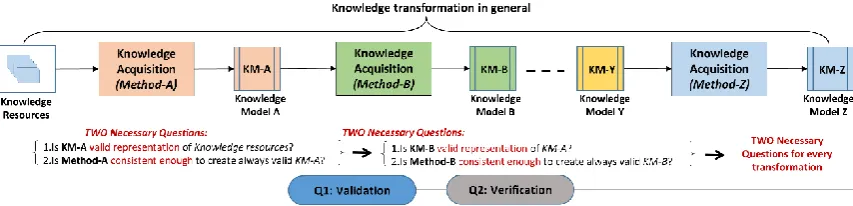
Figure 1 shows the knowledge transformation with a set of knowledge acquisition methods in
72
general. The two basic requirements, for each transformation, is depicted as necessary questions to
73
be answered, at each knowledge acquisition method of transformation. Question 1 reflects the first
74
requirement mentioned above, and the answer is to provide a validation mechanism in the knowledge
75
acquisition method. Question 2 represents the second requirement of the knowledge acquisition
76
method, which necessitates the verification mechanism in the knowledge acquisition method. In a
77
nutshell, validation, and verification are the critical requirements in the CDSS development process to
78
ensure that the knowledge model is valid, and the entire knowledge acquisition method is consistent.
79
In terms of verification, most of the existing approaches [8,10,11] emphasize the principles of
80
knowledge engineering. However, none of them have focused on the alignment of the verification
81
process to the development processes of CDSS. On the other hand, formal methods are widely used
82
in software engineering disciplines such as verification of program [12], formal modeling for
83
scenario-based requirement specification [13], formal verification of secured online registration
84
protocols [14], and formal verification of web services on cloud infrastructure [15]. Additionally,
85
some attempts were made to use the formal method (Z notation) to express the knowledge base
86
structure and reasoning mechanism in the form of software architectural style. For example, Gamble
87
et al. [16] applied Z notation to formally model the knowledge-base to get the clear distinction of
88
reusability of knowledge, enhanced understandability, and flexibility of specification in comparison
89
to traditional knowledge specification approaches.
90
This paper introduces the formal verification process, using Z notation, for our earlier
91
proposed hybrid knowledge acquisition method of Smart CDSS [17] – which is intended to produce
92
guideline-enabled data-driven knowledge model. In hybrid knowledge acquisition, we equipped the
93
method with the sophisticated validation process. Although, at that time, the knowledge model
94
created for oral cavity cancer was validated based on the well-established validation criteria and
test-95
internal consistencies. The adaption of the formal verification process gives an enhanced knowledge
97
acquisition method – which is known as a refined knowledge acquisition (ReKA) method. In ReKA,
98
we are using Z notation. The selection of Z notation was mainly based on its key features such as data
99
rich formalism, ease in knowledge modeling, and support of tools. It is important to mention here, that the
100
artifacts of the proposed verification process (using z notation) align to the content of a development
101
framework that was indigenously used for the development of Smart CDSS in the cancer domain.
102
The development framework for Smart CDSS is based on RUP [18,19] and ISO RM-ODP processes
103
[20,21]. To the best of our knowledge, the existing approaches had neither explored the use of Z
104
notations for the verification of knowledge acquisition nor used the formal methods as a method
105
content in a CDSS development framework.
106
Before the ReKA method, the validity of the knowledge model relied on domain experts. They
107
were free to refine the decision paths in the final knowledge model. This freedom in refinement leads
108
toward a set of inconsistencies which were ignored by the previous method. Examples of some
109
possible inconsistencies in terms of clinical context of oral cavity cancer that could be introduced into
110
knowledge model; i) domain expert may add inappropriate follow-up treatments to knowledge
111
models – such as treatment surgery followed by radiotherapy for palliative patients (deviation from
112
CPGs which suggest follow-up without further treatment) and ii) domain expert may add or refine
113
the rule of evaluating next treatment plan for a variable or patient condition that is not readily
114
available or not in use in existing clinical practices – such as evaluating the palliative patient for
115
radiotherapy based on histopathological risk factor perineural invasion (PNI). In the scope of the
116
current study, this refinement produces inconsistency of introducing non-recordable risk factor
117
(outbound refinement as PNI does not exist in the healthcare system).
118
The detailed evaluation shows that the introduction of formal verification has significantly
119
contributed to revealing hidden inconsistencies in earlier proposed hybrid knowledge acquisition
120
method. In the presence of these inconsistencies, the knowledge model evolution is not always
121
guaranteed to be valid. The ReKA method, as a result of the verification, can identify the main cause
122
of the inconsistencies and guaranteed always producing the valid final knowledge model.
123
This paper addresses following research questions: a) Does introduction of formal verification
124
using Z notation is able to identify the inconsistencies in the developed knowledge acquisition
125
method with respect to standard knowledge resources such as CPG?; b) Does formal verification
126
ensures that knowledge acquisition methods will always maintain the quality of the knowledge?; c)
127
Does propose formal verification is able to prevent inconsistencies occurred due to complexity and
128
freestyle usage of refinement in the knowledge?; d) Is the knowledge model created using ReKA
129
comparable with existing hybrid knowledge models in terms of validity, quality, and integration with
130
workflows?
131
The main contribution of this work is as follow:
132
The proofs of the theorem using Z notations provides a comprehensive explanation for
133
checking the consistency of the knowledge acquisition method. These proofs enable
134
detection of hidden inconsistency in the acquisition method (hybrid knowledge acquisition)
135
and provide with an additional set of nine criteria to ensure that the enhanced method
136
(ReKA) always produces a valid knowledge model.
137
The formal verification activities are streamlined into a concrete set of processes which align
138
to various artifacts of Z notation.
139
Various aspects of Z notation exploited for the knowledge modeling and associated
140
processes are expressed as the inferenceable mathematical models.
141
The ReKA method is formally proved approach which always produces valid knowledge,
142
reflects the CPGs as global evidence and encourage the recommendations well supported
143
by local evidence. At the same time, it is revealed that the model created using ReKA is
144
146
Figure 1: Knowledge acquisition process
147
148
2. Overview of knowledge acquisition for Smart CDSS
149
In our earlier work, we proposed a novel hybrid knowledge acquisition method for Smart CDSS
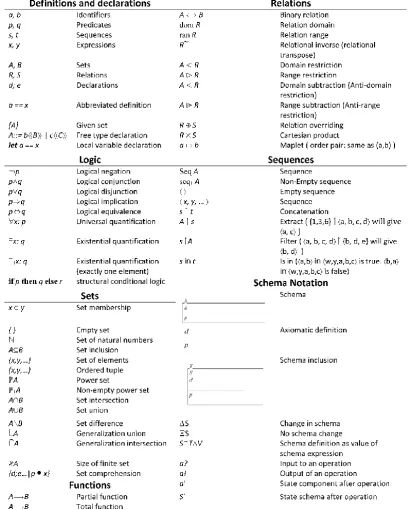
150
[17]. The acquisition method was accompanied by the proper validation process to ensure the validity
151
of the final knowledge model. In this paper, we are introducing a formal verification for the hybrid
152
knowledge acquisition method, which results in an enhanced method - ReKA. Before going into
153
details of formal verification, it is worthwhile to introduce the knowledge models and validation
154
processes briefly of the hybrid knowledge acquisition method. We encourage the readers to read [17]
155
for detailed descriptions of the models and validation processes used in the hybrid knowledge
156
acquisition method.
157
158
2.1. Hybrid knowledge acquisition approach for Guideline enabled data-driven knowledge model
159
In the clinical domain, patient data and CPGs are the most common sources of knowledge for
160
CDSS. Most of the existing knowledge acquisition methods use both sources of knowledge
161
independently. From patient data, the knowledge models are created using machine learning, while
162
from CPGs, various cognitive methods of knowledge acquisitions apply to the knowledge models.
163
Both methods have potential pros; however, there exist some limitations for each of them. The
164
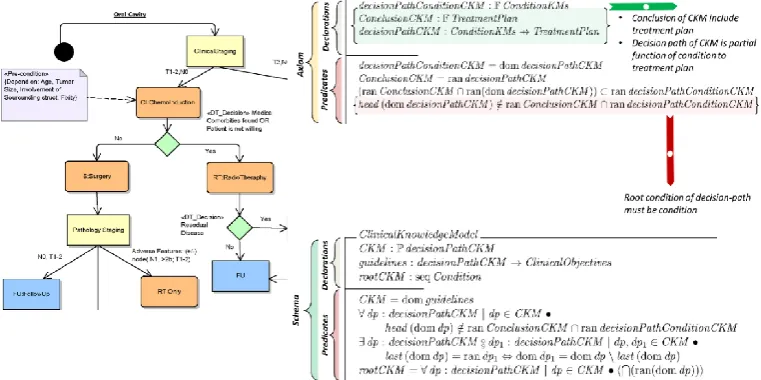
knowledge acquisition method which combines both approaches can overcome somehow those
165
limitations. The key limitations of data-driven knowledge acquisition methods using machine
166
learning are as follows:
167
The quality of the knowledge model depends on the quality of the patient dataset. So the
168
performance of the model (such as accuracy) may vary for the same domain with different
169
datasets.
170
The model validation relies on the statistical validation process (e.g., 10-fold
cross-171
validation). In this case, the validation purely depends on data; and the domain experts are
172
unable to assert any additional criteria to apply constraints on the final knowledge model.
173
The final knowledge model supports only local evidence as it derives from patient data. The
174
recommendation becomes trustworthy for another organization if standard evidence from
175
CPGs and other published studies also associate with the knowledge model.
176
177
The use of CPGs as a knowledge source somehow resolves the inherent problems with the
data-178
driven approach. CPGs covers population-based knowledge supported by standard clinical evidence
179
gathered from different clinical studies. Although it covers-up some cons of the data-driven
180
approach, however, the knowledge models derived from CPGs also come with limitations:
181
CPGs are generic, and the model representing CPGs may not be able to integrate into
health-182
care work-flows directly.
183
The knowledge model strictly following CPGs discourages local practices. In most cases, it
184
is possible that local practices may not fully conform and contradict to CPGs, but may have
185
a huge impact on patient care at that particular jurisdiction.
186
Very few studies include CPGs and patient data as a combined source for hybrid knowledge
188
modeling. For example, Toussi et al. [22] used a model derived from patient data to complete the
189
missing decisions in the CPGs. However, the primary motivation of hybrid knowledge acquisition
190
method is to combine the data-driven knowledge acquisition method and CPGs based knowledge
191
acquisition method to dilute their cons and take advantages of their pros in terms of the refined
192
knowledge model. This knowledge acquisition method is adopted under the umbrella of the
three-193
phase iteration process model of creating an executable knowledge model for Smart CDSS [17] in the
194
cancer domain. The first two phases of the process model dedicated to knowledge acquisition, which
195
covers knowledge model creations from CPGs and patient data and the validation process. The third
196
phase concentrates on the executable knowledge model and the development of associated toolset
197
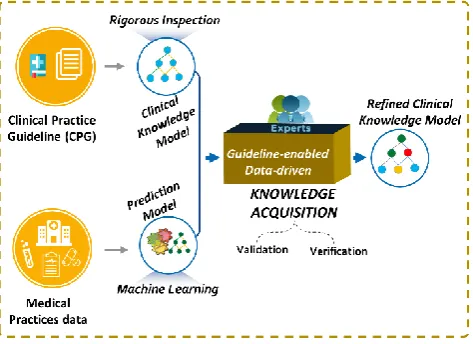
[23]. Figure 2 depicts the abstract representation of hybrid knowledge acquisition method, and the
198
next section provides a brief description of the core knowledge models and validation process of this
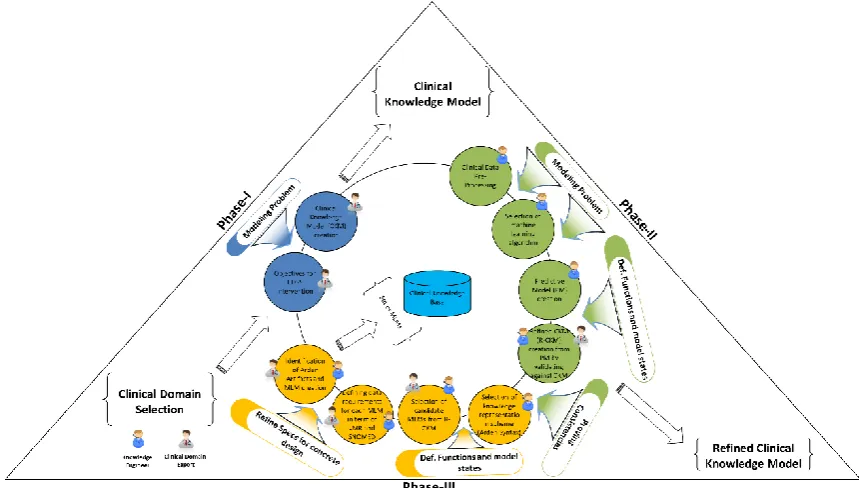
199
approach.
200
201
Figure 2: Hybrid knowledge acquisition method
202
203
2.2. Knowledge models and validation mechanism
204
Hybrid knowledge acquisition method includes a set of tasks encompassing two phases of the
205
iterative three-phase model [17]. In this section, we briefly describe this method of explaining the
206
knowledge models and the process associated with the validation of the models (see Figure 2). The
207
outcome of this method is the final knowledge model - known as a refined clinical knowledge model
208
(R-CKM), which is obtained after the rigorous validation process. It consumes the knowledge models
209
created from CPGs - known as a clinical knowledge model (CKM) and prediction model (PM) created
210
from patient data.
211
212
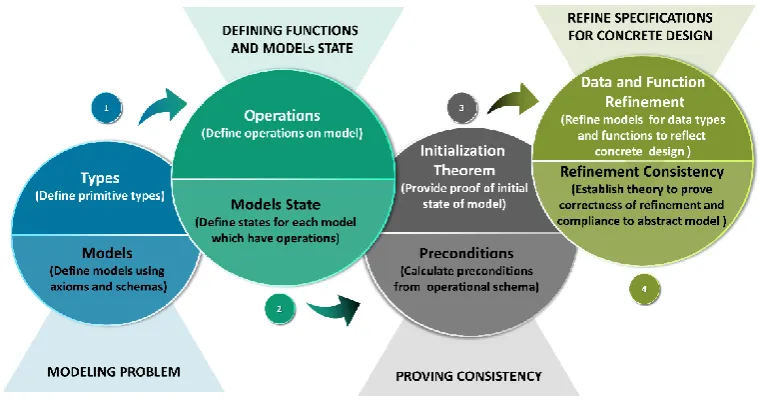
Prediction Model: A PM is a decision tree obtained from patient data using decision tree algorithms.
213
The decision tree algorithm used for this study was CHAID [24], which was selected based on
214
rigorous selection criteria. PM creation involves the formal machine learning method - CHAID and
215
reflects the local practices from patient data. As a decision tree formalism of the machine learning
216
paradigm - it includes the root node and grows in a top-down fashion. The nodes represent
217
conditions and leaf nodes as conclusions. The conclusion always lies at the leaf node where the branch
218
selection at each condition uses proper statistical evaluation processes to proceed for the appropriate
219
decision path. Finally, performance (such as accuracy) for each decision path evaluates from patient
220
data, and its overall performance represents as mean accuracy of all the decision paths in PM.
221
Clinical Knowledge Model: A CKM is a formal decision tree created from CPGs after a rigorous
223
inspection process by a team of physicians. It follows decision tree formalism started with a root
224
node. The tree grows in a top-down fashion from the root node by adding subsequent nodes to make
225
a decision path. The nodes represent a decision node and a conclusion node. Decision node represents
226
condition(s) (such as patient symptoms) to select the next branch of the tree among decision paths.
227
Conclusion node reflects the recommendations (such as treatment plan). In CKM, the conclusion
228
node can also play a role of condition node for the next follow-up conclusion. For example, an initial
229
treatment plan for cancer patient may be surgery, and after follow-up, the secondary treatment plan
230
can be radiotherapy only if surgery already is done. In this context, unlike the decision tree formalism
231
of PM, the conclusion node may appear as an intermediate node in the CKM decision tree. Moreover,
232
the branch selection of the CKM decision tree does not follow any probabilistic evaluation of the
233
condition. Because CKM is a reference model of CPGs, so its performance evaluation against local
234
patient data is not required.
235
236
Refined Clinical Knowledge Model: A R-CKM obtained after a rigorous validation process by
237
combining PM and CKM. It follows the same formalism as of CKM. However, it also reflects some of
238
the properties of PM to encourage decision making from local practices. Unlike CKM, all decision
239
paths in R-CKM evaluated from local patient data, and it also requires evidence for decision paths
240
which are refined but have no direct conformance to the CKM (i.e., guidelines).
241
242
Validation Process: A validation process is the core of the hybrid knowledge acquisition method
243
which unifies two different models to a single refined knowledge model. Figure 3 depicts detailed
244
steps of the process. It consumes PM and CKM as an input model and produces R-CKM as an output
245
model. Each decision path in PM is selected and added to the decision path of R-CKM after passing
246
conformance criteria based on CKM. The PM decision path may be refined by domain expert if
247
required. The activities for the validation process briefly summarized in three steps:
248
249
1. Setting validation criteria: Domain experts define criteria based on CKM (guidelines) and other
250
evidence to be fulfilled by decision path in PM. At the same time, each criterion is classified as
251
primary (compulsory) or non-primary (optional with an alternate), and the order of checking
252
specifies by priority. In the case of an oral cavity cancer treatment plan, domain experts decided
253
two primary and two non-primary criteria. i) The minimum performance limit must be satisfied
254
by each selected decision path in PM (e.g., accuracy greater than 50% in this study); ii) the
255
selected decision path in PM must not conflict with the CKM (guidelines); iii) the decision path
256
in PM should conform to any decision path in CKM, and iv) if criterion iii) is not fulfilled, then
257
the decision path in PM must be associated with an evidence which proves its necessity and
258
effectiveness of inclusion into R-CKM.
259
260
2. PM validation against criteria: During this step, each decision path is selected and evaluated
261
against the well-established criteria. The decision path of PM becomes part of R-CKM if it fulfills
262
the criteria.
263
3.
Inspection and refinement of selected PM decision path: The selected decision path can become265
directly part of R-CKM. However, the domain expert may want to refine it further to reflect the
266
most concrete concepts used in the healthcare workflows. Moreover, the refinement process also
267
allows adding further choices of the treatment plan in the decision path if required.
268
269
Figure 3: Validation Process [17]
270
271
The hybrid knowledge acquisition method was used in the creation of the knowledge model for
272
Smart CDSS in oral cavity cancer [17,23] with proper validation mechanism. However, it was not
273
formally verified even after using as a core method of knowledge acquisition for Smart CDSS. In the
274
validation process at the refinement step, the process provides the freedom to domain expert for
275
adding further treatment plans as a condition to the selected decision path. It leads toward
276
inconsistency and cannot guarantee the validity of R-CKM at all time. In order to cope with this issue,
277
the content of this work introduces the verification process using formal Z notations. After applying
278
the Z formalism, the outcome concludes with the detection of inconsistencies in the step of refinement
279
of the validation process. It explicitly enlisted nine additional criteria that must be in place after
280
refinements are made to the decision path in R-CKM. The existing knowledge acquisition method is
281
enhanced as ReKA method to accommodate the newly discovered criteria.
282
283
3. Preliminaries and key motivation of using formal method for knowledge acquisition
284
3.1. Preliminaries
285
There are several ways to represent objects in the Z notation. Declaration, abbreviation, and
286
axiomatic definitions are simple ways to represent objects in Z notation. "Schema" and "free" types
287
are special ways to represent complex objects in Z notation. All of these types obey mathematical
288
laws and have rules for reasoning with the information that they contain. At this point, the
289
introduction and use of these concepts are important; however, in this paper, we skip the detailed
290
description of the concepts used in Z notation. So, the important concepts introduced with brief
291
details and all other concepts used in this paper provided in Figure 4. Readers may consult reference
292
materials [25,26] and other research works that have used Z notation extensively [27–29].
293
294
Declaration: This is the simplest way to define an object. When an object is a set of some basic
295
type, brackets use to enclose the name of an object. If there are more than one objects, comma uses
296
declarations. ConditionAttribute and ConditionValue are the set of concepts and the corresponding
298
values, respectively, in the clinical knowledge model that construct the basic Condition.
299
300
301
302
Figure 4: Z notation concepts overview
303
304
Abbreviation: Abbreviation introduces another name to an existing object. For example, type
305
definition (2) in Figure 5 is the abbreviation for cancer treatments.
306
307
Free type: Free type allows a variety of data structures to be represented using sets with explicit
308
structuring information. For example, type definition (3) in Figures 5 highlights three different object
309
definitions. ConditionOperator is a free type that distinctly represents the set of operators used in the
310
rules. treatmentSet is a free type that covers high-level semantics for cancer treatments that provided
312
to a patient in a proper sequence by using the guidelines.
313
314
315
316
Figure 5: Declaration, abbreviation and free type examples
317
318
Axiom: Axiom provides the ability to define objects and includes constraints upon it. In an
319
axiomatic definition, the object definition represents in two compartments: declarations and
320
predicates. Declarations represent the content structure of an object and predicates introduce
321
constraints on the contents. Figure 6 shows an example of the axiomatic definition for CKM
322
specification.
323
324
Schema: Schema is the most powerful artifact in Z notation and describes the system behavior.
325
Similar to an axiom, it defines objects using declarations and predicates. However, the schema can
326
take different forms such as a modeling static structure, modeling operations, and modeling different
327
states of the object after operations. Figure 6 shows an example of modeling CKM as a
328
"ClinicalKnowledgeModel" schema.
329
330
Figure 6: Axiomatic definition and schema example
3.2. The motivation for formal methods
332
The ability of domain experts to trust knowledge content is a key factor that influences the
333
success of CDSS implementation. The trust in knowledge primarily depends on how well the
334
knowledge contents have passed through a sophisticated validation process to ensure consistencies
335
in the refined knowledge model. According to a systematic review by Mor Peleg [2], formal
336
verification techniques are used to validate the clinical knowledge for internal consistencies and to
337
check for the fulfillment of the desired properties and specifications. There are two broad categories
338
of these techniques: model checking and theorem proving [2]. In model checking, the knowledge
339
transformed into an appropriate model-checker format, and the model checker verifies the
340
consistency of the knowledge model for the fulfillment of the desired properties. Alessio Bottrighi et
341
al. applied the model checking approach to integrating the computerized guideline management
342
system with a model checker [30]. The guideline representation language GLARE is used and
343
integrated with the SPIN model checker to verify the clinical guidelines. Theorem proving uses the
344
logical derivation of theorems in order to prove the consistency of the knowledge contents available
345
in the formal specification. Annette T. Teije et al. [31] used KIV-based formalism to represent medical
346
protocols and defined semantics of the desired properties. The desired properties of the protocol are
347
verified using formal proof of the KIV theorems.
348
Based on the substantial advantages and the need for formalism in knowledge validation and
349
verification, we introduced the formal verification process as a formal method content into the
350
development framework of Smart CDSS. Selection of an appropriate formal method requires formal
351
guidelines to find the best fit for a knowledge representation scheme. In this work, we used the Z
352
notation as the formal representation language for knowledge representation and for modeling the
353
validation method features. We used the formal theorem proving mechanism to remove
354
inconsistencies in the method, which ultimately ensures a consistent and valid knowledge model.
355
Following are fundamental features of Z notation, which compels its suitability for clinical
356
knowledge modeling and verification of the acquisition process.
357
358
1. Easy knowledge modeling: While using the Z notation, it is simple to decompose the kno
359
wledge specifications into small pieces and formally define the static and dynamic asp
360
ects of the knowledge acquisition (i.e., the knowledge representation and validation pr
361
ocess [25]). The "Schema" represents this aspect of Z notation, where the first-order pre
362
dicate logic uses for the constraints on the typed knowledge contents. Moreover, dyna
363
mic schema represents the validation process that operates within the boundaries of th
364
e knowledge representation schema. The subsequent sections will elaborate, detailed co
365
ntents of the formal verification process for the knowledge acquisition method in term
366
s of Z specifications.
367
2. Data-rich formalism: Another aspect of Z notation is the notion of "types" [26]. Z types
368
are mathematical data types that can be used to represent any object in a system uniq
369
uely. They specifically obey a rich collection of mathematical laws, which make it poss
370
ible to determine the behavior of the system [25,26]. This aspect of Z leverage, toward
371
s data-rich formalism of knowledge contents and the resulting artifacts, can be easily
372
mapped to standard viewpoints of RM-ODP [32] (e.g., the information viewpoint). H.
373
Bowman et al. used Z notation for consistency checking of the two views in the infor
374
mation viewpoint [33]. Similarly, artifacts of Z notation can also map to the "analysis"
375
and "design" disciplines of the RUP framework.
376
3. Support of tools: The Z specification language not only enables formal specifications for
377
a system and a language but also allows for the systematic reduction of such specifica
378
tions into implementations [27]. Moreover, there is a wide range of tools available to c
379
heck for syntax and type consistency in the specifications
380
4. Methods and Materials
382
4.1. Refined Knowledge Acquisition (ReKA) method
383
ReKA method is an enhancement of our hybrid knowledge acquisition method. It follows the
384
same three-phase model used for hybrid knowledge acquisition method. It uses all the steps of hybrid
385
knowledge acquisition described in section 2.1. Besides, it introduces new processes that involve the
386
formal verification artifacts at different phases of the three-phase model. Figure 7 shows the extended
387
three-phase model used by ReKA method. The extended processes are reflected as an additional layer
388
on the basic processes.
389
390
391
Figure 7: Extended three-phase model for ReKA
392
393
This study focuses on the newly adopted processes of formal verification, so we skip details of
394
the common process used with hybrid knowledge acquisition. The model created for oral cavity
395
cancer in the earlier study is re-used for this study with new patient cases of 1229 from Shaukat
396
Khanum Memorial Cancer Hospital (SKMCH), Lahore, Pakistan. Example scenarios have been
397
created by physicians to modify our earlier oral cavity treatment model. Based on the earlier hybrid
398
knowledge acquisition method, the modifications are valid; however, as demonstrated in the result
399
section, ReKA identified that the modifications are not valid because it creates inconsistencies in the
400
final knowledge model. Furthermore, we have also compared ReKA approach with the most relevant
401
hybrid model acquisition approach. The subsequent sections further discuss the technical details of
402
the formal verification processes used in the ReKA method.
403
4.2. Establishing a formal modeling process
404
To the best of our knowledge, no substantial evidence exists in a knowledge engineering
405
discipline that discusses Z notation with discrete processes having proper guidance. Based on the
406
capabilities of Z notation and the guidance available for applying different concepts of Z notation to
407
formal modeling [25,26], we formulate a formal modeling process for knowledge acquisition method.
408
It comprises four distinct processes: "modeling problem", "defining function and model states", "proving
409
consistency", and "refine specification for concrete design". Below is a brief discussion of each of these
410
processes. Figure 8 shows an abstract view.
411
1. Modeling problem: This includes tasks used to analyze the problem context and identify all
413
of the relevant concepts that contribute to the final objectives. Different constructs of the
414
selected formalism technique are used to model concepts at different granularity levels.
415
Primitive types, axioms, free types, and schema are the candidate constructs in Z notations
416
that assist in modeling the problem under consideration. During the knowledge acquisition
417
method, various models created which include PM, CKM, and R-CKM. Different constructs
418
of Z notation used in representing these models. The outcomes of this process produce
419
primitive types, free types, sets of axioms, and sets of the static schema, which represents
420
the knowledge models.
421
422
423
Figure 8: Formal modeling process
424
425
2. Defining functions and models state: This includes tasks to define the behavioral aspects of the
426
system under consideration. Defining operations related to the candidate models and
427
associating the appropriate state model (as a consequence of the operation on the model)
428
are the main activities of this process. Schemas are the central construct in Z and can
429
represent the operations and states of the models. For the knowledge acquisition method,
430
operations are defined for the retrieval of contents from PM, and CKM models. These
431
operations will not affect changing the state of the corresponding models. Different
432
operations define for the R-CKM model in order to validate the candidate decision path
433
from PM against the CKM model and to evolve the final R-CKM model. As a result of the
434
evolution of the R-CKM model, the corresponding state model is defined to formally
435
represent possible changes in the contents of the R-CKM model.
436
3. Proving consistency: Identifying inconsistencies in the specifications of the modeled problem
437
is the ultimate goal of formal methods. The main task is to make sure that the defined models
438
are consistent and have no contradictions with their desired requirements. Moreover, it is
439
desirable to verify that the operations defined in various models are consistent and that their
440
outcomes are within the intended boundaries of the domain. Z specification provides a
well-441
established way to achieve both of these goals. The first part achieves, to prove the constraint
442
part of the state schema of the model is satisfiable using "initialization theorem" - to indicate
443
that an initial state, at least, exists. The second part requires to investigate “preconditions" for
444
the candidate operations - that may be calculated from the operational schema using the
445
one-point rule. For the knowledge acquisition method, the "initialization theorem" proves the
446
satisfiability of the R-CKM state schema. Moreover, "preconditions" investigate for all
447
4. Refining specification for concrete design: The refinement process tends to construct and
449
describe another model that complies with the original model of the design but is closer to
450
implementation. The refinement process comprises large tasks that are applied in
451
consecutive iterations at the data and function levels to ensure that the specifications are
452
free of any uncertainty. These specifications are closer than previously modeled
453
specification to executable program code. In order to prove that refinements are consistent
454
within themselves and appropriately represent the original design model, it is necessary to
455
establish a theory for refinement that includes a set of rules for proving the correctness.
456
457
In this research work, we exploit the first three processes to model the clinical knowledge and
458
the validation process in order to prove that the knowledge acquisition is sufficiently consistent with
459
always producing valid final knowledge model. The refinement process is helpful for systems where
460
the outcomes of the design are required to be sufficiently close for direct conversion into executable
461
code. This process is included purposefully because our knowledge specification can be easily
462
converted into the executable code if we properly exploit the Z refinement mechanism. Furthermore,
463
we are presenting the "Proving consistency" step in the results section to emphasize the outcome of the
464
formal verification process.
465
4.3. Modeling problem
466
The modeling problem investigates the basic concepts used in knowledge acquisition for Smart
467
CDSS, which target the clinical objectives. The fundamental concepts used in Smart CDSS are PM,
468
CKM, and R-CKM, which represent the clinical treatment plan for head and neck cancer. Primitive
469
types, free types, axioms, and schema in Z notation are candidate constructs to represent these
470
concepts.
471
4.3.1. Primitive types
472
Primitive types constitute the basic building blocks of the problem under consideration. In Smart
473
CDSS, the concepts relevant to the clinical knowledge, which play a pivotal role in knowledge
474
acquisition and validation, are cancer treatments (e.g., chemotherapy, radiotherapy, and surgery),
475
clinical objectives (e.g., intervention for a treatment plan), and evidence (e.g., combined
chemo-476
radiotherapy has a significant effect on patient survival; a success rate of 92%). These concepts are
477
represented as a set using primitive types (Type Definition 1 :line 1). Furthermore, cancer treatment
478
is abbreviated (line 3) as a general treatment to provide clarity in further specifications.
479
480
481
In order to define the formal representation of the knowledge model, primitive types are needed
482
to capture the basic concepts used in the knowledge representation scheme. In Smart CDSS, the
483
knowledge models follow decision tree representations where the combination of conditions with
484
logical relationships constitutes the decision path. The Condition includes clinical concepts as an
485
attribute with an exact value or a range of value sets. For example, a condition in the decision tree
486
test node TreatmentIntent = radical represents a patient categorization primarily based on the severity
487
of cancer. Z primitive types (shown in Type Definition 1 (line 2) represents these concepts, and Type
488
Definition 2 provides the corresponding language syntax for the condition.
489
491
Moreover, free types in Smart CDSS reflects the semantics of the clinical concepts and provides
492
conformance to decision tree representation formalism. For example, treatments provided to patients
493
follow a sequence according to standard guidelines and protocols; ChemoInduction follows
494
radiotherapy treatments and surgery for radical patients (from CKM). In order to capture these
495
semantics, Type Definition 3 defines two free types: TreatmentSet and TreatmentPlan (line 1 and line
496
2, respectively).
497
498
499
500
In Smart CDSS, the knowledge model typically uses decision tree representation; however, PM
501
is different from CKM and R-CKM in terms of the decision path. PM does not include treatments as
502
a condition. To distinctly represent this formalism, ConditionCKs (line 3) defines a particular condition
503
as a free type for CKM and R-CKM. Similarly, RefinedTreatmentPlan (line 4) represents refinement in
504
final R-CKM, which dictates the addition of a treatment to R-CKM as a type of refinement (indicating
505
the placement of treatment plan at a particular position in the decision path).
506
4.3.2. Knowledge models
507
Clinical knowledge models, such as PM, CKM, and R-CKM, are represented as axioms and
508
schemas. Subsequent sections explain the specifications for these models.
509
Prediction model specifications: Prediction model specifications cover the properties associated
510
with PM by decision tree formalism. Figure 9 shows the PM created (using CHAID decision tree) for
511
oral cavity cancer treatment intervention [17] with details of corresponding attributes and their
512
formalism semantics. The PM specifications are created using an axiom (Axiom 1) and the
513
PredictionModel schema (Schema 1). The axiomatic definition for PM represents the basic constructs
514
of PM using decision tree formalism. Accordingly, the decision paths are the main constituents of the
515
decision tree skeleton where a combination of logically related conditions makes a single decision
516
path that has one conclusion. The conditions and conclusion are also known as nodes of the decision
517
tree, where the conclusion is always a leaf node. The decision tree obtained from the data (using
518
machine-learning approaches) also has accuracy in terms of possessing correctly classified data cases
519
(i.e., using 10-fold cross-validation).
520
522
523
524
525
526
Figure 9: PM for treatment intervention in oral cavity cancer and its formalism (C CRT: Chemo
527
Induction followed by chemotherapy; C NOS: Carcinoma NOS; CT S: clinical stage S value; CT T:
528
clinical stage T value; HistoDisc: Histology description; RT: radiotherapy; SCC: Small cell carcinoma;
529
SqCC: Squamous cell carcinoma; S RT: Surgery followed by RT; TP_Intent: Treatment Plan Intent)
533
534
In Smart CDSS, PM follows decision tree formalism, which is obtained from patient medical
535
records where conditions are used to represent patient information (e.g., symptoms, problems
536
(diseases), clinical observations, and other demographic information (patient history)) and the
537
conclusion represents the treatment plan. Axiom 1 includes declarations for the decision path as a
538
partial function from the condition to the treatment plan (line 3). Its accuracy represented by a total
539
function from the decision path to the accuracy (line 5). The decision path conditions are represented
540
as a finite set of the Condition (line 1), and the conclusion represented by a finite set of the
541
TreatmentPlan (line 2). In order to reinforce the basic properties of the PM decision path, predicates
542
are used to constrain the defined properties. For example, the PM decision path accuracy must lie
543
between 0 and 100 (line 8). For all decision paths, there must exist one conclusion, and the conclusion
544
must be a TreatmentPlan (line 11).
545
Moreover, for validation purposes, we also associate the evidence (if it exists) with the treatment
546
plan recommendation that is provided by the decision path in PM. The evidence is a finite set (line
547
6), which can represent the effectiveness of the treatment plan in given patient cases in terms of the
548
success rate (as a percentage). It may also include external evidence from other research works.
549
Therefore, the decision path may have evidence represented by a partial function from the decision
550
path to the set of evidence (line 7 and line 12).
551
Prediction model specification is further extended through the PredictionModel schema
552
(Schema 1). PM is formally represented as a decision tree that is associated with the clinical objectives
553
using the injective function from the decision path to the clinical objectives (lines 1, 3, and 7). The PM
554
is associated with accuracy, which is the weighted mean accuracy of all of the decision paths in PM
555
(lines 2, 4, and 8). For simplicity, we consider an equal number of patient cases for each decision path;
556
this simplifies the accuracy of PM (line 8). Also, PM is a decision tree, which means it must include
557
one root node that must be a condition (lines 5 and 9).
558
Clinical knowledge model specifications: Clinical knowledge model specification represents the
559
formalism of CKM as an axiom (Axiom 2) and the schema ClinicalKnowledgeModel (Schema 2). CKM
560
is a knowledge model that represents clinical guidelines using a decision tree formalism. Figure 10 is
561
reference CKM created from clinical guidelines [17]. For the brevity purpose, we are not displaying
562
the pictorial representation of the formalism as it shares most of the structure artifacts with the
R-563
CKM and hence Figure 11 shows a formalism used as a reference for CKM.
564
565
As described in a previous section, unlike PM, the CKM decision path also considers the
568
treatment plan as a condition, and the conclusion is always a treatment plan. Therefore, decision path
569
represented by a partial function from free type ConditionKMs to the treatment plan with axiomatic
570
definition Axion 2 (line 3). The constraint defined by a predicate at Axiom 2 (line 6) reinforce the idea
571
of the CKM decision path that may contain treatment plans in condition. Moreover, every decision
572
path must have a starting condition other than a treatment plan, which defined by a predicate at
573
Axiom 2 (line 7). Axiom 2 (line 1,4 and 2,5) are representing the conditions
574
(decisionPathConditionCKM) and conclusion (ConclusionCKM) of decision path in CKM as finite set of
575
ConditionKMs and TreatmentPlan respectively.
576
577
578
579
The ClinicalKnowledgeModel schema (Schema 2) further extends the CKM semantics. According
580
to the definition of CKM, it covers-up the guidelines and follows decision tree formalism.
581
Furthermore, it is associated with clinical objectives. For example, CKM (in Smart CDSS) consults
582
NCCN guidelines, and its main objective is the provision of standard-based treatment plans for
583
tumors in oral cavities. By using the schema definition (Schema 2), the guideline is a total function
584
from the standard decision paths to the clinical objectives (line 2). CKM is a set of logically related
585
decision paths in the guidelines that fulfill target clinical objectives (lines 1 and 4).
586
587
Every decision path in CKM must start with a condition (other than a treatment plan), and CKM
588
must have only one root condition (line 3) shared by all decision paths. Schema (Schema 2) defines
589
these constraints by predicates at (lines 5 and 7).
590
In CKM, the treatment plan comes as a condition in one decision path and may act as a
591
conclusion for another decision path. In other words, the CKM conclusion may occur in an
592
intermediate node. Schema 2 defines a predicate (at line 6) to reflect this semantic.
593
596
Figure 10: CKM for treatment intervention in oral cavity cancer(CI: Chemoinduction; CRT:
597
Chemotherapy; CT N: clinical stage N value; CT S: clinical stage S value; CT T: clinical stage T value;
598
ECS: Extracapsular spread; FU: Follow-up; MCT: Multidisciplinary consultation; RT: radiotherapy;
599
S: Surgery) [17]
600
601
602
Refined clinical knowledge model specifications: Refined clinical knowledge model
603
specifications represent R-CKM formalism as an axiom (Axiom 3) and a schema
604
(RefinedClinicalKnowledgeModel, Schema 3). R-CKM follows the formalism of CKM in that it also uses
605
decision tree representation, which includes decision paths that have been formally validated from
606
standard guidelines or possess sufficient evidence to prove their effectiveness. Figure 11 shows the
607
R-CKM of a treatment plan for oral cavity cancer [17] with precise semantics and formalism. In this
608
respect, the R-CKM decision path modeled (similar to CKM) by a partial function from free type
609
ConditionKMs to the treatment plan; this is shown in the axiomatic definition (line 3).
610
612
613
As a result of refinements, the decision path of R-CKM may fully not conform to guidelines
614
(CKM). In such cases, the evidence is required to justify the effectiveness of the refinements made to
615
the decision path of R-CKM. To capture this context, a finite set of Evidences (line 6) is associated with
616
the decision path of R-CKM as a partial function (line 7,15).
617
618
622
Figure 11: R-CKM for treatment intervention in oral cavity cancer and its formalism (CI:
623
Chemoinduction; C NOS: Carcinoma NOS; CRT: Chemotherapy; CT N: clinical stage N value; CT S:
624
clinical stage S value; CT T: clinical stage T value; ECS: Extracapsular spread; FU: Follow-up;
625
HistoDisc: Histology description; RT: radiotherapy; S: Surgery; SCC: Small cell carcinoma; SqCC:
626
Squamous cell carcinoma; TP_Intent: Treatment Plan Intent )
627
628
The predicates defined in Axiom 3 (lines 13, 14) capture the semantics of the decision path in
R-629
CKM; a treatment plan can be a condition in the decision path, and the decision path must start with
630
a condition (this should not be a treatment plan).
631
In addition to CKM formalism, decision paths in R-CKM become a part of the model after
632
passing through a formal validation process and refinements (Figure 3). In this respect, the decision
633
path in R-CKM has an accuracy represented by a total function from the decision path to the accuracy
634
(line 5). Also, the accuracy of the decision path must be a finite value bounded interval [0,100]
635
indicated in line (4,10). The refinement in R-CKM is represented by an injective function as shown in
636
(line 9, 16) which maps the refined treatment plan (a free type, line 4, Type Definition 3) to the PM
637
decision path (line 8).
638
The declarations and predicates of schema RefinedClinicalKnowledgModel (Schema 3) are mostly
639
similar to those of CKM (Schema 2); both share the same formalism. A total function (line 7) defines
640
the new contents to support the overall accuracy of R-CKM. The intended accuracy calculated by the
641
weighted mean accuracy for all of the decision paths in R-CKM (line 12).
642
Moreover, R-CKM is derived from PM and validated against CKM (guidelines); thus, the total
643
function defines from the R-CKM decision paths to the intended CKM (line 4), and R-CKM modeled
644
by a finite set of related decision paths (line 3) associated with CKM (line 9). Furthermore, a predicate
645
adds to the schema (line 13), which constrains all of the decision paths; these must be derived from
646
PM and aligned to CKM. Similarly, using schema inclusion, PredictionModel (Schema 1) and
647
ClinicalKnowledgeModel (Schema 2) are also included (lines 1 and 2) into the
648
RefinedClinicalKnowledgeModel (Schema 3) in order to make the contents of PM and CKM available to
649
the R-CKM model.
650
Validation process specifications: Validation process specifications encompass the validation
651
process (Figure 3) and properly represent the validation criteria defined for final knowledge model -
652
models the basic semantics of the validation process. It includes schema
654
RefinedClinicalKnowledgeModel (line 1), which is used to associate the validation process with R-CKM.
655
It also provides a declaration for the two inputs that the validation process is supposed to consume:
656
the PM decision path (line 2) and the minimal accuracy (assigned by a domain expert and acceptable
657
for R-CKM) that requires for the PM decision path (line 3).
658
659
660
661
The validation criteria defined in the validation process of the knowledge acquisition method
662
reflected by predicates in the schema PMPathValidation (lines 4-7). The first two primaries
663
(compulsory) criteria defined in the schema by conjunction predicates (lines 4 and 5) and two other
664
criteria represented by disjunction predicates (lines 6 and 7).
665
4.4. Defining functions and state models
666
The main functions of knowledge models are to evolve R-CKM based on the validation of the
667
decision path. The only evolving model is R-CKM, so the state model for R-CKM is presented.
668
4.4.1. Operations on knowledge models
669
Two types of operations defined for the knowledge model. For PM and CKM, only retrieval
670
operations are required to represent access to different components of the model. So for as R-CKM is
671
concerned, it requires specifications for both retrieval and state change operations.
672
Operations for PM and CKM: PM and CKM specification provide a set of operational schema
673
related retrieval of various components of the PM and CKM, respectively. For the brevity purpose,
674
we concentrate on operational schema related to the evolution of the knowledge model. Retrieval
675
schema for the PM and CKM are straight forward, and we shall not discuss it further.
676
Operations for R-CKM: R-CKM is the only knowledge model that evolves through proper
677
validation processes using PM and CKM. Therefore, in addition to retrieval operations, R-CKM also
678
requires definitions for operations that represent the addition of new decision paths into the final
679
model (in the presence of the validation criteria). For brevity purposes, we only concentrate on
680
operations that are related to the evolution of R-CKM.
681
EvolveRCKM (Schema 5) is an operational schema that mainly represents the evolution of the
R-682
CKM model. The evolution of R-CKM mainly describes as a two-step process after setting the
683
validation criteria: (1) a decision path from PM is evaluated against the validation criteria and (2) the
684
selected decision path is refined further (if needed) and added to the R-CKM.
685
686
Accordingly, EvolveRCKM (Schema 5) is defined as a composite operational schema to reflect
689
these steps. This composition is modeled as a combination of two schemas: PMPathValidation (Schema
690
4) and AddPathRCKM (Schema 6).
691
To get a clear picture of this process, Figure 12 demonstrates three paths of the PM(Figure 9) in
692
the context of the validation process(Figure 3) and produce the R-CKM(Figure 11). The two paths
693
(path 1 and path 2) are fulfilling the first two compulsory criteria (having a minimum threshold of
694
accuracy without any conflicts with CKM) and passing the criteria regarding conformance to CKM
695
(Figure 10). Path 3 fulfilling the compulsory criteria; however, it goes for alternate criterion
696
"Evidence" because of the suggested treatment plan does not conform to CKM. In the refinement step,
697
path 2 and path 5 are refined to path 2.1, 2.2, and path 5, respectively. So far as path 1 is used without
698
any refinements.
699
700
701
Figure 12: A running example of validation and refinement of three decision paths of PM
702
703
AddPathRCKM is the main operational schema (Schema 6) that evolves the R-CKM and changes
704
the original state of the model (Schema 3: RefinedClinicalKnowledgeModel), which represented by a
705
change state in the schema (line 1). In order to understand the complexity of the AddPathRCKM
706
operational schema, we divide the declarations and predicates into the following explanatory
707
sections:
708
AddPathRCKM is the main operational schema (Schema 6) that evolves the R-CKM and changes
709
the original state of the model (Schema 3: RefinedClinicalKnowledgeModel), which represented by a
710
change state in the schema (line 1). In order to understand the complexity of the AddPathRCKM
711
operational schema, we divide the declarations and predicates into the following explanatory
712
sections:
713
Declaration (Input): The AddPathRCKM schema expects two inputs: a candidate decision path
714
from PM (line 2) and the desired treatment plan refinements in the decision path (line 3).
715
Declaration (Output): The final decision path of R-CKM, after refinements, is considered to
716
be an output for the schema AddPathRCKM (line 4).
717
Predicates (Pre-conditions): These include a set of predicates (lines 5-12) that must be met
718
before any changes are made to the R-CKM model (Schema 3:
719
RefinedClinicalKnowledgeModel). Most of these pre-conditions are not known in advance but
720
are calculated using the one-point rule and simplification proofs. We shall describe some
721
important pre-conditions, as evaluation results, for the formal verification process in Section
722
724
725
Predicates (Refinements): The refinement process performed on the candidate decision path
726
of PM (line 14), and the modified path (line 15) according to the necessary treatment plan
727
that is mentioned by the suggested refinements, provided by an input (line 3).
728
Predicates (Evolution): The R-CKM is evolved with the newly refined decision path. All of
729
the relevant components of the RefinedClinicalKnowledgeModel schema are indicated through
730
primed statements in the operational schema (lines 16-28). These primed statements
731
primarily represent the new change state of the R-CKM model; subsequent sections explain
732
further details.
733
4.4.2. Model states for knowledge models
734
Modifications are only made to R-CKM upon evolution through the EvolveRCKM (Schema 5)
735
operational schema using the combination of schema AddPathRCKM and schema PMPathValidation.
736
PMPathValidation (Schema 4) validates a decision path of PM against the validation criteria and makes
737
no change to the R-CKM model. Thus, AddPathRCKM (Schema 6) makes refinements to the decision
738
path of PM and adds the refined path to R-CKM, which ultimately makes changes to the relevant
739
components of the R-CKM. In this respect, the state model of RefinedClinicalKnowledgeModel (Schema
740
3) reflects changes following the AddPathRCKM operational schema. The schema
741
RefinedClinicalKnowledgeModel’ (Schema 7) represents the R-CKM model state, which encapsulates all
742
of the relevant statements from R-CKM specifications (Axiom 3 and Schema 3).
743
The AddPathRCKM operational schema is invoked in conjunction with PMPathValidation
744
through the EvolveRCKM operational schema, and PMPathValidation validates the decision path of
745
PM. The changes made to the R-CKM model (RefinedClinicalKnowledgeModel’: Schema 7) by
746
AddPathRCKM operational schema are summarized as follows:
![Figure 3: Validation Process [17]](https://thumb-us.123doks.com/thumbv2/123dok_us/8023001.1334557/7.595.150.443.130.325/figure-validation-process.webp)