Local and Regional Anesthesia
Dovepress
R e v i e w
open access to scientific and medical research
Open Access Full Text Article
Regional anesthesia to ameliorate postoperative
analgesia outcomes in pediatric surgical patients:
an updated systematic review of randomized
controlled trials
Mark C Kendall
1Lucas J Castro Alves
2edward i Suh
1Zachary L McCormick
3Gildasio S De Oliveira
11Department of Anesthesiology,
Rhode island Hospital, The warren Alpert Medical School of Brown University, Providence, Ri, USA;
2Department of Anesthesiology, Sao
Paulo State University, Sao Paulo, Brazil; 3Division of Physical Medicine
and Rehabilitation, University of Utah, Salt Lake City, UT, USA
Abstract:Regional anesthesia is becoming increasingly popular among anesthesiologists in
the management of postoperative analgesia following pediatric surgery. The main objective of this review was to systematically evaluate the last 5 years of randomized controlled trials on the role of regional anesthesia techniques in alleviating postoperative pain associated with various pediatric surgical procedures. Forty studies on 2,408 pediatric patients were evaluated. The majority of the articles published from 2013 to 2017 reported that the use of regional anesthesia minimized postoperative pain and reduced opioid consumption. Only a few surgical procedures (cholecystectomy, inguinal hernia repair, and non-laparoscopic major abdominal surgery) reported no significant difference in the postoperative pain relief compared with the standard anesthetic management. The growing number of randomized controlled trials in the pediatric literature is very promising; however, additional confirmation is needed to reinforce the use of specific regional anesthesia techniques to provide optimal postoperative pain relief for a few surgical procedures (reconstructive ear surgery, chest wall deformity, hypospadias, umbilical hernia, cleft palate repair) in pediatric patients. More randomized controlled trials are needed to establish regional anesthesia as an essential component of postoperative analgesia management in children.
Keywords:regional anesthesia, peripheral nerve block, pediatrics
Introduction
Postoperative pain remains poorly treated in the general surgical population.
1,2Specifi-cally in pediatric patients, few clinical trials have evaluated the efficacy of non-opioid
analgesic interventions for improving post-surgical analgesic outcomes.
3–5The lack of
established efficacy for multimodal analgesic interventions in pediatric patients can
result in an increased use of opioid medications in the postoperative period.
6–8Post-surgical pain is the most common medical encounter associated with opioid
prescrip-tions.
9As such, the current call to decrease the use of prescription opioids makes the
evaluation of multimodal analgesia (ie, regional anesthesia) in pediatric surgery a very
timely topic in perioperative medicine.
10,11Among the different multimodal analgesic strategies, the use of regional
anesthe-sia has substantially increased in pediatric patients.
12–14The use of ultrasonography
to assist anesthesiologists in the placement of regional nerve blocks may contribute
to the increase in the use of regional anesthesia in children.
15–17The proliferation of
large database studies demonstrating the safety of regional anesthesia in children has
Correspondence: Mark C Kendall Department of Anesthesiology, Rhode island Hospital, The warren Alpert Medical School of Brown University, 593 eddy Street, Providence, Ri 02903, USA Tel +1 401 444 4933
Fax +1 401 444 5090
email [email protected]
Journal name: Local and Regional Anesthesia Article Designation: Review
Year: 2018 Volume: 11
Running head verso: Kendall et al
Running head recto: Regional anesthesia in pediatric surgical patients DOI: http://dx.doi.org/10.2147/LRA.S185554
Local and Regional Anesthesia downloaded from https://www.dovepress.com/ by 118.70.13.36 on 24-Aug-2020
For personal use only.
Dovepress
Kendall et al
supported the increased use of this technique.
18–20Our group
has previously performed a qualitative systematic review
to assess the efficacy of regional anesthesia in reducing
postoperative pain for pediatric patients.
21However, many
randomized studies have been published since that review,
and this more recent knowledge has yet to be evaluated.
The primary goal of the current systematic review was to
evaluate the use of regional anesthesia to improve
postopera-tive analgesia in pediatric patients. In addition, we wanted to
identify complications associated with regional anesthesia in
the same population.
Methods
We followed the same methods previously used in our first
qualitative systematic review in order to update the results.
21We performed a systematic review in accordance with the
PRISMA guidelines.
22Systematic search
Articles of randomized controlled trials exploring regional
anesthesia on postoperative pain in pediatric patients were
searched using the PubMed database, Google Scholar, and
the Cochrane Database of Systematic Reviews, from May
22, 2013, to December 31, 2017. Our prior review included
studies up to May 21, 2013. Free text and MeSH terms
“regional,” “blocks,” “pain,” “surgery,” “post-operative,”
“opioid,” and “analgesia” were used individually and in a
variety of combinations. The inquiry was limited to human
subjects younger than 18 years of age. An attempt to identify
additional studies that were not found by the primary search
methods was achieved by reviewing the reference lists from
the identified studies. No restrictions on language were used.
There was no search performed for unpublished studies. This
initial search yielded 1,552 manuscripts.
Selection of included studies
The inclusion and exclusion criteria were determined in
advance before the commencement of the systematic review.
Two trained authors (MCK and LJCA) independently
evalu-ated the abstract and results of the 1,552 articles obtained
by the primary search. Articles were excluded if they were
clearly not pertinent to our inclusion and exclusion criteria.
Disagreements on inclusion of the articles were resolved by
discussion among the evaluators, and if consensus was not
met, then the final decision was determined by the assistance
of a third investigator (GSDO) who was blinded regarding
the evaluation of the first two authors. The filtered search
subsequently resulted in 123 articles.
inclusion and exclusion criteria
We included randomized controlled trials that compared
perioperative regional blocks with local anesthetics and a
control group in pediatric patients undergoing various
sur-gical procedures. Trials containing a concurrent use of an
alternative multimodal analgesia regimen were rejected if a
direct comparison between a regional anesthesia technique
and a control could not be determined. Studies that provided
a direct comparison between two different regional anesthetic
techniques, two different local anesthetics, and/or
com-parisons involving a block adjunct were included. The trials
included in the review had to report on postoperative pain
outcomes such as pain scores or opioid consumption. There
was no limitation on sample size in the systematic review.
validity scoring
Two authors (MCK and LJCA) independently reviewed the
included articles and assessed their quality using the modified
Jadad five-point scale.
23The Jadad scale evaluates a study
using the following criteria: randomization, valid
random-ization method, double-blind evaluation, concealment of
the study group to an evaluator, and completeness of data at
follow-up. Disagreements in scoring were resolved by
discus-sion among the evaluators, and if a consensus was not met,
then the final decision was determined by the assistance of a
third investigator (GSDO). The minimum score of an included
randomized trial was 1 and the maximum score was 5. No
studies were ruled out based on quality assessment scores.
Data extraction
Two authors (MCK and LJCA) independently evaluated the
full manuscripts of all included trials and performed data
extraction using a data collection form specifically developed
for this review. Discrepancies were resolved by discussion
among the evaluators, and if consensus was not met, then the
final decision was made by the third investigator (GSDO).
The data obtained from the trials included nerve block type,
sample size, the local anesthetic type and dose, use of
ultra-sonography, number of patients in treatment groups, type
of surgery, early (
≤
4 hour) postoperative pain scores and
late (24 hours) postoperative pain scores at rest, cumulative
opioid consumption, time to rescue analgesic administration
(minutes), follow-up period, and adverse events.
Definition of outcome data
Primary outcomes
Early postoperative pain scores at rest (4 hours after
operation); late postoperative pain scores (24 hours after
Local and Regional Anesthesia downloaded from https://www.dovepress.com/ by 118.70.13.36 on 24-Aug-2020
Dovepress Regional anesthesia in pediatric surgical patients
operation); and cumulative opioid consumption (24 hours)
in the postoperative period.
Secondary outcomes
The time to first analgesic administration (minutes) and
adverse events including but not limited to: postoperative
hypotension, nerve damage, and local anesthetic toxicity.
Meta-analyses
Because the study comparisons were clinically
nonhomoge-neous and the number of studies with similar comparisons
was small (less than three studies), a qualitative description
of outcomes was considered more appropriate to assess the
included studies. We therefore did not explore the presence of
publication bias as we have done in our previous studies.
24–26Results
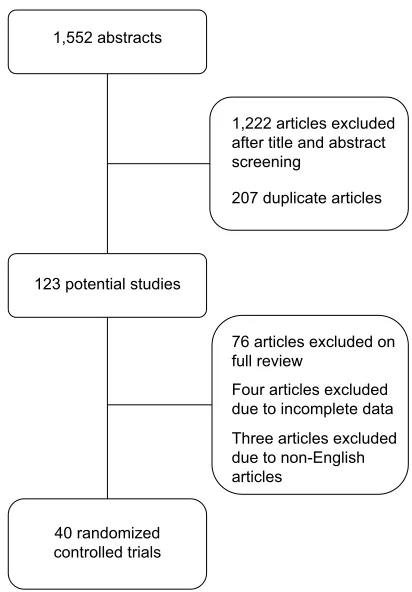
Our search identified 123 articles and we evaluated 40
stud-ies on 2,408 pediatric patients undergoing various surgical
procedures (Figure 1).
27–66The median (interquartile range)
of the sample size for included studies was 60 (40–70) and
the Jadad score was 4 (2–5). Articles that did not meet the
inclusion criteria upon further evaluation of full text were
omitted
67–113and they included incomplete data on analgesic
Figure 1 Flow chart outlining systematic review of randomized controlled trials.
1,552 abstracts
123 potential studies
40 randomized controlled trials
1,222 articles excluded after title and abstract screening
76 articles excluded on full review
Four articles excluded due to incomplete data Three articles excluded due to non-English articles
207 duplicate articles
outcomes,
114–117age limit exceeded,
118–181trials involving
dental procedures,
182–186and non-translated articles.
187–189The
characteristics of the included trials are presented in Table 1.
Appendectomy
One study investigated the use of ultrasound-guided rectus
sheath block compared with placebo on postoperative pain
scores and opioid consumption.
53The children who received
a rectus sheath block reported significantly lower pain scores
compared with the control in the first 3 hours following
surgery. However, there was no difference in pain scores
between groups after 3 hours. Opioid consumption was not
different among groups.
Cholecystectomy
One study reported the use of regional anesthesia compared
with local anesthetic infiltration at laparoscopic port sites
in children scheduled to undergo cholecystectomy.
58Intra-operative opioid requirements were less in children
receiv-ing the bilateral paravertebral block (PVB) than those who
received local anesthetic at the port insertions points. Total
postoperative hydromorphone patient-controlled analgesia
(PCA) consumption and mean pain scores were no different
among groups at 12 hours following surgery. The amount of
PCA hydromorphone consumption at 8–12 hours following
surgery was greater in the PVB group than in the port
infil-tration group. At 24 hours, pain scores were greater in the
PVB group compared with the port infiltration group. The
authors did report that the occurrence of shoulder pain was
less pronounced (49%, 95% CI 0.269–0.893) in the PVB
group compared with the port infiltration group. Although
there were two patients who experienced vascular punctures,
none of the incidents presented as symptoms of local toxicity.
Circumcision
Two studies investigated a commonly performed regional
anesthesia technique for male circumcision: dorsal penile
block. In one study, the authors assessed the analgesic effect
of clonidine with bupivacaine in dorsal penile blocks
com-pared with bupivacaine alone.
39Children allocated to the
clonidine group requested less additional analgesia compared
with control. The Children’s Hospital of Eastern Ontario Pain
Scale (CHEOPS) score was significantly less in the clonidine
group until 24 hours after surgery. In the other study, the
authors evaluated a multimodal regimen consisting of a ring
block, a eutectic mixture of local anesthetic (EMLA) cream,
oral sucrose, and a dorsal penile nerve block.
35The Neonatal
Infant Pain Scale (NIPS) score was significantly lower in
Local and Regional Anesthesia downloaded from https://www.dovepress.com/ by 118.70.13.36 on 24-Aug-2020
Dovepress
Kendall et al
Table 1
Summary of included studies
Author
Year
Procedure
USG
Number treatment/ control
Block/intervention
Outcomes
Block
complications
Modified Jadad score (1–5)
ince et
al
27
2017
Arm/forearm/hand surgery
Y
30/30
infraclavicular brachial plexus block
Pain score: no difference
None
4
Litz et
al
28
2017
Umbilical hernia repair
Y
30/31
Percutaneous rectus sheath block intraoperative rectus sheath block Pain score: no difference in PACU Analgesic use: no difference in PACU
None
3
Luo et
al
29
2017
Pectus excavatum surgery
Y
34/28
Bilateral intercostal
nerve
block
iv
PCA
Pain score: less in block group first 6 hours Analgesic use: higher in
iv
PCA group at 24
hours
None
4
Marjanovic et al
30
2017
Orchiopexy/inguinal hernia repair
Y
13/10/17
Caudal block
Analgesic use: no difference
None
2
Ozkan et
al
31
2017
Soft tissue release for knee/ankle flexion contracture
Y
27/27
Popliteal block
Pain score: less in the popliteal group
None
5
Park el al
32
2017
Orthopedic lower extremity surgery
Y
30/30
PCA
+
dexmedetomidine
PCA
+
fentanyl
Pain score: less in dexmedetomidine group at 6 hours Analgesic use: no difference Neurologic deficit
5
Raof et
al
33
2017
Hernia repair/ hydrocelectomy
Y
30/30
TAP block dexmedetomidine
Analgesic use: lower in the dexmedetomidine group
None
5
Sahin et
al
34
2017
Lower abdominal surgery
Y
30/30/30
TAP block ilioinguinal/iliohypogastric blocks Caudal block Pain score: lower in the TAP and caudal groups at 8 hours Analgesic use: less in TAP and caudal groups
None
1
Sharara-Chami et al
35
2017
Circumcision
Y
20/20/20/10
Dorsal penile nerve block Ring block local anesthetic cream
+
sucrose
Pain score: lower scores in the intervention group. Analgesia: longer in the ring block group/ sucrose/cream
None
5
Uchinami et al
36
2017
Laparoscopic percutaneous extraperitoneal closure
Y
17/17
Rectus sheath block Local anesthetic infiltration
Pain score: no difference at 30 or 60 m
None
3
Abd-elshafy
et
al
37
2016
Lower extremity orthopedic surgery
N
30/30/30
Caudal block iv dexamethasone Caudal dexamethasone Time to first analgesia and number of patients requiring rescue analgesics were less in the
iv
dexamethasone and caudal dexmedetomidine groups
None
4
Abu
elyazed
et
al
38
2016
Open inguinal hernia repair
Y
30/30
TAP block
Pain score: lower in TAP block group at 12 hours analgesia use: higher in GA group
None
2
Anouar et
al
39
2016
Circumcision
N
20/20
Dorsal penile nerve block Clonidine Pain scale: lower in clonidine group at 2 to 24 hours Analgesic use: less in clonidine group at 24 hours
None
3
Local and Regional Anesthesia downloaded from https://www.dovepress.com/ by 118.70.13.36 on 24-Aug-2020
Dovepress Regional anesthesia in pediatric surgical patients
Jarraya et
al
40
2016
Hernia repair Orchiopexy
N
20/20
Caudal block with clonidine
+
fentanyl
Caudal block with fentanyl
+
placebo
Pain score: less in clonidine group after 6 hours
Residual motor blockade in clonidine group
3
Kendigelen et al
41
2016
inguinal hernia
Y
20/20
TAP block Wound infiltration Pain score: lower in the TAP group Analgesia use: higher at fifth minutes, 1, 6, and 12 hours in the
wi
group
None
2
Kendigelen et al
42
2016
Hypospadias
N
41/40
Pudendal nerve block Caudal block Pain score: less in the pudendal group at 24 hours Analgesia use: more in the caudal group
None
5
Marinkovic et al
43
2016
Knee arthroscopy
Y
30/30
Femoral and obturator nerve blocks General anesthesia Pain score: lower in the block group at 2, 6, and 12 hours Analgesia use: less in the block group
None 2 Niiyama et al 44 2016 Microtia surgery N 24/26
intercostal nerve block Continuous wound infiltration Pain control: less in WI group at 12, 36, 48, 60, and 72 hours Analgesia use: less in
wi group None 2 Ohashi et al 45 2016
inguinal hernia repair
Y
19/20
ilioinguinal/iliohypogastric nerve block Pain score: no difference at 30 m, 1 hour, 4 hours Analgesic use: not reported
None 5 Sethi et al 46 2016
Lower abdominal surgery
Y
36/34
Caudal block TAP block Pain control: up to 6 hours no difference; was less in TAP block group 6–24 hours Rescue analgesia: no difference
Not reported 3 Shank et al 47 2016
Burn reconstructive surgery
Y
5/7/7
Local analgesia infiltration LFCN block FiC block
+
continuous infusion
Pain score: less in single shot block and catheter group during first 24 hours. Analgesia use: no difference
Not reported 2 Soaida et al 48 2016 Renal transplant N 30/30 epidural group + multimodal
regimen Multimodal regimen
Pain control: was better in epidural group
None 2 w oo et al 49 2016 Microtia surgery Y 30/29
intercostal nerve block
+
catheter-based infusion/
iv
analgesia
Pain score: less in
iCNB group in chest at rest
Rescue analgesia use: less in the
iCNB group None 3 Arbi et al 50 2015
Open unilateral herniotomy
N 32/32 Caudal iv dexamethasone caudal block
Pain score: less in
iv
dexmedetomidine group on
POD 1 and 2.
None
4
Al-Zaben et al
51
2015
Lower abdominal and perineal surgery
N
31/30/30
Caudal bupivacaine Caudal bupivacaine
+
1μg/kg
dexmedetomidine Caudal bupivacaine
+
2μg/kg
dexmedetomidine
Pain score: less in dexmedetomidine groups at 24 hours Analgesic first use: higher in the non- dexmedetomidine group at 24 hours
None 5 Bryskin et al 52 2015
Bilateral ureteral reimplantation
Y
24/21
TAP block Caudal group Pain scores: lower in the caudal group at PACU Analgesic use: lower in the TAP block group at 24 hours
None 5 Hamill et al 53 2015 Appendectomy Y 73/73
Rectus sheath block
Pain scores: less in block group at 3 hours Analgesic use: no difference
None
5
(
Continued
)
Local and Regional Anesthesia downloaded from https://www.dovepress.com/ by 118.70.13.36 on 24-Aug-2020
Dovepress
Kendall et al
Author
Year
Procedure
USG
Number treatment/ control
Block/intervention
Outcomes
Block
complications
Modified Jadad score (1–5)
Lapmahapaisan et al
54
2015
Non-laparoscopic major abdominal surgery
Y
18/18/18
TAP block Local anesthetic infiltration Placebo Pain score: no difference Analgesic use: no difference
None
5
Lundblad et al
55
2015
inguinal hernia repair
Y
21/22
ilioinguinal/iliohypogastric nerve block with/without dexmedetomidine Pain score: lower in the dexmedetomidine group at PACU Analgesic first use: prolonged in dexmedetomidine group but no difference
None 5 Suresh et al 56 2015
Lower abdominal surgery
Y
18/18
TAP block with bupivacaine 2.5 mg/kg/1.25 mg/kg Pain scores: no difference Analgesic use: higher in the lower dose group
None 5 Tuzcu et al 57 2015 Strabismus N 20/20 Sub-Tenon’s block
Pain scores: less in block group at 30 m Analgesic use: less in block group
None 3 v isoiu et al 58 2015 Cholecystectomy N 41/42
Paravertebral block Port infiltration Pain score: no difference Analgesic use: no difference
None
5
Al-Zaben et al
59
2014
Unilateral orchiopexy
N
35/35
ilioinguinal/iliohypogastric nerve block iv morphine Pain scores: lower in morphine group at 1 hour Analgesic use: no difference at 24 hours
None 3 Bharti et al 60 2014
Lower abdominal and perineal surgeries
N
20/19/20/19
Caudal block dexmedetomidine (0.5/1.0/1.5 μg/kg) Pain scores: higher in the plain ropivacaine group at 3–5 hours Analgesic use: more in the plain ropivacaine group
None 5 Chiono et al 61 2014
Cleft palate repair
Y
30/30
Bilateral suprazygomatic maxillary nerve block Pain scores: no difference Analgesic use: less in the block group at 48 hours Bleeding at puncture site;
cheek hematoma 5 Flack et al 62 2014
Umbilical hernia repair
Y
20/20
Rectus sheath block Wound infiltration Pain scores: no difference Analgesic use: less in the block group
None 3 Kim et al 63 2014 Orchiopexy Y 40/40
Caudal block with/without dexamethasone Pain scores: less in dexamethasone group at 6 hours and 24 hours Analgesic use: less in dexamethasone group
None
5
Seyedhejazi et al
64
2014
inguinal hernia repair, orchiopexy, hydrocelectomy
N
33/33
ilioinguinal/iliohypogastric nerve block Caudal block
Pain scores: more severe in the
ii/
iH group.
Analgesic use: no difference
None 2 Qi et al 65 2014 Pectus excavatum Y 15/15
Bilateral thoracic paravertebral block
+
iv
PCA
iv
PCA
Pain scores: less in the BTPB group at 48 hours Sufentanil use: less in the BTPB group at 24 hours
None 2 Naja et al 66 2013 Hypospadias Y 40/40
Pudendal nerve block Caudal block Pain scores: lower in the nerve block group at 24 hours Analgesic use: higher in the caudal group at 24 hours
None
4
Abbreviations:
BTPB, bilateral thoracic para
vertebral block; F
iC, Fascia iliaca compartment; GA,
general anesthesia;
iCNB, intercostal nerve block;
il/
iH, ilioinguinal/iliohypogastric;
iv
, intravenous;
iv
PCA, intravenous patient-controlled
analgesia;
LFCN, lateral femoral
cutaneous
nerve; PACU, post-anesthesia
care
unit; PCA, patient-controlled analgesia;
POD, postoperative
day;
TAP, transverse
abdominis
plane; USG, ultrasound
guidance;
wi
, surgical
site local anesthetic
infiltration.
Table 1
(
Continued
)
Local and Regional Anesthesia downloaded from https://www.dovepress.com/ by 118.70.13.36 on 24-Aug-2020
Dovepress Regional anesthesia in pediatric surgical patients
the intervention groups compared with those who received
the EMLA cream alone. The addition of the ring block with
the EMLA cream and oral sucrose provided more effective
analgesia than the dorsal penile nerve block, EMLA cream,
and oral sucrose. No adverse events were reported.
Cleft palate repair
Orofacial clefts, such as cleft palate, are a common congenital
abnormality associated with severe postoperative pain.
190,191One study evaluated the efficacy of bilateral suprazygomatic
maxillary nerve blocks on postoperative analgesia outcomes
in pediatric patients undergoing cleft palate repair.
61The
authors reported that bilateral suprazygomatic maxillary
nerve blocks with ropivacaine lowered the overall morphine
consumption compared with placebo after 48 hours
follow-ing surgery. Interestfollow-ingly, the postoperative pain scores were
not different between ropivacaine and placebo groups. Two
minor occurrences related to the nerve block were reported:
one patient experienced bleeding at the puncture site while
the other patient developed a cheek hematoma in the
infrazy-gomatic area on postoperative day 1. The hematoma resolved
spontaneously by postoperative day 5.
Herniotomy
One study investigated the use of a caudal block combined
with intravenous dexamethasone on postoperative analgesia
in pediatric patients scheduled to have unilateral herniotomy
surgery.
50The children who received intravenous
dexametha-sone (0.5 mg/kg) following anesthesia induction reported
less pain (Wong-Baker Face Scale) on postoperative days 1
and 2 compared with placebo. There was no pain reported
in either group immediately following surgery in the
post-anesthesia care unit.
Hypospadias
Two studies investigated the use of regional anesthesia
tech-niques for the pediatric population undergoing hypospadias
surgery.
42,66Both studies compared pudendal nerve block with
caudal block on postoperative analgesic outcomes 24 hours
afterward. One study reported that patients who received
an ultrasound-guided pudendal nerve block experienced
less postoperative pain intensity compared with the caudal
group. Moreover, all of the patients who received a caudal
block requested additional analgesia medication compared
with only 7.5% of the pudendal nerve block group. Taken
together, it is not surprising that the patient satisfaction rate
was lower in the caudal group. The other study evaluated
the efficacy and analgesia duration of a nerve-stimulator
guided pudendal nerve block compared with a caudal block.
The postoperative pain scores at 24 hours were less in the
pudendal nerve group compared with the caudal group. The
total analgesic consumption at 24 hours following surgery
was significantly reduced in the pudendal block group
com-pared with the caudal group. Similar to the aforementioned
study, the patient satisfaction was higher in the pudendal
nerve block group.
inguinal hernia and groin
Eight studies investigated regional anesthesia and its effect
on postoperative analgesia in inguinal hernia and
orchio-pexy procedures. Three studies evaluated ultrasound-guided
transversus abdominis plane (TAP) block on postoperative
analgesia.
33,38,41One study reported a decrease in opioid
consumption at 24 hours in the ultrasound-guided TAP
block group compared with general anesthesia alone. The
CHEOPS and the Behavioral Objective Pain Score (BOPS)
were significantly lower in the TAP block group compared
with the control. Another study compared ultrasound-guided
TAP block to local anesthetic infiltration. At 24 hours after
surgery, the patients who received the TAP block reported
significantly lower pain scores and reduced total opioid
consumption compared with the patients who received local
anesthetic infiltration. Patient satisfaction was higher in the
TAP block group. The third study evaluated the effect of
adding dexmedetomidine to bupivacaine in pediatric patients
scheduled to receive an ultrasound-guided TAP block as part
of their postoperative multimodal regimen. The 24 hours
total analgesic consumption was significantly higher in the
bupivacaine group compared with those who received the
combination of bupivacaine and dexmedetomidine.
Three studies assessed the use of
ilioinguinal/iliohy-pogastric nerve blocks in children undergoing inguinal
surgeries.
45,55,64One study reported postoperative pain
(CHIPPS) in the post-anesthesia care unit (PACU) was
significantly higher in the local anesthetic group compared
with the ilioinguinal/iliohypogastric nerve block group.
Another study compared intraoperative ultrasound-guided
ilioinguinal/iliohypogastric nerve blocks with those who did
not receive a block on postoperative analgesic outcomes.
The BOPS was not different between groups at any of the
four time points (PACU arrival, 30 minutes, 1 hour, and 4
hours). The next study investigated the addition of
cloni-dine to either caudal blocks or ilioinguinal/iliohypogastric
blocks on postoperative outcomes. Patients receiving the
ilioinguinal/iliohypogastric blocks experienced more severe
postoperative pain compared with the caudal group although
Local and Regional Anesthesia downloaded from https://www.dovepress.com/ by 118.70.13.36 on 24-Aug-2020
Dovepress
Kendall et al
it was not statistically significant. In addition, there was no
difference in patients’ postoperative analgesic consumption
between groups.
Two studies evaluated the efficacy of caudal epidural
anesthesia on postoperative analgesia in children
undergo-ing orchiopexy and undergo-inguinal hernia repair.
30,40One study
evaluated three different volumes of 0.25% levobupivacaine
(low: 0.6 mL/kg; middle: 0.8 mL/kg; and high: 1.0 mL/
kg) and reported that the postoperative analgesic
consump-tion at 6, 12, and 24 hours following surgery did not differ
among groups. The postoperative pain was evaluated using
the CHIPPS instrument which was not statistically different
among groups at any time period. The last study evaluated
the efficacy of adding clonidine to a caudal block to alleviate
postoperative pain following orchiopexy or hernia repair
pro-cedures. No patients requested additional analgesia in either
group in the first 6 hours following surgery. The postoperative
pain scores (CHEOPS) at 12 and 24 hours were higher in
patients who did not receive clonidine compared with those
who received clonidine as part of their anesthetic block.
One study compared bilateral ultrasound-guided rectus
sheath block with local anesthetic infiltration for laparoscopic
percutaneous extraperitoneal closure during inguinal hernia
repair in children.
36The pain score (Face, Legs, Activity,
Cry, and Consolability [FLACC]) was higher on arrival to
the PACU in the local anesthetic infiltration group compared
with the rectus sheath block group. However, there was no
difference in postoperative pain scores at 30 and 60 minutes
between groups. No patients in either of the aforementioned
studies experienced immediate or delayed complications.
Lower abdominal procedures
Six studies evaluated regional anesthesia and its effect on
postoperative analgesia in lower abdominal procedures
including herniorrhaphy, hydrocelectomy, and testicular
detorsion.
Four studies examined the efficacy of transversus
abdomi-nis plane block for postoperative pain relief in pediatric
population undergoing abdominal surgery.
34,46,54,56One study
compared local infiltration with 0.25% bupivacaine, a control
(no block group), and a surgeon-placed bilateral TAP block
for non-laparoscopic abdominal procedures. The authors
reported no difference in postoperative pain scores and no
reduction in cumulative 24 hours opioid consumption among
the groups. Suresh et al compared the analgesic efficacy of
1.25–2.5 mg/kg bupivacaine in children scheduled to receive
a TAP block for postoperative pain relief.
56The pain scores
in the PACU were not different between the study groups.
However, the 24 hours total analgesic consumption was
higher in the low-dose group compared with the high-dose
group. The authors concluded that the higher local anesthetic
dose for TAP block in children does not provide benefits in
the immediate postoperative recovery period but does seem
to decrease the analgesic use 24 hours after surgery.
Another study compared ultrasound-guided TAP block
with caudal block for postoperative pain relief after lower
abdominal surgery. There was no difference in pain scores
between groups in the first 6 hours following surgery. The
children who received the caudal block reported a greater
incidence of pain 6 hours following surgery than patients
allo-cated to the TAP block group. No statistical difference was
reported between groups regarding total opioid consumption.
Sahin et al compared three regional anesthesia techniques
in children following elective unilateral lower abdominal
surgery.
34The total analgesic consumption was higher in the
ilioinguinal/iliohypogastric block compared with the TAP
block and caudal block. The pain scores (CHEOPS) during
the first 8 hours in the postoperative period were higher in
the ilioinguinal/iliohypogastric group compared with the
other two groups; however, the pain scores in the
ilioingui-nal/iliohypogastric group at 16 hours were higher compared
with the caudal group. The authors concluded that caudal
blocks and TAP blocks are more effective than ilioinguinal/
iliohypogastric nerve blocks in the early postoperative period.
One study compared the analgesic efficacy of caudal
bupivacaine with two different caudal dexmedetomidine
dos-ages (1 and 2 μg/kg) for postoperative pain relief in pediatric
children undergoing lower abdominal and perineal surgery.
51The time to first analgesic request was longer in children who
were allocated to the dexmedetomidine groups compared
with the plain bupivacaine group. The 24 hours postoperative
analgesic consumption was higher in the plain bupivacaine
group compared with either dexmedetomidine groups.
How-ever, patients who received dexmedetomidine experienced
significantly higher postoperative sedation scores compared
with plain bupivacaine group. Two patients who received the
1 μg/kg dexmedetomidine dose developed bradycardia and
hypotension and one experienced urinary retention compared
with none in the plain bupivacaine group.
A similar study compared caudal ropivacaine to the
addition of three different dexmedetomidine dosages (0.5,
1, and 1.5 μg/kg) in caudal ropivacaine on postoperative
analgesia in pediatric patients.
60The postoperative analgesia
was significantly prolonged in all dexmedetomidine groups
compared with the plain ropivacaine group. All children
receiving plain ropivacaine required opioid analgesia in the
Local and Regional Anesthesia downloaded from https://www.dovepress.com/ by 118.70.13.36 on 24-Aug-2020
Dovepress Regional anesthesia in pediatric surgical patients
first 6 hours following surgery compared with no opioid
requests in all three dexmedetomidine groups. The plain
ropivacaine group experienced higher pain scores (FLACC)
between 3 and 5 hours following surgery compared with the
dexmedetomidine groups. Patients who received 1.5 μg/kg
dexmedetomidine experienced higher postoperative sedation
scores and significantly prolonged sedation compared with
the other groups.
Microtia
Microtia is a congenital deformity of the external ear that
requires reconstructive surgery and rib cartilage harvesting.
Children often complain of severe postoperative pain
dur-ing the immediate postoperative period. Two studies
exam-ined regional anesthesia in children undergoing auricular
reconstruction for postoperative pain relief.
44,49One study
compared a single-shot intercostal nerve block
contain-ing ropivacaine to a 48 hours infusion of ropivacaine into
the surgical site on postoperative analgesia outcomes. The
supplemental analgesic use was significantly higher in the
intercostal nerve block group compared with the surgical site
infiltration group. The postoperative pain score (Face Scale;
0
=
none, 5
=
severe) was significantly lower in the surgical site
infiltration group compared with the intercostal nerve block at
12 to 72 hours after surgery. No patients experienced
symp-toms of central nervous system or cardiovascular toxicity. The
number of patients who experienced postoperative nausea
and vomiting (PONV) was not different between groups.
The second study compared the combination of a
single-shot intercostal nerve block followed by a catheter-based
infusion of ropivacaine to intravenous analgesia on
postopera-tive pain after rib harvesting for auricular reconstruction in
children with microtia. The average pain scores (numerical
pain rating score) of chest pain at rest and during coughing
in the first 48 hours after the surgery was significantly lower
in the intercostal nerve block plus infusion group compared
with the intravenous analgesia (control) group. Ear pain was
also significantly higher in the control group compared with
the study group. Rescue medication during the first 48 hours
following surgery was significantly less in the block plus
infu-sion group compared with the intravenous analgesia group.
Orchiopexy
Two studies examined the use of regional anesthesia for
post-operative pain relief in children undergoing orchiopexy.
59,63Orchiopexy is a commonly performed procedure in children
with an undescended testicle or testes and is associated with
moderate-to-severe postoperative pain lasting up to several
days following surgery.
192One study compared the analgesic
efficacy of caudal ropivacaine with and without
dexametha-sone (0.1 mg/kg) on postoperative pain and rescue analgesic
consumption in children undergoing unilateral orchiopexy. The
postoperative pain scores (numeric rating scale [NRS]) were
significantly lower in the dexamethasone group compared with
the plain ropivacaine group up to 48 hours following surgery.
At 48 hours after surgery, there was no difference in the pain
scores between groups. Consumption of oral analgesics at
48 hours after surgery was less in the dexamethasone group
(28.9%) compared with the plain ropivacaine group (54.1%).
The other study compared ilioinguinal/iliohypogastric
nerve block to intravenous morphine in pediatric patients
undergoing unilateral orchiopexy surgery. The postoperative
pain scores (NRS) were significantly lower in the morphine
group compared with the block group in the first hour after
surgery. After 60 minutes in the PACU, there was no
differ-ence in pain scores between groups. The 24 hours
postopera-tive analgesic consumption was not different between groups.
Patients allocated to the morphine group experienced more
vomiting and itching compared with the nerve block group.
Orthopedic procedures
Four studies investigated the use of regional anesthesia for
postoperative analgesia outcomes in children scheduled to
undergo lower extremity orthopedic procedures.
31,32,37,43As
a component of multimodal anesthesia, regional anesthesia
techniques are increasing in popularity for surgical
pro-cedures especially in orthopedic surgery.
193–195One study
compared ultrasound-guided femoral nerve block together
with the obturator nerve to a no-nerve block group. The
postoperative pain score (Wong-Baker FACE Scale) was
significantly lower in the children who received a nerve block
compared with those who did not receive a nerve block. In
addition, the postoperative analgesic consumption was also
significantly less in the block group.
The second study compared the use of a bupivacaine
cau-dal block with and without dexamethasone and intravenous
dexamethasone on postoperative pain in pediatric patients
undergoing lower limb orthopedic surgery.
37In the first 8
hours and the 12 to 24 hours postoperative period, the
post-operative pain scores were higher in the patients who received
the caudal epidural with plain bupivacaine compared with
those allocated to either dexamethasone groups (caudal or
intravenous). There was no difference in pain scores among
all three groups at the 12 hours postoperative period. The
number of analgesic doses requested was significantly lower
in the dexamethasone groups compared with the caudal block
Local and Regional Anesthesia downloaded from https://www.dovepress.com/ by 118.70.13.36 on 24-Aug-2020
Dovepress
Kendall et al
with plain bupivacaine. Moreover, no difference was reported
between the plain bupivacaine caudal with intravenous
dexamethasone group and the caudal dexamethasone group.
The third study compared the efficacy of epidural
adju-vants, dexmedetomidine, and fentanyl to local anesthetics
in pediatric orthopedic surgery.
32The median postoperative
pain score (revised scale FLACC)
196was not different among
groups at PACU arrival, 12, 24, and 48 hours after surgery.
At 6 hours following surgery, the dexmedetomidine group
reported significantly lower pain scores compared with
the fentanyl group. Rescue analgesic use was not different
between groups throughout the 48 hours follow-up period.
Another study evaluated the effects of preoperative
ultrasound-guided popliteal block on analgesic outcomes in
children with cerebral palsy undergoing lower limb surgery.
31The total paracetamol consumption was significantly lower in
the popliteal nerve block group compared with the non-block
group. The postoperative pain scores (Wong-Baker FACE
Scale) were higher in the control group compared with the
nerve block group at 10 minutes, 20 minutes, and up to 12
hours postoperatively. There was no difference in pain scores
between groups at 24 hours after surgery.
The last study in the group compared ultrasound-guided
infraclavicular brachial plexus blocks with two different local
anesthetic dosages in children undergoing upper extremity
orthopedic surgery.
27The authors detected no statistical
difference in postoperative pain scores (Wong-Baker FACE
Scale) between local anesthetic volumes of 0.5% bupivacaine
(0.25 and 0.50 mL/kg) during the first 24 hours following
surgery. No block complications such as pneumothorax or
hematoma were reported in either group.
Pectus excavatum
Pectus excavatum is the most common congenital chest wall
deformity in children with an incidence of one in 400.
197The
Nuss procedure is a surgical procedure in which a substernal
bar is implanted into the anterior chest wall to help stabilize
its shape. The procedure is associated with moderate
post-operative pain which may affect postpost-operative rehabilitation
and lead to an increased length of hospitalization.
198,199Two
studies investigated the effectiveness of regional anesthesia
in providing postoperative pain in children undergoing the
Nuss procedure.
29,65One study compared ultrasound-guided
bilateral intercostal nerve blocks with intravenous analgesia
for postoperative analgesia. The postoperative pain scores
(Faces Pain Scale-Revised, FPS-R) in the first 6 hours were
significantly decreased in the nerve block group compared
with the control group. The 24 hours opioid consumption
was significantly less in the nerve block group compared
with the control group.
The other study examined the use of
ultrasound-guided bilateral thoracic PVBs and intravenous PCA for
postoperative pain. The postoperative pain scores (FLACC;
visual analog scale) were significantly reduced in the nerve
block group compared with the control group in the first 48
hours following surgery. The 24 hours cumulative opioid
consumption was significantly higher in the control group
compared with that in the nerve block group. No immediate
nerve block complications were reported by the authors in
either study.
Umbilical hernia
Two studies investigated the effectiveness of regional
anes-thesia on postoperative pain for umbilical hernia repair in
children. Flack et al compared the use of ultrasound-guided
rectus sheath blocks with surgical site infiltration on
post-operative opioid consumption and reported that children
allocated to the block group consumed significantly less
opioids than those in the surgical site infiltration group.
62However, there was no difference in the average maximum
pain scores between groups.
The second study compared the use of preoperative
ultrasound-guided rectus sheath blocks with surgeon-placed
rectus sheath blocks for postoperative pain relief.
28The mean
postoperative pain scores (Wong-Baker FACE Scale) and
analgesia consumption in the post-anesthesia care unit were
similar between groups.
Renal transplant
A single study evaluated the effectiveness of a caudal epidural
block with and without intravenous fentanyl and paracetamol
for postoperative pain relief in children undergoing renal
transplantation.
48Postoperative pain management after renal
transplantation poses a challenge due to the limited kidney
function and possible respiratory depression from systemic
opioids.
200–202The placement of catheters to the thoracic
level through the caudal route has been described in many
studies and is thought to be safer than direct catheter
place-ment at the lumbar or thoracic levels in children receiving
general anesthesia.
203,204Soaida et al reported postoperative
pain scores that were statistically higher at 6, 12, and 18
hours in the intravenous fentanyl group compared with
those who received the caudal epidural block.
48Over half
of the patients in the control group compared with none in
the caudal group received rescue analgesia upon arriving to
the post-anesthesia care unit. There were two cases in which
Local and Regional Anesthesia downloaded from https://www.dovepress.com/ by 118.70.13.36 on 24-Aug-2020
Dovepress Regional anesthesia in pediatric surgical patients
threading the epidural catheter to the thoracic region failed
and were excluded from the study.
Strabismus
One study examined regional anesthesia on postoperative
pain in pediatric ocular procedures. Strabismus surgery is
a common pediatric ocular operation that causes several
unpleasant side effects throughout the perioperative period.
The most concerning issue is the occurrence of the
oculo-cardiac reflex. It is associated with increased PONV due to
the disturbance of the extraocular muscles during surgery.
205Tuzcu et al compared the effectiveness of sub-Tenon’s block
on postoperative analgesia in children having strabismus
surgery.
57Patient who received the block reported lower
postoperative pain scores (NRS 0–4; 0
=
no pain, 4
=
very
severe pain) 30 minutes following the procedure compared
with those who did not receive the block. In addition,
post-operative analgesic use was less in the block group compared
with the control group.
Burn reconstructive surgery
One study investigated the use of ultrasound-guided regional
anesthesia for postoperative pain control in pediatric burn
patients undergoing reconstructive surgery. Burn patients
often undergo multiple reconstructive surgeries to regain
body function and esthetics.
206Postoperative pain following
skin grafting has been challenging and is a main reason for
patients to decline reconstructive procedures. Shank et al
compared surgical site infiltration (0.25% bupivacaine),
ultrasound-guided single-shot lateral femoral cutaneous nerve
block, and ultrasound-guided continuous infusion fascia-iliaca
compartment block on postoperative pain in children
undergo-ing reconstructive skin graftundergo-ing.
47The authors reported that
patients who received regional anesthesia via single-shot lateral
femoral cutaneous nerve block (LFCNB) or catheter infusion
fascia iliaca compartment block (FICB) experienced less pain
than those in the surgical site infiltration group. The patients in
the LFCNB group reported significantly less postoperative pain
upon arrival to the post-anesthesia care unit until discharge to
the floor compared with the FICB group or the control group.
However, patients in the FICB group reported significantly
lower pain scores on postoperative days 1 and 2 compared
with LFCNB and the control group. There was no difference
in opioid consumption among all three groups.
Discussion
The current investigation demonstrates that the number of
clinical trials supporting the use of regional anesthesia for the
management of postoperative pain has increased in children
undergoing surgery. Notably, of the 2,408 patients included
in the review, no significant complication attributed to the
regional anesthesia techniques such as systemic toxicity
or neurological sequelae was reported. The majority of the
regional anesthesia techniques were performed using
ultra-sound guidance, which may be a contributing factor in the
observed increased rate of publication of clinical trials in
this area. The ability to provide site-specific analgesia while
reducing opioid consumption results in targeted pain relief
with fewer side effects. Although there has been an increase
in the use of regional anesthesia in the pediatric literature
demonstrating improvement of postoperative outcomes, our
review calls for further examination of the effect of regional
anesthesia techniques on postoperative outcomes in pediatric
patients.
The strongest evidence to support the use of regional
anesthesia for postoperative pain management in children
was demonstrated by studies of intercostal nerve blocks
(three studies) for reconstructive ear surgery and chest wall
deformity. A decrease in postoperative discomfort and
anal-gesic consumption was more pronounced in patients
receiv-ing intercostal nerve blocks compared with local anesthetic
infusion or infiltration of the surgical site.
Pudendal nerve block is commonly used in adults
undergoing obstetric and anorectal procedures. The use of
a pudendal nerve block (two studies) for postoperative pain
management in pediatric hypospadias surgery provided
supe-rior pain relief and reduced 24 hours analgesic consumption
compared with caudal blocks, resulting in fewer side effects
and improvement in sleep patterns.
Bilateral suprazygomatic maxillary nerve blocks (one
study) provided good pain relief by reducing the total opioid
consumption 48 hours following cleft palate repair compared
with placebo and show promise as an alternative to
intrave-nous opioids. Other regional anesthesia techniques, such as
rectus sheath blocks for umbilical hernia surgery, reduced
opioid consumption compared with local anesthetic
infiltra-tion of the surgical site.
In contrast, several studies have shown a marginal benefit
of regional anesthesia in postoperative pain management in
children. Similar to our previous study,
21ilioinguinal/iliohy-pogastric nerve blocks for inguinal hernia repair demonstrate
mixed results.
Abu Elyazed et al reported a decrease in total opioid
consumption at 24 hours following surgery in patients
receiving an ultrasound-guided TAP block compared with
general anesthesia alone.
38This finding is similar to previous
Local and Regional Anesthesia downloaded from https://www.dovepress.com/ by 118.70.13.36 on 24-Aug-2020
Dovepress
Kendall et al
reports that demonstrated that local anesthetics lowered
postoperative analgesic requirements compared with general
anesthesia.
207–209Compared with TAP block or caudal block,
ilioinguinal/iliohypogastric nerve blocks did not provide
substantial pain relief or reduce opioid consumption in the
early postoperative period.
34However, the use of ilioinguinal/
iliohypogastric nerve blocks for unilateral orchiopexy
proce-dures provides short-term pain relief, and patients experience
fewer side effects than with intravenous analgesics.
59The use of PVBs for postoperative pain relief
follow-ing cholecystectomy in pediatric patients demonstrated
inconclusive results when compared with local anesthetic
infiltration at laparoscopic port sites. Similar inconclusive
reports on the application of thoracic PVBs and neuraxial
anesthesia for cholecystectomy have been published in adult
patients.
210–212However, patients who received bilateral
para-vertebral nerve blocks following reconstructive chest wall
repair experienced excellent pain relief in the first 48 hours
following the procedure.
Caudal epidural blocks are one of the most commonly
performed techniques in pediatric regional anesthesia with
success rates of above 95%.
213In the present review, we found
that almost half of the studies that contained a caudal block
arm used ultrasound guidance during catheter placement
which is higher than our previous report. Caudal blocks
together with dexamethasone provided improved
postopera-tive pain relief (greater than 6 hours), particularly in children
undergoing orchiopexy and lower extremity orthopedic
surgery. This finding is similar to the report by Hong et al
which reported a single dose of intravenous dexamethasone
combined with a caudal block prolonged postoperative pain
relief in pediatric orchiopexy.
214In contrast, all children recovering from hypospadias
surgery who received a caudal block requested additional
analgesics, suggesting inadequate pain relief. Further
investi-gations involving the safety of regional neuraxial techniques
with adjuvants in children are warranted.
Use of additives to local anesthetics for prolongation of
the duration of analgesia is common, as this may decrease
the total amount of local anesthetic that is necessary.
215–217Clonidine has been shown to improve postoperative pain
control.
218,219Several trials evaluated the use of adjuvants,
such as clonidine and dexmedetomidine, together with local
anesthetics and reported that patients requested less
supple-mental medication due to the enhanced analgesia.
51,55How-ever, patients who received dexmedetomidine experienced
excessive sedation, and two patients experienced side effects,
which suggests that appropriate dosing of dexmedetomidine
in children deserves further investigation.
The use of
adjuvants to local anesthetics in the pediatric population is
limited and further studies evaluating its enhanced analgesic
effect and safety profile in children are warranted.
Limitations
Our review must be interpreted within the context of the
study’s limitations. Comparisons in pragmatic trials were
heterogeneous (different drugs, adjuvants, or both) and the
number of trials for the same surgical procedure was small.
We did not carry out a quantitative analysis and limited our
review to a qualitative evaluation. We could not assess the
existence of publication bias, and it is plausible that negative
trials investigating analgesic outcomes were never published.
In addition, we did not evaluate if variations of block
tech-nique affected pain outcomes.
Conclusion
We performed a systemic review of randomized controlled
trials published from 2013 to 2017 in order to assess the
effec-tiveness of regional anesthesia procedures on postoperative
outcomes in children after pediatric surgery. Although there
are challenges with conducting randomized controlled trials
in children, the quantity and quality of the number of pediatric
studies published on the topic of regional anesthesia techniques
have increased. Still, further trials are needed to improve our
knowledge of the benefits and risks of regional anesthesia
techniques associated with specific pediatric procedures.
Disclosure
The authors report no conflicts of interest in this work.
References
1. Gan TJ. Poorly controlled postoperative pain: prevalence, conse-quences, and prevention. J Pain Res. 2017;10:2287–2298.
2. Sinatra R. Causes and consequences of inadequate management of acute pain. Pain Med. 2010;11(12):1859–1871.
3. Krane EJ, Weisman SJ, Walco GA. The National Opioid Epi-demic and the Risk of Outpatient Opioids in Children. Pediatrics. 2018;142(2):e20181623.
4. Liu C, Ulualp SO. Outcomes of an Alternating Ibuprofen and Acet-aminophen Regimen for Pain Relief After Tonsillectomy in Children.
Ann Otol Rhinol Laryngol. 2015;124(10):777–781.
5. McNicol ED, Rowe E, Cooper TE. Ketorolac for postoperative pain in children. Cochrane Database Syst Rev. 2018;7:CD012294. 6. Harbaugh CM, Lee JS, Hu HM, et al. Persistent opioid use among
pediatric patients after surgery. Pediatrics. 2018;141(1):e20172439. 7. Shah RD, Suresh S. Acute pain management in the pediatric
ambula-tory setting: How do we optimize the child’s postoperative experience?
J Clin Anesth. 2017;40:103–104.
8. van Cleve WC, Grigg EB. Variability in opioid prescribing for children undergoing ambulatory surgery in the United States. J Clin Anesth. 2017;41:16–20.
9. Waljee JF, Zhong L, Hou H, Sears E, Brummett C, Chung KC. The use of opioid analgesics following common upper extremity surgical procedures: a national, population-based study. Plast Reconstr Surg.
Local and Regional Anesthesia downloaded from https://www.dovepress.com/ by 118.70.13.36 on 24-Aug-2020
Dovepress Regional anesthesia in pediatric surgical patients
10. Verghese ST, Hannallah RS. Acute pain management in children.
J Pain Res. 2010;3:105–123.
11. Cai Y, Lopata L, Roh A, et al. Factors influencing postoperative pain following discharge in pediatric ambulatory surgery patients. J Clin Anesth. 2017;39:100–104.
12. Joshi G, Gandhi K, Shah N, Gadsden J, Corman SL. Peripheral nerve blocks in the management of postoperative pain: challenges and opportunities. J Clin Anesth. 2016;35:524–529.
13. Shah RD, Suresh S. Applications of regional anaesthesia in paediatrics.
Br J Anaesth. 2013;111(Suppl 1):i114–i124.
14. Jöhr M. Regional anaesthesia in neonates, infants and children: an educational review. Eur J Anaesthesiol. 2015;32(5):289–297. 15. Coraci D, Santilli V, Giovannini S, Padua L. The important use of
ultra-sound on a child with chronic pain. J Clin Anesth. 2017;38:105–106. 16. Samol NB, Furstein JS, Moore DL. Regional anesthesia and
pain management for the pediatric patient. Int Anesthesiol Clin. 2012;50(4):83–95.
17. Krause M, Khatibi B, Sztain JF, Rahman P, Shapiro AB, Sandhu NS. Ultrasound-guided airway blocks using a curvilinear probe. J Clin Anesth. 2016;33:408–412.
18. Stein AL, Baumgard D, del Rio I, Tutiven JL. Updates in Pediatric Regional Anesthesia and Its Role in the Treatment of Acute Pain in the Ambulatory Setting. Curr Pain Headache Rep. 2017;21(2):11. 19. Polaner DM, Taenzer AH, Walker BJ, et al. Pediatric Regional
Anes-thesia Network (PRAN): a multi-institutional study of the use and incidence of complications of pediatric regional anesthesia. Anesth Analg. 2012;115(6):1353–1364.
20. Ecoffey C, Lacroix F, Giaufré E, Orliaguet G, Courrèges P; Association des Anesthésistes Réanimateurs Pédiatriques d’Expression Française (ADARPEF). Epidemiology and morbidity of regional anesthesia in children: a follow-up one-year prospective survey of the French-Language Society of Paediatric Anaesthesiologists (ADARPEF).
Paediatr Anaesth. 2010;20(12):1061–1069.
21. Suresh S, Schaldenbrand K, Wallis B, de Oliveira GS. Regional anaesthesia to improve pain outcomes in paediatric surgical patients: a qualitative systematic review of randomized controlled trials. Br J Anaesth. 2014;113(3):375–390.
22. Liberati A, Altman DG, Tetzlaff J, et al. The PRISMA statement for reporting systematic reviews and meta-analyses of studies that evaluate health care interventions: explanation and elaboration. J Clin Epide-miol. 2009;62(10):e1–e34.
23. Jadad AR, Moore RA, Carroll D, et al. Assessing the quality of reports of randomized clinical trials: is blinding necessary? Control Clin Trials. 1996;17(1):1–12.
24. De Oliveira GS, Castro-Alves LJ, Ahmad S, Kendall MC, McCarthy RJ. Dexamethasone to prevent postoperative nausea and vomiting: an updated meta-analysis of randomized controlled trials. Anesth Analg. 2013;116(1):58–74.
25. de Oliveira GS, Chang R, Kendall MC, Fitzgerald PC, Mccarthy RJ. Publication bias in the anesthesiology literature. Anesth Analg. 2012;114(5):1042–1048.
26. de Oliveira GS, Castro-Alves LJ, Chang R, Yaghmour E, Mccarthy RJ. Systemic metoclopramide to prevent postoperative nausea and vomiting: a meta-analysis without Fujii’s studies. Br J Anaesth. 2012;109(5):688–697.
27. Ince I, Aksoy M, Dostbil A, Tuncer K. Can we use lower volume of local anesthetic for infraclavicular brachial plexus nerve block under ultrasound guidance in children? J Clin Anesth. 2017;41:132–136. 28. Litz CN, Farach SM, Fernandez AM, et al. Percutaneous
ultra-sound-guided vs. intraoperative rectus sheath block for pediatric umbilical hernia repair: A randomized clinical trial. J Pediatr Surg. 2017;52(6):901–906.
29. Luo M, Liu X, Ning L, Sun Y, Cai Y, Shen S. Comparison of Ultraso-nography-guided Bilateral Intercostal Nerve Blocks and Conventional Patient-controlled Intravenous Analgesia for Pain Control After the Nuss Procedure in Children: A Prospective Randomized Study. Clin J Pain. 2017;33(7):604–610.
30. Marjanovic V, Budic I, Stevic M, Simic D. A Comparison of Three Different Volumes of Levobupivacaine for Caudal Block in Children Undergoing Orchidopexy and Inguinal Hernia Repair. Med Princ Pract. 2017;26(4):331–336.
31. Ozkan D, Gonen E, Akkaya T, Bakir M. Popliteal block for lower limb surgery in children with cerebral palsy: effect on sevoflurane consumption and postoperative pain (a randomized, double-blinded, controlled trial). J Anesth. 2017;31(3):358–364.
32. Park SJ, Shin S, Kim SH, et al. Comparison of Dexmedetomidine and Fentanyl as an Adjuvant to Ropivacaine for Postoperative Epidural Analgesia in Pediatric Orthopedic Surgery. Yonsei Med J. 2017;58(3):650–657.
33. Raof RA, El Metainy SA, Alia DA, Wahab MA. Dexmedetomidine decreases the required amount of bupivacaine for ultrasound-guided transversus abdominis plane block in pediatrics patients: a randomized study. J Clin Anesth. 2017;37:55–60.
34. Sahin L, Soydinc MH, Sen E, Cavus O, Sahin M. Comparison of 3 different regional block techniques in pediatric patients. A prospec-tive randomized single-blinded study. Saudi Med J. 2017;38(9): 952–959.
35. Sharara-Chami R, Lakissian Z, Charafeddine L, Milad N, El-Hout Y. Combination Analgesia for Neonatal Circumcision: A Randomized Controlled Trial. Pediatrics. 2017;140(6):e20171935.
36. Uchinami Y, Sakuraya F, Tanaka N, et al. Comparison of the analgesic efficacy of ultrasound-guided rectus sheath block and local anesthetic infiltration for laparoscopic percutaneous extraperitoneal closure in children. Paediatr Anaesth. 2017;27(5):516–523.
37. Elshafy SK, Yacoup AM, Abdalla EE, El-Melegy TT, Abd-Elsalam KA. A New Look on Adding Dexamethasone as an Adjuvant to Caudal Bupivacaine; Efficacy on Postoperative Pain and Vomiting in Pediatric Patients. Pain Physician. 2016;19(6):E841–E852. 38. Abu Elyazed MM, Mostafa SF, Abdullah MA, Eid GM. The effect
of ultrasound-guided transversus abdominis plane (TAP) block on postoperative analgesia and neuroendocrine stress response in pediatric patients undergoing elective open inguinal hernia repair. Paediatr Anaesth. 2016;26(12):1165–1171.
39. Anouar J, Mohamed S, Sofiene A, Jawhar Z, Sahar E, Kamel K. The analgesic effect of clonidine as an adjuvant in dorsal penile nerve block. Pan Afr Med J. 2016;23:213.
40. Jarraya A, Elleuch S, Zouari J, Smaoui M, Laabidi S, Kolsi K. Post-operative analgesia in children when using clonidine in addition to fentanyl with bupivacaine given caudally. Pan Afr Med J. 2016;24:182. 41. Kendigelen P, Tutuncu AC, Erbabacan E, et al. Ultrasound-assisted
transversus abdominis plane block vs wound infiltration in pediatric patient with inguinal hernia: randomized controlled trial. J Clin Anesth. 2016;30:9–14.
42. Kendigelen P, Tutuncu AC, Emre S, Altindas F, Kaya G. Puden-dal Versus CauPuden-dal Block in Children Undergoing Hypospadias Surgery: A Randomized Controlled Trial. Reg Anesth Pain Med. 2016;41(5):610–615.
43. Marinkovic D, Simin JM, Draskovic B, Kvrgic IM, Pandurov M. Efficiency of ultrasound guided lower limb peripheral nerve blocks in perioperative pain management for knee arthroscopy in children. A randomized study. Med Pregl. 2016;69(1–2):5–10.
44. Niiyama Y, Yotsuyanagi T, Yamakage M. Continuous wound infiltra-tion with 0.2% ropivacaine versus a single intercostal nerve block with 0.75% ropivacaine for postoperative pain management after reconstructive surgery for microtia. J Plast Recon Aesth Surg. 2016;69(10):1445–1449.
45. Ohashi N, Denda S, Furutani K, et al. Ultrasound-guided ilioingui-nal/iliohypogastric block did not reduce emergence delirium after ambulatory pediatric inguinal hernia repair: a prospective randomized double-blind study. Surg Today. 2016;46(8):963–969.
46. Sethi N, Pant D, Dutta A, Koul A, Sood J, Chugh PT. Comparison of caudal epidural block and ultrasonography-guided transversus abdominis plane block for pain relief in children undergoing lower abdominal surgery. J Clin Anesth. 2016;33:322–329.
Local and Regional Anesthesia downloaded from https://www.dovepress.com/ by 118.70.13.36 on 24-Aug-2020