Prenatal exposure to bisphenol A and phthalates and behavioral problems in children at preschool 1
age: The Hokkaido Study on Environment and Children’s Health 2
3 4
Authors and Affiliations 5
Machiko Minatoya1, Sachiko Itoh1, Keiko Yamazaki1, Atsuko Araki1, Chihiro Miyashita1, Naomi Tamura1, 6
Jun Yamamoto2, Yu Onoda2, Kazuki Ogasawara2, Toru Matsumura2, Reiko Kishi1 7
8
1 Center for Environmental and Health Sciences, Sapporo, Japan 9
2 Institute of Environmental Ecology, Idea Consultants, Inc., Shizuoka, Japan 10
11 12 13 14 15 16 17 18 19 20 21 22 23 24 25 26 27 28 29
Corresponding Author 30
Prof. Reiko Kishi, MD, PhD, MPH
31
Tel.: +81-11-706-4748
32
Email: [email protected]
33
Mailing address: Kita 12, Nishi 7, Kita-ku, Sapporo 060-0812, Japan
34
Abstract 35
Studies reported adverse behavioral development including internalizing and externalizing problems
36
in association with prenatal exposure to bisphenol A (BPA) and phthalates, however, findings were
37
not sufficient due to using different assessment tools and child ages among studies. This study aimed
38
to examine associations between maternal serum levels of BPA and phthalate metabolites and
39
behavioral problems at preschool age.
40
The Strengths and Difficulties Questionnaire (SDQ) was used to assess behavioral problems at 5 years
41
of age. BPA and phthalate metabolite levels in the 1st trimester maternal serum was determined by 42
LC-MS/MS for 458 children. Variables used for adjustment were parental ages, maternal cotinine
43
levels, family income during pregnancy, child sex, birth order and age at SDQ completed.
44
The median concentrations of BPA, MnBP, MiBP, MEHP and MECPP were 0.062, 26.0, 7.0, 1.40, and
45
0.20 ng/ml, respectively. BPA level was associated with increased hyperactivity/inattention risk
46
among girls (OR=1.66, 95% CI: 0.95-2.90) and∑DBPm (MnBP + MiBP) level was associated with 47
decreased total difficulties risk overall and among girls (OR=0.48, 95% CI: 0.20-1.13, OR=0.24, 95%
48
CI: 0.06-1.03, respectively) without significance. MECPP level was associated with increase conduct
49
problems risk (OR=2.78, 95% CI: 1.36-5.68).
50
Our analyses found no significant association between BPA or summation of phthalate metabolite
51
levels and any of the behavioral problems at 5 years of age, however, suggested possible association
between MECPP levels and increased risk of conduct problems.
53
54
Keywords: SDQ, bisphenol A, phthalates, prenatal exposure, birth cohort, behavioral problems 55
56
57
58
59
60
61
62
63
64
65
66
67
68
69
Introduction 71
It has been reported that developmental disabilities have increased in recent decades 1,2). Childhood 72
behavioral problems have influence on individual development, school performance and quality of
73
life. BPA and phthalates are ubiquitous environmental chemicals that were detected from various
74
specimen including urine, blood, breast milk and anomic fluid 3,4). BPA is widely used in polycarbonate 75
products, epoxy resins as coatings on the inside of many food and beverage cans 5). There are variety 76
of phthalates used in consumer products such as food packages, polyvinyl chloride floor materials,
77
lotion and fragrances. Humans are exposed to phthalates by multiple routes. Exposures can be oral
78
or dermal or can also be via inhalation 6). Since BPA and phthalates can cross the placenta7,8), exposure 79
during critical period in fetal development is a concern 6,7). 80
Exposure to environmental chemicals such as bisphenol A (BPA) and phthalates may play roles in the
81
development of child behavioral problems 9,10). BPA and phthalates are both known as endocrine 82
disruptors and there is a growing concern of exposure to these chemicals and adverse health
83
outcomes on human. From laboratory studies, BPA has been shown to disrupt brain function and
84
structure 11-13). 85
Previously several birth cohort studies have investigated associations between BPA and phthalates
86
exposures and child behavioral problems. For example, maternal levels of BPA have been associated
87
with various child behavioral outcomes including behavioral problems, internalizing and externalizing
problems, cognitive development, anxiety and so on in early childhood 14-20). Maternal levels of 89
phthalate including di-2-ethylhexyl phthalate (DEHP), butylbenzyl phthalate (BBzP), and dibutyl
90
phthalates (DBP) were associated with adverse child neurodevelopmental outcomes including
91
internalizing and externalizing problems, however, findings from these studies were inconsistent as
92
the age of children at testing, testing tools, and outcomes varied from study to study 20-24). 93
Additionally, some of these studies found association only in specific child sex.
94
The present study examined the association of maternal levels of BPA and phthalates with child
95
behavioral problems at preschool age using Strength and Difficulty Questionnaire (SDQ), a
widely-96
used assessment tool of child behavioral problems25). 97
98
Methods 99
Study design and selection of study population 100
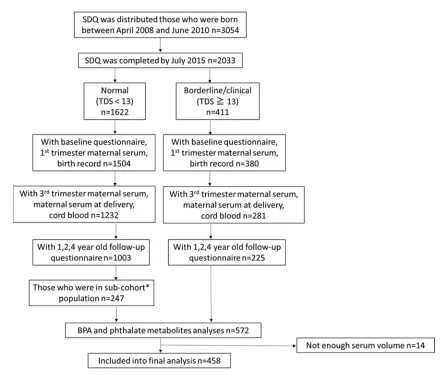
This study formed part of a prospective birth cohort study, the Hokkaido Study on Environment and
101
Children's Health. The details of cohort profile can be found in elsewhere 26,27). Briefly, the 102
subpopulation consisted of cohort study participants who were born between April 2008 and June
103
2010 were included in this study. Total 3054 SDQ were distributed via mail between October 2014
104
and June 2015 to the subpopulation. 2032 SDQ was successfully filled and returned by the end of July
105
2015 (response rate =66.6%). Among 2032 children with valid completed SDQ, 1622 were classified
into normal group and 411 were classified into borderline/clinical group based on total difficulties
107
score of SDQ. Then we applied criteria for selecting participants to conduct exposure assessment.
108
The criteria were follows; those who had maternal 1st trimester baseline questionnaire data, 1st and 109
3rd trimester maternal blood samples, maternal and cord blood samples at delivery, birth record, 110
follow-up questionnaires data at ages 1,2, and 4 years of age to use as covariates. Further, we decided
111
to include all the children in borderline/clinical group and randomly selected children in normal group
112
(n=572). Finally, 14 children were excluded due to not enough serum volume for exposure
113
assessment. This was nested case control study of 245 children in normal group as control and 213
114
children in borderline/clinical group as cases (Fig. 1).
116
Figure 1 Selection of study population.
117
*The sub-cohort of 4869 participants, which corresponded to 23.3% of all participants (n=20926) in
118
the Hokkaido study were established. In this sub-cohort, 500 participants who were randomly
119
selected from each enrollment year between 2003 and 2011, and all 369 participants from the
120
enrollment year 2012 were include. The sub-cohort population was supposed to be representing
121
original cohort population. The aim of establishing the sub-cohort population was for effective
122
exposure assessments.
123 124
This study was conducted with the informed consent of all participants in written forms. The protocol
125
used in this study was approved by the Institutional Ethical Board for epidemiological studies at the
126
Hokkaido University Graduate School of Medicine and Hokkaido University Center for Environmental
and Health Sciences.
128
Assessment of child behavior 129
Japanese parent-report version of SDQ 28) were distributed via mail to the participants. Parents were 130
asked to fill SDQ, which included 25 items on specific strengths and difficulties with an overall rating
131
of whether their child had behavioral problems. SDQ was designed for a broad range of children, age
132
3 to 16 years and well validated tool of childhood mental health 25,29). Each item has three response 133
categories (0) not true, (1) somewhat true, (3) certainly true. It includes five subscales (conduct
134
problems, hyperactive/inattention, emotional problems, peer problems and prosocial behavior). All
135
subscale scores excluding prosocial behavior were summed as total difficulties score (ranged from 0
136
to 40 29)) to assess the behavioral problems. Higher scores denote greater problems. We applied score 137
bandings of the Japanese version of SDQ, children total difficulties with 0-12 were defined as normal,
138
13-15 were as borderline, and 16-40 were as clinical 28). For the subscales, the following cut-offs were 139
applied; Conduct problems: 0-3 = normal, 4 = borderline, 5-10 = clinical; Hyperactivity/inattention:
140
0-5 = normal, 6 = borderline, 7-10 = clinical; Emotional problems; 0-3 = normal, 4 = borderline, 5-10
141
= clinical; Peer problems: 0-3 = normal, 4 = borderline, 5-10 = clinical; Prosocial behavior; 6-10 =
142
normal, 5 = borderline, 0-4 = clinical28). SDQ total and subscale scores were dichotomized comparing 143
the children with borderline and clinical scores with normal children.
144
Maternal serum of the 1st trimester was collected and stored at – 80 ℃ till analyses. Blood samples 146
were analyzed for BPA and seven kinds of phthalate metabolites; mono-n-butyl phthalate (MnBP),
147
mono-isobutyl phthalate (MiBP), mono-2-ethylhexyl phthalate (MEHP), mono-benzyl phthalate
148
(MBzP), mono-2-ethyl-5-hydroxyhexyl phthalate (MEHHP), mono-2-ethyl-5-carboxypentyl phthalate
149
(MECPP) and mono (4-methyl-7-carboxyheptyl) phthalate (cx-MiNP) by isotope-diluted liquid
150
chromatography-tandem mass spectrometry (MS/MS) for BPA analysis and ultra-performance
LC-151
MS/MS for phthalate metabolites analysis. The method detection limits (MDLs) of BPA, MnBP, MiBP,
152
MBzP, MEHP, MEHHP, MECPP, cx-MiNP were 0.011, 0.57, 0.44, 0.19, 0.31, 0.23, 0.11 and 0.12 ng/ml,
153
respectively. All the analyses were conducted at Idea Consultants Inc. (Shizuoka, Japan). The detailed
154
sample preparation for BPA analysis can be found from our previous report30,31). Briefly to each serum 155
sample, BPA-d16 β-glucuronidase spiking solution was added and shaken then β-glucuronidase and 156
0.2 M acetate buffer solution (pH 5.0) were added. Samples were held in an incubator at 37 ℃ for
157
1.5 hrs followed by solid phase extraction. The detailed phthalate metabolites analyses are described
158
in our previous article31). Briefly, serum samples for phthalate metabolites analyses were prepared as 159
follows. MnBP-d4, MiBP-d4, MBzP-d4, MEHP-d4, MEHHP-13C4, MECPP-13C4, cx-MiNP-d4 were added as 160
surrogate and then 90 µL of 1M phosphoric acid was added to the serum sample (0.5 mL). After
161
mixing by vortex and ultrasonic irradiated for 10 minutes and consequently, 940 µL of acetonitrile
162
was added and centrifuged with 3,500 rpm for 5 min. Supernatants were transferred into new tubes
and added 1000 µL of ammonium acetate buffer solution (100 mM, pH 9.1), 3,000 µL of ammonium
164
acetate buffer solution (100 mM, pH 6.5), and 10 µL of β-glucuronidase were added to each sample
165
for the enzymatic hydrolysis of the phthalate metabolites conjugates, and 100 mM ammonium
166
acetate solution were added. Samples were held in an incubator at 37 ℃ for 1.5 hrs followed by
167
solid phase extraction by Oasis MAX 96 well plate (30mg, 30um, Waters, Milford, MA, USA). After
168
solid phase extraction, a 500 uL of elution was transferred into sample vials and added 500 µL of
169
ultra-pure water and analyzed by UPLC (ACQUITY UPLC H-Class,Milford, MA, USA) coupled to triple
170
quadrupole tandem MS (QTRAP 6500, AB SCIEX,Framingham, MA). The insoluble particulates were
171
filtered by in-line filters (2.1×5 mm, 1.7 um, Vanguard Phenyl column, Waters, Tokyo, Japan)
172
preceding the BEH Phenyl column (2.1×50 mm, 1.7 um, Waters, Tokyo, Japan). The retention gap
173
technique was used by installing retention gap columns Atlantis T3 (2.1×50 mm, 3 µm, Waters, Tokyo,
174
Japan), which improved phthalate metabolites sensitivity by trapping mobile-phase phthalate
175
metabolites (contaminants) in the retention gap column. The column temperature was 40℃. The
176
total UPLC cycle time was 20 min including column re-equilibration. The calibration curve was linear
177
over a concentration ranging from 0.02 to 20 ng/ml with a coefficient of correlation (r2) greater than 178
0.999. The procedural blank levels were determined using 0.5 mL of ultrapure water. The MDLs of
179
BPA and phthalate metabolites were calculated as follows according to the procedure of the manual
180
Covariates 182
Parental factors including ages, educational levels, maternal pre-pregnancy BMI, parity, and family
183
income were obtained from baseline questionnaire which was filled by participants during their
184
pregnancy. Additionally, maternal smoking status was examined from cotinine levels of third
185
trimester maternal blood measured by using high-sensitive enzyme-linked immunosorbent assay
186
(ELISA). The limit of detection (LOD) was 0.12 ng/ml. According to previous finding33), we defined 187
cotinine levels ≦ 0.21 ng/ml as non-smokers, 0.22-11.47 ng/ml as passive smokers, and ≧ 11.48
188
ng/ml as active smokers. Gestational age, birth weight and gender of children were obtained from
189
birth record.
190
Data analysis 191
Statistical analyses were performed using SPSS 22.0J (IBM Japan, Tokyo, Japan). Logistic regression
192
models were used to calculate odds ratios (ORs) for having borderline/clinical scores (cases) in
193
relation to maternal BPA and phthalates levels. The main analysis was case control study based on
194
total difficulties scores. Then, 4 of the component subscales of total difficulties score (conduct
195
problems, hyperactivity/inattention, emotional symptoms, and peer problems) were investigated as
196
sub-analyses. Prosocial behavior was not considered as outcome because it is not the component
197
subscales of total difficulties score, which was our main outcome. Maternal BPA and phthalates levels
198
MDL were replaced half the values of MDLs for statistical analyses. MEHP and MECPP were combined
200
and expressed as the summation of DEHP metabolites (∑DEHPm). MEHHP was also a DEHP 201
metabolite; however, in this study population, the detection rate was low, and thus, it was not
202
included in the summation of DEHP metabolites. Similarly, MnBP and MiBP were combined and
203
expressed as the summation of DBP metabolites (∑DBPm). To combine the metabolites, the 204
summation of each metabolite expressed in molar concentration was multiplied with their respective
205
parent molecular weight (MW) as follows:
206
∑DEHPm=((CMEHP/MWMEHP)+(CMECPP/MWMECPP))*MWDEHP 207
∑DBPm=((CMnBP/MWMnBP)+(CMiBP/MWMiBP))*MWDBP 208
where C is the measured concentration (ng/ml) and MW is the molecular weight (ng/nmol)
209
The ORs were given for one-unit increase on log10 scale. Covariate included in the final models were 210
identified a priori using directed acyclic graph: parental ages (continuous), maternal cotinine levels
211
(≦ 0.21ng/ml vs. 0.22-11.47ng/ml vs. ≧11.48ng/ml), family income during pregnancy (< 5M vs.
212
≧ 5M) and birth order (first vs. not first). In addition to above mentioned covariates, we included
213
child sex and child age (months) at SDQ completed in the models based on previous literature.
214
Further analysis was conducted for stratification of child sex. P-value of <0.05 was considered
215
statistically significant.
216
Results 218
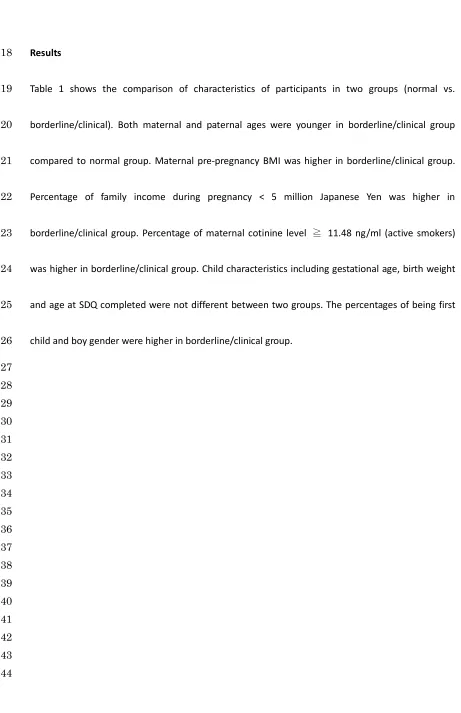
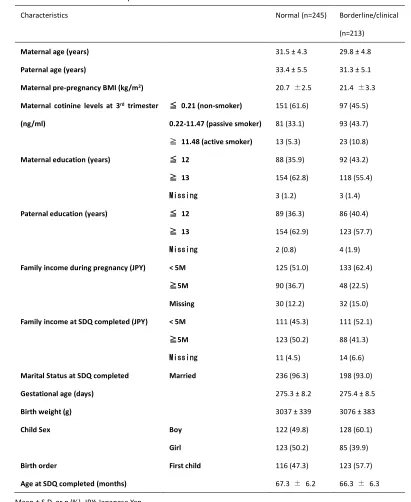
Table 1 shows the comparison of characteristics of participants in two groups (normal vs.
219
borderline/clinical). Both maternal and paternal ages were younger in borderline/clinical group
220
compared to normal group. Maternal pre-pregnancy BMI was higher in borderline/clinical group.
221
Percentage of family income during pregnancy < 5 million Japanese Yen was higher in
222
borderline/clinical group. Percentage of maternal cotinine level ≧ 11.48 ng/ml (active smokers)
223
was higher in borderline/clinical group. Child characteristics including gestational age, birth weight
224
and age at SDQ completed were not different between two groups. The percentages of being first
225
child and boy gender were higher in borderline/clinical group.
Table 1 Basic characteristics of parents and their children. 245
Characteristics Normal (n=245) Borderline/clinical
(n=213)
Maternal age (years) 31.5 ± 4.3 29.8 ± 4.8
Paternal age (years) 33.4 ± 5.5 31.3 ± 5.1
Maternal pre-pregnancy BMI (kg/m2) 20.7 ±2.5 21.4 ±3.3
Maternal cotinine levels at 3rd trimester
(ng/ml)
≦ 0.21 (non-smoker) 151 (61.6) 97 (45.5)
0.22-11.47 (passive smoker) 81 (33.1) 93 (43.7)
≧ 11.48 (active smoker) 13 (5.3) 23 (10.8)
Maternal education (years) ≦ 12 88 (35.9) 92 (43.2)
≧ 13 154 (62.8) 118 (55.4)
Missing 3 (1.2) 3 (1.4)
Paternal education (years) ≦ 12 89 (36.3) 86 (40.4)
≧ 13 154 (62.9) 123 (57.7)
Missing 2 (0.8) 4 (1.9)
Family income during pregnancy (JPY) < 5M 125 (51.0) 133 (62.4)
≧5M 90 (36.7) 48 (22.5)
Missing 30 (12.2) 32 (15.0)
Family income at SDQ completed (JPY) < 5M 111 (45.3) 111 (52.1)
≧5M 123 (50.2) 88 (41.3)
Missing 11 (4.5) 14 (6.6)
Marital Status at SDQ completed Married 236 (96.3) 198 (93.0)
Gestational age (days) 275.3 ± 8.2 275.4 ± 8.5
Birth weight (g) 3037 ± 339 3076 ± 383
Child Sex Boy 122 (49.8) 128 (60.1)
Girl 123 (50.2) 85 (39.9)
Birth order First child 116 (47.3) 123 (57.7)
Age at SDQ completed (months) 67.3 ± 6.2 66.3 ± 6.3
Mean ± S.D. or n (%). JPY: Japanese Yen, 246
247
248
249
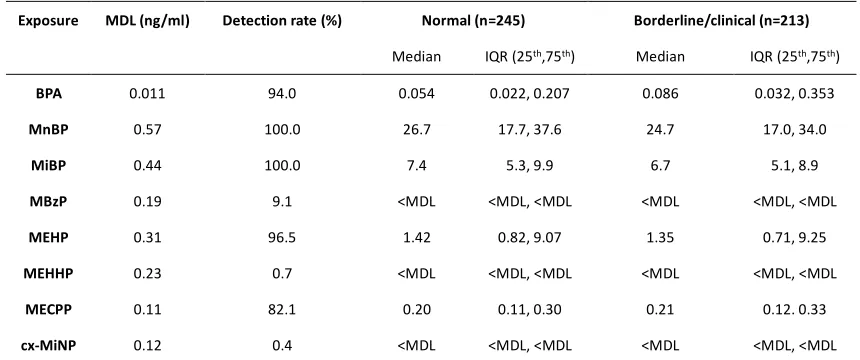
Table 2 presents distribution of BPA and phthalates levels in maternal blood of all participants and of
251
two groups. The median concentrations of BPA, MnBP, MiBP, MBzP, MEHP, MEHHP, MECPP and
cx-252
MiNP were 0.062, 26.0, 7.0, <MDL, 1.40, <MDL, 0.20, and <MDL ng/mL, respectively. The detection
253
rates ofBPA, MnBP, MiBP, MBzP, MEHP, MEHHP, MECPP and cx-MiNP were 94.0%, 100.0%, 100.0%,
254
9.1%, 96.5%, 0.7%, 82.1% and 0.4%, respectively. The detection rates of MBzP, MEHHP and cx-MiNP
255
were below 10%. Thus, these chemicals were excluded from the further analyses. The median
256
concentration of BPA in borderline/clinical group was higher compared to that of the normal group.
257
Contrary the median concentrations of MnBP and MiBP in borderline/clinical group were slightly
258
lower compared to these of the normal group.
259
260
Table 2 Comparison of the distribution of BPA and phthalate metabolite levels in maternal blood between normal and 261
borderline/clinical groups. 262
Exposure MDL (ng/ml) Detection rate (%) Normal (n=245) Borderline/clinical (n=213)
Median IQR (25th,75th) Median IQR (25th,75th)
BPA 0.011 94.0 0.054 0.022, 0.207 0.086 0.032, 0.353
MnBP 0.57 100.0 26.7 17.7, 37.6 24.7 17.0, 34.0
MiBP 0.44 100.0 7.4 5.3, 9.9 6.7 5.1, 8.9
MBzP 0.19 9.1 <MDL <MDL, <MDL <MDL <MDL, <MDL
MEHP 0.31 96.5 1.42 0.82, 9.07 1.35 0.71, 9.25
MEHHP 0.23 0.7 <MDL <MDL, <MDL <MDL <MDL, <MDL
MECPP 0.11 82.1 0.20 0.11, 0.30 0.21 0.12. 0.33
cx-MiNP 0.12 0.4 <MDL <MDL, <MDL <MDL <MDL, <MDL
ng/ml. MDL: method detection limit. IQR: Inter quartile range. 263
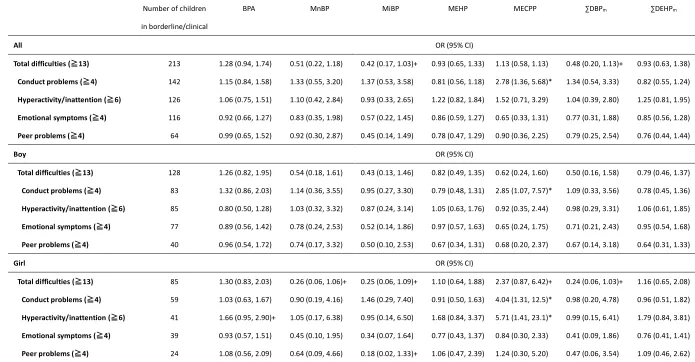
Table 3 presents adjusted odds ratios for ten folds increase of maternal BPA and individual and
265
summation of DBP and DEHP metabolite levels on having behavioral problems. BPA level was
266
associated with increased hyperactivity/inattention risk among girls after adjustment (OR=1.66, 95%
267
CI: 0.95-2.90) without statistical significance. MECPP level was significantly associated with an
268
increased risk of conduct problems (OR=2.78, 95% CI: 1.36-5.68). This association remained after
269
child sex stratification. MECPP level was also significantly associated with an increased risk of
270
hyperactivity/inattention among girls (OR=5.71, 95% CI: 1.41-23.1). ∑DBPm level was associated 271
with decreased total difficulties risk overall and among girls (OR=0.48, 95% CI: 0.20-1.13, OR=0.24,
272
95% CI: 0.06-1.03, respectively) without statistical significance. There were no significant association
273
Number of children
in borderline/clinical
BPA MnBP MiBP MEHP MECPP ∑DBPm ∑DEHPm
All OR (95% CI)
Total difficulties (≧13) 213 1.28 (0.94, 1.74) 0.51 (0.22, 1.18) 0.42 (0.17, 1.03)+ 0.93 (0.65, 1.33) 1.13 (0.58, 1.13) 0.48 (0.20, 1.13)+ 0.93 (0.63, 1.38)
Conduct problems (≧4) 142 1.15 (0.84, 1.58) 1.33 (0.55, 3.20) 1.37 (0.53, 3.58) 0.81 (0.56, 1.18) 2.78 (1.36, 5.68)* 1.34 (0.54, 3.33) 0.82 (0.55, 1.24)
Hyperactivity/inattention (≧6) 126 1.06 (0.75, 1.51) 1.10 (0.42, 2.84) 0.93 (0.33, 2.65) 1.22 (0.82, 1.84) 1.52 (0.71, 3.29) 1.04 (0.39, 2.80) 1.25 (0.81, 1.95)
Emotional symptoms (≧4) 116 0.92 (0.66, 1.27) 0.83 (0.35, 1.98) 0.57 (0.22, 1.45) 0.86 (0.59, 1.27) 0.65 (0.33, 1.31) 0.77 (0.31, 1.88) 0.85 (0.56, 1.28)
Peer problems (≧4) 64 0.99 (0.65, 1.52) 0.92 (0.30, 2.87) 0.45 (0.14, 1.49) 0.78 (0.47, 1.29) 0.90 (0.36, 2.25) 0.79 (0.25, 2.54) 0.76 (0.44, 1.44)
Boy OR (95% CI)
Total difficulties (≧13) 128 1.26 (0.82, 1.95) 0.54 (0.18, 1.61) 0.43 (0.13, 1.46) 0.82 (0.49, 1.35) 0.62 (0.24, 1.60) 0.50 (0.16, 1.58) 0.79 (0.46, 1.37)
Conduct problems (≧4) 83 1.32 (0.86, 2.03) 1.14 (0.36, 3.55) 0.95 (0.27, 3.30) 0.79 (0.48, 1.31) 2.85 (1.07, 7.57)* 1.09 (0.33, 3.56) 0.78 (0.45, 1.36)
Hyperactivity/inattention (≧6) 85 0.80 (0.50, 1.28) 1.03 (0.32, 3.32) 0.87 (0.24, 3.14) 1.05 (0.63, 1.76) 0.92 (0.35, 2.44) 0.98 (0.29, 3.31) 1.06 (0.61, 1.85)
Emotional symptoms (≧4) 77 0.89 (0.56, 1.42) 0.78 (0.24, 2.53) 0.52 (0.14, 1.86) 0.97 (0.57, 1.63) 0.65 (0.24, 1.75) 0.71 (0.21, 2.43) 0.95 (0.54, 1.68)
Peer problems (≧4) 40 0.96 (0.54, 1.72) 0.74 (0.17, 3.32) 0.50 (0.10, 2.53) 0.67 (0.34, 1.31) 0.68 (0.20, 2.37) 0.67 (0.14, 3.18) 0.64 (0.31, 1.33)
Girl OR (95% CI)
Total difficulties (≧13) 85 1.30 (0.83, 2.03) 0.26 (0.06, 1.06)+ 0.25 (0.06, 1.09)+ 1.10 (0.64, 1.88) 2.37 (0.87, 6.42)+ 0.24 (0.06, 1.03)+ 1.16 (0.65, 2.08)
Conduct problems (≧4) 59 1.03 (0.63, 1.67) 0.90 (0.19, 4.16) 1.46 (0.29, 7.40) 0.91 (0.50, 1.63) 4.04 (1.31, 12.5)* 0.98 (0.20, 4.78) 0.96 (0.51, 1.82)
Hyperactivity/inattention (≧6) 41 1.66 (0.95, 2.90)+ 1.05 (0.17, 6.38) 0.95 (0.14, 6.50) 1.68 (0.84, 3.37) 5.71 (1.41, 23.1)* 0.99 (0.15, 6.41) 1.79 (0.84, 3.81)
Emotional symptoms (≧4) 39 0.93 (0.57, 1.51) 0.45 (0.10, 1.95) 0.34 (0.07, 1.64) 0.77 (0.43, 1.37) 0.84 (0.30, 2.33) 0.41 (0.09, 1.86) 0.76 (0.41, 1.41)
Peer problems (≧4) 24 1.08 (0.56, 2.09) 0.64 (0.09, 4.66) 0.18 (0.02, 1.33)+ 1.06 (0.47, 2.39) 1.24 (0.30, 5.20) 0.47 (0.06, 3.54) 1.09 (0.46, 2.62)
Adjusted for parental ages, maternal cotinine levels, family income during pregnancy, child sex, birth order (first child or not), and child age at SDQ complete. 276
Discussion 278
Recent reviews have shown that environmental chemicals may play a role in the etiology of
279
behavioral and developmental disorders34,35). In our study, prenatal exposure to BPA and phthalates 280
were measured in maternal blood of 1st trimester and child behavioral problems at 5 years of age 281
were assessed using the SDQ. Our analyses found no significant association between BPA or
282
summation of phthalate metabolite levels and an increased risk of any of the behavioral problems at
283
5 years of age, however, suggested possible association between MECPP levels and increased risk of
284
conduct problems. Stratification by child sex analyses found that maternal MECPP level was
285
associated with an increased risk of hyperactivity/inattention problems only in girls with a large
286
confidence interval. This could be due to a number of individual was too small in some categories of
287
the adjustment factors, since the crude model found no statistical significance (OR=1.32, 95% CI:
288
0.70-2.48). Thus, the interpretation of findings from adjusted model should be carried out cautiously.
289
SDQ scores of 2032 children in this study was 8.7 and was similar to the other previous studies in UK
290
(5-10 years old) and Japan (4-6 years old), which showed average scores of 8.3 and 8.6,
291
respectively28,36). The BPA level in this study was similar range to previous report of Japanese 292
pregnant women30) and lower compared that of pregnant women in other studies37-39). 293
There have been several prospective cohort studies that investigated associations between prenatal
294
problems at 3.5 years of age using CBCL and found that cord blood BPA level was positively associated
296
with internalizing problem and development problem scores43). Braun et al. assessed child behavior 297
at different ages using the prospective birth cohort in the US (HOME Study)17,18,40). In their study, 298
among girls, higher maternal urinary BPA was associated with increased aggression and hyperactivity
299
at age 217). The follow-up of the same cohort at 3 years of age found that higher maternal urinary BPA 300
was associated with more anxiety and depression of behavioral Assessment System for
Children-301
Second Edition (BASC-2) and poorer emotional control of Behavior Rating Inventory of Executive
302
Function-Preschool (BREIF-P) only among girls18). In our study, we did not find the statistical 303
significance, however, increased odds of hyperactivity/inattention among girls in association with
304
increased BPA level was consistent with findings from Broun et al17,18).Another birth cohort study in 305
the US (CCCEH) also investigated association between maternal urinary BPA and child behavior14,42). 306
The results of their study showed that higher levels of maternal BPA were associated with higher
307
scores on emotionally reactive and aggressive behavior subscales of CBCL among boys at 5 years of
308
age14). A follow-up of the same cohort at 7-9 years of age found that higher maternal BPA levels were 309
associated with more anxiety and depression in boys42). Harley et al. investigated association 310
between maternal urinary BPA and school aged child behavior in the birth cohort study
311
(CHAMACOS)15). They found that higher maternal BPA was associated with higher depression and 312
anxiety in boys. Evans et al. reported that higher maternal BPA was associated with higher level of
aggression, anxiety, oppositional/defiant problems and conduct problems in boys using CBCL at ages
314
6-10 years in a birth cohort study (SFF II)44). Most of the previous studies found sex-specific effects of 315
BPA exposure on child behavioral development and problems, while this study did not find any
316
significant adverse effect of BPA exposure on the risk of child behavioral problems even after
317
stratification of child sex. Inconsistent findings from the previous studies could be due to different
318
exposure assessment timings among studies. The critical period of exposure to BPA during pregnancy
319
on child neurobehavioral development is still not evident, thus using maternal blood samples of the
320
1st trimester may not well evaluate associations between prenatal exposures and outcomes. Braun 321
et al. reported relationship between maternal urinary BPA and child behavior and the relationship
322
was stronger with urine samples of ≦ 16 weeks of gestation compared to that of 26 weeks of
323
gestation, which suggested a possible critical period for BPA exposure on neurobehavior
324
development17). Our result indicated that the 1st trimester BPA level was associated with increased 325
risk of hyperactivity/inattention among girls without significance, which is in line with the previous
326
findings17). Further investigation is required to elucidate critical exposure period of BPA exposure and 327
its influence on child behavioral development.
328
Various study population background may also be a reason for inconsistent findings. For example,
329
maternal education levels > high school in this study was 62.8%, whereas it varied from low to high
330
behavioral problems. It has been reported that maternal education level was a predictor of BPA levels
332
18,45). Thus, it may have contributed to inconsistent findings. Similarly, income is inversely associated 333
with BPA levels according to NHANES data 46) and thus, different cultural background such as poverty 334
rate, ethnicity could be a reason for inconstancy.
335
There have been several reports from birth cohort studies regarding child behavioral development in
336
association with prenatal phthalates exposure. Results from birth cohort studies have suggested that
337
low molecular weight (LMW) phthalate such as DBP and DEP exposures might increase behavioral
338
problems20,21,41,47). Whyatt et al. assessed child behavioral problems using CBCL at 3 years old in 339
association with maternal urine phthalate levels21). In their study, MnBP, MiBP and MBzP were found 340
to be associated with increased behavioral problems. However, no association was found between
341
maternal urinary DEHP metabolites and child behavioral problems. Engel et al., investigated
342
associations between maternal phthalate metabolites and child behavior at 4-9 years old using
343
Behavior Assessment System for Children-Parent Rating Scale (BASC-PRS)47). Increased levels of LMW 344
phthalate metabolites were associated with various behavioral problems including aggression,
345
conduct problems, attention problems and depression. The same group also used Social
346
Responsiveness Scale (SRS) to assess child behavior at ages 7-9 years of age41). It was found that LMW 347
phthalates were also associated with poorer social cognition, social communication and social
348
awareness. In our study, we did not find any association between LMW phthalates and child
behavioral problems. Kobrosly et al. examined child neurobehavior using CBCL among children at
6-350
10 years of age22). They found increased 3rd trimester maternal urine MiBP was associated with 351
attention problems and aggressive behavior and the association was mostly observed among boys.
352
Lien et al. assessed child behavior at 8-9 years of age using CBCL23). In their study, 3rd trimester 353
maternal MBP and MEOHP were associated with delinquent behavior and aggressive behavior scores
354
at 8 years old. Recently, Gascon et al. assessed child behavioral problems using CBCL at 4 and SDQ at
355
7 years in the INMA-Sabadell birth cohort study48). They found that the average concentrations of the 356
sum of 4 kind of DEHP metabolites (MEHHP, MEHP, MEOHP, and MECPP) in maternal urine of 1st and 357
3rd trimester were associated with increased social competence scores at 4 years. Contrary, they 358
found that MEP concentrations were associated with a reduced risk of inattention symptoms at 4
359
years. One previous study reported that maternal MECPP level was inversely associated with child
360
motor development at age 24-36 months only in girls 49). In their study, not only MECPP but also the 361
sum of DEHP metabolites and other DEHP metabolites (MEHHP, MEHP, MEOHP) were negatively
362
associated with child motor development, which was inconsistent with our results. Overall, our
363
findings from this study was not in line with these previous studies, as most of the studies reported
364
effects of LMW phthalate exposures.
365
A number of factors including assessment tools for outcome measurements and age at assessment,
366
timing of exposure assessment, and genetic and demographic variety of study populations, as well
as other unknown factors could explain the inconstancies among studies. Different levels of exposure
368
among studies could also explain the different findings. Most of the previous studies used maternal
369
urine samples during pregnancy for exposure assessment, whereas we used maternal serum. Even
370
though a study reported correlation between serum and urine MECPP levels50), direct comparison of 371
exposure levels with other studies were not possible. It also should be noted thatmeasurable levels
372
are much higher in urine compared to blood samples for bisphenol A and phthalate metabolites.
373
Regarding BPA measurement using blood samples, it possibly be overestimated due to external
374
contamination. In this study, we used glass cartridge to reduce background levels and no free BPA
375
was detected30), which was indication of null possible external contamination. Additionally, 376
background level was measured and confirmed that the influence of external contamination was null.
377
Hydrolytic enzymes are present in blood samples and may be responsible for diester to monoester
378
conversion after the blood sample is drawn51). Analysis of monoester may yield higher levels because 379
of monoester conversion of ex-vivo contamination during sampling, storage, and handling process.
380
To minimize the influence of enzyme activity, the blood samples were immediately stored at -80℃
381
and acid was added immediately after thawing. We still cannot rule out possible external
382
contamination during the process of sample drawing, storage and measurement. Using secondary
383
metabolites of phthalates was recommended. In this study, we found behavioral problems in
384
association with MECPP, which is a secondary metabolite of DEHP.
Limitations of this study should also be discussed. First, our exposure assessment was based on the
386
single measurement which could not represent exposure of entire pregnancy period due to short
387
half-lives of BPA and phthalates. Thus, the critical period of exposure might not be well captured in
388
this study. Other limitation was that we had no information on factors that might have influence on
389
the outcomes such as family psychopathology, exposure to psychosocial environmental stressors.
390
Sample size can be another limitation of this study especially in sex specific analyses. Some of the
391
subscales of SDQ showed small number of children in borderline/clinical group (Table S2). This was
392
due to the study design. This was a nested case control study based on SDQ total difficulties score,
393
but not on subscale scores. Wide range of 95% CIs observed in sex-stratification analyses indicated
394
that the sample size was too small. It also should be noted that there might be a chance that
395
associations may possibly be identified due to the number of chemicals tested.
396
It should be noted that we did not measure postnatal exposures in this study. Some of the
cross-397
sectional and birth cohort studies reported associations between postnatal exposure to BPA or
398
phthalates exposures and child neurobehavioral development52-57). However, two of the prospective 399
studies revealed that only gestational but not childhood BPA was associated with child behavior14,18). 400
Thus, we considered effects of prenatal exposure was more influential on child behavioral
401
development. The Characteristics of participants in this study (n=458) and those who completed SDQ
402
(n=2032) were compared in the Table S1. Population in this study showed higher percentage of
smokers based on maternal cotinine levels and heavier mean birth weight. This implied that healthier
404
mothers and children tended to be included in this study and thus, the effect of prenatal exposure to
405
BPA and phthalates on child behavioral problems might have been underestimated and findings of
406
this study should be interpreted with caution.
407
In conclusion, we found no significant association between BPA or summation of phthalate
408
metabolite levels and any of the behavioral problems, however, suggested possible association
409
between MECPP levels and increased risk of conduct problems.
410
411
Supplementary Materials 412
Table S1: Characteristics of participants in this study (n=458) and those who completed SDQ (n=2032).
413
Table S2: SDQ score distribution stratified by child sex.
414
415
Acknowledgement 416
We thank all the mothers and their children who participated in the study, and all the staff at hospitals.
417
This work was supported by Grant-in Aid from the Ministry of Health, Labour and Welfare of Japan,
418
JSPS KAKENHI Grant Numbers JP16H02645 and JP16K16619 and the Environment Research and
419
Technology Development Fund (5-1454) from the Ministry of the Environment, Japan.
420
Author Contributions 422
Conceptualization, R.K.; Formal Analysis, M.M.; Investigation, J.Y., Y.O., K.O., and T.M.; Writing –
423
Original Draft Preparation, M.M.; Writing – Review & Editing, S.I., K.Y., A.A., C.Y., N.T.; Supervision,
424
R.K.; Funding Acquisition, M.M, R.K.
425
426
Conflicts of Interest 427
The authors declare no conflict of interest.
428
429
430
431
432
433
434
435
436
437
438
References 440
1. Boyle CA, Boulet S, Schieve LA, Cohen RA, Blumberg SJ, Yeargin-Allsopp M, Visser 441
S, Kogan MD. Trends in the prevalence of developmental disabilities in US children, 442
1997-2008. Pediatrics 2011;127(6):1034-42. 443
2. Pastor PN, Reuben CA, Duran CR. Identifying emotional and behavioral problems in 444
children aged 4-17 years: United States, 2001-2007. Natl Health Stat Report 445
2012(48):1-17. 446
3. Dobrzynska MM. Phthalates - widespread occurrence and the effect on male gametes. 447
Part 1. General characteristics, sources and human exposure. Rocz Panstw Zakl Hig 448
2016;67(2):97-103. 449
4. Vandenberg LN, Maffini MV, Sonnenschein C, Rubin BS, Soto AM. Bisphenol-A and 450
the great divide: a review of controversies in the field of endocrine disruption. Endocr 451
Rev 2009;30(1):75-95.
452
5. Vandenberg LN, Hauser R, Marcus M, Olea N, Welshons WV. Human exposure to 453
bisphenol A (BPA). Reprod Toxicol 2007;24(2):139-77. 454
6. Jurewicz J, Hanke W. Exposure to phthalates: reproductive outcome and children 455
health. A review of epidemiological studies. Int J Occup Med Environ Health 456
2011;24(2):115-41. 457
7. Balakrishnan B, Henare K, Thorstensen EB, Ponnampalam AP, Mitchell MD. 458
Transfer of bisphenol A across the human placenta. Am J Obstet Gynecol 459
2010;202(4):393.e1-7. 460
8. Mose T, Knudsen LE, Hedegaard M, Mortensen GK. Transplacental transfer of 461
monomethyl phthalate and mono(2-ethylhexyl) phthalate in a human placenta 462
perfusion system. Int J Toxicol 2007;26(3):221-9. 463
9. Ejaredar M, Lee Y, Roberts DJ, Sauve R, Dewey D. Bisphenol A exposure and 464
children's behavior: A systematic review. J Expo Sci Environ Epidemiol 465
2017;27(2):175-183. 466
10. Ejaredar M, Nyanza EC, Ten Eycke K, Dewey D. Phthalate exposure and childrens 467
neurodevelopment: A systematic review. Environ Res 2015;142:51-60. 468
11. McCaffrey KA, Jones B, Mabrey N, Weiss B, Swan SH, Patisaul HB. Sex specific 469
impact of perinatal bisphenol A (BPA) exposure over a range of orally administered 470
doses on rat hypothalamic sexual differentiation. Neurotoxicology 2013;36:55-62. 471
12. Wolstenholme JT, Rissman EF, Connelly JJ. The role of Bisphenol A in shaping the 472
brain, epigenome and behavior. Horm Behav 2011;59(3):296-305. 473
Vandenbergh JG, Walser-Kuntz DR, vom Saal FS. In vivo effects of bisphenol A in 475
laboratory rodent studies. Reprod Toxicol 2007;24(2):199-224. 476
14. Perera F, Vishnevetsky J, Herbstman JB, Calafat AM, Xiong W, Rauh V, Wang S. 477
Prenatal bisphenol a exposure and child behavior in an inner-city cohort. Environ 478
Health Perspect 2012;120(8):1190-4.
479
15. Harley KG, Gunier RB, Kogut K, Johnson C, Bradman A, Calafat AM, Eskenazi B. 480
Prenatal and early childhood bisphenol A concentrations and behavior in school-aged 481
children. Environ Res 2013;126:43-50. 482
16. Casas M, Forns J, Martinez D, Avella-Garcia C, Valvi D, Ballesteros-Gomez A, Luque 483
N, Rubio S, Julvez J, Sunyer J, Vrijheid M. Exposure to bisphenol A during pregnancy 484
and child neuropsychological development in the INMA-Sabadell cohort. Environ Res 485
2015;142:671-9. 486
17. Braun JM, Yolton K, Dietrich KN, Hornung R, Ye X, Calafat AM, Lanphear BP. 487
Prenatal bisphenol A exposure and early childhood behavior. Environ Health 488
Perspect 2009;117(12):1945-52.
489
18. Braun JM, Kalkbrenner AE, Calafat AM, Yolton K, Ye X, Dietrich KN, Lanphear BP. 490
Impact of early-life bisphenol A exposure on behavior and executive function in 491
children. Pediatrics 2011;128(5):873-82. 492
19. Perera F, Nolte EL, Wang Y, Margolis AE, Calafat AM, Wang S, Garcia W, Hoepner 493
LA, Peterson BS, Rauh V, Herbstman J. Bisphenol A exposure and symptoms of 494
anxiety and depression among inner city children at 10-12 years of age. Environ Res 495
2016;151:195-202. 496
20. Philippat C, Nakiwala D, Calafat AM, Botton J, De Agostini M, Heude B, Slama R. 497
Prenatal Exposure to Nonpersistent Endocrine Disruptors and Behavior in Boys at 3 498
and 5 Years. Environ Health Perspect 2017;125(9):097014. 499
21. Whyatt RM, Liu X, Rauh VA, Calafat AM, Just AC, Hoepner L, Diaz D, Quinn J, 500
Adibi J, Perera FP, Factor-Litvak P. Maternal prenatal urinary phthalate metabolite 501
concentrations and child mental, psychomotor, and behavioral development at 3 502
years of age. Environ Health Perspect 2012;120(2):290-5. 503
22. Kobrosly RW, Evans S, Miodovnik A, Barrett ES, Thurston SW, Calafat AM, Swan 504
SH. Prenatal phthalate exposures and neurobehavioral development scores in boys 505
and girls at 6-10 years of age. Environ Health Perspect 2014;122(5):521-8. 506
23. Lien YJ, Ku HY, Su PH, Chen SJ, Chen HY, Liao PC, Chen WJ, Wang SL. Prenatal 507
exposure to phthalate esters and behavioral syndromes in children at 8 years of age: 508
Taiwan Maternal and Infant Cohort Study. Environ Health Perspect 2015;123 (1):95-509
24. Kim S, Eom S, Kim HJ, Lee JJ, Choi G, Choi S, Kim S, Kim SY, Cho G, Kim YD, Suh 511
E, Kim SK, Kim S, Kim GH, Moon HB, Park J, Kim S, Choi K, Eun SH. Association 512
between maternal exposure to major phthalates, heavy metals, and persistent 513
organic pollutants, and the neurodevelopmental performances of their children at 1 514
to 2years of age- CHECK cohort study. Sci Total Environ 2018;624:377-384. 515
25. Goodman R. The Strengths and Difficulties Questionnaire: a research note. J Child 516
Psychol Psychiatry 1997;38(5):581-6.
517
26. Kishi R, Kobayashi S, Ikeno T, Araki A, Miyashita C, Itoh S, Sasaki S, Okada E, 518
Kobayashi S, Kashino I, Itoh K, Nakajima S. Ten years of progress in the Hokkaido 519
birth cohort study on environment and children's health: cohort profile--updated 2013. 520
Environ Health Prev Med 2013;18(6):429-50.
521
27. Kishi R, Araki A, Minatoya M, Hanaoka T, Miyashita C, Itoh S, Kobayashi S, Ait 522
Bamai Y, Yamazaki K, Miura R, Tamura N, Ito K, Goudarzi H. The Hokkaido Birth 523
Cohort Study on Environment and Children’s Health: cohort profile—updated 2017. 524
Environmental Health and Preventive Medicine 2017;22(1):46.
525
28. Matsuishi T, Nagano M, Araki Y, Tanaka Y, Iwasaki M, Yamashita Y, Nagamitsu S, 526
Iizuka C, Ohya T, Shibuya K, Hara M, Matsuda K, Tsuda A, Kakuma T. Scale 527
properties of the Japanese version of the Strengths and Difficulties Questionnaire 528
(SDQ): a study of infant and school children in community samples. Brain Dev 529
2008;30(6):410-5. 530
29. Goodman R. Psychometric properties of the strengths and difficulties questionnaire. 531
J Am Acad Child Adolesc Psychiatry 2001;40(11):1337-45.
532
30. Yamamoto J, Minatoya M, Sasaki S, Araki A, Miyashita C, Matsumura T, Kishi R. 533
Quantifying bisphenol A in maternal and cord whole blood using isotope dilution 534
liquid chromatography/tandem mass spectrometry and maternal characteristics 535
associated with bisphenol A. Chemosphere 2016;164:25-31. 536
31. Minatoya M, Araki A, Miyashita C, Ait Bamai Y, Itoh S, Yamamoto J, Onoda Y, 537
Ogasawara K, Matsumura T, Kishi R. Association between prenatal bisphenol A and 538
phthalate exposures and fetal metabolic related biomarkers: The Hokkaido study on 539
Environment and Children's Health. Environ Res 2017;161:505-511. 540
32. Ministry of the Environment GoJ. Guidelines Establishing Test Procedures for the 541
Analysis of Pollutants. Japan, 2009. 542
33. Sasaki S, Braimoh TS, Yila TA, Yoshioka E, Kishi R. Self-reported tobacco smoke 543
exposure and plasma cotinine levels during pregnancy--a validation study in 544
Northern Japan. Sci Total Environ 2011;412-413:114-8. 545
and children's cognitive development and behavioral problems. Int J Occup Med 547
Environ Health 2013;26(2):185-204.
548
35. Grandjean P, Landrigan PJ. Neurobehavioural effects of developmental toxicity. 549
Lancet Neurol 2014;13(3):330-8.
550
36. Marryat L, Thompson L, Minnis H, Wilson P. Exploring the social, emotional and 551
behavioural development of preschool children: is Glasgow different? Int J Equity 552
Health 2015;14:3.
553
37. Lee YJ, Ryu HY, Kim HK, Min CS, Lee JH, Kim E, Nam BH, Park JH, Jung JY, Jang 554
DD, Park EY, Lee KH, Ma JY, Won HS, Im MW, Leem JH, Hong YC, Yoon HS. 555
Maternal and fetal exposure to bisphenol A in Korea. Reprod Toxicol 2008;25 (4):413-556
9. 557
38. Zhang T, Sun H, Kannan K. Blood and urinary bisphenol A concentrations in children, 558
adults, and pregnant women from china: partitioning between blood and urine and 559
maternal and fetal cord blood. Environ Sci Technol 2013;47(9):4686-94. 560
39. Kosarac I, Kubwabo C, Lalonde K, Foster W. A novel method for the quantitative 561
determination of free and conjugated bisphenol A in human maternal and umbilical 562
cord blood serum using a two-step solid phase extraction and gas 563
chromatography/tandem mass spectrometry. J Chromatogr B Analyt Technol Biomed 564
Life Sci 2012;898:90-4. 565
40. Braun JM, Kalkbrenner AE, Just AC, Yolton K, Calafat AM, Sjodin A, Hauser R, 566
Webster GM, Chen A, Lanphear BP. Gestational exposure to endocrine-disrupting 567
chemicals and reciprocal social, repetitive, and stereotypic behaviors in 4- and 5-year-568
old children: the HOME study. Environ Health Perspect 2014;122(5):513-20. 569
41. Miodovnik A, Engel SM, Zhu C, Ye X, Soorya LV, Silva MJ, Calafat AM, Wolff MS. 570
Endocrine disruptors and childhood social impairment. Neurotoxicology 571
2011;32(2):261-7. 572
42. Roen EL, Wang Y, Calafat AM, Wang S, Margolis A, Herbstman J, Hoepner LA, Rauh 573
V, Perera FP. Bisphenol A exposure and behavioral problems among inner city 574
children at 7-9 years of age. Environ Res 2015;142:739-45. 575
43. Minatoya M, Araki A, Nakajima S, Sasaki S, Miyashita C, Yamazaki K, Yamamoto J, 576
Matumura T, Kishi R. Cord blood BPA level and child neurodevelopment and 577
behavioral problems: The Hokkaido Study on Environment and Children's Health. 578
Sci Total Environ 2017;607-608:351-356.
579
44. Evans SF, Kobrosly RW, Barrett ES, Thurston SW, Calafat AM, Weiss B, Stahlhut R, 580
Yolton K, Swan SH. Prenatal bisphenol A exposure and maternally reported behavior 581
45. Casas M, Valvi D, Luque N, Ballesteros-Gomez A, Carsin AE, Fernandez MF, Koch 583
HM, Mendez MA, Sunyer J, Rubio S, Vrijheid M. Dietary and sociodemographic 584
determinants of bisphenol A urine concentrations in pregnant women and children. 585
Environ Int 2013;56:10-8.
586
46. LaKind JS, Naiman DQ. Temporal trends in bisphenol A exposure in the United 587
States from 2003-2012 and factors associated with BPA exposure: Spot samples and 588
urine dilution complicate data interpretation. Environ Res 2015;142:84-95. 589
47. Engel SM, Miodovnik A, Canfield RL, Zhu C, Silva MJ, Calafat AM, Wolff MS. 590
Prenatal phthalate exposure is associated with childhood behavior and executive 591
functioning. Environ Health Perspect 2010;118(4):565-71. 592
48. Gascon M, Valvi D, Forns J, Casas M, Martinez D, Julvez J, Monfort N, Ventura R, 593
Sunyer J, Vrijheid M. Prenatal exposure to phthalates and neuropsychological 594
development during childhood. Int J Hyg Environ Health 2015;218(6):550-8. 595
49. Tellez-Rojo MM, Cantoral A, Cantonwine DE, Schnaas L, Peterson K, Hu H, Meeker 596
JD. Prenatal urinary phthalate metabolites levels and neurodevelopment in children 597
at two and three years of age. Sci Total Environ 2013;461-462:386-90. 598
50. Hines EP, Calafat AM, Silva MJ, Mendola P, Fenton SE. Concentrations of phthalate 599
metabolites in milk, urine, saliva, and Serum of lactating North Carolina women. 600
Environ Health Perspect 2009;117(1):86-92.
601
51. Kato K, Silva MJ, Brock JW, Reidy JA, Malek NA, Hodge CC, Nakazawa H, Needham 602
LL, Barr DB. Quantitative detection of nine phthalate metabolites in human serum 603
using reversed-phase high-performance liquid chromatography-electrospray 604
ionization-tandem mass spectrometry. J Anal Toxicol 2003;27(5):284-9. 605
52. Kim BN, Cho SC, Kim Y, Shin MS, Yoo HJ, Kim JW, Yang YH, Kim HW, Bhang SY, 606
Hong YC. Phthalates exposure and attention-deficit/hyperactivity disorder in school-607
age children. Biol Psychiatry 2009;66(10):958-63. 608
53. Cho SC, Bhang SY, Hong YC, Shin MS, Kim BN, Kim JW, Yoo HJ, Cho IH, Kim HW. 609
Relationship between environmental phthalate exposure and the intelligence of 610
school-age children. Environ Health Perspect 2010;118(7):1027-32. 611
54. Chopra V, Harley K, Lahiff M, Eskenazi B. Association between phthalates and 612
attention deficit disorder and learning disability in U.S. children, 6-15 years. Environ 613
Res 2014;128:64-9.
614
55. Hong SB, Hong YC, Kim JW, Park EJ, Shin MS, Kim BN, Yoo HJ, Cho IH, Bhang SY, 615
Cho SC. Bisphenol A in relation to behavior and learning of school-age children. J 616
Child Psychol Psychiatry 2013;54(8):890-9.
617
Wang SL. Fetal and Childhood Exposure to Phthalate Diesters and Cognitive 619
Function in Children Up to 12 Years of Age: Taiwanese Maternal and Infant Cohort 620
Study. PLoS One 2015;10(6):e0131910. 621
57. Won EK, Kim Y, Ha M, Burm E, Kim YS, Lim H, Jung DE, Lim S, Kim SY, Kim YM, 622
Kim HC, Lee KJ, Cheong HK, Kang HT, Son M, Sakong J, Oh GJ, Lee CG, Kim SY, 623
Ryu JM, Kim SJ. Association of current phthalate exposure with neurobehavioral 624
development in a national sample. Int J Hyg Environ Health 2016;219(4-5):364-71. 625