Maximal Repeats Enhance Substring-based Authorship Attribution
Romain Brixtel
Department of Organizational Behavior, Faculty of Business and Economics University of Lausanne, Quartier Dorigny, 1015 Lausanne, Switzerland
Abstract
This article tackles the Authorship Attri-bution task according to the language in-dependence issue. We propose an alterna-tive of variable length character n-grams features in supervised methods: maximal
repeats in strings. When character n
-grams are by essence redundant, maximal repeats are a condensed way to represent any substring of a corpus. Our experi-ments show that the redundant aspect of
n-grams contributes to the efficiency of character-based techniques. Therefore, we introduce a new way to weight features in vector based classifier by introducing
n-th order maximal repeats (maximal
re-peats detected in a set of maximal rere-peats). The experimental results show higher per-formance with maximal repeats, with less data than n-grams based approach (ap-proximately divided by a factor of10).
1 Introduction
Internet makes it easy to let anyone share his opin-ion, to communicate news or to disseminate his lit-erary production. A main feature of textual traces on the web is that they are mostly anonymous. Textual data mining is used to characterise au-thors, by categories (e.g. gender, age, political opinion) or as individuals. The latter case is called the Authorship Attribution (AA) issue. It consists of predicting the author of a text given a prede-fined set of candidates, thus falling in the super-vised machine learning subdomain. This problem is often expressed as the ultimate objective, find-ing the author. Technically the task is to predict a new pair, considering given pairs linking text and author. It is also known aswriteprint, in reference
of fingerprint in written productions. For a
sur-vey, see (Koppel et al., 2009; Stamatatos, 2009; El Bouanani and Kassou, 2014).
For AA, stylometry is most often used. The as-sumption is that a writer leaves unintended clues that lead to his identification. Bouanani et al.
(2014) define a set of numerical features that re-mains relatively constant for a given author and sufficiently contrasts his writing style against any author’s style. In the previous studies, numerical data such as word-length, and literal data such as words or character strings were used to capture personal style features (Koppel et al., 2011). Un-like words or lemmas that belong to a priori re-sources, character strings are in compliance with a language independent objective. Supervised ma-chine learning techniques are used to learn au-thor’s profile, from a training set where text and author pairs are known. Eventually, results are used to attribute new texts to the right author. This is a multi-variate classification problem. Support Vector Machine (SVM) is one of the favorite ap-proaches to handle such complex tasks (Sun et al., 2012). This is the chosen solution here.
AA therefore consists of predicting the author of a textual message given a predefined set of can-didates. The difficulty of the task depends on its scope and the choice of the training set. It in-creases when the objects of study come from the web, with different textual genres, styles or lan-guages. Research on AA can focus on several issues. Item scalability addresses matching text with a huge number of authors. Language inde-pendence requires techniques that are efficient ir-respective of language resources such as lexica.
In this study, the language independence issue is addressed, with character-based methods. How-ever, computation of all the character subtrings in a text is costly. The major contribution of this pa-per is a new way to handle character substrings, to reduce the training data and therefore the train-ing time and cost, without loostrain-ing accuracy in AA. The well-known variable length charactern-grams approach is compared to a variable length
imal repeats approach. As a controversial state-ment, experiments conducted in this article high-light that the redundancy of features based on n -grams is beneficial in a classification task as AA. This introduces a new way to weight features that takes into account this redundancy with n-th
or-der maximal repeats(maximal repeats in a set of
maximal repeats). Experiments are conducted on three corpora: one in English, one in French and the concatenation of those two corpora.
The remainder of this article is organized as fol-lows. Section 2 describes related work and com-monly used features. Section 3 introduces the ex-perimental settings, the characteristics of the cor-pora and the experimental pipeline. Section 4 de-scribes features, detailing the maximal repeats al-gorithm. Section 5 details experimental results. Section 6 concludes.
2 Related Work
AA is a single-label multi-class categorisation task. Three characteristics have to be defined (Sun et al., 2012): single feature, set of features repre-senting a text and the way to handle those sets to match a text with an author.
2.1 Features Definition
AA features exploited in the literature can be sep-arated in different groups as advocated by Abbasi
et al. (2008): numerical values associated with
words (total number of words, number of char-acter per word, number of charchar-acter bi/tri-grams), hence called lexical; mixed values associated with syntax at sentence level (frequency of function words,n-grams of Part-Of-Speech tags); numeri-cal values associated with bigger units (number of paragraphs, average length of paragraphs), called structural; values associated with content (bag-of-words, word bi-grams/tri-grams); and a last group called idiosyncratic related with individual use (misspellings, use of Leet speak).
Among those features, some are specific to some types of language and writing systems. For instance, tokenizing a text in words is common in word separating cases, but is a non-trivial task in Chinese or Japanese. Part-Of-Speech (POS) tagging requires specific tools that might lack in some languages. Approaches based on character
n-grams appear to be the simplest and the most accurate methods when the aim is to handle any
language (Grieve, 2007; Stamatatos, 2006). But, as advocated by Bender et al. (2009), a
language independent method should not be a
lan-guage naivemethod. If the extraction ofn-grams
is done whatever the language, the n parameter has to be chosen according to the properties of the processed language. The same results cannot be expected for the same parameter on different lan-guages according to their morphological typology (e.g. inflected or agglutinative languages).
Sunet al. (2012) argue that using a fixed value
of n can only capture lexical informations (for small values ofn), contextual or thematic informa-tions (for larger values), but do not explain why or whether this is valid for Chinese or all languages. The authors argue that this issue is avoided by exploiting variable length n-grams (substrings of length in[1, n]). Variable length substrings are ex-ploited in this study to see how this parameter im-pacts the results in French and English.
2.2 Feature-based Text/Author Representation
A single feature can be allocated to several text and author pairs. Each text and author does not systematically share the same set of features. Dif-ferent sets of features can be defined to repre-sent texts (and by extension, to reprerepre-sent authors). From existing methods, two main categories of set of features can be defined for AA:
• off-line set of features: features a priori
con-sidered relevant with prior knowledge, as those deeply described by Chaskiet al. (2001). They are defined without the knowledge of the corpus to be processed.
• on-lineset of features: features defined
accord-ing to the current analysis (accordaccord-ing to the training and test corpora for supervised meth-ods, as the character language models described by Penget al. (2003)). They can only be de-fined when the corpora to be processed (test and training) are fully collected.
On-linesets of features naturally match with the
language-independence aim. The characteristics of the corpora are exploited without any external resource. The method described hereafter follows this principle.
2.3 Feature-based Text Categorisation
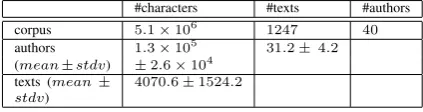
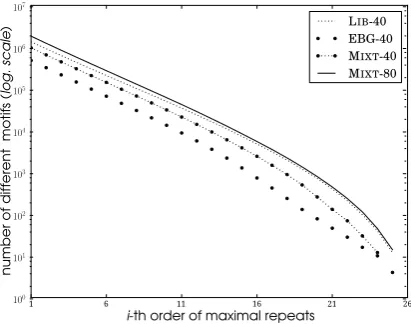
different subcorpora of EBG, LIBand MIXT. We denote EBG-10 (respectively LIB-10 and MIXT -10) a sample of 10 authors from the EBG cor-pus (respectively LIB and MIXT). Note that the MIXT-20, . . . , 80 are the merge of LIB-10 + EBG-10, . . . , LIB-40 + EBG-40. Experiments using these corpora are described hereafter to highlight the characteristics of the features and their differ-ences, used in the experimental pipeline.
4 Features
Maximal repeats, motifs in (Ukkonen, 2009), are based on the work of Ukkonen (2009) and K¨arkk¨ainen (2006). The algorithm is described in Section 4.1 to explain the improvements discussed in Section 4.2. Motifs are a way to represent each substring of a corpus in a condensed manner. For the detection of hapax legomena inside a set of strings from their motifs, see the work of Ilie and Smyth (2011).
4.1 Maximal Repeats in Strings
Maximal repeats are substring patterns of text with the following characteristics: they are repeated
(motifs occur twice or more) andmaximal(motifs cannot be expanded to the left –left maximality– nor to the right –right maximality– without lower-ing the frequency).
For instance, the motifs found in the stringS =
HATTIVATTIAA are T, A and ATTI. TT is not a motif because it always occurs inside an occur-rence ofATTI. In other words, its right-context is always Iand its left-contextA. All the motifs in a list of strings can be enumerated using an Aug-mented Suffix Array (K¨arkk¨ainen et al., 2006).
Given two strings S0 = HATTIV and S1 =
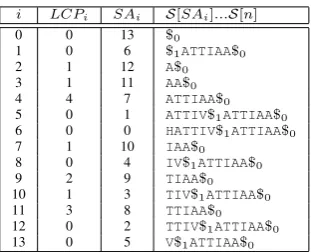
ATTIAA, Table 3 shows the Augmented Suffix Array of S = S0.$1.S1.$0, where $0 and$1 are
lexicographically lower than any character in the alphabet Σand$0 < $1. The Augmented Suffix
Array consists in the Suffix Array (SA), suffixes of S sorted lexicographically, with the Longest Common Prefix (LCP) between each two suffixes that are contiguous inSA. With,nthe size ofS, S[i]theithcharacter ofS,S[n, m]a sample ofS
from thenth character to themth, SAi the
start-ing offset of the suffix ofS at the ith position in
the lexicographical order and lcp(str1, str2) the
longest common prefix between two stringsstr1
andstr2:
LCPi = lcp(S[SAi, n−1],S[SAi+1, n−1])
LCPn−1 = 0
TheLCP allows the detection of all the repeats inside a set of text. The maximal criterion is still not valid because the LCP only inquires on the
left maximalitybetween repeated prefixes inSA.
i LCPi SAi S[SAi]...S[n]
0 0 13 $0
1 0 6 $1ATTIAA$0
2 1 12 A$0
3 1 11 AA$0
4 4 7 ATTIAA$0
5 0 1 ATTIV$1ATTIAA$0
6 0 0 HATTIV$1ATTIAA$0
7 1 10 IAA$0
8 0 4 IV$1ATTIAA$0
9 2 9 TIAA$0
10 1 3 TIV$1ATTIAA$0
11 3 8 TTIAA$0
12 0 2 TTIV$1ATTIAA$0
13 0 5 V$1ATTIAA$0
Table 3: Augmented Suffix Array (SAandLCP) ofS=HATTIV$1ATTIAA$0.
The substringATTIoccurs for example inS at the offsets(1,7), according toLCP4 in Table 3.
The process enumerates all the motifs by read-ing throughLCP. The detection of those motifs is triggered according to the difference between a LCP and the next one in the waySAis ordered.
For example, TTI is equivalent to ATTI be-cause the last characters of these two motifs occur at the offsets(4,10). They are said to be in a rela-tion ofoccurrence-equivalence(Ukkonen, 2009). In that case,ATTIis kept as a motif because it is the longest of its equivalents. The others motifsA
andTare maximal because their contexts differ in different occurrences. All motifs across different strings are detected at the end of the enumeration by mapping the offsets inS with those in S0 and
S1. This way, any motif detected inS can be
lo-cated in any of the stringsSi. SAandLCP are
constructed in time-complexityO(n)(K¨arkk¨ainen et al., 2006), while the enumeration process is done in O(k), with k defined as the number of motifs andk < n(Ukkonen, 2009). This corrob-orate the statement done by Umemura and Church (2009): there are too many substrings to work with in corpus O(n2), but they can be grouped into a
manageable number of interesting classesO(n).
4.2 n-th Order Motifs
LetRbe the set of motifs detected in thenstrings S = {S0, . . . ,Sn−1}, with|S| =Pni=1size(Si).
The set of motifsRis computed on the concatena-tion of all stringsSi: c(S) = S0$n−1. . .Sn−1$0.
Second order motifsR2 inS are computed from
or-2ndorder motifs are used to exploit this
charac-teristic with this assumption: a substring is more relevant than an other of same size if it encapsu-lates less repeated substrings. The weight func-tion w2nd(feat) is defined as the difference
be-tween the number of substrings of a feature and the number of motifs occurring in this feature w2nd(feat) =pot(feat)−sub(feat).pot(feat)
is the potential number of substrings occurring in-side a feature. sub(feat) is the number of mo-tifs occurring inside a feature and elsewhere in the corpus. w2nd(feat) is linked to the length of the
feature and two features with the same length can be weight differently. If there is only one differ-ent character between two motifs (e.g. thingand
things), the weight function minimises this add:
the products of the weight function and the fre-quency are close together. Conversely, a feature that is more than a small variation of any other mo-tif has more importance.
WithS ={S0, . . . ,Sn−1},Rthe set of motifs
fromSandR2the set of motifs fromR, each
mo-tif in R can be weighted according to the set of repeats R2. Ri is a motif used as a feature and
S is the set each text of all authors. The num-ber of different substrings in any string of sizen, pot(feat), is calculated with the formula n(n+1)2 (eq. to the triangular number, the whole string is considered as a potential substring). The number of occurrences of each sub-repeat inR2occurring
in a featureR, sub(feat), is done by enumerat-ing all the occurrences of all the motifs in a set of strings as described in Section 4.1. If each poten-tial substring in a feature is a motif as well, then w2nd(feat) = 1. During our experiments, this
weight function is compared with wlength(feat)
= n(n+1)2 (withnthe length of the feature). Note thatwlength cannot be easily applied ton-grams
because the overlaps between contiguousn-grams make each potential substring of eachn-gram ap-pears elsewhere in the corpus.
5 Experiments
The experiments in this section examine the pre-diction accuracy of the proposed approach. Two sets of features with variable length are exam-ined: n-grams and motifs. Three different ways to consider motifs are analysed: motifs with no weight, weighted by their length (using wlength)
and weighted by2nd order repeats (usingw 2nd).
A stratified 10-fold cross validation is used to
validate the performances. Corpora are randomly partitioned into 10 equal size folds containing the same proportion of authors. To measure the per-formance of the systems, the prediction score is computed as follows: the number of correctly sified texts divided by the number of texts clas-sified overall. SVM is used with linear kernels (adapted when the set of features is larger than the set of elements to be classified) and with the regu-larisation parameterC = 1. The aim of those ex-periments is to highlight the differences between motifs andn-grams. The same settings are there-fore set whatever the feature, assuming that their impacts are similar on bothn-grams and motifs.
5.1 Impact of the Length of Variable Substrings and Maximal Repeats
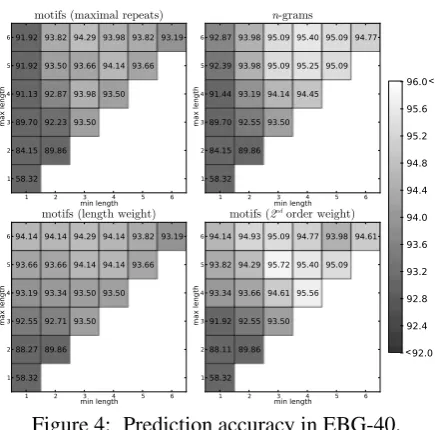
The prediction score of AA is computed in three corpora: EBG-40 (Figure 4), LIB-40 (Figure 5) and MIXT-80 (Figure 6). Each figure is consti-tuted of 4 matrices using different sets of fea-tures: maximal repeats (motif), n-grams, maxi-mal repeats weighted by length (motiflength) and
maximal repeats weighted by 2nd order repeats
(motif2nd). The prediction written in the
coordi-nates(i, j)of each matrix is sourced from the use of features with length in the range[i, j].
motifs (maximal repeats) n-grams
motifs (2nd order weight)
motifs (length weight)
<
<
Figure 4: Prediction accuracy in EBG-40. Whatever the corpus, the features can be or-dered following their ability to correctly predict the author of a text: motif ≤ motiflength <
n-grams < motif2nd. The fact that motifs <
n-grams shows the positive effect of feature redun-dancy. The diagonals of the matrix using motif andmotiflength have the same values because a
motifs (maximal repeats) n-grams
motifs (2nd order weight)
motifs (length weight)
< <
Figure 5: Prediction accuracy in LIB-40.
motifs (maximal repeats) n-grams
motifs (2nd order weight)
motifs (length weight)
<
<
Figure 6: Prediction accuracy in MIXT-80. representation of the texts. The overall high pre-diction score on the EBG corpus is explained by the bind between author and the thematic content of his written productions (for a given author, al-most each of his texts is related to a single topic as sport or arts). For comparison, the systems tested by Brennan et al. (2012) obtain a prediction ac-curacy of approximately 80% in a sample of texts written by 40 authors in EBG as well (≈ −15%). The task is more difficult on LIBbecause, contrary to EBG, each selected author has written texts in different thematic areas. Similar observations have been given by Stamatatos (2012) as well. The prediction on the three corpora has also been com-puted using motif2nd whatever their length,
ob-taining the following scores: 66.40% on EBG-40, 48.20% on LIB-40 and 54.21% MIXT-80. This emphasizes the necessity of selecting a subspace
ofmotifsin AA. From these experiments, the best
parameters for the length of the features are se-lected by computing the average of each predic-tion score on each matrix for each couple of pa-rameters[min, max]length (Table 4).
best length parameter average prediction
[min, max]
n-grams [4,6] 84.61%
motifs [4,6] 83.69%
motifs (length) [4,6] 83.88%
motifs (2ndorder) [4,5] 85.39%
Table 4: Best parameters on LIB-40, EBG-40 and MIXT-80.
motif2nd features obtain the smallest range of
values among the set of parameters computed. Note that the best length parameter extracted for all the corpora is not necessarily the best parame-ters for each corpus (i.e. motif2nd have better
re-sults with parameters[6,6]in LIBthan with[4,5]). Aside from offering a condensed representation of substrings, motifs need less elements to per-form better than other methods. The experiments show better results with variable length features than with fixed length ones. Using a large range of size in substring selection is not systematically the best option according to the results. For in-stance, a 4.01% discrepancy is observable between the range[1,6]and the optimal range[4,5]on the results on LIBusingmotif2ndfeatures (Figure 5).
5.2 Influence of the Number of Authors on the Prediction and the Number of Features
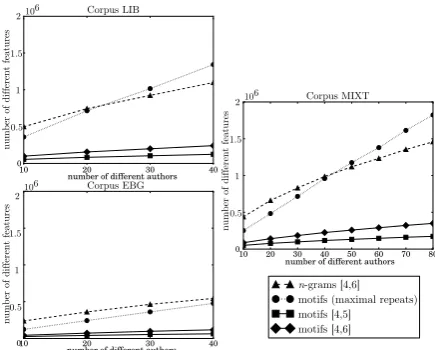
Given the best parameters for each type of features (Table 4), the following experiments draw the evo-lution of the prediction based upon the number of authors (Figure 7).
Whatever the corpus and the type of features, the prediction score decreases steadily as the num-ber of author increases. The corpus with the worst results is still LIB where the prediction score decreases from 92.04% to 77.38% (89.60% to 76.82% with n-grams). The prediction using motif2nd is higher than with the others
meth-ods. Moreover, weighting features by a factor of their length (motiflength) does not enhance
significantly motif-based representations of text. The numbers of features used for the prediction is given on Figure 8. This number of features is the average of the length of the vector represent-ing texts in each fold of the cross-validation.
References
Ahmed Abbasi and Hsinchun Chen. 2008.
Writeprints: A stylometric approach to identity-level identification and similarity detection in cyberspace. ACM Transactions on Information Systems (TOIS), 26(2):7.
Emily M. Bender. 2009. Linguistically na¨ıve != lan-guage independent: Why NLP needs linguistic ty-pology. InProceedings of the EACL 2009 Workshop on the Interaction Between Linguistics and Compu-tational Linguistics: Virtuous, Vicious or Vacuous?, ILCL ’09, pages 26–32. ACL.
Michael Brennan, Sadia Afroz, and Rachel Green-stadt. 2012. Adversarial stylometry: Circumvent-ing authorship recognition to preserve privacy and anonymity. ACM Transactions on Information and System Security (TISSEC), 15(3):12.
Carole E Chaski. 2001. Empirical evaluations of language-based author identification techniques. Forensic Linguistics, 8:1–65.
Sara El Manar El Bouanani and Ismail Kassou. 2014. Authorship analysis studies: A survey. Interna-tional Journal of Computer Applications, 86:22–29. Richard S Forsyth and David I Holmes. 1996. Feature-finding for text classification. Literary and Linguis-tic Computing, 11(4):163–174.
Jack Grieve. 2007. Quantitative authorship attribution: An evaluation of techniques. Literary and linguistic computing, 22(3):251–270.
Lucian Ilie and William F Smyth. 2011. Minimum unique substrings and maximum repeats. Funda-menta Informaticae, 110(1):183–195.
Gary Kacmarcik and Michael Gamon. 2006. Ob-fuscating document stylometry to preserve author anonymity. In Proceedings of the COLING/ACL on Main conference poster sessions, pages 444–451. Association for Computational Linguistics.
Juha K¨arkk¨ainen, Peter Sanders, and Stefan Burkhardt. 2006. Linear work suffix array construction. Jour-nal of the ACM, 53(6):918–936.
Moshe Koppel, Jonathan Schler, and Shlomo Arga-mon. 2009. Computational methods in authorship attribution. Journal of the American Society for in-formation Science and Technology, 60(1):9–26. Moshe Koppel, Jonathan Schler, and Shlomo
Arga-mon. 2011. Authorship attribution in the wild. Lan-guage Resources and Evaluation, 45(1):83–94. Fuchun Peng, Dale Schuurmans, Shaojun Wang, and
Vlado Keselj. 2003. Language independent author-ship attribution using character level language mod-els. InProceedings of the tenth conference on Euro-pean chapter of the Association for Computational Linguistics-Volume 1, pages 267–274. Association for Computational Linguistics.
Efstathios Stamatatos. 2006. Ensemble-based au-thor identification using character n-grams. In Pro-ceedings of the 3rd International Workshop on Text-based Information Retrieval, pages 41–46.
Efstathios Stamatatos. 2009. A survey of modern au-thorship attribution methods. Journal of the Ameri-can Society for Information Science and Technology, 60(3):538–556.
Efstathios Stamatatos. 2012. On the robustness of au-thorship attribution based on character n-gram fea-tures.JL & Pol’y, 21:421.
Jianwen Sun, Zongkai Yang, Sanya Liu, and Pei Wang. 2012. Applying stylometric analysis techniques to counter anonymity in cyberspace. Journal of Net-works, 7(2).
Fiona J Tweedie, Sameer Singh, and David I Holmes. 1996. Neural network applications in stylometry: The Federalist papers. Computers and the Humani-ties, 30(1):1–10.
Esko Ukkonen. 2009. Maximal and minimal represen-tations of gapped and non-gapped motifs of a string. Theoretical Computer Science, 410(43):4341–4349. Kyoji Umemura and Kenneth Church. 2009. Substring statistics. InComputational Linguistics and Intelli-gent Text Processing, pages 53–71. Springer. George Kingsley Zipf. 1949. Human Behaviour and