198
A Fine-Grained Annotated Multi-Dialectal Arabic Corpus
Anis Charfi Information Systems
Carnegie Mellon University in Qatar [email protected]
Wajdi Zaghouani
College of Humanities and Social Sciences Hamad Bin Khalifa University Qatar
Syed Hassan Mehdi Information Systems
Carnegie Mellon University in Qatar [email protected]
Esraa Mohamed Information Systems
Carnegie Mellon University in Qatar [email protected]
Abstract
We present ARAP-Tweet 2.0, a corpus of 5 million dialectal Arabic tweets and 50 million words of about 3000 Twitter users from 17 Arab countries. Compared to the first version, the new corpus has significant improvements in terms of the data volume and the annotation quality. It is fully balanced with respect to dialect, gender, and three age groups: under 25 years, between 25 and 34, and 35 years and above. This paper describes the pro-cess of creating the corpus starting from gathering the dialectal phrases to find the users, to annotating their accounts and re-trieving their tweets. We also report on the evaluation of the annotation quality using the inter-annotator agreement mea-sures which were applied to the whole cor-pus and not just a subset. The obtained re-sults were substantial with average Cohens Kappa values of 0.99, 0.92, and 0.88 for the annotation of gender, dialect, and age respectively. We also discuss some chal-lenges encountered when developing this corpus.
1 Introduction
As the popularity of natural language process-ing (NLP) based tools increases, there is a risprocess-ing need for language resources such as annotated cor-pora to develop NLP tools. In this regard, Ara-bic lags behind other languages due to several rea-sons. First, Arabic is complex at various levels of linguistic representation (phonology, orthogra-phy, morphology, and syntax). Even though na-tive Arabic speakers prefer using Modern Stan-dard Arabic (MSA) for official communications, we are witnessing with the popularity of social
media a rise in the use of dialectal Arabic for in-formal online interactions such as those found in blogs, forums, chats, tweets, posts, etc. (Mubarak and Darwish,2014;Bouamor et al.,2018).
The content written by the users in social media sites can reveal some characteristics and attributes about them, which is the main focus of author pro-filing research. However, the lack of Arabic lan-guage resources limits that research on author pro-filing for the Arabic language in particular dialec-tal Arabic.
We present in this paper ARAP-Tweet 2.0, which is a large-scale manually-annotated multi-dialectal Arabic corpus. A first version of this corpus was presented in (Zaghouani and Charfi,
2018a,b) and it was extended significantly in terms of data volume, number of users, and annotation quality. ARAP-Tweet 2.0 covers dialects from 17 Arab countries and 15 regions. The number of users per region is 198, including a total of about 3000 users and approximately 5 million tweets. All users’ accounts were manually annotated with respect to the dialect, gender, and age. Thereby, we distinguished three age groups: under 25 years, between 25 years and 34 years, and 35 years and above. Moreover, significant effort was put in checking and improving the annotation quality.
2 Related Work
Most research on Arabic NLP has focused on Modern Standard Arabic (MSA) (Habash,2010). There are many parallel and monolingual anno-tated data collections with syntactic and semantic information such as the different iterations of Penn Arabic Probanks (Palmer et al.,2008;Zaghouani et al.,2010,2012) and treebanks (Maamouri et al.,
2010). Based on such resources, various tools were developed for syntactic parsing and morpho-logical analysis (Habash,2010).
Even though there are relatively many resources for MSA, Dialectal Arabic (DA) lags behind in terms of available resources. There have been some limited efforts toward creating resources for the most popular dialects such as the Egyptian and Levantine dialects which were presented in (Habash et al., 2013; Diab and Habash, 2007;
Pasha et al., 2014). For example, Habash et al. created resources for morphological analysis of Egyptian dialect (Habash et al.,2013). For their work on machine translation, Zbib et al. (2012) created Levantine-English and Egyptian-English parallel corpora using crowd sourcing. Khalifa et al. (2018) created a morphologically annotated data corpus of Emirati Dialect.
Khalifa et al. (2016) created a corpus of 100M words covering various Arabic dialects. Other related projects worth to be mentioned are: the Egyptian Arabic Treebank (Maamouri et al.,
2014); the Levantine Arabic Treebank (Maamouri et al.,2006), The Curras Palestinian Arabic anno-tated corpus with more than 70,000 words of vari-ous genres (Jarrar et al.,2014).
Furthermore, AlShargi et al. (2016) created a Yemeni (Sanaa Dialect) dataset and also a Moroccan Arabic corpus, while Al-Twairesh et al. (2018) built SUAR, a Najdi Arabic cor-pus annotated with the morphological analyzer MADAMIRA (Pasha et al., 2014). Finally, Voss et al. (2014) presented a Moroccan Arabic corpus annotated for code-switching (French, Berber and Morrocan Arabic).
Moreover, there have been some efforts towards creating Dialectal Arabic corpora by either trans-lating existing corpora to dialects or by crowd sourcing annotation for data collected through var-ious sources such as microblogs (e.g., Twitter). Along these lines, DART was developed as a Twit-ter based data set of dialectal Arabic covering five Arabic dialects: Egyptian, Levantine, Gulf,
and Iraqi (Alsarsour et al.,2018). The annotation of this corpus was done through crowd sourcing. Bouamor et al. (2014) presented a multi-dialectal parallel corpus with 2,000 sentences translated to MSA, Tunisian, Jordanian, Palestinian and Syr-ian Arabic. Later on, MADAR was developed as a Multi-dialectal large scale corpus that pro-vides parallel translation for 25 Arabic city di-alects (Bouamor et al.,2018). All these efforts on creating Dialectal Arabic corpora either targeted some specific dialects only or did not provide the necessary annotation for author profiling such as annotation about age and gender.
3 Methodology
In the following, we report on the methodology and process followed for the creation, annotation, and validation of our corpus.
3.1 Corpus Overview
Twitter is an increasingly popular social media platform among the Arabic speaking people who tend to frequently use their Arabic dialects when sharing their stories and opinions. Therefore, we focused on Twitter to collect the data for our cor-pus. ARAP-Tweet 2.0 was developed in the con-text of the ARAP research project1and it includes about 5.3 million Arabic tweets of approximately 3000 users from the following 15 Arabic speak-ing regions: Qatar, Kuwait, United Arab Emirate (UAE), Kingdom of Saudi Arabia (KSA), Oman, Yemen, Iraq, Tunisia, Algeria, Libya, Morocco, Lebanon-Syria, Palestine-Jordan, Egypt, and Su-dan. To the best of our knowledge, there is no other corpus that covers as many Arab regions as ours. For every region, we collected the tweets of 198 users that were equally-balanced over gender and three age groups: under 25, 25 until 34, and 35 and up. Compared to the first version of our corpus (Zaghouani and Charfi,2018a) the number of users per region doubled in this second version.
3.2 Users
We used Twitter as our source for finding the users. In the beginning, we got a number of ac-counts by the geographical location of tweets and by searching on Twitter using specific words. We collected the users who posted tweets in a specific geographical location as defined in the tweet’s ob-ject. As this information was not available for all
tweets, we searched for users who had tweets that include some unique words, which are specific to a certain Arab region. Table 1 shows some of these unique words from every region covered by our corpus along with a tweet example for each word. After that, we found further accounts using the followers of the initially identified users. Once the users were found, we hired experienced annotators to manually annotate their age, gender, and dialect. The annotators followed well-defined annotation guidelines, which are based on an extended ver-sion of the guidelines published in (Zaghouani and Charfi, 2018b). We continuously monitored the annotators’ work and updated the guidelines when needed. For each region, we retrieved the tweets of the users from their Twitter profiles. The se-lected users had to have at least 100 Arabic tweets and at most 3200 tweets. Moreover, the tweets had to be the original tweets, which means that we did not include retweets in our corpus. The average number of words per tweet is 10.
3.3 Annotation
In the following, we report on the annotation of the users with respect to gender, age and dialect.
3.3.1 Gender Annotation
The gender was manually annotated for users and the number of users is balanced with respect to the gender across all regions, which means that we have 99 male users and 99 female users for each region. The annotation was done based on guidelines and criteria that were used to distin-guish male and female users. For every user, the annotator determined the gender by analyzing the username, profile picture, and indicative words. The annotator checked the username if it is de-noting a male or female name. Some users put their real photos in their Twitter profile, which also helped in determining their gender. In some cases, the username and the profile picture did not give sufficient information to identify their gender. Therefore, the annotators were looking for some indicative words in the user’ s tweets. For exam-ple, the adjectives that describe feminine in Ara-bic usually end with
é
(Taa’ Marbootah). There-fore, finding words that end with the Arabic let-ter Taa’ Marbootah such asé K@XQK.
(Feeling cold),é KAª K
(Feeling sleepy), oré KAªk.
(Feeling hungry)in the tweets of a user indicates that the writer is a female. However, if the writer is a male, the
adjec-tives used in his tweets would not have that letter. The annotators used this Arabic rule to determine the user’s gender when it was not possible to do so using the username or the profile photo. It is note-worthy that users for which the gender could not determined were not included in the corpus and were replaced by other users for which the gender could be determined as explained above.
3.3.2 Age Annotation
We annotated the age of the selected Twitter users using three age groups: under 25, 25 until 34, and 35 and above. In many cases, we were able to find the exact ages whereas in some other cases we were able to determine the correct age group with-out the exact age. The annotators went through the following steps to determine the age of a user:
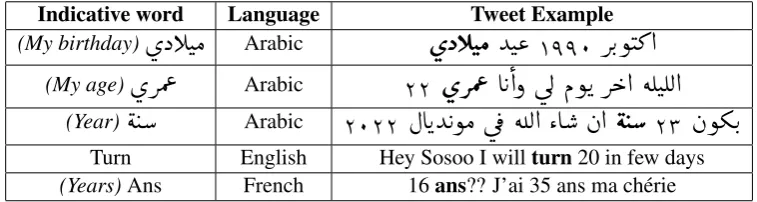
Getting the exact age: Several Twitter users in-clude their birth year as a part of their usernames. For example, in the username Omda1981m the birth year is most likely 1981, which indicates that this user is 38 years old. Some other users put their date of birth in their Twitter biography or in their other social media accounts such as Facebook, In-stagram, or LinkedIn. Other users put their exact age in some of their tweets and we were able to search for those tweets using some relevant key-words in different languages as shown in Table 2.
Getting the estimated age: There were sev-eral cases in which we were not able to deter-mine the exact age even after following the above-mentioned steps. In these cases, we opted to deter-mine the approximate ages, so that we could an-notate the user with the correct age group. This was done by searching for the user on other social media networks such as LinkedIn and Facebook. We often found either their exact ages or other age related hints such as the year of their graduation from university, which helped us in making an ed-ucated guess towards the user’s age. Furthermore, as a last resort for some few users, two annotators guessed the age separately using the Twitter photo. Then, we used Microsoft’s online tool2 that pre-dicts the age by analyzing the facial features of a user through machine learning. Only users were included for which the age group guessed by Mi-crosoft’s age determination tool.
3.3.3 Dialect Annotation
As mentioned above, we selected the users for our corpus by searching for tweets with dialect
Region Unique Word User’s Tweet
Lebanon-Syria
@YJë
ù
ªÓ ©Ê£ ú
ÎK
@YJë
ð É
«ñ
«
IÊÔ«
Tunisia
A
QK.
ú
æ
ñJË@ É
¯B@ð
YË
B@ ù
®J.K ÈðX
A
QK.
¨AJÓ ú
溻 ¨@ñ K
@
I
¯
X
Iraq
éK@ñë@
B@ ©Ó h.
XAÖ
ß ú
j
.
Jë ñ» @
éK@ñë@
iJm é<Ë@ð ø@
KSA
éÊ
®mk.
éÊ
®mk.
éJ
¯ð
à@ éJ
¯ ¨ñ
ñÖÏ@ ú
Gñ
¯Y
Palestine-Jordan
Aë
é JÓ
¨ðQ
®Ó ú
æ @
Aë
AªJ.£
Qatar
ú
GAg@
PX@ AÓ .
é@PYË@
ú
GAg@
ú
æJ.ªË A K@
Kuwait
É¢ J£
é«AÔg. AK ÕºJ
®
É¢ J£
á KñºK ðQ ®Ó ñËX ú
æ K@ XA«
Sudan
Èð P
Èð P
ø@ úÍ
IKñJKP ÉÒªë AÓ ú
GAK
UAE
H.ñKAÓ
H.ñKAÓ
éJ«@P l .×ðX éJ
¯@QËAK
ð
YË@ éJ«@P AK éJ
¯@ñËAK
áÒÊ
Yemen
.XAªÓ
QåË@ AëñÊÒ» ú
æ Bð
.XAªÓ
éËñ
®ªÓ ú
æªK
Morocco
AK.@X
ú
¯A
Ë@ H.@ñm.Ì'@ IJ
®Ë
AK.@X
H.AJºËA ¯ áKA¿
@ ÉKA
J» AÖßX
I J»
Algeria
ð@ P
øñ
Ó èðQKY
Kð èñ jÊ ð
ð@ P
ðYJ
ù
Ô« YËðð AKñ
kð A K@ A J»
Libya
èPYîD
ú
ÎJ.KP ú
¯ ù
ÖÞ @
èPYîD
Ê«
Egypt
ú
æ¯ñËX
ñ» A
K@
ú
æ¯ñËX
ú
GñJ.
Oman
éJ.
®
ú
æJ¯Y
éJ.
®
ù
ªÊ¢. é
K@Qå k Ð ø
XA«
áK Q K@
Table 1: Examples of unique words from each dialectal region with tweets that include these words.
Indicative word Language Tweet Example
(My birthday)
øXCJÓ
ArabicøXCJÓ
YJ« 1990 QK.ñ
J»@
(My age)
øQÔ«
Arabic22
øQÔ«
A K
@ð ú
Í ÐñK Q
k@ éÊJÊË@
(Year)é J
Arabic2022 ÈAKY
KñÓ ú
¯ é<Ë@ ZA
à@
é J
23 àñºK.
Turn English Hey Sosoo I willturn20 in few days(Years)Ans French 16ans?? J’ai 35 ans ma ch´erie
Table 2: Examples of keywords from different languages used to determine the users age.
cific words and then retrieving the users of those tweets and their followers. In addition, once we retrieved the user’s tweets, the annotator(s) man-ually went through them and checked that at least half of the tweets are in the user’s respective di-alect. When the users’ tweets were not mostly in their originally identified dialect, the annotators were instructed to replace them with other users from the same dialect, the same gender, and the same age group.
3.4 Tweets Retrieval
Twitter offers an Application Programming Inter-face (API) that allows developers to interact with Twitter’s web services. We used the Python
pro-gramming language with thetweepy.py3library to interact with the Twitter API and retrieve each user’s timeline (tweets). Due to restrictions by Twitter, we were only allowed to retrieve at most 3,200 of the users most recent Tweets. The num-ber of tweets of every user in our corpus ranges from a required minimum of 100 tweets to a max-imum of 3,200 tweets. After collecting the maxi-mum possible number of tweets for each user, we filtered them. Specifically, we removed the non-Arabic tweets, retweets, and short tweets that con-tain less than 3 words. Eventually, we kept only the Twitter accounts who had at least 100 origi-nal users tweets that are in Arabic and that have
three words at least. At the end of this process, we were able to have a well-balanced multi-dialect corpus of 198 users for 15 regions spanning 17 Arab countries. The corpus is equally-balanced with respect to gender and age.
4 Verification and Evaluation
Our main objective was to produce a multi-dialectal corpus of tweets with a very good qual-ity of annotation so that it can be used to promote Arabic NLP research including research on author profiling. This is a major improvement compared to the previous version of the corpus. To ensure a good quality annotation, we performed two rounds of annotation for each Arab region, which means that each region was annotated by two different annotators. Next, we report on the verification and evaluation process for the annotation of dialect, age, and gender. Moreover, we present the eval-uation results for each annotation category.
4.1 Verification of Dialect Annotation
The annotation was done by experienced Arab an-notators who were asked to go through each file of retrieved users tweets and check the dialect used in these tweets. This step was necessary to verify the overall dialect of all tweets for every user, and not only the last tweets in a users timeline. Based on this dialect verification, we did the following:
Removing the users who post tweets in multi-ple dialects: many Arab users do not live in their original countries, and consequently, their dialects are affected by the dialects of the countries they live in. We opted to drop such users from our cor-pus and we replaced them by users from the same gender and age group and which used one dialect only.
Removing the users who have many tweets in MSA: some Arab users post few tweets in their own dialects, and they write their tweets mostly in MSA. After checking all retrieved tweets of a given user, we included in our corpus only those who have more than half of their tweets written in their dialect.
4.2 Verification of Age and Gender Annotation
Although the age was determined manually, the corpus included initially some users for which nei-ther the exact age nor the age group could be de-termined with high confidence. These cases
oc-curred for example when the age of the user was determined mainly by using their Twitter profile photo.
Moreover, the annotators found initially some difficulties with determining the gender for some users for instance when the profile did not in-clude a real name nor a profile photo. For the lat-ter cases, the accounts were replaced by accounts from the same gender and age group for which the age could be determined with higher confidence. For all accounts, a second round of annotation was performed by a different annotator. At the end of this phase, we were able to have two annota-tions from different contributors for each user ac-count. Eventually, variations were checked and re-solved by a member of the research team together with the annotators by reviewing and discussing the provided justifications for a certain annotation of age, gender, or dialect.
4.3 Annotation Evaluation
In order to evaluate the quality of the annotation, we used the inter-annotator agreement measures. We were able to have two rounds of annotation by different annotators for each user and this applies for the gender, dialect and age group for the whole corpus unlike in the previous version (Zaghouani and Charfi, 2018a) in which the inter-annotator agreement was based on a 10 % subset of the cor-pus data.
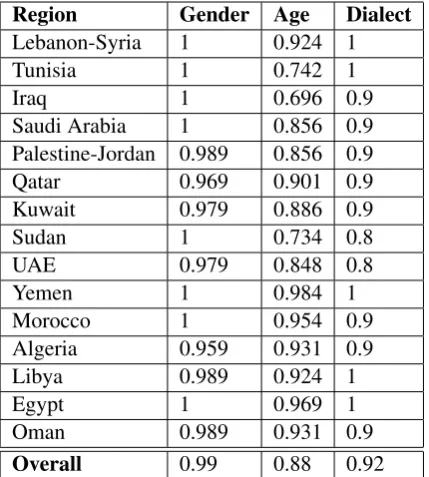
We measured the inter-annotator agreement us-ing Cohens Kappa, which is a statistical measure of the degree of agreement for a data point (gen-der, dialect, and age in our case), that was labeled by two annotators, over what would be expected by chance. We obtained substantial results for the agreement with average Kappa values of0.99, 0.92, and 0.88respectively for the annotation of gender, dialect, and age. The exact Kappa values per region are shown in Table 3.
5 Challenges
In the following, we report on some challenges that we faced when developing this corpus:
cul-Region Gender Age Dialect Lebanon-Syria 1 0.924 1
Tunisia 1 0.742 1
Iraq 1 0.696 0.9
Saudi Arabia 1 0.856 0.9 Palestine-Jordan 0.989 0.856 0.9 Qatar 0.969 0.901 0.9 Kuwait 0.979 0.886 0.9
Sudan 1 0.734 0.8
UAE 0.979 0.848 0.8
Yemen 1 0.984 1
Morocco 1 0.954 0.9
Algeria 0.959 0.931 0.9 Libya 0.989 0.924 1
Egypt 1 0.969 1
Oman 0.989 0.931 0.9
Overall 0.99 0.88 0.92
Table 3: Kappa values per region for gender, age, and dialect annotation.
ture and norms. This was an issue for us as we sometimes depend on the Twitter profile photos to guess the age especially if the username is not a real name. Second, we notice that older Arabs of-ten write in Modern Standard Arabic (MSA) on social media, and this made the task of finding di-alect users above 35 years much harder. Third, we faced an issue with Maghrebi users who often tweet in French more than Arabic.
To address these issues, we put more effort into the user selection and we replaced any users who did not fulfill the criteria explained above.
Fourth, we noticed that some users use more than one Arabic dialect to write their tweets on Twitter. For example, in Arab regions with high immigration rates such as Gulf countries, the di-alect of the residents is sometimes affected by the language of their host country. Consequently, these users tweet in multiple dialects and they might mix dialects even in one same tweet. Other users had similar issues because their parents come from different Arab countries. To address this issues, all tweets were manually reviewed and users tweeting in two dialects or more were re-placed by mono-dialectal users.
Fifth, we worked on regions sequentially, i.e., we selected a large set of accounts from Twitter for one region, annotated them, and then retrieved their tweets. Then, we worked on the next region.
As a result, when we retrieved again the users or their tweets we noticed that some profiles were ei-ther made private or even closed. In such cases, we were no longer able to access the users profile and tweets. We addressed this problem by periodically checking the users’ accounts and replacing any ac-counts that were deactivated or made private.
6 Conclusion
We presented in this paper a significantly improved version of a large-scale manually-annotated and fine-grained multi-dialectal corpus of Arabic tweets, which is compsed of 5 millions dialectal Arabic tweets of about 3000 Twitter users from 17 Arab countries. To the best of our knowl-edge, our corpus is the most comprehensive di-alectal corpus in terms of coverage for so many Arab dialects and the data volume. Moreover, our corpus is balanced with respect to dialect, gen-der, and age. The corpus was annotated manually based on well-defined annotation guidelines and it was fully evaluated using the inter-annotation agreement measures.
The corpus was already and it can further be used to promote research on Arabic NLP including author profiling (Rosso et al.,2018), authorship at-tribution, dialect identification, sentiment analysis in dialectal Arabic, and bots detection in dialectal Arabic.
Acknowledgments
We thank our dedicated annotators: Hoda Ibrahim, Safaa Ellaham, Syrine Guediche for their hard work on the corpus annotation. This publication was made possible by NPRP 9-175-1-033 from the Qatar National Research Fund (a member of Qatar Foundation). The findings achieved herein are solely the responsibility of the authors.
References
Faisal Al-Shargi, Aidan Kaplan, Ramy Eskander, Nizar Habash, and Owen Rambow. 2016. Morphologi-cally annotated corpora and morphological analyz-ers for moroccan and sanaani yemeni arabic. In
10th Language Resources and Evaluation
Confer-ence (LREC 2016).
Nora Al-Twairesh, Rawan Al-Matham, Nora Madi, Nada Almugren, Hanouf Aljmi, Shahad Al-shalan, Raghad AlAl-shalan, Nafla Alrumayyan, Shams Al-Manea, Sumayah Bawazeer, et al. 2018. Suar: Towards building a corpus for the saudi dialect.
Israa Alsarsour, Esraa Mohamed, Reem Suwaileh, and Tamer Elsayed. 2018. Dart: A large dataset of di-alectal arabic tweets. InProceedings of the Eleventh International Conference on Language Resources
and Evaluation (LREC-2018).
Houda Bouamor, Nizar Habash, and Kemal Oflazer. 2014. A multidialectal parallel corpus of arabic. In
LREC. pages 1240–1245.
Houda Bouamor, Nizar Habash, Mohammad Salameh, Wajdi Zaghouani, Owen Rambow, Dana Abdul-rahim, Ossama Obeid, Salam Khalifa, Fadhl Eryani, Alexander Erdmann, et al. 2018. The madar arabic dialect corpus and lexicon. In Proceedings of the Eleventh International Conference on Language
Re-sources and Evaluation (LREC-2018).
Mona Diab and Nizar Habash. 2007. Arabic dialect processing tutorial. In Proceedings of the Human Language Technology Conference of the NAACL,
Companion Volume: Tutorial Abstracts. Association
for Computational Linguistics, pages 5–6.
Nizar Habash, Ryan Roth, Owen Rambow, Ramy Es-kander, and Nadi Tomeh. 2013. Morphological analysis and disambiguation for dialectal arabic. In
Proceedings of the 2013 Conference of the North American Chapter of the Association for
Computa-tional Linguistics: Human Language Technologies.
pages 426–432.
Nizar Y Habash. 2010. Introduction to arabic natural language processing. Synthesis Lectures on Human
Language Technologies3(1):1–187.
Mustafa Jarrar, Nizar Habash, Diyam Fuad Akra, and Nasser Zalmout. 2014. Building a corpus for pales-tinian arabic: a preliminary study .
Salam Khalifa, Nizar Habash, Dana Abdulrahim, and Sara Hassan. 2016. A large scale corpus of gulf ara-bic. arXiv preprint arXiv:1609.02960.
Salam Khalifa, Nizar Habash, Fadhl Eryani, Ossama Obeid, Dana Abdulrahim, and Meera Al Kaabi. 2018. A morphologically annotated corpus of emi-rati arabic. InProceedings of the Eleventh Interna-tional Conference on Language Resources and
Eval-uation (LREC-2018).
Mohamed Maamouri, Ann Bies, Tim Buckwalter, Mona T Diab, Nizar Habash, Owen Rambow, and Dalila Tabessi. 2006. Developing and using a pilot dialectal arabic treebank. InLREC. pages 443–448.
Mohamed Maamouri, Ann Bies, Seth Kulick, Michael Ciul, Nizar Habash, and Ramy Eskander. 2014. De-veloping an egyptian arabic treebank: Impact of di-alectal morphology on annotation and tool develop-ment. InLREC. pages 2348–2354.
Mohamed Maamouri, Ann Bies, Seth Kulick, Wajdi Zaghouani, David Graff, and Michael Ciul. 2010. From speech to trees: Applying treebank annotation to arabic broadcast news. InLREC.
Hamdy Mubarak and Kareem Darwish. 2014. Using twitter to collect a multi-dialectal corpus of arabic.
In Proceedings of the EMNLP 2014 Workshop on
Arabic Natural Language Processing (ANLP). pages
1–7.
Martha Palmer, Olga Babko-Malaya, Ann Bies, Mona T Diab, Mohamed Maamouri, Aous Man-souri, and Wajdi Zaghouani. 2008. A pilot arabic propbank. InLREC.
Arfath Pasha, Mohamed Al-Badrashiny, Mona T Diab, Ahmed El Kholy, Ramy Eskander, Nizar Habash, Manoj Pooleery, Owen Rambow, and Ryan Roth. 2014. Madamira: A fast, comprehensive tool for morphological analysis and disambiguation of ara-bic. InLREC. volume 14, pages 1094–1101.
Paolo Rosso, Francisco M. Rangel Pardo, Bilal Ghanem, and Anis Charfi. 2018. ARAP: arabic author profiling project for cyber-security.
Proce-samiento del Lenguaje Natural61:135–138.
Clare R Voss, Stephen Tratz, Jamal Laoudi, and Dou-glas M Briesch. 2014. Finding romanized arabic di-alect in code-mixed tweets. InLREC. pages 2249– 2253.
Wajdi Zaghouani and Anis Charfi. 2018a. Arap-tweet: A large multi-dialect twitter corpus for gender, age and language variety identification. arXiv preprint
arXiv:1808.07674.
Wajdi Zaghouani and Anis Charfi. 2018b. Guidelines and annotation framework for arabic author profil-ing.arXiv preprint arXiv:1808.07678.
Wajdi Zaghouani, Mona Diab, Aous Mansouri, Sameer Pradhan, and Martha Palmer. 2010. The revised ara-bic propbank. InProceedings of the fourth
linguis-tic annotation workshop. Association for
Computa-tional Linguistics, pages 222–226.
Wajdi Zaghouani, Abdelati Hawwari, and Mona Diab. 2012. A pilot propbank annotation for quranic ara-bic. InProceedings of the NAACL-HLT 2012
Work-shop on Computational Linguistics for Literature.
pages 78–83.
Rabih Zbib, Erika Malchiodi, Jacob Devlin, David Stallard, Spyros Matsoukas, Richard Schwartz, John Makhoul, Omar F Zaidan, and Chris Callison-Burch. 2012. Machine translation of arabic dialects.