Influence of Text Type and Text Length on Anaphoric Annotation
Daniela Goecke
1, Maik St ¨uhrenberg
1, Andreas Witt
2Universit¨at Bielefeld1, Universit¨at T¨ubingen2 Fakult¨at f¨ur Linguistik und Literaturwissenschaft, SFB441
Postfach 10 01 31, Nauklerstr. 35 33501 Bielefeld, 72074 T¨ubingen
Germany, Germany
{daniela.goecke, maik.stuehrenberg}@uni-bielefeld.de, [email protected]
Abstract
We report the results of a study that investigates the agreement of anaphoric annotations. The study focuses on the influence of the factors text length and text type on a corpus of scientific articles and newspaper texts. In order to measure inter-annotator agreement we compare existing approaches and we propose to measure each step of the annotation process separately instead of measuring the resulting anaphoric relations only. A total amount of 3642 anaphoric relations has been annotated for a corpus of 53038 tokens (12327 markables). The results of the study show that text type has more influence on inter-annotator agreement than text length. Furthermore, the definition of well-defined annotation instructions and coder training is a crucial point in order to receive good annotation results.
1.
Introduction
The need for high quality corpus data is widely accepted for linguistic analyses and the development of linguistic appli-cations. Data quality might be measured against reference corpora and – as reference corpora are not available when annotating data – by measuring inter-annotator agreement (IAA) that gives information on how consistent annotations of different coders are. The work presented is based on the development of an anaphora resolution system for both cospecification and bridging relations. In order to anno-tate a corpus for analysis, training and evaluation we inves-tigated factors that influence coder agreement. The study focuses on two hypotheses:
1. Text type has an influence on the IAA of anaphoric annotation; agreement values are lower for more com-plex texts types.
2. Text length has an influence on the IAA of anaphoric annotation; long texts show less agreement than short texts e.g. due to the large number of antecedent candi-dates.
In order to check these hypotheses we have chosen two text types: German Newspaper texts and scientific articles. We assume scientific articles to have a more complex text struc-ture and more complex topics than newspaper texts. Thus, we expect scientific articles to be less easy to understand and, therefore, to have lower agreement values than news-paper texts. In order to investigate the influence of text length independently from from text type, we have cho-sen texts of varying length for both text types. Influence of text length is thus investigated first for homogeneous sets of texts according to text type and checked afterwords for the heterogeneous group of two different text types. The remainder of the paper is structured as follows: Section 2. describes the annotation of anaphoric relations and Sec-tion 3. reviews existing approaches to measure anaphoric agreement and presents our proposal to measure different annotation steps independently. Section 4. describes the
setting of the study as well as the results. Finally, Section 5. derives a conclusion and gives clues for further develop-ment.
2.
Annotating Anaphoric Relations
In order to annotate anaphoric relations, two types of infor-mation have to be specified. First, the markables, i. e. the elements that can be part of a relation, have to be identi-fied. Second, the relation(s) between markables with their respective types and subtypes have to be chosen from a set of disjoint categories. In the domain of anaphoric re-lations, markables are those text units that evoke discourse entities. Discourse entities – or discourse referents – are constants within a discourse model that are evoked by NPs and which can be referred to in the subsequent discourse (Karttunen, 1976; Webber, 1988; Kamp and Reyle, 1993). These markables form the basis for the annotation process and are annotated in advance. By separating the tasks of markable detection and anaphora annotation proper we fol-low Hirschman et al. (1998) who describe for an annotation study that coder agreement can be increased if markables are detected in advance.For our corpus, each text has been preprocessed using the dependency parser Machinese Syntax1which provides lem-matisation, POS information, dependency structure, mor-phological information and grammatical function. Based on this information, markables have been detected automat-ically afterwards by identifying nominal heads (i.e. nouns or pronouns) and their premodifiers.
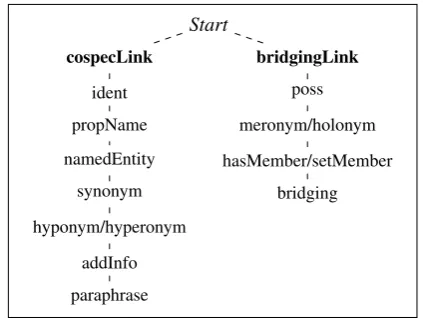
For the annotation process we have investigated several an-notation schemes for annotating anaphoric relations that have been developed in the last years, e.g. the text-based UCREL anaphora annotation scheme (Fligelstone, 1992; Garside et al., 1997), the SGML-based MUC annotation scheme (Hirschman, 1997), and the XML-based MATE/G-NOME scheme for anaphoric annotation (Poesio, 2004), amongst others. The annotation scheme used for our
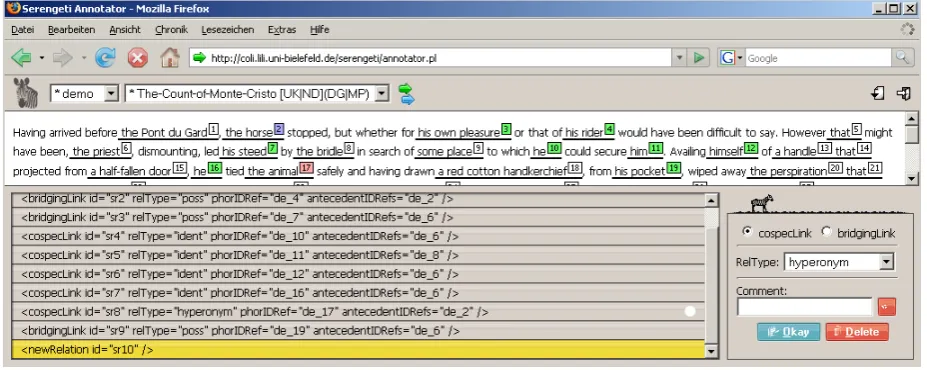
pre-Figure 2:Serengeti’s User Interface.
precision and recall measures where one coder is compared against another. Several chance-corrected coefficients have been discussed for their application for linguistic tasks, es-pecially anaphoric annotations (Carletta, 1996; Di Eugenio, 2000; Di Eugenio and Glass, 2004; Artstein and Poesio, 2005). Cohen’sκand Scott’sπare of special interest when investigating coder agreement for nominal scales. κandπ
both take chance into account but differ in the calculation of the expected agreement. Whereas expected agreement for Scott’s πis computed as the sum of squared proportions over all categories, Cohen’s κcomputes expected agree-ment as joint probabilities of the coder’s single proportions.
κ(as well asπ) is computed as
κ=P(Ao)−P(Ae) 1−P(Ae)
whereP(Ao)andP(Ae)are the probabilities of observed and expected agreement. An IAA value of 1 describes to-tal agreement, whereas 0 describes agreement with no dif-ference to chance. Negative values describe lower IAA than expected by chance. In the domain of anaphoric annotation, coders agree if they choose the same cate-gory (e.g. cospecLink or bridgingLink) for a given item (e. g. anaphora-antecedent-pair). Considering IAA val-ues as an indicator for the reliability of data we follow Carletta (1996) and thus Krippendorff (1980) and assume
.67< κ < .8to allow for tentative conclusions andκ > .8
to show good reliablilty.
An alternative to the investigation of single items (anaphora-antecedent-pairs) is the analysis of anaphoric chains (Passonneau, 2004; Poesio and Artstein, 2005). The use of anaphoric chains allows coders to choose different antecedents as long as these are part of the same anaphoric chain. As the categories (i. e. chains) need not be to be disjoint, total agreement as well as partial agreement can be considered in terms of chain identity, chain intersection, and chain subsets.
In our study we use Cohen’sκbecause of three reasons: (1) We are especially interested in the annotation of primary and secondary relation types. This information, however, is not accessible from anaphoric chains. (2) Our annotation
guidelines define the correct antecedent to be the previous non-pronominal candidate. Therefore antecedent disagree-ment is tested for explicitly. (3) Our annotation scheme defines both cospecification and bridging relations. How-ever, anaphoric chains are properly applicable for cospeci-fication only. For bridging relations, we expect short chains only. In case of chains including both cospecification and bridging relations, chains are no longer equivalence classes of the respective discourse entities but rather describe topic chains or lexical chains. In fact, analysis of our data re-flects the tendency that bridging relations combine separate cospecification chains into larger combined chains.3 In the following Section we describe the setting of the study as well as the results.
4.
Setting and Results
Data The data consists of two sets of German texts. The first consisting of three scientific articles (14485 tokens, 3805 markables) and twelve newspaper articles (2663 to-kens, 763 markables), the second consisting of another three scientific articles (25138 tokens, 4757 markables) and seven newspaper texts (10752 tokens, 2782 markables). A total amount of 3642 different anaphoric relations has been annotated for the two sets. In order to investigate the influ-ence of text length independently from from text type for the second data set, we have chosen texts of varying length for both text types. The average text length is 81 sentences for the newpaper articles and 470 sentences for the scien-tific articles. Figure 1 gives an overview on the texts of the two data sets.
Coders Two coders participated in the study. Both are students at the department of Linguistics and Literary Stud-ies at the University of Bielefeld.
3For example, 163 cospecification chains (minimum length: 2,
#tokens #markables #sentences
scientific-1 432 6467 1190
scientific-2 523 9286 1776
scientific-3 455 9385 1791
newspaper-1 40 682 163
newspaper-2 55 795 183
newspaper-3 37 722 188
newspaper-4 55 894 244
newpaper-5 124 2147 549
newpaper-6 106 2043 561
newspaper-7 149 3469 894
Table 1: Texts of the second data set
Annotation Annotation was done using the annotation tool Serengeti. After the annotation of the first set, the results were discussed and the annotation guidelines were extended by a flowchart defining the decision process to find the correct secondary relation. Afterwards the second set was annotated independently by the two coders. The coders were advised not to discuss their annotations with each other during the annotation process.
Evaluation of the annotation process Figure 3 shows higher overall agreement for the second set than for the first set. The set of anaphoric relations annotated by the first coder is compared with the set of relations from the second coder and overall agreement is given as percentage agreement of the total set of anaphoric relations. These re-sults reflect the positive effects of coder training and well-defined annotation instructions on IAA.
Figure 3: Overall agreement of anaphoric relations
We compute separate agreement values for the four annota-tion steps described in Secannota-tion 2. The investigaannota-tion of text type and text length is based on the annotation of the second data set. Tables 2 and 3 give an overview of the agreement values for scientific and newspaper articles of the second data set. The results for the separate annotation steps are given in the following.
4.1. Identification of anaphoric DEs
We use κto measure agreement for the identification of anaphoric DEs. Two coders agree, if they choose the same value of the dichotomic category +/−anaphoric
for a given item (DE). They disagree if one coder chooses
+anaphoricand the second−anaphoricand vice versa. Different subsets of markables (all markables, indefinite
de-scriptions, definite descriptions) are investigated. The total number of items is the number of markables (and their re-spectives subsets) in the text.
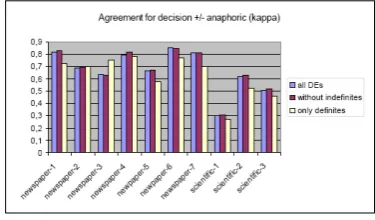
Figure 4 showsκvalues for the identification of anaphoric DEs. The results show that coders perform better on news-paper articles than on scientific articles where IAA values ofκ < .67are abserved. For the newspaper articles, only two texts haveκ < .67and three of the texts have values ofκ > .8showing good reliability. Regarding agreement values within one set of texts, there is no evidence in the data that text length influences IAA values within one set of texts: Coders perform equally well on short and long news-paper texts. For the scientific articles, coders perform bet-ter on the longer texts than on the short one. We therefore assume that the different IAA values across the texts sets are due to text type and not due to text length. Neverthe-less, the newspaper texts under investigation are generally shorter than the scientific articles and further investigation has to be done on even longer newspaper texts. We investi-gated different sets of markables in order to identify sources of disagreement: All markables, only definite description, and the set of markables without indefinite descriptions. In general, best performance values can be observed for the complete set and for the set without indefinite descriptions wich contains both pronouns and definite descriptions.
Figure 4:κvalues for first annotation step
Good performance for these sets is due to the number of indefinite descriptions that are not anaphorically and due to the number on pronouns that are – except from expletiva – always used anaphorically. Regarding the set of definite de-scription, agreement values tend to be lower, especially for the scientific articles. We assume that disagreement occurs because of missing domain knowledge that is necessary in order to distinguish anaphorical and non-anaphorical use of definite descriptions.
4.2. Identification of correct antecedent
scientific-1 scientific-2 scientific-3 #items #iai κ #items #iai κ #items #iai κ
step 1 1190 845 0.3 1776 1565 0.62 1791 1482 0.51
step 2 128 98 – 236 231 – 250 211 –
step 3 98 97 .94 231 229 .96 211 206 .82
step 4 (cospec) 89 86 .66 200 190 0.8 194 194 1.0 step 4 (bridging) 8 6 .39 29 28 0.74 12 12 1.0
Table 2: IAA for scientific articles (#iai: items that have been annotated identically)
newspaper-1 newspaper-2 newspaper-3 newspaper-4 #items #iai κ #items #iai κ #items #iai κ #items #iai κ
step 1 163 151 .82 183 160 .69 188 157 .64 244 226 .79
step 2 39 34 – 39 36 – 49 43 – 47 43 –
step 3 34 34 1.0 36 36 1.0 43 43 1.0 43 42 .88
step 4 (cospec) 24 22 .84 28 26 .82 37 36 .96 38 35 .86 step 4 (bridging) 10 10 1.0 8 8 1.0 6 6 1.0 4 4 1.0
newspaper-5 newspaper-6 newspaper-7 #items #iai κ #items #iai κ #items #iai κ
step 1 549 475 .66 561 526 .86 894 820 .81
step 2 114 96 – 157 139 – 245 210 –
step 3 96 94 .91 139 139 1.0 210 208 .97 step 4 (cospec) 83 83 1.0 126 125 .98 169 158 .87 step 4 (bridging) 11 9 .44 13 13 1.0 39 39 1.0
Table 3: IAA for newspaper articles (#iai: items that have been annotated identically)
total number of items is the number of markables that have been decided as anaphoric by both coders, i.e. the intersec-tion of step 1.
Figure 5 shows percentage agreement for the identification of the antecedent of an anaphoric element. Coders perform well on all texts independently of the text type. Lowest percentage agreement can be observed for one of the sci-entific articles on which the coders performed least in step 1, too. There is no evidence for an influence of text length or text type on this task and we assume the annotation of antecedent to be solvable with rather high agreement.
Figure 5: Percentage agreement for second annotation step
4.3. Identification of primary and secondary relation
Agreement values for primary (step 3) and secondary rela-tion types (step 4) are measured using κ. Coders agree if they choose the same category from a set of categories for a given anaphor-antecedent-pair. The total number of items for the annotation of the primary relation type is the number of anaphoric markables for which both coders have chosen the same antecedent, i.e. the intersection of step 2. The
to-tal number of items for the annotation of the secondary re-lation types is the number of anaphor-antecedent-pairs for which both coders have chosen the same primary relation, i.e. the intersection of step 3. Figure 6 showsκvalues for the annotation of primary and secondary relation types.
Figure 6:κvalues for primary and secondary relation types (second data set)
Regarding the selection of the primary relation for one anaphor-antecendent pair, coders perform well for both newspaper articles and scientific articles with.9< κ≤1.0
for eight texts and.8< κ < .9for two texts. Regarding the annotation of secondary relation types coders performed equally well for both cospecification and bridging relations and across text types. Coders agree with .8 < κ ≤ 1.0
with one exception for cospecification and two exceptions for bridging relations.κ < .67for both cospecification and briddging could be observed for the scientific article that led to low agreement values in the previous steps, too. One of the newspaper texts hasκ < .67for the bridging rela-tions.