Impact of Question Decomposition on the Quality of Answer Summaries
Finley Lacatusu, Andrew Hickl, Sanda Harabagiu
Language Computer Corporation 1701 N. Collins Blvd. Richardson, TX 75080, USA
{finley, andy, sanda}@languagecomputer.com
Abstract
Generating answers to complex questions in the form of multi-document summaries requires access to question decomposition methods. In this paper we present three methods for decomposing complex questions and we evaluate their impact on the responsiveness of the answers they enable.
1.
Introduction
Complex questions cannot be answered by a single entity or even a single sentence. Typically, complex questions ad-dress a topic that relates to many entities, events and com-plex relations between them. For example, when asking about international organized crime many concepts, such as criminals, gangs and their organized crimes come to mind. To convey information related to such complex top-ics, multiple sentences need to be used and organized in a summary if all relevant data is extracted from a document collection. Since such summaries need to be informative and to respond to complex questions, they constitute a good basis for evaluating the state-of-the-art of multi-document summarization. This was the goal of DUC-20051. The complex question-focused summarization task in DUC 2005 required systems to piece together information from
multiple documents. The multi-document summaries
(MDS) produced by such systems had to answer a ques-tion or a set of quesques-tions as posed by a DUC topic. NIST Assessors developed a total of 50 DUC topics to be used as test data. For each topic, the assessor selected 25-50 related documents from the Los Angeles Times and Finan-cial Times of London and formulated a DUC topic state-ment, which was a request for information that could be answered using the selected documents. The topic state-ment could be in the form of a question or set of related questions and could include background information that the assessor thought would help clarify his/her information need. An example of a DUC 2005 topic is provided in Fig-ure 1(a).
We argue that the quality of question-focused summaries like the ones evaluated in DUC 2005 depends in part on how complex questions are decomposed. In order to pro-vide summary answers that are both accurate and respon-sive, we feel that complex questions need to be decomposed into a set of simpler questions that they entail. This can be accomplished in two ways. First, complex questions can be decomposed syntactically by extracting each of the overtly-mentioned subquestions included in a complex question. Since complex questions are used seek multiple types of
in-1The Document Understanding Conferences (DUC) are
con-ference series run by the National Institute of Standards and Tech-nology (NIST) to further progress in summarization and enable researchers to participate in large-scale experiments.
International Organized Crime
Identify and describe types of organized crime that crosses borders or involves more than one country. Name the countries involved. Also identify the perpetrators involved with each type of crime, including both individuals and organizations if possible.
(a)
Semantic Signature
Types of Organized Crime
drug trafficking, money laundering, arms trading, smuggling of illegal immigrants
Perpetrator
Organizations
Columbian drug cartels Italian Mafia
Cosa Nostra Camorra Chinese Triads Japanese Yakuza
Individuals
Pablo Escobar Manuel Noriega Pakistani tribal leaders Gen. Amaldo Ochoa Sanchez Juan Sanchez-Perez Leopoldo Piloto
Location
Panama, Mexico, Guatemala, Nigeria, Cuba, Pakistan, Russia, Peru
(b)
Figure 1: (a) Example of complex question evaluated in DUC 2005; (b) the Semantic Signature for the complex question.
formation simultaneously, it is not uncommon to see com-plex questions that feature coordinated entities or clauses. For example, the complex questionQcin Table 1 features
two instances of syntactic coordination. There is on e coor-dination between two imperative verbs: V1=[identify] and V2=[describe]. There is also a coordination in the relative clause between the verb phrases. VP1=[crosses borders] and VP2=[involves more than one country]. The coordi-nated expressions are derived from the syntactic parse of the complex question, enabling us to generate four question decompositions, listed in Table 1. It is interesting to note that each question decomposition corresponds to a different dimension of the original question’s information need.
Qc: [Identify]
V1andCC1[describe]V2[types of organized crime] that [crosses borders]C1orCC2[involves more than one country]C2.
Q1:Identif yV1types of organized crime that crosses borders.
Q2:DescribeV2types of organized crime that crosses borders.
Q3:Identif yV1types of organized crime that involves more than one country.
Q4:DescribeV2types of organized crime that involves more than one country.
Table 1: Syntactic Decomposition of a Complex Question.
Relation Example DEFINITIONRelations
DEFINITION(predicate) What are the procedures for generating new drugs?
DEFINITION(argument) What is a drug?
ELABORATIONRelations
ELABORATION(Hyponymy) Which new drugs are being produced?
ELABORATION(Number) How many new drugs are being produced?
ELABORATION(Time) When are new drugs being produced?
ELABORATION(Location) Where are new drugs being produced?
ELABORATION(Manner) How do pharma companies produce new drugs?
ELABORATION(Quantity) How many new drugs did pharma companies pro-duce?
ELABORATION(Rate) What was the greatest number of new drugs that pharma companies produced?
ELABORATION(Duration) How long will pharma companies produce new drugs?
ELABORATION(Trend) How much has pharma companies’ production of new drugs increased/decreased?
ELABORATION(Inchoative) When did pharma companies begin producing new drugs?
ELABORATION
(Terminative)
When did pharma companies stop producing new drugs?
ELABORATION(Subjective) How beneficial/detrimental was pharma companies’ production of new drugs?
EVENT- EVENTRelations
CAUSE(Event) What steps did pharma companies take to produce new drugs?
INTENTION(Event) Why did pharma companies produce new drugs?
EFFECT(Event) What happened because pharma companies pro-duced new drugs?
RESULT(Event) What advantages resulted pharma companies pro-ducing new drugs?
OUTCOME(Event) What profits did pharma companies take from pro-ducing new drugs?
TEMPORAL(Event) What happened after/before pharma companies produced new drugs?
RELATIONSHIP(Event) What is the connection between pharma companies producing new drugs and the higher incidence of autism in the US?
Relation Example
GENERALIZATION/SPECIALIZATIONRelations
SPECIALIZATION
(Predicate)
What kind of activities are involved in the creation of new drugs?
GENERALIZATION
(Predicate)
What commercialization effects are typical in the drugs industry?
COUNTERFACTUALRelations
NEGATION(Predicate) What pharma companies don’t produce new drugs?
NEGATION(Argument) What pharma companies have produced no (new) drugs?
NEGATION(Attribute) What pharma companies produce only existing drugs?
EXCEPTIVE
(Argument)
What pharma companies are producing new drugs other than MAOI inhibitors?
CONTRARY(Fact) Despite the FDA’s ban on new drug development, which pharma companies are producing new drugs?
ANSWERRESTRICTINGRelations
RESTRICT(Location) What pharma companies are producing new drugs in the U.S.?
RESTRICT(Temporal) What pharma companies are producing new drugs in 2006?
RESTRICT(Attribute) What up-and-coming pharma companies are produc-ing new drugs?
EPISTEMICRelations
EPISTEMIC(Event) Are pharma companies producing new drugs?
EPISTEMIC -CONDITIONAL(Event)
Is it known if pharma companies are producing new drugs?
EPISTEMIC -EVIDENTIAL(Event)
Is there evidence that pharma companies are produc-ing new drugs?
EPISTEMIC -REPORTED(Event)
Does anyone believe that pharma companies are pro-ducing new drugs?
EPISTEMIC -ALTERNATIVE(Event)
Do U.S. pharma companies produce new drugs or re-search new drugs?
EPISTEMIC -ELABORATION(Event)
Do pharma companies produce new drugs [with the help of foreign labs]?
PARALLELRelations
PARALLEL(Predicate) What pharma companies work with infectious agents?
PARALLEL(Predicate) What pharma companies research new drugs?
PARALLEL(Argument) What pharma companies produce vaccines?
PARALLEL(Attribute) What pharma companies produce affordable drugs?
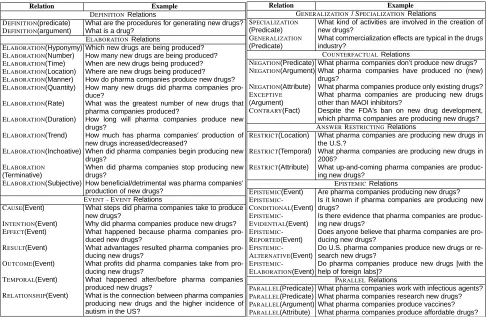
Figure 4: Relations between questions and examples. The examples were obtained when decomposing the complex ques-tion “What pharmaceutical companies produce new drugs?”.
We believe that the relations that exist between a question and its decompositions may be of semantic nature (e.g. def-initions, generalizations) or of discourse nature (e.g. elabo-rations, causes, effects, parallelisms). Furthermore, unlike discourse relations introduced by various coherence the-ories, the relations between questions have an argument. This argument may take any of the values: (1) PREDI -CATE, (2) EVENT, (3) ARGUMENT, (4) ATTRIBUTE, or
(5) HYPERNYMY/HYPONYMY. The first four values
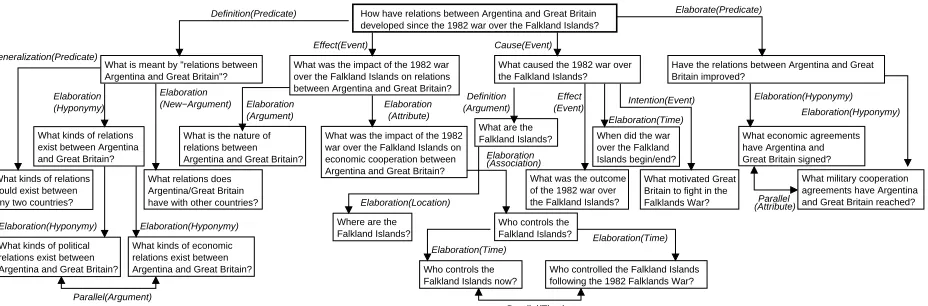
re-fer to a predicate, event, argument or attribute detected in the mother-question, which will also be referred by the daughter-question. The last value (hypernymy/hyponymy) indicates that there is such a semantic relation (defined in WordNet) between a pair of concepts, one for the mother-question, one for the daughter-question. For example, in Figure 2 we illustrate several relations between questions that are labeled EFFECT(Event). This type of relation indi-cates (1) that the EAT of the decomposed question is a class of concepts that are caused by some event; and (2) the event is explicit in both questions. In Figure 2, the referred event is the 1982 war between Argentina and Great Britain. We have considered eight different classes of relations between questions that can be used to perform semantic question de-compositions. The relations are illustrated in Figure 4. When decomposing complex questions in a top-down man-ner, we need to have access to five forms of information: /1.the predicate-argument structures of current question; /2.the EAT of the current question;
/3.the most relevant relations obtained from the topic sig-nature of the text collection;
/4.association-information connecting the question to the most likely decompositions.
Predicate-argument structures are provided by shallow se-mantic parsers trained on PropBank2and NomBank3. The EAT of the question is discovered with the technique
re-ported in (Pasca and Harabagiu, 2001). The most
rel-evant relations from the question topic are identified by the enhanced representations of topic signatures reported in (Harabagiu, 2004). For each EAT we have created a large set of 4-tuples(e1, r, e2, A), that we call association information. The association information consists of (1) e1, the EAT of the mother-question; (2)r, the relation be-tween the pair of questions; (3)e2, the EAT of the daughter-question; and (4) A, the alignment information between the two questions. To produce the alignment information, we have used a lexical alignment module that was built for our Textual Entailment system called GROUNDHOG, which was described in (Hickl et al., 2006). The lexical align-ment module, trained on 460,000 alignalign-ment pairs, uses a maximum entropy classifier that generates alignment in-formation with a precision of 90.2% and recall of 94.4%. Figure 5 illustrates the association information relating two questions from Figure 2.
When generating a decomposition, we use the associa-tion informaassocia-tion to build associaassocia-tion rules similarly to the method introduced in (Nahm and Mooney, 2000). The as-sociation information is akin to the fillers of a template. Therefore, by representing it as binary features that are pro-vided to a decision tree classifier (C5.0 (Quinlan, 1998)), we generate automatically association rules from the deci-sion rules of the classifier. In order to find the new
informa-2
http://www.cis.upenn.edu/∼mpalmer/project pages/ACE.htm
3
3.1. Method 1
Each complex question is associated with a cluster of doc-uments from which the MDS needs to be produced. For each cluster of documents, two topic signatures T S1 and T S2 are automatically devised. T S1 were introduced in (Lin and Hovy, 2000) as a list of ranked terms that are rel-evant to the topic discussed in the document cluster. Each relevant term received a weight, given by likelihood ratios. T S2, introduced in (Harabagiu, 2004), represent a topic by its relevant binary relations (between concepts). Each rela-tion is also weighted.
In this method, keywords were extracted automatically from each subquestion, and stopwords were removed. These keywords were then associated with sets of alter-nations originally developed for the automatic Q/A system (Harabagiu et al., 2005a). A sample of these alternations for two different terms is provided in Figure 9. All the key-words extracted from all decomposed questions and their alternations are collected in a set Ka. Each sentenceS
from the document cluster receives a score which is equal to the sum of (a) the number of topic-relevant terms from T S1encountered inS; (b) the number of topic-relevant re-lations fromT S2encountered inS; and (c) the number of keywords fromKawhich are recognized inS.
benefit:advance, advantage, aid, ameliorate, assist, avail, better, build, contribute to, favor, further, improve, make it, pay, pay off, profit, promote, relieve, serve, succor, work for, acquire, derive, come by, receive, find, collect, obtain, help, payment
problem: state, resolve, difficulty, condition, affairs, effort, overcome, grapple, bear, bitch, predicament, quandry, plight, extricate, difficult, unplesant, trying, awkward, entangle, pinch, fix, holem, jam, mess, muddle, pickle, situation, hard, rough, stress, strain, job, trouble, hindrance, wrinkle, interfere, question, matter, issue
Figure 9: Alternations for the question keywords benefit and problem
Summary answers were generated by merging the top-ranked sentences selected from each subquestion into a sin-gle paragraph. Two simple optimizations were then per-formed to improve the overall quality and legibility of sum-maries. In order to reduce redundancy, we used a semantic parser to create predicate-argument structures for each sen-tence included in the summary; lower-ranked sensen-tences that featured the same predicate-argument structure as higher-ranked sentences were dropped from the summary. In addi-tion, we attempted to resolve pronouns in summary sen-tences by including the immediately preceding sentence from the sentence’s original document; if this immediately preceding sentence also contained a pronoun, both sen-tences were dropped from the summary. This process was repeated until the summary reached a total of 250 words.
3.2. Method 2
Top-down question decompositions do not have any sen-tences associated with them as answer. Bottom-up question decompositions have such sentence-answers known, due to the process in which they were created. However, it is not clear whether the answers selected from the bottom-up question decomposition are the most informative an-swers for the complex question. This observation is im-portant, since, as detailed in Section 4, less than 25% of the questions produced by the two decomposition methods are identical or overlap. Therefore, we chose to use all question decompositions and to find their answers with a
Q/A system that was tuned such that it ranks on the first place the known answers of the questions devied by the bottom-up process. To achieve this goal, we tuned the parameters of the density score for the answer extraction detailed in (Harabagiu et al., 2005a). The rank of each sentence is given by the Density V alue(sentence) =
Density(keywords) × M atch Quality(keywords) × M atchProximity(keywords). Density(keywords) is
the ratio kS
kQ, where kS counts the number of keywords
and alternations extracted from any question decomposition that are matched in the sentence, whereaskQis the
cardi-nal of the set of keywords. The match-quality score uses three values for each keyword matching: (a) 1.0 for perfect match, (b) 0.8 for morphological variation, and (c) 0.6 for semantic synonyms. The match-quality score adds these corresponding values for every keyword matching. Finally, the keyword-proximity score takes pairs of keywords and it favors keywords matched in the same clause (value = 1.0) over keywords matched in the same sentence (value = 0.7), or keywords matched in the same paragraph (value = 0.5). Sentences ranked with this method were sent to the sum-mary generator that proceeded similarly to Method 1.
3.3. Method 3
Textual Entailment evaluated in the PASCAL RTE chal-lenges was used as another method for selecting sentences for MDS. We have used the textual entailment system de-scribed in (Hickl et al., 2006) to decide whether a sentence can be entailed or not from a decomposed question. The TE system generates a YES/NO answer as well as a confidence score in the entailment decision. We have ranked each sen-tence from the document cluster that was entailed by at least one question decomposition by the entailment confidence. After this ranking was produced, sentences were sent to the summary generator that continued the processing similarly to Method 1.
4.
Evaluation Results
Multi-Document Summarization can be evaluated by sev-eral scores: (1) the ROUGE metric (Lin, 2004), (2) the Pyramid score (Nenkova and Passonneau, 2004), and (3) the responsiveness score. We selected to evaluate the im-pact of question decompositions by using the responsive-ness score. The responsiveresponsive-ness score, is given by a compu-tational linguist who selects an integer value between 1 and 5 to assess his/her satisfaction with the information con-tained in the summary as an answer to the question. A score of 1 represents the least responsive summary and 5 is given to the most responsive summary.
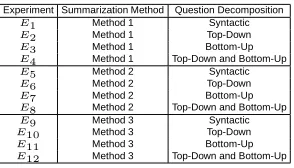
Experiment Summarization Method Question Decomposition E1 Method 1 Syntactic
E2 Method 1 Top-Down
E3 Method 1 Bottom-Up
E4 Method 1 Top-Down and Bottom-Up
E5 Method 2 Syntactic E6 Method 2 Top-Down E7 Method 2 Bottom-Up E8 Method 2 Top-Down and Bottom-Up
E9 Method 3 Syntactic
E10 Method 3 Top-Down E11 Method 3 Bottom-Up E12 Method 3 Top-Down and Bottom-Up
Table 3: Description of Experiments.
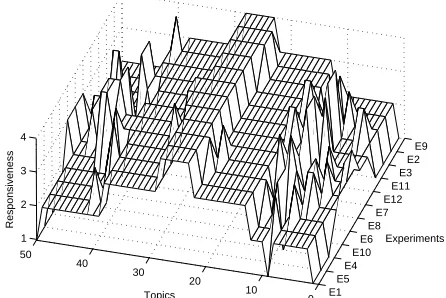
twelve different experiments, which are listed in Table 3. The results of the experiments for the 50 topics from DUC-2005 are illustrated in Figure 10. The best results were ob-tained for 14 topics.
E1 E5
E4 E10
E6 E8
E7 E12
E11 E3 E2
E9
0 10 20 30 40 50 1 2 3 4
Experiments
Topics
Responsiveness
Figure 10: The responsiveness score for the 50 topics, using the twelve summarization methods.
When we wanted to measure the impact of question de-composition on multi-document summarization, we com-pared the results of the experiments listed in Table 3 against three baseline experiments in which no question decompo-sition is available.BE1is the baseline experiment in which Method 1 uses only the keywords extracted from the com-plex question. BE2 is the baseline experiment in which the density value of sentences is measured by using only
keywords extracted from the complex question. BE3 is
the baseline experiment in which textual entailment is per-formed between the sentences and the complex question. By computing the difference in responsiveness score be-tween the results obtained in the experiments listed in Ta-ble 3, and the baseline experiments, we have found that the largest impact (25%) of question decomposition for MDS was obtained in experimentE8for the seven topics that in-cluded topics D385 – “Electric Automobile Development”, and D401 – “Foreign minorities in Germany”. The least im-pact (8%) was obtained in experimentE1, which however produced competitive scores in the DUC-2005 evaluations.
5.
Conclusions
In this paper we presented three methods for question decomposition that enable improved results for question-driven multi-document summarization. The first method decomposes questions based on syntactic information, whereas the other two use semantic and coherence infor-mation for question decomposition. One of the semantic question decomposition methods operated in a top-down manner, whereas the other operates in a bottom-up man-ner. In experimental results, we have found that by combin-ing the two semantic-based question decomposition meth-ods we achieved the highest responsiveness scores, which were improved by 25% from results that are produced by baseline methods that have no access to question decompo-sitions.
6.
Acknowledgments
This material is based upon work funded in whole or in part by the U.S. Government and any opinions, findings,
conclusions, or recommendations expressed in this material are those of the authors and do not necessarily reflect the views of the U.S. Government.
7.
References
Regina Barzilay and Lillian Lee. 2003. Learning to
paraphrase: An unsupervised approach using multiple-sequence alignment. In HLT-NAACL.
T. Clifton and W. Teahan. 2004. Bangor at TREC 2004: Question Answering Track. In Proceedings of the Thir-teenth Text Retrieval Conference.
S. Harabagiu, D. Moldovan, M. Pasca, M. Surdeanu, R. Mi-halcea, R. Girju, V. Rus, F. Lacatusu, P. Morarescu, and R. Bunescu. 2001. Answering Complex, List and Con-text Questions with LCC’s Question-Answering Server. In Proceedings of the Tenth Text REtrieval Conference. S. Harabagiu, D. Moldovan, C. Clark, M. Bowden,
A. Hickl, and P. Wang. 2005a. Employing Two Ques-tion Answering Systems in TREC 2005. In Proceedings of the Fourteenth Text REtrieval Conference.
Sanda Harabagiu, Andrew Hickl, John Lehmann, and Dan Moldovan. 2005b. Experiments with Interactive Question-Answering. In Proceedings of the 43rd Annual Meeting of the Association for Computational Linguis-tics (ACL’05).
Sanda Harabagiu. 2004. Incremental Topic Representa-tions. In Proceedings of the 20th COLING Conference, Geneva, Switzerland.
Andrew Hickl, John Williams, Jeremy Bensley, Kirk Roberts, Bryan Rink, and Ying Shi. 2006. Recogniz-ing Textual Entailment with LCC’s Groundhog System. In Proceedings of the Second PASCAL Challenges Work-shop (to appear).
F. Lacatusu, A. Hickl, P. Aarseth, and L. Taylor. 2005. Lite-GISTexter at DUC 2005. In Proceedings of the Document Understanding Workshop (DUC-2005) Pre-sented at the HLT/EMNLP Annual Meeting.
Chin-Yew Lin and Eduard Hovy. 2000. The automated acquisition of topic signatures for text summariza-tion. In Proceedings of the 18th COLING Conference, Saarbr¨ucken, Germany.
Chin-Yew Lin. 2004. ROUGE: a Package for Automatic Evaluation of Summaries. In Proceedings of the Work-shop on Text Summarization Branches Out (WAS 2004), Barcelona, Spain.
Un Yong Nahm and Raymond J. Mooney. 2000. A Mutu-ally Beneficial Integration of Data Mining and Informa-tion ExtracInforma-tion. In Proceedings of the Seventeenth Na-tional Conference on Artificial Intelligence.
Ani Nenkova and Rebecca Passonneau. 2004. Evaluat-ing Content Selection in Summarization: the Pyramid Method. In HLT-NAACL 2004, Boston, MA.
Marius Pasca and Sanda Harabagiu. 2001. High Perfor-mance Question/Answering. In Proceedings of the 24th Annual International ACM SIGIR Conference.