Pivot-Based Topic Models for Low-Resource Lexicon Extraction
John Richardson† Toshiaki Nakazawa‡ Sadao Kurohashi†
†Graduate School of Informatics, Kyoto University, Kyoto 606-8501 ‡Japan Science and Technology Agency, Kawaguchi-shi, Saitama 332-0012
[email protected], [email protected], [email protected]
Abstract
This paper proposes a range of solutions to the challenges of extracting large and high-quality bilingual lexicons for low-resource language pairs. In such scenarios there is often no parallel or even comparable data available. We design three effective pivot-based approaches inspired by the state-of-the-art technique of bilingual topic mod-elling, extending previous work to take advantage of trilingual data. The pro-posed models are shown to outperform tra-ditional methods significantly and can be adapted based upon the nature of available training data. We demonstrate the accu-racy of these pivot-based approaches in a realistic scenario generating an Icelandic-Korean lexicon from Wikipedia.
1 Introduction
Data-driven approaches to natural language processing have been shown to be greatly effec-tive, and the case of bilingual lexicon extraction is no exception. Recent advances in this area have enabled the construction of large, high-quality bilingual lexicons, requiring less parallel data by making use of comparable corpora.
While such comparable corpora are readily available for many language pairs, particularly when one of those languages is English, previous direct approaches fail when there is no such data available. For many language pairs there sim-ply does not exist comparable (and even less so parallel) data. Even for languages with a large
volume of available parallel data, most corpora cover only limited domains.
There are two natural methods to deal with this problem: constructing or mining new data for the direct approach, and finding new ways to make better use of what data is already avail-able. For an example of the construction of comparable corpora, see Zhu et al. (2013). We take the second approach and design pivot-based models for bilingual lexicon extraction. The ma-jor advantage of using a pivot language is that it is possible to take advantage of the large volume of comparable data sharing a common language such as English.
present a variety of solutions to this problem, demonstrating their application to a practi-cal scenario, and compare their effectiveness to mainstream approaches.
2 Related Work
The use of pivot models has been a common theme in the development of Natural Language Processing systems that deal with low-resource languages. In the field of Machine Transla-tion, pivot models can be used in both decoding and the construction of parallel training data. Utiyama and Isahara (2007) give a comparison of possible methods for integrating a pivot lan-guage into phrase-based SMT systems.
Bilingual lexicon extraction has had a long history of using pivot languages. Tanaka and Umemura (1994) build a pivot lexicon by com-bining bilingual dictionaries, and more recently there have been attempts to extract lexicons or paraphrase patterns (Zhao et al., 2008) from bilingual corpora. A common problem with the use of a pivot language is associated noise, lead-ing to a number of studies aimlead-ing to improve pivot lexicons, such as by using cross-lingual cooccurrences (Tanaka and Iwasaki, 1996) and ‘non-aligned signatures’ (Shezaf and Rappoport, 2010), a form of word context similarity.
Bilingual lexicon mining from non-parallel data has seen much popularity in recent years. Studies have considered a variety of methods such as canonical correlation analysis (Haghighi et al., 2008) and label propagation (Tamura et al., 2012). We use the method of bilingual topic modelling (Vulić et al., 2011), which has been recently applied to a variety of fields such as transliteration mining (Richardson et al., 2013).
3 Model Details
We consider the task of translating a source wordsfrom languageS to a target wordtfrom language T. The baseline model is a direct ap-proach using S-T training data. After describ-ing the baseline model (bildescrib-ingual LDA), we in-troduce three novel methods of taking advantage of data including a pivot languageP, such as S-P +P-T and S-P-T data.
3.1 Baseline: Bilingual LDA
We begin with a baseline non-pivot lexicon ex-traction model MST : S ×T → R that gives
a similarity score to a source-target word pair (usingS-T training data).
The non-pivot lexicon extraction model MST
makes use of a bilingual topic similarity mea-sure. We elected to use bilingual topic mod-els rather than the more intuitive method of comparing monolingual context vectors (Rapp, 1995) as we believe topic modelling is more suit-able for processing uncommon language pairs. This is because a bilingual seed lexicon is re-quired for methods that learn a mapping be-tween source and target vector spaces, such as Haghighi et al. (2008), in order to match cross-language word pairs. This data is unlikely to be available in sufficient quantity for low-resource language pairs, however comparable documents can be found from sources such as Wikipedia.
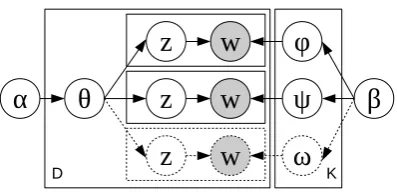
We base our implementation on the state-of-the-art system of Vulić et al. (2011) for com-parison. This method uses the bilingual Latent Dirichlet Allocation (BiLDA) algorithm (Mimno et al., 2009), an extension of monolingual LDA (Blei et al., 2003). Monolingual LDA takes as its input a set of monolingual documents and generates a word-topic distributionϕclassifying words appearing in these documents into seman-tically similar topics. Bilingual LDA extends this by considering pairs of comparable docu-ments in each of two languages, and outputs a pair of word-topic distributions ϕ and ψ, one for each input language. The graphical model for polylingual LDA is illustrated in Figure 1.
In order to apply bilingual topic models to a lexicon extraction task, we must construct an effective word similarity measure for trans-lation candidates. This can be achieved by a variety of methods comparing the similarity of K-dimensional word-topic vectors. We use the simple and well-studied cosine similarity mea-sure (as defined below) to meamea-sure the similar-ity between topic distribution vectorsψk,we and
approximate algorithm collapses into the exact method as b increases. If there are many s to translate, it would be possible to cache theMP T,
further improving the performance.
See Figure 2 for an illustration of our search algorithm.
3.4 ‘Box’ Model
For many low-resource language pairs there does not exist source-target or trilingual data and therefore the pivot model is the only available option. However this is not always the case. For comparison we create one further model, the ‘box’ model, using all available data.
The ‘box’ model uses source-pivot, pivot-target, source-target and source-pivot-target data. The data is combined by creating (source, pivot, target) triples for each document. For each languageL, if there is a version of the doc-ument written inL, we add it to the triple, oth-erwise we insert an empty string. We liken this method to packing boxes, one per document for each language, with whatever data is available. These triples are then used to train a trilingual topic model as in Section 3.2.
This approach has the advantages of avoiding noise and search errors that can be introduced by the pivot model in Section 3.3, however it re-lies on the availability of sufficient training data. When such data is not available we are still able to use the pivot model.
4 Experiments
In this section we consider a task where we wish to extract a Korean-Icelandic (KO-IS) and Icelandic-Korean (IS-KO) lexicon from compa-rable Wikipedia documents using English (EN) as a pivot language. This is a realistic sce-nario in which we have a sufficient quantity of aligned pivot-source and pivot-target document pairs but considerably less source-target data. We chose this language pair to demonstrate the effectiveness of our model on both low-resource and distant language pairs. English was the most natural pivot language for this task, how-ever in some cases it might be preferable to use a different language.
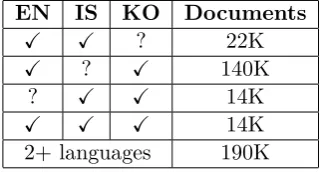
The topic models were all trained on document-aligned Wikipedia data. We ex-tracted these documents from mid-2013 Wikipedia XML dumps and they were aligned using Wikipedia ‘langlinks’. The distribution of aligned document pairs including combinations of these three languages is shown in Table 1.
EN IS KO Documents
✓ ✓ ? 22K ✓ ? ✓ 140K
? ✓ ✓ 14K
✓ ✓ ✓ 14K
2+languages 190K
Table 1: Number of aligned documents for each lan-guage combination. ✓ means ‘included’, ? means ‘possibly included’. The last row shows the number of documents containing at least 2 languages.
Note that there is considerably less IS-KO data than for either EN-IS or EN-KO (only 60% of EN-IS, 10% of EN-KO). In fact the majority of trilingual data covers the same documents as the IS-KO subset, as the documents with IS and KO data very commonly also have an English version.
While it is true that there does exist some IS-KO data in Wikipedia that could be used di-rectly to build an IS-KO lexicon, we show that there is not enough to extract translation pairs with high accuracy. Furthermore, we also show that the proposed pivot model in Section 3.3 functions well without requiring any of this data.
4.1 Settings
We used an in-house English lemmatizer and tokenizer to prepare the English data. Ice-landic data was processed with IceNLP (Lofts-son and Rögnvalds(Lofts-son, 2007) and Korean ana-lyzed with HanNanum (Park et al., 2010). For each language we extracted the most frequent 100K nouns for our experiments, a vocabulary size over 10 times larger than in previous work (Vulić et al., 2011).
KO EN IS
물고기
(fish)
water
fish
shark
vatn (water)
fiskur (fish)
drekka (drink)
hákarl (shark)
0.90.8
0.4
0.5
BiLDA BiLDA
0.3 0.9
0.2
ís (ice)
...
...
Figure 2: An illustration of the beam search algorithm using b = 2. The numbers shown are example similarity scores and the red arrows show the optimal path.
Wikipedia vocabulary and translating these by hand into Korean and Icelandic. For comparison the same test data was used for all experiments. We used the PolyLDA++ tool (Richardson et al., 2013) to generate multilingual topic mod-els. The training was run over 1000 iterations using K = 2000topics. We set the LDA hyper-parameters as α = 50/K and β = 0.01, which are the settings used most commonly in previous work on topic modelling.
The models were evaluated by generating an n-best list of translations for each word in the test set. The following statistics were then mea-sured for the extracted lexicon, whererankiwas
the rank given to the correct translation in the n-best list (∞ if not in n-best list). We used n = 10. We also used b = 10 for the search beam width.
• Top-1 accuracy:
1
N
N ∑
i=1
δranki,1 (3)
• Mean Reciprocal Rank (MRR):
1
N
N ∑
i=1
1
ranki
(4)
Lang Pair Method Top-1 MRR
IS-KO baseline 0.265 0.334 pivot 0.310 0.365
KO-IS baseline 0.220 0.286 pivot 0.240 0.321
Table 2: Results of direct/pivot comparison experi-ment.
4.2 Comparison between Direct and Pivot Model
Before applying the proposed pivot-based ap-proaches to a realistic lexicon extraction sce-nario, we first verified the effectiveness of the pivot model in Section 3.3 using a controlled data set.
We consider a task where we have a corpus of aligned triples of (EN, KO, IS) documents. Our data contained 14K triples (see Table 1) with a combined vocabulary size of 30K nouns. The experiment is to test the effectiveness of using the KO-IS data directly (baseline) with the non-pivot modelMST against using the pivot model
MSP,P T with only KO-EN and EN-IS data.
S
P
T
Test data
(S-P-T articles)
S
T
Baseline ('direct')
Only use S-T data.
S
P
T
Pivot
Only use S-P and P-T.
P
Figure 3: Training data used for direct/pivot comparison experiment.
EN KO
IS
EN KO
IS
EN KO
IS
EN KO
IS
baseline trilingual pivot box
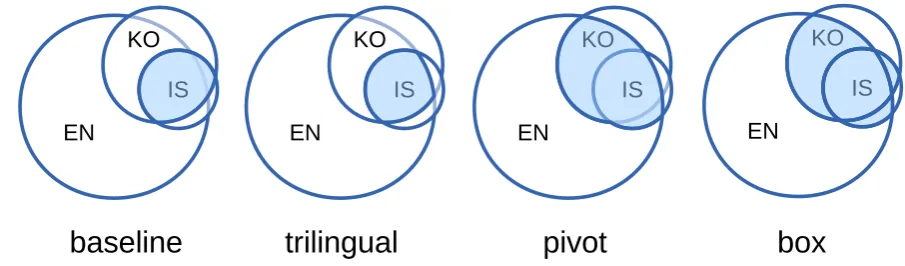
Figure 4: Subsets of Wikipedia data required for each method.
and non-pivot training sets. The organization of the training data is shown in Figure 3.
Table 2 shows the experimental results. These results show that when the same amount of data is available the pivot model is even more effective than using the source-target data directly.
In fact the scores are higher for the pivot model and we believe there could be two reasons for this. Despite the same number of documents being used, the English articles are on average longer than their Icelandic and Korean counter-parts and this could improve the effectiveness of training.
It is also possible that many of the Icelandic and Korean articles were produced by partially or fully translating their corresponding English pages. This would lead to a tighter similarity in the models containing the pivot language.
4.3 Lexicon Extraction Experiment
We now turn to the main experiment, in which we consider the task of extracting a bilingual lexicon from Wikipedia for a low-resource lan-guage pair (IS-KO and KO-IS). In order to demonstrate the practical application of the pro-posed model, we use all the available data in Wikipedia, combining pivot and non-pivot mod-els.
• The baseline score (‘baseline’) is calculated for the non-pivot model MST using only
KO-IS data. This emulates the current state-of-the-art non-pivot lexicon extrac-tion algorithm, which is only able to use the KO-IS data and model for direct trans-lation. See Section 3.1.
data, which in practice is the most difficult to obtain. See Section 3.2.
• The pivot score (‘pivot’) is evaluated for the proposed pivot modelMSP,P T, able to make
use of the KO-EN and EN-IS data. See Section 3.3.
• The score (‘box’), using all possible data, is constructed by combining baseline (KO-IS), pivot (EN-KO, EN-IS) and trilingual (EN-KO-IS) data. See Section 3.4.
Figure 4 shows the data that is required (and was used) for each method. The results of the experiment are shown in Table 3.
Lang Pair Method Top-1 MRR
IS-KO
baseline 0.255 0.324 trilingual 0.350 0.428 pivot 0.380 0.459
box 0.420 0.495
KO-IS
baseline 0.230 0.296 trilingual 0.315 0.392 pivot 0.305 0.398
box 0.390 0.475
Table 3: Results of lexicon extraction experiment.
5 Analysis and Discussion
It can be seen from the results that all three pro-posed models considerably outperform the base-line. This demonstrates that these approaches are able to improve the quality of extracted lex-icons for low-resource language pairs by making use of pivot language data, giving a large accu-racy improvement over previous work.
An interesting observation is that the trilin-gual model is able to greatly improve upon the baseline even though it uses less training data. It is probable that the addition of the addi-tional language (English) has helped to reduce the noise in the Korean-Icelandic model by sta-bilizing the document-topic distribution.
The pivot approach further improves on this by making use of the relatively large volume of EN-KO and EN-IS data. Furthermore, the
Candidate Meaning Score
결혼 marriage 0.875
남편 husband 0.796
아내 wife 0.756
약혼 engagement 0.732
결혼식 wedding 0.726
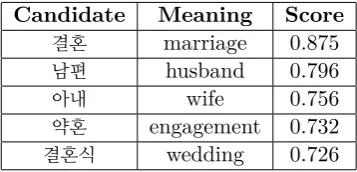
Table 4: An example of a good translation: ‘hjóna-band’ (marriage).
Candidate Meaning Score
스튜어트 Stewart 0.355
주장 claim 0.327
반증 disproof 0.301
논란 controversy 0.296
증언 testimony 0.289
Table 5: An example of a bad translation: ‘tilgangur’ (purpose).
pivot model score is not far from the most effec-tive method ‘box’, which requires all the data, some of which is difficult in general to obtain (trilingual and KO-IS data). This shows that the pivot model is still able to compete with a model trained directly on source-target data.
The most effective method was the ‘box’ ap-proach and this is perhaps to be expected as it was able to make use of the largest volume of data. For relatively high-resource language pairs this method is likely to be the most effec-tive as more data is available, however the pivot model becomes the only available option as the source-target data becomes sparse. When the necessary data is available, the ‘box’ approach can improve upon the pivot model.
how-Rank Pivot p Target t MSP(s, p) MP T(p, t) Score
1 feminism 나혜석 (Na Hyeseok) 0.902 0.969 0.873 2 feminism 여자 (woman) 0.902 0.967 0.871
3 feminism 여성 (female) 0.902 0.907 0.818
... ... ... ... ... ...
9 feminism 여학교(girls’ school) 0.902 0.517 0.466 10 wife 아내 (wife) 0.315 0.914 0.288
Table 6: Analysis of translation for ‘kona’ (woman), showing high clumping.
Rank Pivot p Target t MSP(s, p) MP T(p, t) Score
1 world 세계(world) 0.712 0.851 0.606 2 world 월드(world) 0.712 0.619 0.441 3 cosmos 창조 (creation) 0.278 0.965 0.268 4 cosmos 만물 (all things) 0.278 0.928 0.258 5 universe 우주론(cosmology) 0.225 0.973 0.219 6 universe 빅뱅 (big bang) 0.225 0.965 0.217
Table 7: Analysis of translation for ‘heimur’ (world), showing less clumping.
ever seems not to reduce the quality of the out-put, as we did not notice any significant change in the MRR scores when adding the restriction that only one target word could be generated from any pivot word. An example with less clumping is shown in Table 7.
6 Conclusion and Future Work
In this paper we have presented three novel pivot-based approaches for bilingual lexicon ex-traction with low-resource language pairs. The proposed models are able to generate a high-quality lexicon for language pairs with no direct source-target training data, and we have shown that each model considerably outperforms a state-of-the-art non-pivot baseline. With a vari-ety of approaches it is possible to select an ap-propriate method based on the size and nature of available training data.
There is much still to explore in the area of the construction of lexicons for low-resource lan-guage pairs. A possible extension to the pro-posed model is to use a larger pivot base, of not just one but of multiple pivot languages acting as a form of interlingua, similar to the idea in Dabre et al. (2014). This could improve the quality of the model in cases where there is not
such a clear choice for an appropriate pivot lan-guage.
Another possibility for improvement is remov-ing the assumption that there is an appropriate pivot word, using instead a direct mapping be-tween the word-topic vector spaces for source-pivot and source-pivot-target topic models.
In the future we would like to use the pro-posed method to improve machine translation by extracting a large lexicon and applying it to a low-resource translation task.
Acknowledgments
We would like to thank the reviewers for their instructive comments. The first author is sup-ported by a Japanese Government Scholarship (MEXT).
References
David Blei, Andrew Ng and Michael Jordan. 2003. Latent Dirichlet Allocation. In The Journal of Machine Learning Research, Volume 3.
Aria Haghighi, Percy Liang, Taylor Berg-Kirkpatrick and Dan Klein. 2008. Learning Bilingual Lexicons from Monolingual Corpora. In ACL 2008. Hrafn Loftsson and Eiríkur Rögnvaldsson. 2007.
IceNLP: A Natural Language Processing Toolkit for Icelandic. InInterspeech 2007.
David Mimno, Hanna Wallach, Jason Naradowsky, David Smith and Andrew McCallum. 2009. Polylingual topic models. In EMNLP 2009. Park, S., Choi, D., Kim, E., and Choi, K.-S. 2010.
A plug-in component-based Korean morphological analyzer. InHCLT 2010.
Reinhard Rapp. 1995. Identifying Word Transla-tions in Non-Parallel Texts. InACL 1995. John Richardson, Toshiaki Nakazawa and Sadao
Kurohashi. 2013. Robust Transliteration Mining from Comparable Corpora with Bilingual Topic Models. InIJCNLP 2013.
Daphna Shezaf and Ari Rappoport. 2010. Bilin-gual Lexicon Generation Using Non-Aligned Sig-natures. InACL 2010.
Akihiro Tamura, Taro Watanabe and Eiichiro Sumita. 2012. Bilingual Lexicon Extraction from Comparable Corpora Using Label Propagation. In
EMNLP-CoNLL 2012.
Kumiko Tanaka and Hideya Iwasaki. 1996. Extrac-tion of lexical translaExtrac-tions from non-aligned cor-pora. InConference on Computational Linguistics 1996.
Kumiko Tanaka and Kyoji Umemura. 1994. Con-struction of a bilingual dictionary intermediated by a third language. InConference on Computa-tional Linguistics 1994.
Masao Utiyama and Hitoshi Isahara. 2007. Compar-ison of Pivot Methods for Phrase-based Statistical Machine Translation. InNAACL 2007.
Ivan Vulić, Wim De Smet and Marie-Francine Moens. 2011. Identifying Word Translations from Comparable Corpora Using Latent Topic Models. InACL 2011.
Shiqi Zhao, Haifeng Wang, Ting Liu and Sheng Li. 2008. Pivot Approach for Extracting Paraphrase Patterns from Bilingual Corpora. InACL 2008. Zede Zhu, Miao Li, Lei Chen, Zhenxin Yang. 2013.