Page 1 of 62
Optimizing cost effectiveness
and flexibility of air taxis
A case study for optimization of air taxi operations
Author:
Bart de Jong, BSc. [email protected]
Thesis MSc. Business Information Technology Haarlem, September 2007
Etirc Aviation Dreef 32
2012 HS Haarlem The Netherlands Supervisor
Drs. Teun Mentzel
Page 2 of 62
Management Summary
In the near future, Etirc Aviation will provide air taxi operators with solutions for cost-effective fleet and network management. This study has researched the
requirements for optimization of air taxi operations and techniques for the scheduling of air taxi services. On the basis of this research, this study has developed and tested an algorithm that implements a cost-effective scheduling solution for single operators. The optimization of air taxi operations requires both cost effectiveness and flexibility of operations. The optimization of cost effectiveness and flexibility is the combination of optimization of the air taxi network, the use of flexible time windows for flight scheduling and the use of an efficient algorithm for dispatching aircraft. The dispatch process is a dynamic problem. The air taxi business requires that the effect of
schedule dynamics on operations is minimized. With these requirements, the air taxi optimization problem can be best solved through a dynamic programming approach. A dynamic programming algorithm was developed for this study. In simulations of a real-life case study, this algorithm was able to provide cost optimization, support for time windows and produce a stable operational schedule.
For a selected case study, the algorithm has proven to be more cost effective and flexible than the currently best alternative. Under normal operating conditions, an average 5.5% cost advantage is offered on the cost of empty legs. The addition of a two-hour time window in operations increases the customer acceptance rate with 2-3%. This flexibility can be used to decrease the fleet size, which saves further cost. Most importantly, the developed algorithm is better able to handle unforeseen disruptions and minimizes their negative effects. The algorithm can perform 60% of disrupted flights, instead of the 25% offered by current scheduling solutions.
The developed algorithm is does not guarantee an optimal solution. The algorithm sacrifices 5 to 10% performance in cost optimality. In return for sacrificing some cost optimality, the algorithm offers air taxi operators the operational stability and
Page 3 of 62
Preface
At the time of writing, it is exactly one year ago that I started to create plans for my graduation assignment. I spoke to Mr. Pieper about my wish to graduate in a startup company with innovative services. Through Mr. Pieper, I got into contact with Etirc and Mr. Mentzel. I was lucky to be asked for the project that had caught my eye: Aviation. The assignment required me to move to Haarlem. It is now been half a year since my moving to Haarlem. I will be moving out of Haarlem soon, but I am
thinking about returning sometime in the future for a longer period.
I requested Mr. Van Eck and Mr. Pieper to be supervisors for my graduation
assignment. I am very grateful that they accepted my request and for all the guidance and advice they have provided me with.
It took me a bit more time to select a focus in my research than had I hoped. The amount of research in the field of transportation and optimization is huge and diverse. With the help of Mr. Mentzel, I was able to focus on the business problem and select a research focus. I would like to thank Mr. Mentzel for introducing me to the air taxi business, for all his critical and practical advise and for the enjoyable time at Etirc. On a personal level, I wanted the results of my work to be both useful for further research and well as directly practical for Etirc. The combination of a real-life case study and the creation of a prototype solution offered me that opportunity. The process of creating a prototype was time consuming and frustrating at times. However, the direct results made the effort rewarding.
In the end, I am glad to say that I have delivered the deliverables that I planned in the time I originally planned for it. I enjoyed working with my colleagues at Etirc and I have felt challenged during my assignment. There is still a lot to be done in the air taxi business. I hope that the end-results of my work will be a valuable contribution for Etirc and the future of all air taxi businesses.
Page 4 of 62
2.3 Problem statement ...11
2.4 Research questions ...12
2.5 Research method ...12
3 Literature on transportation ...13
3.1 Definitions...13
3.2 Demand for transport...13
3.2.1 Customer request ...14
3.2.2 Time windows ...14
3.2.3 Cyclic demand influences ...14
3.2.4 Demand simulation models ...15
3.3 Modelling and optimizing air operations...15
3.3.1 Aircraft routing ...16
3.3.2 Crew rotation, crew rostering and duty period regulations...16
3.3.3 Aircraft maintenance and maintenance scheduling ...17
3.3.4 Disruptions ...17
3.3.5 Disruption prevention ...18
3.3.6 Schedule recovery...19
3.4 Conclusion ...19
4 Air taxi operations...20
4.1 Demand for air taxi services ...20
4.2 Modelling air taxi operations ...20
4.2.1 Dispatch definition...20
4.2.2 Flight route ...21
4.2.3 Crews and home bases ...22
4.2.4 Aircraft maintenance...22
4.3 Dispatching process ...22
4.4 Disruption handling ...23
4.5 End-of-day procedure ...24
4.6 Conclusion ...24
5 Literature on air taxi operational costs ...25
5.1 Definitions...25
5.2 Direct and indirect operating costs ...26
5.2.1 Costs of a flight operation ...26
5.2.2 Fuel cost ...26
5.2.3 Aircraft maintenance cost...26
5.2.4 Aircraft cost...26
5.2.5 Insurance cost ...27
5.3 Indirect operating cost ...27
Page 5 of 62
6 Cost modelling for air taxi operations...28
6.1 Cost types in air taxi operations ...28
6.2 Relating air taxi operations and their variable costs...29
6.2.1 Cost of flight hours ...29
6.2.2 Airport and navigational fees ...29
6.2.3 Hotel accommodation costs...29
6.3 Conclusion ...30
7 Transportation optimization models and algorithms...31
7.1 Definitions...31
7.2 Problem classification...31
7.3 Dial-a-ride optimization algorithms ...32
7.3.1 Exact algorithms ...32
7.3.2 Heuristics...32
7.3.3 Meta-heuristics ...33
7.4 Conclusion ...35
8 An optimization model for air taxis ...36
8.1 Requirements...36
8.2 Assumptions ...36
8.3 Algorithm selection ...37
8.4 Conclusion ...37
9 Dispatch algorithm simulation...38
9.1 Building the algorithm...38
9.2 Simulation setup ...38
9.2.1 Case study...38
9.2.2 Benchmark...38
9.2.3 Logical tests...39
9.2.4 Simulation machine configuration...40
9.3 Algorithm calibration...40
9.4 Simulation environment and variables ...40
9.4.1 Simulation technique...40
9.4.2 Fleet size...40
9.4.3 Scenarios ...40
9.4.4 Time window size...41
9.5 Test setup ...41
9.5.1 Test 1 : Performance under normal operations...41
9.5.2 Test 2.1 : Flexibility for handling disruptions...42
9.5.3 Test 2.2 : Flexibility for implementation of an end-of-day procedure ....43
10 Results...44
10.1 Cost optimization under normal conditions ...44
10.1.1 Results on the customer acceptance rate ...44
10.1.2 Results on minimization of empty leg cost ...46
10.1.3 Results on the percentage of empty legs ...47
10.1.4 Results on the average flight hours per aircraft year ...48
10.2 Cost optimization in time of disruptions...49
10.2.1 Results on minimization of delay ...49
10.2.2 Results on rescheduling flexibility...50
10.3 Results of the end-of-day procedure...51
11 Conclusions and recommendations ...52
11.1 Answers to research questions ...52
Page 6 of 62
11.3 Research reflection ...54
11.3.1 Scientific value ...54
11.3.2 Business value ...54
11.3.3 Evaluation of research method ...54
11.3.4 Internal validation ...54
11.3.5 External validation...54
11.3.6 Further research ...55
List of definitions...56
References...58
Appendix A: European legislation on flight time limitations...62
List of figures
Figure 1 - trip composition for airline, automobile and air taxi travel... 7Figure 2 - Etirc backbone ... 9
Figure 3 – activities of Etirc and air taxi operators... 9
Figure 4 - black box of an air taxi operator ...11
Figure 5 - research tree...12
Figure 6 - demand forecast methodology...13
Figure 7 - demand as a function of the time of day ...14
Figure 8 – sequential steps in the air scheduling process...15
Figure 9 - two routes modelled as directed graph...16
Figure 10 - schematic of a crew rotation...17
Figure 11 – frequency and duration of delays in airline operations ...18
Figure 12 - delay chain...18
Figure 13 – a dispatch is a scheduled trip that is part of a single aircraft route ...20
Figure 14 - example of a 24 hour flight route...21
Figure 15 - a relocation flight in an aircraft route...21
Figure 16 – the dispatch process...23
Figure 17 - dynamics in air taxi operation...24
Figure 18 - flight profile as defined by the EAE ...25
Figure 19 - cost structure of air operations...27
Figure 20 – operational cost decomposition by cost type ...28
Figure 21 - cost decomposition for optimizable operational costs ...30
Figure 22 - classification of the dial-a-ride problem...31
Figure 23 - A 2-opt optimization change ...33
Figure 24 - schematic representation of Simulated Annealing Algorithm...34
Figure 25 - schematic display of a Genetic Algorithm ...34
Figure 26 - benchmarking with and without time windows...39
Figure 27 - acceptance rate without time windows...44
Figure 28 - acceptance rate with and without time window...45
Figure 29 - average empty leg cost ...46
Figure 30 - percentage empty legs of the test algorithm ...47
Figure 31 - hours of active aircraft usage per year ...48
Figure 32 - duration of a delay due to a prior delay...49
Figure 33 - ability to reschedule disrupted flights ...50
Figure 34 - frequency of crew rest at home...51
Page 7 of 62
1 Introduction
The year 2006 saw the introduction of the first certified Very Light Jet (VLJ). These Very Light Jets have a take-off weight of less than 4540 kilograms. The introduction of these aircraft is creating a new market for quick and affordable point-to-point transport. This has also created a new market for air taxi services. In this market, Etirc will unroll a service network for Air taxi operators. To be an attractive business partner for air taxi operators, Etirc will offer services that will strengthen the operational efficiency of the operators.
This document is the MSc. Thesis of Bart de Jong. The research for this thesis was performed at Etirc in Haarlem, between January 15th and July 30th. The result of this research is an advise on a technique to optimize the cost-effectiveness and flexibility of air taxi operators.
1.1 Air taxi business model
The value proposition of an air taxi operator for its customer is the value of time saved. The door-to-door travel time is shortened by air taxis. Firstly by flying to smaller airports that are closer to the customer’s origin and destination, thereby decreasing the travel time to an airport (see Figure 1). Secondly, by offering a shorter boarding time. Due to the smaller volume of travellers and lesser security checks, the boarding process is faster than with traditional airlines. Denial-of-service is kept to a minimum. More than 95% of customer requests will be accepted and serviced.
Figure 1 - trip composition for airline, automobile and air taxi travel
Adapted from Mane, 2006
The target customers for the air taxi services are business travellers. Air taxi operators fill a gap between slow auto travel, affordable but rigid business class flights and expensive but flexible charter flights. Air taxis offer full service with an arranged pilot and pickup, while air charters require the customers to arrange these themselves. Overall, the drivers for air taxi services are related to time, cost and travel
Page 8 of 62
Travellers can only be serviced if the route that the traveller wishes to travel is in the network that is operated by the operator. The services are distributed to the customer on-demand. In the point-to-point and on-demand business model, the customer requests are considered for acceptance on a First-in-First-Out basis.
The revenue model of air taxi operators is based on leg price. The main factor that will shape air taxis’ ability to compete with business aviation, car and train travel will be the cost of airfares. This places a price pressure on the airfares. To be
cost-effective, an air taxi operator has to create a flexible and cost-efficient configuration of fleet, crew and covered airports.
The reduced cost of ownership for VLJs drives many initiatives to enter the air taxi market. This will probably lead to a diversification of networks, services and
customer segments. In the long term, more competition in the market of personal air-based business travel will probably lead to a further pressure on the price of airfares. Only those air taxi operators that manage their fleet and network effectively will be strong enough to survive the competition.
1.2 Etirc Aviation
Etirc Aviation (Etirc) operates in the domain of personalized business flights in both Europe and Russia. The customer base of Etirc is formed by air taxi operators that are operating Very Light Jets (VLJ). Etirc is developing a business that offers cost-effective fleet and network management for air taxi operators. Current air taxi
operations typically use 70 to 80% of their capacity. Etirc will offer fleet and network solutions that improve cost effectiveness. The added value of these services for air operators is the fact that the solutions will lower their operational cost and strengthen the operators in surviving the expected price pressure on airfares.
Etirc has organized its services in four key business divisions: 1. Asset Management
Providing financial services like fleet financing services, aircraft leasing and tax optimization;
2. Fleet services
Offering a real-time scheduling and operations system, enabling rapid pricing; 3. Crew services
Services for handling human resource matters, including contracting pilots and payroll services;
4. Jet services
Page 9 of 62
The strategy of Etirc is the creation of a Virtual Jet Network (VJN) through a “Backbone”. This Backbone will create a VJN as an ASP service. The primary function of the Backbone is to offer cost-optimizing tools to air taxi operators. Air taxi operators will be connected to the services of this backbone, see Figure 2.
Figure 2 - Etirc backbone
The strategy and execution of both Etirc and its customers are summarized in Figure 3. It is visible that air taxi operators focus on customers, while Etirc focuses on cost optimization of supporting services and on offering these services in a network of operators.
development of a Virtual Jet Network
strategy
execution
employee training, crew pool, aircraft lease/finance aircraft maintenance
service backbone Etirc
personalized business travel
operating daily flights
customer contact booking & billing Air taxi operators
Page 10 of 62
1.3 Document structure
This document researches cost and flexibility optimizing solutions for air taxi operators and tests a selected solution technique. This introduction has defined the context. The second chapter define the research problem and research approach. The third chapter focuses on air taxi operation in literature, while the fourth chapter creates a model specifically for air tax operations. The operational model is turned into a cost model through chapters 5 and 6.
After formulating a cost model, the focus is shifted to cost optimization. Chapter 7 and 8 research optimization solutions for the air taxi problem and select the most suitable optimization technique. Chapter 9 describes the creation of an algorithm prototype and defines tests that where performed to measure its performance. Chapter 10 discusses the results of the tests. Finally, chapter 11 writes the conclusions and advises Etirc on optimization of air taxi operations.
Literature on
Cost modeling for air taxi operations
Chapter 8
Optimization models for the air taxi problem
Page 11 of 62
2 Problem definition
2.1 Project context
A demand for services that optimize the cost-effectiveness of operations for air taxi operators is expected. Etirc plans to offer these services to air taxi operators in Europe and Russia and needs to know what the cost factors in air taxi operations are and how these cost factors can be optimized.
2.2 Research objective
The objective of this research is to find one or more optimization techniques that improve the cost-effectiveness and flexibility of air taxi operators and to prove the effectiveness of those techniques in a case study.
2.3 Problem statement
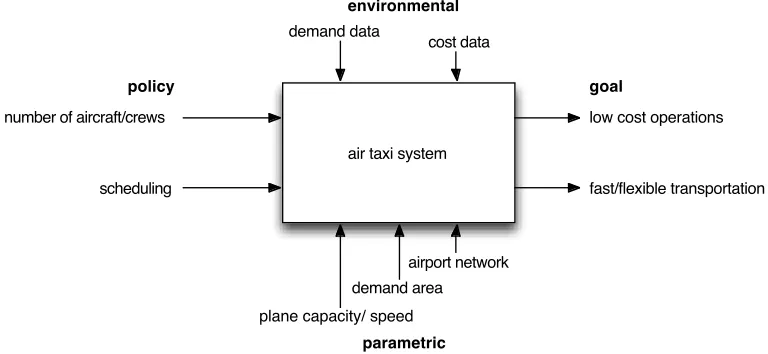
Air taxis have existed for some years, but in many different forms. For the purpose of this study, an air taxi is defined as a personal means of business travel that uses Very Light Jets (VLJ) to provide on-demand flight services. An air taxi is operated by an air taxi operator, which owns and manages several VLJs over a network of airports. An operator is driven by the demand in the demand area that is covered by its airport network. The system of an air taxi operator is depicted as a black box in Figure 4.
air taxi system
Figure 4 - black box of an air taxi operator
Adapted from Bailey, Clark, 1992
The costs of an air taxi operator consists of a fixed overhead and incremental
operational costs. The number of revenue flights determines the revenue of an air taxi operator. There are two basic pricing methods for a revenue flight: per flight leg, or per seat. In the early stages of air taxi services, it is assumed that flights are sold on a per leg basis. The demand is considered exogenous and fixed. With a fixed pricing system and a fixed demand volume, the revenue is also a fixed value. Cost
Page 12 of 62
The scheduling policy is considered the only variable in the air taxi system. The scheduling solution of an air taxi operator determines its ability to offer cost-efficient and flexible services. It is not known what kind of scheduling solutions are available for air taxi systems and what scheduling solution is the most suitable.
2.4 Research questions
The central research question for this master-thesis is:
What are the operational costs of air taxi operations, which factors determine these costs and what is an effective scheduling solution for the minimization of these costs through services oriented at air taxi operators?
This central research question can be split into four sub-questions:
1. What factors form the variable operational costs of a single air taxi operator? 2. How can the cost minimization problem be modelled?
3. What optimization techniques can be used to create optimal solutions? 4. Which solutions can Etirc implement for these optimizations and how can
these solutions be customized?
2.5 Research method
The research objective is maximizing the cost-effectiveness of air taxi operators. The nature of the research is diagnostic practice-oriented. The effectiveness of the selected solution is tested through simulations. The research focuses on the cost structure of air taxi operations and on optimization techniques for operations scheduling. The
resulting research framework is shown in Figure 5.
1. air taxi business
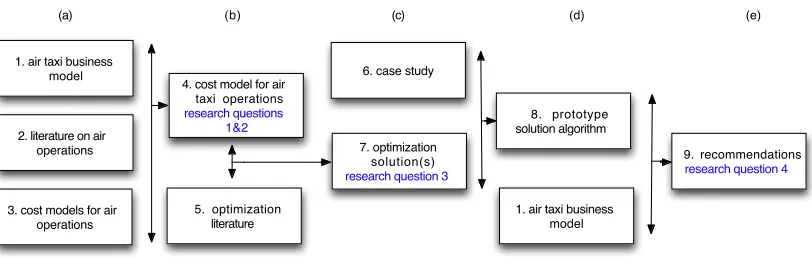
Figure 5 - research tree
(a) An analysis of the air taxi business model, air operations and costs of air taxi operations results in (b) a cost model for air taxi operations. This cost model is confronted with research on transportation optimization. This will results in (c) a selection of the most suitable optimization technique. The confrontation of a prototype based on the selected optimization technique with a case model in a simulation will result in prototype solution for the utilized case study. The
Page 13 of 62
3 Literature on transportation
The introduction chapter has described the business model of air taxi operators. Cost effectiveness and flexibility are important qualities in the air taxi business.
Optimizing of cost and flexibility requires an optimization model. However, at this stage, Etirc has no detailed operational models or cost models for air taxis. These models have to be created. This chapter surveys literature on demand for
transportation, air operations and methods of modelling demand and operations.
3.1 Definitions
The field of transportation has several terms that are used throughout literature and practice. The term trip is frequently used in the field of transportation. A trip is defined as “a single period of non-stop travel from one point to another”. In the field of aviation, a trip is often called a leg. A trip (or leg) is often a paid service towards a customer. When a trip is paid for by a customer it is called a revenue trip. Likewise, trip that are not paid for by a customer are non-revenue trips. In the field of aviation, a non-revenue trip is also called an empty leg. An empty leg is an important concept for cost optimization.
3.2 Demand for transport
The size of transport operations is based on the demand for transport. The specific demand for flight services can be determined from the total demand for
transportation. The total demand for transport is mostly dependent on
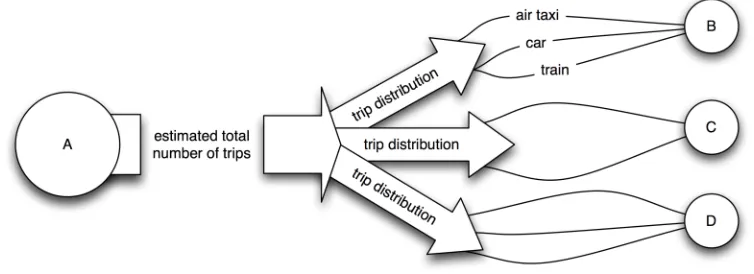
socio-economical factors like income and the distance between home and work. The total demand for transport is often estimated as a total number of trips starting from a single region. The total number of trips can be distributed to trips between individual zones. For each of these zone-trips, the number of trips using an individual
transportation mode is estimated. This is depicted in Figure 6 (adapted from Teodorovic, 1988).
Figure 6 - demand forecast methodology
Page 14 of 62
that each trip can be analyzed independently from other trips and that the time-of-day dimension can be ignored (Kitamura et al, 2000).
3.2.1 Customer request
The previous paragraph showed that total demand can be split into individual trips or ‘requests for transport’. In the air taxi domain, such a trip is called a customer request. Each customer request consists of (Bonnefoy 2005):
- An origin airport; - a destination airport; - a requested departure time.
A customer request is sent in at a specific time. The request is placed hours, days or months ahead of the requested departure time. The period between the request being entered and its requested departure time is called the schedule window.
3.2.2 Time windows
Often, a request for transport has no fixed departure time but is set for a certain time window with an earliest acceptable departure and latest acceptable arrival time (Teodorovic 1988, Cordeau 2004, Savelsbergh 2005). For example: a customer may express the wish that his departure time is somewhere between 1 PM and 3 PM. This constitutes a two-hour time window. Time windows create more flexibility when flights are scheduled, but increase the complexity of the flight scheduling process.
3.2.3 Cyclic demand influences
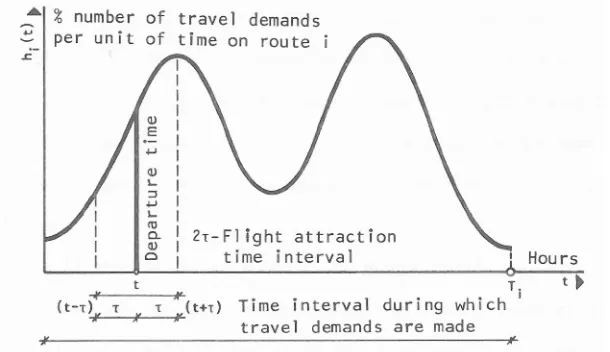
The demand for transport suffers from seasonal influences. Demand also fluctuates during the day. In airline traffic, the demand for transport can be modelled as two peaks a day (Teodorovic, 1988). There is a demand-peak in the morning and a second demand-peak in the early evening. The demand as a function of time of day is
depicted in Figure 7.
Figure 7 - demand as a function of the time of day
Page 15 of 62
3.2.4 Demand simulation models
Due to the complexity of socio-economical demand estimations, very few researchers (Wong et al. 2003) use a socio-economical demand model. Simplified demand models are often applied. In situations where demand is highest just before the moment of transportation, as is the case with urban taxis, an exponential distribution is useful to model demand (Bailey and Clark, 1992). For more complex demand distributions, a Poisson function can be used (Schroeter, 1983).
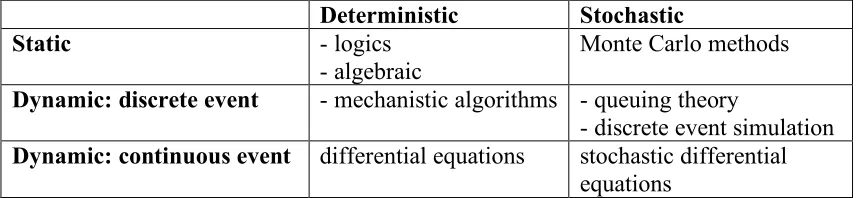
Most research into transportation optimization utilizes a discrete event model to simulate reality. A discrete event model handles demand on a per request basis. This creates a realistic simulation, but it has the disadvantage that it is computationally complex for larger problems. A discrete event model can be simplified to form an aggregate model that aggregates the effects of all events in a period (Lee et al., 2006). The type of demand problem determines the type of simulation model that is best. Table 1 list the characteristics of demand problems and the applicable simulation techniques.
Deterministic Stochastic
Static - logics
- algebraic
Monte Carlo methods
Dynamic: discrete event - mechanistic algorithms - queuing theory
- discrete event simulation
Dynamic: continuous event differential equations stochastic differential equations
Table 1 - study methods for different demand types
Source: Jurkat, M.P., Discrete Event Simulation Systems
3.3 Modelling and optimizing air operations
Air taxi operations resemble airline operations. Both perform cost optimizations. However, the primary focus of airliners is load maximization, while air taxis are focused on minimization of empty legs. Before describing the specific characteristics of air taxis, this paragraph will describe the basics of optimizing air operations.
Figure 8 – sequential steps in the air scheduling process
Page 16 of 62
flight schedules are created, the operator performs a second scheduling step: the scheduling of aircraft and crews. The aircraft routing process and the crew routing process are usually separated in order to facilitate problem solving (Teodorovic, 1988). However, it is often significantly more cost-efficient to integrate the aircraft and crew routing processes (Freling et al., 2003, Mercier, 2005). After creating routes, the third step is the assignment of specific crews and aircraft to the created routes.
3.3.1 Aircraft routing
An aircraft route is a path that a single aircraft performs to execute any number of scheduled flights. The routing problem is often modelled as nodes on a directed graph (Desrochers, 1992, Ombuki, 2004).
Figure 9 shows an example with two routes. Every node in the graph denotes a customer request. Every arc between nodes denotes that those two customer requests can be sequenced. Not all flights can be
sequenced, due to constraints on departure time and the fact that an aircraft can only be at one location at any time.
Every arc can have a cost involved. This is the cost of sequencing its two flights. These costs are either monetary (based on the cost of performing required flights), a time duration (flight duration) or both. With this modeling technique, the cost optimization of operations is effectively turned into an optimizable shortest path problem, that can be solved with existing optimization techniques.
Figure 9 - two routes modelled as directed graph
3.3.2 Crew rotation, crew rostering and duty period regulations
A crew rotation is the path that a single crew performs to execute any number of scheduled flights. Crew rotations are created to minimize the number of crews needed and can be modelled in a similar fashion as aircraft routings. After crew rotations are created, the rotations can be assigned to specific crews. This process is called
Page 17 of 62
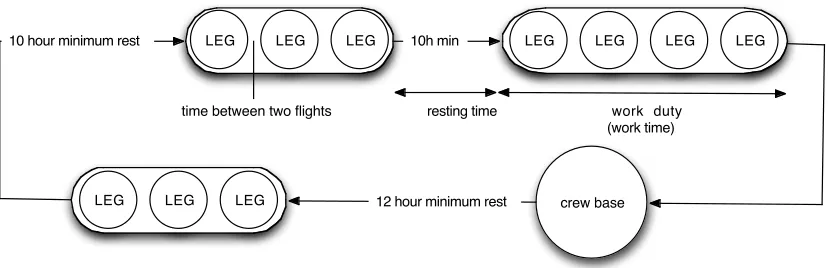
LEG LEG LEG LEG LEG LEG LEG
LEG LEG LEG crew base
resting time
time between two flights work duty
(work time)
12 hour minimum rest
10 hour minimum rest 10h min
Figure 10 - schematic of a crew rotation
Adapted from Ball and Roberts, 1985
3.3.3 Aircraft maintenance and maintenance scheduling
Aircraft maintenance is a constant that can be included in operator schedules. Aircraft are required to be inspected at periodically (Teodorovic, 1988, Gopalan, 1998). The frequency of maintenance checks depends on the combination of number of flight hours and the number of take-off and landing cycles (Feo, Bard, 1989). The number of flight hours and take-off landing cycles is quite constant in airline operations, as are the flight routes. As a result, maintenance can be pre-scheduled. In practice, maintenance is often not implemented in the first design of a flight schedule. Most operators send the design of a flight schedule to their maintenance department for consideration. The maintenance requirements are then added to the aircraft routing.
3.3.4 Disruptions
During the execution of their flight schedule, aircraft and crew suffer schedule
disruptions. Disruptions are a form of constraints on operations that cannot be fully implemented into operational plans. Disruptions in operations are caused by tardy customers, weather conditions, shortage of resources or airfield delays. The cost of disruptions for airlines range from 2% to 3% of annual revenue. (Barnhart, 2003). There are two types of disruptions. A short disruption is a delay. A delay is a
Page 18 of 62
Figure 11 – frequency and duration of delays in airline operations
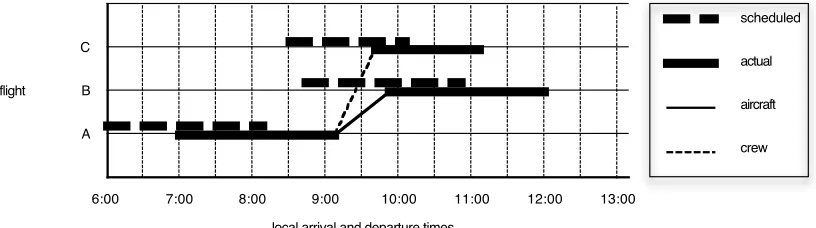
Figure 12 shows how a prior delay of a flight can cause the further delay of the crew and the aircraft. Most delays are between 15 and 45 minutes (FAA, 2007). The Bureau of Transportation Statistics considers a flight on time if it operated less than 15 minutes later than the scheduled time shown in the operator’s schedule. A delay that is shorter than 15 minutes will not be noticeable to the customer. However, if the duration of a delay/disturbance is longer, it can cause scheduled flights to be
cancelled.
A B C
6:00 7:00 8:00 9:00 10:00 11:00 12:00 13:00
scheduled
actual
aircraft
crew
local arrival and departure times flight
Figure 12 - delay chain
Adapted from Barnhart, 2003
3.3.5 Disruption prevention
Schedule disruptions can be prevented by increasing flexibility of the flight schedule or by predicting disruptions and including these predictions into the flight schedule. Aircraft failure for example can be modelled as a function of the time since the last maintenance check (Bonnefoy, 2005). Airline operators usually include some room for unexpected maintenance requirements in their flight schedules.
Specific airports can cause disturbances due to congestion, security issues or weather conditions. During winter season, some airports are frequently closed due to
Page 19 of 62
3.3.6 Schedule recovery
The previous paragraph on disruptions has pointed out that some disruption may be prevented. For those disruptions that could not be prevented, there is a need for recovery methods. When aircraft or crews are taken out of operations or when flights are delayed, an operator can use one of four recovery strategies to remove the
disruption (Teodorovic, 1988, Barnhart, 2003): a) Introduce more aircraft into the operations;
b) design a new airline schedule so that no planned flights are cancelled, but with a number of flights being delayed;
c) cancel a number of planned flights with a certain number of remaining flights being delayed;
d) cancel a number of planned flights, with no remaining flight being delayed; From a customer’s perspective, the first strategy is the most attractive, as it prevents any negative effects for the customer. However, extra aircraft can be costly.
Cancelling flights will safeguard any future scheduled flight, but will also disappoint customers and potentially result in a loss of customers. Delaying flight prevent flight cancellation. However, flight delays can upset an entire flight schedule. A delay might not always be acceptable to the customer.
What recovery strategy an operator prefers depends on how the operator weighs cost versus service to passengers.
3.4 Conclusion
Transportation operations are scheduled on the basis of demand. Demand can be predicted or simulated. On the basis of demand, operations can be scheduled. With the use of special modelling techniques, these schedules can be optimized. However, when executed, such optimized schedules will suffer from disruptions. Any model to describe air taxi operations will have to include considerations like demand
Page 20 of 62
4 Air taxi operations
The previous chapter has described the operations in transportation and air industry. The operations of air taxi operators can be characterized as a combination of the flexibility of urban taxis and the cost optimization of airliners. However, the operations of air taxis are also very different from operations of airliners and urban taxis. This chapter models the operations of air taxi operations. This model will serve as the basis for cost modelling in chapter 6.
4.1 Demand for air taxi services
The distribution of demand for air taxi services over time can be described by the standard demand curve for transportation (see Figure 7). There is a high demand for transport during the morning and late afternoon and low demand during the night hours. Demand for air taxi services is dynamic and stochastic. Unlike airliners, air taxis cannot create flight schedules before actual demand is apparent. This requires the demand to be handled on a per-request basis, where an demand for transport is entered into an existing schedule. Scheduling a particular aircraft to service a particular request is called a dispatch.
4.2 Modelling air taxi operations
All air taxi operations can be modelled on the basis of dispatches, aircraft routes and an end-of-day procedure. The next paragraphs will define these concepts.
4.2.1 Dispatch definition
A customer request is accepted by scheduling that request as a dispatch. A dispatch is defined as a time scheduled trip that is part of a single aircraft’s flight route. A dispatch has an origin and a destination and a pre-determined departure time. This departure time may still have some time-flexibility (a time window). A dispatch can be scheduled to service a particular customer request, but it can also be scheduled for any other reason that requires an aircraft to be relocated. A schematical display of a dispatch is given in Figure 13.
Figure 13 – a dispatch is a scheduled trip that is part of a single aircraft route
Page 21 of 62
The Etirc business model utilizes a two-hour time window. A customer can request a specific departure time. Etirc will then try to schedule the request between one hour earlier and one hour later. If the request cannot be scheduled, the request is denied service.
4.2.2 Flight route
Every dispatch is part of a flight route. A flight route is actually a set of subsequent dispatches for a single aircraft. Unlike airlines, air taxi routes are dynamic and may change during the day. The duration of a route is arbitrary. Dispatches can be constantly added. A flight route consists of:
- The aircraft tail number;
- a set of dispatches assigned to the aircraft; - the crew assigned to a sequence of dispatches.
An example of a 24-hour flight route is depicted in Figure 14. Dispatches are depicted in the figure by an arrow.
Figure 14 - example of a 24-hour flight route
If the arrival airport of a dispatch does not match the departure airport of the subsequent dispatch in the same route, then the aircraft needs to be relocated. Relocation flights are non-revenue trips or empty legs.
Figure 15 is a sequence diagram that depicts an example flight route. The solid lines depict a revenue flight; the dashed arrow from C to B depicts a relocation flight. The figure shows that the number of empty legs and the length of the empty legs are determined by the flight schedule and thus by the dispatcher. A route is optimal if the number of relocation flights is minimized.
Page 22 of 62
4.2.3 Crews and home bases
During active operation, each aircraft has a single crew aboard to perform flight operations. Multiple crews can serve on the same aircraft on the same day. A crew can be replaced only if the destination of one of its dispatches is the home base of that crew.
The crew regulations for air taxis are the same as those for airliners (see paragraph 3.3.2). An air taxi crew starts its duty rotation (see Figure 10) at its home base. A duty rotation is made up of one or more duty periods. If a duty period ends at a base other than the crew’s home base, the crew requires hotel accommodations (hotac). At the end of its rotation, the crew always returns to its home base. The flight that returns the crew to its home base is called the return-to-base.
4.2.4 Aircraft maintenance
The Very Light Jets are sent in for periodic maintenance after 50, 300 and 500 active flight hours. Before any aircraft is sent in for maintenance, its crew is first returned to its home base. After maintenance is performed, it is assumed that the aircraft is returned to that home base.
Air taxis have to include maintenance into the flight schedule. Each maintenance shift can be scheduled into the route of an aircraft as a dispatch with a fixed origin and destination. The duration of such a dispatch can be set at any required length, from a couple of hours to several weeks. Contrary to airliners, air taxi maintenance cannot be scheduled far ahead of time. Although the number of flight hours and take-off landing cycles for an air taxis are probably quite constant, the air taxi flight routes are not. Like urban taxis, an end-of-day procedure is required to determine when aircraft will be put in for maintenance. The concept of an end-of-day procedure is described in paragraph 4.5.
4.3 Dispatching process
The previous paragraphs showed that the process that the scheduling of a dispatch is initiated by a customer request, maintenance requirements or the end-of-day
procedure. The objective of the dispatching process is two-fold. Firstly, to minimize the denials to customers. The second object is the minimization of cost.
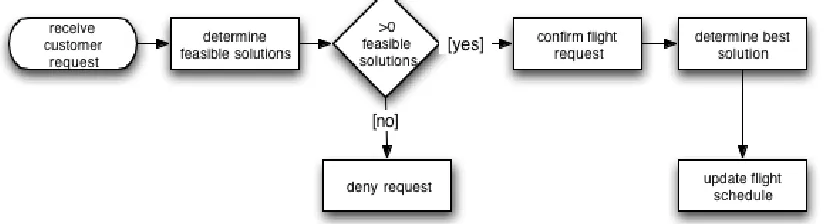
While the airline scheduling process has three steps (see Figure 8), the dispatching process has only two. The routing and rostering step are integrated into a single step. The first step in dispatching is to determine if a feasible dispatch can be scheduled to service the request. A potential dispatch is feasible when:
- It can be sequenced with other dispatches of the same aircraft without overlap; - the aircraft can perform the dispatch without breaking restrictions;
- the crew can perform the dispatch without breaking duty regulations.
Page 23 of 62
If and only if there is at least one feasible dispatch is the second step of the dispatches process initiated. The second step is to select the best available dispatch and include it into the flight schedule. Usually the selection of a dispatch is based on cost, but it can also be based on quality of service. The operator will then update the flight schedules to include the selected dispatch. The dispatching process is depicted in Figure 16.
Figure 16 – the dispatch process
4.4 Disruption handling
The previous chapter has shown that aircraft operations suffer from multiple
disruptions. Dispatches that cannot be performed as scheduled due to a disruption can be rescheduled to a later time, scheduled for another aircraft route or be cancelled (see paragraph 3.3.6). Air taxi operators want to minimize the number and size of delays that customers suffer and minimize the number of flights that is cancelled due to a disruption. When handling disruptions, Etirc uses this prioritization:
1. Minimize the number of cancelled flights; 2. minimize the delay noticed by the customer; 3. minimize the costs of handling the disruption.
From a scheduling perspective, a disruption is related to a particular aircraft for a particular period (e.g. aircraft breakdown) or to a particular dispatch (e.g. due to a short delay). A breakdown can be included in the schedule by modelling the
disruption as a special dispatch with a fixed origin and destination and can be set for a fixed time.
A time window has a special added value if a dispatch needs to be rescheduled due to a disruption. A bigger time window increases the chance that a disrupted dispatch can be rescheduled. Within the Etirc case study, the time window of disrupted dispatches is increased to include a maximum delay of two hours.
Page 24 of 62
4.5 End-of-day procedure
The air taxi schedule problem is almost fully static and deterministic during evening hours. The demand during the evening hours is low (see Figure 7) and demand for the next day is largely known. Due to the static and deterministic character of the dispatch problem, the end of the day is the best time to consider rest and maintenance
considerations and optimize them accordingly.
The inclusion of crew rest into the flight schedule is one of the primary roles of the end-of-day procedure. The end-of-day procedure can send crew back to rest at their home base. The decision to send crews back to their home base is made on the basis of the scheduled flight routes and cost parameters from the business model. There are three different situations wherein the end-of-day procedure can decide to send a crew to its home base:
1. Route passing home base
The last dispatch of the day ends at the home base and/or the first dispatch of the next day requires the aircraft at the home base. The crew is sent to rest at home as early as possible.
2. Affordable return trip
If the crew can be send home for a cost below a set cost, the end-of-day procedure schedules an extra dispatch that returns the crew to its home base. 3. Long idle time
If the aircraft is idle for a period that is longer than a predetermined duration, then the aircraft is send to the home base by scheduling an extra dispatch.
4.6 Conclusion
Air taxi operations are dynamic due to their on-demand character. This requires that operations be scheduled on a dispatch basis. Customer request and maintenance periods can be scheduled on a dispatch basis. Disruptions can be entered into existing flight schedules as a special kind of dispatch.
The flight schedule can be changed at any moment in time. Most customers place their flight requests up to hours before actual departure. Due to this scheduling window, the dispatch schedule is a sliding window that contains a combination of a fully dynamic schedule and a semi-fixed schedule. This is depicted in Figure 17. As a result of the sliding window, the optimization of operations is a continuous process. There is only one event that is always fixed in time: the end-of-day procedure. The end-of-day procedure uses the knowledge of the semi-fixed schedule together with the more dynamic schedule to optimize long-term consideration on the basis of the fixed and the dynamic schedule.
Page 25 of 62
5 Literature on air taxi operational costs
The previous chapter has defined the operational processes of air taxi operators. Cost optimizing these processes requires a cost model. Up to date there are no detailed cost calculation methods for air taxi services (Fiertz, 1999, Mane and Crossly 2006). Existing cost calculation methods for air taxis merely express the economic value of time saved by air taxi transport. This chapter surveys literature on cost of air
operations to be able to build an air taxi cost model in chapter 6.
5.1 Definitions
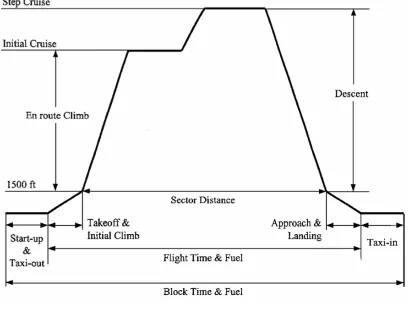
A lot of cost functions in aviation are expressed using special flight profile
terminology. The terminology distinguishes periods of flight and flight preparation. The total time an aircraft is in the air is called the flight time. Before and after each flight, a short handling time is required for fuelling and basic maintenance. The total time of taxi out, take off, flight, landing and taxi is called the block time. This block time is equal to the entire duration of a dispatch. These definitions are given in the flight profile of the Association European Airlines (AEA), as visualized in Figure 18.
Figure 18 - flight profile as defined by the EAE
Page 26 of 62
5.2 Direct and indirect operating costs
The operational costs of air operations can be split into direct costs and indirect costs. The direct costs are related directly to an aircraft and its flight operation and are usually expressed as cost per mile or cost per hour. The most common method for direct cost calculation is the “Standard method of estimating comparative direct operating costs of turbine powered transport airplanes” of the Air Transport Association of America (ATA). The model expresses costs based on aircraft characteristics like cruise speed, weight and crew size. The rest of this paragraph discusses these cost related parameters.
5.2.1 Costs of a flight operation
The cost of a flight operation is based on crew costs, aircraft costs, fuel costs, airport fees and any additional costs. The cost of the crew can be considered fixed, but can also be considered variable on the basis of flight hours (Pant et al., 1995) or can be spread over the cost of other utilized resources (Isikveren, 2002).
5.2.2 Fuel cost
Fuel cost is one of the biggest costs of a flight operation. The ATA standard has a complete cost model for fuel costs. The costs are a function of the fuel per flight block, the cost per fuel unit, the cost of oil for the engines, the number of engines and the block distance. In extensive empirical research into optimal flight techniques, Isikveren (2002) has created a calculation model for minimum fuel costs. Attributes that increase fuel costs are cruising speed and climb/decent speed. Fuel cost is decreased by a greater flight height. However, forty years of statistics shows that the cost function can be simplified to a simple calculation of the required fuel weight in kilograms for a block distance and the price per kilogram of fuel (Pant et. al, 1995).
5.2.3 Aircraft maintenance cost
Aircraft maintenance cost can be split into time-dependent and cyclic components (Isikveren, 2002). A lot of maintenance costs, like air conditioning, instruments and windows, are dominantly dependent on time and usage. Other costs, like maintenance of landing gear and wings, are dominantly time-cyclic and require maintenance on a time-cyclic base. However, these costs can be correlated to the average sector
distance flight time (ATA 1969, Isikveren 2002). As a result maintenance costs can be defined as a function with an almost linear dependency on flight time.
5.2.4 Aircraft cost
Two constructs are considered for financing an aircraft: acquisition and leasing. The cost of acquisition is related to repayment of an initial capital outlay, plus any interest costs. Most literature on aircraft depreciation assumes that an aircraft is depreciated to a residual value of 0% over a depreciation period (Pant et al., 1995). The aircraft interest costs are based on the aircraft’s acquisition price times an interest rate. Fixed depreciation and interest cost can be used (Isikveren, 2002). It may also be
Page 27 of 62
5.2.5 Insurance cost
The ATA standard considers aircraft insurance (or hull insurance) costs a function of the aircraft acquisition cost times a insurance rate, split over the number of utilized flight hours. The passenger insurance can be determined as either the number of flight hours (Pant et al., 1995) or the function of the number of passengers and the distance covered by an aircraft (Isikveren, 2002).
5.3 Indirect operating cost
Indirect operating costs (IOC) are those airline costs not directly connected with the actual flight of the aircraft. An exhaustive list of indirect costs is supplied by Kroo (2006): The size of these indirect costs can only be estimated from statistics (Kroo, 2006). On average, the total of indirect costs for an airliner shows a relationship with the direct operational costs. As a result, most indirect cost can be associated with direct costs, which simplifies calculation models.
5.4 Conclusion
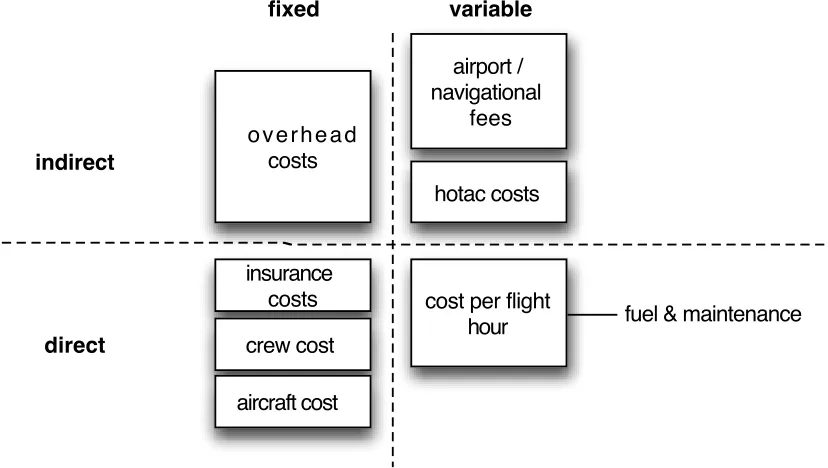
The cost structure of air operations is visualized in Figure 19. The direct variable cost can all be aggregated to form a fixed cost per flight hour. The indirect variable costs are related to the scheduled flight routes and crew rotations. Based on this knowledge, the next chapter builds a cost model for air taxis.
o v e r h e a d
Page 28 of 62
6 Cost modelling for air taxi operations
The previous chapter surveyed cost aspects of air operations. Most cost can be simplified to hourly flight cost and the cost of fees. This chapter builds a cost model for the variable cost of air taxi operations. This cost model will serve as the basis of cost optimization of air taxi operations.
6.1 Cost types in air taxi operations
The cost modelling of air taxis operations is simplified by assuming a fixed cost price per flight hour. This is a valid assumption, as cost per flight hour is very constant, even at different utilization rates. For the same reason, Etirc adopted an hourly rate for its services. The cost per flight hour includes the following costs:
- Fuel consumption; - crew cost;
- third party fees (Etirc services); - progressive and periodic maintenance.
The cost per trip is dependent on the cost per flight hour and the length of the trip, but also the airport fees, navigational fees and the required crew hours. With a fixed cost per flight hour, a fixed flight length and fixed airport and navigational fees, the cost of every trip can be pre-determined. Costs that are not included in the cost per trip are overhead costs and aircraft acquisition or leasing. Figure 20 depicts the cost
decomposition of air taxi operations. The aircraft and aircraft insurance costs are summarized as ‘fleet costs’.
Page 29 of 62
6.2 Relating air taxi operations and their variable costs
The previous paragraph defined the types of variable costs that air taxi operators incur. The variable operational costs are mainly formed by the trip costs. Chapter 4 has shown that all trip-related operations of air taxi operators are dependent on the efficiency of the dispatch process. It can be concluded that variable cost can be optimized by an efficient dispatch mechanism. The rest of this paragraph describes the relation between the dispatch process of air taxi operators and the operational costs.
6.2.1 Cost of flight hours
The cost of flight hours is directly dependent on the sum of flight times from all trips. The total number of flight hours is a combination of the revenue and non-revenue trips. Revenue flights have been agreed with the customer and are therefore a fixed cost factor. The non-revenue flights however are not fixed. Their cost can be optimized. There are three types of non-revenue flights (or empty legs):
1. A relocation that is required to reach a customers origin; 2. a relocation to bring the aircraft crew to its home base;
3. a relocation to bring the aircraft to a specific base (e.g. for maintenance). Each of these three types of empty legs requires different optimization considerations. Only the maintenance related empty legs are ignored in this study.
6.2.2 Airport and navigational fees
Each aircraft takeoff and landing is associated with a fee. The size of this fee is different for every airfield. As a result, each paid fee is directly related to a specific flight, whether that is a revenue flight or not. As said before, revenue flights are a fixed cost factor. Their fees can also be considered fixed. The part of airport and navigational fees that can be optimized is limited to the fee costs of empty legs and the fee cost of dispatches that are scheduled by the end-of-day procedure.
6.2.3 Hotel accommodation costs
The third and last type of variable operational cost is hotel accommodations (Hotac). The costs of hotel accommodation are related to crew activities. An air taxi crew has a duty rotation of maximally five days and requires hotel accommodations when it is at rest at a base other than its home base. The cost of hotel accommodations is assumed to be comparable for all airports in a single operator’s network.
Page 30 of 62
6.3 Conclusion
The previous paragraphs have shown that the all optimizable costs are related to the scheduled routes of aircraft and the specific dispatches in those routes. These relations between operations and their optimizable costs are depicted in Figure 21.
Figure 21 - cost decomposition for optimizable operational costs
Minimizing operational costs for air taxis is directly linked to optimizing the aircraft routes. To optimize costs, a dispatch model is required that models flight routes, individual dispatches, crew rotations, and their costs. An optimization algorithm is required to minimize the operational costs while taking all resource constraints, maintenance requirements and crew duty restrictions into account.
Page 31 of 62
7 Transportation optimization models and algorithms
The previous chapters have characterized the optimization problem for air taxi operations as a dispatch problem and have modelled the operations-cost relation of the dispatch problem. This chapter classifies this dispatch problem in an optimization perspective and describes optimization solutions that are provided by literature. This knowledge will be used in chapter 8 to select a suitable solution for the air taxi optimization problem.
7.1 Definitions
An algorithm is a finite list of well-defined instructions for accomplishing some task (Wikipedia, June 2007). A conceptual algorithm can be calibrated for a specific problem. A calibrated algorithm can be implemented into software. Algorithm calibrations and implementations that do not change the classification of its conceptual algorithm are considered the same algorithm and not a new algorithm.
7.2 Problem classification
The air taxi dispatch problem is classified by literature as a Dial-A-Ride Problem (DARP). This is a special form of the Vehicle Routing Problem (see Figure 22). In the standard DARP, transport is provided by a homogeneous fleet with a fixed size.
Figure 22 - classification of the dial-a-ride problem
The air taxi dispatch problem is a dynamic stochastic problem. Stochastic dynamic problems are the most complex problems. In a stochastic dynamic routing problem, there are events that may lead to route modification (Ghiani, 2003). These events are the arrival of new customer requests, disruptions and maintenance events. How these events are handled is based on the policy set by the operator.
Page 32 of 62
7.3 Dial-a-ride optimization algorithms
There are three ‘schools’ of dial-a-ride algorithms: exact algorithms, heuristics and meta-heuristics.
7.3.1 Exact algorithms
Exact algorithms were the earliest transportation optimization algorithms. Exact algorithms are able to guarantee a global optimal solution, but require huge
computational efforts for large optimization problems. Due to more computational power and more efficient algorithms, exact algorithms have recently regained interest. Exact methods for the Dial-A-Ride Problem can be classified into three approaches (Hjorring, 1995): direct tree search, dynamic programming and linear programming. Direct tree methods consist of incrementally building vehicle routes by means of a branch and bound tree. This method is inefficient and as a result unsuitable for all but small problems.
A dynamic program can solve problems that exhibit properties of overlapping sub problems and an optimal substructure (Wikipedia, April 2007). Dynamic
programming algorithms start at an initial state and create a solution through incremental steps. The method is much faster than naïve methods, while it can still deliver an optimal solution (Trick, 1998).
Most research in transport optimization has been focused on the third approach: linear programming. A linear optimization model can include complex controller functions, useful for an end-of-day procedure. This control functions functionality is limited to linear relations however (Boyd, 1991). There are several formulations for a linear program: set partitioning, vehicle flow and commodity flow. The set partitioning approach generates a constraint matrix in which columns represent feasible routes. The rows in the matrix correspond to customers (Hoffman 1993, Barnhart et al., 1998). This matrix can be solved using mathematical techniques.
A vehicle flow is a optimization model that uses decision variables to determine what vehicle will service which paths. The formulation is also called “three-index
formulation” because the decision variables have three indices: one index to indicate what vehicle is used and two indices to indicate the origin and destination of a single trip. In the air taxi problem, there is a homogeneous fleet. As a result, the vehicle index can be discarded. A commodity flow is an extension on the vehicle flow to model the quantity of goods that are transported. This extension is not required for the air taxi problem.
7.3.2 Heuristics
A heuristic is a method of directing problem solving using knowledge based on experience. Heuristics, while often not able to find the optimal solution, are able to find a suitable solution quickly. Often, the first result of a heuristic is 10-15% from optimal. Four heuristic approaches can be classified: construction methods,
Page 33 of 62
Construction methods are generally based on the savings method of Clarke and Wright (1964). The method computes the savings achieved by combining the end of a route with the start of another route for all feasible route combinations. The second approach, mathematical programming, assigns customers to vehicles based on
approximate delivery costs. The third approach, iterative improvement, is based on an initial solution. The most used interactive improvements are the 2-optimal and 3-optimal method.
The 2-optimal method breaks two edges forming two disconnected chains. It then connects
disconnected chains with different edges, until the optimal solution is found. An example is shown in
Figure 23. The 3-optimal method works on the same principle, but is able to find better solutions.
Figure 23 - A 2-opt optimization change
(original on the left, 2-opt improvement on the right. Source: Lucic, 2002)
The fourth heuristic approach, interactive methods, offer a combination of human experience and algorithm logic. They do not replace human dispatchers, but assist them by allowing the user to define routes and examine route possibilities.
7.3.3 Meta-heuristics
Meta heuristics are heuristic method for solving a very general class of computational problems. Meta-heuristics are generally applied to problems for which there is no satisfactory problem-specific algorithm or heuristic (Wikipedia, April 2007). Meta- heuristics that are used for transportation problems are evolutionary algorithms like Ant System and Genetic Algorithms, along with Tabu Search and Simulated Annealing. These are all stochastic search techniques. The stochastic approach of meta-heuristics enables these algorithms to escape from local optima and potentially find the global optimum. However, meta-heuristics can never guarantee a global maximum solution.
Page 34 of 62
Figure 24 - schematic representation of Simulated Annealing Algorithm
Adapted from Forbes, Jones, 1993
An Ant System is a relatively modern approach in the field of transport optimization. It uses multi-agent technology. In the Ant System (AS), the routing problem is modelled as several nodes in a search space (Dorigo, Gambarella, 1996). Every node is an airport that has to be visited. A set of artificial ants is used to search the problem space. Artificial ants have some memory; they can perceive local information and live in a discrete world. By giving the ants some basic behaviour, their actions and their interactions can be steered. For example: each individual ant’s behaviour can be set to minimize the cost of its own movements. Artificial ants are able to define part of a solution at every iteration. At the end of every iteration, an ant can use a pheromone trail to exchange basic information with other ants. After a certain number of cycles, the process is ended (Lucic, 2002). However, only individual ant behaviour can be adapted. As a consequence, the actions of the system as a whole cannot be steered directly.
Genetic Algorithms (GAs) are inspired by biological processes of populations of organism to adapt to their surrounding environment. A GA has three steps that build solutions. First is the selection of suitable solutions. Second is crossover, where two suitable solutions are combined to create two new solutions. The third step is
mutation. The mutation step introduces noise into the population to prevent the algorithm from sticking to a local optimum (Lucic, 2002). Each Genetic Algorithm can differ in mainly three aspects. Firstly, in the ways to encode (or model) the individuals; Secondly, in the method used to test solution fitness; and thirdly in the strategies used for mutation and crossing over (Li et al., 2005, Goncalves, 2004).
Figure 25 - schematic display of a Genetic Algorithm
Page 35 of 62
Tabu search (Cavique, 1999, Lucic, 2002) is a general heuristic procedure that is suitable for guiding a search to obtain a good solution in a complex solution space. The technique helps to search beyond local extreme points by using memory structures. Tabu search uses a fixed number of iterations. Its goal is not to find an optimal solution but a solution that is good enough. From each iteration to another, two solutions exist: the current and the best found. Every new solution is found as a move to a neighbouring solution. Tabu search is limited to a local optimization. New solutions are always limited to the neighbourhood of the current solution and best-found solution.
7.4 Conclusion
The main difference between several Dial-a-ride algorithms is the optimacy of the results and the speed of their solution. Another difference is the method that is used to build solutions. The solutions are constructed, adapted, replaced and/or improved. As a result, some algorithms provide a reasonably ‘stable’ solution, while others can completely alter its solution in every step of the problem-solving process.
Page 36 of 62
8 An optimization model for air taxis
The previous chapter has surveyed a broad range of optimization algorithms that can solve Dial-A-Ride Problems. The air taxi problem is a special version of the Dial-a-ride problem, with some additional solution requirements. This chapter sets these requirements before selecting a suitable optimization solution for the air taxi problem.
8.1 Requirements
The additional requirements for the air taxi dispatch problem are closely related to the business model. On top of the standard speed and flexibility requirements for an on-demand solution, the air taxi business model has specific requirements for the
optimization objectives, the flexibility of the fleet size, the inclusion of an end-of-day procedure and the ‘stability’ of the results.
The optimization objective is three-fold: firstly to minimize customer rejects, secondly to minimize cost and thirdly to maximize flexibility to handle disruptions. The optimization solution is required to provide an optimal solution. An optimal solution is defined as the combined best performance on all three of these objectives. Additionally, the optimization solution is required to enable the exchange of capacity. Aircraft resources can either be added to the model or removed from the model for any period of time.
Thirdly, the optimization solution is required to be able to implement an end-of-day procedure. The end-of-day procedure can perform a control function on the basis of all available demand data and operations planning.
Lastly, the optimization solution is required to minimize the number and size of changes to the schedule in order to create a ‘stable’ schedule. In the real world, every change has to be communicated to crews and airports. Changes in the existing
schedule are only acceptable if these changes offer a cost benefit.
8.2 Assumptions
The above requirements are directly related to the air taxi business model. It is assumed that the dispatch problem can be simplified to a scale that can be solved within 30 seconds. Further, it is assumed that the level of uncertainty is low. Departure times are fixed when scheduled and passengers always show up at the agreed time.
The number of available crews is not in the optimization model as a constraint. For simplification, it is assumed that a crew is always available for dispatch. This
assumption is reasonable for the business case. Aircraft are the most costly resources and operators wish to prevent aircraft being grounded due to crew-shortages.
Page 37 of 62
8.3 Algorithm selection
Paragraph 8.1 showed that the most important requirements for the selection of optimizing algorithm are the ability to minimize rejects, optimize cost, the support for an end-of-day procedure and the stability of the solution.
Heuristic algorithms do not meet these requirements. Heuristics can be caught in locally optimal solutions. Exact algorithms are preferred over the traditional heuristics because they promise better cost optimization.
Ant and Bee systems cannot implement an end-of-day procedure. To do so, the Ant or Bee behaviour is required to implement special end-of-day behaviour. Ants càn be made aware of the progress of time. However, the agents are unaware of their future movements (which model future dispatches). Their behaviour is limited to ad-hoc reactions and incremental solution building. As a result, the end-of-day procedure cannot be implemented in an Ant or Bee System.
Simulated Annealing, Genetic algorithm and Tabu Search are unable to meet the requirement for a stable solution due to their “improvement function”. The function stochastically changes the solutions in every iteration. This makes it hard to guarantee the stability of solutions.
Likewise, a linear programming approach cannot guarantee stable solutions. At every change in the problem, the linear model completely rebuilds the previous solution, which can result in a completely rescheduled schedule.
A dynamic programming solution is the most suitable. It can implement an end-of-day procedure as a separate procedure that considers the solution of the current schedule as a sub problem. The exchange of capacity can be modelled by adding resources to or removing resources from the model. A dynamic programming approach can also guarantee solution stability.
8.4 Conclusion
A dynamic programming approach is probably the best solution to optimize air taxi operations. The dynamic programming approach stands out specifically due to its flexibility in handling dynamic optimization problems and the stability of its results. Etirc has developed a Dynamic Programming algorithm. Its logic promises to offer a relatively fast and efficient capacity allocation. Its basis is simple, robust and
Page 38 of 62
9 Dispatch algorithm simulation
The previous chapter has concluded that a dynamic programming algorithm provides a fitting solution for the dispatch problem. This conclusion needs to be proven in practice. It is unsure if a dynamic programming algorithm is able to supply an optimal solution. To decrease the complexity of the problem, the Etirc algorithm limits the searched solution space. This may prevent the algorithm from finding an optimal solution. To test the fitness of the dynamic programming approach, a prototype has been build and used in simulations of a specific real life case study.
9.1 Building the algorithm
A prototype of a dynamic programming algorithm has been created. This algorithm will serve as the basis for proving the effectiveness of a dynamic programming solution. This prototype is based on the working paper “An optimal dispatch algorithm for n aircraft and m airfields”, by T. Mentzel of Etirc aviation.
9.2 Simulation setup
9.2.1 Case study
All tests are set up within a simulation environment with a fixed configuration. This simulation is based on a real life case study of Etirc. It is assumed this case study is a typical representation of air taxis in the network of Etirc.
The basic simulation is built on these numbers: - Ten airports;
- thirty-eight routes between these airports that are regularly flown; - a weekly demand of 270 flight requests.
All simulations for this case study are based on ten test runs. The average of these test runs indicates the algorithm performance.
9.2.2 Benchmark
Although dynamic programming algorithms are often exact, the tested algorithm is a non-exact dynamic programme. The outcomes of non-exact algorithm are not fully predictable. To prove a non-exact algorithm, it needs to be proven that the algorithm is better than existing algorithms for a standard problem. In the air taxi domain, a standard problem can be defined by a typical demand scenario.
Page 39 of 62
The insertion heuristic is leading in its sort. Both Campbell and Savelsbergh are at the front-line of current logistic research. Their algorithm supports all DARP problems that are researched in current literature: time windows, shift time limits (crew regulations), variable delivery volumes, variable delivery times and multiple routes per vehicle. The algorithm is also successfully used in practice. It has been utilized for home grocery delivery and shuttle bus services as recently as 2007.
Comparative research of non-exact (approximating) algorithms by Golden et al. (1980) show that the basic form of the benchmark algorithm can be classified as a ‘cheapest insertion’ algorithm. This type of algorithm will produce results that are on average 10-15% from optimal for a 100-node problem.
The results of the benchmark are directly compared to those of the test algorithm. The benchmark does not implement a time window. The results of tests with time window are benchmarked against the same test algorithm without time window.
Figure 26 - benchmarking with and without time windows
9.2.3 Logical tests
The output of the test algorithm and the benchmark is a flight schedule. Every schedule is tested by a few basic logic tests (see Table 2). These tests are required to prove the validity of the results