Towards Shared Datasets for Normalization Research
Orph´ee De Clercq, Sarah Schulz, Bart Desmet and V´eronique Hoste
LT3, Language and Translation Technology TeamGhent University
Groot-Brittanni¨elaan 45, 9000 Gent, Belgium [email protected]
Abstract
In this paper we present a Dutch and English dataset that can serve as a gold standard for evaluating text normalization approaches. With the combination of text messages, message board posts and tweets, these datasets represent a variety of user generated content. All data was manually normalized to their standard form using newly-developed guidelines. We perform automatic lexical normalization experiments on these datasets using statistical machine translation techniques. We focus on both the word and character level and find that we can improve the BLEU score with ca. 20% for both languages. In order for this user generated content data to be released publicly to the research community some issues first need to be resolved. These are discussed in closer detail by focussing on the current legislation and by investigating previous similar data collection projects. With this discussion we hope to shed some light on various difficulties researchers are facing when trying to share social media data.
Keywords:user generated content, text normalization, resource sharing
1.
Introduction
In the current age, social media are omnipresent online and represent a rapidly evolving aspect of human communi-cation to research. In NLP, working with user generated content (UGC) is becoming increasingly popular. Work-shops – NLP4UGC at LREC2012 (Melero, 2012), LASM (Farzindar et al., 2013) and WASSA (Balahur and Mon-toyo, 2013) at NAACL2013 – shared tasks – SemEval2013 Task 2 (Kozareva et al., 2013) – and special journal issues – “Analysis of short texts on the web” (LRE 42:1) – or books (Moens et al., 2014) are devoted to this subject. The bulk of these studies focuses on issues such as performing opinion mining on UGC (Maynard et al., 2012) and on coping with the noise present in this type of data (Beaufort et al., 2010). Especially this latter topic is important because it serves as a basis for all other research performed on UGC. State-of-the-art NLP tools that are trained on standard data, reveal a crucial drop in performance when applied to noisy data (Ritter et al., 2011). Essentially, there are two ways to overcome this problem: the tools can either be adapted, i.e. domain adaptation (Daume, 2007) or the noisy text can be brought closer to a standard form, i.e. text normalization (Liu et al., 2011a; Han et al., 2013).
We have chosen to normalize Dutch and English data. Before performing this automatic step it is crucial to collect data coming from these social media and enrich these corpora with annotations. We describe our corpus collection and normalization efforts and present a basic set of experiments to illustrate the usefulness of such a corpus for normalization purposes. We show that by using a standard statistical machine translation system we can already improve the BLEU score with 20% for both languages. As in all scientific disciplines, research is only valuable when it can be reproduced by others working in the same field. This, however, brings up the issue of resource sharing. In this paper we particularly want to draw attention to the necessity of solving the therewith
connected legal issues. This is complicated in the case of social media where the large companies all want their share and where legislation provides various restrictions.
The remainder of this paper is structured as follows. In Section 2 we describe our datasets and how these were an-notated. The lexical normalization experiments that were performed using these data are presented in closer detail in Section 3. In Section 4 we introduce the problem of col-lecting and sharing social media resources. Section 5 con-cludes this paper and offers some prospects for future work.
2.
Normalization Datasets
In order to fully represent the domain of UGC we decided to include three social media genres for each language: text messages (SMS), message board posts from a social networking site (SNS) and tweets (TWE).
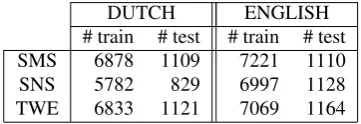
For our Dutch corpus we sampled 1,000 text messages from the Flemish part of the SoNaR corpus (Treurniet et al., 2012), aiming at a balanced spread of two characteristics: age and region. In order to also include longer streams of UGC, 1,505 message board posts were randomly selected from the social networking site Netlog, which is popular amongst Belgian teenagers. In order to take into account the vast amount of normalization research done on Twitter data, we also included 248 randomly selected tweets and 600 tweets accompanying a popular Flemish TV show (tvvv1). For our English corpus, we followed a similar approach: 574 text messages were sampled from the NUS SMS corpus collected by Chen and Kan (2012) and Netlog posts and tweets were again randomly selected. Some data statistics of these corpora are presented in Table 1. These numbers show that the genres are not equally noisy. For both languages, the posts from social networking sites seem most noisy, i.e. we observe an increase in tokens after
1
DUTCH ENGLISH
# items before after % # items before after %
SMS 1000 14739 15364 4.2 574 10329 10539 2.0
SNS 1505 29986 31341 4.5 817 18245 18882 3.5
TWE 848 11500 11657 1.4 356 13273 13571 2.2
Table 1: Data statistics of our Dutch and English corpus representing the amount of data and the number of tokens before and after normalization. For all datasets the number of tokens increases after normalization. We present this increase in percentages.
normalization of 4.5% for Dutch and of 3.5% for English. What also draws the attention is that the Dutch tweets contain almost no noise, i.e. a token increase of only 1.4%.
All data was normalized to their standard Dutch or English form following normalization guidelines adapted to each language’s characteristics (De Clercq et al., 2014). For Dutch, these guidelines have been drawn up in close col-laboration with the developers of the Chatty Corpus (Keste-mont et al., 2012) and for English findings from previous studies (Baron, 2003) were included. The guidelines can roughly be divided into two parts. The first part consists of the actual text normalization and comprises three steps: clearing all obvious tokenization problems, stating the dif-ferent normalization operations and writing down the full normalized version. We allow four different operations: in-sertions, deletions, substitutions and transpositions. Exam-ples of tokens requiring these operations are given below.
• INS: spoke (spoken), sis (sister)
• DEL: baaaaabyyyy (baby)
• SUB: iz (is), stoopid (stupid)
• TRANS: liek (like)
Insertions allow to indicate missing characters in a string. Deletions are used when characters should be deleted from a certain string. Substitutions are used when a character has been replaced with another similar one. Finally, trans-positions are used when a combination of characters should be switched within one string. The second part of the guidelines consists of flagging additional information that might be useful for further automatic processing purposes. Within each utterance the annotators were asked to indicate the end of a thought (to account for missing punctuation), regional words, foreign words and named entities. They could also flag words that are ungrammatical, stressed, part of a compound, used as interjections or words that require consecutive normalization operations.
Using these guidelines, all data has been annotated by two annotators for each language. For Dutch, we were able to check the reliability by computing the word error rate (WER) between 1,000 text messages that were annotated by two linguists independently from each other. The result-ing WER was 0.048 which reveals an almost perfect inter-annotator agreement.
3.
Normalization Experiments
One well-known problem when dealing with UGC text is that the traditional NLP tools do not perform well on this type of text. The Stanford NER, for example, drops from 90.8% tot 45.88% when applied to tweets (Liu et al., 2011b). Also part-of-speech tagging, chunking and other techniques reveal a significant drop in performance when applied to UGC (Ritter et al., 2011). This is where our corpora come in as useful data for performing normalization experiments. Currently, there are three dominant approaches to transfer noisy into standard text: using spell-checking (Choudhury et al., 2007; Cook and Stevenson, 2009; Beaufort et al., 2010), speech recognition (Kobus et al., 2008) or machine translation techniques (AiTi et al., 2006; Liu et al., 2011a). For the present study we focus on applying statistical machine translation (SMT).
The underlying idea is to perceive normalization as a trans-lation task from noisy text in one language to normalized standard text in the same language. Applying SMT to text normalization can be done at different levels of granularity. Previous work in this field has mostly focused on the word level (AiTi et al., 2006; Kobus et al., 2008; Raghu-nathan and Krawczyk, 2009). However, if we consider normalization, the task intuitively has a lot in common with transliteration tasks for which character-based SMT systems have proven adequate (Vilar et al., 2007). Pennell and Liu (2011) were the first to study character-based normalization. They, however, limited their approach by only focusing on abbreviations whereas we studied the added value by processing all the words on the character level for Dutch (De Clercq et al., 2013). For the present study, we focus on both Dutch and English. Important to note is that we only focus on lexical normalization, thus not resolving grammatical or other issues.
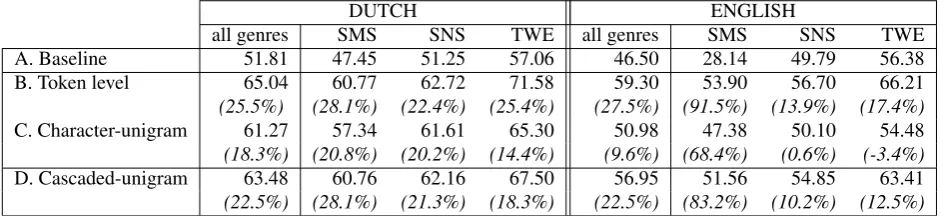
In the current set-up, two levels are compared: the token or word level and the character-unigram level. The aim of our experiments is to find out which level yields the best results. The assumption is that the different levels account for different normalization problems. The token level model is supposed to find frequent abbreviations (such as
DUTCH ENGLISH
all genres SMS SNS TWE all genres SMS SNS TWE
A. Baseline 51.81 47.45 51.25 57.06 46.50 28.14 49.79 56.38
B. Token level 65.04 60.77 62.72 71.58 59.30 53.90 56.70 66.21
(25.5%) (28.1%) (22.4%) (25.4%) (27.5%) (91.5%) (13.9%) (17.4%)
C. Character-unigram 61.27 57.34 61.61 65.30 50.98 47.38 50.10 54.48
(18.3%) (20.8%) (20.2%) (14.4%) (9.6%) (68.4%) (0.6%) (-3.4%)
D. Cascaded-unigram 63.48 60.76 62.16 67.50 56.95 51.56 54.85 63.41
(22.5%) (28.1%) (21.3%) (18.3%) (22.5%) (83.2%) (10.2%) (12.5%)
Table 3: Results of training on all data and testing on all data as well as the individual genres. The results are expressed in BLEU measure together with their improvement in percentages in between brackets.
legislation for scientific research, the boundaries of this exception are not clear, and differ across the EU. Moreover, the “terms” of use imposed by social networks are binding contracts, and most of them explicitly prohibit crawling or copying data. This even overrules the scientific research exception in most Member States.2
Currently, the two most popular genres to collect user gen-erated content from are text messages (SMS) and tweets. With SMS, the largest problem is the private character of this type of data. Three notable SMS collection projects have, however, made this type of information available for research purposes. The sms4science project (Cougnon and Franc¸ois, 2011) is probably the most successful one. It was started up in Belgium to collect French text messages and over the years the same techniques have been carried out in other countries (Switzerland, France, Greece, Spain and Italy). The technique used for this was to lower the barrier for donation by letting people forward their messages directly to a central number free of charge The NUS SMS project (Chen and Kan, 2012) focused on collecting English and Mandarin text messages whereas the SoNaR project (Oostdijk et al., 2013) focussed on collecting Dutch text messages. These two latter approaches used the same technique to collect messages, namely by developing an application on the Google Android platform that allowed users to automatically send messages to the corpus.3 Most of the time data can be acquired from these projects for research purposes when mentioning the source or after signing a license agreement. This is also valid for our SMS data which originates from two of the above-mentioned corpora.
Twitter data, on the other hand, is more difficult to release. Previous tweet collections, of which the Edinburgh Corpus (Petrovi´c et al., 2010) is a well-known example, have been collected but are no longer available to the general public because Twitter changed its “terms” of use for crawling through the API during the summer of 2013. Following these new rules it now seems good practice to provide a third party with the user and message id and a download
2
For a more detailed overview of the current legislation we refer to Truyens and Van Eecke (2014).
3For a complete overview of techniques used to collect user
generated content such as text messages we refer the reader to Treurniet et al. (2012).
script that only downloads tweets from users that are still publicly available and that does not download tweets which have been removed by the user. This is for example how the data for the SemEval 2013 Task 2 (Kozareva et al., 2013) were spread to the research community. However, as soon as Twitter again changes its rules the data might become unavailable once more. Recently, Twitter has re-acted to this problem by launching the pilot projectTwitter Data Grants4 where research institutions could submit a proposal to receive both public and historical Twitter data without violating their terms. No exact numbers on how many applications were submitted and granted are available at the time of writing but this is already a step in the right direction.
Closely related to Twitter is other data coming from popular social networking sites (SNS). The large com-panies such as Facebook and Google are known for not giving access to their valuable data. As far as the smaller companies are concerned, such as Netlog with which we worked together to get our data, these mostly ask you yo sign a non-disclosure agreement (NDA) which explicitly prohibits you to spread the data to other, third parties.
Based on these findings, we can state with certainty that all SMS data will be made publicly available for download at the LT3 website5. As far as the tweets and SNS data are concerned we are investigating the possibilities of re-leasing our data for research under terms satisfactory to all parties involved. Currently, the European Commission has also taken up a leading role in investigating these issues for copyright and database legislation, in order to foster non-commercial research in Europe which we hope will become clearer in the next few months.
5.
Conclusion and Future Work
In this paper we have presented a Dutch and English corpus containing three genres of user generated content – text messages, message board post coming from social network sites and tweets – which have been manually normalized. Using social media data is a fast growing research topic in NLP and by performing experiments on these data we can achieve deeper insights which is important for advances4
https://engineering.twitter.com/research/data-grants-closed
5
tial Speech and Language Technology for Dutch, Theory and Applications of Natural Language Processing, The-ory and Applications of Natural Language Processing, pages 219–247. Springer, New York.
Oostdijk, N. (2000). The spoken Dutch corpus. Outline and rst evaluation. InProceedings of LREC 2000, pages 887–894, Athens, Greece.
Papineni, K., Roukos, S., Ward, T., and Zhu, W. (2002). Bleu: A method for automatic evaluation of machine translation. InProceedings of ACL2002, pages 311–318. Petrovi´c, S., Osborne, M., and Lavrenko, V. (2010). The Edinburgh Twitter corpus. InProceedings of the NAACL HLT 2010 Workshop on Computational Linguistics in a World of Social Media 2010.
Raghunathan, K. and Krawczyk, S. (2009). CS224N: In-vestigating SMS Text Normalization using Statistical Machine Translation. Technical report, Stanford Univer-sity: Department of Computer Science.
Ritter, A., Clark, S., and Etzioni, M., O. (2011). Named entity recognition in tweets: An experimental study. In
Proceedings of EMNLP 2011, pages 1524–1534. Treurniet, M., De Clercq, O., van den Heuvel, H., and
Oost-dijk, N. (2012). Collection of a Corpus of Dutch SMS. InProceedings of LREC 2012, pages 2268–2273, Istan-bul, Turkey.