\
Jt~
.3,ODO
INFLUENCE OF SC
H
OOL
ENVIRONMEN
T
ON PRE
-
PRIMARY
SCHOOL CHILDREN'S
PERFORMAN
C
E IN
C
URRI
C
U
L
AR
ACTIV
I
TIES IN LA
MB WE D
I
VISION
,
MBI
T
A DISTRI
CT,
HOMA BAY
COU
N
TY
ISAACK OGUTU OTTO
E55/0L12161112010
A RESEARCH PROJ
E
CT
S
U
BMITTED IN PAR
TI
A
L
F
UL
F
ILL
MEN
T
.
OF THE
R
EQUIREM
EN
TS
F
OR
THE AWAR
D O
F
T
H
E
DE
G
REE OF
MASTER OF EDUCATIO
N
(
E
A
R
L
Y
C
HI
L
DH
OOD EDUCAT
I
O
N
)
SCHOOL OF EDU
C
ATION
KE
NYATTA UNIVE
RS
ITY
DECLARATION Student's Declaration
I declare that this research is my original work and has not been presented in any other university/institution for consideration. This research has been complemented by referenced sources duly acknowledged. Where text, data . (including spoken words), graphics, pictures or tables have been borrowed from other sources, including the internet, these are specifically accredited and references cited in accordance and in line with anti-plagiarism regulations.
Sign ~ . Date.S:...
.\.t.?:-\ ~
\~
Isaack Ogutu Otto E55/0L/21611/2010
- Declaration by the Supervisors
We confirm that the work reported in this project was carried out by the candidate under our supervision as university supervisors
Sign ~ . Date
..t,JJ?
.
J
.~
l
't
DR. Juliet Mugo Lecturer
:i:Y.C~
.~,e~a~ment
~;~
DR. Nyakwara Begi Lecturer
Date .
Lt
.
l
.
'l:
:
)
.
(~
ACKNOWLEDGEMENT
I thank the Almighty God who is a source ,of all my inspiration in enabling me to undertake this study. Much thanks to my supervisors for having agreed to supervise my project and their patience in reading the drafts and guiding me, without which the research proposal may not have taken the right, shape.
ABSTRACT
TABLE OF CONTENTS
DECLARATION ii
ACKNOWLEDGEMENT : iii
ABSTRACT iv
TABLE OF CONTENTS v
CHAPTER ONE 1
INTRODUCTION AND CONTEXTUALIZATION OF THE STUDY 1
1.0 Introduction : .. 1
1.1 Background to the Study.. 1
1.2 Statement of the Problem ~ 6
1.3 Purpose of the Study 6
1.3.1 Objectives of the Study -e•••••••••••••••••••••••••••••••••••••••••••••••••••••••••••••••• 7
1.4. Research Questions 7
1.5. Significance of the Study 7
1.6 Limitations and Delimitation of the study 8
1.7 Assumptions of the Study ; 9
1.8 Theoretical Framework 9
1.10 Definition of terms ~ 12
CHAPTER TWO ~ 13
LITERATURE REVIEW 13
2.0 Introduction 13
2.1 The Early Childhood Education and Curriculum in Kenya 13
2.2 School Environment. 14
2.3 School Location and Children's Performance in Curricular Activities 17 2.4 The ECDE Teacher Related Variable and Children's Performance in
Curricular Activities 19
2.5 School Leadership Approaches and ECDE Children's Performance in
Curricular Activities 27
2.6 Summary of the Literature Reviewed 45
3.0 Introduction 46
3.1 Research Design 46
3.2 Variables 47
3.2.1 Dependent Variable 47
3.2.2 Independent Variables 47
3.3·Location of the Study 48
3.4 Target Population 48
3.5 Sampling techniques and sample size 48
3.5.1 Sampling Techniques 48
3.5.2 Sample Size 49
3.6 Research Instruments 49
3.6.1 Questionnaires · ~ 50
3.6.2 Interview schedule : 50
3.7. Piloting Study 50
3.7.1 Validity of Instruments 51
3.7.2 Reliability of Instruments
.
513.8. Data Collection Procedures 51
3.9. Data Analysis ~ : 52
3.10 Logistical and Ethical Considerations 52
CHAPTER FOUR 54
FINDINGS, INTERPRETATION AND DISCUSSION 54
4.0 Introduction 54
4.2 General and Demographic Information : 54
4.2.1 General Information 55
4:2.2. Demographic Data : 55
4.2.2.1 Type of School 56
4.2.2.2 Gender of the ECDE Teacher Respondents 56 4.2.2.3 The Marital Status ofECDE Teachers 57
4.2.2.4 Teachers' Professional Qualification 58
4.3 The School Location and ECDE Children's Performance in Curricular
4.3.1 The Location of the school and the ECDE Children's Performance in
Language activities 60
4.3.2 Location of the school and the ECDE Children's Performance in
Mathematics activities 61
4.3.3 Location of the school and the ECDE Children's Performance in science
activities 62
4.3.4 Location of the school and the ECDE Children's Performance in Social
studies activities , 63
4.3.5 Location of the school and the ECDE Children's Performance in Religious.
activities 64
4.3.6 Location of the school and the ECDE Children's Performance in Creative
activities 66
4.4 The ECDE Teacher Variables and Children's Performance in Curricular
Activities 68
4.4.1 The Teaching Approaches and ECDE Children's General Performance 68
4.4.3 The ECDE teacher's Teaching Experience 71
.
4.4.4 Teaching Experience and ECDE Children's General Performance in
Curriculum Activity Areas " 72
4.4.5 Localization of curriculum ; 73
4.4.6 Localization of curriculum and the Children's performance 74 4.4.7 Teachers' Professional Qualification and ECDE Children's General
Performance in Curriculum Activity Areas 76
4.5 School Leadership and Children's Performance in Curricular Activities : 78 4.5.1 The Head teachers' involvement in Children's Activities : 78 4.5.2 The Head teachers' involvement in Children's Activities and children's
general performance in curriculum Activity Areas 78
4.5.3 Head teacher's Involvement in Ensuring the Attainment of Education goals 79 4.5.4 The Head teachers' involvement in the attainment of the Educational Goal
4.5.6 The Head Teachers' Provision of Teaching Guidelines and ECDE
Performance 83
4.5.7 Head Teacher's Involvement in Ensuring Task Oriented Atmosphere in
School and ECDE performance : 84
CHAPTER FIVE 87
SUMMARY, CONCLUSION AND
RECOMMENDATION
875.0 Introduction 87
5.1 Summary 87
5.1.1 The School Location and Children' Performance in Curricular Activities in 5.1.2 The ECDE Teacher Related Variables and Children's Performance in
5.2 Conclusion 88
5.3 Recommendations ; 88
5.3.1 Recommendations for the policy makers (Ministry of Education) 89
5.3.2 Recommendations for Head Teachers 90
5.3.3 Recommendations for the ECDE Teachers 90
5.3.4 Recommendation for Further Research ~ 91
REFERENCES
93
APPENDICES ...•... 103
APPENDIX I:INTRODUCTORY LETTER : 103
APPENDIX II: QUESTIONNAIRE FOR TEACHERS 104
APAPPENDIX III: INTERVIEW GUIDE FOR QUALITY ASSURANCE
OFFICERS 111
APPENDIX IV:AUTHORIZATION LETTER FROM GRADUATE SCHOOL 112
APPENDIX V:AUTHORIZATION LETTER FROM COUNTY DIRECTOR 113
APPENDIX VI: AUTHORIZATION LETTER FROM COUNTY
COMMISSIONER 114
APPENDIX VII: AUTHORIZATION LETTER FROM
NACOSTI.
115LIST OF TABLES
Table 3.1 Sampling Frame 49
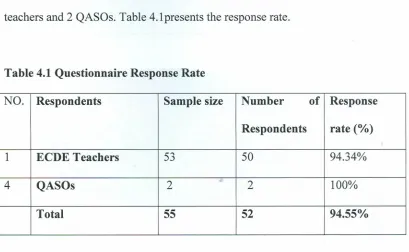
Table 4.1 Questionnaire Response Rate 55
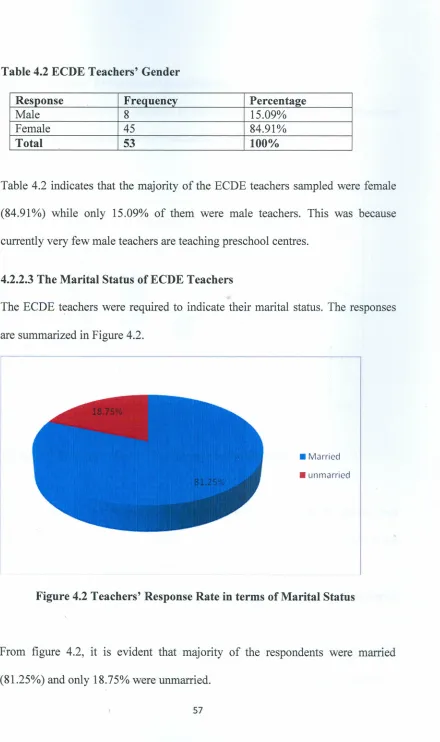
Table 4.2 ECDE Teachers' Gender 57
Table 4.3 the General ECDE performance in Various Activity Areas 59
Table 4.4 the Location of the school and the ECDE Children's Performance in
Mathematics activities 61
Table 4.5 Location of the school and the ECDE Children's Performance in Social
studies activities . 64
Table 4.6 Location of the school and the ECDE Children's Performance in
Creative activities 66
Table 4.7 The Common Approach Used
By
The Teacher 68Table 4.8 The Common Used Approach And The Children's General
Performance 69
Table 4.9 the ECDE Teachers' Teaching Experience , 71
Table 4.10 Curriculum Localization 73
Table 4.11 Teachers' Professional Qualification and ECDE Children's General
Performance in Curriculum Activity Areas 76
.Table 4.12 the Head Teachers' Involvement in Children's Activities 78
Table 4.13 The Head Teachers' Involvement in the Attainment of the Educational
Goal and Children's General Performance in Curriculum Activity Areas 81
Table 4.14 Head teachers' Observation of Lessons in progress 81
Table 4.16 Task Oriented Atmosphere in Pre-School and academic performance
in ECDE Centres 85
LIST OF FIGURES
Conceptual Framework 11
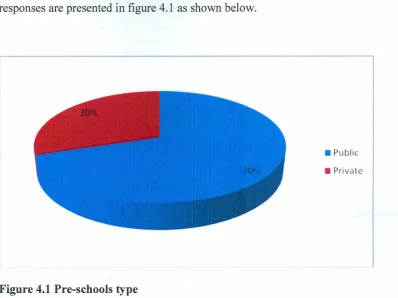
Figure 4.1 Pre-schools type 56
Figure 4.2 Teachers' Response Rate in terms of Marital Status 57
Figure 4.3 Teachers' Highest Professional Qualification 58
Figure 4.4 Location of the school and the ECDE Children's Performance in
Language activities 60
Figure 4.5 Location of the school and the ECDE Children's Performance in
science activities : 63
Figure 4.6 Location of the school and the ECDE Children's Performance in
Religious activities 65
Figure 4.7 Children Learn Through Play 70
Figure 4.8 The ECDE Teachers' Teaching Experience and Children's General
Performance in Curriculum Activity Areas : 72
Figure 4.9 Localization of curriculum and the Children's performance 74
Figur~ 4.10 the Head Teachers' Involvement in Children's Activities an~
Children's General Performance in Curriculum Activity Areas 79
Figure-l.l l Head teacher emphasizes Educational Goals ...•... 80
Figure 4.12 Head teacher Observes Lessons in Class and ECDE performance 82
Figure 4.14 Head Teacher's Involvement in Defining School Goals to the Staff
and ECDE Academic Performance 84
CHAPTER ONE
INTRODUCTION AND CONTEXTUALIZATION OF THE STUDY 1.0 Introduction
This chapter discusses the background to the study,
statement of the problem,
purpose of the study,
objectives of the study,
research questions,
significance of
the study,
limitations and delimitations of the study,
assumptions of the study,
theoretical framework, conceptual framework,
and operational definitions of
terms.
1.1 Background to the Study
At independence in 1963,
the government recognized education as a basic right
and a powerful tool for national development.
Over the years the government has
addressed challenges facing the Education
sector through
commissions,
Committees and Task Forces with the purpose of providing quality and relevant
education to its citizenry. The Government through Sessional Paper No. 1(2005)
committed itself to develop policies that would ensure accessibility
of education
to all children including preschool.
In
this regard,
early childhood education has
far reaching consequences that we need to clear about them.
(Osakwe 2006). In Kenya, early childhood education is a formalized education
process between the ages of three to six (Republic of Kenya, 2005). Preschool is
an institution of learning aimed at promoting knowledge and developing skills for
further learning (Gatumu & Ciumwari, 2010). At present the public preschool is
a component of a primary school (Republic of Kenya, 2005), which is headed by
the head teacher who usually assumes the roles of an administrator at the ECDE
centres. This has been a challenge of managing two independent learning sections
within the same compound.
According to UNESCO (2006), Early Childhood is defined as the period from
birth to six years. A time of remarkable brain development, these years lay the
foundation for subsequent learning. The terms pre-school education and
Kindergarten emphasize education around the ages 3-6 years. Early Childhood
Education (ECE) often focuses on child learning through play. However, many
child care centres are now using more educational approaches. They are creating
curricular and incorporating it into the early daily routines to foster greater
educational learning.
Education is one of the most important aspects of human resource development.
Every child should therefore have the opportunity to achieve his or her academic
potential (Sunil and Madhuri, 2005). According to Sunil and Madhuri (2005), at
least 20% of children in a classroom get poor marks. They suggest that among
The issue of pupils' performance at schools has been of concern ever since modem education was introduced. Many countries have come to realize that pupils are the heart of educational process and that without good performance; all innovations in education are doomed to failure.
Hence early childhood education in Kenya enables one to have an entry into primary school (Anning & Edwards, 2006). Preschool education has formalized syllabus and curriculum which entails activities to be done in preschool (Catron & Alllen,2003).
Despite the increase in the number of pre-school centres in Kenya, little had been done to initiate a rich outdoor environment in many centres (Ngecha, 2011).
Further more recent studies indicated that majority of pre-school teachers are untrained and rarely participated in children's play, let alone guiding play activities (Ngecha, 2011). If the issue of play among learners is not addressed with the seriousness it deserves, the quality of pre-school learning will become irrelevant.
In the U.S for example research indicates that 13% - 17% of the school
environment influences performance in curricular activities (Hanushek, 2010)
while in U.K. research found that the school environment accounts for 14% of
variation in individual participation in curricular activities (Hirsch, 2007). In
Norway and Sweden, the school environment accounted for only 10% according
to OEeD report (2008) which is much lower than that of the US and the UK. For
industrialized countries, the school environment explained small portions of
variance in performance in curricular activities. However, in developing countries
the block of the school environment explained significant portions of the variance
in achievement.
Other studies have shown that children's performance can be affected either
positively or negatively by the school environment (Abere, O. S. (2006). A
substantial body of research shows that, for good or ill, a school social activity has
a broad influence on children's academic performance (Tarlov &Debbink, 2008).
Hence school environment should be inspirational, colourful, motivational,
stimulating and comfortably attracts children. According to Ruto (2004) children
from traditional schools in Kenya once moved to open-space schools, responded
brightly and positively to the surroundings although other studies indicate that
urban children performs relatively better than rural children.
In Kenya Hungi and Thuku's (2010) study on differences in children achievement
found that the school environment explained 27% of performance in curricular
activities of children. This means that with the increase in Enrolment in ECDE
centres in Kenya over the past decade; from 35% in 2003 to 60.9 % in 2012
(Republic of Kenya, 2012) ECDE faces many challenges including low
participation in curricular activities caused by the school environment namely
school leadership, school location and the school curriculum.
In the Sessional Paper No. 1 of 2005 on a Policy Framework for Education,
Training and Research; the government planned to integrate ECDE into basic
education but the policy was not fully implemented, and therefore the ECDE
sector is mainly run by private initiatives. This has led to the indiscriminate
establishment of ECDE institutions with little or no concern for standards. Varl
(2008) concurs that all these school environment factors lead to poor performance
of ECDE sub-sector characterized by low enrolment of children and high rate of
dropouts. It is against this background that the study was undertaken to
investigate the influence of the school environment on performance in curricular
activities of pre- primary schools in Lambwe division where most studies have
concentrated on secondary schools and not early childhood. This is the gap that
1.2 Statement of the Problem
Research by the International Institution for Educational Planning (I1EP, 2004),
shows that a leamer's success relies on the environment in which he or she is
learning. The literature reviewed had shown that the school environment explained small portions of variance in performance in curricular activities for
industrialized countries however; in developing countries the block of the school environment explained significant portions of the variance in achievement. This is
characterized by the teacher variables, the leadership and the location of the
school. Since most early childhood education centres in Kenya are majorly
privately owned these factors have not been emphasized on and hence standards
vary. A proper and adequate environment is very much necessary for the fruitful
learning of the child. Moreover research on these factors is also limited especially
in Lambwe division as most of them focused on secondary education and yet the
school environment should be put in consideration if children are to develop fully
and perform well in curricular activities hence need for the study.
1.3 Purpose of the Study
Based on the problem stated, the study sought to explore the influence of school environment on children's performance in curricular activities in Lambwe
Division, Mbita District, Homa Bay County.
In
order to achieve this, the studyaddressed school location, ECDE teacher variables, school leadership and their
1.3.1 Objectives of the Study
This study aimed at achieving the following objectives;
1. To find out the influence of school location on children's performance in
curricular activities in Lambwe division, Mbita district.
11. To determine the influence of the EeDE teachers' related variables on
children's performance in curricular activities in pre-primary schools in
Larnbwe division, Mbita district.
iii. To determine the influence of school leadership approaches on children's
performance in curricular activities in Larnbwe division, Mbita district.
1.4. Research Questions
The study sought to answer the following research questions.
1. Does location of school influence children's performance in curricular
activities in pre-primary schools in Larnbwe division, Mbita district?
11. Does EeDE teachers' related variable determine children's performance
in curricular activities in pre-primary schools in Lambwe division, Mbita
district?
111. Does the school leadership approach influence children's performance in
curricular activities among pre-pnmary school children in Larnbwe
division, Mbita district?
1.5. Significance of the Study
The findings of this study may provide significant information to early childhood
and parents as it may give them a better understanding of the school environment
and how it affects children hence find ways to deal with the issue.
The study findings may also be of importance to the Ministry of Education
(MOE), which is responsible for policy formulation, to plan programmes that take
into consideration the environment that pre-scholars study and how they can
benefit from it.
The study findings may also make a significant contribution to existing
knowledge on the school environment and also help on improving the school
environment so that pre-school children benefit.
1.6 Limitations and Delimitation of the study
1.6.1 Limitations
The study limited its scope to ECDE schools in Lambwe Division, Homa Bay
County hence the findings can only be generalized to a population with similar
characteristics. The study used survey design. The samples were collected from a
sample population of ECDE teachers and not all teachers of the centres in the
Division. This was a major limitation since some teachers and QASOs might have
deliberately given wrong information concerning performance at ECDE canters.
This generated diverse responses from the same question. The researcher was
unable to control the attitudes of the respondents and this may have affected the
findings. The distance to be covered by the researcher was very wide and
generated a lot of problems in transportation. Some of the respondents seemed to
ECDE learning and leadership. However they were assured of confidentiality of
the information that they gave and that it was only used for study purposes.
1.6.2 Delimitations
Participation in this study was delimited to pre-primary school children, teachers
and Quality and Standard Officers in Lambwe Division. This means that teachers
and Education Officers who do not deal with pre-primary school children were
excluded from the study.
1
.
7
Assumptions of the StudyThe study assumed that the information on the study interest would be readily
available and that the respondents would be willing to give valid information
concerning the questions that would be raised. This is so because the researcher
designed the instruments where the participants were not needed to include their
names and hence confidentiality was ensured.
1.8 Theoretical Framework
The study adopted Urie Bronfenbrenner's (1979) systems ecological theory which
explains how everything in a child and the child's environment affects how he/she
grows and develops.
Research has shown that a child's environment is a strong contributor to their
social, emotional, cognitive, and academic development (Han, 2006). This means
that development occurs between a person and his immediate surroundings and
for a child this happens with the parents, school and culture (Bronfenbrenner &
Evans, 2000). This is viewed in the micro system which encompasses the
Structures in the micro system include family, school, neighborhood, or childcare
environments.
Developmental theorists (e.g. Piaget, Dewey, and Malaguzzi) argue that children
actively explore their environments creating solutions to problems they encounter
within their surroundings (Roskos &Neuman, 2003). While the home is generally
considered the primary environment in which children are raised, the ecological
models (Bronfenbrenner 2000) emphasizes that a child's development is also
influenced by experiences outside the home, such as a childcare center. This study
therefore focuses on the outside experience which is the child care center and how
it influences children's participation in curricular activities in regards to the
leadership, curriculum and the location. Children need an environment that
1.9
Conc
eptual
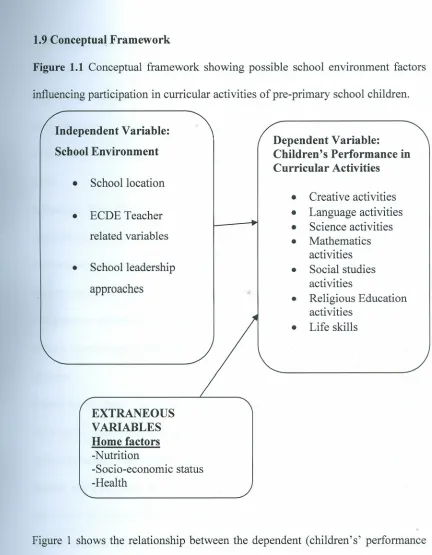
FrameworkFigure 1.1 Conceptual framework showing possible school environment factors
influencing participation in curricular activities of pre-primary school children.
Independent Variable:
School Environment
Dependent Variable:
Children's Performance in Curricular Activities
•
Creative activities•
Language activities•
Science activities•
Mathematicsactivities
•
Social studies activities•
Religious Educationactivities
•
Life skillsFigure 1 shows the relationship between the dependent (children's' performance • School location
• ECDE Teacher
related variables
• School leadership
approaches
EXTRANEOUS VARIABLES Home factors -Nutrition
-Socio-economic status
-Health
in curricular activities) and independent variables (school leadership, school
1.10 Definition of terms
The following variables are defined according to the study;
Curricular activities: Refers to all the activities areas children do in a pre-school
they inc1ude:- creative activities, language activities, science activities,
mathematics activities, social activities, religious education activities and life
skills.
Influence: The effect the school environment has on children's performance in
curricular activities.
Performance in curricular activities: Refers to how well children are fairing in
the curricular activities.
Pre-primary school: Formal institution for 3 to 6 years old children.
School curriculum: The methods and approaches used by schools to teach
children
School leadership: The process of enlisting and guiding the talents and energies
of teachers, children, and parents toward achieving common educational aims.
School location: The location where schools are found that is urban or rural
School environment: For the purpose of this study, school environment IS
defined by the internal characteristics of a school.
ECDE teacher related variables: These are the unique characteristics of the
CHAPTER TWO
LITERATURE REVIEW
2.0 Introduction
This section gives a systematic identification, location, and analysis of the
pertinent and related literature to the problem. This entails a review of literature to
establish the influence of school location, teacher related variables and leadership
approaches on children's performance in curricular activities.
2.1 The Early Childhood Education and Curriculum in Kenya
Education is a process of systematic training and instruction designed to transmit
knowledge skills which enables an individual to contribute effectively to the
growth and development of the society. It involves all round development of an
individual physically, socially, morally, intellectually and mentally (Osakwe
2006). In Kenya, early childhood education is a formalized education process
between the ages of three to six (Republic of Kenya, 2005). Preschool is an
institution of learning aimed at promoting knowledge and developing skills and
(Gatumu & Ciumwari, 2010). At present the public preschool is a component of a
primary school (Republic of Kenya, 2005), which is headed by the head teacher
who usually assumes the roles of an administrator at the ECDE centres.
The curriculum is defined as an educational philosophy for achieving desired
educational outcomes through the presentation of an organized scope and
sequence of activities with a description and inclusion of appropriate instructional
and Education School Syllabus and Hand book (2008), the pre -pnmary
curriculum consist of nine curriculum activity areas. Each of these activity areas
is allocated lessons which cover a week. Language, outdoor and mathematics
activities are taught five times a week. Creative, social, music and movement and
science activities are taught twice a week. Religious and life skills activities are
taught once a week.
2.2 School Environment
According to Githinji & Kanga ( 2011), learning takes place within a web of
social relationships as teachers and children interact both formally and informally
.Schools are institutional spaces for community of children, including teachers
and children. School environment therefore means the school setting of the
physical plant, fairness and adequacy of disciplinary procedures, academic
surrounding and student health.
According to Maicibi (2005), a good environment should be provided by the
school if the children in school must learn, if the school administration must be
successful and if the school must develop. Skinner (1945) advised that for proper
learning to take place, learning experiences should be guided and appropriately be
controlled. This means, the environment or the circumstances under which
learning occurs should be supportive and conducive enough for effective learning
School environment which include instructional spaces planning, administrative
spaces planning, circulation spaces planning, spaces for conveniences planning,
accessories planning, the teachers as well as the students themselves are essential
in teaching-learning process (Githinji & Kanga, 2011). The extent to which
student learning could be enhanced depends on their location within the school
compound, the structure of their classroom, availability of instructional facilities
and accessories (Abbott & Nutbrown, 2001). It is believed that a well planned
school will gear up expected outcomes of education that will facilitate good
social, political and economic emancipation, effective teaching and learning
process and academic performance of the students.
Relating this study to international occurrences are the assertions of Williams,
Persaud, and Turner (2008), quoting Marsden (2005), which reported that safe
and orderly classroom environment (aspect of instructional space), School
facilities (accessories) were significantly related to students' academic
performance in schools. The three researchers, also quoted Glassman (1994),
asserting that a comfortable and caring environment among other treatments
helped to contribute to students' academic performance.
The physical characteristics of the school have a variety of effects on teachers,
students, and the learning process. Poor lighting, noise, high levels of carbon
dioxide in classrooms, and inconsistent temperatures make teaching and learning
among students as well as teachers, which leads to poor performance and higher absentee rates (Frazier, 2002 Lyons, 2001; and Ostendorf, 2001). These factors can adversely affect student behavior and lead to higher levels of frustration among teachers, and poor learning attitude among student.
Beyond the direct effects that poor facilities have on students' ability to learn, the combination of poor facilities, which create an uncomfortable and uninviting workplace for teachers, combined with frustrating behavior by students including poor concentration and hyperactivity, lethargy, or apathy, creates a stressful set of working conditions for teachers(Abbott & Nutbrown,2001). Because stress and job dissatisfaction are common pre-cursors to lowered teacher enthusiasm, it is possible that the aforementioned characteristics of school facilities have an effect upon the academic performance of students.
significant differences between schools in the different socioeconomic contexts.
The pre-schooling rate among children at schools in the high socioeconomic
context was 97 percent, in middle context schools it was 96 percent, but in
schools in the lower context it was only 81 percent.
2.3 School Location and Children's Performance in Curricular Activities
According to OEeD (2002) school location refers to the community in which the
school is located, such as a village, hamlet or rural area (fewer than 3 000 people),
a small town (3 000 to about 15 000 people), a town (15 000 to about 100 000
people), a city (100 000 to about 1 000 000 people) .Ezike (1997) conceptualized
urban environment as those environment which have high population density
containing a high variety and beauty and common place views. He further
identified the rural environment as being characterized by low population density
containing a low variety and isolated place views. Boylan (1998) reported that
rural schools were inferior and lacking in the range of facilities with high staff
turnover and suffered from lack of continuity in their curriculum. He pointed
further that they are staffed by young, beginning and often in experienced staff
who regrettably, would not conform to socio-cultural ethos and above all, offered
a restricted curriculum. This therefore affects preschool learner's participation in
curricular activities.
Studies on the impact of school location on children's performance are mixed for
schools were likely not to participate fully in curricular activities because rural
children were more likely to be poor than children in urban areas,
rural parents
and communities lack awareness about what a quality
program should look like,
and preschools lack the necessary materials to help children fully participate in
curricular activities. Similarly in the United States a comparison of national rural
and non-rural data found that rural children were less proficient in some literacy
skills at the start of kindergarten and were more likely
to be placed in special
education than their non-rural counterparts (Grace,
Shores,
Zaslow,
Brown,
Aufseeser,
&Bell,
2006).
In South Africa, according to the Department of Education (2007),
there is no
significance difference in the performance of children in rural and urban school
.But the difference is their difference in involvement towards high academic
standards. Even today, many people assume that urban and rural areas have their
own distinct cultures and concerns that affect their priorities and needs.
Furthermore,
the Department of Education now recognises that improving
schooling in rural areas must go beyond "fixing up schools". A good plan has to
address poverty and sustainable development,
as well as promoting social
cohesion
-
that is,
the need to work together to solve problems (Gardiner
&Michael, 2008).
Further a study by Considine and Zappala (2002) in Australia found that
geographical location do not significantly predict school performance. In view of
these inconclusive findings, it necessary to carry out further research to confirm
or annul the otherwise protracted issue on the effect of location (urban/rural) on
participation of children in curricular activities in Lambwe Division.
2.4 The ECDE Teacher Related Variable and Children's Performance in
Curricular Activities
According to Barbara (2004) a teacher is a key agent in curriculum
implementation. This means that the quality of education is as good as the quality
of the teacher. Therefore, the quality of the teacher is important in the
implementation of the ECDE curriculum. These qualities include teacher's
academic and professional qualifications, in-service training, teacher's
motivation, teacher's attitude towards ECDE curriculum, teacher's teaching
experience among others (Githinji &Kanga, 2011).
Teachers play an important role in nurturing positive approaches to learning
(Copple & Bredekamp, 2009). An important starting point is to develop a caring
and respectful relationship with children and their families. Children who feel
valued and receive the message that they are capable learners become engaged
and excited about learning. When children are given ample time and support to
incentives to learn and behave unnecessar
y
(Abbott
&Nutbrown
,
2001).
The
intentional teaching practices outlined in this document, such as listening,
observing, providing specific feedback, asking thought-pro
v
oking questions
,
providing verbal and emotional support, encouraging effort and teamwork
,
modeling flexibility, noticing children's interests
,
and helping them make
connections
,
will provide teachers with strategies for reinforcing positi
v
e
approaches to learning throughout the day (Copple
&Bredekamp
,
2009).
The way a child approaches learning is a strong predictor of later success in
schoo
l
(Epstein, 2007). School environment is essential
i
n enabling p
re
-s
c
hool
children to tackle and persist at challenging or frustrating tasks with
f
lexibi
l
ity
,
follow directions
,
take risks
,
make and learn from mistakes
,
and
w
ork as a part
of
the group. Young children develop these skills by engaging in playful learning
experiences
,
which strengthen cognitive capacities such as paying at
t
en
t
io
n,
remembering rules
,
and inhibiting impulses to achie
v
e a larger goal (Tomlinson
,
2012).
Teacher Professional Development is a continuous
,
ongoing process necessar
y
in
the implementation of the curriculum to meet the preschool standards (Epstein
,
2007). This involves a fully understanding of the curriculum
,
and fami
l
iarity with
the de
v
elopmentally appropria
t
e practices necessar
y
for its implementat
i
on.
T
his
can be fostered through a well-organized, localized and consistent plan for
In
USA, a study was conducted by Heroman , Burts, Berke
&Bickart (2010) on
Teaching Strategies, the found that child-centered approaches to learning was
the most effective method of teaching in pre
-
school centres . This study further
indicate that this approach promote the development of children's critical thinking
skills
;
fosters awareness of diversity and supports enthusiasm and engagement in
various learning activities. Therefore
,
it is important for teachers have in place
environment that nurture children's capacity to engage deeply in individual and
group activities and projects (Bedrova
,
Leong
&Shore
,
2004).
Such an
environment
is
created
through
interactions
with
indoor
and
outdoor
environments that offer opportunities for children to set goals and persist in
following through with their plans while acquiring new knowledge and skills
through purposeful play (Conn
-
Powers
,
2006).
In
USA
,
according to Alexander Forbes (2001) teachers who use child-centered
methods of teaching achieve more than those who use teacher-centered methods.
The findings further shows that in child-centered method of teaching, the child is
the centre of knowledge
;
children learn through practical involvement
,
interest
and confidence is developed, plenty of materials are needed
,
many skills are
developed and few facts are learnt and applied to life situation.
utilization of locally available teaching support materials. In addition to daily
opportunities for independent choice and exploration, preschool classroom time
should be regularly allotted for in depth, small group experiences that encourage
children to interact, pursue problem solving strategies and reflect. Teachers
should facilitate a supportive learning environment by continuously observing,
listening and scaffolding children's thinking in everyday contexts.
In USA, a study by Epstein (2007) on choosing the best strategies for young .
children's learning, the study found a positive relationship between the teacher's
strategies of teaching and children's performance. The study further shows that
there is no effective early childhood learning without a rich and supportive
environment. A preschool classroom's physical and teaching environments should
capitalize on children's natural, spontaneous interactions .The learning
environment must, therefore, should accommodate planned. and unplanned, as
well as structured and unstructured experiences (Epstein, 2007). Unstructured
play should take up a substantial portion of the day. Structured activities include
daily routines that provide young children with needed stability and familiarity
(e.g., circle time, small-group time, and lunch), as well as learning activities that
integrate preschool content and achieve specific goals planned by adults. For both
structured and unstructured activities, the learning environment must be
welcoming, safe, healthy, clean, warm, and stimulating (Harms, Thelma, Richard
In USA, Barnett (2004) conducted a study on Better Teachers, Better Preschools.
The findings indicated that there is a positive relationship between the ECDE
teachers' professional qualifications and performance of pre-school children.
Further the study found that teacher education was related to effective
implementation of the ECDE ccurriculum and the development of children in
ECDE classrooms. In addition the study asserts that better-educated teachers have
more positive, sensitive and responsive interactions with children, provide richer
language and cognitive experiences, and are less authoritarian, punitive and
detached. The result is better in social, emotional, linguistic, and cognitive
development for the child.
In USA, Resnick & Zill (2002) conducted a study on the relationships between
teacher's beliefs and qualifications to classroom quality in Head Start programme
in USA found that teachers with four-year degrees teach effectively in Head Start
programme. Further Phillips (1991) found that teachers professional training has a
positive relationship with better teaching approaches. Also Mishra ( 2009) argues
that the teachers with higher academic credentials teach well than those with
lower credentials.
Muhammad (2011) observes in a study on the impact of teacher quality on the
academic achievement of students at secondary stage in Punjab (Pakistan) that
teachers with higher levels of education teach well and are competent than those
knowledge about the relevant subject than the academically less qualified teacher.
The researcher was to establish the level of academic qualifications of ECDE
teachers in Borabu since this has an implication in curriculum implementation and
instruction.
A study done by Nga'sike (2004) found out that majority of preschool teachers
had low academic qualification and the low academic qualification was affecting
the quality of teaching of ECDE teachers. If the teacher is qualified, he/she is
likely to have well performing students but unqualified teacher is likely to have
poor performing students. A study conducted by Mugoh (2003) to investigate
problems inhibiting access to effective participation in pre-school Education of
Central Division in Embu Distinct found that 20% of the teachers had attained
CPE/KCPE qualification, 66.7% had attained KCSE qualification. This reveals
that the majority of teachers are academically qualified to effectively implement
the ECDE curriculum. Nyabuto (2005) who did a study on factors constraining
management of early childhood education in Nyamarambe Division, Gucha
District revealed that 10% of ECDE teachers were KCPE holders and 90% were
KCSEIKCE holders. This shows that majority of ECDE teachers are form four
graduates.
According to Muhammad (2011), teaching experience is the time spent by a
teacher in the teaching profession. It starts from the date when a teacher joins the
the teaching skills and the methodologies adopted. With the passage of time,
teachers get command on their subjects and become competent in the art of
teaching through experience. A common hypothesis with respect to the
relationship between teachers' experience and pupils' achievement is that pupils
taught by more experienced teachers achieve highly, because their teachers have
mastered the content and acquired classroom management skills to deal with
different types of classroom problems (Gibbons, 1997).
On contrarily a study by Gathumbi (1995) indicates that teaching experience and
academic and professional qualifications of teachers have no significant effect on
teaching behavior but it only affect class participation. In this respect, experience
might be said to have a part to play in changing teacher's behaviours in the
classrooms.
Barbara (2004) asserts that teachers' education and expenence account for
variation in students' achievement than all other factors. She continues to argue
that teachers should be well prepared when they begin teaching and that they
should continue to improve their knowledge and skills throughout their career.
Furthermore, more experienced teachers are considered to be more able to
concentrate in the most appropriate way to teach particular concepts to pupils who
In UK, Clough, Nutbrown & Selbie (2008) noted that schools with stable, experienced and qualified teachers usually have better school facilities in terms of school buildings, books and equipments than those schools which have difficulty in attracting experienced and qualified staff. Numerous investigations have also been carried out to find the effects of instructional resources on students' academic achievement. Eminent scholars have also contributed immensely to report the effect of one variable on the other. Consequently, there have been many reports from these studies which had served as useful guides to the present one.
In Kenya, according to Ng'asike (2004) and Ndegwa (2005), effective curriculum implementation equally needs teacher experience. This study further found that most experienced ECDE teachers were no-longer teaching in Nairobi due to attrition. Ng'asike found that teachers' having 0-4 years teaching was 45 percent of teachers while Ndegwa had found that 72 percent of the teachers' had teaching experience of 0-4 years. There has also been high attrition rate among ECDE teachers due to poor remunerations (Ngome, 2002). An experienced teacher is thus, expected to effectively implement curriculum than inexperienced teachers.
(2005) shows that the number of trained ECDE teachers has increased
significantly over the years in Kenya. Increased number of trained ECDE teachers
is attributed to increased number of DrCECE Centres and Priva
t
e colleges country
wide. However, Githinji and Kanga (2011) argue that
t
he number of untrained
teachers in ECDE Centres is still high at 56 percent in public ECDE Centres. This
is attributed to high rates of attrition as a result of poor pa
y
packages.
2.5 School Leadership Approaches and ECDE Children's Performance in
Curricular Activities
Morgan (2006) supported the necessit
y
of administrati
v
e support for a successful
curriculum implementation by discussing the fact that teachers need more tha
n
just knowledge and skills, they need encouragement and assistance to reach the
goals defined for their children
.
In Turkey
,
a study was conducted by Akinoglu
(2008) to assess the curricular reform initiatives. The stud
y'
s fmdings indicated
that there was a positive relationship between the support from administrators and
colleagues and effectiveness of the early childhood teachers
'
curriculum
implementation approaches and their children performance in pre-school
education. Cannon
,
Karoly
&Kilburn (2005) further confirm that the support
from the school administrator as a key factor for successful curriculum
implementation. In other words
,
collaborative environment is a necessit
y
.
The relationship between effective leadership and children
'
s achievement
ISperceptible impact on children's learning (HMIE, 2000). While leadership has
been found to be central to successful schools, equally there is scope for
improving the quality of that leadership (HMIE, 2000): managers often focused overly on the day-to-day without being strategic in the longer term. The
complementary nature of leadership and management is often assumed; however,
in the educational literature a distinction is clearly drawn: leadership is perceived
to include vision, based on shared values. Leaders are better placed to provide
both motivation and direction to colleagues (HMIE, 2000).
Key alms of SEED's broad leadership programmes include increased
collaboration among the key groups who contribute to the development of
leadership capacity in Scottish education and developing excellence and capacity
building across the educational system. Leadership development priorities should
be identified, innovation generated, expertise and new approaches developed in
order to contribute to a general strengthening of leadership capacity (Scottish
Executive, 2005).
This link between leadership and effective provision is also true for early
childhood settings, where research indicates that leaders play an important part in
the provision of quality services. Effective leadership has been found to be a key
element of effective early childhood provision (Muijs 2004; Harris 2002; Rodd,
2005). Other factors that have contributed to the focus on leadership include
pressure for increasing professionalization and accountability from within and
According to Adebola and Ademola (2011) school leadership is one of the
school-environmental factors that have to be reckoned with in students
'
achievement
.
Maicibi (2005) contends that, without proper leadership, effective performance
and participation of children cannot be realized in schools. Even if the school has
all the required instructional materials and financial resources, it will not be able
to use them effectively, if the students are not d
ir
ected in their use, or
i
f the
teachers who guide in their usage are not properly trained to implement them
effectively. Purkey and Smith (1998)
reveal that while there are some
differences of approach, the active leadership of the head teacher
i
s regarded as
essential to school improvement in general and the most essentia
l i
ngredient of
educational reform
Cotton (2003) concurs with this in a meta
-
analysis study in USA wh
i
le exploring
the relationship between school head teacher and student achievements in Low
socio
-
economic status schools
,
he noted that head teachers w
h
o we
re
knowledgeable and actively involved with their school
'
s instructional
p
rograms
had higher numbers of high achieving students than those who managed only the
non-instructional aspects of their schools. Similarly in the UK, Ha
r
r
i
s (2004)
asserts that successful leadership in schools has resulted in higher levels of both
student attainment and achievements. Denmark, Krejsler, Kofod,
&Jense
n
(2005). Remark that the head teacher's robust participatory consultation with
teachers and other stakeholders promoted student achievement while
i
n Austra
l
ia
,
GUIT,
Drysdale,
&Mulford (2005) stressed the role of the head teache
r
's personal
that was consultative, conciliatory and inspirational. They also mentioned the
school leader's beliefs and values in the promotion of child-centred education and development of staff and relationships as key elements that enhanced success and achievement.
In Africa studies on school leadership and performance in curricular activities
also document similar results. In Nigeria for example Adeyemi and Bolarinwa
(2013) found in their study that the head teachers' leadership style was a function of students' performance in curricular activities in the school. In yet another study
in Ghana Norviewu-Mortty (2010) notes that the head teacher's genuine pursuit
of team spirit and welfare of teachers and students in an atmosphere of discipline and punctuality are distinct strategies for providing a positive learning
environment that fosters better student achievement while studies of primary
school effectiveness.
In Burundi, Eisemon, Schwille, and Prouty (1989) document a strong and
significant relationship between the frequency of teacher supervision by the
school head teacher and student achievement: student test scores rose as the
number of times the school head teacher visited the classroom increased. Frequent
teacher supervision improved the punctuality of teachers and their adherence to the curriculum, which in turn produced higher scores Similarly findings by
Odubuker (2007) on school performance in schools in Uganda, revealed that the
head teachers' management training was critical to the performance of the school.
performance in curricular activities of their schools often involve teachers in
dialogue and decision-making. However,
it does not show whether by involving
teachers in dialogue and decision-making affects performance in curricular
activities of children in pre-primary schools. Hence, this study is set to establish
the extent to which teacher's involvement in decision-making affects the
performance of pre-primary school children in curricular activities in Lambwe
Division.
them into five different frames: educational, canng, managing, practical and
personal. (Rosemary and Puroila in Nivala and Hujala, 2002).
According to Solly (2003), we need to develop high-caliber leaders in the early
years who can both 'maintain' and 'enhance', but studies (Rodd, 2005; Bloom,
1997, in Muijs 2004) show that most leaders in early childhood settings in the UK
found that roles most common to their work could be described as focusing more
on maintenance than development; there was more emphasis on management than
on leadership (Muijs 2004). Scottish nursery teachers saw leadership as an
essential element of their role while acknowledging that they did not themselves
hold management positions (Dunlop, 2002). The concept of 'lead-practitioner' as
someone who promotes shared values and ethos in early years is increasingly
articulated in Scotland (Adams, 2005).
An important part of early childhood leadership is co-ordination between different
players or interest groups (Nivala in Nivala and Hujala, 2002), including family,
school and community (Muijs et al, 2004; Osgood, 2004). These interest groups
have their own view on early childhood education (Nivala in Nivala and Hujala,
2002). Practitioners see themselves as contributing to the cohesion and strength of
local communities (Osgood, 2004) and adopt collaborative approaches to
management. There is a strong emphasis on working with parents in early
Zealand repor
t
a downplaying of the importance of this kind of
w
ork - a
perspective that the EPPE project outcomes can be understood to refute.
As part of the International Leadership Project (ILP)
,
a research project on
leadership in early childhood context established between 1998 and 2000 by five
countries including England
,
Nivala proposes a contextual leadership model
in
early childhood education
,
in which four contextual elements seem to be
important for a successful leadership in the ear
l
y years. These e
l
ements are
:
paradigms
,
actions
,
education in the substance meaning of earl
y
childhood
education
,
and env
i
ronment- it is asserted that the more the interest groups
i
n
early childhood education share the meaning of these elements, the better the
everyday reali
t
y of leadership will function (Nivala in Ni
v
ala and Hujala
,
2002
)
.
The importance of community-orientated proVISIOndoes not match w
i
th an
entrepreneurial managerial approach (Osgood
,
2004
)
nor with masculinis
t
constructs
of
leadership
associated
with
aggressiveness
,
forcefulness
,
competitiveness and independence (Scrivens in Nivala and Hujala
,
2002). Kagan
speaks of collaborative leadership
,
which fits with a systems theory and integra
t
ed
services that conceptualises work across agencies and disciplines (Kagan, 1993)
.
Multi-agency working in early childhood requires co-ordination and the ability to
deal with conflict (Muijs et al
,
2004). Muijs cite an audit undertaken b
y
Atkinso
n
et al (2001
,
2002)
,
in which it was found that
t
he key to success of earl
y
multi-agency work. The early childhood field is complex because of its diversity and
scale but also because of the aspect of community leadership (Muijs et al, 2004;
Waniganayake in Nivala and Hujala, 2002). Kagan and Hallmark (2001) make a
focus on community aspects of early childhood leadership; their model embraces
five styles of leadership, shows the need for different types of leaders, and
emphasizes the need for training and development in these aspects:
•
Community leadership•
Pedagogicalleadership•
Administrative leadership•
Advocacy leadership•
Conceptual leadership.More detail of these styles is given in the synopses' of research that follow. Like
Dalli (2003), they see a need for early years leaders to be educationally and
politically aware. Additionally they see community leadership as a core capacity
for development.
Shared leadership models, promoted in several studies of leadership within the
sector, provide a contrast with the assumption in much of the literature that
leadership is linked to a role, and open up the possibility that several people
within a centre/service may be involved in leadership. Louise Hard (2004) has
proposed the concept of formal and informal leaders. She suggests that the formal
leader is recognized because of their position whereas the informal leader is one
leadership position. This accord well with Scottish teachers
'
concepts of
leadership as reported by Dunlop (2002).
Janet Moyles's publication Effective Leadership and Management in the Early
Years is a research-based text which draws from the project 'The Effective
Leadership and Management Scheme for the Early Years
'
. The project produced
ELMS - a tool for those who are in leadership and management roles in early
years settings so that they may evaluate their effectiveness. It is claimed that the
purpose of evaluation of leadership and management is to ensure the best possible
experiences for children and early educators
;
in other words
,
effective leadership
and management are central to the quality agenda. Moyles highlights leadership
qualities, management skills, professional skills and attributes, and personal
characteristics and attitudes. She endorses Ebbeck and Waninganayake
'
s (2002)
view that
'
there are few publicly acknowledged leaders and no set of common
expectations for leaders in early childhood
'
. Moyles juxtaposes leadership and
management, whereas Rodd (2005) distinguishes between them: her typology of
what managers and leaders do includes the following aspects:
Managers plan
,
organize
,
co
-
ordinate and control, whereas leaders are typified as
people who give direction, offer inspiration, build teamwork
,
set an example and
gain acceptance. Often the literature reinforces the view that leadership and
In their Effective Leadership in the Early Years Study (ELEYS), Siraj-Blatchford
and Manni (2006) highlight the effective leadership practices identified in the
settings that took part in the study:
• Identifying and articulating a collective vision
• Ensuring shared understandings, meanings and goals
• Effective communication
• Encouraging reflection
• Commitment to ongoing, professional development
• Monitoring and assessing practice
• Distributed leadership
• Building a learning community and team culture
• Encouraging and facilitating parent and community partnerships
• Leading and managing: striking the balance
Here the idea of striking a balance between leadership and management is
highlighted. The work drew from the REPEY study - also part of the wider EPPE
project.
Nupponen (2006a, 2006b) also considers that effective leadership is vital to
quality services for young children. Effective leadership frameworks are needed
as a starting point towards ensuring quality. Nupponen emphasizes the complex
external social activities in which early childhood settings operate (Bergin-Seers
and Breen, 2002) and the consequent need for self- reflection. As elsewhere she
and management role of heads (directors) of centre-based child care. National figures of children entering childcare is unavailable in Australia (OECD Country Note, 2001), but in Queensland where she was researching, more children attend private provision rather than community-managed centres. Her study included case studies of directors of child care centres, based on interviews with them. She concludes that training and experience in business management and leadership is needed in order to enhance the competence of centre managers.
Solly (2003) highlights: enthusiasm, passion, inspiration and advocacy as leadership qualities. Whalley (2005) emphasises influence rather than authority as an important element of leadership. What comes through most sources is that there is a high potential for leadership activity in the field of early childhood.
What is less clear in the literature is who provides quality leadership, and agreement about who might do so in early childhood services in the future is still more elusive and under-researched. The paucity of research into early childhood leadership in the UK is beginning to be addressed through studies led by Janet Moyles (2004) and Carol Aubrey (2007). The new Scottish workforce categories include 'Lead Practitioner' and herald a need for research into the roles played by the various professionals responsible for early childhood services, integrated services and schooling in Scotland.
supports education and training initiatives that aim to raise the level of education
of
practitioners,
and
to
include
a
leadership
level
in
that
training.
Bronfenbrenner's ecological systems theory offers the idea that children
'
s
development takes place through the interrelationships
·betweenthe various levels
of environment they occupy and interactions with others who form part of their
environment.
It is possible to reflect that unless those out
-
of
-
home environments
are led by practitioners with 'formal leadership training or credentials', quality is
less likely to be sustained. Since most early childhood settings are presently led
by practitioners who have lacked until now the opportunity to engage in
leadership training
-
a crucial variable in ensuring quality (Nupponen, 2003b)
,
a
political commitment or culture is required
,
so creating the opportunity for
improvement in the quality of early childhood services as newly trained leaders
become agents for change.
Bella and Bloom (2003)
'
s study Zoom: The Impact of Early Childhood
Leadership Training on Role Perceptions, Job Performance, and Career Decisions
was conducted with a sample of 182 participants who took part in two different
models of leadership training up until 2003. The study set out to look at the
impact of the forms of training on role perceptions
,
job performance and career
decisions in the sample group. Self
-
report questionnaires were used as well as
follow
-
up interviews. The research questions guiding this study were clustered
into four areas:
11. Perceived short- and long-term outcomes from having participated III
leadership training
111. Subsequent professional development experiences and knowledge of
professional development resources
IV. Feedback on the design and delivery of training.
Participants reported the link between their sense of empowerment following
training, their consequent raised sense of self-esteem and the impact of both on
their leadership role. This new confidence had been sustained and continued to
allow participants to take on new challenges. Ratings of 'novice', 'capable' and
'master' were used in this study to provide data for change in feelings of
competence. The percentage viewing themselves as 'master' changed from 10%
to 50% as a result of the 'Taking Charge of Change' model ofleadership training.
In this study further statistical analyses were undertaken to establish which
background variables correlate strongly with participants' perceptions of
competence in a leadership role. It was found that perceptions of competence are
linked most strongly to the level of education of the participant and less to years
of experience either in the field or in an administrative role. New perspectives on
their leadership role allowed individuals to move beyond 'nitty-gritty', day-to-day
matters, and to adopt a more strategic role in which they developed a vision of
what they wanted their service to become and a strong sense of what this meant in
11. Perceived short- and long-term outcomes from having participated m
leadership training
111. Subsequent professional development expenences and knowledge of
professional development resources
IV. Feedback on the design and delivery of training.
Participants reported the link between their sense of empowerment following
training, their consequent raised sense of self-esteem and the impact of both on
their leadership role. This new confidence had been sustained and continued to
allow participants to take on new challenges ..Ratings of 'novice', 'capable' and
'master' were used in this study to provide data for change in feelings of
competence. The percentage viewing themselves as 'master' changed from 10%
to 50% as a result of the 'Taking Charge of Change' model ofleadership training.
In
this study further statistical analyses were undertaken to establish whichbackground variables correlate strongly with participants' perceptions of
competence in a leadership role. It was found that perceptions of competence are
linked most strongly to the level of education of the participant and less to years
of experience either in the field or in an administrative role. New perspectives on
their leadership role allowed individuals to move beyond 'nitty-gritty', day-to-day
matters, and to adopt a more strategic role in which they developed a vision of
what they wanted their service to become and a strong sense of what this meant in