Design and Control of Single Phase PWM
Rectifier using Two IGBT
Seshadri Gopalan
PG Student, Dept. of Electrical and Electronics Engineering, SVNIT, Surat, India
ABSTRACT: A PWM rectifier is a new member of rectifier family which can overcome the shortcomings of conventional phase controlled rectifiers. In all inverter controlled drive applications and in wind power conversions, the use of two stage power conversion i.e power conversion from AC-DC and DC-AC is unavoidable. For such applications this PWM rectifier can be used for primary AC-DC conversion and hence in literature it is also called as front end converter. This paper will describe the working and control of PWM rectifier using two IGBTs instead of four IGBTs.
KEYWORDS: AC-DC conversion, Hysteresis control, Pulse width Modulation, Non linear loads, PCC, Harmonics.
I.INTRODUCTION
In Present days for AC-DC conversion we use SCR based phase controlled rectifier. This method is simple as we do not require any closed loop control and the required output voltage can be controlled. But looking at the source side, the phase controlled rectifier is drawing non sinusoidal current from the supply. In previous days we do not have any alternative method to handle this problem, but now using PWM rectifier we can be able to control both input side AC source current and the output side load voltage.
II
.
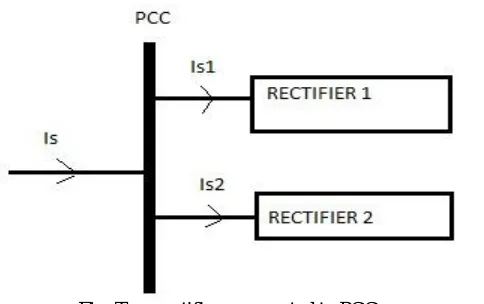
COST EFFECTIVE SOLUTION FOR CHOOSING TYPE OF RECTIFIERFig. Two rectifiers connected to PCC
III. SINGLE PHASE PWM RECTIFIER - POWER CIRCUIT
Fig. Power circuit using four IGBTs
For the positive half cycle the switches S2, S3 and body diodes D1 ,D4 will get forward biased. Turn on the switch S2. The conduction path for this operation is VS-L-S2-D4. Source is connected to inductor and hence current through the inductor(source current) will rise. Turn off the switch S2. Now conduction path will be Vs-L-D1-Load-D4.
Fig. Equivalent circuit when S2 is OFF
In order to control current, turning OFF switch S2 should decrease the current through inductor i.e L(di/dt)= Vs-Vo , should be negative.
Or Vs<Vo.
Hence the PWM operation can control current only when the output voltage Vo is greater than the peak value of input voltage. So it is also called as Boost rectifier.
IV. MODIFIED POWER CIRCUIT
Fig.PWM rectifier- power circuit with only two IGBTs The rectification is done through the diodes and it is controlled by the switches S1 and S2.
V. CONTROL CIRCUIT- USING HYSTERESIS CONTROLLER
Fig. Control circuit for rectifier
The control circuit should perform two controls: 1. Source current 2. Output voltage. Output of PI controller decides the magnitude of current to be drawn from the source which depends on the required reference voltage. From the source voltage, unit sine template is obtained and the reference current is obtained by multiplying the required magnitude of current and unit sine template. Hence the reference source current is obtained. The actual current through the inductor(actual source current) is controlled using hysteresis current controller method.
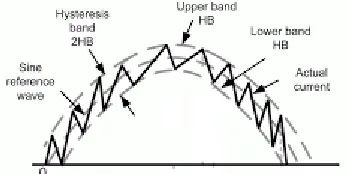
The hysteresis band current control is given for positive half cycle. Two bands are created with reference current as shown and when the inductor current(actual current) touches the upper band S2 switch is OFF , hence the current starts to fall , when it touches the lower band S2 switch is ON and the current now increases.
Hence by turning ON and OFF of the switch S2 in positive half cycle and controlling S1 switch in negative half cycle , source current can be controlled to be sinusoidal and inphase with the source voltage. Thus Source power factor can be controlled.
VI. SIMULATION RESULT AND DISCUSSION
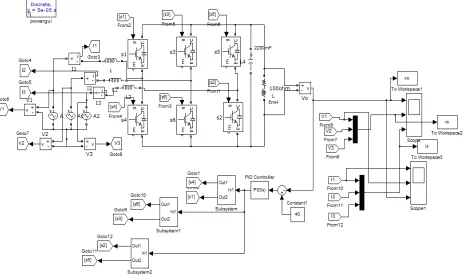
In the fig 1, the simulation of the proposed rectifier along with control circuit is shown. The numerical display shows the magnitude of current to be drawn from source. This can be verified from the source current plot shown in fig 2.
Fig. 1 Simulation of PWM rectifier
Three parameters have to be sensed for closed loop operation. They are 1. Source voltage 2. Source current 3.Load voltage. In this method Hysteresis current control is used, but this can also be implemented by other control methods like peak current control, average current control etc.
Fig 3 shows the magnified view of fig2, in order to ensure the load voltage and source current of required value.
Fig .3 Source current inphase with source voltage
VII. THREE PHASE PWM RECTIFIER
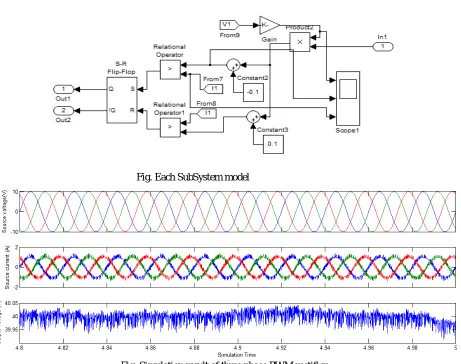
The proposed control strategy for single phase can also be applied for three phase also. But the number of parameters to be sensed will be 7 (3 phase voltages, 3 line currents and output voltage).
Fig. Each SubSystem model
Fig. Simulation result of three phase PWM rectifier
VIII.CONCLUSION
PWM rectifier allows controlling both the output load voltage and source current. Hence input power factor can be improved by this method. Also the proposed model consists of only two IGBTs rather than four for the same satisfactory operation. Using SIMULINK the power and control circuit are modelled and verified for required load voltage and source current is controlled inphase with the source voltage. By this topology whatever the type of load connected, source will see it as resistive and power factor will be near unity. These converters can mainly be used in two stage power converters (AC-DC and DC to AC).
REFERENCES
[1] M.P. Kazmierkowski, L.Malesani, “Current control techniques for three phase voltage source PWM converters: a survey”, IEEE Trans. On Ind. Electronics, Vol.45,No,5,pp.691-703,1998.
[2] Fen Li, Yunping Zou, Wei Chen, Jie Zhang, “Comparison of Current Control Techniques for Single-phase Voltage source PWM Rectifiers” IEEE International Conference on Industrial Technology(ICIT), pp. 1-4, April 2008
[3] B. Shi, G. Venkataramanan, and N. Sharma, "Design Considerations for Reactive Elements and Control Parameters for Three Phase Boost Rectifiers," in Proceedings of International Electric Machines and Drives Conference, Antonio, Texas, 2005, pp. 1757-1764.
[4] Yasuyuki Nishida, Osamu Miyashita, Toshimasa Haneyoshi, Hideo Tomita and Akeshi Maeda, “A Predictive Instantaneous-Current PWM Controlled Rectifier with AC-side Harmonic Current Reduction” IEEE Trans. On Ind. Electronics, VOL. 44, pp. 337-343, June 1997.