ISSN (Print) : 2320 – 3765 ISSN (Online): 2278 – 8875
I
nternational
J
ournal of
A
dvanced
R
esearch in
E
lectrical,
E
lectronics and
I
nstrumentation
E
ngineering
(An ISO 3297: 2007 Certified Organization)
Vol. 4, Issue 6, June 2015
Design of Power System Stabilizer Using
Harmony Search Algorithm
Syed Afsar
PG Student Dept. of EEE, Andhra University College of Engineering, Visakhapatnam, Andhrapradesh, India
ABSTRACT: Power system stability problem has received a great deal of attention over the years. Its stability depends upon the loading conditions of the power system and its topology. Single Machine Infinite Bus (SMIB) power system helps in tuning the controllers at one machine without considering the effect of other machines in the power system. In this paper, a comparison of Conventional Power System Stabilizer (CPSS) and Harmony Search Algorithm (HSA) based PID controller is presented through small signal stability of power system comprising of one machine connected to infinite bus and is modelled. As power systems is being operated closer to their stability limits, the weakness of a synchronizing torque among the generators was recognized as a major cause of system instability instead of damping torque. Harmony Search Algorithm is to tune optimal gains of a PID controller. The addition of a supplementary controller into the control loop, such as Harmony Search Algorithm based PID controller on the Single Machine Infinite Bus System (SMIB), provides the means to reduce the inhibiting effects of low frequency oscillations and settling time. The robustness and reliability of the various control schemes is examined through simulations. In the present work, the effectiveness of Harmony Search Algorithm based PID controller and Conventional Power System Stabilizers has been compared for SMIB systems of different ratings. The results show that the proposed Harmony Search Algorithm based optimized PID controller have an excellent capability in damping power system inter-area oscillations and enhance greatly the dynamic stability of the power system for a wide range of loading conditions.
KEYWORDS: Conventional Power System Stabilizer (CPSS), Harmony Search Algorithm (HSA), PID controller
I.INTRODUCTION
A power system mainly consists of generators, loads, transformers and transmission lines. Any disturbance in the power system will cause electromechanical oscillations and hence the system variables will start to oscillate. These variables may include system voltage, frequency, load angles of generators and other parameters of the system. Stabilizing these parameters is of great importance in power system stability.. Whereas, transient stability of the power system deals with system analysis, following a severe disturbance such as a single or multi-phase short-circuit or a generator loss. Under these conditions, the linearized power system model does not remain valid. The stability under the condition of small load changes has been called steady state stability. The concepts of synchronous machine stability as affected by excitation control and the phenomenon of stability of synchronous machines under small perturbations in the case of single machine connected to an infinite bus through external reactance has been presented
Power system operation is characterized by the random variation of the load condition, continuous change in generation schedule and network interconnection. Moreover, power systems are subjected to different disturbances such as actions of different controllers, switching of lines or increasing such loads in the system. Such disturbance will initiate low frequency power system oscillations which should be consequently endangering the overall stability of the system. Due to increased loading of the power systems, the stability has become a concern. The recent analytical work carried out the determination of Harmony Search Algorithm control parameters for the power systems presently to maintain stability. Once the low frequency oscillations started, they would continue for a while and disappear, or continue to grow causing system separation. Nowadays Harmony Search Algorithm based controller is one of the most important controllers in modern power systems for damping low frequency oscillations.
ISSN (Print) : 2320 – 3765 ISSN (Online): 2278 – 8875
I
nternational
J
ournal of
A
dvanced
R
esearch in
E
lectrical,
E
lectronics and
I
nstrumentation
E
ngineering
(An ISO 3297: 2007 Certified Organization)
Vol. 4, Issue 6, June 2015
increase in the load, loss of one generator or switching out of a transmission line, during a fault .One of the major problems in power system operation is related to the small-signal oscillatory instability caused by insufficient natural damping in the system. The most cost-effective way of countering this instability is to use Harmony Search Algorithm based controllers. Harmony Search Algorithm based PID controller is designed to damp the low frequency oscillations of power system. Harmony Search Algorithm based controller is used to damp the generator rotor oscillations by controlling its excitation using auxiliary stabilizing signals.
II. CONVENTIONAL POWER SYSTEM STABILIZAR
Today PSS are widely employed on synchronous generators. The most commonly used PSS, referred to as the CPSS, is a fixed parameter analogy type PSS. Earlier the CPSS is designed based on the use of transfer function, using the classical control theory. It contains a phase compensation network for the phase difference from the excitation controller’s input to the damping torque output. By appropriately tuning the phase and gain characteristics of the compensation network, it is possible to set the desired damping ratio. CPSS are widely used in the power system and have improved power system dynamic stability.
III. HARMONY SEARCH ALGORITHM
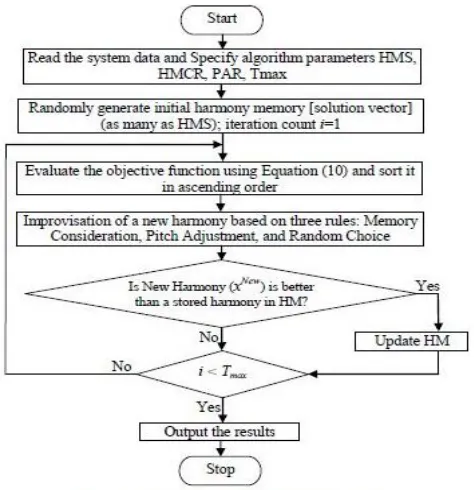
The Harmony Search Algorithm is a new Meta heuristic population search algorithm. The Harmony Search Algorithm is simple in concept, less in parameters and easy in implementation.. The flow chart of the HSA is shown in the Figure 4.
The main steps of Harmony Search Algorithm are as follows 1. Initialize the optimization problem and Algorithm parameters. 2. Initialize the Harmony memory.
3. Improve a New Harmony. 4. Update the New Harmony. 5. Check for termination condition.
Step 1: Algorithm Parameters:
The HSA parameters that are to be specified are Harmony Memory Size (HMS), Harmony Memory Considering Rate (HMCR), Pitch Adjusting Rate ( Rpa ) and Band width ( bi ). The Harmony Memory (HM) is a memory location where all the solution vectors are stored. Here HMCR, Rpa and bi to be used to improve the solution vector.
Step 2: Initialize Harmony Memory:
In this step, the HM matrix is filled with as many randomly generated solution vectors as the HMS. The elements in the HM are determined with randomly generated solution vectors. For instance the ithvariable xican be generated as
= + ( )∗( − )
Where r and (1) is a randomly generated number between 0 and 1 are the lower and upper bounds of the each decision variable.
Step 3: Improvise a New Harmony:
A new Harmony vector = ( ′, ′ … … ′ )
is generated based on three criteria, memory consideration, Pitch adjustment, Random selection Further every component obtained by memory consideration is pitch adjusted with a Pitch Adjusting Rate of Rpa. If pitch adjustment is enforced 'ix is replaced as ′= + ( )∗ where bi is the
distance bandwidth of the variable in the new vector.
Step 4: Update the New Harmony
ISSN (Print) : 2320 – 3765 ISSN (Online): 2278 – 8875
I
nternational
J
ournal of
A
dvanced
R
esearch in
E
lectrical,
E
lectronics and
I
nstrumentation
E
ngineering
(An ISO 3297: 2007 Certified Organization)
Vol. 4, Issue 6, June 2015
Step 5: Check for the Termination Condition
The HSA will be terminated when the termination condition is met. This may be usually a sufficiently a good objective function value or a maximum number of iterations. The maximum number of iterations criterion is employed in this work.
Fig 1 Harmony Search Algorithm
SMIB System with Conventional PSS
"The simulink model of this system represented is below
Fig2. SMIB System with Conventional Power System Stabilizer (CPSS)
ISSN (Print) : 2320 – 3765 ISSN (Online): 2278 – 8875
I
nternational
J
ournal of
A
dvanced
R
esearch in
E
lectrical,
E
lectronics and
I
nstrumentation
E
ngineering
(An ISO 3297: 2007 Certified Organization)
Vol. 4, Issue 6, June 2015
SMIB SYSTEM WITH HARMONY SEARCH ALGORITHM BASED PID CONTROLLER
The Simulink model of this system represented is below
Fig4. SMIB System with Harmony Search Algorithm based PID controller
IV.RESULTS AND DISCUSSIONS
SMIB SYSTEM
By considering the above two cases, the below are the output waveforms obtained for load angle delta and rotor speed for two different perturbations being created at 0.05, 0.1 respectively for each case. Consider a SMIB system of parameters of PSS and SMIB dynamic constants.
Parameters of PSS
Parameters Magnitude Lead Time constant, 0.154s Lag Time constant, 0.033s Lead Time constant, 0.5s Lag Time constant, 0.0055s Washout Time constant, 1.4s
SMIB dynamic constants:
ISSN (Print) : 2320 – 3765 ISSN (Online): 2278 – 8875
I
nternational
J
ournal of
A
dvanced
R
esearch in
E
lectrical,
E
lectronics and
I
nstrumentation
E
ngineering
(An ISO 3297: 2007 Certified Organization)
Vol. 4, Issue 6, June 2015
ISSN (Print) : 2320 – 3765 ISSN (Online): 2278 – 8875
I
nternational
J
ournal of
A
dvanced
R
esearch in
E
lectrical,
E
lectronics and
I
nstrumentation
E
ngineering
(An ISO 3297: 2007 Certified Organization)
Vol. 4, Issue 6, June 2015
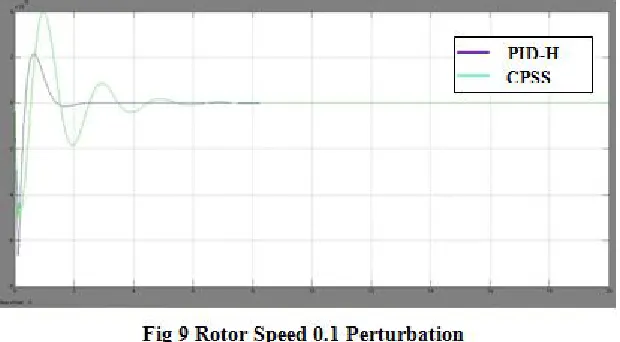
Figure 6 and 8 represents the variations of load angles at various perturbations in Single Machine Infinite Bus (SMIB) system and Figure 7 and 9 represents the variation of rotor speed at various perturbations. From the figures it is clear that Harmony Search Algorithm based PID controller has given the better results. It was found that the proposed technique not only optimizes the parameters faster, but also with the optimized gains the Harmony Search Algorithm shows better damping performance when the system is perturbed. Thus, there is a reduction in Peak Overshoot, Peak Undershoot and settling time. Because of the reduction in Peak Overshoot, Peak Undershoot and settling time, the system attains stability very quickly.
V.CONCLUSION
In this paper, stability analysis of Single Machine Infinite Bus Power System (SMIB) using Conventional Power System Stabilizer (CPSS), and Harmony Search Algorithm based PID controller has been carried out. It has been observed from results, that stability has been improved with Harmony Search Algorithm based PID controller.PID gains are tuned with Harmony Search Algorithm which results in reduce of peak over shoot, peak under shoot and settling time.
With the use of Harmony Search Algorithm based PID controller damping of oscillations in rotor speed, load angle and output power has been improved. Variation of load angles and rotor speed at 0.05 and 0.1 perturbation are compared and from the results obtained we can observe that Harmony Search Algorithm based PID controller has given the better results when compared with conventional Power System Stabilizer (PSS).Thus it was found that the proposed technique not only optimizes the parameters faster, but also with the optimized gains the Harmony Search Algorithm shows better damping performance when the system is perturbed.. Thus it can be conclude that system is stabilized quickly and efficiently with tuning of gains by Harmony Search Algorithm.
REFERENCES
[1]Power System Stability and Control by Kundur. P.
[2] Clarification on power system stabiliser design Jin Ma; Hao Jing Wang; Kowk Lun Lo Generation, Transmission & Distribution, IET Year: 2013, Volume: 7, Issue: 9
Pages: 973 - 981, DOI: 10.1049/iet-gtd.2012.0219 Cited by: Papers (1) IET Journals & Magazines
[3] Coordinated design of unified power flow controller and power system stabilizer to enhance power system stability Eslami, M.; Shareef, H.; Mohamed, A. Power System Technology (POWERCON), 2012 IEEE International Conference on Year: 2013 Pages: 1 - 6, DOI: 10.1109/PowerCon.2012.6401261Cited by: Papers (1)IEEE Conference Publications
ISSN (Print) : 2320 – 3765 ISSN (Online): 2278 – 8875
I
nternational
J
ournal of
A
dvanced
R
esearch in
E
lectrical,
E
lectronics and
I
nstrumentation
E
ngineering
(An ISO 3297: 2007 Certified Organization)
Vol. 4, Issue 6, June 2015
[5] An approach for coordinated automatic voltage regulator–power system stabiliser design in large-scale interconnected power systems Golpı̂ra, H.; Bevrani, H.; Naghshbandy, A.H.Generation, Transmission & Distribution, IETYear: 2012, Volume: 6, Issue: 1Pages: 39 - 49, DOI: 10.1049/iet-gtd.2011.0411 Cited by: Papers (2) IET Journals & Magazines
[6] Evolutionary harmony search algorithm for non-convex economic dispatch Vo Ngoc Dieu; Khai Phuc Nguyen; Nguyen Thanh Hop; Le Anh Dung; Ongsakul, W.Power Engineering Conference (UPEC), 2013 48th International Universities ‘Year: 2013
Pages: 1 - 6, DOI: 10.1109/UPEC.2013.6714889 IEEE Conference Publications
[7] A Modified Harmony Search Algorithm for Optimization Problems Jiali Yang; Jihong Zhu Computational Intelligence and Design (ISCID), 2012 Fifth International Symposium on Year: 2012, Volume: 2 Pages: 100 - 104, DOI: 10.1109/ISCID.2012.177 Cited by: Papers (1) IEEE Conference Publications
[8] Solving combined economic emission dispatch problems using self-adaptive differential harmony search algorithm Arul, R.; Velusami, S.; Ravi, G.Circuit, Power and Computing Technologies (ICCPCT), 2014 International Conference on Year: 2014 Pages: 757 - 762, DOI: 10.1109/ICCPCT.2014.7054939 IEEE Conference Publications