ISSN (Print) : 2320 – 3765 ISSN (Online): 2278 – 8875
I
nternational
J
ournal of
A
dvanced
R
esearch in
E
lectrical,
E
lectronics and
I
nstrumentation
E
ngineering
(A High Impact Factor, Monthly, Peer Reviewed Journal)
Website: www.ijareeie.com
Vol. 7, Issue 6, June 2018
Novel Algorithm of Adaptive Median Filter
for Removal of Noises in both Image and
Signal Processing
Rakesh M R
Assistant Professor, Dept. of ECE, AJIET Mangaluru, Karnataka, India
ABSTRACT: In signal or image processing, a filter is a device (or process) that removes some unwanted components
or features from a signal or image. The median filtering algorithm which has better noise reducing capacity than other
general filters and it takes small amount of time to reduce noise also having little complex due to some calculations in algorithm. The paper proposed an improved novel algorithm of adaptive median filter, which is implemented for denoising of corrupted (noisy) image and signal by preserving edges and saving original features of the images or signal. Experimental results show that the algorithm reduces the noise and retains the fine details of the image or signal. The complexity of the algorithm is decreased and the performance of noise reduction has effectively improved. The adaptive median filter with new algorithm will be useful in both signal processing and digital image processing for removal of noises.
KEYWORDS: Filters, Noises, Adaptive Filters, Median Filters, Adaptive Median Filters
I. INTRODUCTION
Processing an Image Broadly Includes the Following Steps
Capturing or Importing the image with an scanner or by digital photography
Analyzing and manipulating the image which includes data compression and image enhancement
Result or output can be an altered image or a report that is based on image analysis.
ISSN (Print) : 2320 – 3765 ISSN (Online): 2278 – 8875
I
nternational
J
ournal of
A
dvanced
R
esearch in
E
lectrical,
E
lectronics and
I
nstrumentation
E
ngineering
(A High Impact Factor, Monthly, Peer Reviewed Journal)
Website: www.ijareeie.com
Vol. 7, Issue 6, June 2018
II. NOISES
Noise tells unwanted information in digital images or signal. Noise produces unenviable effects such as artifacts, improbable edges, unseen lines, corners, blurred objects and disturbs background scenes. To reduce these unwanted effects, preceding learning of noise details is essential for advance processing. Image noise is random variation of
brightness or colour information in images, and is usually an aspect of electronic noise. It can be produced by
the sensor and scanner circuit or digital camera. Image noise is an objectionable by-product of image capture that obscures the desired information.
Gaussian Noise
Principal sources of Gaussian noise in digital images arise during acquisition or capturing. The sensor has inherent noise due to the level of illumination and its own temperature, and the electronic circuits connected to the sensor inject their own share of electronic circuit noise. In digital image processing Gaussian noise can be reduced using a spatial filter, though when smoothing an image, an unwanted outcome may result in the blurring of fine-scaled image edges and details because they also correspond to blocked high frequencies.
Speckle noise
Speckle is a granular noise that normally exists in and degrades the quality of the active radar, synthetic aperture radar (SAR), medical ultrasound and optical coherence tomography images. Speckle is primarily due to the interference of
the returning wave at the transducer aperture. Speckle noise in conventional radar results from random fluctuations in
the return signal from an object that is no bigger than a single image-processing element. Images with speckle noise will results in reducing the contrast of image and difficult to perform image processing operations like edge detection, segmentation. So filtering is very important in case of speckle noisy image.
Periodic noise
A common source of periodic noise in an image is from electrical or electromechanical interference during the image capturing process. An image affected by periodic noise will look like a repeating pattern has been added on top of the original image. In the frequency domain this type of noise can be seen as discrete spikes.
Impulse Valued Noise (Salt and Pepper Noise)
This noise can be caused by sharp and sudden disturbances in the image signal. An image containing salt-and-pepper noise will have dark pixels in bright regions and bright pixels in dark regions. This type of noise can be caused by analog-to-digital converter errors, bit errors in transmission, etc. An effective noise reduction method for this type of noise is a median filter or a morphological filter. Median filtering is a common image enhancement technique for removing salt and pepper noise. Because this filtering is less sensitive than linear techniques to extreme changes in pixel values, it can remove salt and pepper noise without significantly reducing the sharpness of an image.
III. FILTERS
Filter removes some unwanted features from a signal or an image. Filtering is a class of signal and image processing, the defining feature of filters being the complete or partial suppression of some aspect of the signal. Most often, this means removing some frequencies or frequency bands. Filters are widely used in electronics and telecommunication, radio, television, audio recording, radar, control systems, music synthesis, image processing, and computer graphics. In image processing Filtering is a technique for modifying or enhancing an image. Image processing operations implemented with filtering include smoothing, sharpening, and edge enhancement. Image filtering is used to Remove noise, Sharpen contrast, Highlight contours, Detect edges. Image filters can be classified as linear or nonlinear. Linear filters are convolution filters as they can be represented using a matrix multiplication. Thresholding and image equalisation are examples of nonlinear operations (median filter).
ISSN (Print) : 2320 – 3765 ISSN (Online): 2278 – 8875
I
nternational
J
ournal of
A
dvanced
R
esearch in
E
lectrical,
E
lectronics and
I
nstrumentation
E
ngineering
(A High Impact Factor, Monthly, Peer Reviewed Journal)
Website: www.ijareeie.com
Vol. 7, Issue 6, June 2018
There are many traditional based filters for noise reduction,
Mean Filter - noise reduction using mean of neighbourhood. Mean filtering is a simple, sensitive and easy to implement method of smoothing images, i.e. reducing the amount of intensity variation between one pixel and the next. It is often used to reduce noise in images
Median Filter - noise reduction using median of neighbourhood. The median filter is normally used to reduce noise in an image, somewhat like the mean filter. However, it often does a better job than the mean filter of preserving useful detail in the image.
Gaussian Smoothing - noise reduction using convolution with a Gaussian smoothing kernel. The Gaussian smoothing operator is a 2-D convolution operator that is used to `blur' images and remove detail and noise. In this sense it is similar to the mean filter, but it uses a different kernel that represents the shape of a Gaussian hump.
Frequency Filters - Process an image in the frequency domain. The image is Fourier transformed, multiplied with the filter function and then re-transformed into the spatial domain. Attenuating high frequencies results in a smoother image in the spatial domain, attenuating low frequencies enhances the edges. All frequency filters can also be implemented in the spatial domain and it is computationally less expensive to perform the filtering in the spatial domain. Frequency filtering is more appropriate if no straightforward kernel can be found in the spatial domain, and may also be more efficient.
Unsharp Filter - edge enhancement filter. The unsharp filter is a simple sharpening operator which enhances edges via a procedure which subtracts an unsharp, or smoothed, version of an image from the original image. The unsharp filtering technique is commonly used in the photographic and printing industries for crispening edges.
IV. ADAPTIVE FITER
Adaptive filters are commonly used in image processing to enhance or restore data by removing noise without significantly blurring the structures in the image. Adaptive filtering techniques that can be generalized to multidimensional signals
V. MEDIAN FILTER
Median filtering is a nonlinear method used to remove noise from images. It is very effective at removing noise while preserving edges. It is particularly effective at removing salt and pepper type noise. The median filter works by moving through the image pixel by pixel, replacing each value with the median value of neighbouring pixels. The pattern of neighbours is called the ‘window’, which slides, pixel by pixel over the entire image 2 pixel, over the entire image. The median is calculated by first sorting all the pixel values from the window into numerical order, and then replacing the pixel being considered with the middle (median) pixel value.
VI. NOVEL ADAPTIVE MEDIA FILTER
The new Adaptive Median Filter is designed to eliminate the problems faced with the general adaptive median filter. In the Adaptive Median Filter, the size of the window surrounding each pixel is variable. This variation depends on the median of the pixels in the present window. If the median value is a noise, then the size of the window is expanded otherwise, further processing is done on the part of the image within the current window specifications. The center pixel of the window is evaluated to verify whether it is a noise or not. If it is a noise, then the new value of that pixel in the filtered image will be the median value of the pixels in that window. If, however, the center pixel is not a noise, then the value of the center pixel is retained in the filtered image. Thus, unless the pixel being considered is a noise, the grayscale value of the pixel in the filtered image is the same as that of the input image. Thus, the Adaptive Median Filter solves the dual purpose of removing the noise from the image and reducing distortion in the image. Adaptive Median Filtering can handle the filtering operation of an image corrupted with noise. This filter also smoothens out other types of noise, thus, giving a much better output image than the general Adaptive median filter.
ISSN (Print) : 2320 – 3765 ISSN (Online): 2278 – 8875
I
nternational
J
ournal of
A
dvanced
R
esearch in
E
lectrical,
E
lectronics and
I
nstrumentation
E
ngineering
(A High Impact Factor, Monthly, Peer Reviewed Journal)
Website: www.ijareeie.com
Vol. 7, Issue 6, June 2018
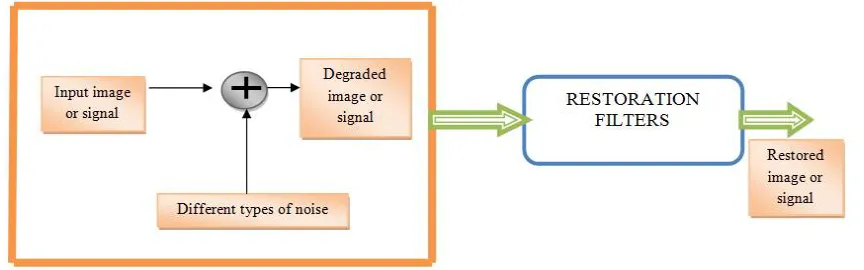
make up the window beyond the image dimensions. The image or signal with noise passed through new designed filter which gives noise free image or signal at the output shown in Figure 2
Fig 2: Block Diagram
The Adaptive Median Filter performs spatial processing to preserve detail and smooth noise. A prime benefit is that repeated applications of this new adaptive median filter do not erase edges or other fine details in the image. The new algorithm of adaptive median filtering has been introduced as an improvement to the general adaptive median filtering which performs a spatial processing to determine which pixels in an image have been affected by noise, and run the filter only in this pixel. The Adaptive Median Filter classifies pixels as noise by comparing each pixel in the image to its surrounding neighbour pixels. The size of the neighbourhood is adjustable, as well as the threshold for the comparison. A pixel that is different from a majority of its neighbours, as well as being not structurally aligned with those pixels to which it is similar, is labelled as salt and pepper noise. These noise pixels are then replaced by the median pixel value of the pixels in the neighbourhood. The new algorithm of adaptive median filter can better handle speckle, periodic, Gaussian, salt and pepper noises. This new algorithm of filter is mainly designed for images and by slight modification in code (with same algorithm); we can also apply this algorithm to signal processing.
VII. RESULT
Image with noise is passed through new algorithm filter and output contains clean image without noise. The two different images with noise (input to new filter) and without noise (after passed through new filter) are shown in Figure 3.
ISSN (Print) : 2320 – 3765 ISSN (Online): 2278 – 8875
I
nternational
J
ournal of
A
dvanced
R
esearch in
E
lectrical,
E
lectronics and
I
nstrumentation
E
ngineering
(A High Impact Factor, Monthly, Peer Reviewed Journal)
Website: www.ijareeie.com
Vol. 7, Issue 6, June 2018
Fig 3: Image Passed Through New Adaptive Median Filter
With small modification in the code, the code is also applicable to signal processing. The figure 3 shows the signal with noise. Input signal of sine wave which is disturbed by some noise signals. That noisy input is given to our new algorithm filter and output of this filter will contain only sine wave without any noise shown in Figure 4.
Fig 4: Signal Passed Through New Adaptive Median Filter
VIII. CONCLUSION
Median filters are used to remove noise from an image. Adaptive median filter is an advanced and powerful filter than median filter to do same process with some additional qualities. In this paper a new algorithm of adaptive median filter is explained with proper results. The new proposed algorithm will applicable to both image processing and signal processing (with small modification in the code) which reduce noise from an image and signal by preserving all fine details. Time required to get a clear output is very less and filtered output is almost same as original required output with removal of all noises from degraded image.
REFERENCES
[1] S.Haykin,”Adaptive Filter Theory”,Upper Saddle River,Prentice- Hall, 2002, 4th Edition. [2] Monsoon.H.Hayes, “Statistical Digital Signal Processing And Modelling”,Wiley India.
ISSN (Print) : 2320 – 3765 ISSN (Online): 2278 – 8875
I
nternational
J
ournal of
A
dvanced
R
esearch in
E
lectrical,
E
lectronics and
I
nstrumentation
E
ngineering
(A High Impact Factor, Monthly, Peer Reviewed Journal)
Website: www.ijareeie.com
Vol. 7, Issue 6, June 2018
[5] Suman shrestha, “ image denoising using new adaptive Based median filter signal & image processing”, : an international journal (sipij) vol.5, no.4, august 2014
[6] Rakesh M.R, Ajeya B, Mohan A.R, “Hybrid Median Filter for Impulse Noise Removal of an Image in Image Restoration”, International Journal of Advanced Research in Electrical, Electronics and Instrumentation Engineering Vol. 2, Issue 10, October 2013
[7] Monika Kohli, Harmeet Kaur,” Noise Removal in Image Processing using Median, Adaptive Median and Proposed Median Filter and Respective Image Quality Comparison”, International Journal of Engineering Technology, Management and Applied Sciences November 2015, Volume 3, Special Issue, ISSN 2349-4476
BIOGRAPHY