An Efficient Model Over Attribute Encrypted Outsourced Data
Using Secure K-D Tree
ABSTRACT
In cloud era, it raises the intractability to keep the confidentiality and efficiency simultaneously while outsourcing encrypted data base. The secure issues are inevitable and urgent in range query (a pivotal component). Secure range query (SRQ), removing such concerns, is urgent to resolve. Concretely, a secure k-d tree (SKD tree) is constructed by invoking comparable encryption
(CE) and AES, and SKD mechanism is proposed to resolve SRQ directly over the encrypted data. Until both the CE and AES are cracked, it is infeasible to reveal the query, data base or query result. In our proposal, only a single interaction is occurred between user and cloud, which promotes the searching efficiency dramatically. Experimental studies show that SKD mechanism is efficient over really geographical datasets.
Keywords-secure range query; k-d tree; comparable encryption
I. INTRODUCTION
For individuals and organizations, subjected to various of limitations, there is a central requirement to outsource both the data base and workloads to cloud server. For example, by the end of 2013, Netflix has been 100% on Amazon Web Services1. However, cloud computing raises the secure concerns of user’s confidentiality.
A sound trade-off between security and efficiency are as follows. The private data owner (owner) encrypts the data base and builds a secure index. Following on that,
owner subcontracts them to cloud server (cloud). The authorized user (user) submits the encrypted query to cloud, which locates the candidates of query directly over the encrypted data base afterwards. Finally, user complete the query by decrypting and pruning the returned encrypted candidates.
A. Motivation and Scenario
Consider a scenario that a national government organizes a large data base consisting of massive private resources with their specific locations (e.g., longitude, latitude, etc). The government (i.e., owner) allows paid companies (i.e., user) to query for private resources within a geographical region. Due to economize and security reasons, owner subcontracts both the encrypted data base and queries to cloud. Such a problem is named secure range query (SRQ).
SRQ is also applied extensively to location-based services (LBS), geo-referenced market research, etc. Owner and user are fully trusted. However, cloud is semi-honest by strictly following the mechanism but also being curious about the data base and workload.
During the whole process, cloud can analyze the workload without violating the mechanism. In this paper, we aim at
J.PREMALATHA
M.Tech (VLSI) Dept of E.C.E
Chaitanya Institute of Technology and Science, Warangal, Telangana,India
Email: [email protected]
T. RATAN BABU Assistant Professor
Dept of E.C.E
Chaitanya Institute of Technology and Science, Warangal, Telangana,India
proposing a mechanism to resolve SRQ problem with minimal communication cost and round trips between user and cloud dramatically, named secure k-d (SKD) mechanism. The number of round trip in SKD is only 1, which is the possible minimal one.
B. Contributions
For the sake of confidentiality, cloud is always considered to be a pure storage without any unilateral process capacity, which leads to multi round trips between user and cloud. At the mean time, existing schemes can not provide a sound filter capacity. Both put tremendous negative affect on the efficiency of existing schemes. The proposed scheme here resolves above concerns. Our contributions are as follows: • We present a concrete SKD that minimize the communication cost and round trip. • Experimental evaluations and comparisons over real datasets guarantees our scheme’s superiority.
II. PRELIMINARIES AND RELATED WORK
We investigate CRT mechanism and show the drawbacks. Then, we review comparable encryption (CE) algorithm briefly and discuss the related works.
A. CRT mechanism
CRT, as a state-of-art in SRQ, employs R*-tree and AES to provide the confidential of query and data base. There exists a multi round trip between user and cloud in CRT. Recently, there are still many works related to data base outsourcing. Most relevant works, assume a pre-installed
trusted component (e.g., software, tamper-proof device, etc) in cloud. Consequently, cloud must be opened completely to owner which is unacceptable. It is obvious that we make a sound tradeoffs in terms of confidentiality and efficiency.
B. Comparable Encryption
Furukawa presented an optimized short CE in 2014. CE is composed of Gen, Enc, Der and Cmp. Here, Gen, system parameter param and secret key mkey are omitted for the lack of space. Further information is recommended.
Enc: ciph = Enc(num). Der: tok = Der(num).
Cmp: res = Cmp(ciph, ciph_, tok).
C. Related work
Cryptography based approaches.
Providing database as a service (DaaS) was firstly introduced. Agrawal et al. presented an insecure orderpreserving encryption (OPE) scheme that allows any comparison directly over encrypted data. Popa et al. presented the first ideal secure OPE. However, multi round trips are inevitable and lead to low efficiency. In owner either builds a B+-tree on one-dimensional data or an R*-tree for two-dimensional data. At the meantime, conventional cryptographic techniques (e.g., AES) are employed to encrypt nodes in the tree. However, in CRT, The multi round trips are intolerable. In SKD, cloud burdens most of workloads, and thereby further the quality of service is guaranteed.
Anonymity based approaches.
anonymizer. The anonymous spatial region is instead of exact location. It hides the location of user, but does not protect the data base. Following on that, t-closeness and l-diversity are proposed. In these methods, the generalization process alters the dataset only for statistical purposes. This goes against our original intention.
III. CONSTRUCTION
This section introduces the problem of SRQ. Following on that, a concrete SKD mechanism is proposed.
A. Problem Definition
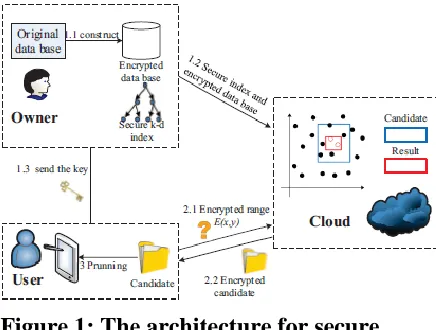
The architecture is illustrated in Fig. 1. First owner builds an appropriate secure index and encrypts the data base. Both them are subcontracted to cloud. The secret keys are shared between owner and user. When issuing
Figure 1: The architecture for secure range query.
a new query, user encrypts the query and submits it to cloud. Following on that, cloud conducts the query over encrypted data base and index, and then returns the encrypted candidate. Finally, user decrypts and prunes the candidates to get the accurate result.
B. Secure k-d tree
SKD tree employs short CE to achieve confidentiality of nodes in standard k-d tree. It provides a security guarantee resisting any type of location-based attack (e.g., the general attack). During the whole query processing of encrypted query E(q), there is only single communication with cloud while locating candidate. The algorithm will be executed until the original (remainder) dataset D is empty (Lines 1-3). First of all, determine the scopes of each dimension separately and encrypt the elements in nodes under CE. Then, we calculate the split dimension and generate the root of subtree. We encrypt the data of all the leaves. Then, repeat all the procedures to allocate all data.
The SKD tree can be constructed in which each node stores the ciphers of all the data aes ciph encrypted by AES and the ciphers of all the data ce ciph encrypted by CE.
C. Secure Range Query
Given a new query q, user generates encrypted query E(q) = {tok0, ciph0, tok1, ciph1} by encrypting each dimension with ce. Then, user sends E(q) to cloud, to locate candidate. It is a typical recursive access, and we let the detail ignored. Since CE can achieve cipher comparison, overlap can be instantiated in a trivial way and is omitted here. The encrypted candidate generated is sent to user. Then, he decrypts and prunes the false candidates. Such a process is trivial and omitted here too. Note that, S is global, but root is local.
D. Complexity analysis
dominant cost. The cost to encrypt query is 2(4nb+1)d・Hash, which integrates the time of generating ciphers and tokens. Furthermore, the query phase is almost completely conducted in cloud, in which the cost is O(d・n1−1d ) ・ 2(nb−l+2)・ Hash. User needs to decrypt nc candidates. Hence, the cost mainly comes from the decryption and is d ・ nc ・ td, in which td is the encryption time for a single dimension.
E. Security analysis
Security concern of our scheme mainly depends on CE, since AES is deeply probed and widely adopted. We consider the possible security breach from an attacker who can not change the SKD mechanism itself. Assume that A (including cloud) is an attacker and monitors all the processing of queries, aiming to grab useful information. The confidentiality of the query and data is protected due to the indistinguishability property of CE. Assume there is an adversary that can obtain non-trivial information from CE ciphers with a nonnegligible probability. It is easy to distinguish the differences between those ciphers. They are contradictory.
Additionally, it is intractable for attacker A to obtain non-trivial information from returned encrypted candidate. Suppose that A obtains a set of candidates within the scope of the hyper-rectangle bounded by query q. All the information A can inferred is that p falls in the hyper-rectangle. That is to say, for any two points in the hyper-rectangle, A cannot distinguish them, since they follow the same path along SKD tree. Therefore, the whole query processing only
reveals trivial information to an external attacker A.
IV.RESULTS
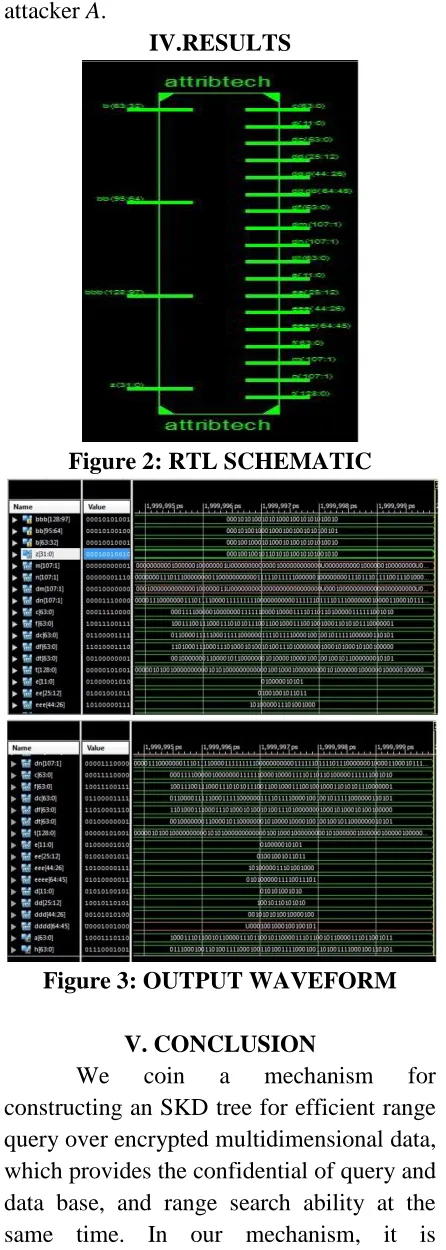
Figure 2: RTL SCHEMATIC
Figure 3: OUTPUT WAVEFORM
V. CONCLUSION
intractable for an attacker (including cloud) to recover the original dataset precisely from the SKD tree, encrypted query or encrypted candidate. The computation cost and round trip between cloud and user are extremely low compared to the previous techniques (i.e., CRT). Experimental studies over four real private spatial datasets shows that our scheme is light enough specific to the resource constrained users.
VI.REFERENCES
[1] M. L. Yiu, G. Ghinita, C. S. Jensen, and P. Kalnis, “Enabling search services on outsourced private spatial data,” The VLDB Journal, vol. 19, no. 3, pp. 363–384, 2010. [2] R. Agrawal, J. Kiernan, R. Srikant, and Y. Xu, “Order preserving encryption for numeric data,” in SIGMOD, 2004, pp. 563– 574.
[3] E. Damiani, S. Vimercati, S. Jajodia, S. Paraboschi, and P. Samarati, “Balancing confidentiality and efficiency in untrusted relational dbmss,” in CCS, 2003, pp. 93– 102.
[4] J. Furukawa, “Short comparable encryption,” in Cryptology and Network Security, 2014, vol. 8813, pp. 337–352. [5] H. Hacig¨um¨us, B. Iyer, and S. Mehrotra, “Providing database as a service,” in ICDE. IEEE, 2002, pp. 29–38.
[6] R. A. Popa, F. H. Li, and N. Zeldovich, “An idealsecurity protocol for order-preserving encoding,” in S&P, 2013, pp. 463–477.
[7] B. Gedik and L. Liu, “Location privacy in mobile systems: A personalized anonymization model,” in ICDCS. IEEE, 2005, pp. 620–629.
[8] G. Ghinita, P. Kalnis, A. Khoshgozaran, C. Shahabi, and K.-L. Tan, “Private queries in location based services: anonymizers are not necessary,” in SIGMOD, 2008, pp. 121– 132.
[9] P. Kalnis, G. Ghinita, K. Mouratidis, and D. Papadias, “Preventing location-based identity inference in anonymous spatial queries,” TKDE, vol. 19, no. 12, pp. 1719– 1733, 2007.
[10] M. F. Mokbel, C.-Y. Chow, and W. G. Aref, “The new casper: query processing for location services without compromising privacy,” in VLDB, 2006, pp. 763–774.
[11] N. Li, T. Li, and S.
Venkatasubramanian, “t-closeness: Privacy beyond k-anonymity and l-diversity,” in ICDE, 2007, pp. 106–115.
[12] A. Machanavajjhala, D. Kifer, J. Gehrke, and M. Venkitasubramaniam, “l-diversity: Privacy beyond k-anonymity,” TKDD, vol. 1, no. 1, p. 3, 2007.
Authors:
J.PREMALATHA studying M.Tech (VLSI) from Chaitanya Institute of Technology and Science, Warangal, Telangana,India.
T. RATAN BABU working as Assistant Professor in