ISSN 2286-4822 www.euacademic.org
Impact Factor: 3.1 (UIF) DRJI Value: 5.9 (B+)
A Study of Learning Styles of Upper Primary School
Students
Dr. PARESH B. ACHARYA Assistant professor Shri I. J. Patel M. Ed. Course Mogri, Anand, India
Abstract:
This study investigated the learning style of upper primary school students in relation to academic achievement and gender at Anand district Gujarat, INDIA. Descriptive research survey design was adopted for this study. The sample consisted of five hundred thirty five (535) of standard eight students. The participants were selected using random sampling methods. Instruments used to collect data were developed by Prof. K. S. Likhia and for academic achievement collect from school. Hypotheses were tested at 0.01 level of significance. Data collected were analyzed using Chi-square statistics and t-test. The result showed that there is a significant difference between different learning style of students and their academic achievement. Findings of the study reveal that, visual learning style was found to be more prevalent than kinesthetic and auditory learning styles among secondary school students. Visual, auditory and kinesthetic are significant on academic achievement. Also gender difference with different learning styles was significant.
Key words: Learning Style, academic achievement.
Introduction:
and the changes have resulted in more effective learning” (Reid, 1999). Gardner‟s research has shown that human cognitive ability is pluralistic rather than unitary and that learners of any subject will make greater progress if they have the opportunity to use their areas of strength to master the necessary material. He recommends that teachers use a wide variety of ways to deal with the subject because “genuine understanding is most likely to emerge and be apparent to others (Gardner, 1991). In the classroom it is possible to motivate learners by activating multiple ways of meaning-making through the use of tasks relating to the different intelligences. Providing a variety of language activities that stimulate the different tools or intelligences proposed by Gardner (1999) makes it possible to engage multiple memory pathways necessary to produce sustained deep learning (Schumann, 1997). In order to achieve the ultimate goal of student learning it is important to use a combination of teaching methods and to make the classroom environment as stimulating and interactive as possible. Students learn in many different ways.
Learning style and students’ achievement
Learning style and gender:
students have significantly different learning styles. Gabe Keri (2002) Male and female college students' learning styles differ: an opportunity for instructional diversification. Chi-square statistic performed to compare males' and females' learning styles indicated that significant differences exist between males and females, [chi square] (8, N=585) =50.68612, p< .0000). More females than males demonstrate strong preferences for the social/conceptual learning style (27.1% to 13.0%). Females are more of the conceptual learning style type than males (12.3 % to 7.5 %). Furthermore females than males demonstrate a proclivity for independent/applied type (15.9% to 8.4%).
Objective of the study:
1 To find level of learning styles of upper primary school students.
2 To study the learning style of upper primary school student in the context of academic achievement. 3 To study the learning style of upper primary school
student in the context gender.
Present research is in the field of advanced psychology, its sub field - learning style. Statistically it is a quantitative type of research and also a descriptive type research.
Hypothesis of the study:
H01: There will be no significant difference between the mean scores of the achievement of visual and auditory learning style. H02: There will be no significant difference between the mean scores of the achievement of visual and kinesthetic learning style.
H04: There will be no significant difference between the mean scores of visual learning style of boys and girls.
H05: There will be no significant difference between the mean scores of auditory learning style of boys and girls.
H06: There will be no significant difference between the mean scores of kinesthetic learning style of boys and girls.
H07: There will be no significant difference between observed values of the visual, auditory and kinesthetic types learning style of boys.
H08: There will be no significant difference between observed values of the visual, auditory and kinesthetic types learning style of girls.
Limitations of the study:
Present research limited to the upper primary Guajarati medium school of standard 8 of Anand distinct.
Method
Participants: Researcher selects a total student of 8th standard student of upper primary schools of Anand districts as a population. Researcher selected randomly seven schools. Out of those schools researcher selected classes randomly. Total sample was 535 out of them 401 boys and 129 girls (age between 13 and 14).
For solving the problem of the study, researcher used survey research method and parametric techniques t-test.
achievement the result of last semesters were taken as a student‟s achievement score.
Procedure: Prof. K. S. Likhia‟s learning styles was administered on 535 participants. The participants were required to complete inventory by choosing among 3 alternatives, ranging from often, sometimes to seldom. For often give 3, sometimes gives 2 and seldom give 1.maximum scores for any one type learning styles will be 30 and minimum scores 10 of each learning style. Total scores on each subscale learning style is called learning style of the students. Also academic achievement of the students collected from the schools. Both scores were continuous type data. To find significant difference researcher use t-test parametric techniques.
Significance of the study: It is observed from the literature on learning styles that knowing students learning styles can be useful for both teachers and students and make the learning process more Fruitful (Reid, 1995). The results of this study may help instructors in understanding the various learning styles favored by their students.
Result and discussion
Table 1: Different learning style s levels
Learning
style N Range Minimum Maximum Mean
Standard
deviation variance Visual 535 16.00 14.00 30.00 21.41 2.61 6.831 Auditory 535 21.00 9.00 30.00 18.02 3.21 10.30 Kinesthetic 535 18.00 12.00 30.00 21.24 2.72 7.41
Here highest range for auditory learning style while lowest was visual learning style. Mean value more for visual learning style while low for auditory learning style. Standard deviation was higher to lower Kinesthetic, Visual and auditory respectively. Also variance was higher to lower auditory, Visual and Kinesthetic respectively.
Table 2: t-value table for different learning style with academic achievement
Visual Auditory Kinesthetic
Visual(N=257) - - -
Auditory(N=58) 4.96** - -
Kinesthetic(N=220) 8.22** 5.58** - ** Level of significance 0.01
8.22 (level of significance 0.01). Academic achievement mean (M=51.34) of kinesthetic learning style was greater than academic achievement mean (M=43.45) auditory of learning style. So H03 rejected. It means kinesthetic learning style learner was better than visual learning style learner and auditory type learning learner. While visual learning style learner was better than auditory type learning learner.
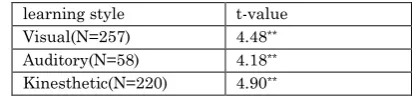
Table 3: t-value table for gender difference with different learning style
There will be significant difference between the mean scores of visual learning style of boys and girls. t-value for that were 4.48 (level of significance 0.01). Mean (M=22.30) of visual learning style girls was greater than mean (M=21.14) of visual learning style boys. So H01 rejected. There will be significant difference between the mean scores of auditory learning style of boys and girls. t-value for that were 4.18 (level of significance 0.01). Mean (M=18.85) of auditory learning style girls was greater than mean (M=17.57) of auditory learning style boys. So H02 rejected. There will be significant difference between the mean scores of kinesthetic learning style of boys and girls. t-value for that were 4.48 (level of significance 0.01). Mean (M=22.08) of kinesthetic learning style girls was greater than mean (M=20.71) of kinesthetic learning style boys. So H03 rejected. In gender differences girls were high learning style than boys. In girl‟s visual learning styles is better than kinesthetic and auditory learning style. While kinesthetic learning style is more batter than auditory learning style in girls, same as in boys.
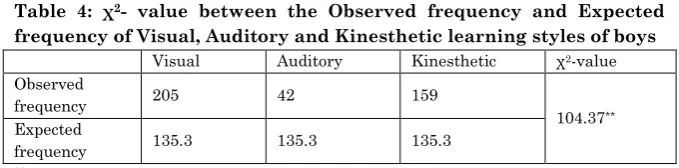
Table 4: χ2- value between the Observed frequency and Expected
frequency of Visual, Auditory and Kinesthetic learning styles of boys
Visual Auditory Kinesthetic χ2-value Observed
frequency 205 42 159
104.37** Expected
frequency 135.3 135.3 135.3
** Level of significance 0.01
There will be significance difference between the Observed frequency and Expected frequency of Visual, Auditory and Kinesthetic learning styles of boys.
Table 5: χ2- value between the Observed frequency and Expected
frequency of Visual, Auditory and Kinesthetic learning styles of girls
Visual Auditory Kinesthetic χ2-value Observed
frequency 52 16 61
26.37** Expected
frequency 43 43 43
** Level of significance 0.01
There will be significance difference between the Observed frequency and Expected frequency of Visual, Auditory and Kinesthetic learning styles of girls.
The findings is against by the previous research work by Dobson (2010) in his study cites two of the studies (Alkhasawneh et al. 2008; Slater et al. 2007) which found no significant inferences in preferences between men and women, whereas one study (Wehrwein et al. 2007) did report a difference which was descriptive in nature and was not supported by statistical analysis. Also Dobson (2010) in his study found a significant trend in sensory modality preferences and sex.
Conclusion:
the students. A student‟s choice of learning style affects his academic achievement in that subject. Visual learning style was the most preferred learning style among the students in both boys and girls. There was gender difference in the learning style preference among the students. Thus, we can conclude that we need to shift from classroom teaching and incorporate various different styles to teach our multimodal learners.
REFERENCES
Chuah, Chong-Cheng; Sinar, Cendekia, Malaysia, Penang: University Saints Malaysia (USM) 1988.
Drysdale, M.T., Ross, P., Schulz, R.A.; Cognitive learning styles and academic performance in 19 first-year University Courses: successful students versus students at risk. Journal of Education for Students at Risk, 2001; 6 (3): 271-289.
Dunn, R, Beaudry, J, Klavas, A; Survey of research on learning styles. Educational Leadership, 1989; 46(6): 50-58. Felder, R. M., Spurlin, J; Applications, Reliability and Validity
of the Index of Learning Styles. International Journal on Engineering Education, 2005; 21(1): 103-112.Tuan LT; EFL learners‟ learning styles and their attributes. Mediterranean Journal of Social Sciences, 2011; 2 (2): 299 320.
Gay, L. R. & Airasian, P. W. (2009). Educational research: competencies for analysis and application. USA: Merrill Prentice Hall.
Gonyea, N. (2010). The impact of acculturation on Mexican students‟ learning styles. Journal of Mexican Higher Education, 9(1), 73-81.
Research on Teacher Learning. ERIC. Document Reproduction Service no. 1996ED 393607.
O‟Brien, T. P.; Relationships among characteristics of college students and cognitive style preferences. College Student Journal, 1991; 25: 492-500.
Riding, R.J., Cheema, L.; Cognitive styles – An overview and integration. Educational Psychology, 1991; 11: 93– 215.
Uchat, D. A. (1997) theoretical and practical basis in selecting research problem. (1st edition) Rajkot: Paras Prakashan, Shant‟, 3. Tagore Nagar, Near Amin Marg.
Uchat, D.A. & others (1998). How will you prepare the research report?Rajkot: Nijjijan Psycho Centre.