Delay Dependent Coordinated Controller
Design for SSSC & PSS to Improvement
Power System Stability
Vikash Kumar1, Kumar Prabhakar2
PG Student [Power System], Dept. of EX, IES College of Technology, Bhopal, Madhya Pradesh, India1 Assistant Professor, Dept. of EX, IES College of Technology, Bhopal, Madhya Pradesh, India2
ABSTRACT:The usage of remote signals obtained from a Wide-Area Measurement System (WAMS) introduces time delays, which would degrade system damping and even cause instability. In this work, design a delay dependent coordinated strucutre of Power System Stabilizer (PSS) and Static Synchronous Series Composator (SSSC) to improve the power system stability. Genetic Algorithm (GA) is used in order to find the controller parameters. Some simulations results on Kundur Two-Area Four Machine system show that the proposed controller effectively damp-out the inter-area oscillations.
KEYWORDS:Wide-Area Measurement System (WAMS), Power System Stabilizer (PSS), Static Synchronous Series Composator (SSSC), Genetic Algorithm (GA), Signal delay, Integral of Time Error (ITE).
I.INTRODUCTION
Recently, with the increasing of electric power demand, either existing power system network should be interconnected or we add new lines in existing network. The main reason for interconnection of power system network is that it can efficiently utilize various power resources distributed in different areas and achieve the optimal allocation of energy resources. This also optimizes the economic dispatch of power and gets relatively cheaper power, which implies that decrease of system installed capacity and the investment. Moreover, in case of fault or disturbance in operating condition, it can provide additional supporting power of each area of interconnected grids which can increase the reliability of generation, transmission and distribution system.
But with the expansion of new power system network, lot of restrictions like environmental factors, cost factors etc. occurs. The major problem associated with an interconnected power system when connected by a weak line is the low frequency oscillations [0.1 Hz - 1 Hz] [18] are developed. If the damping of the system is not adequate, then these oscillation leads to system separation. The inter area oscillations inherent to the large inter connected grid becomes more dangerous to the system’s security and the quality of the supply during transient situation. Hence it can be said that the low frequency oscillations put limitations on operation of the power system and network’s control security. The increased interconnected network of power system carries out heavy inter change of electrical energy which invokes such poorly damped low frequency oscillations that the system stability becomes major concern.
development of Phasor Measurement Units (PMUs). PMUs have very useful contribution in newly developed Wide Area Measurement System (WAMS) technology. The initial development of PMU based WAMS was introduced by Electric Power Research of Institute (EPRI) in 1990. It is found that if remote signals come from one or more distant location of power system are used as a controller input then, the system dynamics performance can be improved in terms of better damping of inter-area oscillations [23]. The signals obtained from PMUs or remote signals contain information about overall network dynamics whereas local control signals lack adequate observability with regard to some of the significant inter-area mode. The real time information of synchronous phasor and sending the control signal to major control device (e.g. PSSs, HVDC controllers, FACTS based controllers) at high speed has now become easier due to the use of PMU [23].
The PMU can provide wide area measurement signals. The signals can be used to enhance the wide area damping characteristics of a power system. Generally a FACTS device is installed far away from the generator. On the other hand PSS is installed near to the generator. Thus a transmission delay is observed due to various signal transmission [24]. These delays should be included when designing a FACT/PSS based damping controller. Such kind of delay varies from ten to several hundred milliseconds. [25]–[27]. Generally a dedicated communication channel provides not more than 50 ms delay in any condition during transmission [28]. Pade approximation [29-30] is the effective approach to deal with this kind of constant time delay problem. Presently, in industries to damp out these oscillations, many different techniques have been introduced, such as application of Automatic Voltage Regulator (AVR) equipped with Power System Stabilizer (PSS) [13].
However, at present, power electronic technologies have been developed. They are more effective in increasing the amount of transmitted power with improving the dynamic performance and more precise to control the route of the power flow. These technologies are referred to use Flexible AC Transmission System (FACTS) in power systems. Modern utilities are beginning to install FACTS devices in their transmission networks to increase the transmission capacities and enhance controllability. In view of their advantages, there is a growing interest in the use of FACTS devices in the operation and control of power systems. There are two main aspects that should be considered while using FACTS controllers: The first aspect is the flexible power system operation according to the power flow control capability of FACTS controllers. The other aspect is the improvement of stability of power systems [8].
Due to the technology advancements in power electronics, the trend of using FACTS devices in power systems both transmission and distribution levels is increasing. If FACTS and wide-area power system monitoring and control system (WAMS) technologies are used together, they can help improve the stability performance of power systems. In this study, the Static Synchronous Series Composator (SSSC) which is a series connected FACTS controller based on Votage Source Conveter (VSC) is coordinated with PSS is used to control the tie-line power flow between two areas of a study power system.
Normally, the input control signal of SSSC can be obtained locally from these signals, such as voltage, current, active power flow, frequency, etc. However, in order to obtain better performance, two Phasor Measurement Units (PMUs) are installed in different areas so as to detect the inter-area oscillation more obviously. The control signal obtained by PMUs is used as the control input of SSSC damping controller. Moreover, in this paper, a simple SSSC based controller designed based on change in speed deviation as a input signal. The key factor for coordinated control system design is its robustness. In order to design robust controller to damp out inter area oscillations parametrs of controller are optimized by Genetic Algorithm (GA) based on Integral of Time Error (ITE).
II. STUDY POWER SYSTEM
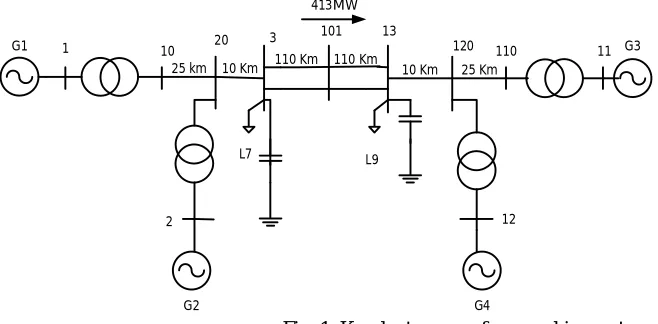
The test system under this research work is shown in figure-1[13]. The system consists of two symmetrical areas linked by two parallel tie-line of length 220 Km and 230 kV. Each area is equipped with two identical round rotor generators rated 20 kV/900 MVA. All four generators have identical parameters, except inertia coefficient (H), which are H = 6.5s for Gen-1 and Gen-2 in area-1 and H = 6.175s for Gen-3 and Gen-4 in area-2.
1
2 12
11
10 20 3
101 13
120 110 25 km 10 Km 110 Km 10 Km 25 Km G1
G2 G4
G3
L7 L9
413MW
110 Km
Fig. 1. Kundur two-area four-machine system
III. THE PROPOSED CONTROL METHOD
(a)Controller design considering time delay with coordinated structure of PSS and SSSC
Figure-2 shows a damping controller structure which is basically used to control the voltage injected (Vq) by the SSSC.
The change in speed deviation (Δ )of G-2 and G-4 is considered to be the input of the controllers and Vq is considered
to be the output of the controller. The damping structure considered here consists of four blocks, namely signal delay block with Pade approximation, gain block with gain Kstab, determines the amount of damping introduced by the PSS.
A washout high-pass filter with time constant TW, which eliminates the low frequencies that are present in the speed
signal and allows the PSS to respond only to speed changes and two-stage phase compensation block as shown in figure-2. The signal washout block will serve as a high-pass filter and the appropriate phase-lead characteristics will be provided by the phase compensation block, with time constants T1, T2, T3 and T4.
(b)Pade Approximation
The feedback signal delay of wide-area controller affects the control effect is because the delay will introduce phase deviation at the input signal. Usually, for an oscillation mode with frequency off, the phase lag φ introduced by delay T
can be obtained by
φ= 360fT
For example, when the dominant frequency of a WPSS is 0.5 Hz, a delay of 100 ms will introduce a phase lag of
360 × 0.5 × 0.05 = 9 (Phase lag)
It can be seen from above that the phase lag introduced by delay is determined by both the delay itself and the oscillation frequency[33]. For the same delay, the corresponding phase lag is larger with the higher frequency, and vice versa.In MATLAB, time-delays are expressed in the exponential form ( e ) in the Laplace domain. It can be replaced by a first-order Pade Approximation [32]:
e ≈− sT + 1
sT + 1
In this work, 50ms time-delay is taken only
(c) Optimization Method - Genetic Algorithm (GA)
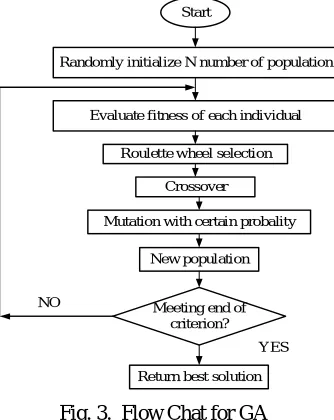
The GA is basically a search algorithm in which the laws of genetics and the law of natural selection are applied. For the solution of any optimization problem (using GA), an initial population is evaluated which comprises a group of chromosomes. Initially, a random population is generated, and then from this population fitness value of each chromosome is calculated. This can be found out by calculating the objective function by the process of encoding. Then a set of chromosomes termed as parents are evaluated which are known as offspring generation, which are generated from the initial population. The current population is replaced by their updated offspring that can be obtained by considering some replacement strategy. Figure-3 shows the flow chart for the Genetic algorithm [14].
Start
Randomly initialize N number of population
Evaluate fitness of each individual
Roulette wheel selection
Crossover
Mutation with certain probality
New population
Meeting end of criterion?
Return best solution NO
YES
Fig. 3. Flow Chat for GA
(offspring); more suitable they are more chances they have to reproduce. This is repeated until some condition (e.g. number of populations or improvement of the best solution) is satisfied.The oscillation of a system can be seen through the tie-line active power deviation or speed deviation of rotor. To minimize the oscillationof any deviation is research objective. For kundur’s two area four machines system, integral of time error of speed deviation for G-2 and G-4 taken as a objective function (J)
J = |∆ω|. t. dt
where
t = simulation time range.
For a stipulated period of time, the time domain simulation of the above power system is worked out and from the simulation the calculation for the objective function is calculated. The prescribed range of the PSS and damping controller are limited in a boundary. Thus the following optimization problem is formulated from the above design approach.
Minimize J
Subject to : ≤ ≤
≤ ≤
≤ ≤
≤ ≤
Where, T and T are the lower and upper bound of time constant for the controllers. All four time constants have same range of lower and upper limits: 0.01 to 1.
IV. SIMULATION RESULTS OF PROPOSED CONTROLLER
1
2 12
11
10 20 3
101 13
120 110
25 km 10 Km 110 Km 10 Km 25 Km
G1 G2 G4 G3 L7 L9 413MW SSSC Controller PMU PMU
dw2 dw4
110 Km
Fig.4. Two-area four-machine interconnected power system with a SSSC installed in series with the transmission line
The structure of study power system with proposed controller as shown in figure-4. The SSSC is installed in series with the transmission line between B-101 and B-13. For wide-area control, two Phasor Measurement Units (PMUs) are installed at G-2 and G-4 respectively to measure the speed difference between two generators representing the inter-area oscillation mode. The proposed control system structure includes the 50 ms delay time due to the communication system of the wide-area control.
Table – 1 Optimized Controller Parameters Using GA T1 (S) T2 (S) T3 (S) T4 (S)
Damping Controller
(without delay) 0.9067 0.9142 0.1066 0.5514 Damping Controller
(50ms delay) 0.1706 0.1156 0.8545 0.7824
V. SMALL SIGNAL STABILITY ASSESSMENT
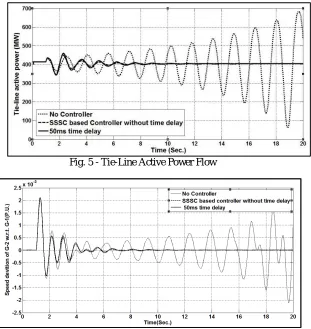
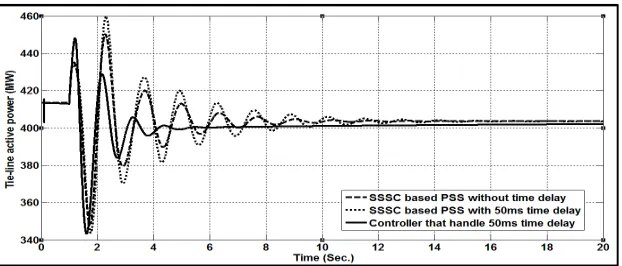
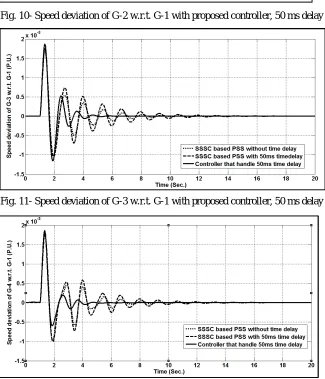
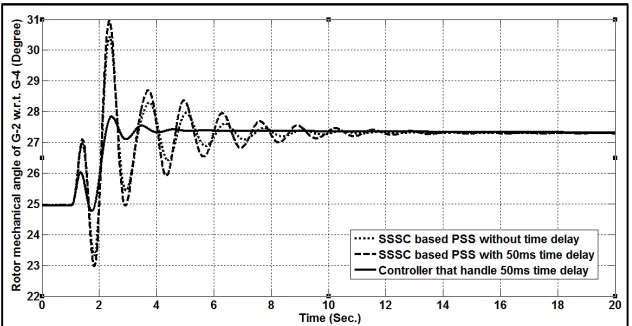
To perform the dynamic analysis of the closed loop test system for Kundur two area four machine systems as shown in figure-4, a small pulse with magnitude of 5% as a disturbance was applied to the generator G-1 for 12 cycles.The simulation time was of 20 seconds. Then the response of tie-line active power flow from area-1 to area-2, rotor speed deviation, rotor mechanical angle deviation are examined by considering the test system with proposed controller with considered the effect of signal delay.
Fig. 5 - Tie-Line Active Power Flow
Fig.7 - Speed deviation of G-3 w.r.t. G-1
Fig. 8 - Rotor mechanical angle deviation of G-2 w.r.t G-4
Fig. 10- Speed deviation of G-2 w.r.t. G-1 with proposed controller, 50 ms delay
Fig. 11- Speed deviation of G-3 w.r.t. G-1 with proposed controller, 50 ms delay
Fig. 13- Rotor mechanical angle of G-2 w.r.t. G-4 with proposed controller, 50 ms delay
VI.CONCLUSION
In this paper researcher designed a delay dependent (50ms) wide-area damping controller to damp out the inter-area oscillations in a large scale power system using coordinated design of SSSC and PSS. A time domain simulation based on minimization of an objective function for the controllers is carried out by using GA. Some simulation results are carried out to verify the effectiveness of proposed controller under small disturbance. From the simulation results, it reveals that the proposed controller damps out the inter-area oscillations effectively.
REFERENCES
[1] Cai LJ, Erlich I. Simultaneous coordinated tuning of PSS and FACTS damping controller in a large power system. IEEE Trans Power Syst 2005;20:294–300.
[2] Chang W. Nonlinear system identification and control using a real-coded genetic algorithm. Appl Math Model 2007;541. 550-31.
[3] Chaudhuri B., Pal.B.C., “Robust damping of inter-area oscillations through controllable phase shifters using global signals,” IEEE PES General Meeting, Vol. 3, pp.1673-1679, 13-17 July 2003.
[4] Ela, Magdy E. Aboul; Sallam, A.A.; McCalley, James D.; and Found, A.A.; - ‘ Damping Controller Design For Power System Oscillations’ – IEEE Transaction on Power Systems, Pub: IEEE, Vol. 11, No. 2, May 1996, pp. 767-773.
[5] Mirjalili S, Hashim SZM. A new hybrid PSOGSA algorithm for function optimization. IEEE ICCIA 2010;374:377.
[6] Gyugyi L, Schauder CD, Sen KK. Static synchronous series compensator: a solid state approach to the series compensation of transmission lines. IEEE Trans Power Del 1997;12:406–17.
[7] Heniche A. and Kamwa I, “Control loops selection to damp inter-area oscillations of electrical networks,” IEEE Trans. Power Syst., vol. 17, no. 2, pp. 378–384, May 2002.
[8] Hingorani NG, Gyugyi L. Understanding FACTS: concepts and technology of flexible AC transmission systems. New York: IEEE Press; 2000. [9] Kamwa I, Grondin R, and Hebert Y., “Wide-area measurement based stabilizing control of large power systems—A decentralized/hierarchical
approach,” IEEE Trans. Power Syst., vol. 16, no. 1, pp. 136–153, Feb. 2001.
[10] Kamwa, L. GérinLajoie, “State-Space System Identification-Toward MIMO Models for Modal Analysis and Optimization of Bulk Power Systems,” IEEE Trans. on Power Systems, vol. 15, no. 1, Feb. 2000,pp. 326-335.
[11] Kamwa, I. ; Hiniche, A.; Trudel, G.; Dobrescu, M.; Grondin, R.; and Lefebvre, D. – ‘Assessing the technical value of FACTS-based Wide-Area Damping Control Loops’ – IEEE Power Eng. Soc. General Meeting, Vol. 2, June 2005, pp. 1734-1743
[12] Khadanga RK, Satapathy JK. Gravitational search algorithm for the static synchronous series compensator based damping controller design. IEEE TechSym 2014;356:361.
[13] Kundur P, Power System Stability and Control. New York: McGraw-Hill, 1994.
[14] Mahran A. R., B. Hogg W., and El-Sayed M. L., Coordinated Control of Synchronous Generator Excitation and Static VAR Compensator, IEEE Trans. Energy Conversion, 7(4): 615--622, December 1992.
[15] Panda S. Multi-objective evolutionary algorithm for SSSC-based controller design. Electr Power Syst Res 2009;79:937–44.
[16] Panda S, Swain SC, Rautray PK, Mallik R, Panda G. Design and analysis of SSSC based supplementary damping controller. Simulat Model PractTheor 2010;18:1199–213.
[17] Pal, B.C. “Robust Damping Control of Inter-Area Oscillations in Power System with Super-conducting Magnetic Energy Storage Devices ,” PhD thesis, Imperial college of Science Technology and Medicine, Department of Electrical & Electronics Engineering.
[19] Ugalde-Loo C. E, Acha E, Castro E. L, “Multi-Machine Power System State-Space Modelling for Small-Signal Stability Assessments,” Elec. Power Syst. Res., vol. 37, Jan 2014, pp. 10141-10161.
[20] Y. Hua, H. Jian, L. Yutian, A method for computing eigenvalue of time-delayed power system based on pade approximation, Automation of Electric Power Systems, 37(7), 2013:25-30.
[21] Zhang P., Messina A. R, Coonick A., and Cory B. J., “Selection of locations and input signals for multiple SVC damping controllers in large scale power systems,” in Proc. IEEE Power Eng. Soc. Winter Meeting,1998, pp. 667–670.
[22] Panda, Manoj Kumar; Pillai, G.N.; and Kumar, Vijay; - ‘Power System Stabilizer Design: Interval Type-2 Fuzzy Logic Controller Approach’ – 2nd International Conference on Power, Control and Embedded Systems, Pub: IEEE, 2012
[23] Ugalde-Loo C. E, Acha E, Castro E. L, “Multi-Machine Power System State-Space Modelling for Small-Signal Stability Assessments,” Elec. Power Syst. Res., vol. 37, Jan 2014, pp. 10141-10161.
[24] Panda S, Yegireddy NK, Mohapatra SK. Hybrid BFOA–PSO approach for coordinated design of PSS and SSSC-based controller considering time delays. Int J Electr Power Energy Syst 2013;49:221–33.
[25] Kamwa, L. GérinLajoie, “State-Space System Identification-Toward MIMO Models for Modal Analysis and Optimization of Bulk Power Systems,” IEEE Trans. on Power Systems, vol. 15, no. 1, Feb. 2000,pp. 326-335
[26] Kamwa, I. ; Hiniche, A.; Trudel, G.; Dobrescu, M.; Grondin, R.; and Lefebvre, D. – ‘Assessing the technical value of FACTS-based Wide-Area Damping Control Loops’ – IEEE Power Eng. Soc. General Meeting, Vol. 2, June 2005, pp. 1734-1743
[27] Tomsovic, K.; Bakken, D.E.; Venkatasubramanian, V.; and Bose, A.; - ‘Designing the Next Generation of Real-Time Control, Communication and Computations for large Power Systems’ – Proc. IEEE, Pub: IEEE, Vol. 93, No. 5, May 2005, pp. 965-979
[28] Ray S, Venayagamoorthy GK, Watanabe EH. A computational approach to optimal damping controller design for a GCSC. IEEE Trans Power Del 2008;23:1673–81.
[29] W. Chengshan, S. Jie, PSS designing with considering of time delay impact, Proceeding of the CSEE, 27(10), 2007:1-6.
[30] D. Daniel, S. Aguinaldo, C. Ildemar, Wide-area measurements-based two-level control design considering signal transmission delay, IEEE Trans. on Power System,24(1), 2009: 208–216.
[31] Y. Hua, H. Jian, L. Yutian, A method for computing eigenvalue of time-delayed power system based on pade approximation, Automation of Electric Power Systems, 37(7), 2013:25-30
[32] L. D. Philipp. AusifMahmood, B. L. Philipp, “An improved refinable rational approximation to the ideal time delay,” IEEE Trans. Circuits and Systems, vol. 46, pp. 637-640, May 1999.