A Study on Work Performance And
Stress Management in An
Organisation
Tapender sharma
Assistant Prof. of Commerce GBD College Rohtak
Abstract
In recent years the rise in stress has seen across all spheres of life, particularly in the workplace. Stress has been associated with every human life and is there to stay for all times to come.The employees working in different organizations have to deal with stress. Stress is man‘s adaptive reaction to an outward situation which would lead to physical, mental and behavioural changes.However, stress is not always bad. Some stress is always necessary to motivate and stimulate us. Stress has become significant due to dynamic social factor and changing needs of life styles. Even if some stress is a normal part of life, excessive stress can influence one’s productivity, health and emotions and it has to be taken under control. When people lose confidence, they refuse to take responsibilities, they get quickly irritated, they are unsatisfied of their job, their performance will be very low and the organization will be in danger and the Stress Management is a lesson that helps learners to understand that stress is a part of everyone’s life.
Stress management never talks of eliminating stress thoroughly. The one significant reason for this is that to certain extent stress increases efficiency. Some people even go the length of saying, "There is no life without stress." It can be said that in case stress crosses a certain limit, it has to be controlled to avoid its negative effects. Various studies have been conducted to examine the relationship between stress management and work performance and they said that Work performance can be viewed as an activity in which an individual is able to accomplish the task assigned to him/her successfully, subject to the normal constraints of reasonable utilization of the available resources. This article aims to capture the relationship between stress management and work performance among the employees working in different organizations. Another objective of the study is to explore the stress related problems of employees and examine the impact and effect of stress on employee work performance. It also looks at a range of strategies, causes, different types and the different techniques which can be adopted by the organizations to prevent, minimize and to overcome the stress.
We have seen that high volume of stresses contribute to decreased organizational performance, decreased employee overall performance, decreased quality of work, high staff turnover, and absenteeism in the workplace due to existence of depression, headache among employees. Stress effect the efficiency of the employees in very adverse manners. Hence company would like to take their employees out of stress with the help of stress management and must develop stress prevention as well as stress reduction techniques.
Keywords: -
StressManagement, Types of SM,Causes of Stress, Stress & Work Performance, SM techniques.Introduction
The word stress is derived from the Latin word “stringere” which meant literally to draw tight and was used in the 17th century to describe hardship, strain, adversity or affliction. These root words refer to the internal feelings of constriction many feel under stress. Originally the wordstress was used in the context of physics. Hans selye was the first to apply the notion of stress to human beings. He was known as the father of stress research. During the late 18th century, stress denoted “force, pressure, strain or strong effort, referring primarily to an individual or to an individual organs or mental powers. Hooke’s analysis greatly influenced early 20th century he was developed models of stress in physiology, psychology andsociology. The adoption of the term stress as a psychological concept is frequently attributed to Hans’sselye in 1936. During the 1950, selye had added to the developing ideas about stress by putting forward a three stage process known as the general adaptation syndrome (GAS). Selye stated that in response to some external stressor we first react by mobilizing our physical resources to deal with or escape from the stressor. Selye called this the ‘alarm’ stage. The second stage, called; resistance’, involves ways of coping with the alarm stage by trying to reverse it. Thirdly the stage of ‘exhaustion’ occurs if an individual is repeatedly exposed to the stressor and is unable to escape. Today, the term stress can be used in different ways for
different purposes. Psychologists also
distinguish between stress that is harmful (distress) and stress that is positive (eustress). In research terms stress now embraces biochemical, behavioural, physiological and psychological effects. In order to comprehend stress management, it is necessary to first understand the concept of stress is a condition or feeling experienced when a person perceives that demands exceed the personal
and social resources the individual is able to mobilize. Stress management refers to the
wide spectrum of techniques and
psychotherapies aimed at controlling a person’s levels of stress, especially chronic stress, usually for the purpose of improving everyday functioning. According to Lazarus and Folkman (1984), stress management referred to the formal programs to prevent or ameliorate debilitating stress for people in general. Monat and Lazarus (1991) described stress management as a general treatment approach to a wide variety of adaptations and health problems. Stress management, as a treatment, is universal with no one for whom treatment is unneeded or inappropriate. Edelman and Mandle (1998) stated that stress management is a critical component of a healthy lifestyle. They stated that healthy behaviours, such as good nutrition and exercise, might help strengthen individuals’
resistance to stress. Therefore, stress
management is about applying many practical techniques which may help an individual to reduce their levels of stress through providing positive feelings of control over one’s life and promote general well-being. The goal of stress management is to help you to manage the stress of everyday life by using many different methods such as bio feedback and meditation in order to lead a more balanced healthier life.
REVIEW OF LITERATURE
Liza Varvogli, Christina Darviri(2011)concluded that stress contributes to the aetiopathogenesis, initiation and continuation, aggravation of the disease, or quality of life of patients and the stress reduction techniques can lower stress levels of the organism, resulting in reduction of disease symptoms, lowering of biological indicators of
disease, prevention of disease and/or
management techniques is essential for
preventing stress related disease and
enhancing health overall. Some of the most
commonly used, evidence-based stress
reductions techniques for health related problems such as cardiovascular disease, high
blood pressure, diabetes, obesity, and
headaches. In addition, stress management is effective for preventing behaviours such as smoking, unhealthy eating habits etc. The selection of the techniques presented reflects those that are being taught in our program and used in our research. It is concluded that progressive muscle relaxation, autogenic training, relaxation response, biofeedback, and meditation are all effective treatment methods
for reducing stress and anxiety that
accompanies daily life and chronic illness. The same techniques are also therapeutic for
healthcare providers, enhancing their
interactions with patients. No negative side effects from any of those techniques have been documented. However, the literature shows that there is a need for more extensive
randomized control trials of the
aforementioned stressreduction techniques in order to establish their usefulness in the prevention and management of disease.
Kamala Balu, (2002) found that Most stress management programmes focus attention on the individual either assisting employees or help them to cope with job-related stressors. There is more concern in organizations with coping with the consequences of stress rather than eliminating or reducing the actual stressors themselves. Wide range of stress reducing programmes for employees rather than interventions to change the nature of work which would bring a more effective solution for the problem. Employee assistance programmes such as counselling and support
services for employees have shown a promising approach of dealing with stress,
however their effectiveness is limited.
Training or counselling employees to cope with stress are just short-term solutions but have long-term benefits for mental health and well-being.
Sharma S, Sharma J. & Devi A. (2012)
concluded that the level of stress within a role varies because of individual differences in mind set, age, gender, and their performance in job. However, various factors that influence stress are age where the younger employees are more stressed as compared to other employees, level of qualification, pay, and authorities of control, awards, and word of praise, improved designations and working
couples. The study recommended a
reinforcement approach that should be positive in nature so as to reduce the degree of stress at the workplace.
P.S. Swami Nathan,&Raj Kumar S. (2013)
found that focused on the levels of stress among the age group, profession, different varieties of jobs, hours of work and the influence of work environment on the degree of stress faced by employees . Stress in an employee is very individual in nature. His study indicates about an optimum level in which every individual can perform with his full capacity. He has identified three conditions responsible for work stress they are a) Role overload b) Role self-distance c) Role stagnation.
OBJECTIVES OF STUDY
1. To describe the concept of stress management.
2. To define the different types and causes of stress management.
4. To describe the effects of stresson work performance.
TYPES OF STRESS
When thinking about types of stress there are two perspectives to consider one is physicist’s perspective and the other one is psychological perspective.
According to psychological perspective: - Stress is primarily of two types which are as following.
1) Eustress (Positive or Good Stress):-
According to psychological perspective
eustress has one of the important types of stress. It has positive effects and it arises in any situation or circumstance that a person finds motivating or inspiring or we can say that Eustress or positive stress occurs when the level of stress is high enough to motivate a person to move into action to get things accomplished. Eustress provides a sense of urgency and alertness needed for survival
when confronting threatening situations.
Examination day’s stress is the best example of Eustress stress. If this stress is not there on the students, they will not study well. This stress creates energy. As a result the efficiency increases.
2) Distress (Negative or Bad Stress):- it has another type of stress according to psychological perspective. It has called Distress or negative stress. it occurs when the level of stress is either too high or too low and the body and/or mind begin to respond negatively to the stressors. It is a contributory factor to ill-health, such as headaches, digestive problems, skin complaints, insomnia
and ulcers. Excessive, prolonged and
unrelieved stress can have a harmful effect on mental, physical and spiritual health. This is a stress which is absolutely not desirable. For
example, Insecurity of job. It creates tension. If it is not managed or controlled in time, it becomes an enemy. It leads to high blood pressure and diseases.
According to is physicist’s perspective: - it is of three types which are as following.
1) Acute Stress: - Acute stress is the most common form of stress and is short lived. It can be beneficial and create motivation, like cramming for an exam or finishing a report under a deadline. Acute stress is also thrilling and exciting in small doses, but too much is exhausting. Take water skiing, for example. Starting out it is fun and exhilarating. After two hours or more, it becomes tiring and mentally draining. Prolonged acute stress can cause anger or irritability, anxiety and depression in the short term, but does not carry the extensive damage that prolonged stress carries over the long term.
2) Episodic Acute Stress: -this type of stress emerges in people who live disordered and chaotic lives those who suffer acute stress frequently. In other words it refers to a situation where acute stress seems to be a way of life. Life is constantly filled with one stressful event after another after another. Episodic stress is also typically observed in the people with type A personality, which involves being overly competitive, aggressive, demanding and sometimes tense and hostile.
sufferer to view the world as a threatening place. The person with chronic stress usually sees no end to their miserable situation and gives up searching for solutions. Chronic stress can lead to suicide, violence, heart attacks, stroke and cancer.
CAUSES OF STRESS
Stress is an individual experience that can be caused by many different kinds of situations and events. Factors that are cause stress are called “stressors”. The following are the sources or causes of an organisational and non- organisational stress.
INDIVIDUAL LEVEL STRESSORS:-
1) Career changes: -when a person suddenly switches over a new job, he is under
stress to shoulder new responsibilities
properly. Under promotion, over promotion, demotion and transfer can also cause stress. 2) Personal features: - every individual has some special characteristics. These characteristics govern the effect of stress, quick or otherwise, on that individual. Friedman and Rosen man have characterised people on the basis of their characteristics and placed them into two groups. “Type A” personality and Type B personality.
“Type A” personality features include:
Feels guilty while relaxing.
Gets irritated by minor mistakes of self
and others.
Feels impatient and dislike waiting.
Does several things at one time.
While the “type b” people are exactly opposite and hence are less affected by stress due to above mentioned factors.
3) Life changes:-life changes can bring stress to a person. Life changes can be slow or sudden. Slow life changes include getting older and sudden life includes death or accident of a loved one. Sudden life changes are highly stressful and very difficult to cope. 4) Frustration:-it is another cause of stress. Frustration arises when goal directed behaviour is blocked. Management should attempt to remove barriers and help the employees to reach their goals.
5) Role Ambiguity:-it occurs when the person does not known what he is supposed to do on the job. His tasks and responsibility are not clear. The employee is not sure what he is expected to do. This creates confusion in the mind of worker and results in stress.
GROUP STRESSORS:-
taking a decision. This develops a feeling of being neglected. This may lead to stress. 4) Lack of social support:-when individuals believe that they have the friendship and support of others at work, their ability to cope with the effects of stress increases. If this kind of social support is not available then an employee experiences more stress.
ORGANISATIONAL LEVEL STRESSORS:-
1) Organisation structure:-organisational structure divides all the people working in an organisation into different levels, e.g. Higher level, middle level, lower level, etc. under this the work is distributed. Rules are laid down for the smooth running of the organisation.
Authorities and responsibilities are
determined.If the levels of management happen to be more or less than the actual need, it is a source of anxiety for the employees which causes stress.
2) Working condition: - employees may be subject to poor working conditions. It would include poor lighting and ventilator, unhygienic sanitation facilities, excessive noise and dust, presence of toxic gases and fumes etc. All these unpleasant conditions creates physiological imbalance in humans there by causing stress.
3) Organisational climate: - A high pressure environment that places chronic work demands on employee’s fuels is the stress response.
4) Organisational changes: - when changes occur, people have to adapt to the changes and this may cause stress. Stress is higher when changes are major or unusual like transfer or adaptation of new technology. 5) Organisational processes:-many
processes are at the work in every
organisation. They are communication
process, decision making process, controlling process etc. if these processes happen to be
ambiguous, long and difficult; they create stress for the employees.
ENVIRONMENTAL STRESSORS:-
The following are usually counted among the environmental stressors:
1) Economic condition: - in an age of quickly rising prices, it is becoming difficult for the fixed income group people to make both ends meet. Such an economic condition pushes people towards stress.
2) Political condition: - political instability in the country can be a cause of stress.
3) Family conditions: - every individual has a family. Every big or small mishap in the family is a source of stress for him.
STRESS
AND
WORK
PERFORMANCE
One of the major concerns of management is the negative impact stress has on work performance. People under high stress tend to withdraw from the contact with the stressor in the form of turnover and absenteeism. In extreme cases it may result in sabotage. Workers sometimes create mechanical failure in order to take a break from strain of monotonous work. Any factor that causes
negative effects on our physical and
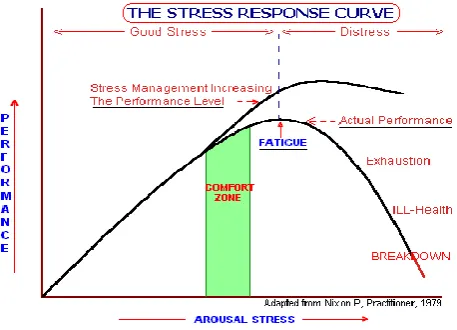
psychological wellbeing is also expected to affect our work behaviour. Exposure to strong and enduring stress influences important aspects of our behaviour at work thus affecting productivity. The relationship between stress and performance appears to be rather complex. It is affected by the difficulty of the task being performed. The relationship between stress and performance has been portrayed by the stress response curve created by Nixon P. in 1979.
While we can easily recognize the
consequences of normal or excessive amounts of stress through mere observation, it’s best to learn about the scientific relationship between stress and performance.
The Stress Response Curve
To better understand the effects of stress to performance, Nixon, P. (1979) created the following graph of the stress performance
curve explaining how stress affects
performance in theoretical terms.
Figure 1: The Stress Response Curve
The curve shows that as the level of stress
increases, the performance level also
increases, to the point of eustress, or healthy tension. Near the point of fatigue, an identified area called the Comfort Zone indicates the range of stress levels that we can absolutely manage and facilitates good performance levels.
As stress begins to be perceived as overwhelming or excessive, the person reaches a fatigue point wherein the performance levels starts to decline. The ultimate end of overwhelming stress, called burnout, can be exhaustion, ill-health or breakdown.
Positive Effects
As shown by the graph, performance levels increase when stress management is effective. Stressors such as pressure and demands can facilitate better stress response and thus, higher levels of performance. For instance, a basketball player tries to run faster, shoot a three-point shot and succeeds in it because of the pressure he has obtained from the audience, the close scores and the tough opponents.
Another example is the short but adequate deadline given to an employee, which motivates and encourages her to work actively and efficiently on the project assigned to her another instance, is an approaching major examination which leads a college student to double time on studying and reviewing of lessons.
Negative Effects
When stress is perceived as uncontrollable or unmanageable, the person begins to experience a gradual to drastic decrease in performance levels, causing a decline in productivity and enthusiasm to respond to the stress.
For instance, a very tight deadline is given to an office employee who has to take care of her four children at home and a sick mother at the hospital. This overwhelming mix of situations, if not managed carefully and totally, will result to a poor performance at work, bad relationships with other members of the family, ill health, and burnout.
EFFECTS OF STRESS
There are three types of problem occurred caused by high Stress level, which include:
flight’ response which happens at the automatic nervous level. In other words, people gear the body up so as to respond to the challenges facing by them, either by standing ground or hitting back or by a prompt strategic withdrawal. All these responses are happened automatically, in which the body will recognize the need for a response and produces it without the need of people to tell the body to do so. However, the problem associated is that those responses are acted as a shortterm and immediate reaction, designed to shut down as soon as the emergency is past. If they do not shut down, there will be adverse effects. There are altogether four main aspects characterized by the author about human body’s responses to stress, namely energy
mobilizes, energy support systems,
concentration aids and defensive reactions.
Psychological problem due to stress:-As mentioned previously, an optimum level of stress is healthy to us. However, when the stress level is too high, it drains our
psychological energy, impairs our
performance and leaves people a feeling of useless and undervalued, with diminishing purpose and hopeless, unattainable objectives. As mentioned in the previous part, the General Adaptation Syndrome (GAS) model, involves three stages: alarm reaction stage, the stage of resistance and the stage of exhaustion. There will be some adverse impacts when an individual reaches the stage of exhaustion. Firstly, there will be increase in physical and psychological tensions, in which the ability to relax muscle tone, to feel good, to switch off worries and anxiety reduces. Secondly, there will be changes in personality traits. For example, if a person is a neat and tidy person originally, he or she may become messy and untidy, etc. When a person is having too much stress, he or she will have a lower spirit or a
sense of powerlessness to influence events or ones feelings. However, if the personality is affected by the stress level, this will incredibly affect the decision-making process, which may cause huge problem to the construction process.
Behavioural problem due to stress:-There are also other types of consequences apart from those suggested above, which can
be categorized as general behavioural
consequences. Firstly, long working hours have been a very common source of stress and hence there will be less time spent with their family. As a result, working long hours and having insufficient time with their immediate family may limit the amount of social support that they receive. The lack of social support can be a very serious problem, which may trigger the threats of committing suicide. Apart from that, negative health-related behaviours such as smoking more, drinking more alcohol as usual and skipping breakfast are associated with high levels of occupational stress. All of these behaviours will affect one’s health and ultimately lead to work impairment or other adverse effects. As a result, there will be a high labour turnover and thus the loss of ‘good’ employee. Stress can be costly as key people may have to leave due to ill-health, and indecision may cause the loss of important contract. Therefore, addressing the problem of high stress levels and figuring out the solutions can help the company to save cost and increase the efficiency of the firm’s operation.
STRESS
MANAGEMENT
TECHNIQUE
Management of stress possible with the help of following techniques:
1)
Meditation:-meditation is the art of shifting your focus to a more neutral and balanced perception. This ability is essential in life and requires a learning process. Meditation should be basic school training, but meanwhile it is up to you to try it out and discover its profound transforming benefits. Some of the benefits of meditation are includes reduction of generalized anxiety, increased energy and productivity, improved concentration and memory, reduction of insomnia and fatigue, prevention and/or reduction of psychosomatic disorders such as hypertension etc.2)
Deep Breathing:-Deep breathing is a simple but very effective method of relaxation. It works well in conjunction with other relaxation techniques such as Progressive Muscular Relaxation, relaxation imagery and meditation to reduce stress.3)
Time Management:-One of the principal sources of stress is over-commitment or poor time management. Trying to take care of everything at once can seem overwhelming, and, as a result, one may not accomplish anything.Identifying the potential causes of poor time management and addressing them in time helps a great deal in reducing stress.Time management seems a relaxing aid because if you have adequate time then things are more likely to go well and more predictable.4)
MASSAGE:-Massage is a great way to reduce stress. It releases a hormone called oxytocin, which turns off your stress response and promotes a sense of relaxation. In other words massage helps our muscles to relax which gives us a sound sleep which in turn refreshes our body. As a result of it stress also gets relieved.5)
SUFFICIENT SLEEP:-Good sleep habits reduce stress and help your body recover from stress. Everyone needs a different amount of sleep, however it isrecommended to get 7-8 hours of sleep a night. Adequate sleep refreshes our body and mind and stress cannot bother us.
6)
Exercise:-Regular physical exertion of any intensity helps discharge muscle tension and builds strength, resilience and energy. Apart from yoga and meditation, light exercise also helps in reducing stress. Lightexercise includes walking, jogging, hopping, cycling etc.7)
Yoga:-yoga is gettingvery popular for the last some many years. This is a great stress buster. Under the yoga some asanas are performed. These asanas bring flexibility to our bones and muscles. As a result of it, our nervous system gets activated and our body gets a balanced blood supply. In this way, we achieve physical and mental peace through eliminated stress.8)
Balanced diet:-A balanced diet provides us physical and mental strength. As a result of it, we face stress with strength. Our food should include fruits, vegetables, bread, milk, etc. in sufficient quantity. A well balanced diet is crucial in preserving health and helping to reduce stress.9)
Music:-Medical research reveals that music can affect a person’s physiological state, inducing excitement or relaxation. Listening to favourite music relives stress by providing a predictable and “secure” environment through inducing feelings of well-being. It will also helpful in Decreasing physical responses, such as heart rate and respiration by Inducing and maintaining relaxation. Organisational related techniques:-
the effective selection must needed to avoid stress.
2)
Workers welfare program:-company should make various welfare programs for its employees. This can be implemented to ease the pressure from the employees. The aim of these welfare programs is to help them leave their bad habits like drinking, smoking etc. it will boost their confidence. They will be more efficient and stress free.3)
Effective communication:-effective communication is a medium of getting prevention from stressful situation. It has also lead a free exchange of orders, suggestions, complaints, etc. such situation removes all kinds of ambiguities and employees remain stress free. An effective communication system ensures a proper flow of information within an organisation.4)
Employees participation in decision making:-employees participation in decision making is also an effective way of overcomeor prevention from stressful situation.
Generally it has been observed that the employees do not know their role in the organisation. As a result of this, they remain under stress. If the employees are made a part of the process of decision making regarding their job. Their efficiency will increase; they will remain happy and be able to face stress boldly.
5)
Effective reward system:-company should reward all those employees who perform expertly. This will improve their efficiency and stress will stand eliminated. Thus we can say that company must have an effective reward system for enhancing the performance of their employees.6)
Employees training programme:-every employees wishes to be efficient in his work. Keeping this thing in the mind effortshould be made for the training. Consequently, they will gain efficiency in their job and they will get recognition in the organisation. This will keep them happy and stress will not affect them.
7)
Effective policies:-in order to run the organisation smoothly, policies are formulated. If these policies are against the expectation of the employees, it createsstress for them. Therefore, the policies have to be appropriate to avoid any stress for the employees.Conclusions
It was found that organisations use lots of techniques to overcome stressful situation. Such as Meditation, Deep Breathing, Time Management, Massage, sufficient Sleep, Exercise, Balanced diet, Yoga is all effective treatment methods for reducing stress and anxiety that accompanies daily life and chronic illness. Beyond this some other ways of
minimizing stress appearance, by
implementing efficient measures at strategic level includes creating a proper environment
for conducting activities, implementing
efficient regulation ,procedures and policies ,
developing efficient programs regarding
employees welfare, communication,
promotion, and motivation, creating a strong organizational culture and implicating the management function in creating work teams, making team training, solving different problems such as workload, fair assessment and equity conduct in recruitment, selection
and employment processes, developing
careers, and finding pertinent solutions of reducing conflict situations.This research are further explore that today almost every HR organizations uses the concept of stress management in order to maintain and increases
competent workforce within their
organisations through reducing and
overcoming of stress.
Suggestion
The demand for efficiency and racing with time at work often creates a certain amount of stress to us. Employers and employees should look at the issue of work stress positively and work together to build a good and harmonious working atmosphere to minimize the negative
effects of stress in employees work
performance.
REFERENCES
[1] Murphy, L. R. (1995). Occupational stress management: Current status and future
directions. Trends in Organisational
Behaviour, 2, pp. 1-14.
[2] Cooper, C. L. and M. Kompier (1999).
Preventing Stress, Improving
Productivity: European Case Studies in the Workplace, New York: RoutledgeS.
[3] Cooper, C. L. and S. Cartwright (1997). An Intervention Strategy for Workplace
Stress, Journal of Psychosomatic
Research, 43 (1), 7-16.
[4] DeFrank, R.S. and C.L. Cooper (1987).
Worksite stress management
interventions: Their effectiveness and conceptualization, Journal of Managerial Psychology 2, 10-40.
[5] Kompier, M.A.J.et al. (1998). Cases in Stress Prevention: The Success of a Participative and Stepwise Approach, Stress Medicine, 14, 155-168.
[6] Loo, R. (1996). Managing workplace
stress: A Canadian Delphi study among human resource managers, Work & Stress, 10 (2), 183-189.
[7] Manufacturing, Science and Finance
Union. Preventing stress at work: an MSF guide . London: MSF, 1997.
[8] Kagan NI, Kagan H, Watson MG. Stress
reduction in the workplace: the
effectiveness of psychoeducational
[9] H. Selye, “History and present status of the stress concept”, In A. Monat and R.S. Lazarus, eds. Stress and Coping, 2nd ed. New York: Columbia University, 1985.
[10] Imtiaz, S. and Ahmad, S. (2009), Impact of Stress on Employee Productivity, Performance and Turnover: An Important Managerial Issue, International Review of Business Research Papers, 5(4): 468-477.
[11] Selye, H. (1976), the Stress of Life, New York: McGraw-Hill. Stress and Stress Management (2010), Klinic Community Health Centre, Canada.
[12] Brook, A. (1978, "Coping with the stress of change", Management International Review, Vol. 18 No. 3, pp. 9-15.
[13] Smith, Melinda, Ellen Jaffe-Gill, and Robert Segal (2008) "Stress Management: How to Reduce, Prevent, and Cope with Stress." Helpguide.org: Understand, Prevent and Resolve Life's Challenges. Helpguide.org.
[14] Andres L M Larraz, (2011), Stress Management, Trafford pub, U.S.A.
[15] Palm M. Lehrel, Robert L. Woolfolk,
Wepley E. sime, (2007), Stress
Management, 3rd Edition, Guilford press.