ISSN (Print) : 2320 – 3765 ISSN (Online): 2278 – 8875
I
nternational
J
ournal of
A
dvanced
R
esearch in
E
lectrical,
E
lectronics and
I
nstrumentation
E
ngineering
(An ISO 3297: 2007 Certified Organization)
Vol. 5, Issue 7, July 2016
Interference Alignment Technique to Improve
Energy Efficiency in MIMO-IFBC
Ansu Varughese1, Mercy Mathew2
PG Student [Communication Engineering], Dept. of ECE, B C Caarmel Engineering College, Kerala, India1
Assistant Professor, Dept. of ECE, B C Caarmel Engineering College, Kerala, India2
ABSTRACT: Characterising the energy efficiency(EE) and spectral efficiency(SE) performance of multiple-input– multiple-output interfering broadcast channels (MIMO-IFBC) for the design of green wireless system.In this work, develop a new network architecture based on EE and SE maximization for Multi-Cell MIMO-IFBC within the context of interference alignment (IA).This work develop two methods to optimize energy efficiency for different signal-to-noise ratio regions. For high SNR operating regions, develop a grouping-based interference alignment scheme to jointly cancel intra- and inter-cell interferences and thus transform the MIMO-IFBC to a single-cell MIMO broadcast channel.A gradient-based power adaptation scheme is developed based on singular value decomposition and water filling power adaptation to maximize energy efficiency for each cell. For moderate SNR cases, employ an approach using dirty paper coding (DPC) based on the principle of multiple access channel and broadcast channel duality to perform interference alignment while maximizing EE in each cell. The algorithm in its dual form is solved by using a subgradient method and a bisection searching scheme. However,the extent to which interference can be aligned over a finitenumber of signalling dimensions remains unknown.The important concern for interference alignment scheme is the requirement of global channel knowledge.So this work can achieveinterference alignment with only local channel knowledge at each node.In the proposed work determining the sum rate based on channel coefficients and can calculate spectralefficiency at high signal to noise region. By using maximum SINR algorithm ,analyse sum rate Vs signal to noise ratio to get the maximum achievable spectral efficiency. Simulation results gives the performance of the proposed schemes over several existing approaches.
KEYWORDS: Energy efficiency, Spectral efficiency,interference alignment, Water filling, dirty paper coding.
I.INTRODUCTION
ISSN (Print) : 2320 – 3765 ISSN (Online): 2278 – 8875
I
nternational
J
ournal of
A
dvanced
R
esearch in
E
lectrical,
E
lectronics and
I
nstrumentation
E
ngineering
(An ISO 3297: 2007 Certified Organization)
Vol. 5, Issue 7, July 2016
transmit powers and beamforming vectors was studied. However there is a general lack of research study on the EE aspect of multi-cell MU-MIMO system, which is a very practical scenario. There is only which extended the energy efficient optimization problem to a partial-cooperative multi-cell MU-MIMO system by employing the interference zero-forcing (I-ZF) technique
II.SYSTEM ANALYSIS
In this section, introduce the system model of MIMOIFBC and formulate the EE optimization problem.
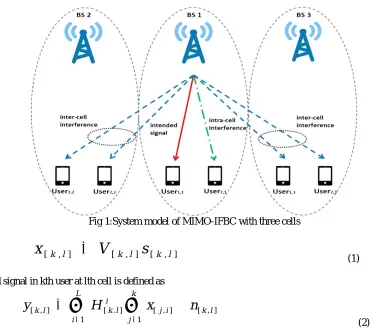
Consider a downlink cellular system with multiple cells (L) and each cell serves K multiple users with Nk transmit and Nr receive antennas, corresponds to a multiple input multiple output interfering broadcast channels scenario.The information transmitted from each BS to any of its respective users consists of ds data streams where ds < min(Nk,Nr).In the lth cell, the intended signal from the serving BS to the user is expressed as
Fig 1:System model of MIMO-IFBC with three cells
(1)
The received signal in kth user at lth cell is defined as
(2)
The received signal for each user is multiplied by a receiver beamforming matrix to obtain the desired signal from its corresponding BS.It is well-known that BSs are the primary source of energy consumption in cellular networks. Due to the recent advances in circuit technology, it has been made possible for wireless transceivers to consume different power levels in different operational modes. These include BS sleep, idle, transmit, and receive modes which can be accordingly adjusted based on the daily fluctuations in network load for the purpose of saving energy .
Conventional energy efficiency for downlink transmission is defined as the total number ofdelivered bits per energy, where energy consumption includes transmission energy consumption and circuit energy consumption in active mode. Hence, we define energy efficiency of the lth cell in multi-Cell multiple input multiple output interfering broadcast channels as
] , [ ] , [ ]
,
[ k l
V
k ls
k lx
] , [ 1
] , [ 1
] . [ ]
,
[ k l
k
j
i j L
i i
l k l
k
H
x
n
y
ISSN (Print) : 2320 – 3765 ISSN (Online): 2278 – 8875
I
nternational
J
ournal of
A
dvanced
R
esearch in
E
lectrical,
E
lectronics and
I
nstrumentation
E
ngineering
(An ISO 3297: 2007 Certified Organization)
Vol. 5, Issue 7, July 2016
c l T K k l k l BC l EE
P
P
C
P
C
] [ 1 ] . [ ] [ ] [
(3)whereC[k,l] is the capacity achieved by the kth user in the lth cell and P l
T is the total transmission power for BS l. The
objective of this paper is to maximize the energy efficiencyof each cell in multi-Cell multiple input multiple output interfering broadcast channels whilstachieving a desirable throughput. It is therefore reasonable to maximize energy efficiencysubject to satisfying a minimum throughput requirement.The optimization problem for celll can be formulated as
(4)
S.t
(5)] [ min 1 ] , [ l K k l k
C
(6)
whereP[L]max and ᵟminare the maximum total transmit power constraint at BS l and minimumthroughput constraint for
cell. Due to the existence of inter-channelinterference and intra-cell interference in multi-Cell multiple input multiple output interferingbroadcast channels, the solution of the above problem is nontrivial and cannot be solveddirectly. Therefore, in thefollowing sections, we develop resource allocation schemes forinterference alignment based systems to solve the above optimization problem.
III.ENERGY EFFICIENCY IN MULTI-CELL MIMO-IFBC WITH INTERFERENCE ALIGNMENT
In this section, design interference mitigation techniques in order to jointly remove the intra- and inter-cell interferences.Therefore,to remove both intra-and inter-cell interferences. grouping-based interference alignment solution is capable of removing both the intra- and intercell interferences but with less transmit antennas at each BS, As a result, we employ the grouping-based interference alignment solution from in this work.The interference alignment scheme under consideration group users to a subspace and then designs the receiver beamforming matrices.Once the effective inter- and intra-cell interfering channels are identied, we designthe transmitter beamforming matrices.The interference alignment scheme using the grouping method can ensure zero intra- and inter-cell interference at the receiver of each user. Considering the kth user in the lth BS, the effective channel after applying interference alignment is ] , [ ] , [ ] , [ 1 l k l l k H l
k
H
V
U
H
(7)Since there does not exist any intra- and inter-cell interference, the multiple-cells with multiple MIMO users scenario has been transformed to a single-cell single user MIMO case.SVD precoding is known to achieve the MIMO channel capacity since the transmitter emits multiple streams in the eigen-directions of the channel covariance matrix. The SVD of the effective channel is given by
l l k sH l k s l k lk
U
V
H
] , [ ] , [ ] , [ ] , [ 1 (8)After applying IA and SVD, the rate achieved by this user is
)
1
(
log
[ ,] [ ,] 1 2 ] , [ l i k l i k d i lk
B
P
g
r
s
(9)where B represents the transmission bandwidth, pl[k,i] denotes the power allocated on the ith data stream of the kth
user,gl[k,i]denotes the effective channel-gain-to-noise ratio of user [k,l] EE
max
] [ max ] , [ 1 l l k Kk
p
p
ISSN (Print) : 2320 – 3765 ISSN (Online): 2278 – 8875
I
nternational
J
ournal of
A
dvanced
R
esearch in
E
lectrical,
E
lectronics and
I
nstrumentation
E
ngineering
(An ISO 3297: 2007 Certified Organization)
Vol. 5, Issue 7, July 2016
The maximum achievable energy efficiency at a certain total transmit power, PT , is achieved with transmit power PT ,
is achieved with transmit power that satisfy the constraints namely,
K k d i c K k k i k p T EE s p i k p r P 1 1 1 0 ] , [ ] , [ max ) ( (10)The next step is to find out the optimal power allocation scheme to maximize sum-rate.theoptimal power can be calculated using the following water-filling scheme (11)
(12)
(13)
(14)
Gradient based optimal power adaptation algorithm
1. Do single user water filling to get
p
[k,n] and
s.Calculate the power consumption Po.2. If Po>Pmax
3. infeasible 4. ELSE
5. Initial power PT (0)[Po, Pmax]
6. REPEAT
7. For the remaining power,do water filling 8. Update transmission power using gradient of EE 9. STOP when | pT(n) pT(n 1)|
10. STOP
The idea of the water-filling process includes two steps.We first allocate power to satisfy the minimum rate requirement.The total power used in the first step is Po. It must be noted that if the power used to satisfy the minimum rate requirement is larger than the power budget, i.e., Po >Pmax, the energy efficiency optimization problem is infeasible. We then allocate the remaining power (PT -Po) using to further maximize the sum rate. Consequently, we
can combine a derivative-assisted gradient scheme and water-filling approach to obtain the optimal solution.We call this algorithm as gradient based power adaptation approach.
V. EFFICIENCY IN MULTICELL MIMO-IFBC WITH HYBRID INTERFERENCE ALIGNMENT
The interference alignment scheme presented fully utilizes the available degrees of freedom for transmission. The grouping based interference alignment method is therefore best suited, and in fact capacity optimal,in high SNR operating regimes. On the other hand,pure interference alignment may lead to lower network capacity in low to intermediate SNR region due to the lack of coherent array gain .Hence, we propose a hybrid approach by applying interference alignment only for the inter-cell users and tackle the intra-cell interference among users by using dirty paper coding, which is a capacity-achieving scheme for MIMO-BC, to maximize energy efficiency of each cell.
)
1
(
] , [ ] , [ i k s i kg
p
min ]
, [
2
(
)
log
i k s Kk i S
g
W
i)
1
(
~
] , [ ] , [ ] , [ i k i k i kg
p
P
K k i Si k T i k i k K
k i Si i
p
p
p
g
[ ,] [ ,] [ ,])
1
ISSN (Print) : 2320 – 3765 ISSN (Online): 2278 – 8875
I
nternational
J
ournal of
A
dvanced
R
esearch in
E
lectrical,
E
lectronics and
I
nstrumentation
E
ngineering
(An ISO 3297: 2007 Certified Organization)
Vol. 5, Issue 7, July 2016
Authors proved that the capacity region of the MIMO MAC with a total power constraint P for all K transmitters is equal to the dirty paper region of the dual MIMO broadcast channel withpower constraint P. Also any rate vector that is in the dirty paper region of the BC is also inthe dual MIMO MAC region with the same total power constraint. Hence, the dirty paper region of a MIMO BC with power constraint P is equal to the capacity region of the dual MIMO medium access channel with total power constraint P.We develop a more efficient two-layer scheme to obtain the maximum energy efficiency in a MIMO-BC scenario.Therefore, the problem can be decomposed into two layers and solved iteratively through the following processes.
Inner-layer: For a given transmission power, PT , finds the maximum energy efficiency
Outer layer:Finds the optimal energy efficiency , via a gradient based algorithm.
Defining
(
...
)
log
|
1
/
|
1 2 * 1 K m k K k H k N N m k m
H
Q
H
I
Q
Q
f
T t
we rewrite the optimization problem as)
...
(
max
1 m K mQmK
f
Q
Q
s.t T
K k m k
P
Q
Tr
)
(
1 (15)Since the positive semi-definiteness of Qmk is equivalent to the non-negativeness of the eigen- values of Qmk .In this
work, we use an iterative method to obtain the optimal Qmk for the dual MAC problem. Qmk is updated using the
gradient based on Qmkasfollows
)
1
(
)]
1
.(
),...
1
(
),
(
),...
(
[
1 1*
n
Q
n
Q
n
Q
n
Q
n
Q
df
I
L
Q
m k m K m k m k m N N mk r r
(16)
The gradient can be promptly determined as
H k k m k K k H k N N k m k m k m
H
H
Q
H
I
H
Q
Q
Q
f
t t 1 1 2 * 1)
/
1
(
)
,...
(
(17)Bisection based resourse allocation algorithm
1.Initialisemin and
max; 2. REPEAT3.
(
min
max)
4. REPEAT. Initialise
Q
1m(
0
)...
Q
km(
0
),
n
1
; 5. FOR k=1,...K6. ,
Q
km(
n
)
|
Q
km(
n
1
)
t
Q
kmL
|
7. END FOR;8. n = n + 1;
9. UNTIL
Q
km for k=1….K converge i.e.;
||
2||
Q
km for a small present 10.
min 1
,
)
(
K k T m kP
Q
Tr
Else if
max 1
,
)
(
km TK
k
ISSN (Print) : 2320 – 3765 ISSN (Online): 2278 – 8875
I
nternational
J
ournal of
A
dvanced
R
esearch in
E
lectrical,
E
lectronics and
I
nstrumentation
E
ngineering
(An ISO 3297: 2007 Certified Organization)
Vol. 5, Issue 7, July 2016
11. UNTIL
|
min
max|
After the dual MAC covariance matrices Qkm are determined for all users, we need to obtain the optimal . Due to the
convexity property of the Lagrangian function g(ή), the optimal ή can be determined through a one-dimensional search
process. However, since g(ή) is not necessarily differentiable, the gradient algorithm is not suitable in this case. Alternatively, we can apply the subgradient method to find the optimal solution. In each iterative step ή is updated according to the subgradient.Upon convergence of the transmit covariance matrix Qkm we compare the current
transmission power in dual MAC with PTanddecrease otherwise.This process will continue until converges.The
complexity of dirty paper coding are based on QR decomposition in while the complexity of grouping interference alignment is based on .We calculate the computational complexity based on the number of floating points . As can be seen from the I-ZF scheme proposed in has a higher computational complexity compared to the two proposed schemes
VI. SPECTRAL EFFICIENCY USING MAXIMUM SINR ALGORITHM
In the proposed work results establish the optimality of interference alignment to approach the Shannon capacity of interference networks at high SNR.However,the extent to which interference can be aligned over a finite number of signalling dimensions remains unknown.Another important concern for interference alignment scheme is the requirement of global channel knowledge.So one can acheive interference alignment with only local channel knowledge at each node.The recent emergence of the idea of interference alignment for wireless networks has shown that the capacity of wireless networks can be much higher than previously believed.For the Gaussian interference channel with K interfering transmitters-receiver pairs with each transmitting and receiving node having M antennas each, and with random, time varying channel coefficients drawn from a continuous distribution, reference characterizes the network sum capacity.Here SNR is defined as the total transmit power of all the transmitters in the network when the local noise power at each receiving node is normalized to unity. Here this work determining the sum rate based on channel coefficients and we can calculate spectral efficiency at high signal to noise region.By using maximum SINR algorithm one can analyse sum rate Vs signal to noise ratio to get the maximum achievable spectral efficiency
VII. SIMULATION RESULTS
In this section, this work present simulation results to verify the theoretical findings and analyzethe effectiveness of the proposed algorithms in terms of energy efficiency. We refer to thescheme in SVD-IA and the approach in DPC-IA. All the cells are ordered in an warpedaround linear array and each BS is surrounded by uniformly-distributed users. The drainefficiency of the power amplifier is set to 38 percentage in our simulation. Signal to noise ratio is defined as
ISSN (Print) : 2320 – 3765 ISSN (Online): 2278 – 8875
I
nternational
J
ournal of
A
dvanced
R
esearch in
E
lectrical,
E
lectronics and
I
nstrumentation
E
ngineering
(An ISO 3297: 2007 Certified Organization)
Vol. 5, Issue 7, July 2016
Fig 2:Energy efficiency Vs transmit power using water filling and dirty paper coding scheme
It can beseen from Fig. 2 that the energy efficiency transmission power relationship has abell shape curve and is quasiconcave. This quasiconcavity is the foundation of the proposedmethodology and infers that the proposed water-filling based resource allocation algorithmfor SVD-IA always leads to the maximum energy efficiency performance. It also impliesthat the proposed bisection based resource allocation algorithm for DPC-IA can serve as anoptimal inner layer step for energy efficiency maximization. From there, as expected, λEEopt decreases with increasedcircuit power
due to the higher power consumption. On the other hand, we can observe that the respective PTopt increases.
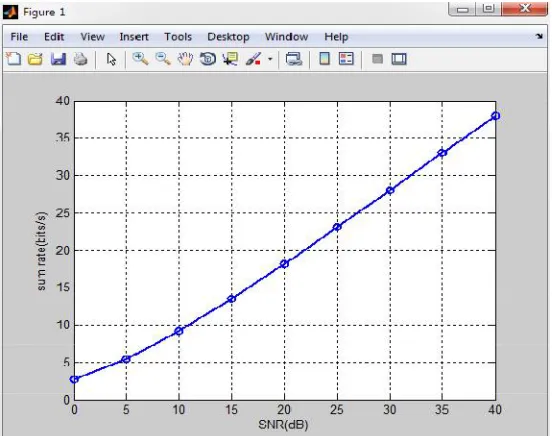
In the proposed work , determining the sum rate based on channel coefficients and we can calculate spectral efficiency at high signal to noise region.By using maximum SINRalgorithm we can analyse sum rate Vs signal to noise ratio to get the maximum achievable spectral efficiency.It can be seen from Fig. 3that the sum rate and SINR has a linear shape curve and is quasiconcave. This quasiconcavity is the foundation of this proposed methodology and infers that the proposed maximum SINR algorithm leads to the maximum spectral efficiency performance.
ISSN (Print) : 2320 – 3765 ISSN (Online): 2278 – 8875
I
nternational
J
ournal of
A
dvanced
R
esearch in
E
lectrical,
E
lectronics and
I
nstrumentation
E
ngineering
(An ISO 3297: 2007 Certified Organization)
Vol. 5, Issue 7, July 2016
VIII. CONCLUSION
In this work, addressed the energy efficiency optimization problem for multi-cell MIMO-IFBC with interference alignment. This work developed two schemes to optimize energy efficiency for different SNR regions. For high SNR region, employ a grouping-based interference alignment scheme to cancel inter- and intra-cell interference and transform the MIMO-IFBC to a single-cell single user MIMO scenario.A gradient-based power adaptation scheme has been proposed based on the water filling approach and SVD to maximize energy efficiency for each cell.
Here developed a new network architecture proposition based on energy efficiency and spectral efficiency maximization for Multi-Cell MIMO-IFBC within the context of interference alignment (IA).In the proposed work the extent to which reference can be aligned over a finite number of signalling dimensions remains unknown.Another important concern for interference alignment scheme is the requirement of global channel knowledge .So one can acheive interference alignment with only local channel knowledge at each node and determined the sum rate based on channel coefficients and calculate spectral efficiency at high signal to noise region.By using maximum SINR algorithm ,analysedsum rate Vs signal to noise ratio to get the maximum achievable spectralefficiency.Simulation results demonstrate that the proposed schemes outperform several existing approaches in all SNR range
REFERENCES
[1] H. Dai and H. Poor, “Asymptotic spectral efficiency of multi-cell MIMO systems with frequency-flat fading,” IEEE Trans. Signal Process., vol. 51,no. 11, pp. 2976–2988, Nov. 2003.
[2] S. Verdu, “Spectral efficiency in the wideband regime,” IEEE Trans. Inf. Theory, vol. 48, no. 6, pp. 1319–1343, Jun. 2002.
[3] R. S. Prabhu and B. Daneshrad, “Performance analysis of energy-efficient power allocation for MIMO-MRC systems,” IEEE Trans. Commun.,
vol. 60, no. 8, pp. 2048–2053, Aug. 2012
[4] G. Miao, N. Himayat, and G. Y. Li, “Energy-efficient link adaptation in frequency-selective channels,” IEEE Trans. Commun., vol. 58, no. 2, pp. 545–554, Feb. 2010..
[5] Z. Hasan, H. Boostanimehr, and V. K. Bhargava, “Green cellular networks:A survey, some research issues and challenges,” IEEE Commun. Surveys Tuts., vol. 13, no. 4, pp. 524–540, 4th Quart. 2011.
[6] J. Tang, D. K. C. So, E. Alsusa, and K. A. Hamdi, “Resource efficiency: Anew paradigm on energy efficiency and spectral efficiency tradeoff,” IEEETrans. Wireless Commun., vol. 13, no. 8, pp. 4656–4669, Aug. 2014.
[7] Z. Chong and E. Jorswieck, “Energy efficiency in random opportunistic beamforming,” in Proc. Veh. Technol. Conf., 2011, pp. 1–5.
[8] J. Tang and S. Lambotharan, “Interference alignment techniques for MIMO multi-cell interfering broadcast channels,” IEEE Trans. Commun., vol. 61, no. 1, pp. 164–175, Jan. 2013.
[9] K. Gomadam, V. R. Cadambe, and S. A. Jafar, “A distributed numerical approach to interference alignment and applications to wireless interference networks,” IEEE Trans. Inf. Theory, vol. 57, no. 6, pp. 3309–3322,Jun. 2011.
[10] J. Xu and L. Qiu, “Energy efficiency optimization for MIMO broadcast channels,” IEEE Trans. Wireless Commun., vol. 12, no. 2, pp. 690– 701,
Feb. 2013.
[11] .Jie Tang, Daniel K. C.,"Energy Efficiency Optimization With Interference Alignment inMulti-Cell MIMO Interfering Broadcast Channels",IEEE Trans. Commn.,Vol. 63, no.7, july 2015.
[12] G. Miao, N. Himayat, G. Y. Li, and A. Swami, “Cross-layer optimizationfor energy-efficient wireless communications: A survey,” Wiley J. WirelessCommun. Mobile Comput., vol. 9, no. 4, pp. 529–542, Apr. 2009.
BIOGRAPHY
AnsuVarughesereceived the B.Tech degree in Electronics and Communication Engineering from MG University, Kottayam, Kerala, India, in 2014 and currently she is doing M.Tech in Electronics and Communication Engineering with Specialization in Communication Engineering from BC Caarmel Engineering College, Perunad,MG University Kottayam, Kerala, India.