Fragment-Visible Mosaic Images by Color Transformations
D. Dakshayani Himabindu Bharathi.Panduri
Assistant Professor, Assistant Professor,
M. Tech (IT) M. Tech (CSE)
ABSTRACT:
The variety image, which looks much like a randomly selected target image and can be utilized like a camouflage from the secret image, is produced by dividing the key image into fragments and changing their color qualities to become individuals from the corresponding blocks from the target image. Existing data hiding techniques mainly make use of the techniques of LSB substitution, histogram shifting, difference expansion, conjecture-error expansion, recursive histogram modification, and discrete cosine/wavelet changes. A brand new secure image transmission strategy is suggested, which transforms instantly confirmed large-volume secret image right into a so-known as secret-fragment-visible variety image of the identical size. Skilled techniques are made to conduct the color transformation process so the secret image might be retrieved nearly lossless. A plan of handling the overflows/underflows within the converted pixels’ color values by recording the color variations within the untransformed color space can also be suggested. The data needed for recuperating the key image is embedded in to the produced variety image with a lossless data hiding plan utilizing a key. Good experimental results show the practicality from the suggested method. Within the first phase, a variety image is produced; featuring it’s the fragments of the input secret image with color corrections based on a similarity qualifying criterion according to color versions.
I. INTRODUCTION
Lately, many techniques happen to be suggested for acquiring image transmission, that two common approaches are image file encryption and knowledge hiding. Image file encryption is really a technique that takes advantage of the natural property of the image, for example high redundancy and powerful spatial correlation, to obtain an encoded image according to Shannon’s confusion and diffusion qualities. These images usually contain private or private information so they ought to be protected
against leaking during transmissions.
Presently, images from various sources are often utilized and sent online for a number of programs, for example online personal
photograph albums, private enterprise
archives, document storage systems, medical
imaging systems, and military image
databases [1].
The encoded image is really a noise image to ensure that no-one can have the secret image from this unless of course he/she's the right key. However, the encoded image is really a meaningless file, which cannot provide more information before
understanding and could arouse an
attacker’s attention during transmission
because of its randomness healthy. An
alternative choice to avoid this issue is data hiding that hides a secret message right into a cover image to ensure that no-one can realize the presence of the key data, where the data kind of the key message investigated within this paper is definitely an image.
Existing data hiding techniques
mainly make use of the techniques of LSB substitution, histogram shifting, difference
expansion, conjecture-error expansion,
recursive histogram modification, and
discrete cosine/wavelet changes. However, to be able to lessen the distortion from the resulting image, a maximum bound for that distortion value is generally focused on the payload from the cover image. But, for a lot of programs, for example keeping or
transmitting medical pictures, military
images, legal documents, etc., which are
valuable without any allowance of
significant distortions, such data
compression procedures are often not
practical. Furthermore, most image
items. Attorney at law about this rate distortion issue is available. Thus, a primary publication of the techniques for hiding data in images may be the difficulty to embed a lot of message data right into a single image. Particularly, if a person really wants to hide a secret image right into a cover image with similar size, the key image should be highly compressed ahead of time.
Within this paper, a brand new way of secure image transmission is suggested, which transforms a secret image right into a significant variety image with similar size and searching just like a preselected target image. The transformation process is controlled with a secret key, and just using the key can an individual recover the key image nearly lossless in the variety image. The suggested technique is inspired by Lai and Tsai, where a new kind of computer art image, known as secret-fragment-visible variety image, was suggested. The suggested technique is new for the reason that a significant variety image is produced, in comparison using the image file encryption way in which only produces meaningless noise images. Also, the suggested method can modify a secret image right into a
disguising variety image without
compression, while an information hiding
method must hide a very compressed form of the key image right into a cover image once the secret image and also the cover image have a similar data volume.
II. METHODOLOGY
The suggested method includes two primary phases as provided by the flow diagram: variety image creation and secret image recovery. Within the first phase, a variety image is produced; featuring it’s the fragments of the input secret image with color corrections based on a similarity qualifying criterion according to color versions. The phase includes four stages: fitting the tile pictures of the key image in to the target blocks of the preselected target image changing the color sign of each tile image within the secret image to get those of the related target block within the target image rotating each tile image right into a direction using the minimum RMSE value regarding its corresponding target block and embedding relevant information in to the produced variety image for future recovery from the secret image [3].
Fig: Flow Diagram of proposed method Within the second phase, the embedded details are removed to recuperate nearly lossless the key image in the produced variety image. The phase includes two stages: removing the embedded information for secret image recovery in the variety image, and recuperating the key image while using removed information.
Problems experienced in producing variety images are talked about within this section with methods to them suggested. Within the first phase from the suggested method, each tile image T within the given secret image is squeeze into a target block B inside a preselected target image. Because the color qualities of T and B aren't the same as one another, how you can change their color distributions to ensure they are lookalike may be the primary issue here. Reinhard et al. suggested one transfer plan within this aspect, which converts the color sign of a picture to become those of another within the lab color space [4].
colors within the block like a measure to decide on the most similar B for every T.
Following the color transformation process is carried out as described formerly; some pixel values within the new tile image T may have overflows or underflows. To be able to recover the key image in the variety image, we must embed relevant recovery information in to the variety image. Furthermore, we must embed too some related details about the variety image generation process in to the variety image to be used within the secret image process of recovery.
Using the bit stream MT embedded in to the variety image, we are able to recover the key image back and so will be described later. It's noted that some loss is going to be incurred within the retrieved secret image, or even more particularly, within the color transformation process. Based on the outcomes of the experiments carried out within this paper, each retrieved secret image includes a really small RMSE value with regards to the original secret image. A limitation from the suggested method would be that the dimensions of accessible target images should match individuals of possible input secret images [5]. Particularly, if there exists a large secret
image only small target images for choices, then any selected target image ought to be enlarged before variety image creation to be able to match how big the key image, and also the produced variety image will end up blurred.
An experimental result showing this blurring effect is presented. To improve the safety from the suggested method, the embedded information later on recovery is encoded having a secret key. Just the receiver that has the important thing can decode the key image. However, an
eavesdropper who doesn't have the
important thing can always try all possible permutations from the tile images within the variety image to obtain the secret image back.
Algorithm:
The detailed algorithms for mosaic image creation and secret image recovery may now be described in Algorithms 1 and 2 respectively.
Algorithm 1 Mosaic image creation T-target image, S-secret image, F-mosaic image
Stage 1. Fitting blocks of secret images into blocks of target blocks
2. Divide S and T into n blocks of same size 3.Compute the means and the standard deviations(SD) of each tile [1]
4.Compute the average SD 5. Sort the tile images in S and T 6.Map tile between S and T 7.Create F
Stage 2. Transforming color characteristics of blocks of secret image similar to target image
8. For each mapping from secret to target calculate the mean and SD
9.Each pi in each block of F with color value ci, transform ci into a new value using ci’’=qc(ci-μc) + μc’
a. If ci’’ is not less than 255 or if it is not greater than0, then change to be 255 or 0 Stage 3. Rotating secret image blocks in the direction with minimum RMSE value
10. Compute the RMSE values
11. Rotate tile into the optimal direction with the smallest RMSE value
Stage 4. Embed information for recovery purpose
12. For each tile image in F, construct a bit stream M for recovering T
otation angle θ°, means and the SD quotients
13. Generate a bit stream Mt by K 14. Embed Mt into F
Algorithm 2 Secret image recovery
T-target image, S-secret image, F-mosaic image
Stage 1. Extracting the embedded
information.
1. Extract the bit stream Mt by K 2. Decompose Mt into n bit streams
3. Decode M for each tile image to obtain the data items
Index, rotation angle θ°, means and SD quotients
Stage 2. Recovering the secret image. 4. Recover tile images by the following steps
se direction and fit the resulting
block content into T to form an initial tile image
quotients
or 0
el values 5. Compose all the final tile images to form the desired secret image S
III. CONCLUSION
A brand new secure image
suggested, which although create significant variety images but additionally can modify a secret image right into a variety one with similar data size to be used like a camouflage from the secret image. Also, the initial secret images could be retrieved nearly lossless in the produced variety images. Good experimental results have proven the practicality from the suggested method. Future studies might be forwarded to using the suggested approach to pictures of color models apart from the RGB. Through proper pixel color changes in addition to a skilled plan to handle
overflows and underflows within the
converted values from the pixels’ colors, secret-fragment visible variety images with high visual commonalities to randomly-selected target images could be produced without a target image database.
RESULTS:
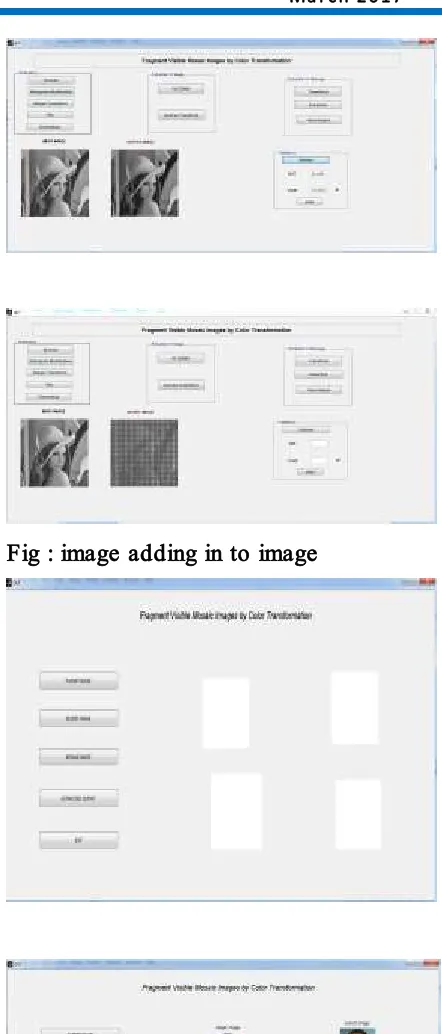
Fig : Text adding in to image
Fig : image adding in to image
[1] X. Hu, W. Zhang, X. Hu, N. Yu, X. Zhao, and F. Li, “Fast estimation of optimal marked-signal distribution for reversible
data hiding,” IEEE Trans. Inf. Forens.
Secur., vol. 8, no. 5, pp. 187–193, May 12013.
[2] J. Tian, “Reversible data embedding
using a difference expansion,” IEEE Trans.
Circuits Syst. Video Technol., vol. 13, no. 8, pp. 890–896, Aug. 2003.
[3] E. Demaine and M. Demaine, “Jigsaw puzzles, edge matching, and polyomino
packing: Connections and complexity,”
Graphs Combinator. vol. 23, no. 1, pp. 195– 208, 2007.
[4] R. Z. Wang, C. F. Lin, and J. C. Lin, “Image hiding by optimal LSB substitution
and genetic algorithm,” Pattern Recog., vol.
34, no. 3, pp. 671–683, 2001.
[5] J. Fridrich, M. Goljan, and R. Du,
“Invertible authentication,” Proc. SPIE, vol.