A System for Generating Cloze Test Items
from Russian-Language Text
Andrey Kurtasov
Vologda State Technical University
Russia
[email protected]
Abstract
This paper studies the problem of automated educational test generation. We describe a procedure for generating cloze test items from Russian-language text, which consists of three steps: sentence splitting, sentence filtering, and question generation. The sentence filtering is-sue is discussed as an application of automatic summarization techniques. We describe a sim-ple experimental system which imsim-plements cloze question generation and takes into ac-count grammatical features of the Russian lan-guage such as gender and number.
1
Introduction
In recent years, e-learning has become a widely used form of post-secondary education in Russia. Highly-developed Learning Management Sys-tems (LMS), such as Moodle1, have been broadly accepted by Russian colleges and universities. These systems provide rich opportunities for de-livering, tracking and managing education, and significantly help to reduce a teacher’s workload as well as to establish distance learning. One of the most noticeable functions provided by the LMSs is assessment, which is implemented through automated tests. However, the task of preparing questions for the tests is not yet auto-mated. The teacher has to compose all the test items manually, and this is a time-consuming task.
Moodle allows using different types of test items for student assessment, including calculat-ed questions, multiple-choice questions, match-ing questions, and questions with embedded
1 Available from: https://moodle.org/
swers, also known as cloze questions or fi ll-in-the-blank questions.
We are considering the opportunity for auto-mated test generation based on extracting sen-tences from electronic documents. We find this approach promising, because electronic text-books are widely used, and many texts with po-tential educational value are available through the Internet. As a starting point, we aim to study methods for generating cloze questions, because they are obviously the easiest to be produced from sentences. To produce a cloze question, one takes a sentence and replaces some of the words in the sentence with blanks.
Once we have studied how to extract useful sentences from the text and how to select words to blank out, we will continue our research in order to develop methods for generating more complicated types of test items, such as multiple-choice.
2
Related Work
The idea of automating the composition of test items is not new.
For instance, several Russian authors, includ-ing Sergushitcheva and Shvetcov (2003) and Kruchinin (2003), suggest using formal gram-mars (FG) to generate test questions with varia-ble parts. Although the development of FG-based templates is performed manually, this approach allows generating multiple various tests of dif-ferent types (including multiple-choice) and eliminates students’ cheating.
The approach of generating test items by ex-tracting sentences from electronic documents has received significant attention in English-language literature. Several authors have considered different kinds of test items in terms of automa-tion. For instance, cloze questions were studied
by Mostow et al. (2004) for the purpose of read-ing comprehension assessment. Mitkov et al. (2006) implemented an environment that allows producing multiple-choice questions with dis-tractors. Heilman (2011) developed a system for generating wh-questions that require an answer to be typed in.
However, only a few authors have considered this approach for Russian. Voronets et al. (2003) published one of the first papers on the topic, in which they proposed applying this approach to instructional texts used in cosmonaut training. Sergushitcheva and Shvetcov (2006) considered using this approach in combination with the FG-based one.
3
Workflow for Computer-Assisted
Test Generation
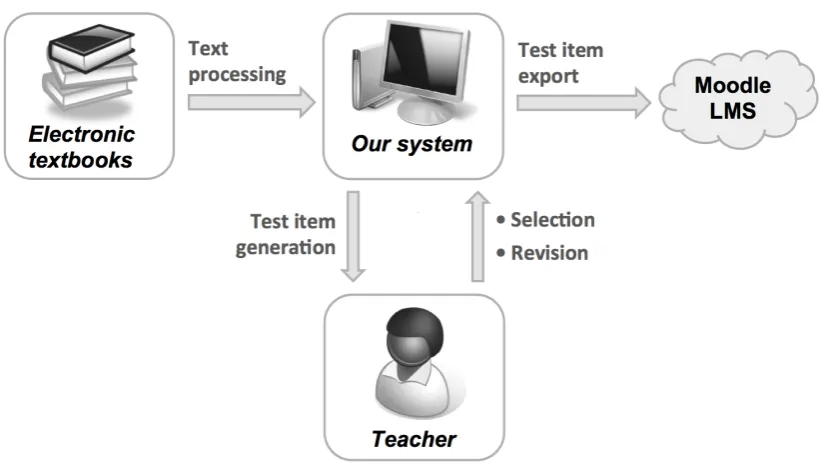
Our idea is to establish a system that delivers computer-assisted test authoring and leverages Natural Language Processing (NLP) techniques to provide the teacher with test items, which are generated automatically from electronic text-books or similar texts. After the generation the test can be passed to the Moodle LMS and used for student assessment.
Fig. 1 shows the basic workflow of the sys-tem, which could be considered as a computer-assisted procedure. The system takes a text as an input and produces test items as the output. The test items are then presented to teachers, who select and edit the ones that they consider useful.
4
Text Processing
The approach is based on sequential application of linguistic processors that perform the follow-ing tasks on the text:
• Sentence splitting – to acquire sentences
from which the system will produce ques-tions for test items
• Sentence filtering – to filter the set of
sen-tences so that it contains the most salient sentences
• Question generation – to convert the
sen-tences into questions
4.1 Sentence Splitting
At first sight, a sentence is a sequence of charac-ters that ends with “.”, “!” or “?”. In practice we should keep in mind that these characters can also be used inside one sentence (Grefenstette and Tapanainen, 1994). To address this issue, we initially used a simple tokenization algorithm that had been developed for educational purpos-es. It took into account abbreviations, proper name initials and other special cases. For in-stance, the algorithm recognized commonly used Russian abbreviations containing periods, such as “г.” (year), “гг.” (years), “и т. д.” (etc.), “т. е.” (i.e.), “т. н.” (so called), “напр.” (e.g.) and so on.
interventions. Technology, Instruction, Cognition and Learning (2): 97–134.
Ani Nenkova and Kathleen McKeown. 2011. Auto-matic Summarization. Foundations and Trends in Information Retrieval, 5(2–3): 103–233.
Anna P. Sergushitcheva, Anatolii N. Shvetcov. 2003. Synthesis of Intelligence Tests by means of a For-mal Production System. Mathematics, Computer, Education: Conference Proceedings, vol. 10 (1): 310–320. R&C Dynamics, Moscow – Izhevsk, Russia (А. П. Сергушичева, А. Н. Швецов. 2003.
Синтез интеллектуальных тестов средствами формальной продукционной системы. Мате-матика, Компьютер, Образование. Сборник научных трудов, выпуск 10 (1): 310–320. R&C Dynamics, Москва – Ижевск, Россия) [in Rus-sian].
Anna P. Sergushitcheva, Anatolii N. Shvetcov. 2006. The Hybrid Approach to Synthesis of Test Tasks in Testing Systems. Mathematics, Computer, Educa-tion: Conference Proceedings, vol. 13 (1): 215– 228. R&C Dynamics, Moscow – Izhevsk, Russia (А. П. Сергушичева, А. Н. Швецов. 2006. Ги
-бридный подход к синтезу тестовых заданий в тестирующих системах. Математика, Компь-ютер, Образование. Сборник научных трудов,
выпуск 13 (1): 215–228. R&C Dynamics,
Москва – Ижевск, Россия) [in Russian].
I. V. Voronets, Anatolii N. Shvetcov, Viktor S. Alyoshin. 2003. A Universal Automated System for Knowledge Assessment and Self-teaching based on Analysis of Natural-language Texts of Textbooks. Proceedings of the 5th International
Scientific and Practical Conference “Manned Spaceflight”, Star City, Moscow Region, Russia (И. В. Воронец, А. Н. Швецов, В. С. Алешин. 2003. Универсальная автоматизированная система тестирования знаний и самообразова
-ния, основанная на анализе естественно