ISSN 2286-4822 www.euacademic.org
Impact Factor: 3.4546 (UIF) DRJI Value: 5.9 (B+)
Study to the effect of Thyroid Dysfunction on Lipid
Profile
DHEYAA SH. HAMMAD Department of Community Health Technology College of Health and Medical Technology in Basra Southern Technical University, Iraq
Abstract:
This study was carried out to investigate the pattern of lipid profile in individuals with thyroid dysfunction and healthy control and to know whether any correlation exists between serum lipids and thyroid hormones.
The study was performed on 125 persons, among them 73 had thyroid dysfunction were accepted in the study as patients group and 52 subjects with normal thyroid function and no history of chronic diseases were taken as control group. Then the patient group subdivided into hypothyroidism and hyperthyroidism groups on the bases of clinical examination and laboratory investigation for thyroid hormones. Serum total cholesterol (TC), High density lipoprotein cholesterol (HDL-C), Low density lipoprotein cholesterol (LDL-C), very low density lipoprotein (VLDL), and Triglyceride (TG) were assessed in all groups.
high risk of atherosclerosis induced coronary heart disease observed in hypothyroidism patients.
Key words: Hypothyroidism, Hyperthyroidism, thyroid hormone, lipid profile, atherosclerosis
INTRODUCTION
The main function of thyroid gland is the production and secretion two types of hormones, thyroid hormone and calcitonin. Calcitonin is the calcium regulating hormone. Thyroid hormone has a role in the regulation of body metabolism, neurological development, and other body functions. There are two metabolically active forms of thyroid hormone, triiodothyronine (T3) and tetraiodothyronine (T4)
which also called thyroxine [1, 2].
Thyroid hormone production is regulated by a hypothalamic-pituitary-thyroid system. The hypothalamus gland synthesizes and stores the thyrotropin-releasing hormone (TRH). Secretion of this hormone stimulate the pituitary gland to release the thyrotropin stimulating hormone (TSH), which is in turn circulates to thyroid gland and stimulate it to produce and release of thyroid hormone [3, 4].
The most common presenting clinical features of thyroid disease are the result of; hypothyroidism, due to decrease thyroid hormone secretion, with a normal or high TSH, or hyperthyroidism, due to excess thyroid hormone secretion with low TSH [5]. Clinically, individuals with hyperthyroidism will have symptoms of increased metabolism such as appetite change, tachycardia and fatigue, while individuals with hypothyroidism have symptoms of lowered metabolism like edema, dry skin and constipation [6, 7].
the liver and increases its conversion to bile salts. The thyroid hormone, T3 has the ability to sensitize the adipocyte to the
lipolytic action of epinephrine this increases the flow of fatty acids to the liver and thereby indirectly increases hepatic triacylglycerol synthesis [8].
Lipid profile is a group of blood tests that are often ordered together to determine risk of cardiovascular disease (CVD). It includes total cholesterol(TC), low density lipoprotein (LDL), high density lipoprotein (HDL), very low density lipoprotein (VLDL), and triglyceride (TG) [9]. Lipids are hydrophobic, means insoluble in water this make them to be cannot transport in the blood by themselves, so it binds to protein and form lipoproteins to transport fats such as cholesterol, phospholipids, and triglycerides around the body. LDL frequently labeled as being bad cholesterol because it transport fat to the artery walls which in turn can lead to atherosclerosis. HDL carries cholesterol and other fats away from the artery walls to the liver, and because a higher level of HDL is associated with a decreased risk of atherosclerosis it is known as the good cholesterol. VLDL transport fats and cholesterol into the bloodstream. When compared to the other types of lipoproteins, VLDL contains the highest amount of triglycerides, and it is considered to be a bad type of cholesterol [10, 11].
Thyroid hormones regulate lipoprotein metabolism, whereas thyroid diseases considerably alter lipid profile. However studies have shown that lipid profile in subjects with thyroid dysfunction varies among individuals and in different countries [12, 13, 14].
MATERIALS AND METHODS
The study was carried out during the period from November 2016 to June 2017 on 125 subjects visiting the General Qurna hospital, from Basra, Southern of Iraq with suspicion of thyroid disorders, among them seventy three had thyroid dysfunction were accepted in the study as patients cases. Fifty two subjects with normal thyroid function and no history of chronic diseases were taken as control group. Detailed information of all subjects was collected that included age, sex and family or personal history of chronic diseases. Then the patient cases subdivided into hypothyroidism and hyperthyroidism groups on the bases of clinical examination and laboratory investigation. Venous samples were drawn after 12 hours of overnight fasting. Serum was separated and assays were performed within 24 hrs. Serum T3, T4 and TSH were measured by micro
plate competitive enzyme immunoassay on the TOSOH analyzers. Serum total cholesterol (TC) and triglyceride (TG) were determined by enzymatic colorimetric assay using the kit from Biolabo, France depending on CHOD-PAP and GPO methods respectively. High density lipoprotein (HDL) was determined enzymatically in the supernatant after Phosphotungstate method precipitation of other lipoproteins using the kit from Randox, United Kingdom. Low density lipoprotein (LDL) and very low density lipoprotein (VLDL) was calculated using the Friedewald formula [15].
RESULTS
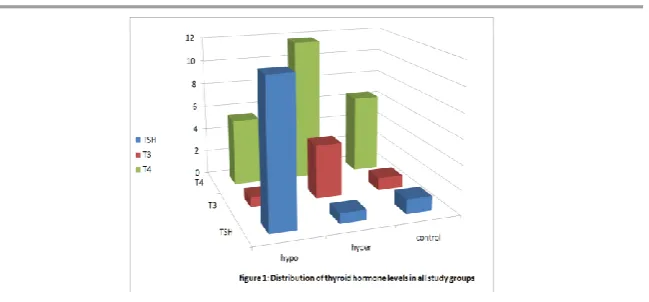
The mean levels for T3, T4, and TSH hormones in
hypothyroidism, hyperthyroidism, and control subjects are shown in table 1 and figure 1.
Hypothyroidism patients had highly significant increase in TSH levels (p<0.0001) as compared with hyperthyroidism patients and control subjects. There was a highly significant decrease in TSH levels (p<0.001) in hyperthyroidism patients as compared with control subjects.
Hypothyroidism patients had highly significantly decrease in the levels of T3 and T4 as compared with
hyperthyroidism patients and control subjects (p<0.0001 and p<0.001 respectively). There was also a highly significant increase in T3 and T4 (p<0.0001) in hyperthyroidism patients as
compared with control subjects.
Table 1 showing mean±SD of T3, T4, and TSH of thyroid dysfunction
and control subjects
Hypothyroidism Hyperthyroidism Control
TSH
***a
***b
11.655±1.266
**a
0.825±0.343
1.189±0.114
T3
**a
***b
0.806±0.262
***a
4.405±0.714
1.028±0.693
T4
**a
***b
5.496±0.828
***a
11.765±1.965
6.496±0.686
a hypothyroidism and hyperthyroidism significant compared to control group (**p < 0.001, ***p < 0.0001)
Table 2 and figure 2 demonstrates the mean levels of lipid profile activity in all study groups.
Hypothyroidism patients present an abnormal lipid profile with highly significant increase in the levels of TC, TG, LDL, and VLDL (p˂0.0001) compared to hyperthyroidism patients and control subjects. There is a highly significant decrease in the activity of HDL in hypothyroidism patients when compared with hyperthyroidism patients (p˂0.001), but there is a significantly increase in the activity of HDL in hypothyroidism patients when compared with control subjects (p˂0.001).
Table 2. Comparison of lipid profile fractions between all study groups
All values are given in mean±SD
a hypothyroidism and hyperthyroidism significant compared to control group (**p < 0.001, ***p < 0.0001)
b hypothyroidism significant compared to hyperthyroidism group ( **p < 0.001, ***p < 0.0001 ).
DISCUSSION
In our study, the mean total cholesterol, LDL-C, VLDL and TG were found significantly increased, whereas HDL-C was found significantly decreased in hypothyroidism cases compared to hyperthyroidism and control subjects; this showed that hypothyroid patients present a high risk for atherosclerosis and
Hypothyroidism Hyperthyroidism Control
for coronary heart disease. These data agree with other studies [17, 18, 19].
Regulation of TC and LDL levels can be attributed to altered clearance of LDL-C from plasma by changes in the number of LDL receptors on liver cell surfaces [20, 21].The promoter of the LDL receptor gene contains a thyroid hormone responsive element (TRE), T3 bind directly to TRE and
modulate the gene expression of LDL receptor [22]. Moreover thyroid hormones stimulate the 3-hydroxy-3-methylglutaryl-coenzyme A (HMG-CoA) reductase, enzyme catalyzed the first step in cholesterol biosynthesis [23]. On the other hand the effect of thyroid hormone on cholesterol 7-α-hydroxylase (CYP7A), this enzyme catalyzes the rate-limiting step for the synthesis of bile acid from cholesterol. CYP7A is regulated by T3 then in hyperthyroid conditions more cholesterol is converted
to bile acids, which are excreted in the feces this make serum cholesterol levels decline [24, 25].
Regulation of TG levels can be attributed to alter clearance of TG from plasma by changes the activity of lipoprotein lipase (LPL) by thyroid hormone. The enzyme LPL is synthesized and secreted by adipocyte, and is important for the transfer of triacylglycerol fatty acids from the circulating blood into adipocyte [26]. Moreover, a decrease in LPL activity is found in hypothyroidism, decreasing the clearance of TG by adipocyte lead to increase TG levels in plasma and this associated with increased levels of VLDL [27, 28].
Our study also show decreasing in HDL levels in hypothyroidism patients mainly due to the regulation of cholesterol ester transfer protein (CETP) and hepatic lipase (HL) activity by thyroid hormone [29, 30].
Hepatic lipase is a lipolytic enzyme hydrolyzes triglyceride and phospholipid in HDL and also stimulates HDL cholesterol ester uptake by hepatocyte. Therefore, hepatic lipase, together with lipid transfer proteins, determines both HDL level and its function in reverse cholesterol transport [32].
The present study shows that there is inverse relationship between serum thyroid hormone and serum lipid levels (except HDL). Monitoring of lipid profile is necessary for subjects suffering from thyroid dysfunction to anticipate any cardiac risk.
REFERENCES
1. Grennspan, F.S. Gardner, D.G. The thyroid gland. 7th ed. Basic and clinical endocrinology. 2001. p. 215-294.
2. Michael L. Bishop, Edward P. Fody, Larry E. Schoeff; Clinical Chemistry Techniques, Principles, Correlations, 6th
edition,2010. 470-476
3. Dentice M, Salvatore D. Deiodinases: the balance of thyroid hormone: local impact of thyroid hormone inactivation. J Endocrinol. 2011 Jun; 209(3): 273-82.
4. Martin A Crook; Clinical biochemistry and metabolic medicine, 8th edition, 2012, 164 – 175.
5. Yen PM. Physiological and molecular basis of thyroid hormone action. Physiol Rev 2001; 81: 1097‑142.
6. Malik R, Hodgson H. The relationship between the thyroid gland and the liver. QJM 2002; 95: 559‑69.
7. Friis T, Pedersen LR. Serum lipids in hyper- and hypothyroidism before and after treatment. Clin Chim Acta. 1987; 162: 155–63.
9. Kathleen Deska Pagana, Timothy J. Pagana, Mosby’s Manual of Diagnostic and Laboratory Tests; fourth edition, 2010, 323-366
10.Wendy Ameason, Jean Brickell; Clinical Chemistry A laboratory Perspective, 2007. 399-410.
11.Bishop, M.L., et al." Clinical chemistry; Principles, Procedures, Correlations"; 4th edition; 2000. 470-481
12.Tsimihodimos V., Bairaktari E., Tzallas C., et. al.; The incidence of thyroid function abnormalities in patients attending an outpatient lipid clinic. Thyroid. 1999;9:365–8. 13.Asvold BO, Vatten LJ, Nilsen TI,; The association between
TSH within the reference range and serum lipid concentrations in a population-based study. The HUNT Study. Eur J Endocrinol. 2007;156:181–6.
14.C.V Rizos, M.S Elisaf, and E.N Liberopoulos; Effects of Thyroid Dysfunction on Lipid Profile *Open Cardiovasc Med J. 2011; 5: 76–84.
15.Friedwald WT Levy RI, Fridrickson DS. "Estimation of the concentration of low density lipoprotein cholesterol in plasma without use of the preparation ultracentrifugation"
Clin. Chem. 18: 499-502. 1972.
16.Bradford Hill A. A short text book of medical statistic 11th ed.
1984; 156-193.
17.Abrams, J. J., and Grundy, S. M. (1981) Cholesterol metabolism in hypothyroidism and hyperthyroidism in man, J Lipid Res 22, 323-338.
18. C.V Rizos, M.S Elisaf, and E.N Liberopoulos. Effects of Thyroid Dysfunction on Lipid Profile. Open Cardiovasc Med. J. 2011; 5: 76–84.
19.Shashi, A., Sharma, N, Lipid profile abnormality in hypothyroidism, International Journal of Science and Nature Vol. 3(2) 2012: 354-360.
21.Soutar AK, Knight BL. 1990 Structure and regulation of the LDL receptor and its gene. Br Med Bull. 46:891–916.
22.Bakker O, Hudig F, Meijssen S, Wiersinga WM. 1998 Effects of triiodothyronine and amiodarone on the promoter of the human LDL receptor gene. Biochem Biophys Res Commun. 249:517–521.
23. Xiujuan Zhang,Yongfeng Song,Mei Feng, et. al. Thyroid-stimulating hormone decreases HMG-CoA reductase phosphorylation via AMP-activated protein kinase in the liver. J. lipid Res. 2015 May; 56(5): 963–971
24.Li T, Matozel M, Boehme S, Kong B, Nilsson LM, Guo G, et al. Overexpression of cholesterol 7α-hydroxylase promotes hepatic bile acid synthesis and secretion and maintains
cholesterol homeostasis. Hepatol Baltim
Md. 2011;53(3):996–1006.
25.Gullberg, H., Rudling, M., Forrest, D., Angelin, B., Vennstrom, B. (2000). Thyroid Hormone Receptor Beta-Deficient Mice Show Complete Loss of the Normal Cholesterol 7-alphaHydroxylase (CYP7A) Response to Thyroid Hormone but Display Enhanced Resistance to Dietary Cholesterol. Molecular Endocrinology 14, 1739-1749.
26.Martin Bergo, Gengshu Wu, Toralph Ruge, et.al. Down-regulation of Adipose Tissue Lipoprotein Lipase during Fasting Requires That a Gene, Separate from the Lipase Gene, J. Biol. Chem. 2002 277: 11927
27.Rizos CV, Elisaf MS, Liberopoulos EN. Effects of Thyroid Dysfunction on Lipid Profile. Open Cardiovasc Med J. 2011; 5: 76–84.
28.Nikilla EA, Kekki M. Plasma triglyceride metabolism in thyroid disease. J Clin Invest 1972; 51: 2103-14.
30.Brenta G, Berg G, Arias P, et al. Lipoprotein alterations, insulin sensitivity and hepatic lipase activity in Lipoprotein subclinical hypothyroidism. Response to treatment with L-T4. Thyroid 2007; 17: 453-60.
31.Foger B, Ritsch A, Doblinger A, et. al: Relationship of plasma cholesteryl ester transfer protein to HDL cholesterol. Studies in normotriglyceridemia and moderate hypertriglyceridemia. Arterioscler Thromb Vasc Biol. 1996 Dec;16(12):1430-6.