m.
ASSOCIATION
European Atomic Energy Community EURATOM/
Brown Boveri/Krupp Reaktorbau GmbH BBK/
Kernforschungsanlage Jülich des Landes NordrheinWestfalen e.V.
m
mfmÊÊm
| | | | | | §
COSTANZA BBK
| | | .
A ONE DIMENSIONAL DYNAMIC CODE FOR
l i
HIGH TEMPERATURE
GAS COOLED REACTORS
bv
K. F R I E D R I C H *, L. MASSIMO ** and E. VINCENTI
mmß'
'BBK
1970
» !
fif»
TR 91
«Ρ
?f Iwál l i i BS
#silÉiiiSiliå''''
Report prepared at BBK
This document was prepared u n d e r t h e sponsorship of t h e Commission
of t h e E u r o p e a n Communities.
s
i"· Bri
hi
; i
V i d
■mm.
Neither t h e Commission of t h e E u r o p e a n Communities, its contractors
express or implied, w i t h resp
t o t h e accuracy, completeness or usefulness of t h e information con
tained in this document, or t h a t t h e use of a n y information, a p p a r a t u s ,
m e t h o d
or process disclosed in this document m a y n o t infringe
privately owned rights; or
piffiiüfw
assume a n y liability with respect t o t h e use of, or for damages resultin,
from t h e use of a n y information, a p p a r a t u s , m e t h o d or process
disclosed in this document.
«SPR»?!
m
m y ' » s u l Mfcikt¿;£flí.F.£! V i ' i
ñ'Xi
t.,
ι*
Μ
Λ i Ú
■Må
li
This report is on sale a t t h e addresses listed
i t r
4"
>·Μι· „
t-i .-■■■!»
-
mm
—
Bd on cover P ^ f t Ä ^
!
ill
a t t h e price of F F
ll.-áft?
F B 100.—
DM 7.30
Lit. 1 2 5 0
Fl. 7.25
'"Lr*JV"'fÍ
W h e n οι
w h i c h a
1
-WmSSi Warnmfflr§
W h e n o r d e r i n g , p l e a s e q u o t e t h e E U R n u m b e r a n d t h e title,
title,
a r e i n d i c a t e d o n t h e c o v e r of e a c h r e p o r t .
l-ii
;.W
document was reproduced on t h e basis of t h e best available copy.
Printer! h v Guvot. S.a.
Μ
Brussels, J a n u a r y 1970
EUR 4410
e
COSTANZA BBK — A O N E D I M E N S I O N A L DYNAMIC CODE F O R
H I G H T E M P E R A T U R E GAS COOLED R E A C T O R S
by K. F R I E D R I C H *, L. MASSIMO ** and E. V I N C E N T I **
* BBK
** E U R A T O M
Association :
European Atomic Energy Community - E U R A T O M /
Brown Boveri/Krupp Reaktorbau G m b H - BBK/
Kernforschungsanlage Jülich des Landes NordrheinWestfalen e.V.
-K F A
T H T R 93
Report prepared at B B K
Brown Boveri/Krupp Reaktorbau G m b H - Mannheim (Germany)
Association No. 003-G3-1 RGAD
Luxembourg, J a n u a r y 1970 - 68 Pages - 7 Figures - F B 100
On the basis of the already existing COSTANZA code for liquid cooled
reactors a programme has been developed for the one-dimensional dynamic
calculations of the high temperature gas cooled reactors.
EUR 4410
e
COSTANZA B B K — A O N E D I M E N S I O N A L DYNAMIC CODE F O R
H I G H T E M P E R A T U R E GAS COOLED R E A C T O R S
by K. F R I E D R I C H * , L. M A S S I M O * * and E. V I N C E N T I * *
* B B K
** E U R A T O M
Association :
European Atomic Energy Community - E U R A T O M /
Brown Boveri/Krupp Reaktorbau G m b H - BBK/
Kernforschungsanlage Jülich des Landes NordrheinWestfalen e.V.
-KFA
T H T R 93
Report prepared at B B K
Brown Boveri/Krupp Reaktorbau G m b H - Mannheim (Germany)
Association No. 003-03-1 RGAD
Luxembourg, J a n u a r y 1970 - GS Pages - 7 Figures - F B 100
The programme solves the two-group dynamic neutron diffusion equations
in the radial direction.
The temperature feedback on reactivity is obtained through the consideration
of the temperature dependence of all of the coefficients of the two-group
equations.
The parameters for a consistent zero-dimensional calculation arc calculated
by the code.
A comparison of zero and one-dimensional calculations shows that it is
important to perform in one dimension the thermal calculation, while a
one-dimensional neutron flux dynamic calculation is normally not necessary for
the safety calculations of high temperature gas cooled reactors.
The programme solves the two-group dynamic neutron diffusion equations
in the radial direction.
The temperature feedback on reactivity is obtained through the consideration
of the temperature dependence of all of the coefficients of the two-group
equations.
The parameters for a consistent zero-dimensional calculation are calculated
by the code.
E U R 4 4 1 0
è
ASSOCIATION
European Atomic Energy Community - EURATOM/
Brown Boveri/Krupp Reaktorbau GmbH - BBK/
Kernforschungsanlage Jülich des Landes Nordrhein-Westfalen e.V. - KFA
COSTANZA BBK
A ONE DIMENSIONAL DYNAMIC CODE FOR
HIGH TEMPERATURE
GAS COOLED REACTORS
by
K. FRIEDRICH *, L. MASSIMO ** and E. VINCENTI **
*BBK
** EURATOM
1970
T H T R 93
Report prepared at BBK
Brown Boveri/Krupp Reaktorbau GmbH, Mannheim - Germany
A B S T R A G T
On the basis of the already existing COSTANZA code for liquid cooled
reactors a programme has been developed for the one-dimensional dynamic
calculations of the high temperature gas cooled reactors.
The programme solves the two-group dynamic neutron diffusion equations
in the radial direction.
The temperature feedback on reactivity is obtained through the consideration
of the temperature dependence of all of the coefficients of the two-group
equations.
The parameters for a consistent zero-dimensional calculation are calculated
by the code.
A comparison of zero and one-dimensional calculations shows t h a t it is
important to perform in one dimension the thermal calculation, while a
one-dimensional neutron flux dynamic calculation is normally not necessary for
the safety calculations of high temperature gas cooled reactors.
KEYWORDS
C-CODES DIFFUSION
PROGRAMMING DIFFERENTIAL EQUATIONS
HTGR TEMPERATURE
GROUP THEORY REACTIVITY
I n d e x
1. Introduction
2. The time-dependent diffusion calculation
3. The heat transfer calculation
4. Computation of the parameters for zero
dimensional calculations
5. Comparison between COSTANZA and a
zero-dimensional code for high temperature
reactor calculations
6. Nomenclature
7. Literature
8 . Input description
9. Programme listing and test case
- 5
COSTANZA BBK
A ONE DIMENSIONAL DYNAMIC CODE POR HIGH TEMPERATURE
GAS COOLED REACTORS*)
1. Introduction
On 'the basis of the already existing CONSTANZA code for
liquid cooled reactors [ref.l] , a programme has been
developed for the one dimensional dynamic calculations
of the high temperature gas cooled ractors.
The programme solves the two group dynamic neutron diffusion
equations in the radial direction.
Two energy group have been considered instead of the usual
one-group approximation in order to treat properly the
power peaking near the reflector and the effectiveness of
reflector control rods. In the undermoderated high tempe
rature reactors it is particularly important to treat
properly the slowing down of neutrons in reflector.
The temperature feedback on reactivity is obtained through
the consideration of the temperature dependence of all
of the coefficients of the two-group equations.
The reactor is radially subdivided in a maximum of 10 re
gions, including the reflector.
Up to 10 groups of delayed neutrons can be considered.
2. The time-dependent diffusion calculation
The two group equations take the following form:
+A
f =±2a.
ί2
> 4 ^ - ί 4 ^ ^ ^ α ν Μ
"ΊΓΨ
6
And for each group i of delayed neutrons we have:
,3, | ^ ^ K i ^ 4 i J - / U ·
i-*...k-Suffix 1 means fast and 2 means thermal group. The meaning
of the symbols is given in appendix.
The quantity ρ includes all fast absorptions and not only
resonances.
The quantity ß „ takes into account the higher importance
of the delayed neutrons due to the fact that they are born
with lower energy than the fission neutrons. About the
method of calculating ß
~~
see ref.l2j.
The coefficients of the above written equations change
from region to region and are temperature dependent. These
equations are transformed, with the finite difference
method, into a system of linear equations by subdividing
the radius of the reactor in a appropriate number of mesh
points and the time in constant time steps. The time
dependence is discretized in the following way:
{
'
V
'
9t
""
V '
At
where
φ
is the flux value calculated at the previous time
step.
At every time step the coefficients can be given new values
which are determined according to the temperature feedback.
Having performed this time discretization and integrating
the diffusion equations over annular regions corresponding
to each mesh point and substituting to the
In the common practice it is not necessary to perform the
temperature correction of the coefficients at every time
step.The programme uses two different time steps, one for
7
-integrals their finite
difference expressions, we ob
tain at each time step, a
system of 2n linear equations
(n being the number of mesh
points). This system is solved
with the direct method
discri-bed in ref. 3.
The flux calculation subroutine has been programmed in double
precision because of the smaller precision of the IBM 360 in
comparison with the 7090.
In general one.can say that a neutronic time step of 1/15
of the minimum period during the transient gives accurate
results.
A maximum of 100 mesh points are allowed. Mesh spacing is
arbitrary/
The boundary condition -g— = 0 at the core centre is obtained
by defining points 1 and 2 of the mesh symmetrically to the
axis and imposing that Φ(1) = Φ(2).
At the outer boundary Φ(η) = O. At every time step the
concentration of the delayed neutron precursors are varied
according to the last value of the fission density.
Any radial region can be specified as control region. In
the control regions control rods are simulated by a poison
whose microscopic cross section (equal for all regions) is
read in input for the fast and thermal group.
The control poison concentration in each control region is
given by two terms : a term which is calculated in a
critica-lity search before beginning the actual dynamic calculation,
and a term which is read in input for each control region as
function of time. A negative concentration may simulate an
increase in reactivity.
Before starting the dynamic calculation the reactor is made
critical by iterating on the control poison concentration
in all regions specified as control regions. This iteration
is performed without calculating k
~~
but calculating the
period corresponding to a certain poison concentration,
and iterating until the reciprocal of the period is smaller
than a given convergence criterion.
At each time step an average fuel and moderator temperature
is clculated for each power producing region. The heat transfer
calculation is only performed for those regions which are
specified in input as power producing, for all other regions
the temperature is supposed to be constant. These temperatures
are used in order to obtain the temperature dependent coeffi
cients of the diffusion equations. This temperature dependence
has been expressed in the form of a Taylor expansion:
(5) c=c
o+
oC(T
f
-T
fc
)
+
^
W
*
<r(V
T
fo
)2+
^
(T
m-
T
mo
)2
T, and Τ
to
mo
are the fuel and moderator reference tempera
tures which are calculated for the initial condition.
c is a generical coefficient of the diffusion equation
(diffusion coefficient, absorptions cross section, etc..)
c
o '
T
f ^ m ^ f o ^ m o ' ^ ' Æ ' / ' ^
a r e r e <
J
i o n
dependent.
The coefficients
σί,/3,/ an
o
are specified in input, and are
usually obtained performing several zero-dimensional
multi-group calculations with codes of the type of MUPO (ref.4/
Γ
Ι
9
3. The heat transfer calculation
The heat balance equation in the j
shell of a fuel element
at axial level i is (see symbol list in appendix)
There are as many equations as shells.
After reordering, the coefficients of this system of linear
equations form a tridiagonal definite positive matrix. It
can therefore be solved by the well known factorization
method (see ref. [ 7J p. 195)
Each temperature T. is calculated as function of Τ. , by
the recurrence formula:
(7)
Tj
=
ocj *
4
T/
4i
oL.
and/?, are constants which are determined by the recur
rence formulae :
(8)
U: =
k
<
A
j 2*
(9)
/3..——5L
A^,B.,C.,K. are the coefficients of equation (6) after
reordering. They depend only on the physical properties of
each shell.
When two fuel element types are present, two systems of li
near equations have to be solved at the same time. Let us
consider the two equations of type (6) for the outer shells
of both; fuel elements, together with the coolant heat ba
lance equations.
-ï-
hi
^
h)a
(A)Τ
Lίο)
Τ
=
oí -t- β
l
c
ID
Γ
*>
= «!
ι)
+β
(ί)
ν
10
These three equations contain three unknown Τ, ,Τ,,,Τ
1
,
and can be directly solved. Once T. for the outer shell is
known, the recurrence equations (7 ) provides all the tempe
ratures T. for both fuel types.
Knowing the percentage of fuel and moderator present in
each fuel element shell it is possible to calculate the
average fuel and moderator temperature for each core zone.
These temperatures are used in equation (5) to obtain the
temperature feedback on the two group coefficients.
4. Computation of the parameters for zero dimensional calculations
As a one dimensional calculation is rather time consuming
it is thought that many calculations would be performed
with other zero dimensional codes while a few cases would
be checked with COSTANZA. In zero dimensional codes it is
usually necessary to specify the ^k
fitf
which is causing the
transient, and the average prompt neutron lifetime 1. Both
quantities are not specified in COSTANZA, but it is possible
to calculate them in order to be able to perform consistent
zero dimensional calculations.
The programme can calculate in given regions the poison
concentration corresponding to a given
Δ
k „ .
The y value is devided by k
cc
and the reactor is made
-
1err
critical reducing the poison concentration in the specified
regions. Then
f
is set again to the original value and the
reactor period Τ is calculated neglecting the delayed neu
trons and the temperature feedback.
The average prompt neutron lifetime is than
11
In the COSTANZA code the period Τ is calculated as the
logaritmic derivative of the thermal flux
st
9 < &
(14)
Τ
Ã
Vt
Even neglecting the delayed neutrons the period is not
constant at the beginning of a transient. This is due to
two reasons: the consideration of two energy groups, and
the consideration of various regions with different pro
perties .
First, even in the case of the point model, the two group
equation implies as a solution the sum of two exponen
tials
φ
2
-
Ae
-t- ße
one can see that one of the two exponentials vanishes very
rapidly with a time constant dependent from the slowing
down time.
The second effect is the most important and is due mainly
to the reflector, which is returing neutrons to the core
with a certain delay and brings therefore a considerable
increase in the prompt neutron lifetime.
These effects can be seen in fig. 1. The full line gives
the ratio: T/T,»of the period Τ calculated by COSTANZA as
function of time after a reactivity accident, referred to
the asymptoti'C value T«? . The dotted line shows the same
curve for a bare reactor. In this second case the period
stabilizes very rapidly.
The prompt neutron lifetime must be calculated with the
12
calculate until the period has stabilised before using
equation (13) .
In this way it is possible to obtain automatically a prompt
neutron lifetime calculated in two groups and averaged over
the reactor volume. A spatial averaging would otherwise have
to be calculated with perturbation theory provided the
adjoint fluxes have been previously calculated. A two
group calculation of 1 is also important. A calculation
with one group extending over the complete energy range
would give the average lifetime of all prompt neutrons,
including those which do not produce fission. The neutrons
absorbed in the resonance region shorten considerably the
average lifetime of all prompt neutrons, but should not be
considered in 1. A calculation of 1 as sum of the slowing down
time and the lifetime of the thermal neutrons would on the
contrary give a too high 1 because it would neglect the
epithermal fissions which are in high temperature reactors
not negligible.
5. Comparison between COSTANZA and a zero-dimensional code for
high temperature reactor calculations
A certain number of comparison calculations have been made
between the zero-dimensional DYN code fre f. 9/and COSTANZA
Two reactivity steps have been considered:
a 0.28 % step in a homogeneous core, and a 0.64 % step in
a small central region of the THTR two zone core, simulating
a rod ejection accident. (The extraction of a control rod in
such a short time is not possible in THTR, but the case has
been considered in order to have a pessimistic example).
13
following time steps
These time steps have been choosen in such a way that
smaller steps would not change appreciably the results.
In COSTANZA two fuel element classes have been considered:
the first class represents the fresh elements, and the
second all remaining elements.
The DYN calculation has been performed twice:
once with two fuel element classes as in COSTANZA and once
with only one average fuel element class, calculating the
higher power of the fresh element with the consideration
of an "age factor" (ratio of macroscopic fission cross sec
tion of a fresh element to the average macroscopic fission
cross section). In DYN the geometrical power shape is taken
into account with a geometrical power shape factor (ratio
between maximum and average power).
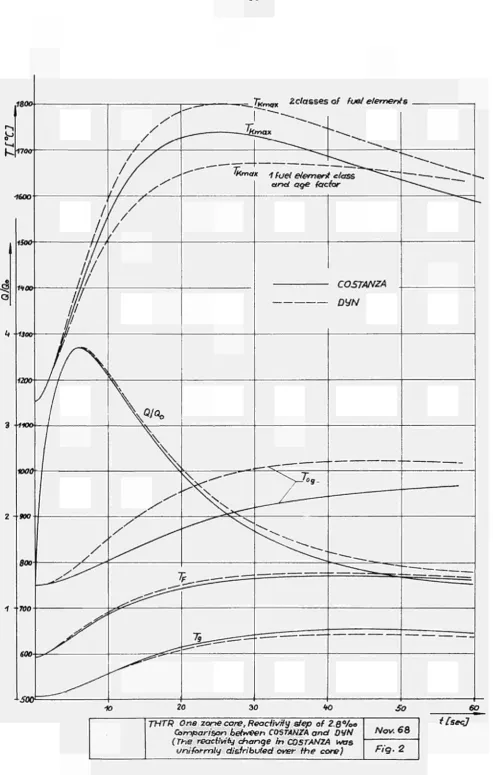
The results are shown in fig. 2
One can see that the temperatures calculated by DYN are in
one case optimistic and in one case pessimistic. There is
no appreciable difference in the flux excursion calculated
with the zero and one-dimensional model.
The second case (0.64 % reactivity step) has been simulated
in COSTANZA with a ramp of 0.002 sec. The time step width
has been
/ft = 0.002 sec
a
neutr
14
-Two calculations have been performed with COSTANZA, once
localizing the accident to a small central region of 20 cm
diameter, and once distributing the reactivity change over
the whole core.
Fig. 3 shows the comparison between DYN and these two
COSTANZA calculations. There is no appreciable difference
in the total reactor power excursion (Q). In the case in
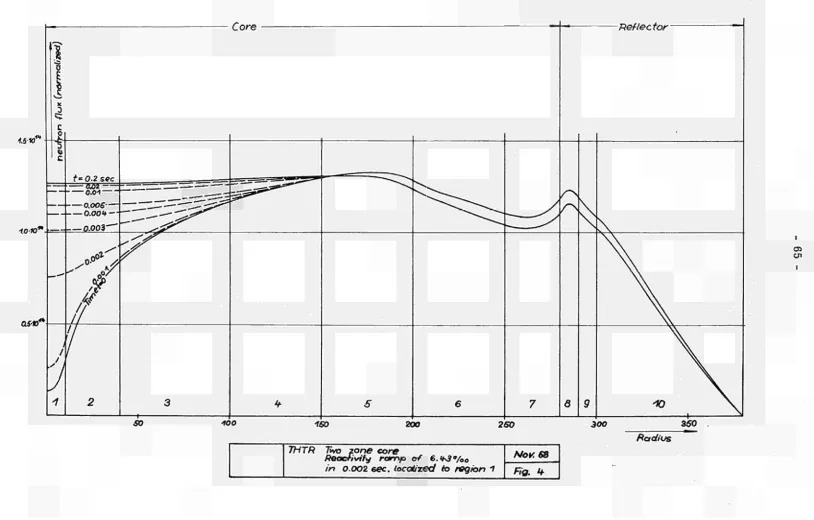
which the accident is localized to a small central region
(rod ejection) higher modes of the flux distribution are
excited for a short time, then the flux takes the form
corresponding to the foundamental mode of the new
confi-guration with rod extracted. Fig. 4 shows the change in
flux shape as function of time. In order to visualize
better the change in shape, all distributions have been
renormalized to the initial value.
One can see that after about 0.02 sec the flux has settled
to the new foundamental mode.
Fig. 5 shows the effect of changes in the prompt neutron
lifetime on the DYN results.
-4
The proper 1 given by COSTANZA is 7.0 · 10 sec. A
one-group zero-dimensional calculation for the
homoge-nized case gives 1~5.0·10~
4
. A two-crrouo calculation performed
by COSTANZA without reflector gives the value 6.2· 10
One can see that if the reactor is nearly prompt critical,
these inaccuracies in 1 lead to considerable inaccuracies
in the power excursion.
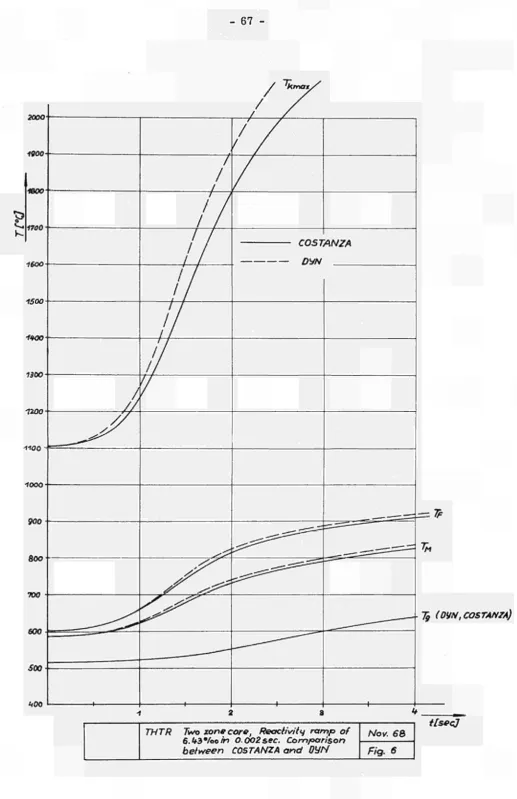
In fig. 6 is shown the comparison of curves of temperature
as function of time obtained from the one and zero
dimensio-nal calculations for the 0.64 % reacitivity step. There is
an appreciable difference in the maximum gas and fuel
ele-ment temperature between the two calculations, although in
15
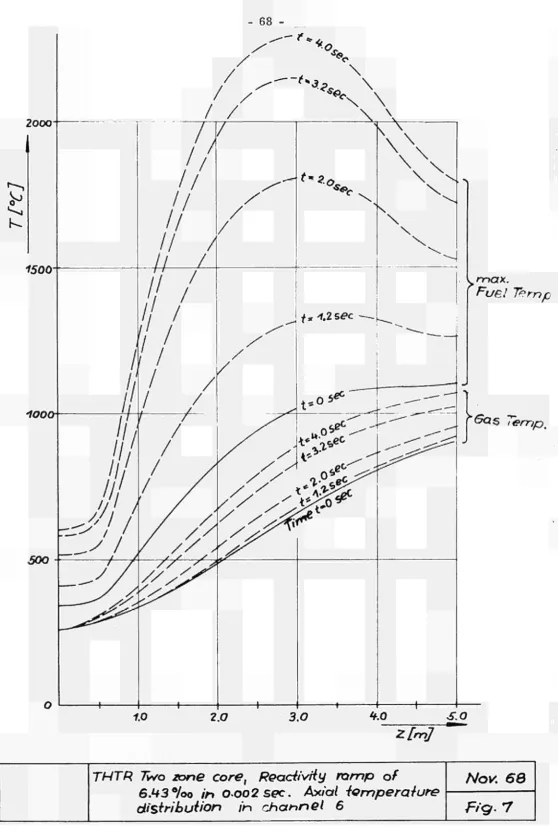
excursion. This is due to the fact that in the zero dimen
sional calculation the axial temperature profile is supposed
to be constant with time, while COSTANZA ^recalculates it at
every thermal time step. This change in axial temperature
profile is shown in fig. 7.
The result of this investigation is that, for the particular
cases which have been considered, there is a need for a
one dimensional thermal calculation, but not for a one dimen
sional neutron flux calculation.
A one dimensional neutron flux calculation is needed when
either the flux shape in the foundamental mode is strongly
modified by the transient, or when the higher modes bring
a considerable contribution to the reactor temperature.
Modifications of the foundamental modes can be easily forseen,
If these modifications can appreciably change the geometri
cal power shape factor, a one dimensional dynamic calcula
tion is required.
The contribution of the higher modes to the core temperatu
res is negligible in high temperature reactors, except for
accidents considerably bigger than those studied in our
examples·.
This is due to the very high heat capacity of the high tem
perature reactor fuel.
One can see from fig. 4 that the higher modes have practi
cally disappeard after 0.05 sec. As the thermal capacity of
the THTR fuel elementsis about
Ζ [MWscc¡m
°C]
even in a
pessimistic adiabatic assumption, one needs an average power
in 0.05 sec. In the case of a 0.64 % reactivity
step the overall power increases in 0.05 sec. only
of less than a factor 2, and even in the central
region does not increase more than of a factor 13. It
does not appear to be possible with forseeable accidents
to reach .
0.05 sec.
17
6.. Nomenc
1 ature
D
Diffusion coefficient
S
Neutron flux
2
B„
Axial buckling
Σ,
Ζ
£
Macroscopic removal cross section
rem
L
(absorption + slowing down)
Macroscopic fission cross section
ν
Number of secondary neutrons per fission
2^
Macroscopic absorption cross section (fission + capture)
3.
£
Microscopic control poison cross section
Ν
Control poison concentration
C.
Concentration of delayed neutron precursor, group i
k
Total number of delayed neutron groups
λ.
Decay constant of delayed neutron precursor, group i
ß
Delayed neutron fraction
ß
f~
Effective delayed neutron fraction
ρ
Fast absorption excape probability
Σ, _j
Macroscopic slowing down cross section
V
Neutron velocity
P.
Power of a fuel element at level i
ι
F.
Fraction of power generated in shell j
C.
Shell j thermal capacity
R.
Thermal resistance between shell j and the next one
or between the last shell and the coolant.
T.
Temperature shell j
T*
Temperature shell j for the previous time step.
Τ
, Τ ' Outer shell temperature in the two fuel element classes
Τ
Coolant temperature at axial level i
η.,n_ Number of class 1 and 2 elements present at level i
c
Coolant specific heat
C/
Coolant density
m
Mass flow
A
Channel section
18
7. Literature
r
l'
G. Forti, E. Vincenti
The codes Costanza for the dynamics of liquidcooled
nuclear reactors
EUR 3633 e
1967
'¡ 2 (
Κ. Friedrich, Ε. Inführ, L. Massimo
Spezielle Probleme der Dynamik bei gasgekühlten
graphitmoderierten Hochtemperaturreaktoren
ATKE 13 16 (80 83) 1968
3
R. Monterosso, E. Vincenti
Finite difference method for solving the spatiotemporal
diffusion equation in the two groups approximation
EUR 596. e (1964)
¿4j
J. Schlösser
MUPO. An IBM7090 programme to calculate neutron spectra
and multigroup constants. D.P. Report 17 2
[5]
C. V. Smith, H. A. Vieweg
GGC II
GA 44 36
December 17, 196 3
¿6
7
K. Friedrich, E. Inführ, L. Massimo
Rechenmodell für die Berechnung von schnellen Leistungs
exkursionen bei Reaktoren mit kontinuierlicher Beschickung
ATKE 1/6 9
[lj
S. Varga
Matrix iterative Analysis
Prentice Hall Inc.
[8J
A. Agazzi, G. Forti, F. Vincenti
EUR 3171 e
A cylindrical one dimensional dynamic code for liquid
cooled multichannel nuclear reactors.
¿9j
K. Friedrich, E. Inführ, L. Massimo
DYN, ein Dynamikprogramm für Kugelhaufenreaktoren
19
8. Input description
A title card is the first input card of each problem.
A vector of 3500 memory positions DATA (1) ... DATA (3500)
contains all the data. Since entire groups of memory positions
are zero, it is possible to read different sets of
significant data; each set must be preceded by a card
containing the integers K.¡·,/ K.
2
defining the first and
last datum of the set. K. and K
< 2
are given in integer
form adjusted to the right at columns 12 and 24. The last
set of a problem is indicated by 1 in columns 1 and 2.
The data of each set are all in floating form (FORMAT El2.8) .
Any number of problems may be run in sequence and only the
data changed in the preceding problem need to be given. A
title card must be present·
for each problem.
TITLE 1
col.12/
col.24/
Κ
11
κ
12
DATA(K
n
) DATA(K
11
+
1.) DATA(K
.DATA(K
12
) 1st set
K
21
K
22
DATA(K
21
) DATA..
etc
2nd set
I K .
Κ _
ni
n2
DATA
(Κ , )
last set
ni
TITLE 2
20
-Title Card - a positive integer in columns 1-6 means that
the problem is the last of the run. Any alohanumerical
information may appear in cols. 7 - 7 2 and will be printed
in the output.
DATA N
sVARIABLE
NAME
DESCRIPTION
ALLOWABLE
VALUES
NOTES
DELT t(sec) neutronic time
step for transient
pected inverse pe
1/15 of minimum ex
riod generally
gives good results.
DELT t(sec) neutronic time
step for initialization
(10·20 if source problem)
3
4
SI Reactor power in Watt
IMAX Number of mesh points ^ 1 0 0
NREG Number of regions (for
different composition
anr'/or typical coolant
channel characteristics)^10
Point 1 is symmetri
cal of point 2
with reactor axis.
Last point corres
ponds to the outer
(extropolated)
boundary of the
reactor.
NRIT Number of delayed neutrons
groups ^10
2
Bu Β - Transverse buckling
(cm-2) (same for all
regions and groups)
IDST Number of steps for
initialization (50)
ITCR max. Ν of iterations to
find correspondence between
period and poison (20)
10
NCAN Number of power producing regions (renions for
which a thermal calculation
is performed)
^10
11
KPC Thermal calculation is done
21
DATA N"
V A R I A B L EDESCRIPTION
ÄLLOWABLE
UAlA N
N A M EL U ^ K I F I I U I N
VALUES
NOTES
12
KTME1 A v e r a g e t e m p e r a t u r e s
are printed every
KTME1 thermal steps
13
KMA1 Temperature maps are
printed every KMA1 KTME1
thermal step
14
CALU Core height
15
ITCI N of flux
iteration in CRITIC before
calling (ANPAL (5)
3140
BETA ßi delayed neutron yeIds
per fission
4150
DLI
λϊ delayed neutron pre
cursors decay constants
61-71 11-12 Region boundary mesh numbers
73 VM V. neutron velocity for thermal group
74 WM V- neutron velocity for fast group
75 O .microscopic control poison
fast cross section
76 o 2 microscopic control poison
thermal cross section
NUCLEAR CONSTANTS
Region 1
81 Dl Diffusion coefficient-fast group
82 SR
¿S„ —
¿jnSc-.f-*
removal cross section
8 3
Ρ
ρ resonance escape probability
22
D A T A Ν
σV A R I A B L E
N A M E
D E S C R I P T I O N
A L L O W A B L E
V A L U E S
N O T E S
8 5
86
87
A E Q U I E n e r g y / f i s s i o n i W s e c / f i s s i o n j
S O R
N e u t r o n f l u x d e n s i t y (fast)
D 2
D i f f u s i o n c o e f f i c i e n t t h e r m a l
g r o u p
SA
-¿ΌΖ thermal absorption cross
section
89
90
91
92
SP
SF
blank
*£*¡
ANU Number of secondary neutrons
per fission y
ICAN
¿Ά if the region is a power producing region
for which a thermal calculation has to be per
formed (Reflector = 0)
93-104 etc.
same for 2nd region
201-300 X
Distance of mesh points
from axis
They are arbitrary,
except X(l) = -X(2)
CONTROL ROD MOVEMENT
301-330
331-360
361-390
391-420
Times of successive poison
values
Corresponding values of
N (t) for first region
Times for 2nd region
Ν for 2nd region
The first time
value must always
be O.Any number
of successive
times (up to 30)
and corresponding
Ν values may be
given for each
region, the code
will linearly in
terpolate between
the values to get
the current N
cfor
each time step.
After the last time
given, N
cwill be
23
DATA N«
V A
^
L E
DESCRIPTION
^
^
Ε
^
NOTES
DESCRIPTION OF THE TEMPERATURE
DEPENDENCE OF THE TWO GROUP COEFFICIENTS
The coefficients C„ are numbered as
follows
c
i
C2
C
3
C
4
C
5
C
6
C7
C8
C
9
SS
=
=
=
=
=
=
=
=
D
i
¿>ft*n
Ρ
^
v
i
D
2
<£*«2
^ Z
V
2
The thermal dependence is given as
a Taylor expension
CÏ-CÎ
+ CTNfK^NÎùTt
^ CTH(/<
>
¿^)aT
m
rr
9011380 CTN (K,L,N) = DATA (900 + 12 (Ll) + 48 (Nl)+K)
Ν is the power producing region number (channel
number) numbering from the core center
the regions,
for which a heat transfer
calculation is performed
13811390 RAVI Fraction of power generated
in the first fuel element class,
for each region
13911400 RAIN Fraction of power generated in
the second fuel element class,
for each region
24
DATA N° VARIABLE
NAME
DESCRIPTION ALLOWABLE
VALUES
NOTES
1401-1410
Fuel reference temperature
for the temperature coefficient
calculation (for each region)
1411-1420
Moderator reference temperature
for the temperature coefficient
calculation (for each region)
1501
DK
Excess reactivity
&
k
eff
program calcu-
If DK?*Q the
lates only the
poison
concen-tration and the
prompt lifetime,
1521-1530 KV1 Regions for which the poison
concentration correspending
to DK has to be calculated.
1601-1610 KV(I) I if poison is present in
region I
0 if not
1611
SPRG Second guess of control
poison concentration N
(same for all region
checked)
1st guess is
zero
1612
DAPF convergence criterium
for search. Reciprocal of
period will be ^ DAPF
1613
LF Maximum number of trials for
search (100)
PRINTING INSTRUCTIONS
1851+6n KTP Number of time steps for n
printing pattern
th
n=0, 1, 2 etc.
1852+6n IIP Number of time steps after
which the more frequent type
of printing is done
185 3+6n IIS Type of more frequent output
1, 2, 3
As many cards as
wanted can be
given, allowing
different
- 25
DATA N VARIABLE
MAME
DESCRIPTION
l854+6n I2P
1355+6n
1856+6n
I2S
ALLOWABLE
VALUES
1 only average fluxes and
period
2 complete map of fluxes
and delayed neutron
pre-curors concentration
3 average fluxes in the
reactor and region by
region
Number of time steps for
less frequent type of
out-put. Must be multiple of
IIP and divisor of KTP
completed the
cal-culation stops
and a final print
is done.Then the
control is
trans-fered to the
be-ginning of the
programme to start
a new problem,
un-less the title
card is checked,
in which case the
run is stopped.
Same as IIS for less
1, 2, 3 output
Not employed
frequent
AXIAL POWER DISTRIBUTION
(These date should be given for each power producing region)
2001-2020
2021-2040
Axial power distribution for
1st power producing region.
Relative values are
signifi-cant.Normalization is
per-formed by the code.
Same for 2nd channel
The axial power
distribution may
be different for
each power producing
region and is kept
constant during
transient.
As many point as
there are axial
zones in thermal
calculation. Must
be given for each
channel (see
further).
COOLANT CHANNELS DATA
(These data should be given for each power producing region)
2501 NSV Number of axial zones
DATA N
c
- 26
VARIABLE ALLOWABLE
NAME DESCRIPTION VALUES NOTES
2503 SEZ Channel cross section
2504 SC Gas specific heat
[
Joule /g °C7
f 3 7
2505 RØ Gas density ¿g / cm j
2506 NI Number of shells in fuel
element class 1
2507 PALN1 Number of class 1 elements
per axial zone corresponding
to the section SEZ
2509 N2
2510 PALN2 Same as before for class 2
2512 Porosity empty volume
total volume
2801-2810 RESI thermal resistance
between shells in fuel element
class 1
2811-2820 CPT1 thermal capacity for each shell
of class 1 elements
28 21-28 30 V0S1 Shell volume for each shell of
class 1 elements
28 31-2840 PZ01 Power fraction for each shell of
class 1 elements
2841-2850 FF1 Percentage of fuel for each shell
of class 1 elements
- 27
DATA N° VARIABLE
NAME
DESCRIPTION
ALLOWABLE
VALUES
NOTES
2901-2910 RES2 Same data for class 2 elements
2911-2920 CPT2
2921-2930 V0S2
2931-2940 PZ01
2941-2950 FF2
2951-2960 FM2
The following condition must be
satisfied:
Σ FNA(I)
+
£ FNl(L) -1
ΐ'1 1·η
Σ
FPìU)
+
Σ FF2 ¡η - 1
1*1
2521
2522
2523
2524
2525
2526
25312560
e t c . . . .
Inlet temperature of coolant
at equilibrium initial condi
tions (zero if inlet temperature
is tabulated as function of"
time)
Step of coolant inlet
temperature
dT
Value of rr for ramp in coolant
inlet temperature
*
Initial value of coolant mass
flow (zero if tabulated)
Step of coolant mass flow
Only if
DATA (2521)7*0.
Only if
DATA (2524) 7*0.
Value of sr for ramp in coolant Only if
mass flow
at
♦
DATA (2524)7*0.
28
-DATA N° VARIABLE
NAME
DESCRIPTION
ALLOWABLE
VALUES
NOTES
VARIABLE INLET
TEMPERATURE
(these data have to be
aiven
for each
power
producing region)
3001-3010
Inlet temperature values
for 1st channel
Only if DATA
(2521) and
analogous are 0,
3101-3110
Corresponding times for
1st channel
be 0.
First time must
3011-3020
Same for 2nd channel
VARIABLE COOLANT MASS FLOW
(these data have to be given for each power producing region)
3201-3210
Mass flow values for 1st
channel
FORTRAN IV G LEVEL It MOD 3
BLK DATA
DATE = 69111
15/41/30
PAGE 0001
0001
0002
0003
0004
BLOCK DATA
COMMON /COAT/ DATA(3500) REAL DATA / 3 5 0 0 * 0 . /
END
COS COS COS COS
10
20
30
40
FORTRAN IV G LEVEL 1, MOD 3 MAIN DATE = 69111 L5/41/30 PAGE OOOl COSTCI
MAIN
COSTANZA C I L I N D R I C O 0001
0002 0003
0 0 0 4
0005 0006 0007 0008 0009 0010 0011 0012 0013 0014 0015 0016 0017 0018 0019 0020 0021 0022 0023 0024 0025 0026 0027 0028 0029 0030 0031 0032 0033 0034 0035 0036 0037 0038 0039 0040 0041 0042 0043 0 0 4 4 0045 9001
110
20
23
22
100
101
10 2104
REAL*8 P M 1 , P M 2 , P M P T , P 1 , P 2 , T N 1 COMMON/DP/PMPT,PM1,PM2,Ρ 1 ( 1 0 0 COMMON/COMN/KBΑ,ΚΤ E , K B A R , K S , Ν Ι Ι Μ Ι , Ν Κ , S I , R E P , S P C R , S B E T A , P 2 F , D E L T , D L D , D L M , S P F l ( 1 0 ) t S P T K 3 0 1 ( 1 0 ) i D 2 ( 1 0 ) , S F 1 1 0 ) , S R ! 1 0 > ,S 4 ( 1 0 ) , S P ( 1 0 ) , P ( 1 0 ) , B E T A I 1 0 ) , D L 5 , I 2 ( 1 0 ) , K V ( 1 0 ) , F L M 1 ( 1 0 ) , F L M 2 ( 6 C 0 R I 1 0 ) , T M U I ( 1 0 ) , T M C 1 1 ( 1 0 ) , T M 8 X 1 1 0 0 ) , V 0 L K 1 9 0 ) , B E 2 ( 1 0 0 ) , A L 1 ( 1 0 0 ) , A L 2 ( 1 0 0 ) Α , Β Ι Κ 1 0 0 ) , B I 2 ( 1 0 0 ) , E P 1 ( 1 0 0 ) , E BER2( 100 ),DEM1( 100) , D E M 2 ( 1 0 0 ) , C ) , C T N ( 1 2 , 4 , 1 0 ) , D 1 I ( 1 0 ) , S R I ( 1 0 D I O ) , S F A ( 1 0 ) ι V I ( 1 0 ) ,SMP F ( 1 0 ) ,S E,VM,WM,A E Q U I ( 1 0 ) , A N U ( 1 0 ) » E Q U I C O M M O N / C O N T / T P K 1 0 , 2 1 , 1 0 ) , T P 2 1 , N S , N S V , N I , N I M I , Ν Ι Ρ 1 , N 2 , N 2 M 1 ,
COMMON/CDAT/DATA(3500)
DIMENSION ALF A ( 16) , Ι Τ IPO ( 10 ) , DIMENSION K V l ( l O ) ,
P I N T = 0 .
DO 9 0 0 1 1 = 1 , 3 5 0 0
DATAI I ) = 0 . 0
READ ( 5 , 2 0 ) L A S T , ALFA FORMAT < I 6 . 1 6 A 4 ) WRITE ( 6 , 2 3 )
FORMAT I 1 H 1 . 3 5 X ,20HC0STANZA WRITE ( 6 . 2 2 1 A L F A
FORMAT ( 1 H 0 . 3 0 X , 1 6 A 4 / / / / / ) CALL AZER
R E A 0 ( 5 , 1 0 1 ) J K L M , K 1 , K 2 » ( DATA ( I FORMATI 2 1 6 , 1 1 2 / ( 6 E 1 2 . 8 ) ) WRITE ( 6 , 1 0 2 ) ¡ I ,DATAI I ) , I = K 1 ,
FORMAT (61 I 5 . E 1 4 . 6 ) ) I F ( J K L M . G E . O ) G O T O 100 P I N T = 0 . 0
T 0 = 0 . 0
IT = 0
DELT=DATA(2) S I = D A T A ( 3 )
I M A X = D A T A ( 4 ) + 0 . 0 0 0 1 N R E G = D A T A ( 5 ) + 0 . 0 0 0 1 N R I T = D A T A ( 6 ) + 0 . 0 0 0 1
8U=DATA(7)
I D S T = D A T A ( 8 ) + 0 . 0 0 0 1 I T C R = D A T A ( 9 ) + 0 . 0 0 0 1 N C A N = D A T A ( 1 0 ) + 0 . 1
KPC = D A T A ( 1 1 ) + 0 . 1 DT=DELT*FLOAT(KPC)
KTME1 = D A T A < 1 2 ) + 0 . 1 K M A 1 « D A T A ( 1 3 ) + 0 . 1
KTE = 1 KMAP=0
KTMED=0 KCAN=0
DO 104 I = 1 , N R I T BETA!I)«=DATA<1+30)
D U I ) = D A T A ( I + 4 0 )
,TN2 ) , P 2 ( 1 0 0 ) , REG,IDST» I ER, P I N T , BU 10) ,
A(10),SPR( (10),DLDT( 1 0 ) , S A V ( 1 0 C 2 I ( 1 0 ) , T C 0 0 ) ,V0L2(1 ,AL22(100) P 2 ( 1 0 0 ) , T O S O R M ( I O O ) , ),ALAN ,S M P T ( I O ) , A B 1(100),EQU (10,21,10) N2P1
T N K 1 0 0 ) , T N 2 ( 100) TCR, I T , L F , L 1 , Ι Μ Α Χ , Κ Β
»VOLT, S
10) , s 10) ,D ) , F L I I ( 1 0 ) 00) ,V ,AB2 (
S F K 1
Filli
Κ 100
I2( 10 ,TMEDFK10
ETA( 1 M2I10 ,ICAN 0L(10 100) ,0 0 ) ,S 0 ) ,WI ) , A L 1 0) , P 0 1 1 0 , 4
) ,S0R 0) , V I ) , P I ( ( 10) , 0) ,BE B L U 1
F i l l i ( 10) 2 ( 1 0 0 WERd ) ,SEZ
(10) , M ( 1 0 ) 10) ,C SPRI (
1100) 0 0 ) ,B DERI 0 0 ) ,C D2I ( 1
)
0) ( 10) ■
MAI MAI MAI MAI MAI MAI I,NRIT,MAI PRG.DAPMAI W(10),VMAI ,1 Κ 1 0 1 M A I 0U(10),ΜΑΙ 1 0 ) , MAI , Β Ε Κ 10MAI L211001MAI (100),DMAI (10.100MAI 0),SAI(MAI MAI VR(10)
P O T Z I 1 0 )
V E P F ( 1 0 ) , V E P T ( 1 0 ) . C O N T R I 10)
C I L I N D R I C O / / )
),I=K1,K2> Κ2 ) MAI MAI MAI MAI MAI MAI MAI MAI MAI MAI MAI MAI MAI MAI MAI MAI MAI MAI MAI MAI MAI MAI MAI MAI MAI MAI MAI MAI MAI MAI MAI MAI MAI MAI MAI MAI MAI MAI MAI MAI MAI MAI HAI MAI 10 2 0 30 40 50 60 70 80 100 110 120 130 140 150 160 170 180 190 2 0 0 210 2 2 0 230 2 4 0 250 2 6 0 270 2 8 0 290 3 00 310 3 2 0 330 3 4 0 350 3 6 0 370 3 8 0 390 4 0 0 410 4 2 0 430 4 4 0 450 4 6 0 470 4 8 0 490
5 00 510 5 2 0 530 5 4 0 550 5 6 0 570 5 8 0 590 6 00 610 6 2 0 630
FORTRAN IV G LEVEL 0046 0047 0048 0049 0050 00 51 0052 0053 0054 0055 0056 0057 0058 0059 0060 0061 0062 0063 0064 0065 0066 0067 0068 0069 0070 0071 0072 0073 0074 0075 0076 0077 0078 0079 0080 0081 0082 0083 0084 0085 0086 0087 0088 0089 0090 0091 0092 0093 0094 0095 0096 0097 0098 0099 0100 0101 0102 0103 0104 0105 0106 0107 0108 105 1 48 107 108 800 103 16 17 8
1 , MOD 3 MAIN DATE = 6 9 1 1 1 DO 105 I=1,NREG
I 1 ( I ) = D A T A ( I + 6 0 ) + 0 . 0 0 0 1 121 I ) = DATAI 1 + 6 1 ) + 0 . 0 0 0 1 CONTINUE
DO 1 I=1,NREG K V ( I ) = D A T A ( 1 + 1 6 0 0 ) DO 48 M=1,NREG
TMUKM) = DATA (1400 + M) TMC1I(M)= DATA ( 1 4 1 0 + M) TMC2I (M)=DATA I 1420 + M)
T C I ( M ) = DATA ( 1 4 3 0 + M) CONTINUE
VM = DATAI73) WM = DATAI74)
IDF=80
DO 107 M=1,NREG D1(M)=DATA( IDF+1 ) SR(M)=DATA( IDF+2) P(M)=DATA( IOF + 3) S F 1 ( M ) = D A T A ( I D F + 4 ) AEQUI(M)=DATA(IDF+5) SOR(M)=DATA(IDF+6) D2(M)=DATA( IDF+7) SA(M)=DATA( IDF+8) SPR(M) = DATA( IOF+9) SP(M)=SPR(M) SF(M)=DATA( I D F + 1 0 ) ANU(M)=DATA(IDF+11)
ICAN(M)=DATA(IDF+12) MAI 860 I D F = I D F + 1 2
CONTINUE
DO 108 I = 1 , I M A X A B 2 I I ) = 0 .
X ( I ) = D A T A ( I + 2 0 0 )
X ( l ) = - X ( 2 )
P 1 ( I M A X ) = 0 . P 2 ( I M A X ) = 0 . P 1 ( 1 ) = P 1 ( 2 ) P 2 ( 1 ) = P 2 ( 2 ) SBETA=0.
I F ( N R I T . L E . 0 ) G 0 T 0 103 DO 800 K = 1 , N R I T DETA(K) = B E T A ( K ) / D L ( K ) CONTINUE
I M 1 = I M A X - 1
NK=IMAX-2 D 0 1 6 I = 2 , I M 1
8 E ( I ) = ( X ( I ) + ( X ( I + l ) - X ( I ) ) / 2 . ) / ( X ( I + l ) - X ( D ) V O L I ( I ) = ( X ( I ) + ( X ( I + l ) - X ( I ) ) / 4 . ) * ( X ( I + l ) - X ( I ) ) / 2 . V 0 L 2 I I ) = ( X ( I ) - ( X ( I ) - X ( I - 1 ) ) / 4 . ) * < X ( I ) - X ( 1 - 1 ) ) / 2 .
V 0 L 2 ( I M A X ) = ( X ( I M A X ) - ( X ( I M A X ) - X ( I M 1 ) ) / 4 . ) * ( X ( I M A X ) V O L ( 2 ) = ( ( X I 2 1 + X ( 3 ) ) / 2 . ) * * 2 * 3 . 1 4 1 6
DO 1 7 I = 3 , I M I
V O L ( I ) = ( V O L K I ) + V 0 L 2 I I ) 1 * 6 . 2 8 3 2 V 0 L T = 0 .
DO 8 1 = 2 , I M I
VOLT=VOLT+VOL(I)
V 0 L T = V O L T + 6 . 2 8 3 2 * V O L 2 ( I M A X ) DO 300 M=1,NREG
I S = I 1 ( M ) + 1 I D = I 2 ( M ) - 1
V0L0 = 6 . 2 8 3 2 * V 0 L 1 ( I S - 1 )
DO 3 0 1 1 = 1 Si ID
FORTRAN IV G LEVEL 1, MOD 3 MAIN DATE = 69111 15/41/30 PAGE 0003
V0L0=VOL0+V0L(I) MAI 1210
VR(M)=VOL0+6.2832*V0L2(ID+1) MAI 1220
WRITE(6,69) (VR(M) ,M = 1,NREG) MAI 1230
F0RMAT(1H1,10X, 'SEZIONE DELLE REGI ONI ■///IOE 12.4) MAI 1240
DO 4 2 0 M=1,NREG S P F K M ) = 0 . S P T 1 ( M ) = 0 . A L A N = 1 .
DK = D A T A I 1 5 0 1 ) MAI 1 2 5 0
I F ( A B S ( D K 1 - 1 . 0 E - 1 0 1 4 5 2 , 4 5 2 , 4 5 1 CONTINUE
DO 4 5 0 M=1,NREG MAI 1260
K V K M ) = DATAIM + 1 5 2 0 ) MAI 1 2 7 0
LAN=-10 CONTINUE CONTINUE CALL MAT
DO 3 3 1 = 1 , I M I P i l i ) = S I P 2 ( I ) = S I CALL INIZ
CALL STAMPAI2)
IF ( N C A N 1 1 2 0 0 , 1 2 0 0 , 1 2 0 1
CONTINUE CALL DCANIDT) CALL POREG
N = 0
DO 1009 M=1,NREG MAI 1400 ^
D 1 I ( M ) = D1(M) MAI 1410 t o
SRI (M)=SR(M) P I ( M ) = P ( M ) S F 1 I ( M ) = S F 1 ( M ) D 2 I ( M ) = D 2 ( M ) S A I ( M ) = S A ( M ) SPRI (M) =SPR(M) S F A ( M ) = S F ( M )
IF ( I C A N ( M ) ) 1 0 0 9 , 1 0 0 9 , 1 0 1 0 N=N+1
CALL C A N P A L ( 0 . 0 , N , T O , P O W E R ( M ) 1 CONTINUE
DO 1020 N=1,NCAN NKK = 4 8 * ( N - 1 ) DO 1020 L = l , 4 LTAY= 1 2 * ( L - 1 )
DO 1 0 2 0 K = l , 1 2
C T N ( K , L , N ) = DATAI900+NKK+LTAY+K) CONTINUE
WRITE ( 6 , 1 0 2 1 )
FORMAT ( 1 H 0 / / / / . 2 7 H C O E F F I C I E N T I TEMPERATURA , / / / ) DO 1 0 2 2 N=1,NCAN
WRITE ( 6 , 1 0 2 3 ) N
FORMAT (1H0//,10H CANALE NI3,//)
WRITE (6,1024)
FORMAT (1H0//,5X,6H TERM.,6X,2HD1,9X, 9HS.REMOVAL,8X,1HP,9X,15H 1FAST FISSION,5X.1HW)
DO 1025 L=l,4
WRITE I 6,1026) L, (CTN(K,L,N),K = 1,5)
F0RMATI1H0 ,9X,12,4X,6E14.6) WRITE (6,1027)
FORMAT I 1 H 0 / / , 5 X , 6 H T E R M . , 6 X , 2 H D 2 , 7 X , 1 3 H T H . A B S 0 R P T I O N , 4 X , 6 H P 0 1 SON,MA I 1 7 X , 1 1 H T H . F I S S I O N , 5 X . 1 H V 1
0168 0169 0170 0171 0172 0173 0174 0175 0176 0177 0178 0179 0180 0181 0182 0183 0184 0185 0186 0187 0188 0189 0190 0191 0192 0193 0194 0195 0196 0197 0198 0199 0200 0201 0202 0203 0204 0205 0206 0207 0208 0209 0210 0211 0212 0213 0214 0215 0216 0217 0218 0219 '0220 0221 0222 0223 0224 0225 0226 1028 1022 1029 1200
34
35
47
41
42
53
43
44
55
45
90
46
779
669
777
799
C
403
404
400
405
430
432
43 1 3,5X: 15/41/30MAI
MAI
MAI
MAI
MAI
MAI
MAI
MAI
MAI
MAI
MAI
MAI
MAI
MAI
MAI
MAI
MAI
MAI
MAI
MAI
MAI
MAI
MAI
MAI
MAI
MAI
,5HTG =MAIMAI
MAI
1780 1790 1800 1810 1820 1830 1840 1850 I860 1870 1880 1890 19001910
1920
1930
1940
1950
1960
1970
1980
1990
2000
2010
2020
2030
2040
2050
2060
FORTRAN IV G LEVEL 1 , MOD 3 MAIN DATE = 6 9 1 1 1 1 5 / 4 1 / 3 0 PAGE 0004 DO 1028 L = l , 4
W R I T E ( 6 , 1 0 2 9 ) L , ( C T N ( K , L , N ) ,K = 7 , 1 1 ) CONTINUE
FORMATdHO , 9 X , 12 ,4X , 5 E 1 4 . 6 ) CONTINUE
I F ( I T C R ) 3 5 , 3 5 , 3 4
CALL C R I T I C CALL STAMPA12) CALL STAMPAI3)
IC = O
00 46 M = 1 , NR EG I F ( I C A N ( M l ) 4 6 , 4 6 , 4 7
IC=IC+1
WRITE ( 6 , 4 1 ) I C I
F 0 R M A T I 1 H 0 / / / / 9 H CANALE N I 3 , 5 X , 3 H T = F 8 . 3 / / ) WRITE ( 6 , 4 2 )
FORMAT (1H0//12H SFERE VIVE ) DO 53 1=1,NS
WRITE (6,43) I,(TP1(J,I,IC),J=1,N1P1) FORMAT (1H0,I5,10F10.3)
WRITE (6,44)
FORMAT (1H0//,14H SFERE INERTI ) DO 55 1=1,NS
WRITE (6,45) I,(TP2(J,I,IC),J=1,N2) FORMAT (1H0,I5,10F10.3)
WRITE (6,90) (TMEDI I C I ) , 1 = 1 , 3 )
FORMAT (1H0///21H TEMPERATURE MEDIE //,5X,4HTU =F10. 1F10.3,5X,6HTGAS =F10.3)
CONTINUE WRITE(6,779)
FORMATI////20X.45HC0STANTI FISICHE DOPO IL CALCOLO DI CRITICITÀ/// 1)
DO 777 M=1,NREG
WRITE(6,669)(D1(M),SR(M),P(M),SF1(M),AEQUI(M),SOR(M), 1D2(M),SA(M),SPR(M),SF(M),ANU(M),ICAN(M))
FORMAT (6E20.5/5E20.5.I20) CONTINUE
WRITE(6,799) (M»POWER(M),M=1,NCAN)
FORMAT (////10X,18HP0TENZE DEI CANAL I///IO I 12,5X,E 12.5) ) DELT=DATA(1)
DT=DELT*FLOAT(KPC)
IF(ABSIDK)-l.OE-lO) 402,402,403
I F (LAN) 4 0 4 , 4 0 4 , 4 0 5 DO 400 M=1,NREG S P F K M ) = SMPF(M)
SPTKM) = SMPT(M) KV(M) = K V K M )
ALAN = 1 . / ( 1 . + DK ) LAN=+1000
GO TO 34 ALAN=1.0
CALL MAT V I T A M I = 0 . 0
CONTINUE
DO 432 1=1,IMAX T N K I ) = DER1( I ) * P 1 ( I ) T N 2 I I ) = D E R 2 ( I ) * P 2 ( I ) CALL FLUSSI
I T = I T + 1
TO = DELT*FLOAT( I T )
I F U T - 1 0 ) 4 3 0 , 4 3 0 , 4 3 1
1, MOD 3 MAIN DATE = 69111 15/41/30 PAGE 0005
DP=(PM2-PMPT)/DELT PER=(PM2 + PMPT ) / ( D P * 2 . 0 ) VITAM=DK*PER
W R I T E ( 6 , 4 3 6 ) DK,VITAM
IF ( A B S ( ( V I T A M - V I T A M 1 1 / V I T A M ) - 0 . 0 0 0 0 1 ) 9 0 0 3 , 9 0 0 2 , 9 0 0 2 V I T A M I = VITAM
IT = 0 GO TO 4 3 0
DO 433 M=1,NREG VEPF(M)=SMPF(M)-SPF1(M)
VEPT(M)=SMPT(M)-SPT1(M) CONTR(M)=VEPT(M)/DATA(76)
CONTINUE
FORMAT ( 1 H 0 / / / / , 1 4 H REACTIVITY =,F 1 0 . 6 , 1 0 X , 1 1 H M E A N LIFE = , F 1 0 . 6 , / 1/)
W R I T E ( 6 , 4 3 7 ) (K V ( I ) , I =1 ,NREG )
FORMAT ( 1 H 0 / , 2 1 H POISON CONCENTRAT I O N , / / , 1 0 E 1 3 . 5 ) FORMAT ( 1 H 0 / / / / . 1 8 H PERTURBED REG I O N S , / / , I 8 , 9 113) WRITE ( 6 , 4 3 8 ) (CONTR(M 1,M = l,NREG1
I F (LAST 1 1 1 0 , 1 1 0 , 9 0 0 0
CONTINUE MAI 2480
DO 80 K = 1 , N R I T MAI 2 5 0 0
DLDT(K) = D L ( K ) * D E L T MAI 2510 D E T A ( K ) = B E T A ( K ) * D E L T MAI 2 5 2 0 SBETA=SBETA+BETA(K) MAI 2530 CALL MAT MAI 2 5 4 0 CALL TEST MAI 2550 KS=0 MAI 2 5 6 0
KST=1851 MAI 2570 ' CONTINUE MAI 2 5 8 0 oo
KTP = DATA(KST) + 0 . 0 0 0 1 MAI 2590 t£> I F (KTP) 1 0 6 , 1 0 6 ,127 MAI 2 6 0 0
U P = D A T A ( K S T + 1 1 + 0 . 0 0 0 1 MAI 2610 ' I S 1 = D A T A ( K S T + 2 ) + 0 . 0 0 0 1 MAI 2 6 2 0
I 2 P = D A T A ( K S T + 3 ) + 0 . 0 0 0 1 MAI 2630 I S 2 = D A T A ( K S T + 4 ) + 0 . 0 0 0 1 MAI 2 6 4 0 DO 13 K K = 1 , K T P , I 2 P MAI 2650 DO 14 LL = 1 , I 2 P , I 1 P MAI 2 6 6 0 DO 15 MM=1,I1P MAI 2670 I T = I T + 1 MAI 2 6 8 0 TO=DELT*FLOAT(IT) MAI 2690 I F ( N C A N 1 1 0 1 1 , 1 0 1 1 , 1 2 0 3 MAI 2 7 0 0 CONTINUE MAI 2710 KCAN=KCAN+1 MAI 2 7 2 0 IF (KCAN-KPC 11011., 1 0 1 2 , 1 0 1 2 MAI 2730 KCAN=0 MAI 2 7 4 0 N=0 MAI 2750
KTMED=KTMED+1 MAI 2760 CALL POREG MAI 2770 DO 1013 MR=1,NREG MAI 2780 IF (ICAN(MR)11013,1013,1015 MAI 2790 N=N+1 MAI 2800 POTZ(N)=POWER(MR) MAI 2810 CALL CANPALIl.0,N,TO,POWER(MR) 1 MAI 2820 D1(MR)=D1I(MR)+CTN(1,1,N)*(TMED(N,1)-TMUI(MR))+CTN(l,2,N)*(TMED(N,MAI 2830 12(-TMC1I (MR))+CTN(l,3,N)*(TMED(N,l1-TMUI(MR) 1**2 + CTN(1,4,N 1 *(TMED(MA I 2840 2N,2)-TMC1I(MR)1**2 MAI 2850 0281 SR(MR)=SRI(MR)+CTN(2,1,N)*(TMED(N,1)-TMUI(MR))+CTN(2,2,N)*(TMED(N,MAI 2860
12)-TMC1I(MR))+CTN(2,3,N)*(TMED(N,l1-TMUI(MR)1**2+CTN(2,4,N1*(TMEDIMAI 2870 2N,2)-TMC1I(MR) 1 **2 MAI 2880 028 2 P(MR)=PI(MR)+CTN(3,1,N)*(TMED(N,1)-TMUI(MR))+CTN(3,2,N)*(TMED(Ν,2)MAI 2 890
FORTRAN IV G LEVEL 1 , MOD 3 MAIN DATE 6 9 1 1 1 0283 0284 0285 0286 0287 0288 0289 0290 0 2 9 1 0292 0293 0294 0295 0296 0297 0298 0299 03 00 0 3 0 1 0302 0303 03 04 0305 0306 0307 03 08 0309 03 10 0 3 1 1 0312 0313 0314 0315 0316 0317 0318 0319 0320 0 3 2 1 0322 0323 0324 0325 0326 0327 0328 0329
SF1 (MR) = 1 ( N , 2 ) - T M C 2TMED(N,2)
W ( M R ) = W I (
1-TMC1I(MR 221-TMC1I (
D2(MR) = D2 1 2 1 - T M C 1 I ( 2 N , 2 ) - T M C 1 SA(MR)=SA 1 2 1 - T M C 1 K 2 N , 2 ) - T M C 1
SF(MR) = SF 1 N , 2 ) - T M C 1 2 M E D ( N , 2 )
-V ( M R ) = -V I (
1 2 1 - T M C 1 K
2 D ( N , 2 1-TM 1013 CONTINUE CALL MAT
IF (KTMED KTMED=0 WRITE ( 6 , FORMAT ( 1 1 1 0 X , 2 H T U ,
SF1KMR1+CTN I I (MR) )+CTN( - T M C 1 K M R ) ) * M R ) + C T N ( 5 , 1 ,
) ) + C T N ( 5 , 3 , N M R ) ) * * 2 I (MR)+C TN ( 6 , M R ) ) + C T N ( 6 , 3 I (MR) ) * * 2 I ( M R ) + C T N ( 7 , M R ) ) + C T N ( 7 , 3 I ( M R ) ) * * 2 A(MR)+CTN( 8
I ( M R ) ) + C T N ( T M C 1 I ( M R ) ) * * MR1+CTNI 9 , 1 MR))+CTN( 9 C1KMR ) ) * * 2
( 4 , 1 , N ) * ( T M E D 4 , 3 , N ) * ( T M E D ( * 2
N ) * ( T M E D ( N , 1 ) ) * ( T M E D ( N , 1 ) -1 , N ) * ( T M E D ( N , , N ) * ( T M E D ( N , 1 1 , N ) * ( T M E D ( N , , N ) * ( T M E D ( N , 1 , 1 , N ) * ( T M E D ( N 8 , 3 , N ) * ( T M E D ( 2
, N ) * ( T M E D ( N , 1 3 , N ) * ( T M E D ( N ,
( N . l ) - T M U I ( M R ) ) + C T N N , l 1-TMUKMR) ) * * 2 + C - T M U I ( M R ) ) + C T N ( 5 , 2 , T M U I ( M R ) ) * * 2 + C T N ( 5 , D - T M U I (MR) ) + C T N ( 6 ,
1 - T M U I ( M R ) ) * * 2 + C T N ( D - T M U I (MR) ) + C T N ( 7 , 1 - T M U I ( M R ) ) * * 2 + C T N ( , D - T M U I (MR) )+CTN( N , D - T M U I ( M R ) ) * * 2 + C
1-TMUI(MR))+CTN( 9 , D - T M U I (MR) ) * * 2 + C T N
K T M E D 1 0 1 1 , 1 1 0 7 , 1 1 0 7
1107
1150
1150)TO H0///.21H Τ
12X,3HTG,12X EMPERATURE MEDIE ,5X,4HT0 =F10. ,4HTGAS///)
VTOTM = 0.0
VTOT = 0 . 0 TBREN = 0.0 TMODM = 0 . 0 TGAS = 0.0 M = 0
DO 1152 J=1,NREG
IF (ICAN(J)) 1152,1152,2000 2000 M = M + 1
TBREN = TBREN + VR(J) * TMED(M,1) TMODM = TMODM + VR(J) * TMED(M,2) TGAS = TGAS + VR(J) * TMED(M,3) VTOT = VTOT + VR(J)
VTOTM = VTOTM + VR(J) * DATA(2494 WRITE (6,115DM, (TMED (M, I), 1 = 1,3) 1151 FORMAT ( I5.4F15.2)
1152 CONTINUE
TBREN = T8REN / VTOT TMODM = TMODM / VTOT TGAS = TGAS / VTOTM
WRITE (6,2020) TBREN,TMODM,TGAS 2020 FORMAT (1H0///23H M ITTL.BRENNST.TE
IMP. = F12.2,5X,18HMITTL.GAS.TEMP.
* DATA(2494 + 30*M) + 30*M)
MP. = F 1 2 . 2 , 5 X , 2 0 H M = F 1 2 . 2 )
KMAP=KMAP+1
I F ( K M A P - K M A D 1 0 1 1 , 1 1 0 8 , 1 1 0 8 1108 KMAP=0
DO 1109 N=1,NCAN
WRITE ( 6 , 1 1 1 0 ) Ν,ΤΟ,ΡΟΤΖ(Ν)
1110 FORMAT ( 1 H 0 / / / / 9 H CANALE N I 3 , 5 X , 4 H T 0 =F8.3,5X.7HP0WER WRITE ( 6 , 1 1 1 6 )
1116 FORMAT ( 1 H 0 / / / 1 2 H SFERE VIVE / / ) DO 1111 J=1,NS
. 1 1 1 1 WRITE ( 6 , 1 1 1 2 ) J , ( T P 1 ( K , J , N ) , K = 1 , N 1 P D 1112 FORMAT ( 1 H 0 , 1 5 . 1 0 F 1 0 . 3 )
FORTRAN IV G LEVEL 1, MOD 3 MAIN DATE = 69111 15/41/30 PAGE 0007
0330 WRITE (6,1118)
0331 1118 FORMAT (1H0///14H SFERE INERTI //) 0332 DO 1121 J=1,NS
0333 1121 WRITE ( 6 , 1 1 1 2 ) J , ( T P 2 ( Κ , J , N ) , K = 1 , N 2 ) 0334 1109 CONTINUE
0335 1011 CONTINUE 0336 CALL BARRE 0337 DO 12 1=1,IMAX
0338 A L 1 2 I I ) = A L 1 ( I ) + Δ Β 1 ( I )
0339 E P 1 I I ) = B E 1 ( 1 - 1 ) + B E 1 ( I ) + A L 1 2 ( I ) * V O L 1 ( I ) + A L 1 2 ( I - 1 ) * V 0 L 2 ( I ) 0340 A L 2 2 I I ) =AL2( I 1 + A B 2 U )
0 3 4 1 E P 2 ( I ) = B E 2 ( I - D + B E 2 I I ) + AL22( I ) * V 0 L 1 ( I )+AL22( I - 1 ) * V 0 L 2 ( I )
0 3 4 2 S R I T = 0 .
0343 I F (NRIT 1 8 1 , 8 1 , 8 2 0344 82 CONTINUE
0345 DO 73 K = 1 , N R I T
0346 73 S R I T = S R I T + D L ( K ) * C ( K , I ) 0347 81 CONTINUE
0348 T N K I ) = SR I T * (VOL K I ) + V 0 L 2 ( I ) 1+DERK I 1 * P 1 ( I 1 +SORM ( I 1 0349 12 T N 2 ( I ) = D E R 2 ( D * P 2 ( I )
0350 CALL FLUSSI
0 3 5 1 PINT=PINT+PM2*DELT
0352 DO 30 I=2,IMAX 0353 DO 74 K=1,NRIT
0354 74 C(K,I)=C(K,I1-DLDT(K)*C(K,I)+DETA(K)*(SFI(I )*P2(I 1+SF11(I 1*P1(I 1 1
0355 30 CONTINUE 0356 DO 75 K = 1 , N R I T 0357 75 C ( K , D = C ( K , 2 ) 0358 IF ( K T E 1 1 2 0 , 1 2 0 , 1 2 1
0359 121 CALL TEST MAI 3 8 5 0 ω
0360 120 CONTINUE MAI 3860 CD 0 3 6 1 15 CONTINUE
0362 CALL S T A M P A ( I S l ) 0363 14 CONTINUE
0 3 6 4 CALL STAMPAUS2) 0365 13 CONTINUE
0366 KST=KST+6 0367 GO TO 1000
0368 106 CALL STAMPAI2) 0369 I F (LAST 1 1 1 0 , 1 1 0 , 9 0 0 0 0370 9000 STOP
0 3 7 1 END